


CPR Certification: Essential Guide for Healthcare Pros
.png)
CPR certification is a provider-issued credential that proves you can recognize cardiac arrest, activate emergency response, and deliver evidence-based chest compressions, rescue breaths when indicated, and AED support. It isn't a medical license, and it isn't just a classroom attendance ticket.
The reason that distinction matters is simple, immediate CPR can double or triple survival chances after cardiac arrest, and survival drops by about 10% for every minute that passes without it (AHA CPR). In practical terms, CPR certification is a readiness standard for the first minutes before professional help arrives. If you've ever wondered whether online training can count, whether BLS is the same thing, or what your card proves, this guide will clear that up.
What CPR Certification Means
The simplest cpr certification definition is this, it documents that a person completed approved training in cardiopulmonary resuscitation and can perform the skill under pressure. CPR itself is the emergency procedure used when the heart stops beating or a person is in cardiac arrest, while certification is the proof that the learner completed instruction and skills assessment in that procedure (Mayo Clinic).
That difference sounds small until you are standing in front of a collapsed patient. CPR is the action. Certification is the credential that says, “I can do the action correctly when it matters.” As a skills-based competency credential, it verifies recognition, activation, compressions, rescue breaths when appropriate, and AED support until the next responder takes over (Rescue One).
A credential also has to survive real-world scrutiny. A class certificate may show attendance, but a workplace, licensing board, or emergency team is usually looking for proof that the person can perform under pressure and that the training was accepted in the setting where it will be used. That is where the gap between online training and in-person acceptance matters, because the question is not only whether someone learned the material, but whether the credential demonstrates hands-on competence in the way that employer expects.
Why the credential matters in real life
The value of CPR certification becomes clearer in settings where delay is costly. In hospitals, clinics, schools, gyms, and workplaces, the first responder is often the person already in the room, not the ambulance crew outside. A certification card works like a competency check in a flight simulator, it shows the learner did more than read instructions, and it helps employers trust that the person can step in until the next responder arrives.
That is also why the format of training matters so much in practice. Some employers accept online instruction when it includes a valid hands-on skills check, while others want in-person assessment because they need direct confirmation of performance. The difference is not administrative trivia, it shapes whether the credential will be recognized where the work happens.
The Technical Skills Your Certification Verifies
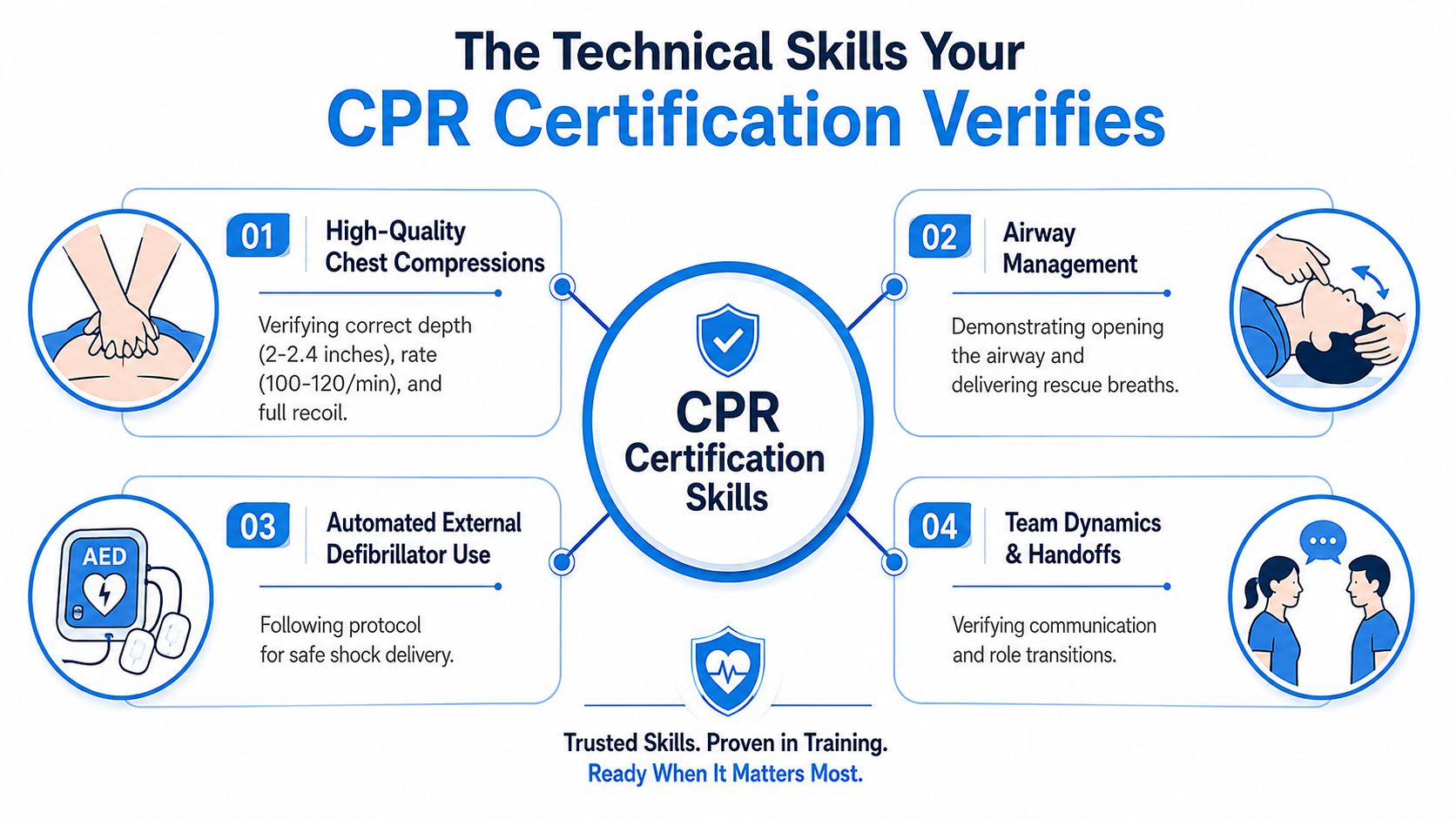
Think of CPR certification like a driver's test. Reading the manual is useful, but the card only matters if you can control the vehicle. CPR works the same way, the credential verifies performance, not just familiarity.
What the skill check is really measuring
Adult chest compressions are the core test. Clinical guidance says they should be delivered at 100 to 120 per minute with a depth of at least 2 inches (5 cm), while allowing full chest recoil. The American Heart Association also states adult CPR compressions should be at 100 to 120 per minute and the chest should be pushed at least 2 inches but no more than 2.4 inches deep (AHA CPR).
Those numbers aren't arbitrary. Too shallow, and you don't move enough blood to support the brain and heart. Too little recoil, and the chest never fully refills between compressions. Too much force can increase injury risk. Certification is the place where technique gets measured against those targets, so the card reflects more than good intentions.
The point of CPR training is repeatable performance under stress, not memorizing steps in a quiet room.
A good course also verifies airway opening, rescue breaths when the situation calls for them, AED use, and clear team communication. That's where a credential turns into a bedside tool, especially for nurses, physicians, and compliance managers who need to know the person next to them can do the job.
For learners comparing course types, BLS Certification is one format that packages CPR skills into a broader healthcare-focused credential. ProMed's course snapshot describes it as 100% Online BLS Certification, with the course, exam, and card available in as quick as one hour or less, which makes it a practical example of how modern certification delivery is changing.
Online Versus In-Person CPR Certification
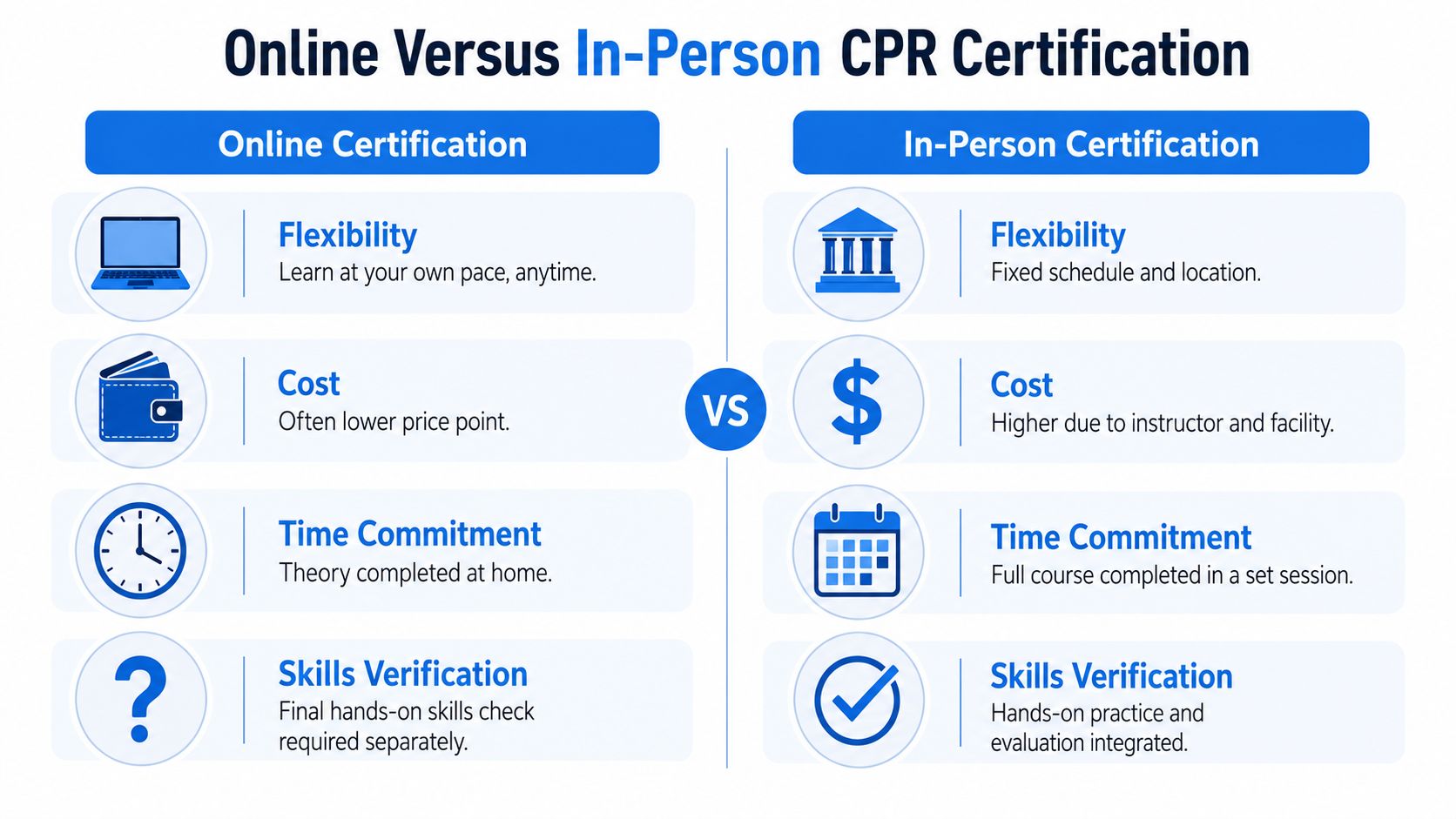
A certification card is only useful if it reflects real skill. That is the main issue behind the online versus in-person debate. In CPR education, the better question is not which format looks more official, but which one proves the learner can perform the required actions to the same standard.
Online and in-person certification often get treated as if they represent opposite levels of legitimacy. In practice, they are delivery methods. One may fit a packed clinical schedule better, while the other may fit a hands-on classroom better, but the credential should still be judged by what it verifies.
Why online formats keep winning on practicality
Online learning has gained acceptance because it is easier to fit around real work. For nurses, physicians, and compliance managers, that matters because training time usually has to compete with shifts, coverage needs, family responsibilities, and renewal deadlines. A course that removes travel and scheduling friction can make completion much easier without changing what the learner is expected to know.
The stronger online programs are built around clear standards and assessment, not passive reading. That matters because a screen can deliver explanations, scenarios, and exam questions, but the certification still has to reflect whether the learner understands the steps well enough to apply them under pressure. Like a checklist in a procedure room, the format supports the task, but the value comes from what gets verified.
For many organizations, the practical benefits are easy to see. Learners can work at their own pace, avoid commuting, and fit training into the gaps between clinical duties. Compliance teams also benefit because fewer people need to leave the floor at the same time, which reduces scheduling headaches and missed renewals.
Acceptance often causes the most confusion. Some buyers still assume that only a narrow set of classroom-based courses count, but CPR certification is provider-issued, and employers commonly recognize a range of established issuers, including the American Heart Association, American Red Cross, HSI, National Safety Council, and approved local training centers. The key issue is not whether the course happened online or in person. The key issue is whether the provider and the assessment match the employer's expectations.\
For learners who want to see how an online exam is typically organized, this CPR certification exam guide walks through the process in a straightforward way. It can help before enrollment, especially for anyone who wants to understand what the assessment looks like before choosing a course.
How CPR Differs from BLS ACLS and PALS
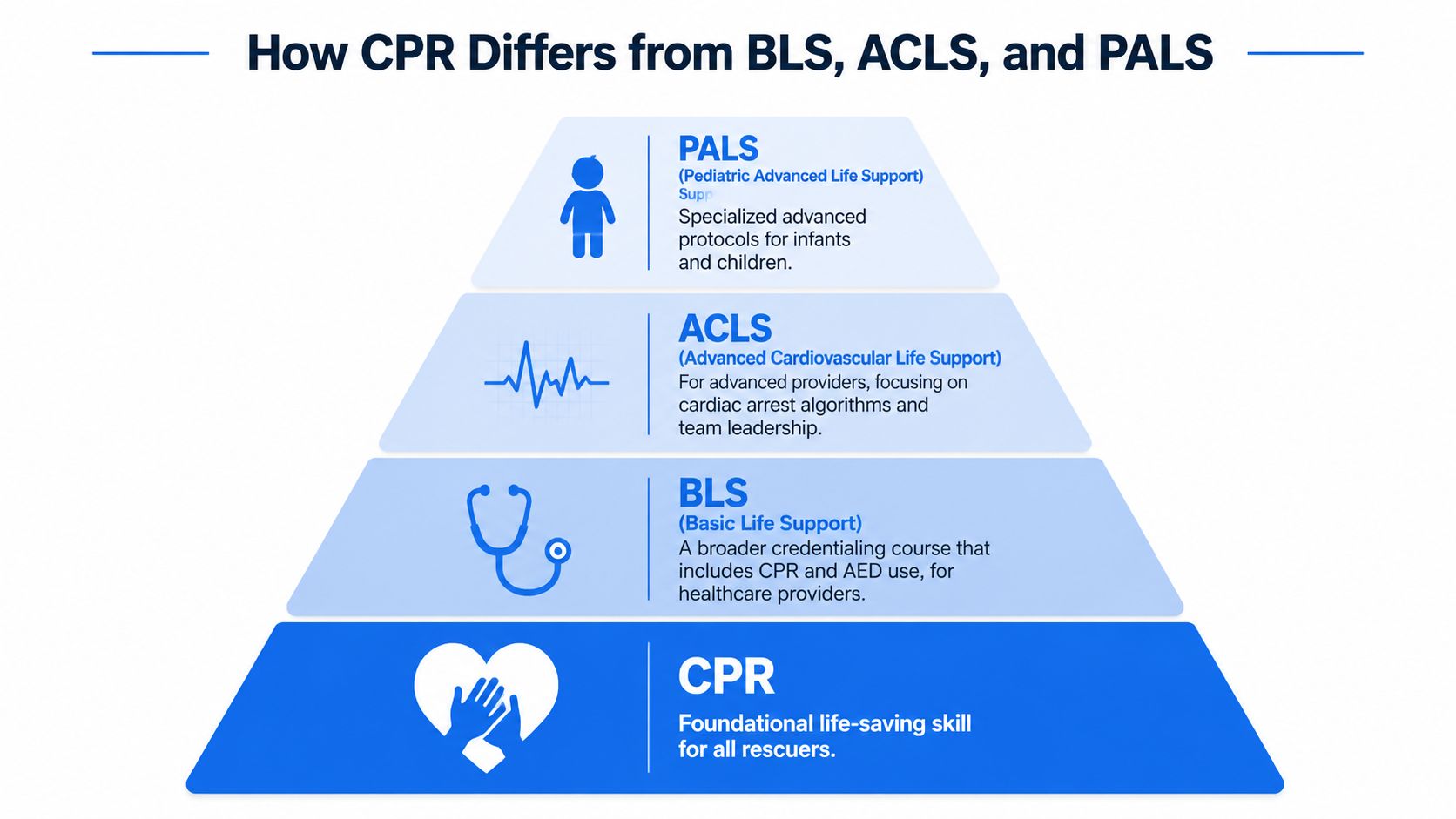
A lot of confusion starts when people use CPR, BLS, ACLS, and PALS interchangeably. They're related, but they're not identical. The cleanest way to think about them is as a ladder of responsibility, with CPR as the foundation.
The practical hierarchy
- CPR is the basic life-saving response. It teaches recognition of arrest, chest compressions, rescue breaths when indicated, and AED support.
- BLS builds on that foundation for healthcare settings, adding team-based response and a broader provider expectation.
- ACLS moves into advanced cardiac arrest management, rhythm interpretation, and leadership during resuscitation.
- PALS focuses on infants and children, where the physiology and response patterns are different.
That hierarchy is why some roles require BLS instead of basic CPR, especially in hospitals, clinics, and procedural settings. The skill set expands as the patient population and clinical complexity increase. A nurse on a med-surg floor, for example, usually needs a different level of readiness than a school coach or office manager.
CPR is the foundation, BLS is the first floor, and ACLS or PALS are the specialized upper levels.
If you want a side-by-side explanation of the distinction, this BLS versus CPR guide is a practical companion. It helps readers match the credential to the job instead of guessing based on the course title.
That matters because choosing the wrong credential can create avoidable friction with employers and clinical educators. The right one depends on the setting, the population, and the level of response expected when an emergency starts.
Who Needs CPR Certification and Why It Matters
CPR certification reaches far beyond hospitals. Dental offices, outpatient clinics, schools, fitness centers, corporate wellness teams, and community responders all rely on people who can act before EMS arrives. The key question is usually not whether CPR matters, but which CPR credential matches the job and the level of response expected.
The readiness gap is real. The American Heart Association says less than half, 46%, of bystanders will perform CPR, and an international review notes bystander CPR rates are below 20% in many countries (Red Cross CPR). Another useful benchmark is that a national U.S. survey found only 18% of the population had current CPR training, even though 65% reported lifetime training.
That gap tells compliance managers something important, training fades if it is not refreshed. People may have been certified before, but that does not mean they are current or confident now. In operational terms, CPR renewal is risk management. It reduces the chance that a workplace has a card on file but no real readiness on the floor.
The same source also notes that World Restart a Heart trained more than 5.4 million people worldwide in 2019 and reached up to 206 million people through the campaign, which shows how widely CPR education has been adopted. That scale only makes sense if organizations keep treating CPR as a working skill, not a one-time event.
For clinicians, the takeaway is straightforward. If your job places you near patients, vulnerable populations, or public spaces where arrest could happen, current certification is part of your professional responsibility. If an employer does not spell that out clearly, the safer choice is to renew before you are asked.
Verification Renewal and Employer Acceptance
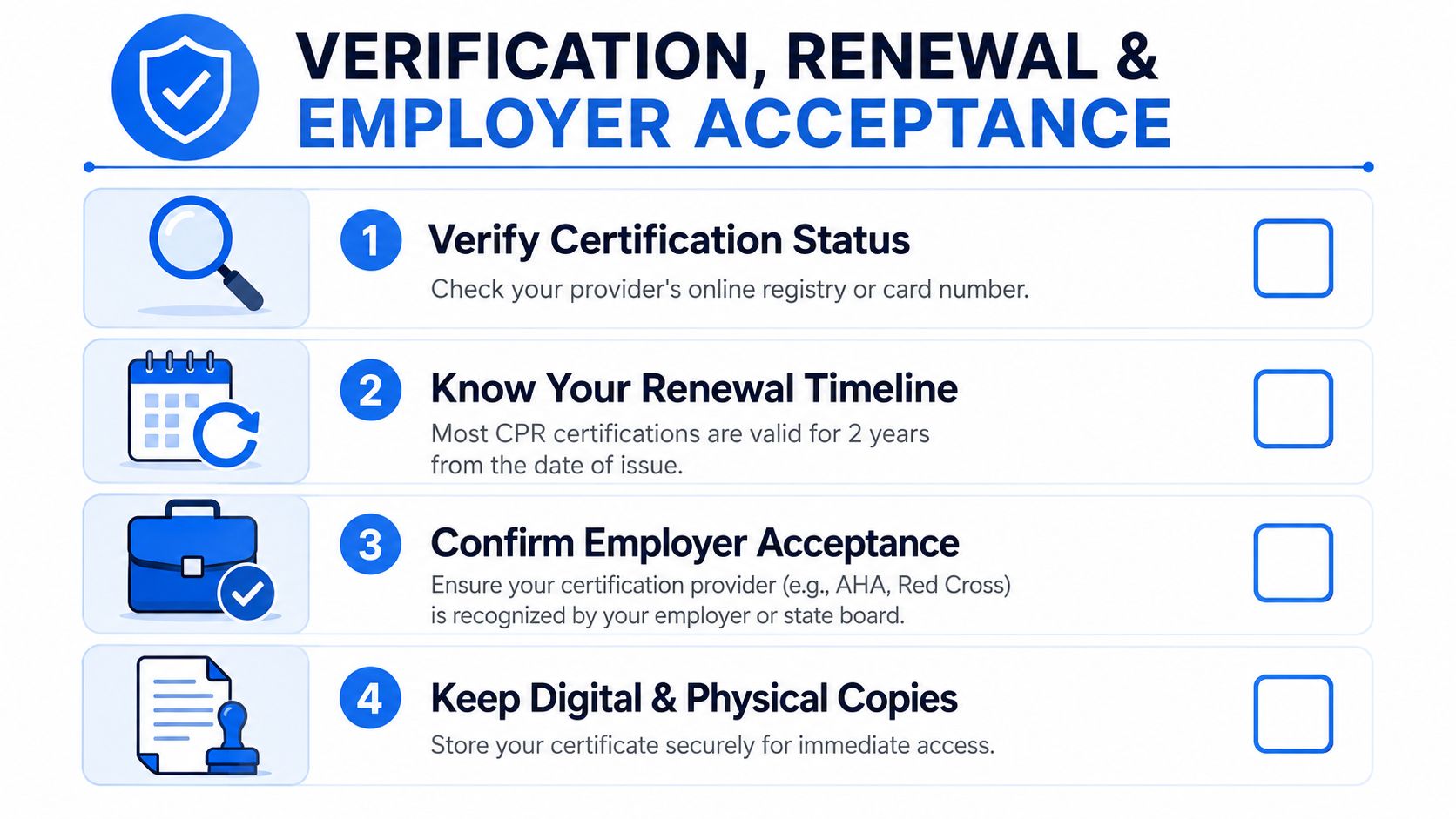
The cleanest way to avoid problems is to verify the card before someone else does. CPR certification is provider-issued, so acceptance depends on whether your employer, state board, or clinical site recognizes the issuing organization and format.
A simple renewal checklist
- Check your status. Confirm the card number, issue date, and expiration date through the provider or certificate record.
- Renew before it lapses. Many programs use a 2-year validity cycle, so don't wait until the last week to look for a class.
- Ask your employer early. Some organizations care about the issuer, some care about the learning format, and some care about both.
- Store copies in two places. Keep a digital file and a physical copy so you're not scrambling on a deadline.
A useful place to compare online formatting, employer expectations, and course logistics is this online CPR certification guide for healthcare providers. It's especially helpful if your workplace accepts online coursework but still wants proof of assessment and current documentation.
The acceptance question often comes down to paperwork discipline, not training quality. If the issuer is recognized and the competency is documented, the card is usually straightforward to validate. If a manager pushes back, the best response is calm and specific, provide the issuer, the course type, and the expiration date.
Common Misconceptions About CPR Certification
One of the most common misunderstandings is that CPR certification only counts if it comes from a single in-person provider. CPR certification is better understood as a verified competency credential, not a classroom attendance ticket. Employers usually look for a recognized issuer, a documented skills assessment, and a format they trust for their setting. The key question is whether the credential is accepted where you work.
Another misconception is that online certification is automatically weaker. That assumption misses how credentialing works in practice. In healthcare education, online CE and certification can still meet competency-based standards when the course includes clear assessment and the issuing organization is recognized. The issue is not the format itself, it is whether the program proves the learner can perform the required skill.
A third point of confusion is the phrase “CPR trained.” Training alone does not always mean certification. Someone may have attended instruction and still not hold a verified credential. Certification is the documented proof that the person completed the approved course and met the assessment standard, which is the difference employers, renewals, and auditors usually care about.
If the card proves performance and the issuer is recognized, the format is usually a secondary issue.
Modern providers reflect that shift in credentialing. ProMed Certifications offers online CPR, BLS, ACLS, PALS, and other healthcare certifications with self-paced access, no time restrictions, and unlimited retakes, which fits the broader move toward flexible credentialing. It shows how a provider can combine convenience with a skills-based credential without treating online education as second-tier.
The safest approach is straightforward. Check the requirement tied to your role, confirm that your current card is still valid, and choose a format that fits your schedule without losing employer recognition.
.avif)
Stay compliant with ProMed+
Certifications included: ACLS, BLS, PALS, CPR & Neonatal Resuscitation
Unlimited continuing education: over 200 hours of accredited CME
All-inclusive: One price. No surprises.
Get certified today

The Advanced Cardiac Life Support (ACLS) is an accredited online medical certification course that teaches medical professionals to respond to nearly all cardiopulmonary emergencies.

The Pediatric Advanced Life Support (PALS) Recertification instructs medical professionals on performing pediatric cardiopulmonary resuscitation in emergencies.

The Basic Life Support (BLS) Recertification is intended to teach healthcare professionals the basic steps of CPR and rescue breathing for adults, children, and infants.

Our online medical certification course for CPR, Automated External Defibrillator (AED), and First Aid is designed to teach adult, child, and infant CPR and AED use.

The Neonatal Resuscitation Certification trains medical professionals in performing resuscitation procedures and life-saving techniques for newborns at the time of delivery.

.png)
.png)
.png)