


Your Ultimate Guide to the CPR Certification Exam
Taking the CPR certification exam can feel like a high-stakes test, but it’s really designed to confirm your life-saving skills, not to trip you up. With the right approach, you’ll walk away with a certification that gives you the confidence to take charge in an emergency. This guide will pull back the curtain on the whole process, showing you how modern training has made getting certified more straightforward and accessible than ever.
Passing Your CPR Certification Exam with Confidence
If you're wondering just how hard the CPR certification exam is, let us put your mind at ease. It's not some impossible barrier. Think of it more as a final check to confirm what you’ve learned, ensuring you can apply those life-saving techniques correctly when every second counts.
This final validation is critical. It’s what builds the competence you need to respond effectively during a real cardiac emergency. The exam isn’t designed to be tricky; it’s a straightforward assessment of the skills that matter most.
High Pass Rates Tell the Real Story
The numbers behind the CPR certification exam are pretty revealing. Major institutions report an impressive 98% success rate on these exams. That high number isn't an accident—it’s a direct result of how effective and accessible modern training programs have become, especially online courses that let you learn at your own pace.
With failure rates dipping as low as 2%, it’s clear that passing is the norm, not the exception. For more CPR facts and statistics, the American Heart Association is an excellent resource. This success is built on clear training materials and flexible options that focus on actually understanding and applying skills, not just rote memorization.
The core goal of any CPR certification exam is to build your confidence alongside your competence. It confirms that you have the skills to make a critical difference, turning a moment of helplessness into one of empowered action.
The Move Toward Accessible, Credible Training
The days of being locked into rigid, in-person-only classes are quickly fading. The healthcare industry has increasingly embraced the convenience and effectiveness of online learning. In fact, many peer-reviewed studies and industry articles support that online education delivers knowledge retention and patient care outcomes that are equal to—and sometimes even superior to—traditional classroom formats.
This industry-wide shift is a game-changer for busy professionals. Accredited online providers now offer courses that are just as valid and comprehensive as their in-person counterparts, perfectly aligning with the demands of a modern healthcare career.
At ProMed Certifications, we're at the forefront of this evolution. We provide nationally accepted online certifications designed for people like you, offering:
- Unmatched Flexibility: Complete your training and exam on your own schedule, from literally anywhere.
- Cost-Effectiveness: You save on travel and time away from work, all without sacrificing an ounce of quality.
- Total Credibility: Our courses are fully accredited and even come with an employer acceptance guarantee.
Ultimately, preparing for your CPR certification exam is about empowerment. When you partner with a trusted, future-focused provider, you’re not just studying for a test; you’re getting ready to save a life.
Choosing the Right Type of CPR Exam
Not all CPR certifications are the same. Picking the right one is the very first step, and it’s a critical one. Think of it like a mechanic grabbing a specific tool for a job—a high school coach has different needs than a paramedic, and their certification should reflect that. The "best" exam is simply the one that matches your professional role and responsibilities.
This decision sets the entire tone for your training and dictates the complexity of the skills you'll be tested on. Understanding the key differences from the get-go ensures you're investing your time and energy wisely, getting the exact certification your employer requires.
BLS for Healthcare Professionals
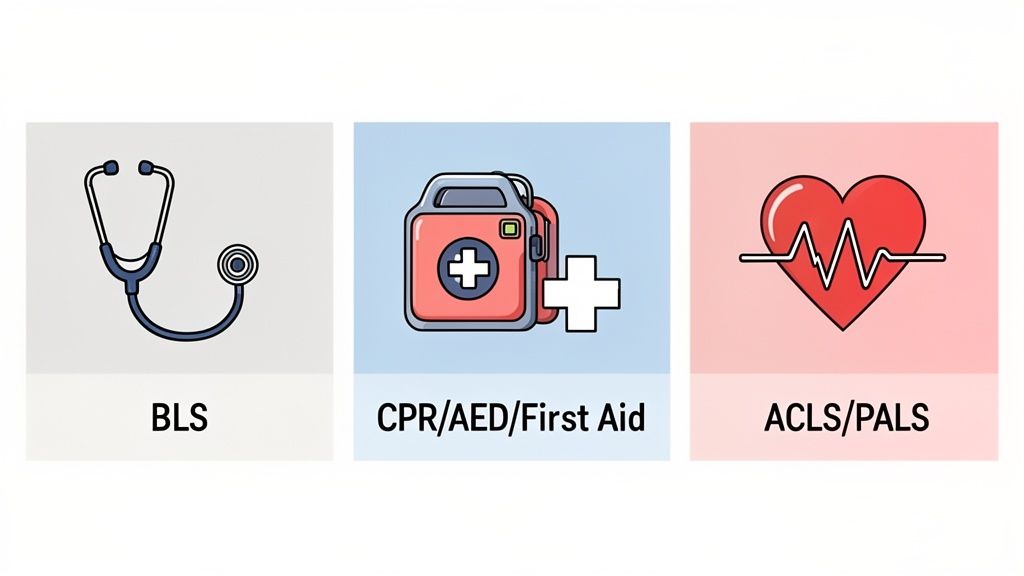
If you work in a clinical setting—think hospitals, clinics, or on an ambulance crew—then Basic Life Support (BLS) is almost certainly your standard. The BLS exam goes far beyond basic CPR, zeroing in on the skills essential for those in the healthcare field.
The entire curriculum is built for a professional environment where you’re not acting alone, but as part of a coordinated response team. You can bet the BLS exam will cover:
- Team-Based Response: How to work smoothly with other responders during a code.
- Advanced Airways: Using devices like bag-valve masks (BVMs) to deliver effective ventilations.
- High-Performance CPR: The finer points of delivering compressions and breaths in a clinical scenario, often with multiple rescuers swapping out.
- Special Considerations: Tackling complex situations like opioid overdoses or drowning incidents.
Bottom line: The BLS exam confirms you can function seamlessly within a healthcare team. It's the required certification for doctors, nurses, paramedics, and other allied health professionals.
CPR/AED/First Aid for Lay Responders
For pretty much everyone outside of a direct patient care role, the CPR/AED/First Aid certification is the way to go. This exam is designed for lay responders—people like teachers, corporate employees, coaches, and community volunteers who just want to be prepared to help in an emergency.
Here, the focus is on the fundamental, life-saving actions one person can take before professional help arrives. The test will quiz you on:
- Recognizing Emergencies: Spotting the signs of cardiac arrest, stroke, choking, and other critical events.
- Performing CPR: The correct techniques for chest compressions and rescue breaths on adults, children, and infants.
- Using an AED: How to properly and safely operate an Automated External Defibrillator.
- Basic First Aid: Managing common injuries like bleeding, burns, and sprains.
This certification gives you the core skills you need to be a confident and capable first responder in your workplace or community.
While the American Heart Association (AHA) and Red Cross have long been seen as the only options, this is an outdated belief. Today, a growing number of fully accredited online providers offer certifications that are nationally accepted and align with the latest ILCOR guidelines, and the industry is evolving toward broader online acceptance.
Advanced Certifications Beyond CPR
For seasoned healthcare professionals working in critical care, BLS is often just the starting line. Advanced certifications build on that foundation to manage far more complex cardiovascular emergencies.
- Advanced Cardiac Life Support (ACLS): This one's for professionals responding to adult cardiac arrests. It dives deep into pharmacology, interpreting ECG rhythms, and complex resuscitation algorithms.
- Pediatric Advanced Life Support (PALS): Essentially the pediatric version of ACLS, this course is tailored to managing life-threatening emergencies in infants and children.
These advanced exams are built for specialists in fields like emergency medicine, intensive care, and surgery. Here at ProMed Certifications, we offer the whole suite of courses—from BLS to ACLS and PALS—all delivered online to fit the crazy schedules of today's medical professionals.
Online vs. In-Person Exams: Which Path Is Best for You?
One of the first big decisions you'll make on your certification journey is the format. Do you go the traditional route with an in-person class, or do you choose a modern, online course? For years, there was a stubborn belief that only sitting in a physical classroom could provide a valid certification, but that old-school thinking is quickly becoming a thing of the past.
The reality is, high-quality online education is just as effective as classroom learning for healthcare certifications. The general consensus in the industry is shifting, with hospitals, clinics, and organizations increasingly recognizing accredited online certifications.
Let's break down the two paths so you can see which one truly fits your professional life.
The Power of Flexibility and Self-Paced Learning
The biggest win for an online CPR certification exam is its incredible flexibility. Let's be honest, the schedules of busy healthcare professionals rarely line up with rigid, multi-hour classroom sessions. Online courses, like those from ProMed Certifications, put you back in the driver's seat.
You can dive into the material at midnight after a grueling shift or review a tricky concept during a quiet lunch break. There's no commute, no need to juggle your work schedule, and zero pressure to keep up with the pace of a group. This self-directed approach means you can spend extra time on challenging topics and breeze through what you already know, creating a truly personalized learning experience.
Peer-reviewed studies have shown time and again that online learning leads to knowledge retention and patient care outcomes that are equal to, or even better than, traditional classroom formats. The focus shifts from just showing up to actually mastering the material.
This isn't just about convenience; it's about smarter, more effective education built for the realities of a demanding career. It gives you the power to learn when and where you learn best.
Challenging the Myth of In-Person Exclusivity
For a long time, the American Heart Association (AHA) and the American Red Cross were seen as the only names in the game, and their in-person model was the undisputed gold standard. While these are still respected organizations, they are no longer the only credible options.
The idea that only hands-on, in-person training is valid is a myth that ignores huge leaps in educational technology and evolving industry standards.
Today, accredited online providers offer comprehensive, evidence-based training that is perfectly aligned with the latest ILCOR guidelines—the very same international standards the AHA follows. As more healthcare institutions prioritize efficiency and proven outcomes, the acceptance of these rigorous online certifications has exploded. We take a deeper dive into this shift in our guide on online CPR certification for healthcare providers, highlighting how online training is meeting the real-world needs of today's medical professionals.
Comparing Online And In-Person CPR Certification
Choosing the right format really comes down to what works for you, your schedule, and your learning style. To help you decide, this table breaks down the key differences between online and in-person CPR certification.

This side-by-side view makes it clear: both paths lead to certification, but the journey is very different. The best choice depends on what you value most—the structure of a classroom or the freedom of a digital platform.
At ProMed Certifications, we are at the forefront of this educational evolution. We built our platform to give you the convenience you need without ever sacrificing the credibility you demand. Our courses are designed for the future of healthcare, aligning with the industry's move toward accessible, top-tier online education. We confidently bridge that gap, offering a modern solution backed by an employer acceptance guarantee, so you can get certified with complete peace of mind.
What to Expect During Your CPR Exam
Walking into any kind of test can be nerve-wracking, but your CPR exam shouldn't be. Think of it less like a final exam designed to trip you up and more like a final confirmation that you're ready to act. It's a straightforward process to verify you can apply your life-saving training when it counts.
Let's pull back the curtain on what the experience actually looks like, from the first question on the written test to the hands-on skills check. The whole thing is broken down into two key parts: a written knowledge assessment and a practical skills evaluation. This ensures you not only know the "why" behind CPR but can confidently perform the "how."
The Written Knowledge Assessment
First up is usually the written (or online) test. This is where you show you've absorbed the theory behind the techniques. You'll face a series of multiple-choice questions that cover the core principles you learned in your training.
This part is the foundation. The questions zero in on the critical concepts you need to make smart, fast decisions in an emergency.
You'll definitely see questions on:
- The C-A-B Sequence: Knowing the correct priority of Compressions, Airway, and Breathing.
- Compression Depth and Rate: Recalling the specific measurements for adults, children, and infants. These aren't just numbers; they're the difference between effective and ineffective CPR.
- AED Operation: Understanding the steps for proper pad placement and how to safely follow the device's prompts.
- Emergency Recognition: Being able to spot the signs of cardiac arrest or choking.
For most providers, you'll need to score around 84% to pass, though this can vary. This benchmark just ensures you have a solid grasp of the essentials before moving on to the physical skills.
The Practical Skills Evaluation
After you've passed the written portion, it's time for the hands-on assessment. This is your chance to prove you can turn that knowledge into real action. How this works depends entirely on whether you chose an in-person or online course.
In a traditional classroom setting, you'll perform CPR on a manikin while an instructor observes you. They're looking at your hand placement, the quality of your compressions, and how you manage the workflow in a simulated emergency.
For modern online courses, the process is adapted for learning at home. Reputable providers like ProMed Certifications use well-designed self-assessment tools and virtual validations. You might perform the skills on a manikin you have at home while following guided prompts, making sure you hit the same performance standards without having to travel. It's the same level of rigor, just with a whole lot more convenience.
The real purpose of the skills test is to build muscle memory. In a crisis, you don't have time to second-guess yourself—you just need to act. This practical test confirms your body knows what to do, even when your mind is racing.
The skills you'll need to show are universal:
- Performing 30 high-quality chest compressions followed by 2 rescue breaths. This 30:2 ratio is absolutely vital. Think of it as a manual pump system designed to keep oxygen-rich blood flowing to the brain until paramedics arrive.
- Correctly attaching and operating an AED on a manikin.
- Responding to a simulated choking emergency for an adult, child, and infant.
Why Every Detail Matters
The exam isn't just a formality; it targets specific knowledge gaps that can mean the difference between life and death. For instance, meta-analyses show that while 55% of untrained people know the basics of CPR, only 32% can remember the correct 30:2 compression-to-breath ratio, and just 54% recall the proper emergency sequence. The certification exam is built to close these gaps and make sure you're in the group that's truly prepared.
This focus on detail is also why you have to renew your certification every two years. Medical guidelines change, and skills can get rusty without practice. The exam process keeps you sharp and up-to-date with the latest, most effective techniques.
At ProMed Certifications, we get that test anxiety is a real thing. That’s why we’ve built our exam platform to be as straightforward and stress-free as possible. More importantly, we offer an unlimited retake policy at no extra cost. Our goal isn't to put up roadblocks; it's to make sure you truly master the material so you can walk away feeling confident and ready to save a life.
How to Prepare and Pass Your CPR Exam
Passing your CPR certification exam isn't about pulling an all-nighter to cram. It's about smart, focused preparation that builds real confidence. Think of this section as your personal action plan—a way to move beyond just memorizing steps and truly understand the why behind them.
After all, knowing the "how" is only half the battle. You also need to understand the critical reasoning. For instance, why is the compression depth for an infant so different from an adult's? When you grasp the logic, the techniques become second nature, ready for you during the exam and, more importantly, in a real emergency.
The journey to getting certified is actually pretty straightforward. It boils down to a simple three-step process.
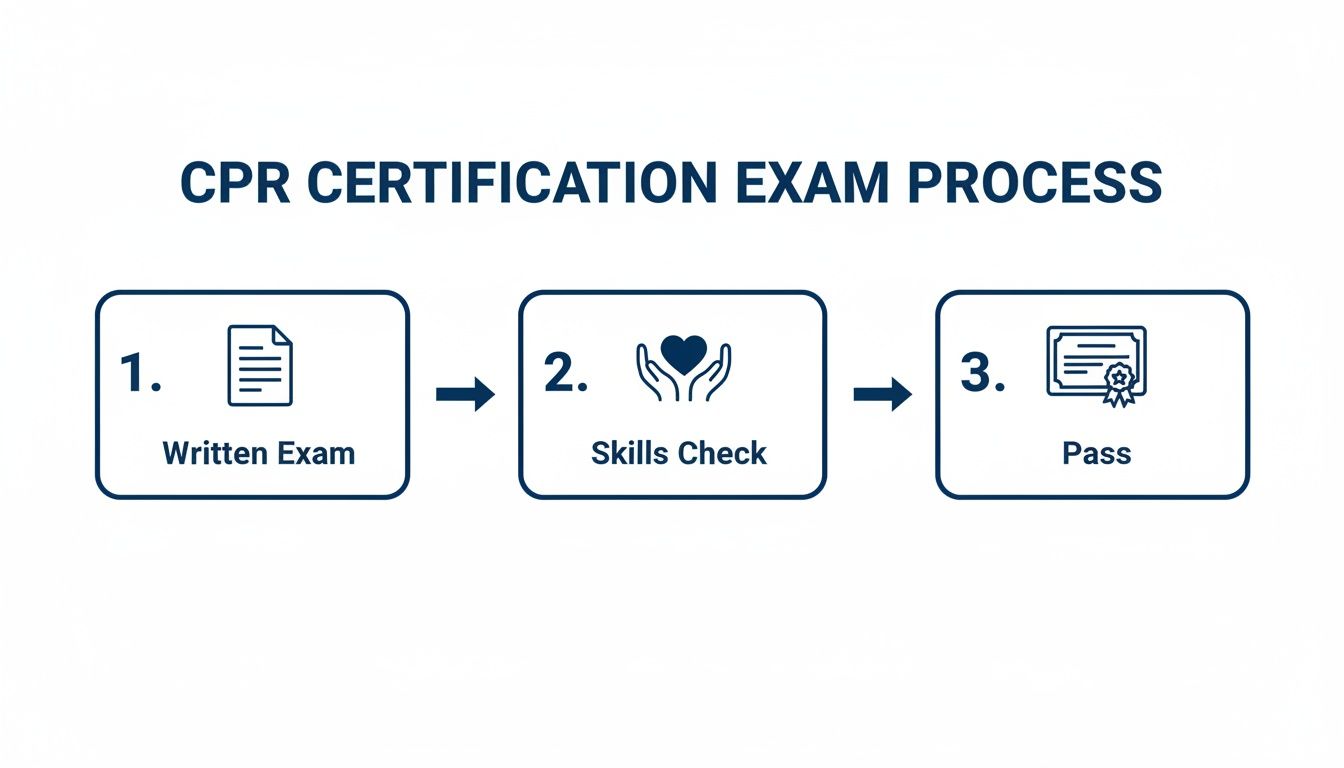
As you can see, it’s a clear path: first, you show you know the material, then you prove you can perform the skills, and finally, you earn that official credential.
Create a Structured Study Plan
A solid study plan is your best friend here. Instead of feeling overwhelmed by trying to learn everything at once, break the material down into smaller, more manageable topics. This roadmap ensures you cover all the must-know areas without missing a thing.
Make sure your study sessions hit these core competencies:
- CPR for Different Age Groups: Get comfortable with the specific techniques for adults, children, and infants. The key is to nail the differences in hand placement, compression depth, and the all-important compression-to-breath ratios.
- Proper AED Use: You should know exactly where to place AED pads on various body sizes without a second thought. Practice the sequence: turn on the device, apply the pads, and follow the voice prompts.
- Choking Emergencies: Be able to spot the universal signs of choking and know the correct response for conscious and unconscious victims, no matter their age.
With ProMed's 24/7 online course materials, you can build this plan around your schedule. We designed our platform for busy professionals, letting you study whenever and wherever it works for you.
Use Practice Questions to Your Advantage
One of the single most effective ways to prep for the written exam is to drill practice questions. This does more than just test your memory; it gets you used to the phrasing and format of the questions you'll face on the real test.
Treat each practice question like a mini-scenario. As you work through them, ask yourself why one answer is correct and the others are wrong. This approach cements a much deeper understanding. To get a true feel for what's coming, work through our comprehensive CPR practice test, which is designed to mirror the actual exam experience.
The need for skilled responders is massive. Immediate CPR can double or even triple the chances of survival, yet only 40.2% of out-of-hospital cardiac arrests get bystander CPR. This highlights a critical gap that well-prepared, certified people like you can fill.
This is especially true when you consider that 73.4% of these events happen at home, where a loved one is often the first and only person who can help before professionals arrive.
Master the Hands-On Skills
The written exam checks what you know, but the skills assessment confirms you can actually do it. The key here is repetition. Pure and simple. Practice the physical motions over and over again until they become muscle memory.
Focus on the quality of your technique. Are your hands in the right place? Are you pushing hard enough to get the right compression depth? Is your timing right for the breaths? If you're using an online course, follow the self-assessment guides down to the letter.
With a smart approach, passing the CPR certification exam is completely within your reach. See it not as a hurdle, but as the final step that validates your ability to step up and save a life.
Your CPR Certification Exam Questions Answered
Even with a solid game plan, you probably still have a few questions rattling around. It's completely normal. Let's walk through some of the most common ones to clear things up so you can move forward with total confidence.
How Long Is My CPR Certification Valid?
Your CPR certification is good for two years. This is the standard across the board for most accredited providers, including those who follow ILCOR and AHA guidelines.
This two-year cycle isn't just an arbitrary deadline; it's designed to make sure your skills stay sharp and you're current with any new life-saving protocols. Think of it as a quick refresher to keep you ready to act effectively.
What Happens If I Don’t Pass the Exam on My First Try?
First off, don't panic. Failing the exam isn't the end of the road—not even close. Reputable training providers get it. Test anxiety is real, and sometimes you just need another look at the material.
That’s why we offer an unlimited retake policy at no extra cost. Our goal is to see you master the skills, not to penalize you for needing another shot. You can simply review the course content and try again whenever you feel ready.
How Do I Renew My Certification?
Renewing your certification is a pretty straightforward process, especially with an online provider. You'll enroll in a recertification course, which is usually a more condensed version of the initial training.
It’s designed to hit the high points, review key skills, and get you up to speed on any updated guidelines. Once you finish the material, you’ll take a final exam to lock in your credentials for another two years.
Will My Employer Accept an Online Certification?
This is a big one, and the answer is a resounding yes—as long as you choose a nationally accredited provider. The old myth that only in-person certifications from the AHA or Red Cross are accepted is simply untrue and outdated. Today, thousands of healthcare institutions and employers recognize that high-quality online courses deliver equivalent, and often more convenient, training. The industry is evolving, and online CE is gaining significant traction.
To take any guesswork out of the equation, we offer a 100% employer acceptance guarantee. If for any reason your employer does not accept your ProMed certification, we will provide a full refund.
For a deeper dive into the kinds of topics you'll see on the exam, check out our comprehensive CPR question and answer guide. It’s a great resource to make sure you're prepared for anything.
At ProMed Certifications, our whole mission is to give you the most accessible, credible, and stress-free path to getting certified. Our courses are built to fit your life, all backed by guarantees that give you complete peace of mind. Get started with your CPR certification today!
.avif)
Stay compliant with ProMed+
Certifications included: ACLS, BLS, PALS, CPR & Neonatal Resuscitation
Unlimited continuing education: over 200 hours of accredited CME
All-inclusive: One price. No surprises.
Get certified today

The Advanced Cardiac Life Support (ACLS) is an accredited online medical certification course that teaches medical professionals to respond to nearly all cardiopulmonary emergencies.

The Pediatric Advanced Life Support (PALS) Recertification instructs medical professionals on performing pediatric cardiopulmonary resuscitation in emergencies.

The Basic Life Support (BLS) Recertification is intended to teach healthcare professionals the basic steps of CPR and rescue breathing for adults, children, and infants.

Our online medical certification course for CPR, Automated External Defibrillator (AED), and First Aid is designed to teach adult, child, and infant CPR and AED use.

The Neonatal Resuscitation Certification trains medical professionals in performing resuscitation procedures and life-saving techniques for newborns at the time of delivery.

.png)
.png)
.png)