


8 Key CPR Question and Answer Scenarios for 2025
.png)
Performing CPR correctly under pressure is one of the most critical skills a healthcare professional can possess. But are you confident you could recall the precise steps, ratios, and adaptations when every second counts? This guide is designed to sharpen your skills and build that confidence by providing a comprehensive CPR question and answer review. We will walk through common factual questions and challenging real-world scenarios, breaking down the essential "why" behind each correct answer and a tactical analysis of the steps involved.
Our goal is to ensure you’re not just memorizing protocols but truly understanding the principles of effective resuscitation. This deep comprehension is key to passing your certification exam and, more importantly, being prepared for a genuine emergency.
As we explore each CPR question and answer, it's worth noting how medical education has advanced. Mastering this material through flexible, high-quality online courses is now a respected and effective standard for busy professionals. Many peer-reviewed studies confirm that accredited online learning delivers knowledge retention and patient care outcomes that are just as good as, if not better than, traditional in-person classes. This shift is why leading institutions increasingly recognize and accept certifications earned online, offering a convenient and credible path for maintaining your life-saving skills. This guide will help you master the core knowledge needed, no matter how you choose to certify.
1. What is the correct compression-to-ventilation ratio for adult CPR?
This question is a cornerstone of any CPR certification exam. It directly tests your recall of the most fundamental sequence in resuscitation: the precise balance between circulating oxygenated blood (compressions) and providing oxygen (ventilations). Mastering this ratio is non-negotiable for performing effective CPR and is a common point of focus in any reputable CPR question and answer review.
.png)
The correct answer, based on the latest international guidelines, is 30 compressions to 2 ventilations (30:2) for a single rescuer performing CPR on an adult. This ratio is designed to maximize blood flow to the brain and vital organs while minimizing interruptions for rescue breaths.
Why This Ratio Is Critical
The 30:2 ratio is a carefully researched standard that optimizes a victim's chance of survival. Each set of 30 compressions builds up crucial blood pressure to perfuse the brain, and the two quick breaths replenish oxygen. Pausing for too long or too frequently for ventilations causes this vital pressure to drop, reducing the effectiveness of your efforts.
For untrained bystanders, guidelines now strongly support Hands-Only CPR, which involves continuous chest compressions at a rate of 100-120 per minute without any rescue breaths. Think of it like this: simplifying the process encourages more people to act immediately during an out-of-hospital cardiac arrest.
Test-Taking Strategy and Actionable Tips
When you encounter this cpr question and answer scenario on an exam, focus on the specific context provided (e.g., single rescuer, adult victim).
- Memorize the Core Number: The number "30" should be your immediate recall for adult single-rescuer CPR compressions.
- Practice the Rhythm: The correct compression rate is just as important as the ratio. Use the beat of songs like "Stayin' Alive" by the Bee Gees to internalize the 100-120 compressions per minute tempo.
- Understand the "Why": Knowing that the ratio prioritizes circulation helps reinforce its importance and makes it easier to remember under pressure.
ProMed's online certification courses provide interactive modules that drill these core concepts, ensuring you can confidently answer factual questions like this one. Our accredited programs are designed for busy professionals, offering a flexible and equally effective alternative to traditional in-person classes, proving that high-quality, life-saving education is accessible anywhere.
2. An adult collapses in a grocery store; what are your first three actions?
This type of scenario-based question is a staple in modern CPR exams. It moves beyond rote memorization to test your critical thinking and ability to apply knowledge under pressure. The question evaluates your understanding of the initial steps in the Chain of Survival, which are crucial for setting a victim up for the best possible outcome. Answering this cpr question and answer correctly demonstrates you can prioritize actions in a real-world emergency.
The correct sequence of the first three actions is: 1) Check the scene for safety and check the victim for responsiveness, 2) Call 911 (or activate the emergency response system) and get an AED, and 3) Check for breathing and a pulse, then begin high-quality chest compressions. This sequence ensures your safety, immediately alerts professional help, and starts life-sustaining care without delay.
Why This Sequence Is Critical
This ordered response is the foundation of effective emergency care.
- Check the scene: This prevents you from becoming a second victim.
- Confirm unresponsiveness: Tapping the shoulders and shouting "Are you okay?" is the trigger for the entire emergency response.
- Call 911 & get an AED: These are the most critical interventions to improve survival rates from out-of-hospital cardiac arrest.
- Start compressions: This immediately addresses the need to circulate oxygenated blood to the brain.
Initiatives like Seattle's renowned Medic One program have proven that rapid bystander action, following this exact sequence, dramatically increases survival rates. When you act quickly and correctly, you form a vital bridge until professional help arrives.
Test-Taking Strategy and Actionable Tips
When faced with a scenario question, break it down into a logical, step-by-step process. Don't jump ahead. Think about what you must do first to ensure a safe and effective rescue.
- Scene Safety First: Always ensure the area is safe. While often assumed in a test question, it's the absolute first step in reality.
- "Tap and Shout": Your first interaction with the victim is to check for responsiveness. This simple action determines if you need to proceed with the cardiac arrest algorithm.
- Activate and Delegate: Immediately after confirming unresponsiveness, call 911. If others are present, point to a specific person and give clear commands like, "You in the blue shirt, call 911 and find an AED!"
ProMed's online certification programs use dynamic, scenario-based learning to prepare you for these exact situations. Our training emphasizes that high-quality, accredited online education is just as effective as in-person classes, building the confidence and competence needed to act decisively and correctly, whether on an exam or in a real emergency.
3. What is the correct hand placement for adult chest compressions?
This question zeroes in on the technical precision required for effective CPR. Proper hand placement is not just a detail; it's fundamental to delivering compressions that successfully circulate blood without causing injury. Answering this cpr question and answer correctly on an exam demonstrates your understanding of the mechanics behind high-quality resuscitation.
.png)
The correct hand placement for adult CPR is on the center of the chest, on the lower half of the sternum (breastbone). To find this spot quickly, you can identify the area between the nipples. You should place the heel of one hand on this location and place your other hand on top, interlacing the fingers. This technique focuses the force directly over the heart.
Why This Placement Is Critical
Proper hand placement is essential for maximizing the effectiveness of each compression and minimizing the risk of injury. Placing hands too high, too low, or off to the side can result in fractured ribs or damage to internal organs like the liver or spleen. By concentrating force on the sturdy sternum, you can compress the heart between the breastbone and the spine, effectively pumping blood to the brain and other vital organs.
Think of it like this: every push contributes to building and maintaining critical blood flow. Modern CPR feedback devices, often used in training, provide real-time data on hand position, reinforcing this crucial skill.
Test-Taking Strategy and Actionable Tips
When faced with a question about hand placement, visualize the anatomy of the chest to reinforce the correct location.
- Landmark Location: Remember the phrase "center of the chest, between the nipples" as your primary landmark.
- Focus on the Heel: The force comes from the heel of your hand, not the palm or fingers. Keep your fingers off the chest.
- Body Mechanics: Keep your arms straight and your shoulders positioned directly over your hands. This uses your body weight for leverage, preventing fatigue and ensuring consistent compression depth.
- Visualize the Goal: Understanding that you are compressing the heart helps solidify why the center of the chest is the correct spot. Learn more about the specifics of proper hand placement for CPR on ProMedCert.com to master this technique.
ProMed's online certification programs utilize detailed animations and video demonstrations to ensure you can master hands-on skills like this from anywhere. Our accredited, evidence-based courses prove that flexible online learning provides the same high-quality, life-saving knowledge as traditional in-person classes, aligning with the modern needs of healthcare professionals.
4. You witness a collapse in a remote hiking area with no cell service; what do you do?
This advanced scenario-based question moves beyond rote memorization to test your critical thinking and adaptability. It forces you to apply CPR principles in a high-stress, resource-limited environment where standard protocols like "call 911 immediately" are impossible. Answering this type of CPR question and answer correctly demonstrates a deeper understanding of survival priorities and decision-making under pressure.
The correct approach involves a rapid assessment and a calculated decision balancing immediate care with the need to summon advanced help. The priority is to start high-quality CPR immediately after confirming unresponsiveness and absence of normal breathing. In a lone-rescuer wilderness situation, you provide CPR for a set period (e.g., 5-15 minutes of continuous, high-quality CPR) before leaving the victim to find help.
Why This Prioritization Is Critical
In a remote setting, the victim’s only chance of survival rests on your initial actions. Immediate chest compressions are vital to circulate any remaining oxygenated blood to the brain. However, without advanced medical care, CPR alone is unlikely to achieve a return of spontaneous circulation. Therefore, a difficult but necessary decision must be made about when to stop and go for help.
Wilderness First Responder (WFR) and similar advanced training programs provide specific protocols for this dilemma. The core principle is that if you are alone, you are the victim's only link to a higher level of care. Continuing CPR indefinitely without a path to rescue is futile.
Test-Taking Strategy and Actionable Tips
When faced with this complex CPR question and answer on an exam, break down your response into a logical sequence.
- Scene Safety First: Always mention checking for scene safety, even in a remote area.
- Initial CPR: State that you would immediately begin high-quality CPR (30:2 ratio) after assessing the victim.
- The Go/Stay Decision: Articulate the need to perform CPR for a dedicated period before leaving for help. This shows you understand the balance between immediate care and the necessity of activating a rescue.
- Prepare to Leave: If you must leave, mention key actions like placing the victim in a recovery position (if breathing returns), marking their location clearly, and noting the time.
ProMed's online certification programs emphasize critical thinking alongside procedural skills. Our scenario-based modules are designed to mirror these challenging real-world situations, ensuring you are prepared not just for the exam, but for unexpected emergencies. This approach validates that high-level, life-saving decision-making can be effectively taught and mastered through a flexible, accredited online format.
5. When should you use an Automated External Defibrillator (AED), and what rhythms does it treat?
This question assesses your technical understanding of one of the most critical tools in the chain of survival. Knowing precisely when to apply an AED and what it is designed to treat is fundamental to its effective use. This topic is a key component of any comprehensive CPR question and answer guide, as it tests both procedural knowledge and the underlying pathophysiology of cardiac arrest.
.png)
An AED should be used as soon as it becomes available for a victim who is unresponsive and not breathing normally. AEDs are specifically designed to treat two life-threatening, chaotic heart rhythms: Ventricular Fibrillation (V-Fib) and Pulseless Ventricular Tachycardia (pVT). These are known as "shockable rhythms" because they can potentially be corrected with a controlled electrical shock.
Why This Knowledge Is Critical
An AED does not restart a heart that has flatlined (asystole); think of it like a reset button. It stuns the heart to stop the chaotic electrical activity of V-Fib or pVT, allowing the heart's natural pacemaker to hopefully resume a normal rhythm. Using it incorrectly or for a non-shockable rhythm is ineffective. Public defibrillation programs, which place AEDs in airports, malls, and sports venues, have dramatically improved survival rates because they get this technology to victims quickly.
It is crucial to follow the AED's prompts exactly and to continue high-quality CPR with minimal interruptions. The device will guide you through every step, making it usable even by untrained bystanders.
Test-Taking Strategy and Actionable Tips
For any cpr question and answer on your exam involving an AED, focus on speed, safety, and the specific rhythms.
- Remember "Shockable Rhythms": Associate AEDs with V-Fib and pVT. An exam might try to trick you with options like asystole or PEA (Pulseless Electrical Activity), which are non-shockable.
- Prioritize CPR: Never delay chest compressions to find an AED. Start CPR immediately and have a second rescuer retrieve and set up the device. Continue compressions while the AED pads are being applied and even while it charges.
- Safety First: Ensure no one is touching the victim during the AED's analysis or when the shock is delivered. The device will prompt you with a "clear the victim" warning.
ProMed's online certification programs offer in-depth modules on AED use that are fully aligned with the latest guidelines. These courses detail everything from pad placement to the specifics of the BLS Adult Cardiac Arrest Algorithm, ensuring you can confidently manage an AED. Our accredited online platform demonstrates that top-tier, life-saving training can be just as rigorous and effective as in-person classes, offering the flexibility modern professionals need.
6. You're performing CPR when the victim vomits; how do you respond?
This scenario-based question moves beyond simple recall and tests your ability to adapt under pressure. Vomiting during CPR is a common event, but knowing how to manage it swiftly is crucial for maintaining an open airway and continuing effective resuscitation. This cpr question and answer scenario gauges your practical knowledge and problem-solving skills in a high-stress, real-world complication.
The correct response is to immediately turn the victim's head to the side (if no spinal injury is suspected), clear their mouth of vomit, and then promptly resume chest compressions and ventilations. The priority is to clear the airway to prevent aspiration (inhalation of stomach contents) while minimizing any interruption to CPR.
Why This Response Is Critical
Vomit in the airway is a severe obstruction that prevents oxygen from reaching the lungs. If left unmanaged, rescue breaths become ineffective, and the victim can suffer from aspiration pneumonia if they are resuscitated. Pausing CPR to manage the airway is essential, but this pause must be as brief as possible. Every second without compressions reduces blood flow to the brain, so the goal is to clear, reposition, and resume.
This situation highlights a significant challenge that differentiates real-life emergencies from controlled training environments. Up to 80% of cardiac arrest patients may regurgitate, making this a skill every rescuer must be prepared to handle.
Test-Taking Strategy and Actionable Tips
When faced with this cpr question and answer on an exam, think in terms of priorities: Airway, then Circulation.
- Turn and Clear: Your first action is always to manage the immediate obstruction. Turn the head, sweep the mouth with your gloved fingers, and then turn the head back to a neutral position.
- Minimize Interruption: The goal is to clear the airway in just a few seconds. Do not delay restarting compressions.
- Use Protection: If available, use a barrier device for rescue breaths. This is not just for your protection but also helps maintain a seal if the face is messy.
- Prioritize Compressions: Remember that chest compressions are the most critical element of CPR. After clearing the airway, your focus must immediately return to high-quality compressions.
ProMed's online certification programs utilize realistic video scenarios and simulations to prepare you for complications like this. Our courses ensure you can confidently apply your knowledge, proving that comprehensive, accredited training is fully achievable through a flexible online format that fits your professional schedule.
7. What is the correct compression depth for adult CPR, and why is it important?
This technical question moves beyond ratios and rates into the quality of an individual compression. It tests your knowledge of the precise physical force needed to circulate blood effectively. Understanding and applying the correct depth is a frequent topic in any high-quality cpr question and answer review because it directly correlates with patient outcomes, particularly neurological survival.
The correct compression depth for an adult is at least 2 inches (5 cm) but not more than 2.4 inches (6 cm). This specific range is based on extensive research showing that compressions shallower than 2 inches fail to generate adequate blood flow, while compressions deeper than 2.4 inches can increase the risk of injury without providing additional benefit.
Why This Depth Is Critical
Proper compression depth is the engine of CPR. When you press down on the chest, you are manually squeezing the heart to pump blood to the brain and other vital organs. If the depth is too shallow, you are not creating enough pressure to circulate oxygenated blood, rendering your efforts ineffective. Conversely, excessive depth can cause harm, such as rib fractures or internal organ damage.
Real-time CPR feedback devices, now common in many professional settings and training programs, constantly measure depth and rate to help rescuers stay within this crucial window. Studies have consistently shown that the use of these devices improves compliance with guidelines and boosts survival rates from cardiac arrest.
Test-Taking Strategy and Actionable Tips
When answering a cpr question and answer about compression depth, memorize the specific range and understand the reasoning behind it.
- Memorize the Range: Lock in "2 to 2.4 inches" or "5 to 6 cm" as the target for adult CPR.
- Focus on Body Mechanics: To achieve this depth, position your shoulders directly over your hands with straight arms. Use your body weight, not just your arm muscles, to compress the chest.
- Allow Full Recoil: Just as important as depth is allowing the chest to fully return to its normal position between compressions. This allows the heart to refill with blood before the next push.
- Fight Fatigue: Switch rescuers every two minutes (or five cycles of 30:2) to prevent fatigue, which is a leading cause of shallow compressions.
ProMed's accredited certification programs use state-of-the-art animations and detailed modules to help you master these technical skills. Our online format allows you to learn and practice these concepts at your own pace, ensuring you develop the confidence needed for both the exam and a real-world emergency. For an in-depth look at compression mechanics, you can learn more about chest compression best practices here.
8. A child collapses at a swimming pool; what modifications to CPR do you make?
This question tests a critical area of emergency response: adapting life-saving techniques for pediatric victims, especially in high-risk situations like drowning. It goes beyond simple recall to assess your understanding of how a child’s anatomy, physiology, and the likely cause of arrest (often respiratory in nature) demand specific modifications to standard adult CPR. Answering this type of CPR question and answer correctly demonstrates a deeper, more nuanced level of training.
The correct response involves recognizing that a child who collapses at a pool has likely suffered from respiratory arrest leading to cardiac arrest. Therefore, your first actions must address the immediate need for oxygen. Key modifications include prioritizing rescue breaths at the start, adjusting hand placement and compression depth for a smaller body, and using an appropriate compression-to-ventilation ratio, especially if a second rescuer is present.
Why These Modifications Are Critical
Unlike adults, who most often suffer cardiac arrest from a primary heart problem, children's cardiac arrests are typically secondary to a respiratory issue like choking, an asthma attack, or drowning. In a drowning scenario, the child's lungs are filled with water, and their blood is severely depleted of oxygen.
Because of this, Hands-Only CPR is not recommended for children or any victim of drowning. The initial priority is to provide oxygen. Guidelines recommend starting with 5 rescue breaths for drowning victims before beginning chest compressions. Subsequent modifications, such as using one hand for compressions and adjusting the depth to about 2 inches (or one-third the depth of the chest), protect the child from injury while ensuring effective circulation.
Test-Taking Strategy and Actionable Tips
When faced with a pediatric scenario on a CPR exam, immediately shift your mindset from the standard adult protocol.
- Identify the Cause: If the scenario suggests a respiratory cause like drowning, remember that breaths are a top priority.
- Adjust for Size: For a child, use one hand for compressions. For an infant, use two fingers. The depth changes to approximately 2 inches for a child and 1.5 inches for an infant.
- Know the Ratios: While a single rescuer uses the familiar 30:2 ratio, the protocol changes to 15:2 for two-rescuer CPR on a child or infant. This change provides more frequent ventilations, which is crucial for pediatric victims.
- AED Modifications: Use pediatric AED pads if available. If not, adult pads can be used as long as they do not touch each other.
ProMed’s PALS certification courses are specifically designed to master these nuanced scenarios. Our online modules use interactive simulations that prepare you for complex pediatric emergencies, proving that high-quality, accredited training is fully accessible online and just as effective as traditional in-person classes for today’s busy healthcare professionals.
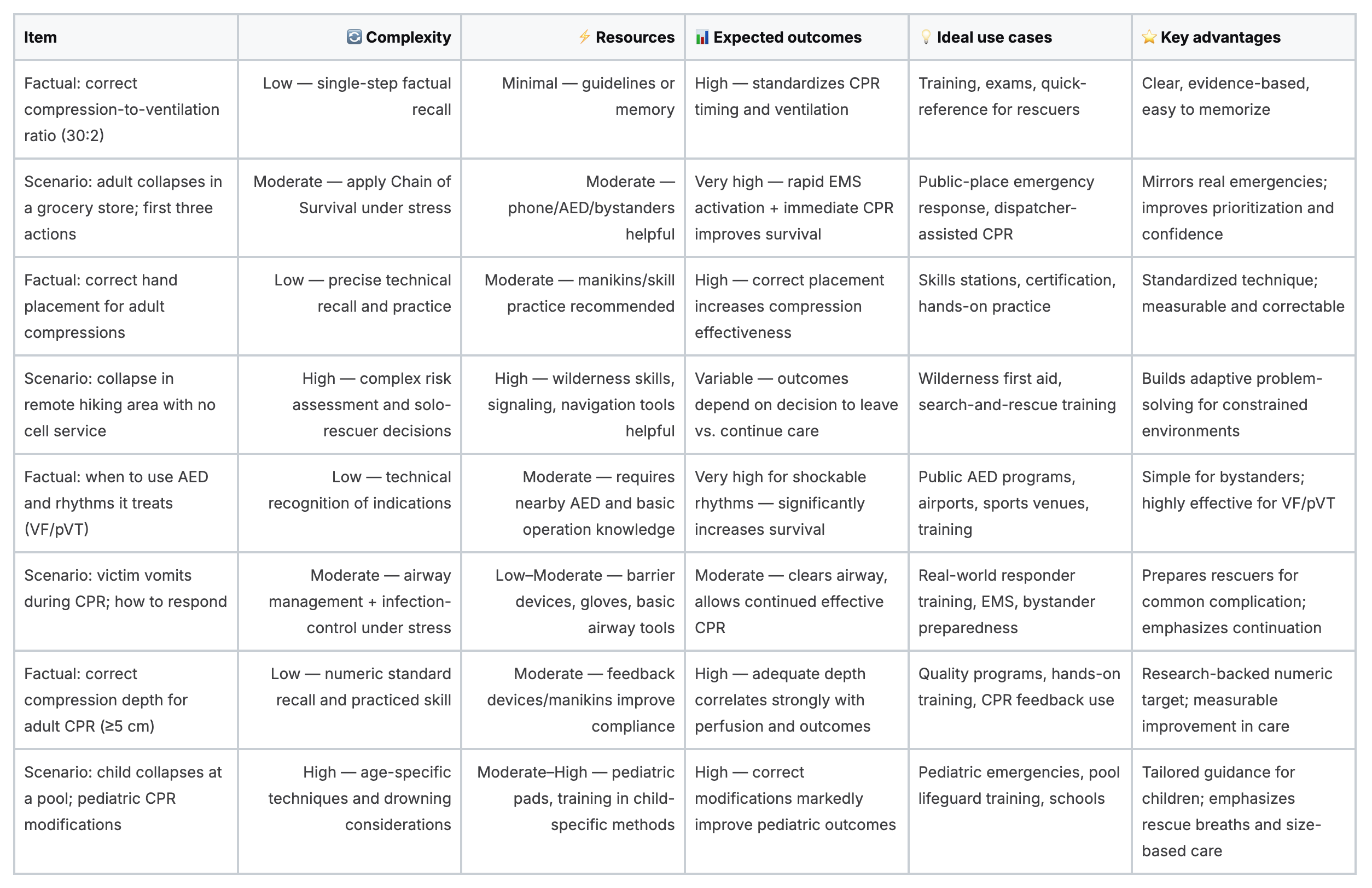
8-Item CPR Q&A Comparison
Master Your Skills with Modern, Flexible Certification
Navigating the landscape of CPR and BLS requires more than just memorizing facts; it demands critical thinking, adaptability, and the confidence to apply knowledge under pressure. The detailed CPR question and answer scenarios we’ve explored in this guide highlight a crucial point: effective emergency response is about understanding the why behind every action. This guide provides a solid framework for developing that critical thinking, preparing you not just to pass an exam, but to act decisively when it matters most.
The journey to certification, however, has evolved significantly. The long-held belief that only traditional, in-person classes from specific organizations like the AHA or American Red Cross can provide valid training is an outdated perspective. The modern healthcare industry is embracing a more flexible and efficient model, supported by a growing body of evidence.
The Shift Toward High-Quality Online Certification
Peer-reviewed studies and industry analyses consistently demonstrate that accredited online learning delivers outcomes that are equivalent, and in many cases superior, to in-person training. Key advantages include:
- Enhanced Knowledge Retention: Online modules often allow you to review complex topics at your own pace, reinforcing difficult concepts until they are fully understood. This self-directed learning can lead to better long-term retention of critical information.
- Unmatched Flexibility: Designed for the demanding schedules of healthcare professionals, online courses remove the barriers of travel, classroom time, and rigid scheduling. You can complete your training when and where it works for you, without sacrificing quality.
- Proven Efficacy: The focus of certification should be on competency and patient outcomes, not the format of the classroom. High-quality online programs are meticulously designed to meet the same rigorous standards as their in-person counterparts, ensuring you are fully prepared for clinical practice.
Hospitals, clinics, and healthcare systems across the country are increasingly recognizing the validity and value of accredited online certifications. This industry-wide shift acknowledges that modern educational technology can provide an immersive, effective, and convenient pathway to maintaining essential life-saving skills.
At ProMed Certifications, we are at the forefront of this educational evolution. Our courses are built to provide the highest standard of evidence-based education in a format that respects your time and supports your professional goals. By mastering the concepts in this CPR question and answer guide, you are not just studying for a test; you are building a foundation of confidence and competence that will serve you throughout your career. The next step is to formalize that knowledge with a certification that is as forward-thinking as you are.
Ready to get certified with a program that respects your time and is built for the future of healthcare? Explore our fully accredited online CPR and BLS certification courses at ProMed Certifications and see how our modern approach can help you master every CPR question and answer with confidence.
.avif)
Stay compliant with ProMed+
Certifications included: ACLS, BLS, PALS, CPR & Neonatal Resuscitation
Unlimited continuing education: over 200 hours of accredited CME
All-inclusive: One price. No surprises.
Get certified today

The Advanced Cardiac Life Support (ACLS) is an accredited online medical certification course that teaches medical professionals to respond to nearly all cardiopulmonary emergencies.

The Pediatric Advanced Life Support (PALS) Recertification instructs medical professionals on performing pediatric cardiopulmonary resuscitation in emergencies.

The Basic Life Support (BLS) Recertification is intended to teach healthcare professionals the basic steps of CPR and rescue breathing for adults, children, and infants.

Our online medical certification course for CPR, Automated External Defibrillator (AED), and First Aid is designed to teach adult, child, and infant CPR and AED use.

The Neonatal Resuscitation Certification trains medical professionals in performing resuscitation procedures and life-saving techniques for newborns at the time of delivery.

.png)
.png)
.png)