


Pharmacology CME For Nurse Practitioners: Your Essential Guide

Pharmacology Continuing Medical Education (CME) is so much more than a box to check for license renewal—it's one of the foundational pillars of providing safe, effective patient care. For busy professionals like you, this guide will help you navigate the specialized, ongoing training that keeps you sharp on new medications, updated safety protocols, and the constantly evolving world of treatment guidelines. Accredited online platforms like ProMed Nursing CE are the most practical and widely accepted way to meet these crucial educational needs without missing a beat.
Why Pharmacology CME Is So Critical For Modern Nurse Practitioners
Think of your pharmacology knowledge like a high-tech operating system. When you first graduate, it’s shiny, new, and runs perfectly. But over time, new viruses (drug interactions, side effects) and better software (new medications, treatment protocols) are released. Without regular updates, that once-perfect system becomes slow, outdated, and vulnerable. Pharmacology CME is that essential system update.
Having prescriptive authority is a huge responsibility. Staying current isn't just a good idea—it's absolutely non-negotiable for protecting your patients and your license. This commitment to continuous learning reinforces your vital role as a trusted healthcare provider and is at the heart of what separates nurse practitioners and their advanced scope of practice.
The Real-World Impact on Patient Care
Effective pharmacology CME isn't about rote memorization of drug names. It's all about understanding how to apply pharmacotherapeutics in the real world, with real patients.
- Improving Patient Safety: Keeping up with the latest black box warnings, contraindications, and potential adverse reactions helps you sidestep medication errors that can have devastating consequences.
- Optimizing Treatment Outcomes: When new, more effective drugs hit the market, CME gets you up to speed so you can integrate them into your treatment plans, giving your patients the best possible shot at a good outcome.
- Navigating Complex Cases: For patients with multiple health issues on a laundry list of medications, a deep and current understanding of polypharmacy is absolutely essential to avoid dangerous interactions.
The Shift Toward Modern, Accessible Education
The outdated belief that only in-person training counts has been thoroughly debunked. A growing body of peer-reviewed studies and industry articles supports the effectiveness of online learning, highlighting that outcomes for patient care, knowledge retention, and learner flexibility are often equal or even superior in online formats. Healthcare institutions and professionals are increasingly embracing accredited online CME because it offers incredible flexibility without sacrificing quality.
Today's accredited online pharmacology CME for nurse practitioners provides a robust, evidence-based educational experience that is every bit as effective as traditional, in-person seminars. The industry consensus is clear: quality and convenience can—and should—go hand in hand.
This shift means you can complete your required hours on your own terms—during a lunch break, after the kids are in bed, or on a weekend, all without the expense and hassle of travel. ProMed is at the forefront of this change, delivering the high-quality, accredited education you need in a format that actually fits into your demanding life.
Navigating National and State CME Requirements
Figuring out your Continuing Medical Education (CME) requirements can feel like piecing together a puzzle with parts from different boxes. You’ve got national standards from your certifying body, and then a whole separate set of rules from your state board.
Getting it right is obviously critical, but it doesn’t have to be a headache. Let’s break it all down.
Understanding National Certification Standards
First things first, let's look at the national certifying bodies. These organizations set the baseline for every nurse practitioner, establishing the minimum hours you need to prove you’re keeping up with your clinical expertise.
The two big players here are the American Academy of Nurse Practitioners (AANP) and the American Nurses Credentialing Center (ANCC). While their specific rules vary a bit, they share one common mission: making sure NPs stay current, especially in a high-stakes field like pharmacology.
The AANP, for example, has a clear path for recertification. They require NPs to complete 100 contact hours of advanced continuing education every five years. Of those 100 hours, at least 25 have to be laser-focused on pharmacology.
That's 25% of your total requirement, which really drives home how vital pharmacology knowledge is for safe and effective prescribing.
The national requirement of 25 pharmacology hours isn't just a suggestion—it's the mandatory foundation. Meeting this is the first and most critical step in keeping your certification active.
The ANCC is right in line with this, mandating 75 total CE hours, with 25 of those dedicated to pharmacology, within the same five-year renewal window. The bottom line is simple: no matter who certifies you, pharmacology is a major, non-negotiable part of your ongoing education.
Adding State-Specific Requirements to the Mix
Once you have a handle on your national requirements, it's time to zoom in on your state. This is where things can get a lot more specific. State boards of nursing often add another layer on top of that national baseline, usually to address pressing public health issues or specific areas of practice.
You’ll often find your state requires a certain number of hours on hot-button topics like:
- Controlled Substance Prescribing: Many states now have specific mandates covering the best practices for prescribing controlled substances to prevent misuse.
- Opioid Management and Pain Guidelines: With the ongoing opioid crisis, it's common for states to require dedicated training on safe opioid prescribing and alternative pain management strategies.
- Implicit Bias Training: A growing number of states require training on implicit bias to promote health equity and ensure fairness in patient care and prescribing habits.
This decision tree gives you a simple way to think about how to keep your pharmacology knowledge sharp for the best possible patient care.
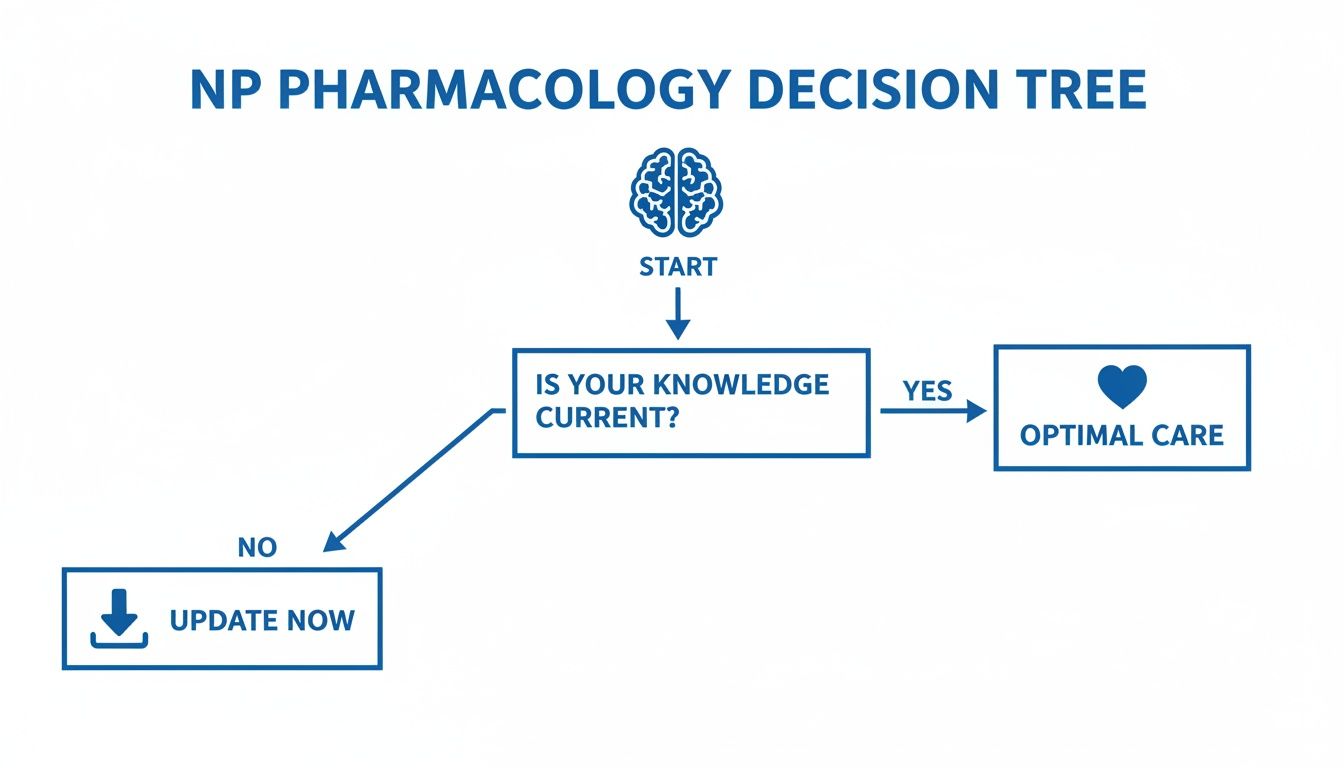
The flowchart reinforces a core professional duty: constantly assessing and updating your pharmacology skills is a direct path to providing the best patient outcomes.
To make this clearer, let's compare the baseline national requirements against what a state might add on top.
National vs. State Pharmacology CME Requirements for NPs

As you can see, the state requirements are additions, not replacements. You have to satisfy both to stay in good standing. Because these rules can change and vary so much, it’s absolutely essential to check your state board’s official website for the most current information.
Ultimately, staying on top of these rules is a key part of healthcare compliance. This is where online course bundles can be a lifesaver—they often package the national and state-mandated topics together, letting you check all the boxes in one shot.
Mastering Specialized Pharmacology Topics
A solid grasp of general pharmacology is the bedrock of your practice, but today’s healthcare world demands a much deeper dive into specialized topics. It's no longer just about routine updates. Certain areas of pharmacology have become mandatory, driven by urgent public health crises. Think of these not as extra hurdles, but as opportunities to sharpen your skills and directly help solve critical national issues.

This shift toward specialized mastery empowers you to handle complex patient situations with real confidence, from managing chronic pain responsibly to addressing substance use disorders with the latest evidence-based treatments.
The MATE Act: A New Federal Mandate
One of the biggest recent changes to pharmacology CME for nurse practitioners is the Medication Access and Training Expansion (MATE) Act. This isn't just another piece of bureaucratic red tape; it's a direct, nationwide response to the ongoing opioid crisis.
Because of this epidemic, both federal and state boards have rolled out new pharmacology CE requirements. As of June 27, 2023, any DEA-registered practitioner—including NPs—must complete a one-time, 8-hour training on treating and managing patients with opioid or other substance use disorders. On top of that, many states have added their own controlled substance prescribing rules.
This mandate gives you the tools to be a leader in your community, helping to combat addiction and promote safer pain management. It's less of a requirement and more of a professional duty to learn life-saving skills.
Key Focus Areas of the MATE Act Training
This 8-hour training is designed to be practical. It moves beyond abstract theory and into the real-world application of safe, effective prescribing that you can use immediately.
You can expect to cover core competencies like:
- Best Practices for SUD Treatment: This means understanding evidence-based methods for treating substance use disorders (SUD), including how to properly use buprenorphine and other medications.
- CDC Pain Management Guidelines: You'll learn to apply the latest clinical practice guidelines for prescribing opioids for pain, with a sharp focus on minimizing risks while still providing adequate relief.
- Responsible Prescribing of All Controlled Substances: This involves developing strategies to reduce the risk of diversion and misuse for all scheduled medications, not just opioids.
- Recognizing and Managing Addiction: You’ll get better at spotting the early signs of substance misuse and knowing the right steps for intervention and referral.
Mastering these areas isn't just about checking a box for compliance. It’s about building trust with your patients and making sure every prescription you write is both safe and effective. It's also crucial to stay current on the latest drug therapies. For instance, understanding the differences between Semaglutide and Tirzepatide helps you make more informed decisions for patients dealing with diabetes and obesity.
Beyond Opioids: Advancing Health Equity
While the opioid crisis is a huge focus, specialized pharmacology CME is also branching out to tackle other vital issues, like health equity. More and more state boards now require training in implicit bias, and for good reason.
Implicit bias training is crucial because our unconscious assumptions can subtly influence prescribing decisions, leading to disparities in care for patients from different racial, ethnic, or socioeconomic backgrounds.
By becoming aware of these biases, you can work to ensure every single patient gets the same high standard of care, no matter who they are. This training ties directly into pharmacology, promoting fairness in everything from pain management to prescribing essential medications. For a deeper look at how certain drugs function in high-stakes situations, you might find our guide on the critical role of epinephrine in patient care interesting.
Ultimately, mastering these specialized topics elevates your practice, prepares you to handle major public health challenges, and reinforces your role as a highly skilled and compassionate provider.
How To Choose The Right Online Pharmacology CME
With a sea of online options, picking the right pharmacology CME can feel like a chore. You need courses that are high-quality and relevant to your daily practice, but more importantly, you need the absolute certainty that they'll be accepted by your state board and national certifying body. The trick is knowing what to look for—and letting go of some outdated ideas about continuing education.
Let's clear the air on something right away: the old belief that only traditional, in-person classes from specific providers like the AHA or Red Cross are legitimate is officially a myth. A mountain of research has confirmed that accredited online learning delivers the same, and sometimes even better, outcomes when it comes to retaining knowledge and applying it on the job. Hospitals, clinics, and professional organizations have fully embraced this shift because they know quality education comes down to accreditation and content, not the format it's delivered in.
Your Checklist For Vetting Online CME Providers
When you're comparing platforms for your pharmacology CME, you need to zero in on what actually matters for your license and your professional growth. Any provider worth your time will make these details crystal clear and easy to find.
Here’s a no-nonsense checklist to guide you:
- Accreditation Is Non-Negotiable: This is the absolute bottom line. The provider must be accredited by the American Nurses Credentialing Center (ANCC). ANCC accreditation is the gold standard for nursing education. It’s your guarantee that the course content meets strict educational standards and will be recognized by state boards and employers everywhere.
- Is It Relevant to Your Practice? The best CME is practical. Look for courses that tackle the things you see every day—like managing common primary care meds, handling controlled substances, and keeping up with new drug therapies. The content should be fresh and based on solid evidence.
- A Modern, Mobile-Friendly Experience: You're a busy NP. Your education needs to fit into the cracks of your schedule, not the other way around. A good online platform works flawlessly on your phone, tablet, or desktop. You should be able to start a lesson on one device and finish it on another without a hitch.
- Instant Access to Your Certificate: When you finish a course, you shouldn’t have to wait days for your certificate. A reputable provider gives you immediate, 24/7 access to download and print your proof of completion. This is a game-changer when renewal deadlines are looming.
The industry has evolved. The new standard for professional development is all about accredited, high-quality content delivered in a way that respects the intense demands on modern healthcare professionals. Flexibility and credibility are no longer mutually exclusive.
The Importance Of Automated Reporting
One of the biggest headaches with CME has always been manually submitting all those completed hours to the right boards. This is where modern online platforms really prove their worth.
Look for a provider that offers automated reporting directly to services like CE Broker and other state-specific tracking systems. This single feature saves you a ton of time, eliminates the risk of a typo derailing your renewal, and gives you peace of mind that your compliance is handled. It's a small detail that makes a huge difference, turning CME from a tedious task into a seamless part of your professional life.
Providers like ProMed Nursing CE are built for this new reality, delivering ANCC-accredited pharmacology CME that checks every single box on this list. We’ve combined rigorously reviewed content with a platform that’s genuinely easy to use, complete with instant certificates and automated reporting. Our goal is simple: to give you the convenience you need with the credibility you demand.
Completing Your CME With ProMed: A Step-by-Step Guide
The thought of tackling your pharmacology CME can feel like just another chore on an already packed to-do list. We get it. That’s exactly why we designed the ProMed Nursing CE platform to get rid of the usual headaches, letting you focus on the learning, not the logistics.
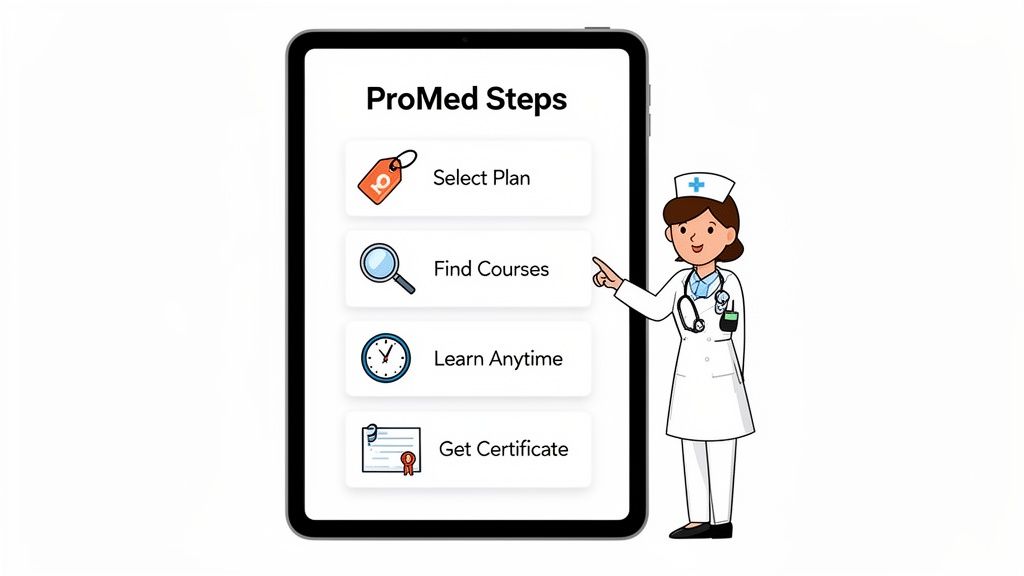
Here’s a simple breakdown of how you can knock out all your pharmacology CME for nurse practitioners in just a few steps.
Step 1: Select Your Plan
First things first, pick a plan that makes sense for you. While you can always purchase courses one by one, our unlimited access subscription offers the best bang for your buck by a long shot.
For a single price, you unlock our entire library—that's over 200 hours of ANCC-accredited content at your fingertips. This covers all the pharmacology courses you need for national and state requirements, plus extras like the DEA MATE Act training and other mandated topics. It’s the easiest, most affordable way to get everything done in one place.
Step 2: Find Your Courses
Once you’re in, finding what you need is a breeze. We’ve organized our library so you can quickly pinpoint specific courses, especially those focused on pharmacology.
You can search for topics that are directly relevant to your daily practice or just grab one of our state-specific bundles. We've curated these bundles to include all the mandatory hours for your state, which takes all the guesswork out of compliance. This makes sure you’re not just hitting the baseline 25 pharmacology hours but also covering any local rules on controlled substances or pain management.
Step 3: Learn On Your Schedule
This is where online learning really proves its worth. With ProMed, you’re in the driver's seat of your own education.
- Learn Anywhere, Anytime: Our platform is totally mobile-friendly. That means you can knock out courses on your phone during a lunch break, on your tablet after your shift, or on your desktop at home.
- Self-Paced Learning: No rigid schedules or looming deadlines here. You can start, pause, and pick up courses whenever your life allows, letting the material actually sink in without feeling rushed.
- Unlimited Retakes: We want learning to be stress-free. If you don't pass an exam on the first go, you can retake it as many times as you need. No questions asked.
This whole approach is built around respecting your time and expertise, letting professional development fit into your life—not the other way around.
The whole point of modern CME is that it has to be both high-quality and easy to access. Our process is built on that idea, delivering a credible and convenient learning experience from start to finish.
Step 4: Get Your Certificate Instantly
The moment you pass a course, your certificate is ready. No waiting period, no delays. You can download, print, or save your documentation 24/7.
Better yet, we handle the boring part for you. We automatically report your completed hours to CE Broker and other state boards that require it. This final step is seamless and gives you peace of mind, knowing your license renewal is secure and your records are up-to-date—without any extra admin work for you.
Why Online Learning Is The Future For Nurse Practitioners
If you still have any reservations about online education, it’s time to put them to rest. The old-school notion that only in-person training holds real value is quickly being replaced by a modern reality, and it's backed by a mountain of peer-reviewed research.
The evidence is overwhelming: accredited online pharmacology CME delivers learning outcomes that are just as good as—and often even better than—traditional classroom settings.
For today’s busy nurse practitioner, the benefits are just too big to ignore. Online learning gives you the flexibility to complete your pharmacology CME requirements whenever and wherever your schedule allows. No more expensive travel, no more taking time off work, and no more logistical headaches of attending a physical seminar.
Equal Quality, Unmatched Convenience
The healthcare industry has already made the switch. Hospitals, clinics, and professional organizations across the country now widely agree that high-quality, accredited online education is just as valid as its in-person counterpart.
They get it. What truly matters is the quality of the accredited provider, not how the material is delivered.
This growing acceptance is rooted in solid results. Study after study shows that online learning leads to excellent knowledge retention and practical application in the real world of clinical settings. ProMed is at the forefront of this shift, giving you the convenience you need with the credibility you absolutely demand.
The new standard for professional development is clear: quality education has to be accessible. For nurse practitioners, this means embracing a future where career growth and excellent patient care are powered by flexible, evidence-based online learning.
The Smart Choice For Your Career
Choosing online pharmacology CME for nurse practitioners isn't just about convenience; it's a strategic move for your career. It shows you're committed to modern, efficient, and effective professional development.
When you take this forward-thinking approach, you get:
- Significant Cost Savings: Forget about the travel, lodging, and steep registration fees that come with in-person events.
- Ultimate Time Efficiency: Fit learning into your life without having to sacrifice your personal or professional commitments.
- Guaranteed Acceptance: With ANCC accreditation, you can be confident your certificates are recognized by boards and employers nationwide.
Don't let an outdated mindset hold back your professional growth. It's time to embrace the modern, effective, and widely accepted path to meeting your CME requirements. Explore ProMed’s comprehensive, ANCC-accredited pharmacology courses today and take the next step in advancing your career and delivering exceptional patient care.
Your Pharmacology CME Questions, Answered
When it comes to keeping your NP credentials up to date, the specifics around pharmacology CME can get a little confusing. Let's clear up some of the most common questions we hear from nurse practitioners.
Are Online Pharmacology CME Courses Actually Accepted By State Boards?
Yes, absolutely. The old idea that in-person courses are somehow better is a myth that just won't quit. What state boards and national certifying bodies really care about is the accreditation of the provider, not whether you took the course at a conference or on your couch.
As long as your pharmacology CME comes from a provider accredited by a recognized body like the ANCC, it’s considered valid and will be accepted nationwide. This is exactly why thousands of NPs confidently use online platforms to meet their continuing education requirements every year.
The entire industry has shifted. Accredited online education is now seen as equally effective and valid as traditional in-person training by licensing boards and healthcare systems alike. It’s the quality and accreditation of the education that matters, not where you happen to be when you complete it.
At ProMed, all of our nursing CE courses are ANCC-accredited. This ensures they meet the highest educational standards and will be accepted for both your license and certification renewal, no questions asked.
How Do I Figure Out How Many Pharmacology Hours I Need?
This is a great question, and figuring it out is a two-step process. It’s simpler than it sounds.
- Check with Your National Certifying Body: First things first, head to the website for either the AANP or the ANCC. This will tell you the baseline pharmacology hours you need for your five-year recertification cycle, which is typically 25 hours.
- Look Up Your State Board of Nursing: Next, visit your specific state board's website. State boards often have their own requirements on top of the national baseline. They might mandate specific hours on topics like opioid prescribing, pain management, or other issues relevant to your state.
To make things easier, many NPs choose online providers that offer state-specific course bundles. These packages group all the necessary national and state-mandated courses into one convenient bundle, taking all the guesswork out of staying compliant.
What’s This DEA MATE Act Requirement I Keep Hearing About?
The MATE Act is a new, one-time federal training requirement for all DEA-registered prescribers, including nurse practitioners. Think of it as specialized training to make sure you’re equipped with the latest knowledge to help address the opioid crisis.
This is a mandatory 8 hours of training that focuses on treating and managing patients with opioid or other substance use disorders. It’s critical to remember that this is a separate federal mandate—these hours are in addition to your regular state and national pharmacology CME requirements.
Ready to check off your pharmacology CME requirements with confidence? ProMed Certifications offers a full library of ANCC-accredited courses, state-specific bundles, and the DEA MATE Act training to make sure you have everything you need.
.avif)
Stay compliant with ProMed+
Certifications included: ACLS, BLS, PALS, CPR & Neonatal Resuscitation
Unlimited continuing education: over 200 hours of accredited CME
All-inclusive: One price. No surprises.
Get certified today

The Advanced Cardiac Life Support (ACLS) is an accredited online medical certification course that teaches medical professionals to respond to nearly all cardiopulmonary emergencies.

The Pediatric Advanced Life Support (PALS) Recertification instructs medical professionals on performing pediatric cardiopulmonary resuscitation in emergencies.

The Basic Life Support (BLS) Recertification is intended to teach healthcare professionals the basic steps of CPR and rescue breathing for adults, children, and infants.

Our online medical certification course for CPR, Automated External Defibrillator (AED), and First Aid is designed to teach adult, child, and infant CPR and AED use.

The Neonatal Resuscitation Certification trains medical professionals in performing resuscitation procedures and life-saving techniques for newborns at the time of delivery.

.png)
.png)
.png)