

Unlimited certifications + CE, from $14/moAll certs + CE from $14/mo

Neonatal Resuscitation Algorithms
Healthcare providers who care for infants should understand the dynamics of cardiac and respiratory arrest, particularly with emphasis on this demographic, in order to be able to apply that knowledge when called upon to resuscitate a newborn in an emergency situation.
The Neonatal Resuscitation algorithms, when paired with the ProMed Certifications Neonatal Resuscitation course will give you the confidence to resuscitate newborns at the time of delivery.
Test your Neonatal Resuscitation
Knowledge
Our Neonatal Resuscitation practice exam includes questions pulled directly from a real Neonatal Resuscitation exam.
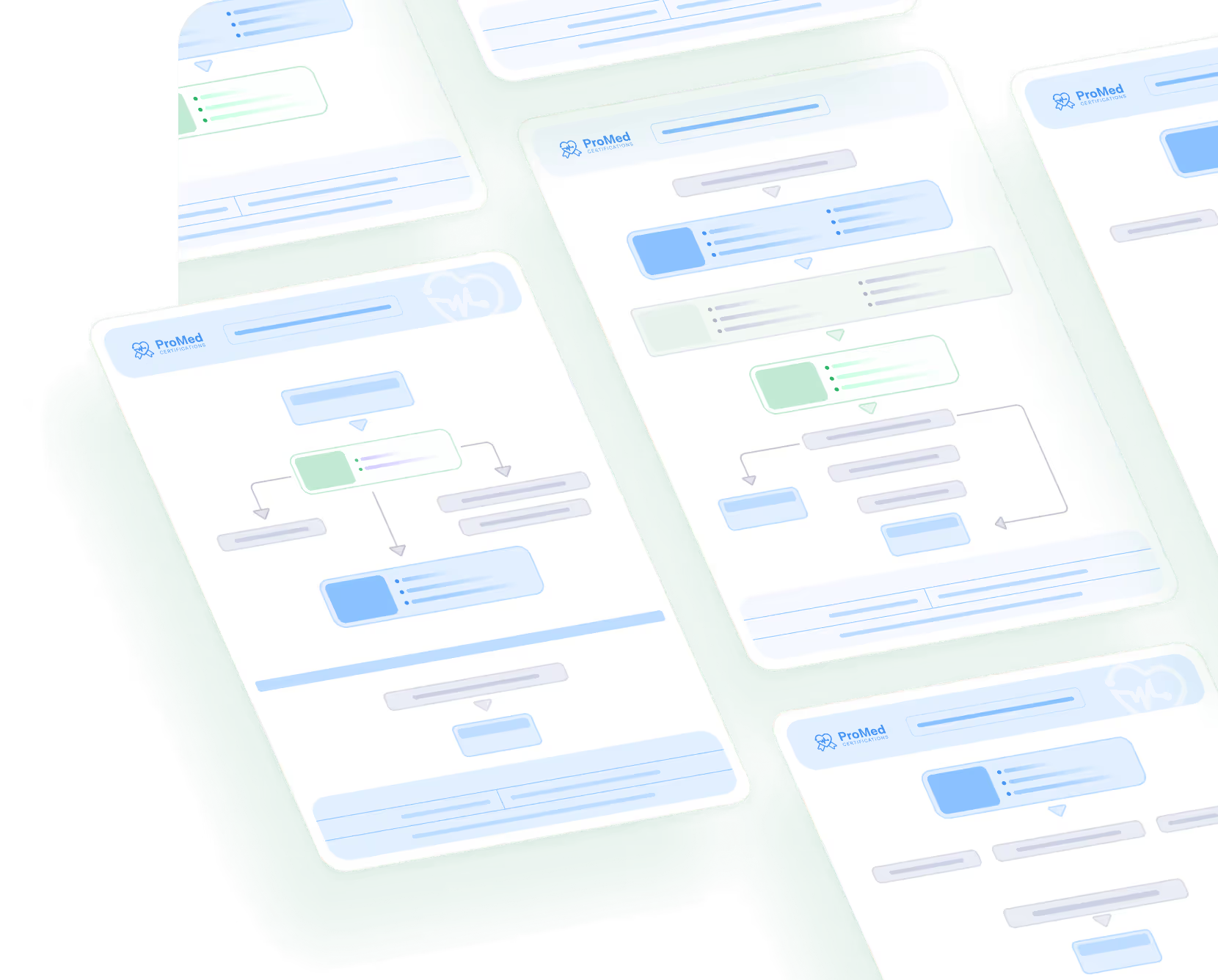
Neonatal Resuscitation Algorithm
- 1
Before and at birth
- Ask about gestational age, amniotic fluid, risk factors and the umbilical cord plan.
- Check three things at birth: is the baby term, is there good muscle tone, and is the baby breathing or crying?
- 2
Initial steps
- Warm, dry and stimulate the baby.
- Position the airway and clear secretions only if needed.
- 3
Ventilation
- Start positive-pressure ventilation for apnea, gasping or a heart rate under 100 bpm.
- Ventilate at 30–60 inflations per minute and attach a pulse oximeter to the right hand or wrist.
- Make sure each breath moves the chest. Effective ventilation is the single most important step.
- 4
Chest compressions
- Begin compressions if the heart rate stays under 60 bpm after at least 30 seconds of effective ventilation.
- Use 3 compressions to 1 breath (90 compressions and 30 breaths per minute) and increase oxygen to 100%.
- 5
Medication
- If the heart rate stays under 60 despite good ventilation and compressions, give epinephrine, preferably through an umbilical venous line.
- Consider low blood volume or a pneumothorax if the baby isn't responding.
- 6
Oxygen targets
- Babies born at 35 weeks or later start with 21% oxygen (room air); babies born before 35 weeks start with 21–30% oxygen.
- Preductal oxygen saturation rises gradually after birth and should reach 85–95% by 10 minutes.


Simple, affordable pricing
Select your Online ACLS, PALS, BLS, CPR or Neonatal Medical Certification Course below

The Advanced Cardiac Life Support (ACLS) is an accredited online medical certification course that teaches medical professionals to respond to nearly all cardiopulmonary emergencies.
Learn more
The Pediatric Advanced Life Support (PALS) Recertification instructs medical professionals on performing pediatric cardiopulmonary resuscitation in emergencies.
Learn more
The Basic Life Support (BLS) Recertification is intended to teach healthcare professionals the basic steps of CPR and rescue breathing for adults, children, and infants.
Learn more
Our online medical certification course for CPR, Automated External Defibrillator (AED), and First Aid is designed to teach adult, child, and infant CPR and AED use.
Learn more
The Neonatal Resuscitation Certification trains medical professionals in performing resuscitation procedures and life-saving techniques for newborns at the time of delivery.
Learn more