DEA MATE Training Requirement: What You Need to Know
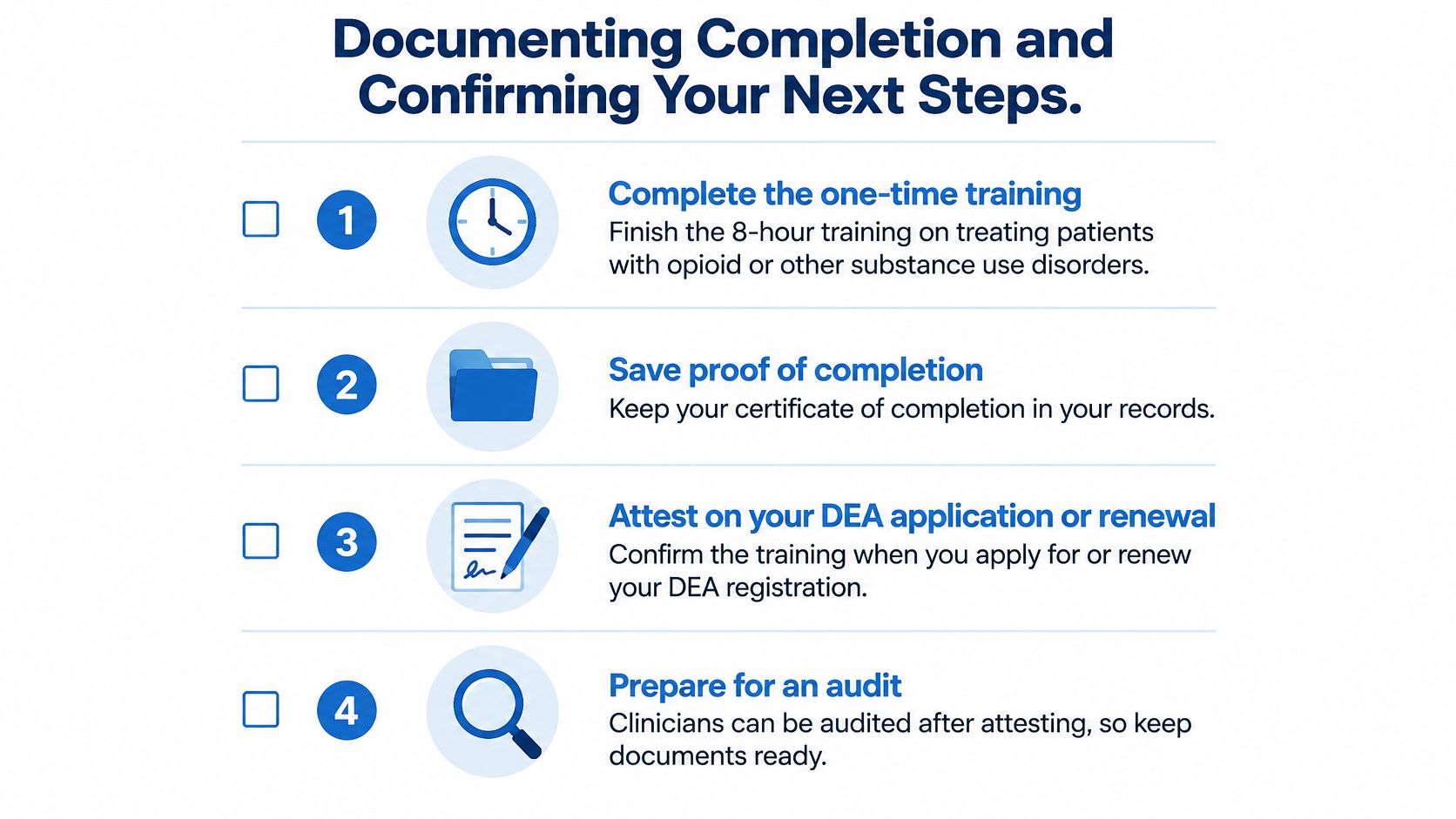
DEA-registered practitioners, except those who are solely veterinarians, must complete at least 8 hours of training on opioid and other substance-use disorders, once, at their next DEA application or renewal on or after June 27, 2023.
But if someone asked you to substantiate your attestation, could you show exactly which training qualified? That's the gap busy clinicians can overlook. Completing education and keeping defensible proof are related, but they aren't the same task.
The DEA MATE training requirement is easier to manage when you treat it as a documentation obligation, not just another course to finish.
Who Must Complete the DEA MATE Training
Registration status decides whether you are covered; profession alone does not. The federal requirement generally applies to practitioners who hold or apply for a DEA registration, with an exception for veterinarians practicing solely as veterinarians.
The DEA's MATE training guidance describes a one-time requirement established by the Consolidated Appropriations Act of 2023, signed December 29, 2022. It applies to registration submissions beginning June 27, 2023, and requires at least 8 hours of qualifying education. Keep documentation that shows how your completed training supports your attestation.
MATE Training Coverage by Practitioner Type

A nurse practitioner who renews a DEA registration after two years of practice, for example, should check whether that renewal is their first qualifying submission on or after June 27, 2023. The implementation date is not a universal course deadline. Your own qualifying application or renewal sets the timing.
This is a one-time federal training obligation, not an annual course that automatically repeats with each renewal. Save proof of completion so you can support your attestation if asked. State boards, employers, and professional organizations may set separate education requirements, so federal completion does not resolve those obligations.
Check your next DEA submission date and registration history. If you have already completed the applicable attestation, you generally do not need to repeat the federal training.
What the Eight Hours Must Cover
A 12-hour pharmacology course may devote only two hours to qualifying substance-use care. The federal requirement is eight hours of education on treating and managing patients with opioid or other substance-use disorders, so count the relevant instruction, not the course's total length. The DEA's MATE Act FAQ explains that qualifying content may include the appropriate clinical use of FDA-approved medications for substance-use-disorder treatment.
Match the Content to Your Clinical Role
Review the syllabus for the subjects that apply to your practice:
- Substance-use-disorder treatment and management: Clinical approaches to caring for patients with opioid or other substance-use disorders.
- Medication treatment: Appropriate use of FDA-approved medications for substance-use care, rather than general pharmacology unrelated to that care.
- Dental pain management: For the dental pathway, safe pharmacological management of dental pain.
- Screening and referral: For that pathway, screening, brief intervention, and referral for patients with, or at risk of developing, substance-use disorders.
A brief intervention is a focused conversation that helps a patient recognize risk and consider treatment. A referral connects the patient with appropriate ongoing care.
You may complete the eight hours in one activity or combine qualifying education from separate sessions. In either case, exclude unrelated material, even when it appears in the same accredited course. The syllabus should make clear which instruction addresses the required topics.
Check the Sponsor Before Counting the Hours
Eligible organizations listed by the DEA include the American Medical Association, American Osteopathic Association, American Dental Association, American Association of Nurse Practitioners, American Association of Physician Associates, and American Nurses Credentialing Center. Qualifying providers accredited by ACCME or CCEPR are also among the eligible pathways.
Use the syllabus to build a record of what you are counting. Mark each relevant topic, note its module or page, and keep the activity's accreditation statement with your completion documentation. This evidence helps support your attestation if you need to show why the education qualified.
A generically named course may qualify if its content and sponsor meet the requirements. A course labeled MATE still needs qualifying instruction and an eligible sponsor. If the outline does not identify how much time is devoted to the required topics, ask the provider for written clarification instead of estimating from the course's full duration.
Accepted Course Formats and How Online Compares
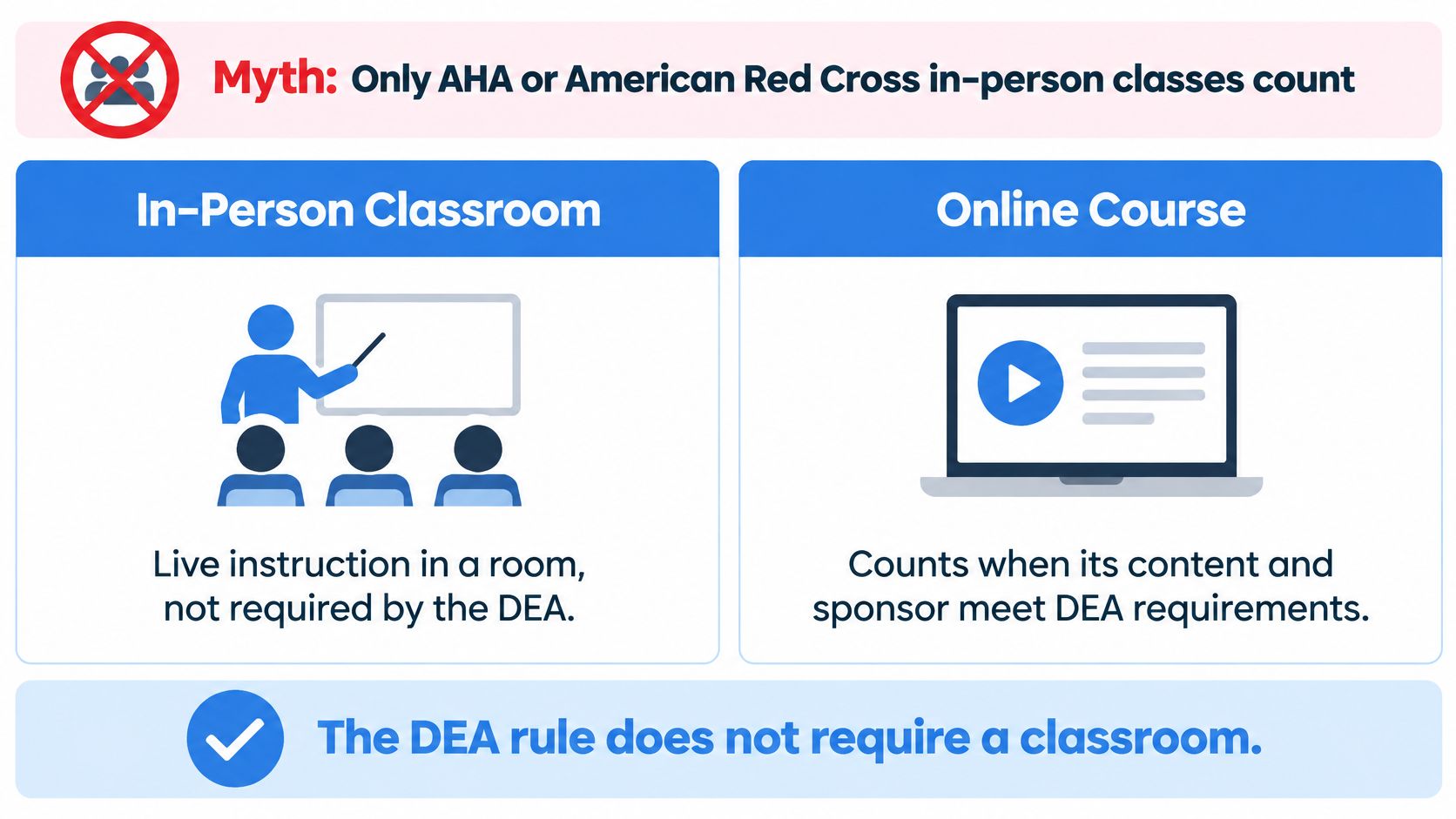
Does a qualifying MATE course have to take place in a classroom? No. The federal requirement focuses on eligible course content and sponsor credentials, not whether you attend online or in person. Online CE can meet the MATE requirement when those conditions are satisfied. For other certifications, check the credential's requirements and your employer's policy.
What the Evidence Supports
A systematic scoping review indexed by ERIC identified 17 eligible studies. The studies reported benefits in knowledge acquisition, skills and performance, attitudes, satisfaction, confidence, and self-efficacy. They also described distance education as a way to address time and location constraints.
Online Versus In-Person MATE Training

Online and in-person courses differ in scheduling and access, but neither format alone establishes MATE eligibility. The proof you keep should show the course's qualifying content and eligible sponsor, supporting the attestation you submit to the DEA. Keep that documentation with your training records; your personal deadline follows your own DEA submission date.
ProMed's guide to continuing medical education online offers context for comparing course options. For an example of digital access to treatment, Integrative Psychiatry of America describes online Suboxone care in Pennsylvania. That patient-care resource is separate from evidence of MATE course eligibility.
Edge Cases for Graduates, Waiver History and Prescribers
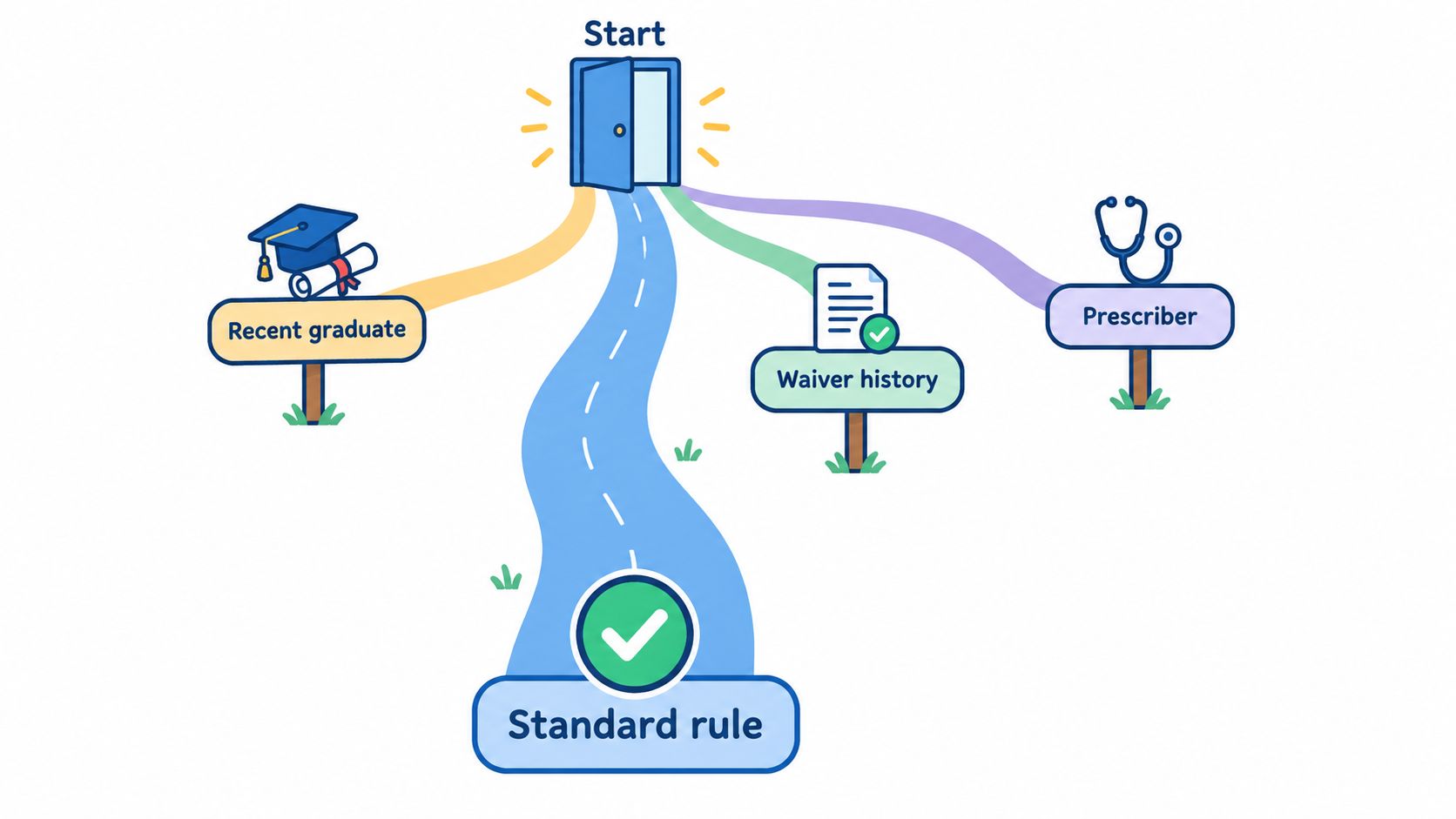
Your pathway depends on what training you completed and what records you can produce. The documentation matters because it supports your attestation, while your personal deadline follows your DEA submission date.
According to the DEA's guidance on graduate and waiver pathways, qualifying recent education and prior DATA-2000 waiver training may satisfy the requirement. Eligible curricula must include at least 8 relevant hours within the applicable five-year window. A former 30E waiver holder may still need qualifying education if the waiver did not require that training.
Test Your Pathway
- Recent graduates: Check whether your eligible U.S. medical, advanced-practice nursing, physician-assistant, or dental curriculum covered the required subjects. Compare the applicable five-year window with your registration submission date, not just your graduation date.
- Former DATA-waiver holders: Retrieve the certificate or other records for your completed education. A past waiver designation by itself does not show what the training covered.
- Former 30E waiver holders: Confirm whether you completed qualifying training independently. Receiving a waiver does not establish that you took education that was not required at the time.
- Nonphysician prescribers: Check whether your education addresses treatment and management of opioid or other substance-use disorders through an eligible pathway. State authority to dispense Schedule II–V controlled substances does not remove the federal education obligation.
Use the pathway flow chart to identify which records to retrieve.
A transcript showing pharmacology may not establish the relevant instructional hours. If the detail is missing, ask your program for a syllabus or curriculum letter and keep it with your completion records.
Nurse practitioners can also review pharmacology CME considerations while checking licensing obligations. Federal MATE eligibility and state-specific pharmacology or prescribing requirements are separate determinations.
Where ProMed Courses Fit the Mandate
Could an online course support your DEA MATE attestation? Yes, when the specific activity meets the federal requirements. The delivery format does not establish eligibility by itself. Check the course details, then keep records that show what you completed and when, because your personal deadline follows your own DEA submission date.
Options for Nurses
ProMed+ Nursing CE provides online continuing education, including DEA MATE Act training. Its program information lists subscription access, certificates, automated CE Broker and state-board reporting, exam retakes, and optional certification courses. These features describe the service; they do not establish that every activity qualifies for a federal attestation.
Options for Physicians
ProMed+ Physician CME offers on-demand courses and digital completion certificates. Its published program information names ACCME, ACPE, and ANCC accreditation. Review the activity-level statement to confirm the accredited provider and the credit awarded for the course you choose.
ProMed also offers Flex Expire™ for certification validity. That feature concerns certification timing, not your DEA training deadline.
For any provider, verify the individual activity before relying on it. Check the sponsor and accreditation statement, and read the learning objectives to see whether the course covers eligible subject matter. A subscription is like a library card: access to the catalog does not mean every course serves the same purpose.
Before enrolling: Confirm that the specific activity supports your federal attestation, rather than relying on the platform's general description.
After completion, save the certificate and related course information. The certificate is your proof of completion; the activity details help explain why it supports your attestation. Automated state-board reporting may reduce administrative work, but it does not replace keeping your own records or checking what the specific activity covers.
Review any applicable refund or certification terms directly. A refund policy or certification feature is separate from whether a course satisfies the federal training requirement. Your records should make the distinction clear: the course you took, its eligible content, and your completion date.
Documenting Completion and Confirming Your Next Steps
What will show that your DEA attestation was supported by qualifying education? Treat your records as the evidence behind the statement you make on a federal registration application. Your own deadline follows your DEA application or renewal date, so organize proof around both the education you completed and the submission it supports.
SAMHSA's training-requirement guidance explains that eligible education may come from more than one qualifying entity, online or in person, and that qualifying prior education can count toward the eight-hour total. You can meet the requirement through a combination of eligible activities; one course carrying a MATE label is not the only path.
Build a File That Supports Your Attestation
The attestation is made on the DEA application or renewal. Keep the supporting records available in your own files, since you generally retain certificates rather than uploading a course packet with the application.
Keep these items together:
- Completion certificate: Save the document showing your name, activity title, and awarded hours. Check that your name matches your professional records.
- Provider identity: Retain the sponsor's name and evidence of its eligible organization or accreditation pathway.
- Completion date: Note the date you finished the activity. This helps connect your education to the application or renewal you are supporting.
- Subject coverage: Keep the syllabus, agenda, or learning objectives that identify the substance-use-disorder topics.
- Qualifying clinical content: Preserve evidence of applicable treatment and management, FDA-approved medications, screening, brief intervention, referral, or the dental pain-management pathway.
- Combined-activity log: If your hours come from several activities, list each course, provider, completion date, relevant hours, and certificate filename.
A certificate describing an activity only as general pharmacology may need an accompanying syllabus to show its relevant content. Clear records make it easier to explain why an activity qualifies, without having to reconstruct the course later.
For example, your certificates may show that you completed several activities but leave unclear which modules covered qualifying topics and which covered unrelated material. Ask the providers for clarification before adding the full credit totals to your log. Count only the relevant instruction.
Keep Your Own Copies
Download certificates as PDFs and store each with its corresponding outline. Give files descriptive names that identify the provider and activity, then keep a secure backup. A dedicated folder makes it easier to find the documentation when you prepare an application or renewal.
Automated state-board reporting can help with administration, but a board transcript may not include enough content detail to explain why an activity qualified for your federal attestation. Keep your own evidence file as well.
Keep enough documentation that you won't need an old course webpage to remain available.
If you are relying on prior education, retrieve its supporting records before attesting. If you later find uncertainty about a previous submission, seek clarification rather than assuming a later course resolves the earlier documentation gap.
The checklist below summarizes the steps from completion through attestation.
Put Your Compliance Plan Into Action
- Find your submission date. Check your next DEA application or renewal and whether you have already made the applicable attestation.
- Identify your pathway. Confirm your practitioner category and review any relevant recent-graduate or waiver-history documentation.
- Match content to the rule. Use the course outline to identify qualifying topics and confirm the relevant instructional total.
- Finish any outstanding education. Choose eligible online or classroom activities from one provider or several. Avoid counting overlapping instruction twice.
- Save the evidence. Put certificates, outlines, provider information, and your running log in a dedicated folder.
- Check other obligations. Review state-board and employer rules separately, including any recurring education or credential-specific requirements.
Online delivery is an option when the sponsor and course content meet the DEA eligibility criteria. Nurses can review ProMed's nursing education platform, then check the selected activity against the same documentation checklist.
ProMed offers online continuing education and medical certification courses designed for healthcare professionals. Visit ProMed Certifications to explore its options, and confirm the selected MATE activity's qualifying content and sponsor before relying on it for your attestation.

Stay compliant with ProMed+
Certifications included: ACLS, BLS, PALS, CPR & Neonatal Resuscitation
Unlimited continuing education: over 200 hours of accredited CME
All-inclusive: One price. No surprises.
Get certified today

The Advanced Cardiac Life Support (ACLS) is an accredited online medical certification course that teaches medical professionals to respond to nearly all cardiopulmonary emergencies.

The Pediatric Advanced Life Support (PALS) Recertification instructs medical professionals on performing pediatric cardiopulmonary resuscitation in emergencies.

The Basic Life Support (BLS) Recertification is intended to teach healthcare professionals the basic steps of CPR and rescue breathing for adults, children, and infants.

Our online medical certification course for CPR, Automated External Defibrillator (AED), and First Aid is designed to teach adult, child, and infant CPR and AED use.

The Neonatal Resuscitation Certification trains medical professionals in performing resuscitation procedures and life-saving techniques for newborns at the time of delivery.