


ALS Occupational Therapy: A Complete Caregiver Guide
.png)
ALS occupational therapy focuses on maintaining independence through adaptive equipment, energy conservation, and stage-based interventions matched to progressive weakness. Multidisciplinary ALS clinics provided assistive aids in 93.1% of cases, compared with 81.3% in general care, according to a major evidence review.
What happens when a loved one can no longer dress, eat, transfer, or use a phone in the way they once did? Conventional rehabilitation often aims to restore function, but ALS requires a different question: How can this person keep doing what matters, safely and with dignity, as abilities change?
Occupational therapy helps answer that question. It connects clinical assessment with everyday life, turning progressive weakness into practical decisions about routines, equipment, communication, home layout, fatigue, and caregiver support. This guide explains how ALS occupational therapy works, when interventions should change, how to choose equipment, and why reassessment matters more than a one-time recommendation.
Understanding the Purpose of ALS Occupational Therapy
How can everyday tasks remain safe and dignified as ALS changes strength, coordination, and endurance? Occupational therapy answers this question by adjusting the task and its setup before frustration or injury forces a crisis.
Early recommendations may be small but meaningful. Built-up handles can make a toothbrush or fork easier to hold. Positioning supports can steady the arm during eating or computer use. A phone with voice control, a simplified keyboard, or an eye-gaze communication system may preserve access to conversation as hand and speech function change. The right choice depends on what the person wants to keep doing, not on a standard equipment list.
What the therapist evaluates
An ALS occupational therapy assessment may examine:
- Self-care: Dressing, bathing, toileting, grooming, and feeding.
- Transfers: Moving between the bed, chair, toilet, and wheelchair.
- Upper-limb function: Reaching, grasping, typing, phone use, and wheelchair control.
- Home routines: Cooking, medication management, household tasks, and movement between rooms.
- Work and communication: Adjusting tools, schedules, access methods, and technology.
- Caregiver demands: Identifying tasks that create unnecessary lifting, strain, or repetition.
The therapist matches the person's current abilities with the demands of each activity and the surrounding environment. A lighter cup, improved seating angle, transfer aid, or altered work surface can reduce effort while allowing the person to take part. Communication technology may need early trial and later replacement as access becomes harder.
Practical rule: If a task has become slower, unsafe, exhausting, or dependent on another person, it deserves an occupational therapy discussion.
ALS care involves neurology, pulmonology, physical therapy, speech-language pathology, respiratory therapy, nursing, nutrition, and social work. Occupational therapy links those clinical observations to daily routines, helping the team decide when a device should be adjusted, replaced, or retired.
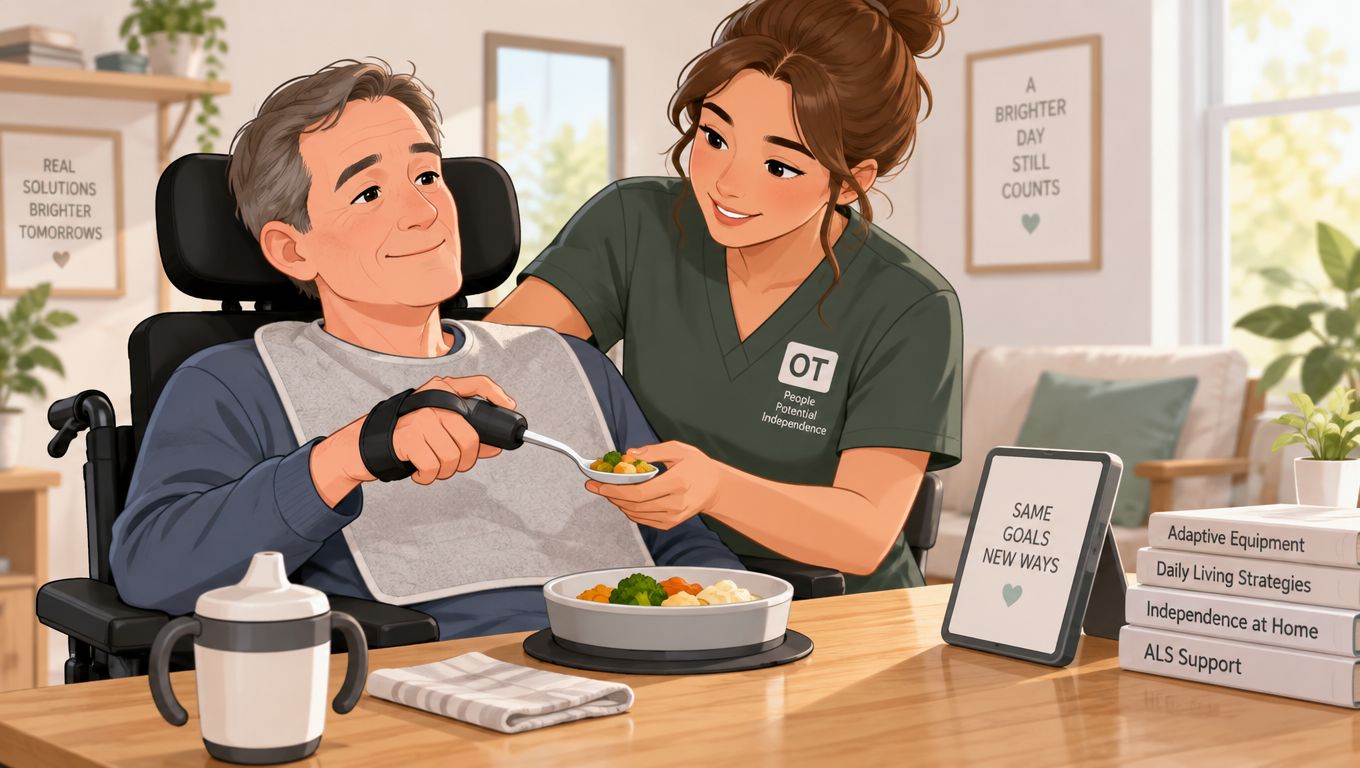
Reassessment protects more than physical function. It can preserve privacy, choice, and participation by preventing caregivers from taking over tasks the person can still perform with a better setup. A device that worked last month may now be heavy, slow, uncomfortable, or difficult to control. Reviewing strength, fatigue, communication, cognition, home layout, and personal goals keeps support aligned with changing needs.
Evidence Supporting Occupational Therapy in ALS Care
What does the research support when ALS weakness changes everyday tasks? The clearest historical evidence favors coordinated multidisciplinary care, rather than therapy delivered in isolation. In a major evidence review cited earlier, patients attending multidisciplinary clinics received assistive aids or appliances in 93.1% of cases, compared with 81.3% receiving general care, a statistically significant difference of p = 0.008. The review also reported better quality-of-life measures and concluded that multidisciplinary clinics were probably effective in increasing adaptive-equipment use, improving quality of life, and lengthening survival.
These findings explain the occupational therapist's role. Neurology may identify disease progression, physical therapy may address movement, and speech-language pathology may address communication or swallowing. Occupational therapy connects those observations to dressing, feeding, transfers, work, home access, and participation. The practical question is not just whether a device works today, but whether it still fits the person's strength, fatigue, safety, privacy, and preferences as function changes.
What the research can and can't tell us
The evidence base remains comparatively small. A 2014 systematic review identified only 14 studies involving occupational-therapy-related interventions for people with ALS (PubMed). It found limited-to-moderate evidence that multidisciplinary programs were associated with longer survival than general care, greater access to appropriate assistive devices, and better quality of life, including social functioning and mental health.
The same review found limited evidence that people with ALS were satisfied with the comfort and ease of use of power wheelchairs, and that these devices could increase community interaction. Moderate evidence supported a home exercise program involving daily stretching and resistance exercise for improving function. Exercise still requires careful adjustment. Excessive fatigue, overuse, falls, or injury can reduce participation as weakness progresses.
A later scoping review reported that, among 32 studies covering occupational therapy interventions in multiple sclerosis and ALS, only 3 studies involved ALS populations. Its interventions mainly addressed physical rehabilitation, cognitive rehabilitation, and fatigue reduction, with targets including manual dexterity, falls prevention, memory, communication, depression, and quality of life. This imbalance limits how confidently clinicians can apply findings from other neurological conditions to ALS.
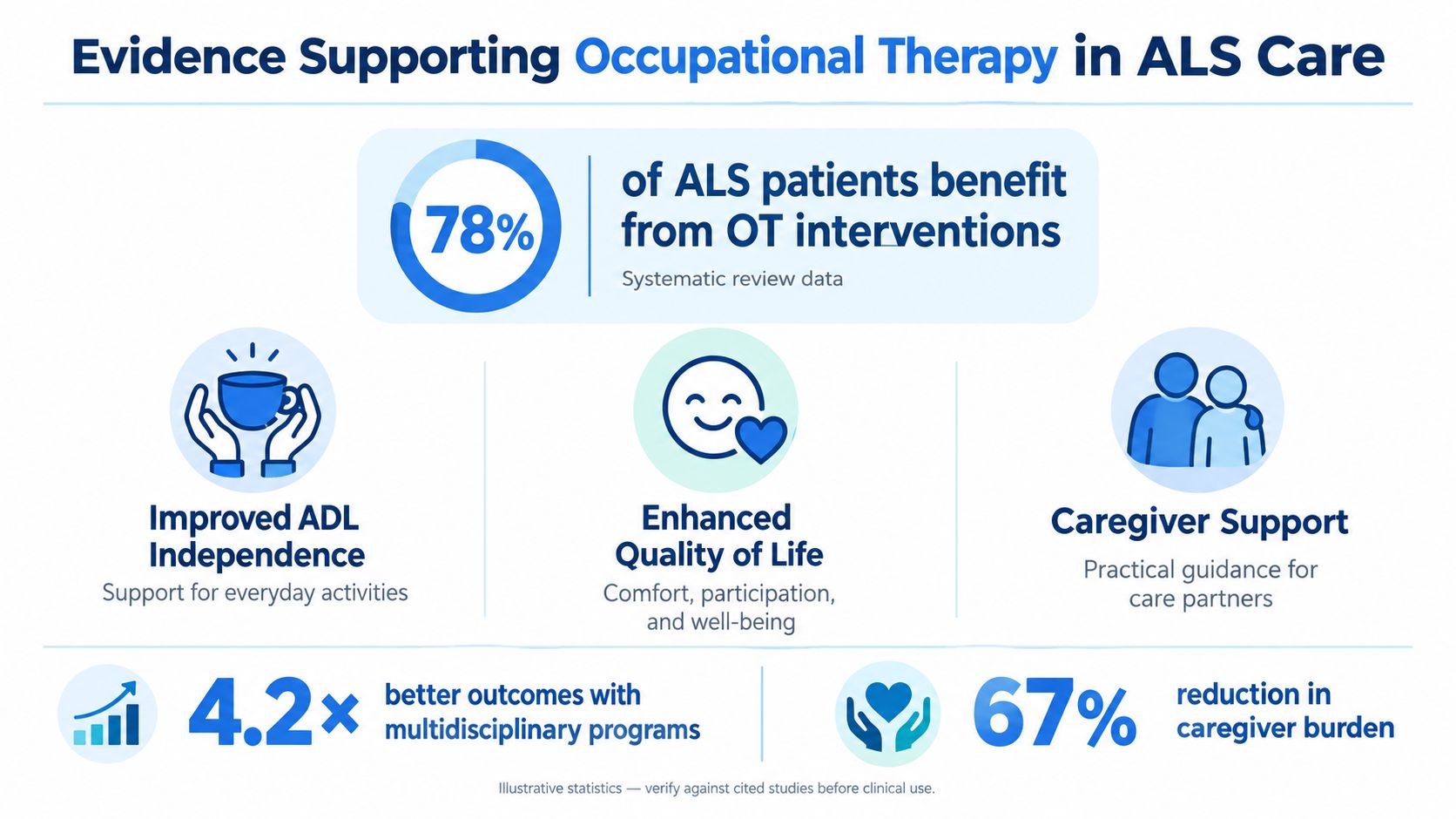
The infographic's additional claims should not be treated as established evidence. Current research supports a careful conclusion: occupational therapy belongs within multidisciplinary ALS care, while larger ALS-specific trials are needed to measure effects on independence, caregiver burden, participation, and quality of life.
Clinicians seeking broader professional learning can consult evidence-based practice resources. A separate PALS Certification option includes online review material, an exam, and card delivery through its platform.
Stage-Based Occupational Therapy Interventions for ALS
ALS occupational therapy should change as function changes. The therapist isn't following a fixed equipment calendar. Instead, each visit asks what the person can do now, what causes unnecessary fatigue or risk, and which activities should be protected for the future.
Earlier changes
Early intervention often focuses on preserving independence without creating overuse. A therapist may modify handles, seating, clothing fasteners, work tools, and kitchen arrangements before a person loses the ability to complete the activity. Early equipment trials also give the person time to learn a new method while communication, cognition, and motor control remain adequate for practice.
The therapist may recommend gentle activity, stretching, or a home exercise program in coordination with the broader team. The purpose isn't bodybuilding. It is maintaining comfortable movement and useful participation without exercising to exhaustion.
Middle-stage adaptation
As weakness becomes more noticeable, compensatory methods become increasingly important. A person may perform grooming while seated, use a mobile arm support for eating, simplify the home layout, or move essential supplies within easy reach. Communication and wheelchair access should be considered before hand function changes make rushed decisions necessary.
Reassessment is appropriate after a fall, a marked change in hand control, increasing difficulty with transfers, new shoulder or neck fatigue, or repeated inability to complete an important task. Access can be inconsistent, however. A 2025 survey of ALS-care providers in Saudi Arabia found that 38.5% overall perceived occupational therapy access as inconsistent (ALS Association resource guide). Families may need help from the ALS clinic, social worker, insurer, equipment supplier, or telehealth service while waiting for specialist review.
Later-stage priorities
Later care often prioritizes comfort, positioning, safety, communication access, and meaningful participation. An intervention might involve environmental control, supported feeding, pressure management, caregiver training, or a simpler device that requires less effort. A technically advanced solution isn't automatically the best solution if it increases setup time, confusion, privacy concerns, or caregiver workload.
Resources on neurorehabilitation from Orange Neurosciences can offer broader rehabilitation context, but ALS-specific decisions still belong with the treating team. The practical principle is simple: protect autonomy wherever possible, and replace effortful performance with well-designed support when necessary.
Choosing and Implementing Adaptive Equipment for ALS
How can adaptive equipment preserve independence as ALS changes? Start with the specific task that has become difficult, then identify whether weakness, fatigue, limited reach, reduced hand control, or positioning is creating the problem. The right device should make the activity easier while preserving the person's control, privacy, and dignity.
Upper-limb assistive technology has some of the clearest measurable findings. A systematic review and meta-analysis of 14 studies involving 184 participants found that wearable upper-limb assistive devices improved functional task performance compared with no device. The overall effect size was 1.06, with a 95% confidence interval of 0.76 to 1.36 and p < 0.00001.
Match the device to the failed task
- Eating: Built-up utensils, universal cuffs, plate guards, mobile arm supports, or adjusted seating can reduce grasp and reach demands.
- Grooming: Lightweight tools, adapted handles, forearm support, and seated positioning can reduce arm effort.
- Typing and communication: Alternative keyboards, switch access, speech-generating systems, and eye-gaze technology may support communication as hand control changes.
- Transfers and toileting: Grab bars, transfer aids, raised surfaces, shower supports, and positioning systems can improve safety.
- Wheelchair control: Alternative-access interfaces may help a person continue directing mobility when standard controls become difficult.
A later scoping review found that 23 of 27 studies, or 85%, reported at least one participant improving function with an assistive device. The available research largely consisted of feasibility or case studies, so questions about sustained effectiveness, training, adoption, and quality-of-life effects remain.
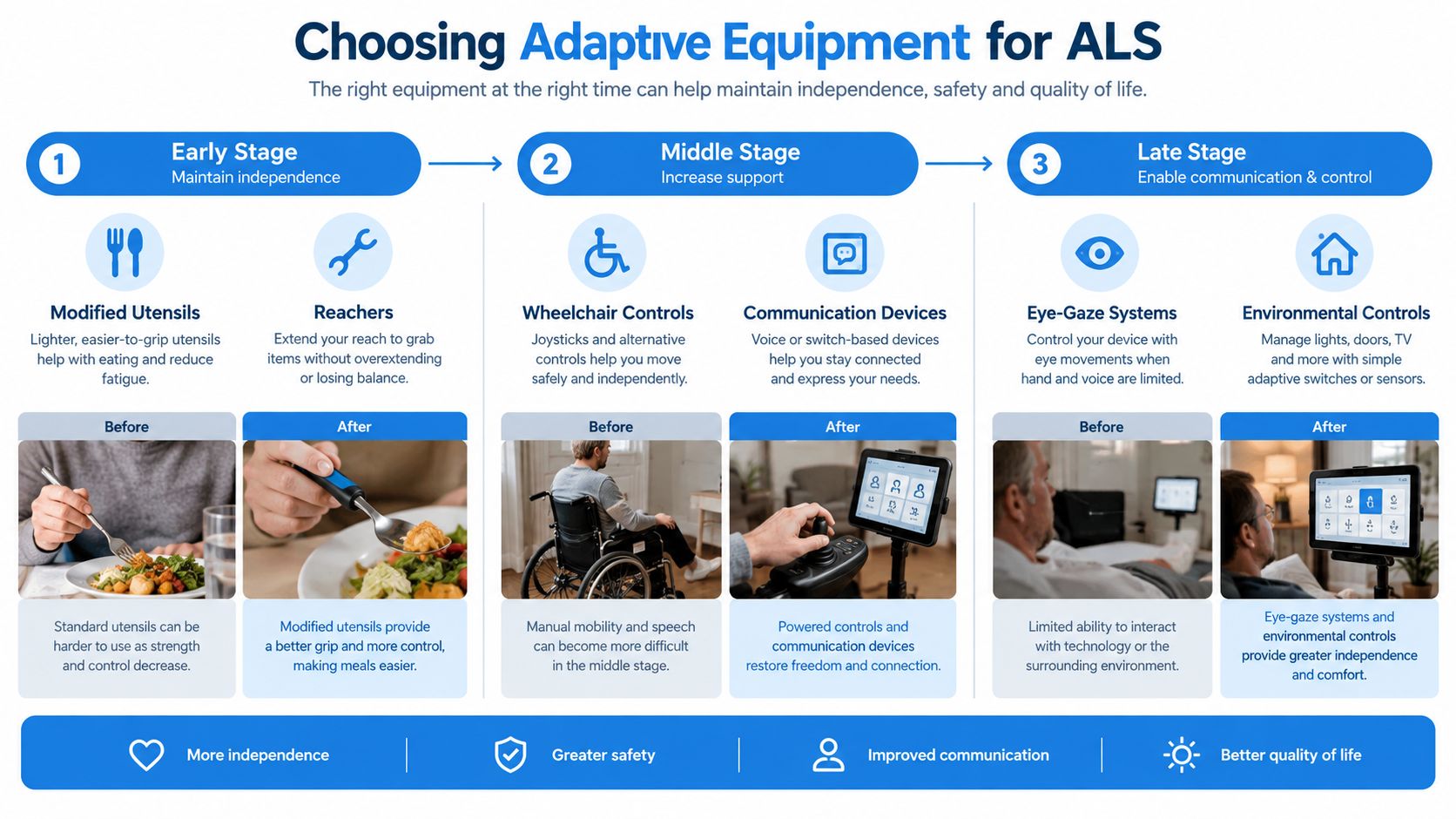
Trial equipment during real activities rather than relying only on a clinic demonstration. Observe task duration, effort, control, setup reliability, and whether the person feels comfortable using the device in front of others. Reconsider the choice as strength, fatigue, cognition, communication, or personal preferences change. A 2025 focus-group study found that device needs change over time and identified dressing and other daily activities as areas requiring assistance (focus-group study).
Home setup also affects whether equipment works in practice. Rx360 connected care insights can help families consider the wider living environment, while back injury prevention guidance can support safer caregiver setup and transfer techniques. Reassessment keeps equipment aligned with changing abilities, so a device remains useful instead of becoming difficult, conspicuous, or burdensome.
Energy Conservation Strategies for Daily Living with ALS
Energy conservation isn't just resting after a person becomes exhausted. In ALS, the timing of rest matters. Scheduled rest before fatigue begins can preserve enough usable energy for eating, communicating, visiting family, or completing another personally meaningful activity.
Start by identifying the day's high-value activities. A person may choose a shower, a work meeting, a meal with family, or a community outing. Less important tasks can be simplified, delegated, postponed, or removed.
Practical changes that protect energy
- Plan demanding tasks early: Use the time of day when energy and attention are usually strongest.
- Rest before depletion: Schedule short pauses before fatigue becomes severe, rather than waiting until recovery takes much longer.
- Sit whenever possible: Seated dressing, grooming, food preparation, and bathing reduce the energy cost of standing.
- Simplify the environment: Keep essential objects nearby, reduce unnecessary steps, and arrange supplies at accessible heights.
- Prioritize essential actions: Choose the part of a task that matters most, then accept help with the rest.
- Stop before exhaustion: Pain, unusual fatigue, cramping, or declining movement quality signals the need to pause and contact the clinical team if the pattern persists.
A therapist might help someone prepare clothing while seated, use a lightweight cup, divide bathing into smaller steps, or arrange a rest period before a family meal. These aren't signs of giving up. They are ways to spend limited energy deliberately.
A useful question: “Which activity do you want to protect today, and what can we change so it costs less?”
Energy conservation also protects dignity. The person remains involved in decisions, chooses priorities, and uses assistance as a tool rather than being pushed through tasks that no longer fit their capacity.
Online Education Options for ALS Caregivers and Clinicians
How can a clinician or caregiver keep learning when ALS care already fills the day? Online education can place training beside clinical shifts, appointments, and home responsibilities. A systematic review of 50 studies found online health-professions education at least equivalent to traditional teaching and potentially stronger for knowledge and skills. Twenty-nine percent of studies reported significantly higher knowledge gains online, 40% reported greater skill acquisition, and 14% found higher learner satisfaction.
The practical choice depends on the learner's situation. A clinician covering a busy clinic may study in shorter sessions, revisit a difficult topic, and complete an assessment when ready. A caregiver may need the same flexibility around transfers, appointments, or changing symptoms. Classroom teaching offers scheduled live interaction, while online learning reduces travel and can make repeated review easier. Neither format is automatically appropriate for every course or learner.
Course quality matters more than the delivery method. Check accreditation, clinical relevance, update dates, assessment methods, and acceptance by the employer or licensing body. Requirements differ among institutions, so confirmation before enrollment prevents an unpleasant surprise later. Accredited online CME programs, including those offering 200+ AMA PRA Category 1 Credits™, allow clinicians to study around patient care schedules while meeting licensure requirements.
For ALS education, the most useful course connects learning to decisions that change over time. A module may help a clinician recognize when a transfer method no longer fits, or help a caregiver prepare questions about communication, seating, or daily routines. Learning should support shared decisions and preserve the person's privacy and control, rather than turning equipment or assistance into a fixed prescription.
Continuing medical education online can help clinicians maintain learning around patient care, provided the course meets the relevant professional requirements. Caregivers should favor clear, clinically grounded teaching that leaves room for questions with the ALS occupational therapy team.
Key Takeaways for ALS Occupational Therapy Success
Successful ALS occupational therapy is continuous, personal, and practical. It doesn't ask a person to perform a failing movement indefinitely. It asks how the person can continue participating in dressing, eating, communication, work, family life, and meaningful routines with less risk and less wasted effort.
Keep these principles in view:
- Request assessment around real problems: Falls, rapidly changing hand function, new transfer difficulty, shoulder fatigue, or declining communication access should prompt contact with the ALS team.
- Choose equipment for the task: A device should address a specific failure, such as grasping a utensil, reaching a keyboard, controlling a wheelchair, or managing toileting.
- Treat equipment as temporary and adjustable: Replacement may be appropriate when a device becomes tiring, uncomfortable, difficult to operate, unsafe, or inconsistent with the person's goals.
- Protect energy proactively: Rest before exhaustion, sit for demanding tasks, simplify the environment, and reserve strength for what matters most.
- Include dignity in every decision: The most advanced technology isn't the right choice if it removes privacy, control, identity, or meaningful involvement.
- Plan for continuity: Care should remain connected across home, outpatient, hospital, and end-of-life settings. A single evaluation can't anticipate every change.
Caregivers shouldn't have to solve every adaptation alone. Ask the therapist to demonstrate the task, explain when to call for reassessment, identify which changes require in-person evaluation, and document the person's preferences. When specialist access is delayed, safe interim changes may include seated task performance, removing trip hazards, moving essential items closer, and stopping activities that cause unusual fatigue. Equipment fitting, transfers, swallowing-related adaptations, respiratory support, and rapidly changing function require the treating team.
Online professional education is also part of this evolving care environment. Peer-reviewed evidence supports online learning as a valid, flexible, and widely accepted alternative to classroom-only training. That shift benefits clinicians who need current knowledge while continuing to care for patients and families.
ProMed Certifications offers online medical certification courses that healthcare professionals can complete through a flexible digital format, including CPR, ACLS, BLS, PALS, and related training options. Visit ProMed Certifications to review available courses and choose education that fits your clinical schedule and professional requirements.
.avif)
Stay compliant with ProMed+
Certifications included: ACLS, BLS, PALS, CPR & Neonatal Resuscitation
Unlimited continuing education: over 200 hours of accredited CME
All-inclusive: One price. No surprises.
Get certified today

The Advanced Cardiac Life Support (ACLS) is an accredited online medical certification course that teaches medical professionals to respond to nearly all cardiopulmonary emergencies.

The Pediatric Advanced Life Support (PALS) Recertification instructs medical professionals on performing pediatric cardiopulmonary resuscitation in emergencies.

The Basic Life Support (BLS) Recertification is intended to teach healthcare professionals the basic steps of CPR and rescue breathing for adults, children, and infants.

Our online medical certification course for CPR, Automated External Defibrillator (AED), and First Aid is designed to teach adult, child, and infant CPR and AED use.

The Neonatal Resuscitation Certification trains medical professionals in performing resuscitation procedures and life-saving techniques for newborns at the time of delivery.

.png)
.png)
.png)