What Is Objective Information in Healthcare Practice
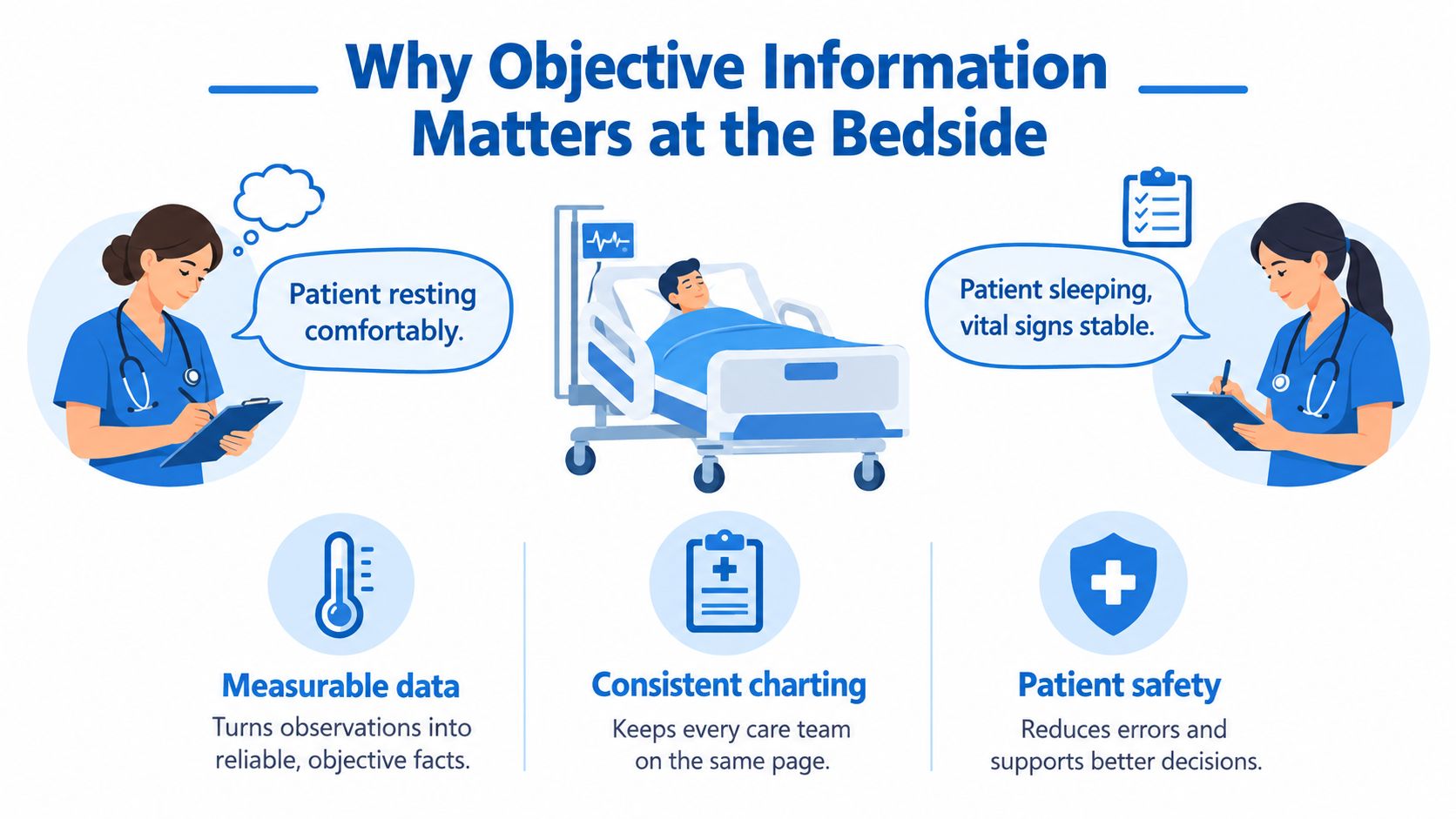
A nurse finishing a busy shift may write, “Patient resting comfortably.” The next nurse still has to ask what that means: Is the patient asleep? Did they deny pain? Are their vital signs within the expected range? A note that records observable details gives the care team a clearer starting point.
So, what is objective information in healthcare practice? It's information that can be checked against observable evidence, not just personal belief or interpretation. Knowing how to distinguish it from subjective information helps you document clearly, give safer handoffs, evaluate clinical evidence, and make informed choices about continuing education and certification.
Why Objective Information Matters at the Bedside
“Patient resting comfortably” may sound reassuring, but it leaves room for different interpretations. One clinician might mean the patient is asleep; another might mean they appear relaxed. A more useful note describes what was observed, such as “patient asleep, respirations even and unlabored,” alongside relevant measurements and the time they were taken.
That distinction matters because chart notes and handoffs help other clinicians understand what happened and decide what to do next. Objective information is grounded in evidence that another person can observe, measure, or verify. It doesn't mean every part of a patient's experience can be reduced to a number. A patient's report of pain, for example, is important information, even though another clinician can't directly measure the sensation.
A clearer record supports safer care
A specific note gives the next clinician details to compare with the patient's current condition. For instance, “denies pain” records what the patient reported, while a documented respiratory rate or oxygen saturation records measured findings. Keeping those kinds of information distinct makes it easier to identify changes and follow up.
Objectivity also matters when you're studying for recertification. The same habits apply: identify the claim, examine the evidence, and separate what was measured from what someone concluded. This guide puts those habits into everyday clinical contexts, from charting and handoffs to evaluating evidence and choosing CE.
At the bedside: Write what the patient reported and what you observed. Don't replace either one with a broad impression.
Defining Objective Information with Real Examples
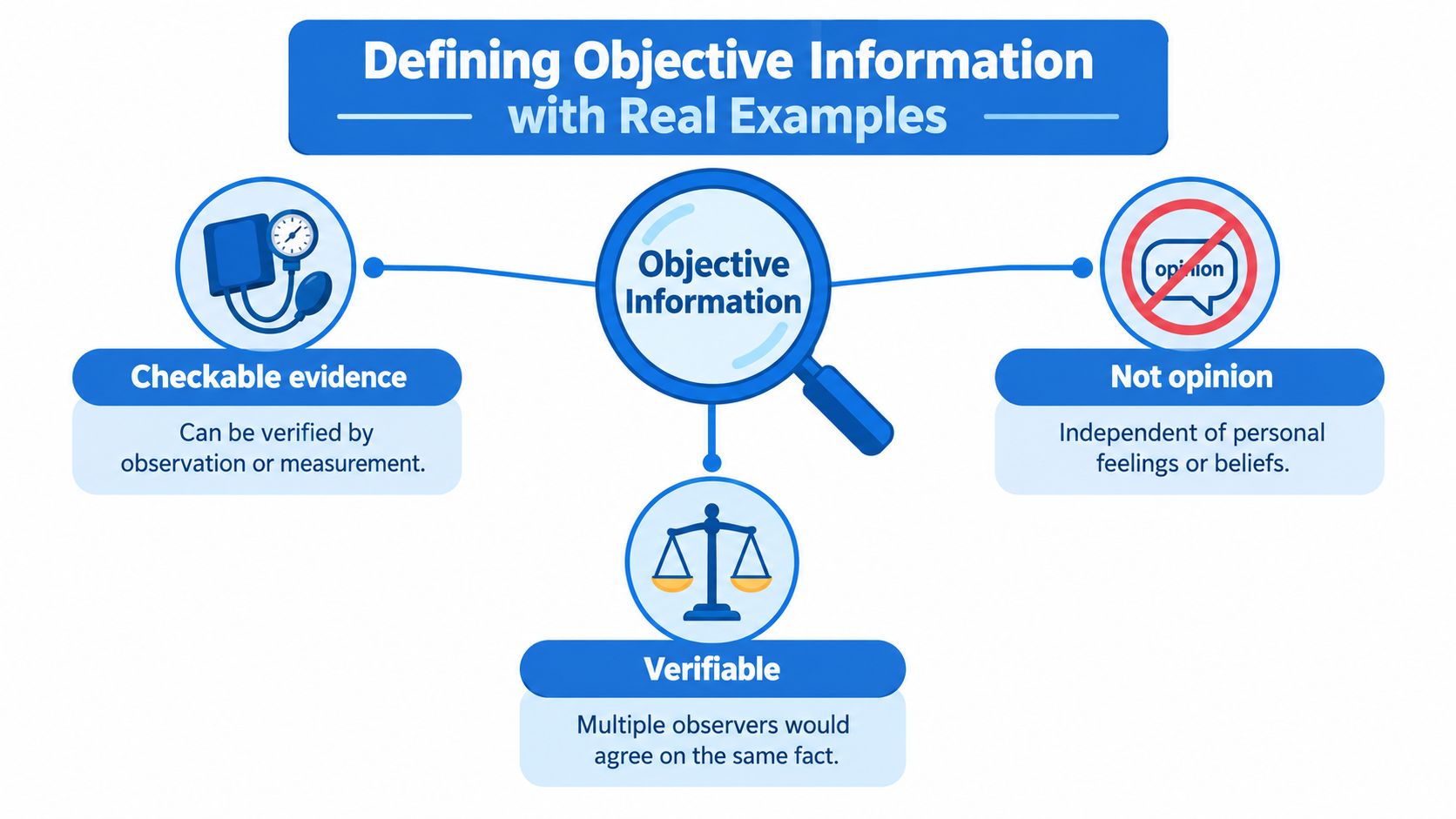
Objective information can be checked against observable evidence rather than depending mainly on someone's preferences, beliefs, or value judgments. Think of a thermometer reading: another clinician can look at the display, check when the measurement was taken, and consider how the device was used. That makes the reading more than a confident-sounding statement.
A scholarly account of journalistic accuracy describes factual reporting as making claims that can be verified against facts in the world. It also traces an early systematic study of reporting accuracy to Mitchell Charnley's 1936 study of three Minnesota newspapers, in which people cited in articles examined those reports for errors. Later researchers used documentary records to compare news reports with underlying evidence. The lesson for clinical practice is clear: objectivity depends on verification and disciplined presentation, not a neutral tone (the history of objective reporting and accuracy).
Measurements need context, too
A number alone doesn't tell the whole story. A blood pressure reading, for example, is easier to interpret when the record includes when it was taken and how it was obtained. If a reading seems unexpected, repeating it with appropriate technique may help clarify whether it reflects the patient's condition or a measurement issue.
The National Institute of Standards and Technology explains that a complete measurement result includes both the measured value and its uncertainty. Uncertainty describes the range or dispersion of possible values supported by the information used. It may be evaluated from repeated measurements or from other evidence, such as calibration information and technical judgment (NIST's guidance on measurement uncertainty).
In practice, this means objectivity includes being honest about limits. A test result isn't automatically exact just because it appears in a chart. Consider the method, the device, the conditions, and any stated uncertainty before treating a difference as meaningful.
If you're reviewing a structured assessment, the same principle applies: describe what you assessed and what you found, rather than relying on a vague label. ProMed's guide to head-to-toe assessments can provide a practical point of reference for organizing those observations.
Objective vs Subjective Information in Practice
A patient reports chest pain. The report is subjective because it describes the patient's experience, but that doesn't make it unimportant or unreliable. You need it to understand what the patient is feeling. Objective information adds findings that can be observed, measured, or checked, giving the care team another part of the clinical picture.
Consider how the same encounter might look in documentation:

The first column of documentation examples captures an impression, while the second gives information a teammate can examine or reassess. In the pain example, the patient's rating remains a subjective report even though it uses a number. The blood pressure, heart rate, skin finding, and ECG description are objective findings when they're obtained and recorded accurately.
Objectivity doesn't mean interpretation disappears
Clinical care requires judgment. A nurse chooses what to assess, what to document, and what information to report urgently. That selection can shape a record, even when every individual detail is accurate. A review of objective information notes that omission and framing can influence apparently factual accounts, especially when evidence is incomplete or credible sources disagree.
A useful approach is to make the underlying evidence visible, use language proportionate to what it supports, and distinguish what you observed from what you infer. “Patient appears anxious” can be replaced or supported with specific observations, such as “patient speaking rapidly, hands trembling, and states, ‘I feel anxious.’” The patient's own words and the observable signs both matter, but they're different kinds of information.
Where Objective Information Shows Up in Documentation and Handoffs
A receiving nurse hears, “The patient is stable.” That handoff might be accurate, but it doesn't say what was assessed, when the assessment happened, or what the next team should monitor. If the receiving clinician can't verify what “stable” means, they may need to repeat assessments or ask follow-up questions before acting.
A more useful handoff names the relevant findings and their timing. For example: “At 19:30, patient denied chest pain, blood pressure was 118/76, and oxygen saturation was 98% on room air. No acute change was observed during the last assessment.” The details give the receiving team something concrete to compare with the patient's condition after transfer.
Make the record useful to the next person
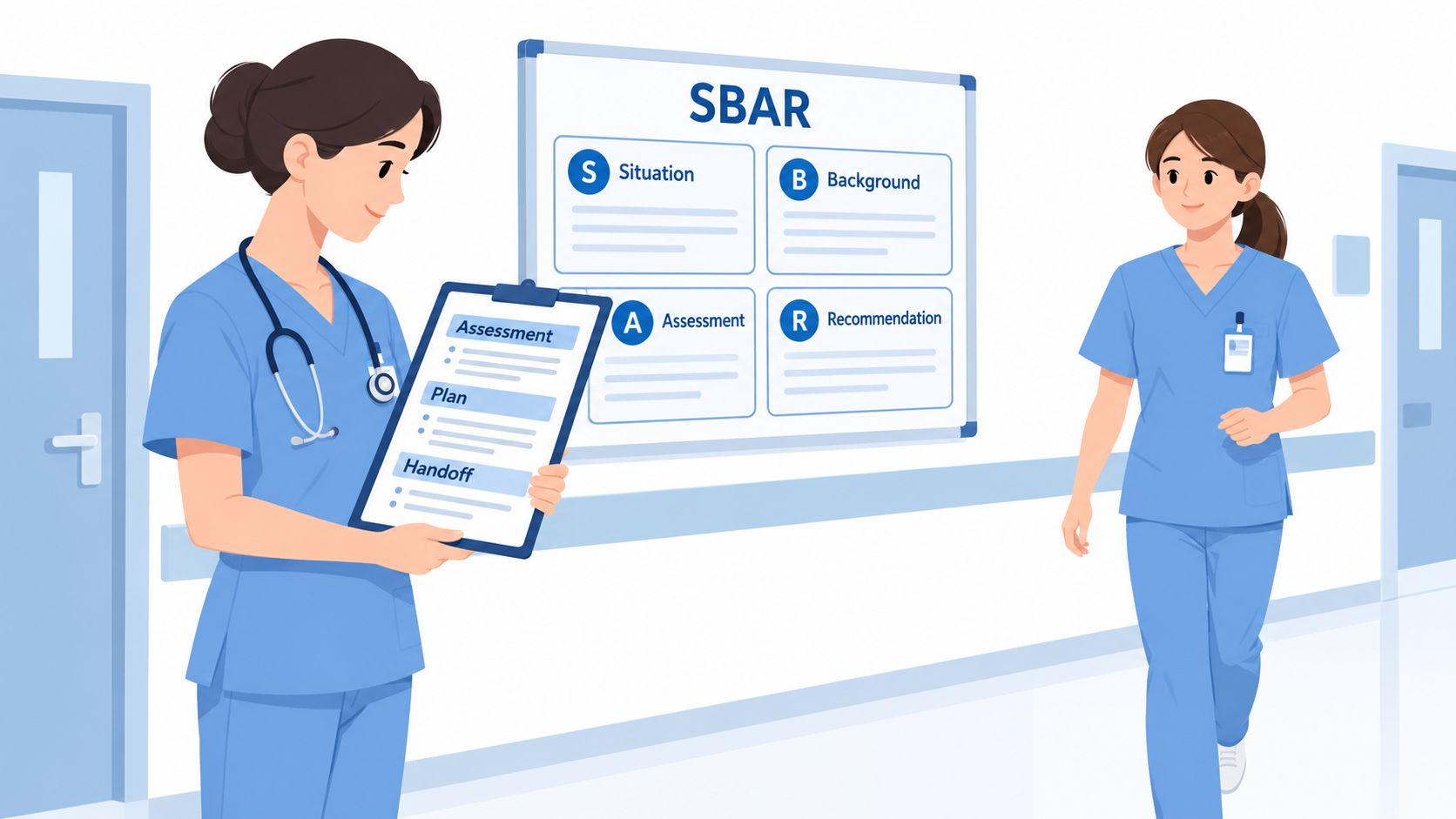
Objective documentation supports more than bedside charting. It also helps clinicians communicate concerns in an SBAR handoff, describe what happened in an incident report, and maintain records related to professional education. In each case, separate observations and measurements from conclusions, and make the source of a statement clear.
For instance, “patient is noncompliant” assigns a judgment. “Patient reports missing prescribed medication” records what the patient said. Likewise, “patient became aggressive” is less specific than describing the person's observable words or actions. Precise language can reduce ambiguity, support review, and help clinicians discuss events without turning an interpretation into a recorded fact.
Practical rule: If another clinician would need to ask, “What did you see or measure?” add the evidence that answers that question.
How Objective Information Connects to Evidence-Based Practice
A clinical note describes one patient; evidence-based practice asks clinicians to use research and other reliable evidence to guide care. The same discipline underpins both: identify the claim, examine the evidence behind it, and make the limits clear. Guidelines and peer-reviewed studies can inform decisions, but readers still need to check what the evidence supports.
For example, when reviewing an ACLS algorithm, don't rely only on polished presentation or a familiar organization's name. Check which patient population the guidance addresses, what evidence it cites, whether the recommendation reflects established practice or a developing area, and whether the version is current. A confident tone isn't proof.
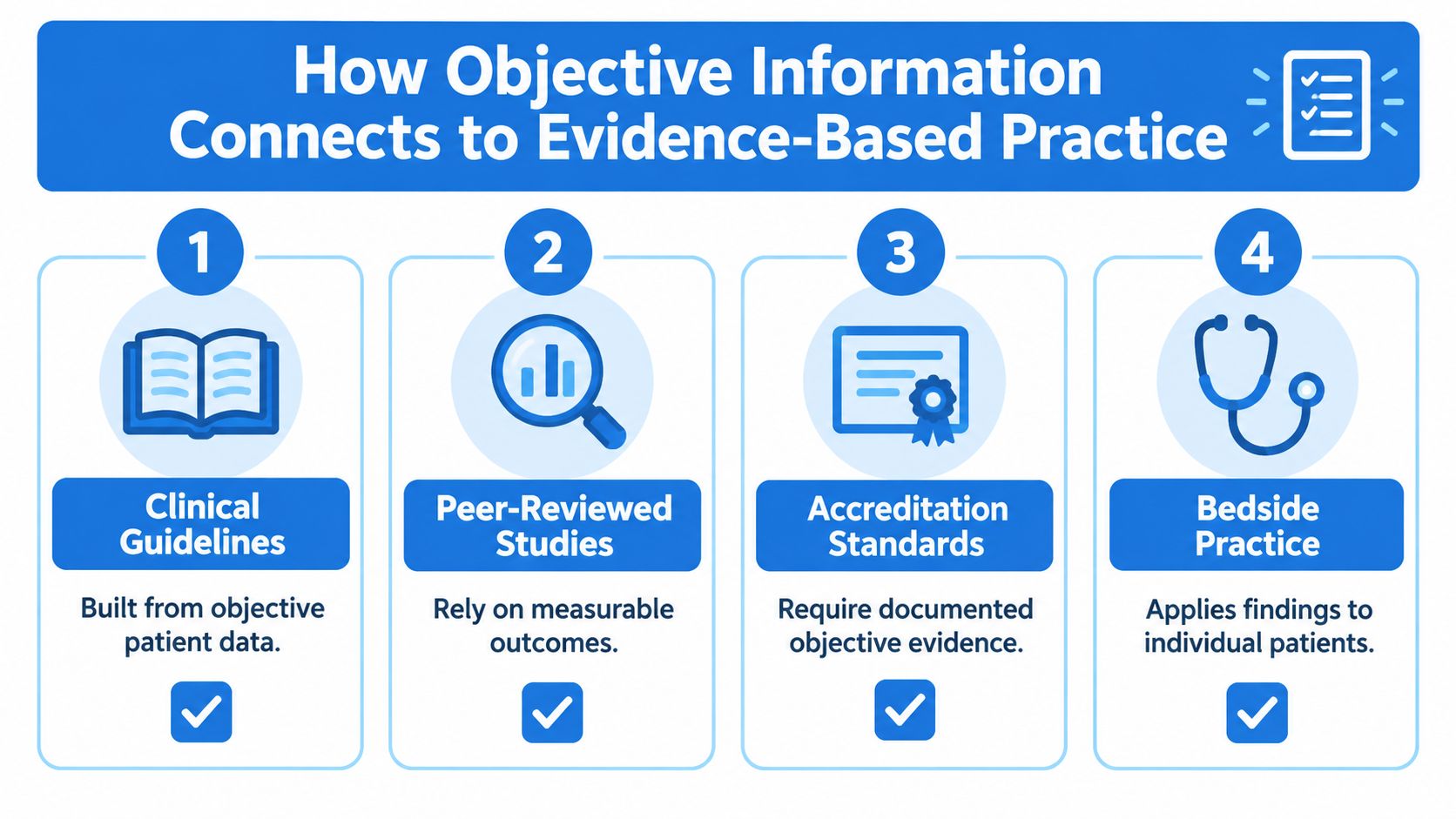
The same checks apply when you evaluate online CE or certification material. Look for clear accreditation information, current guidelines, traceable clinical sources, and assessments that test understanding. Online delivery doesn't, by itself, establish whether content is sound. Nor does classroom delivery guarantee that a course's claims are well supported.
Applying evidence to CE and certification choices
Research on online healthcare education offers a nuanced picture. A systematic review of online communication-skills training for cancer and palliative-care professionals reported that clinicians assigned to online education completed modules at six times the rate of those assigned to face-to-face education in one included study.
A 2024 systematic review and meta-analysis found a small, statistically significant advantage in knowledge retention for spaced online education compared with control approaches, with an SMD of 0.38 and a 95% confidence interval of 0.10 to 0.65. It also found spaced online learning superior to massed online learning for post-intervention knowledge, with an SMD of 0.32 and a 95% confidence interval of 0.13 to 0.51 (spaced digital education). These results point to the value of course design and repeated practice, not the screen or classroom where learning happens.
ProMed offers an online ACLS Certification course that learners can complete on their own schedule; its course information says learners can take the exam and receive a card in as quick as one hour or less. For a wider discussion of how research informs clinical decisions, see this guide to evidence-based practice.
The Outdated Belief That Only In-Person Training Counts
A common assumption holds that only in-person classes from the AHA or American Red Cross count for healthcare CE or certification. That isn't true as a general rule. The right option depends on the specific credential, employer, regulator, and any hands-on skill requirements. A clinician should check those requirements directly instead of treating one delivery format as universally valid.
Research also doesn't support the idea that in-person instruction is automatically more effective. A Cochrane review of 16 randomized studies comparing e-learning with traditional learning included 3,236 participants in knowledge analyses and 2,912 in skills analyses. It concluded that e-learning may make little or no difference in knowledge, patient outcomes, professional behavior, or skills compared with traditional instruction, while noting low or very low certainty for several outcomes (Cochrane review of e-learning for healthcare professionals).
Evaluate the course, not just the classroom
A review of health-sciences education literature summarized an analysis of 176 empirical studies published between 1996 and 2008, in which students in online conditions performed modestly better than students learning the same material face to face. It also summarized a 2018 Cochrane analysis involving 5,679 health professionals, which found little or no difference between e-learning and traditional formats in patient outcomes, professional skills, and professional behavior (review of online learning in health-sciences education).
Those findings don't mean every online course is equivalent, or that every skill can be assessed without hands-on practice. They do show why format alone isn't a reliable measure of quality. Check the course's accreditation, curriculum, assessment, and whether your workplace or credentialing body requires an in-person component.
Online education can make CE and certification more flexible by letting learners study around work and other responsibilities. That convenience is useful only when the course meets the requirements that apply to you. ProMed's BLS Certification is described as a fully online course that learners can take on their own schedule; its course information says learners can pass the exam and receive a card in as quick as one hour or less. Confirm that the option fits your employer's and credential's requirements before enrolling.
Verifying Objective Information and Your Next Step
Use this checklist when you're reading a clinical resource, documenting care, or choosing CE:
- Trace the claim: Identify what the information asserts and what evidence supports it.
- Check its provenance: Confirm who produced it and whether the course or source has the accreditation your requirement calls for.
- Look for limits: Notice whether methods, measurement uncertainty, or gaps in evidence are disclosed.
- Compare sources: Check important claims against independent, authoritative material.
- Check the date: Confirm that the publication or guideline version is current for your purpose.
Apply the same care to your next recertification decision. Check accreditation and course requirements, then choose a format that fits your needs and includes the assessment or hands-on components you're required to complete. Online CE and certifications are valid options when they meet those standards.
ProMed Certifications offers online CE and certification courses for healthcare professionals, including nursing CE and certifications such as ACLS, BLS, PALS, CPR, and Neonatal Resuscitation. Explore ProMed Certifications to compare options for your next requirement and choose a course that fits your learning schedule.

Stay compliant with ProMed+
Certifications included: ACLS, BLS, PALS, CPR & Neonatal Resuscitation
Unlimited continuing education: over 200 hours of accredited CME
All-inclusive: One price. No surprises.
Get certified today

The Advanced Cardiac Life Support (ACLS) is an accredited online medical certification course that teaches medical professionals to respond to nearly all cardiopulmonary emergencies.

The Pediatric Advanced Life Support (PALS) Recertification instructs medical professionals on performing pediatric cardiopulmonary resuscitation in emergencies.

The Basic Life Support (BLS) Recertification is intended to teach healthcare professionals the basic steps of CPR and rescue breathing for adults, children, and infants.

Our online medical certification course for CPR, Automated External Defibrillator (AED), and First Aid is designed to teach adult, child, and infant CPR and AED use.

The Neonatal Resuscitation Certification trains medical professionals in performing resuscitation procedures and life-saving techniques for newborns at the time of delivery.