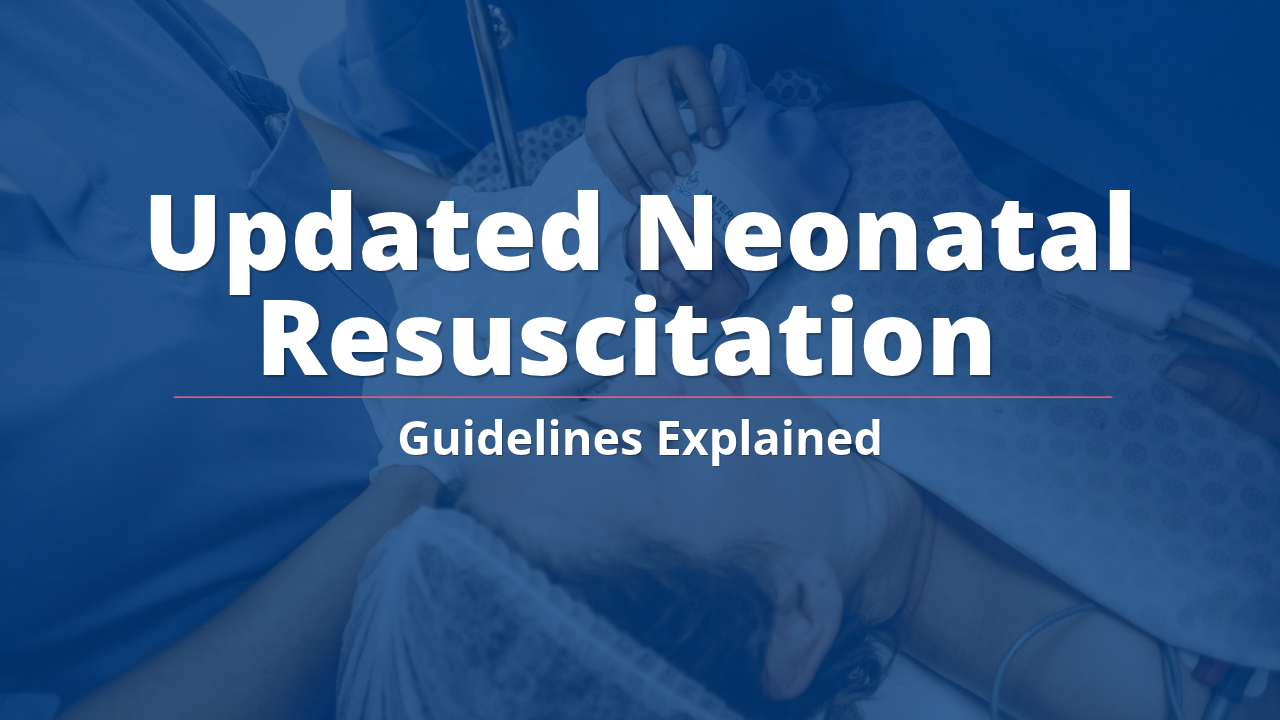
Updated Neonatal Resuscitation Guidelines Explained
More oxygen isn't what saves most struggling newborns. Effective lung inflation is. That's the counterintuitive idea you'll keep returning to as you work through the updated neonatal resuscitation guidelines, and it's a shift in emphasis that changes bedside decisions in the first minute of life.
This guide will help you see why ventilation sits at the center of the algorithm, how oxygen targets and cord decisions now depend on context, and how you can stay current through accredited online learning without losing a full day to a classroom. We'll build step by step, in plain language, so the numbers make physiological sense instead of feeling like trivia to memorize.
Why the New Neonatal Resuscitation Guidelines Matter
The 2025 AHA and AAP update reframes the whole algorithm around ventilation as the central intervention. That sounds subtle. In practice, it tells you where to put your attention, your hands, and your troubleshooting effort when a baby doesn't breathe well.
Most newborns transition without advanced help. A clinically important minority don't. The American Heart Association reports that approximately 5% to 10% of newborns need help beginning to breathe at birth, and about 1% require advanced resuscitative measures, as detailed in the 2020 AHA Guidelines for Neonatal Resuscitation digest.
What the Golden Minute Asks of You
The first minute is not a countdown to do everything. It is a deadline to get air moving if warming, drying, and stimulation have not worked.
- Warm, dry, and stimulate: Provide initial steps while you rapidly assess breathing and heart rate.
- Watch for apnea or gasping: A baby who's not breathing effectively needs positive-pressure ventilation without unnecessary delay.
- Use heart rate as your signal: A heart rate below 100 beats per minute after initial steps points you toward ventilation support.
The international framework calls this the Golden Minute, meaning a nonbreathing newborn should receive effective ventilation within the first 60 seconds after birth when initial steps don't establish respirations, a principle summarized in the ANZCOR introduction to resuscitation of the newborn. That same source notes the scale-up evidence from Nepal covering 68,435 vaginal births and 9,253 cesarean births, where reductions in deaths before 24 hours, intrapartum stillbirths, and transfers of sick newborns each reached p<0.001 after Helping Babies Breathe implementation.
You don't need to memorize every implementation detail. You do need the takeaway. Written recommendations only help when trained people, working equipment, and fast recognition come together at the warmer.
Refinements Within a Proven Framework
Today's changes aren't a rewrite from scratch. Neonatal mortality in the United States and Canada declined from nearly 20 deaths per 1,000 live births in the 1960s to approximately 3.5 per 1,000 in the modern era, a long arc reported by the AHA in the digest linked earlier in this section.
That decline doesn't come from resuscitation alone. Improved obstetric care, neonatal care, and emergency systems all contributed. Standardized resuscitation training sits inside that larger system, which is why guideline literacy matters for anyone attending deliveries.
Practical rule: If you understand why ventilation comes first, the thresholds for escalating care stop feeling arbitrary and start feeling like a logical sequence.
When you can explain that sequence in your own words, you're better equipped to act calmly, communicate clearly with the obstetric team, and recognize when a baby needs more than initial steps. That's the value of staying current. It's not about collecting new numbers. It's about making the first minute count.
The Ventilation-First Algorithm at a Glance
Start simple. A newborn arrives, and your first job isn't advanced airway management. It's assessment paired with basic support.
You warm, dry, and stimulate. You assess tone, breathing, and heart rate. Most babies respond. When a baby remains apneic, gasping, or has a heart rate below 100 beats/min despite initial steps, the 2025 guidance makes effective positive-pressure ventilation the primary intervention at 30 to 60 breaths/min, according to the 2025 AHA neonatal resuscitation guidance in Circulation.
Follow the Cause and Effect Chain
Here's where clinicians sometimes get stuck. The bag is moving, so ventilation must be working, right? Not necessarily.
- Seal, airway, or pressure problem: An inadequate mask seal, airway obstruction, or insufficient pressure prevents lung inflation.
- No effective inflation: Without lung inflation, oxygenation and venous return stay limited.
- Persistent bradycardia: The heart rate doesn't recover because the underlying respiratory problem hasn't been corrected.
That chain explains why you troubleshoot ventilation before you escalate. Confirm visible chest movement. Correct the seal, reposition the airway, and adjust pressure as needed. Use heart rate as your principal indicator of whether ventilation is effective, because a rising heart rate tells you the lungs are inflating and oxygen is reaching the circulation.
It resembles inflating a new balloon. If air leaks around the opening, squeezing harder somewhere else will not fix the problem. You fix the seal first.
When Compressions Enter the Picture
Chest compressions have a clear trigger, and it's later than many adult-trained clinicians expect. Compressions are indicated only when the heart rate remains below 60 beats per minute after at least 30 seconds of effective ventilation, a threshold carried through the guideline framework described earlier. When compressions become necessary, ventilation and compressions are coordinated at a 3:1 ratio with 100% oxygen, as specified in the Circulation guidance linked above.
That order matters because neonatal collapse usually starts with respiratory failure, not primary cardiac failure. Adult algorithms often prioritize circulation early. Neonatal resuscitation asks you to reverse that instinct.

You don't need to force adult thresholds onto a newborn. If you keep asking one question, "Is ventilation effective?", you'll follow the algorithm the way it's designed to work.
Oxygen Targets and Pulse-Oximetry Goals
Let's challenge a common assumption. Starting with 100% oxygen feels safer, so it must be safer. The new neonatal resuscitation guidelines say otherwise for the initial moments of support.
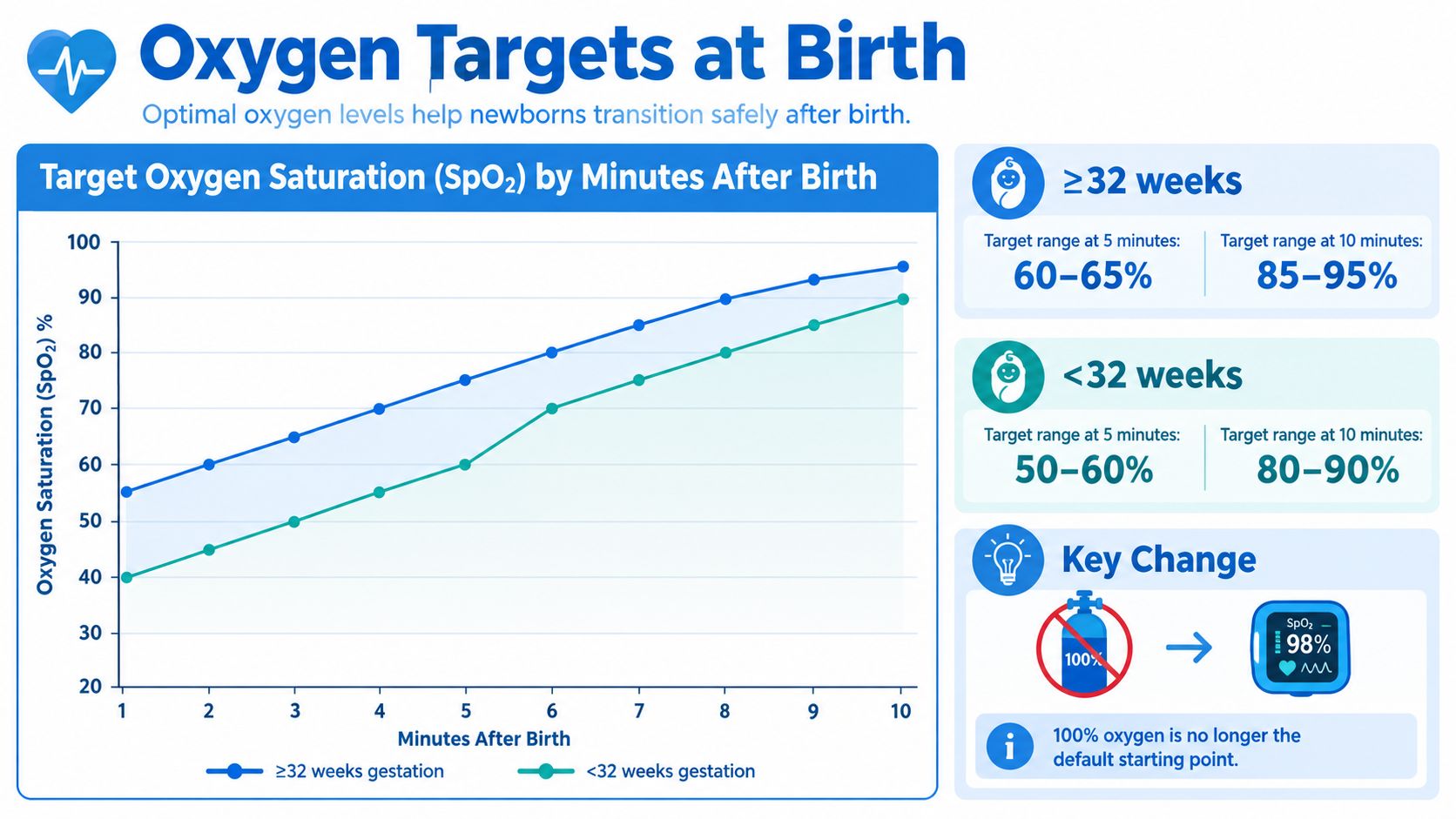
The chart below visualizes how saturation targets rise gradually after birth rather than jumping immediately to adult-like values.
Start by Gestational Age, Then Titrate
Initial oxygen concentration is stratified rather than defaulting to the highest setting. Infants at 32 weeks or above generally begin with 21% oxygen, while infants below 32 weeks begin with at least 30%, followed by titration using preductal pulse oximetry.
That distinction protects vulnerable preterm infants from hyperoxia while still giving you room to increase oxygen based on response. More oxygen isn't a substitute for effective lung inflation. If the chest isn't moving, turning up the oxygen can expose a baby to excess oxygen without correcting bradycardia.
Expect a Ramp, Not a Switch
Think of saturation after birth like a slow ramp, not a light switch. Target saturation is approximately 65 to 70% at 2 minutes, 70 to 75% at 3 minutes, 75 to 80% at 4 minutes, 80 to 85% at 5 minutes, and 85 to 95% at 10 minutes, per the target ranges described in the 2025 guidance cited earlier.
- At 2 minutes: A reading in the high 60s can be physiologically appropriate.
- At 5 minutes: You should see steady upward movement, not instant normalization.
- At 10 minutes: The range approaches what you'd expect later in transition.
Immediate normalization to adult-like saturation isn't expected, and it isn't desirable. Chasing it can push you toward excess oxygen in a preterm brain and lungs that are especially sensitive to injury.
A low early number doesn't automatically mean failure. The trend, the heart rate, and visible chest movement tell the fuller story.
During chest compressions, the risk profile changes and 100% oxygen becomes appropriate. Outside that moment, your job is measured titration. Confirm ventilation first, watch preductal saturation, and adjust deliberately. That's how you individualize care instead of memorizing isolated numbers.
Cord Management and Delayed Clamping Decisions
Here's a question summaries often skip. What do you do when delayed cord clamping conflicts with immediate resuscitation?
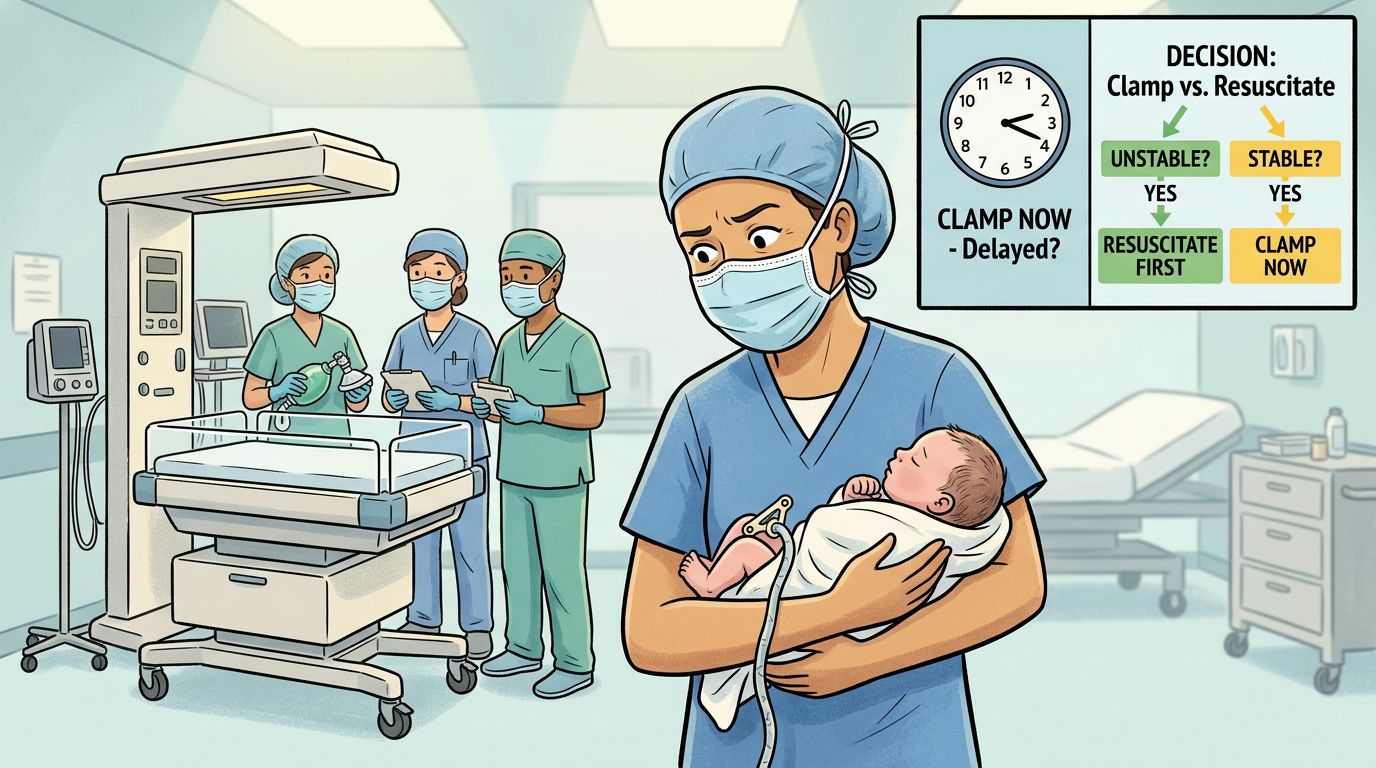
The visual below introduces the delivery-room context where that decision has to happen in seconds, with obstetric and neonatal teams working side by side.
Use a Pathway, Not a Slogan
The 2025 guidance treats cord management as a context-specific decision, not a universal rule. For stable infants who don't need respiratory support, at least 60 seconds of delayed clamping is encouraged, while infants needing life-saving interventions may have the cord clamped within 30 seconds so care isn't delayed, as explained in the 2025 update review on neonatal resuscitation guidance.
Walk through it in order:
- Assess breathing and tone: Is the baby vigorous, or apneic and floppy?
- Decide if ventilation can wait: If effective ventilation is needed now, resuscitation takes priority.
- Coordinate placement: Can your team provide intact-cord stabilization at the bedside, or does the baby need to move to the warmer?
- Name the exception: Apnea, severe bradycardia, a placental complication, or inability to ventilate at the bedside can justify earlier clamping.
That shared language helps you and the obstetric team act as one unit. Nobody has to guess whether you're waiting out of habit or moving because the baby's condition demands it.
Why Saturation Targets Now Start Later
Delayed clamping also changes your monitoring timeline. The algorithm shifts oxygen-saturation targets to begin at 2 minutes because a 60-second delay means a 1-minute saturation won't routinely be obtained, a timing adjustment noted in the review linked above.
For very preterm infants, the picture has extra nuance. European guidance favors longer intact-cord stabilization when safe, particularly below 34 weeks, while implementation still depends on equipment, staffing, and coordination, according to that same review.
The short video below reinforces how teams coordinate those first assessments and interventions in real time.
Don't teach yourself to delay clamping. Teach yourself to decide, communicate, and document why you chose that path for that baby. That's the skill the guidelines are asking you to build.
How Online CE Stacks Up Against In-Person Training
You need to learn these updates, but you don't automatically need a classroom seat to learn them well. Accredited online CE is a valid, evidence-backed way to build guideline knowledge around a shift schedule.
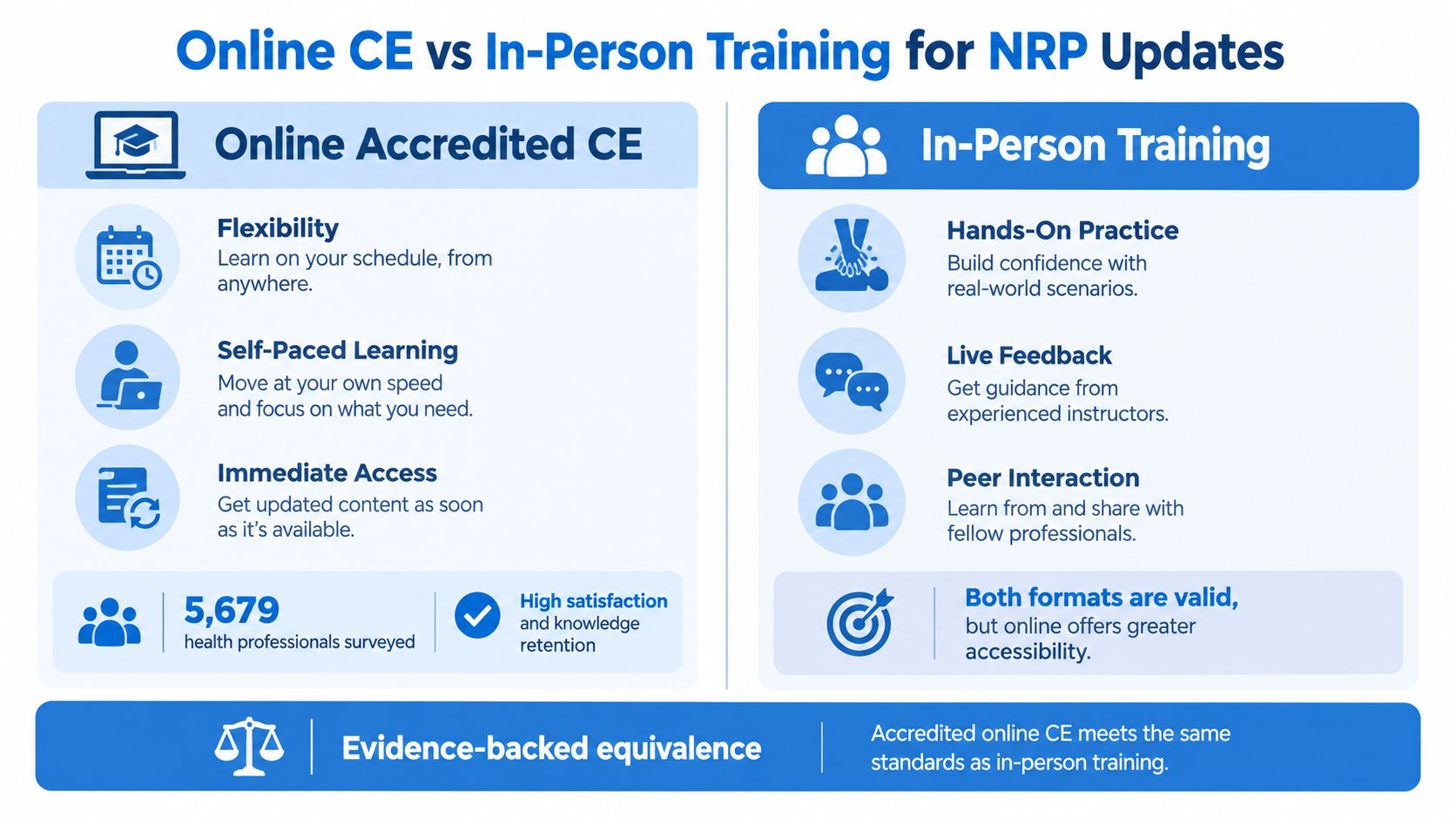
The comparison below summarizes how online and in-person formats serve different parts of the learning process while meeting the same educational goal.
What the Evidence Actually Shows
A systematic review of evidence-based healthcare education found that pure e-learning improved knowledge and skills compared with no training and produced outcomes no better or worse than face-to-face instruction across the primary outcomes examined, as reported in the Campbell systematic review of e-learning for healthcare professionals. That review also found blended learning outperformed face-to-face education for attitudes and professional behavior.
A Cochrane review involving 5,679 health professionals found little or no difference between e-learning and traditional learning in patient outcomes, professional skills, or behaviors, a finding summarized in the health sciences education review on online learning outcomes. The same review describes a synthesis of 176 empirical studies where online learners performed modestly better than peers who received the same material face to face.
Retention improves further when learning is spaced. A 2024 meta-analysis found spaced digital education beat massed online learning for post-intervention knowledge with a standardized mean difference of 0.32, 95% confidence interval 0.13 to 0.51 across nine studies, as published in the JMIR systematic review of spaced digital education. Knowledge retention also favored spaced learning with a standardized mean difference of 0.38, 95% confidence interval 0.10 to 0.65, in that same analysis.
Addressing the Classroom-Only Belief
The belief that only AHA or American Red Cross in-person classes are valid isn't true. Hospitals, clinics, and organizations increasingly recognize accredited online CE and certification preparation for knowledge components. Where a credential requires hands-on skills validation, employers and regulators can handle that verification separately. Format alone doesn't determine quality.
If you're weighing schedules, travel, and repeat access to updated content, our comparison of in-person versus online medical certification formats lays out practical differences in flexibility, time efficiency, and cost.
For nurses who need ongoing credits alongside guideline review, ProMed+ Nursing CE is described as a one-stop shop for continuing education needs, with a streaming platform designed to fulfill CE requirements. That's one example of how future-focused online platforms align with the broader shift toward broader acceptance.
What to look for: Current guideline alignment, real assessment, and the ability to revisit material in spaced sessions matter more than whether you sat in a particular room.
Online learning gives you that repeat access between shifts. You can review ventilation troubleshooting tonight, oxygen titration tomorrow, and cord decisions before your next delivery rotation. That's not a shortcut. Used well, it's a retention advantage.
Matching NRP Courses and Certification to the Updates
An NRP-aligned curriculum that reflects the new neonatal resuscitation guidelines should feel different from an older course built around memorized numbers. You should see ventilation, oxygen, and cord decisions taught as connected clinical reasoning.
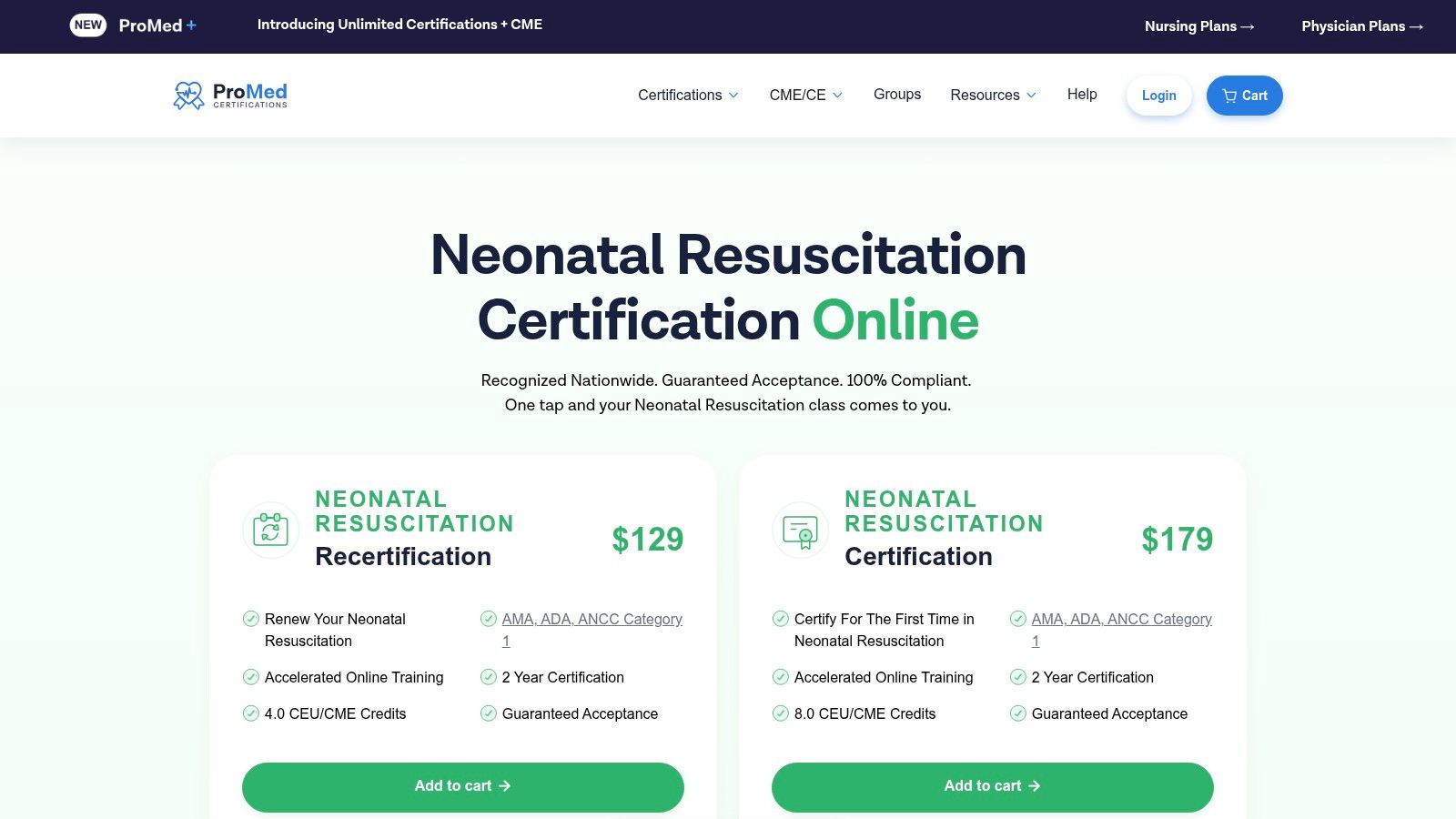
The screenshot below shows the online neonatal certification course page, where the format is built around self-paced review rather than a fixed classroom schedule.
What Updated Course Content Should Cover
Look for explicit teaching in these areas:
- Ventilation corrective steps: Seal, airway position, pressure, chest movement, and when to move to an alternative airway.
- Oxygen titration by gestational age: Starting concentration, preductal monitoring, and the gradual saturation ramp.
- Cord management pathways: Stable versus unstable scenarios, intact-cord stabilization logistics, and documented exceptions.
- Escalation logic: Why compressions follow effective ventilation rather than replacing it.
If a course only lists rates and ratios, it hasn't gone far enough. You want the physiological why behind each step, plus scenarios where pulse oximetry is delayed, heart rate stays low despite apparent ventilation, or the cord plan changes mid-delivery.
An Honest Note on Skills and Reinforcement
Evidence specific to neonatal resuscitation adds useful nuance. A 2022 scoping review identified five studies of e-learning for physicians in neonatal resuscitation, and four assessed effectiveness immediately or months later without consistently showing improved NRP knowledge or performance in already-certified providers.
That doesn't invalidate online learning. It tells you passive, one-time exposure isn't enough for any format. Spaced reinforcement, booster review, and clearly defined competency checks matter, whether you learned online or in person. Online coursework handles guideline updates and knowledge review efficiently. Your organization can pair it with simulation or hands-on assessment where required.
If your renewal window is approaching, our guide to the Neonatal Resuscitation Program renewal process helps you map timing and requirements before a deadline forces a rushed choice.
For a fully online knowledge pathway, Neonatal Resuscitation Certification is presented as a 100% Online Neonatal Resuscitation Certification that brings the class directly to you through a convenient, easy-to-use platform where you can finish review material, complete the exam, and receive your card. ProMed Certifications offers that course with self-paced study and unlimited retakes, built around the realities of rotating schedules.
Don't wait for a renewal deadline to refresh your understanding. The guidelines have refined how you ventilate, titrate oxygen, and decide about the cord. Reviewing those changes now means you'll walk into your next delivery already thinking in the new sequence, not translating from an old one under pressure.
If you're ready to turn these guideline updates into confident bedside practice, ProMed Certifications offers self-paced online neonatal resuscitation certification and continuing education aligned with current AHA guidance. Visit today to review the material on your schedule, complete your exam with unlimited retakes, and keep your credentials current without rearranging your shifts.

Stay compliant with ProMed+
Certifications included: ACLS, BLS, PALS, CPR & Neonatal Resuscitation
Unlimited continuing education: over 200 hours of accredited CME
All-inclusive: One price. No surprises.
Get certified today

The Advanced Cardiac Life Support (ACLS) is an accredited online medical certification course that teaches medical professionals to respond to nearly all cardiopulmonary emergencies.

The Pediatric Advanced Life Support (PALS) Recertification instructs medical professionals on performing pediatric cardiopulmonary resuscitation in emergencies.

The Basic Life Support (BLS) Recertification is intended to teach healthcare professionals the basic steps of CPR and rescue breathing for adults, children, and infants.

Our online medical certification course for CPR, Automated External Defibrillator (AED), and First Aid is designed to teach adult, child, and infant CPR and AED use.

The Neonatal Resuscitation Certification trains medical professionals in performing resuscitation procedures and life-saving techniques for newborns at the time of delivery.