RN Continuing Education Requirements by State for 2026
By 2025, the American Nurses Credentialing Center's nursing professional development accreditation program covered more than 600 organizations across 16 countries, according to a history published in The Journal of Continuing Education in Nursing. That reach reflects how far nursing education has moved beyond local classroom training. Yet a broad choice of accredited education doesn't mean every course counts toward every license.
RN continuing education requirements are a matching exercise, not just an hour total. You need the right education, accepted by your board, completed within the correct renewal period. This guide helps you identify those requirements, evaluate online and in-person options, and keep evidence that supports your renewal.
RN Continuing Education Requirements by State at a Glance
A total hour count tells only part of the story. State boards may also set rules for providers, renewal periods, practice, exemptions, and required subjects. California, for example, requires 30 contact hours every two years through a Board-recognized provider, according to the California Board of Registered Nursing's CE renewal guidance.
RN Continuing Education Requirements for Selected States

Use this selected-state comparison to identify what to check in your own board's renewal rules. Each row raises a different question: whether a provider must be recognized, whether practice is also required, or whether an exemption or topic mandate applies.
Washington illustrates why hours alone can be misleading: its listed CE requirement sits alongside practice hours and health-equity education. Oregon's listed competency mechanism also shows why checking current rules matters when renewal options change.
Read the Conditions Before Choosing Courses
Start with the provider rule. Accreditation and state recognition are related, but they are not interchangeable. Then check which dates fall within your accepted renewal period. A course completed outside that window may not count toward the renewal you are preparing.
Finally, look for exemptions and mandatory subjects. A first-renewal exemption may affect the general CE requirement while leaving a separate training requirement in place.
Practical rule: Build your course list from your board's requirements, not your requirements from a course bundle.
If your state is not listed, use the same fields to review its current renewal guidance: hours or activities, renewal period, mandatory topics, and exemptions. The board's current rules determine what counts.
Requirement Types Beyond Contact Hours
Boards may evaluate continuing competence through education, clinical practice, certification, or assessment. These mechanisms answer different questions: what you learned, whether you've practiced, and whether you can demonstrate the required competence.
The National Council of State Boards of Nursing's 2024 licensure survey, discussed in the National Conference of State Legislatures' continuing-education summary, illustrates that diversity.
Renewal Options Used by State Boards

These percentages describe the jurisdictions represented in that survey category. They aren't the percentage of nurses who must complete each activity, and the options shouldn't be treated as mutually exclusive.
A refresher course is a structured review of nursing knowledge and skills. It may be particularly relevant when you're returning to practice, but its acceptance and required components come from the board.
Practice hours document work in your licensed role. Paid employment and unpaid service may receive different treatment, so volunteering shouldn't automatically be counted as equivalent to paid clinical work.
A continued-competency assessment formally evaluates knowledge or performance. It is not just a course evaluation asking whether you liked the instructor.
Decide Whether Requirements Combine or Substitute
The key distinction is “and” versus “or.” A board may require CE and practice hours, or it may allow an accepted certification instead of a course-hour pathway.
Say you maintain a specialty certification. Before relying on it for renewal, confirm that your board recognizes that credential and that it remains current for the relevant period.
Put practice documentation, assessments, and certification deadlines on the same calendar as your courses. CE can be only one part of compliance, even when the course-hour total receives the most attention.
How to Confirm Your State's Rules Before You Enroll
Start with the authority that regulates your license. The National Council of State Boards of Nursing's licensure guidance directs nurses to the applicable jurisdiction because accepted activities, exemptions, and renewal procedures differ.
Use this workflow before purchasing education.
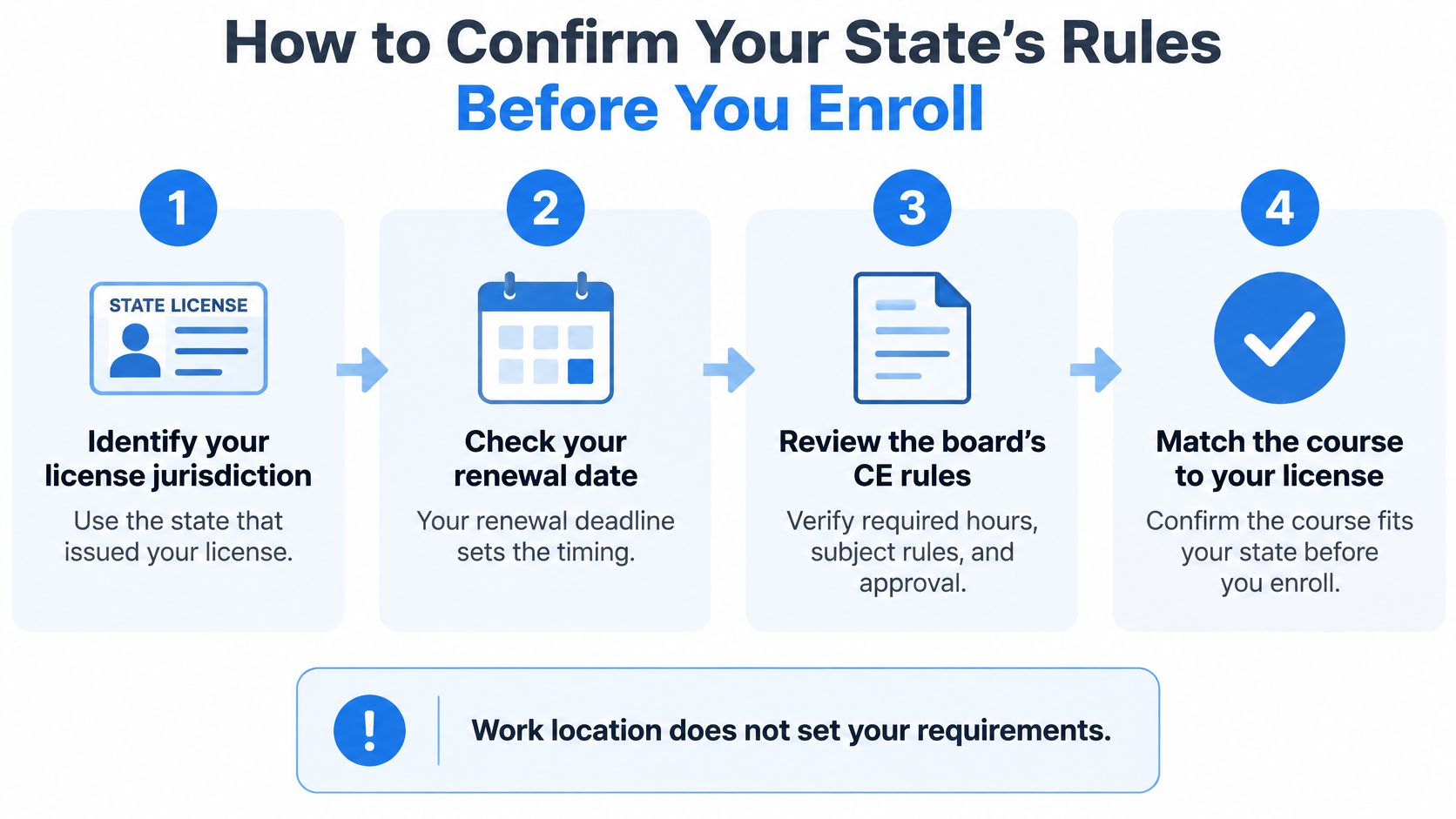
- Identify your license jurisdiction. Start with the state that issued the license you're renewing. Don't substitute your work location for the licensing authority. For compact practice, confirm renewal obligations with your home-state board and check any separate practice-related obligations.
- Check your renewal date and eligible learning period. Record the deadline and the dates within which education must be completed. Don't assume a calendar-year course belongs to your current licensing cycle.
- Read the current board rules. List required hours, accepted alternatives, mandatory subjects, exemptions, and documentation instructions. A search-result excerpt or an old employer handout may omit a recent change.
- Match each course to your license. Confirm the approving organization, subject coverage, completion requirements, and applicable license type. Approval by another state board isn't automatic portability.
Watch for License-Specific Requirements
Hawaii illustrates why the final check matters. Its rules distinguish general RN continuing competence from additional obligations for APRNs with prescriptive authority, and other boards' CE requires comparable standards before acceptance.
Ask a focused question when something is unclear: “Does this activity meet this requirement for my license type and renewal period?” Save the written response with your renewal records.
Before enrolling: A provider's approval statement should identify what is approved, by whom, and for which purpose.
At ProMed, we don't guarantee that our courses will meet your individual needs. You're responsible for verifying that a course meets applicable licensing or regulatory requirements. That distinction protects you from confusing a convenient enrollment option with a confirmed renewal solution.
What Makes an RN CE Hour Count
A nursing contact hour represents 60 minutes of eligible organized learning, excluding breaks and similar downtime, under the ANCC-based accreditation guidance published by the National Association of School Nurses.
Eligibility depends on how the activity is planned, what it teaches, and how completion is assessed. The course should address a learning need, set clear objectives, and explain how participants earn credit.
Evaluate the Education Behind the Credit
A strong activity begins with an identified practice gap: something nurses need to know, do, or apply more effectively. Its objectives should describe what you'll be able to do after learning.
For example, “understand medication safety” is broad. “Identify medication-reconciliation discrepancies during admission” gives you a clearer basis for judging the lesson and its assessment.
Apply this checklist to the course page:
- Measurable objectives: Look for specific learning outcomes that fit your clinical role or required subject.
- Evidence-based content: Check references and whether the material reflects the best available evidence.
- Independent planning: Check that educational decisions are protected from ineligible commercial influence.
- Completion criteria: Find out whether credit requires attendance, a post-test, an evaluation, a return demonstration, or a combination.
- Assessment rules: Where testing applies, review the passing standard and retake policy before starting.
- Credit documentation: Confirm that the certificate identifies the accreditor or approving authority and includes the relevant approval statement.
Eligible delivery methods include classroom sessions, live webinars, self-paced online courses, hybrid programs, and conference activities. The learning objectives, content, and completion process determine the educational value of any format.
Understand How Self-Paced Hours Are Calculated
For self-paced education, providers need a logical, documented method of estimating learning time. Pilot testing and the Mergener formula are examples of methods used to support those calculations.
A browser tab left open does not establish that you completed the learning. Finishing quickly, by itself, also doesn't show whether the advertised credit was calculated appropriately.
Watching a video alone may not meet the activity's completion requirements. You may also need to complete an assessment, participate in an activity, or submit an evaluation.
Your certificate should identify the completed activity and the credit awarded. Check that it includes the details you need for your records.
Separate Accreditation From Individual Acceptance
Accreditation signals that an activity meets educational standards. Your board determines whether the course satisfies its rules, including any requirements for the subject, renewal pathway, or credit type.
ProMed's continuing education is AMA and ANCC accredited. In partnership with the Postgraduate Institute for Medicine, ProMed is authorized to issue continuing education credits for license maintenance.
For each course, match the profession-specific credit and approval statement to your licensing requirements. Accreditation supports your assessment of the education, while the board's rules determine whether it counts toward your renewal.
Mandatory Topics Including the DEA MATE Act
A course can add hours to your total without satisfying a required subject. State rules may specify both the topic and who must complete the education, so match each requirement to your license and prescribing authority.
- DEA MATE Act: The one-time 8-hour training requirement applies to covered DEA-registered practitioners. Check whether your DEA registration and prescribing authority place you in this group, and confirm that your education qualifies. The addiction medicine training guide provides an orientation to the topic.
- Pain management and opioid prescribing: Identify whether your board requires education in pain management, prescribing, or both. A course covering one subject may not satisfy a requirement for the other.
- Cultural competency: Check whether the rule calls for education on cultural differences in care, communication, or bias, and whether it applies at each renewal.
- Suicide prevention: Confirm that the course covers the populations, assessment, or intervention specified by your board. A general mental-health course may not address those requirements.
- Health equity: Match the course content and any approval conditions to your state's rule.
- Infection control and professional conduct: Check for separate requirements on infection prevention, ethics, nursing law, or professional responsibilities.
Check Overlap Rather Than Assuming It
One course may address multiple required topics. Compare its learning objectives and certificate with each board requirement. Similar wording in a course title is not enough to show that the content qualifies.
Topic overlap also does not necessarily mean you can count the same hours twice. Your board's rules determine how credits may be applied.
Before enrolling, check for first-renewal exemptions, requirements for reinstating a lapsed license, and limits on carrying hours forward. List each required topic beside the course that will cover it. Any blank entry shows what you still need to address.
Online and In-Person CE Compared on Quality and Flexibility
The format of a continuing education course affects scheduling, travel, and how you engage with the material. Research offers some evidence that online learning can support outcomes comparable to in-person education, but evidence about long-term practice change and patient outcomes remains limited.
A peer-reviewed study of 100 nurses examining venous-thromboembolism education reported average behavior-score improvements of 3.16 (SD 1.49) for e-learning and 2.77 (SD 1.26) for conventional education. The study found no significant knowledge advantage for either format. A 2019 systematic review of 22 reviews found generally positive results for nurses' knowledge, attitudes, self-efficacy, skills, and satisfaction after e-learning, while noting limited evidence on longer-term outcomes.
A scoping review of distance and hybrid healthcare education reported broadly positive online-learning outcomes, though one comparison favored classroom performance. Taken together, the studies reviewed suggest that well-designed online CE can produce outcomes comparable to in-person education, while leaving questions about lasting effects.
Online and In-Person CE Compared

Online study can reduce travel, but it does not automatically mean lower tuition or paid study time. This guide to online continuing medical education explains factors to consider when comparing delivery formats.
A course's format alone does not determine whether it meets your needs. The belief that only AHA or American Red Cross in-person classes are valid is too broad: programs have different approval and credentialing arrangements, and an employer may require a particular credential or hands-on assessment. Consider educational quality, board acceptance, and employer acceptance separately.
Keeping Audit-Ready CE Records
An audit-ready record connects you, the activity, the credit, and the eligible period. Save the certificate when you finish, rather than relying on continued access to a provider account.
Use these fields to prevent common documentation problems.
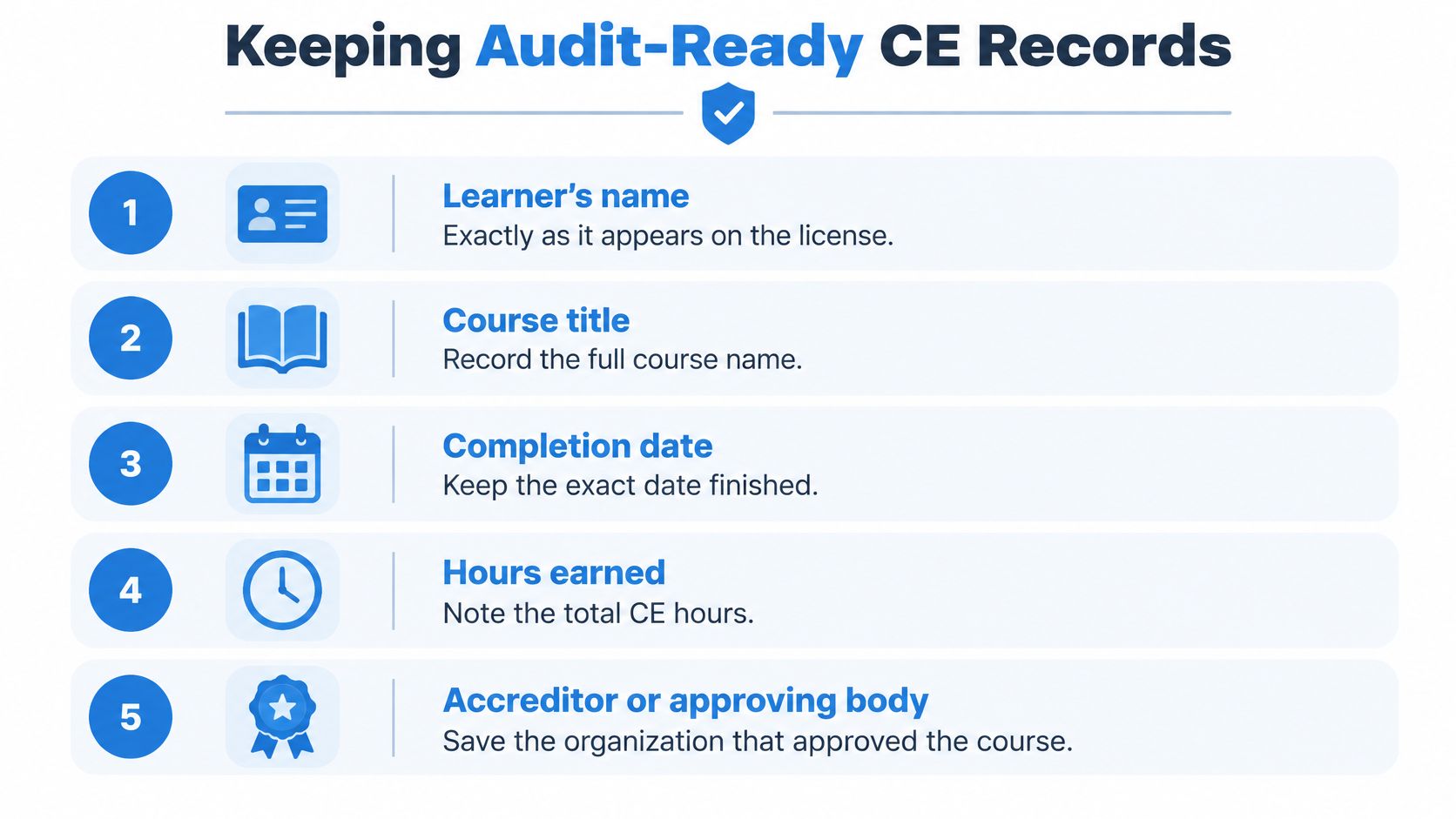
- Licensed name: Match the name on your license so the certificate can be attributed correctly.
- Full course title: Preserve the exact title to support subject-matter review.
- Completion date: Verify that the activity falls within the accepted renewal window.
- Hours earned: Keep the awarded credit total, not just proof of attendance.
- Accreditor or approving authority: Retain the approval statement to establish the credit's basis.
- Subject and provider identifiers: Record mandatory-topic coverage, provider details, and any course identifier to support verification.
Reconcile Records Before Renewal
Keep a spreadsheet and a folder organized by license and renewal cycle. Compare completed activities against both your total requirement and your mandatory-topic checklist before submitting renewal.
If your board uses a reporting service, confirm that completions appear. The CE Broker account guide can help you understand that part of the process.
Automated reporting is useful, but your own saved certificate remains important evidence.
Some boards recognize practice-based learning, such as precepting. Confirm eligibility and documentation requirements before relying on that activity.
Retain records for the period your board specifies. Avoid applying an activity to the wrong cycle, even if its certificate remains available in your account.
How Subscription CE Platforms Track Compliance
Does your learning dashboard show which activities meet your state's rules, or only how many hours you have completed? A subscription may provide access to a course library for a set period. Tracking, certificates, and reporting can vary, so check which features are included.
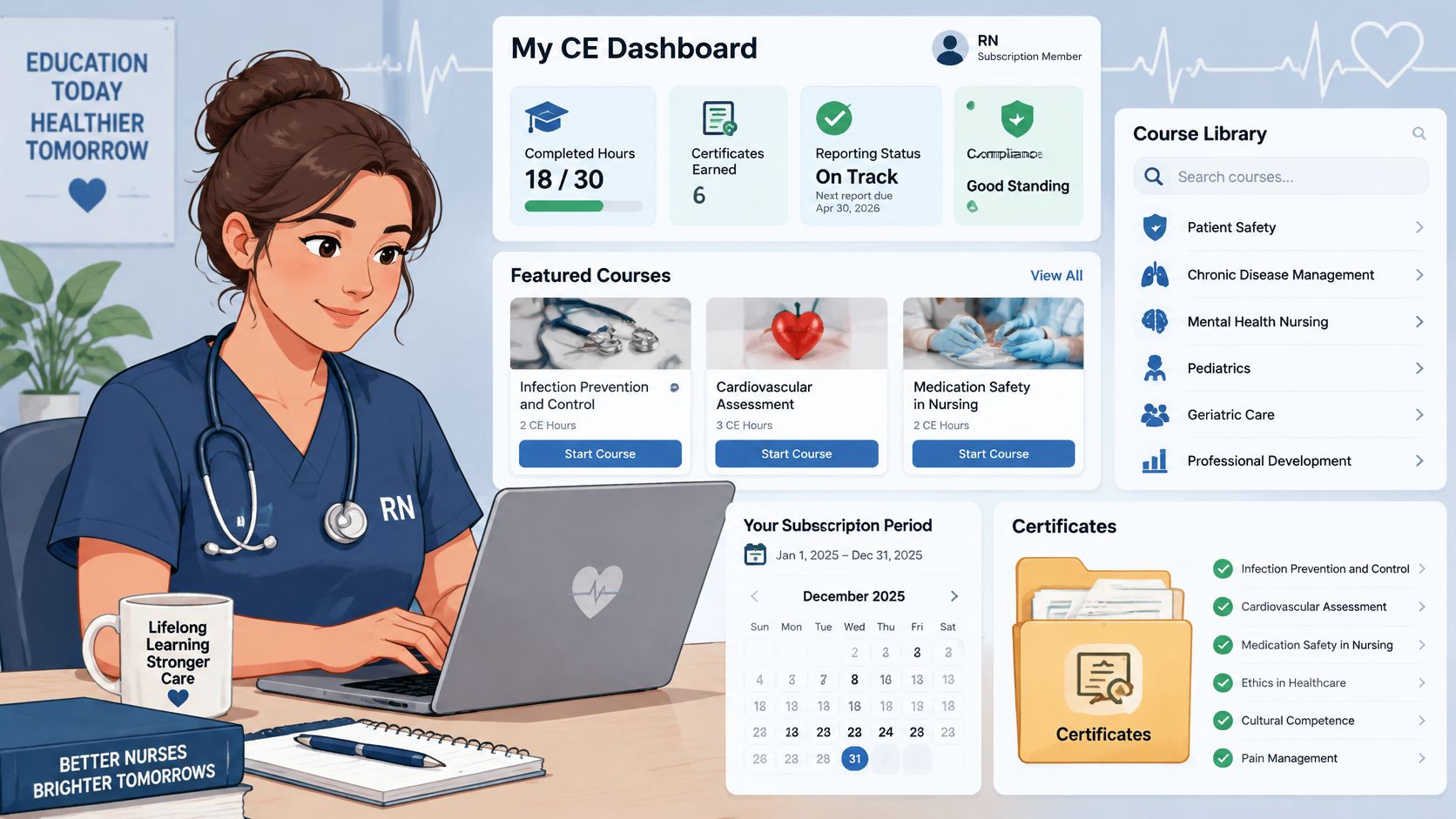
Course dashboards may group activities by subject, show completed hours, or flag unfinished items. Some platforms also report completions to a board or tracking service. These tools can help you monitor progress, but they cannot determine whether a course satisfies your particular license requirements.
ProMed Certifications offers continuing education for nurses and physicians. Compare each course's fit with your license requirements, as you would with any platform.
Evaluate the Details Behind the Dashboard
- State coverage: Check approval for every license you maintain.
- Required subjects: Confirm the library includes your mandatory topics.
- Reporting: Find out where completions are sent, how reporting works, and what to do if a completion is missing.
- Access and retakes: Review subscription duration, examination rules, and access to past certificates.
- Acceptance policies: Distinguish board acceptance from employer acceptance and review applicable refund terms.
Before enrolling, use the overview below to clarify what the platform includes and what you may need to confirm.
A progress indicator reflects the requirements entered and the activities classified. If those do not match your state's rules, the displayed total may not show whether you are on track.
Check whether your employer already provides education or whether you have another subscription, so you can avoid paying twice. If you hold licenses in multiple states, review coverage for each one rather than assuming a national course library meets every jurisdiction's rules.
Confirm Your State Requirements and Choose Accredited CE
Your renewal worksheet should capture your license state, expiration date, required education or competency activities, mandatory subjects, and any applicable exemptions. Use it as a checklist for reviewing courses before you enroll.
Compare each course with the worksheet. Check its objectives, completion rules, approval statement, and eligible learning dates. If a requirement remains unclear, ask your board a focused question.
Make Your Next Step Specific
- Resolve uncertainty: Ask your board about any rule you cannot interpret confidently.
- Choose relevant learning: Select activities that support compliance and your clinical responsibilities.
- Preserve evidence: Keep certificates and approval details with your renewal worksheet.
- Check completion: Reconcile your records before submitting your renewal application.
Online CE can meet renewal requirements when the board accepts the activity and it satisfies the rules for your license. The course, your board's requirements, and any separate employer conditions all need to align.
ProMed Certifications offers CE and CME for nurses and physicians. Review its available education options at ProMed Certifications, then confirm that a specific course meets your licensing requirements before enrolling.

Stay compliant with ProMed+
Certifications included: ACLS, BLS, PALS, CPR & Neonatal Resuscitation
Unlimited continuing education: over 200 hours of accredited CME
All-inclusive: One price. No surprises.
Get certified today

The Advanced Cardiac Life Support (ACLS) is an accredited online medical certification course that teaches medical professionals to respond to nearly all cardiopulmonary emergencies.

The Pediatric Advanced Life Support (PALS) Recertification instructs medical professionals on performing pediatric cardiopulmonary resuscitation in emergencies.

The Basic Life Support (BLS) Recertification is intended to teach healthcare professionals the basic steps of CPR and rescue breathing for adults, children, and infants.

Our online medical certification course for CPR, Automated External Defibrillator (AED), and First Aid is designed to teach adult, child, and infant CPR and AED use.

The Neonatal Resuscitation Certification trains medical professionals in performing resuscitation procedures and life-saving techniques for newborns at the time of delivery.