4 CME Courses for Physicians to Consider in 2026
Accredited online CME is as effective as in-person learning for many physician education needs, with a Cochrane review of 16 randomized studies finding little or no difference in patient outcomes, professional behavior, or knowledge. Choose by credit type, accreditation, state requirements, reporting, and intended use, not classroom attendance alone.
The advice that only in-person education counts, or that only AHA or American Red Cross classes are valid, confuses educational quality with credential acceptance. The Cochrane review of online healthcare education supports comparable outcomes, while noting low-quality evidence. It doesn't establish universal acceptance of any particular certification.
Online education is already a mainstream choice. ACCME recorded 113,730 enduring-material activities in its 2024 annual data report, demonstrating the scale of education available beyond scheduled events.
The resources below serve different decisions: physician license renewal, nursing team education, and specific certifications. Compare AMA PRA Category 1 Credits™, specialty relevance, self-paced access, mobile usability, certificates, and reporting.
CME credit and certification cards aren't interchangeable. The same scrutiny applies to specialized education such as hyperbaric training for clinic owners: confirm what the training awards before treating it as licensure credit.
1. ProMed+ Physician CME
Choose this as the primary subscription option when your main objective is physician CME. ProMed+ Physician CME offers unlimited, on-demand access to more than 200 AMA PRA Category 1 Credits™, according to its product description. It's the most directly relevant resource in this comparison for physicians building a continuing education plan.
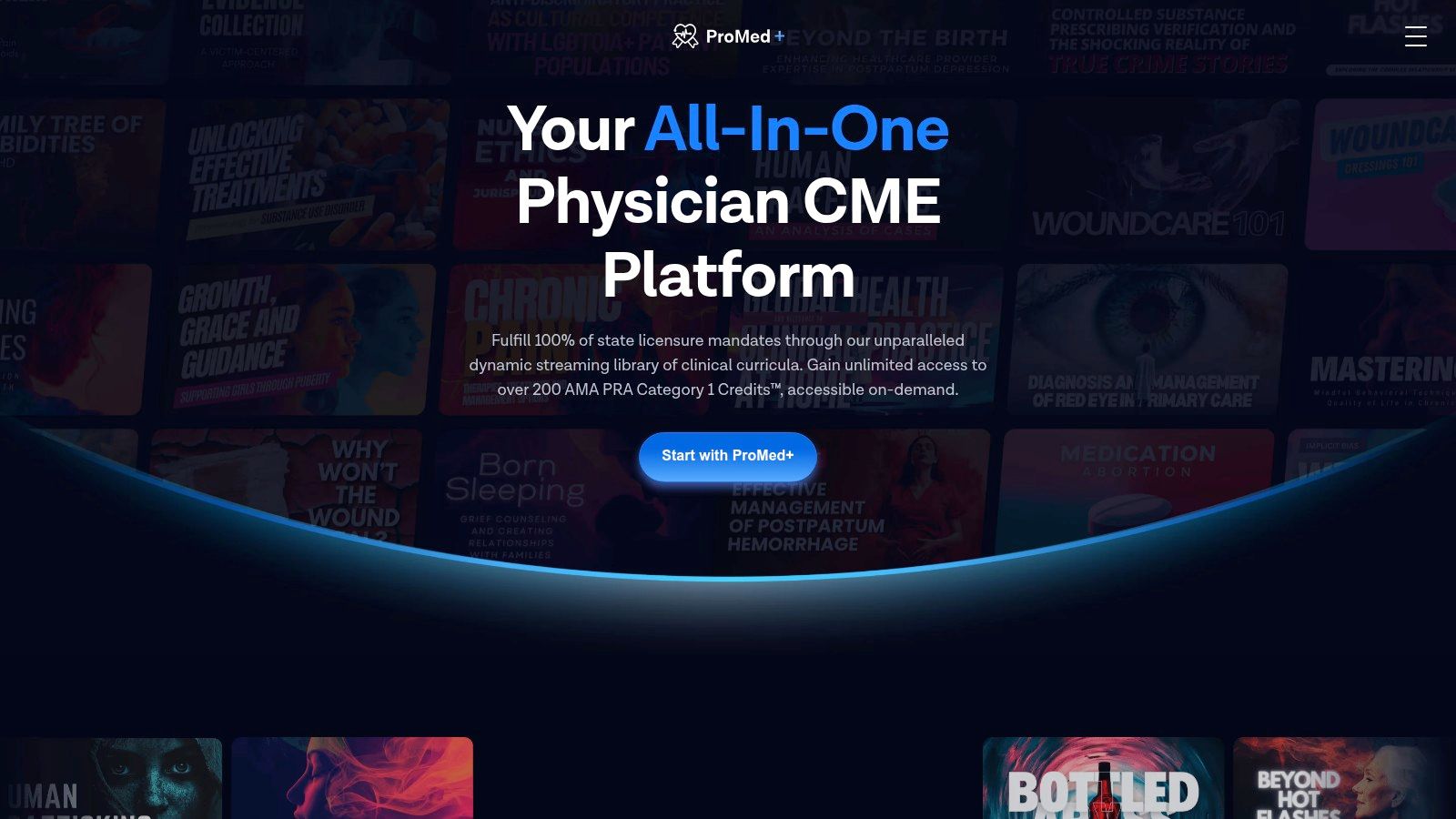
A streaming library makes sense when you want to spread learning around clinical work rather than organize everything around a conference. You can prioritize required topics, then choose education that addresses questions arising in your specialty.
The product describes broad state-mandate coverage. Treat that as a reason to examine the curriculum, not permission to skip a board-by-board review. Match individual activities to your license type, required subjects, and renewal window before relying on the subscription.
Evaluate the credit pathway before the library size
Accreditation and credit designation answer different questions. ACCME's accreditation eligibility guidance explains that it accredits organizations providing physician education, not individual educational activities.
For each activity you intend to claim, inspect the provider statement and credit designation. Then check whether the activity addresses the requirement you're trying to satisfy, particularly when a board specifies subject matter or an approved training pathway.
Use these questions to evaluate the subscription:
- Credit documentation. Does the activity identify the responsible accredited provider and the credit available?
- Specialty relevance. Will the material help with decisions you make, rather than add hours?
- Accessibility. Can you comfortably review content, answer assessments, and retrieve records on your preferred device?
- Reporting. Which boards or systems receive completion information, and what must you submit yourself?
The publisher's guide to continuing education for physicians provides additional context for organizing your learning. Keep your own requirement list beside the course catalog so you can distinguish mandatory subjects from elective professional development.
Make the subscription useful beyond renewal
My recommendation is to select courses around clinical questions and compliance needs together. For example, use a prescribing requirement to examine a decision you regularly face, then identify what you'll change after completing the activity.
Practical rule: Buy access to relevant education, not just a large credit balance. A library is valuable when you can connect its courses to your requirements and clinical work.
The main limitation is straightforward: a CME subscription isn't automatically a specialty-board program or a substitute for a required certification card. Confirm those separate obligations independently. For physicians comparing CME courses for physicians primarily for license renewal, this is the logical starting point.
2. PALS Certification
A physician who needs a pediatric resuscitation credential has a different purchasing problem from a physician who needs general CME. Choose PALS Certification when the requirement specifically concerns pediatric advanced life support, then confirm that the issuing credential is accepted for your role.
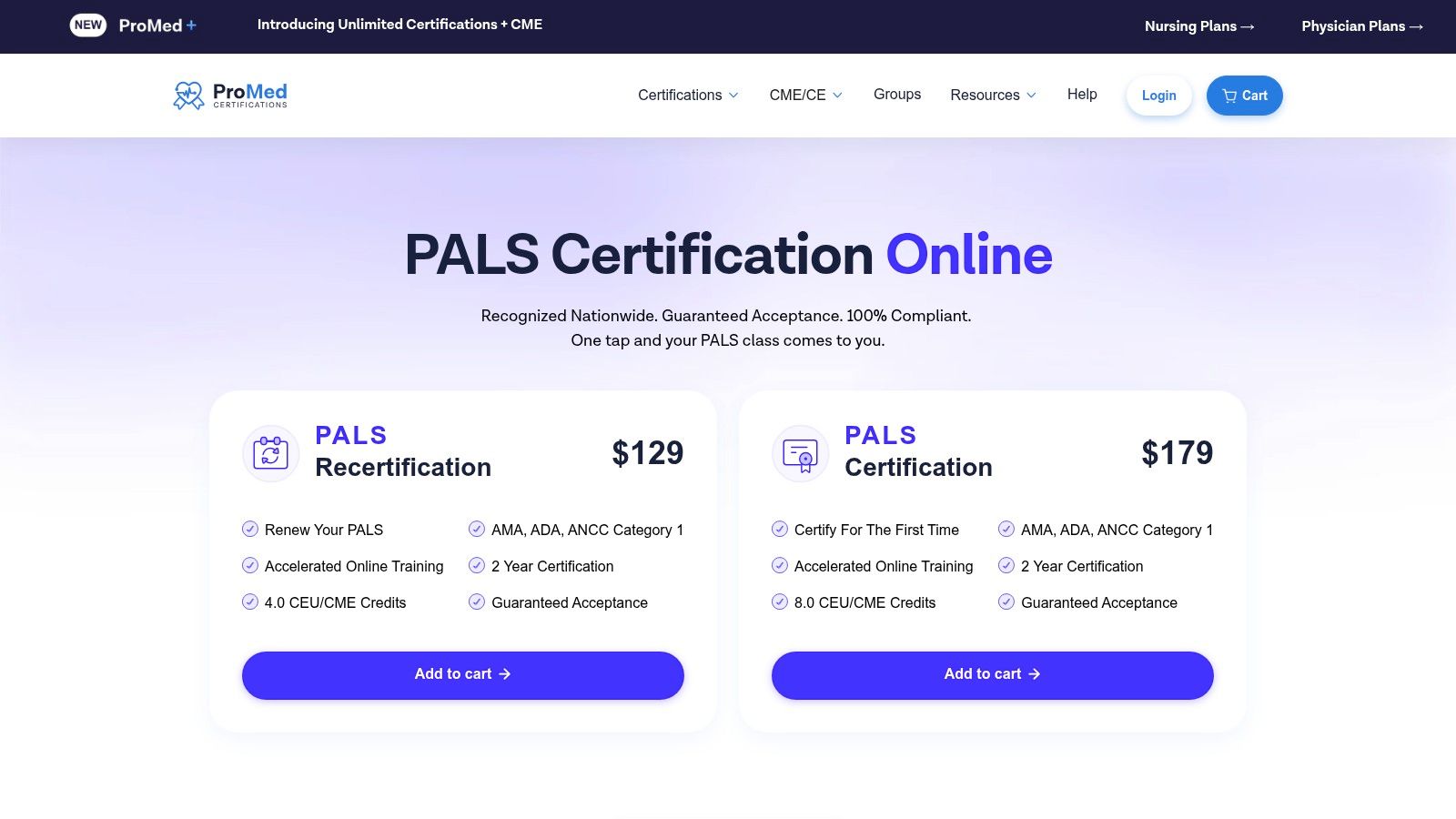
ProMed describes an online pathway involving review material, an examination, and a certification card. That makes it a certification option to evaluate separately from the physician CME library.
Don't buy it just because pediatric content sounds specialty-relevant. First determine whether you need a particular card, documented training, CME credit, or a practical skills assessment. Those are distinct deliverables.
Online quality and institutional acceptance are separate decisions
Peer-reviewed comparisons support taking online healthcare training seriously. A systematic review comparing online training with alternative instruction included 14 studies and 1,089 participants and found no meaningful knowledge difference between online instruction and workshops, although the evidence quality was very low.
That finding supports online learning as a credible educational choice. It doesn't prove that an online examination alone demonstrates every hands-on resuscitation skill.
The belief that only AHA or American Red Cross in-person classes can ever be valid is too broad. AHA and American Red Cross aren't the only options to evaluate, but an employer can still specify an issuing organization or assessment pathway. Obtain that requirement before enrolling.
Ask your credentialing office for:
- Issuer acceptance. Will it accept this provider's PALS card for your appointment or privileges?
- Skills requirements. Must you complete an observed assessment, simulation, or additional practical component?
- CME status. Does the selected activity explicitly award physician CME, and under what designation?
- Documentation rules. What must you upload, and when must the credential remain current?
The publisher's explanation of PALS certification for nurses offers background, but physicians should use their own credentialing requirements to make the final choice.
Use flexible study time for clinical preparation
Online review lets you revisit material instead of depending entirely on a scheduled class. Use that flexibility to work through clinical reasoning and connect the material to your workplace's emergency processes.
Ask the credentialing office to approve the exact course and issuer before you pay. Save the written response with your completion documents.
The strongest use case is a defined PALS requirement with confirmed acceptance. If your department requires practical validation, combine online preparation with that assessment rather than treating the two as competing approaches. If your only goal is license-renewal credit, choose an explicitly designated CME activity instead.
3. CPR AED & First Aid Certification
Start with the required credential's name, not the most convenient course title. CPR AED & First Aid Certification is an online option for learners seeking training in cardiopulmonary resuscitation, automated external defibrillator use, and first aid. It belongs in a specific certification decision, not automatically in a physician CME plan.
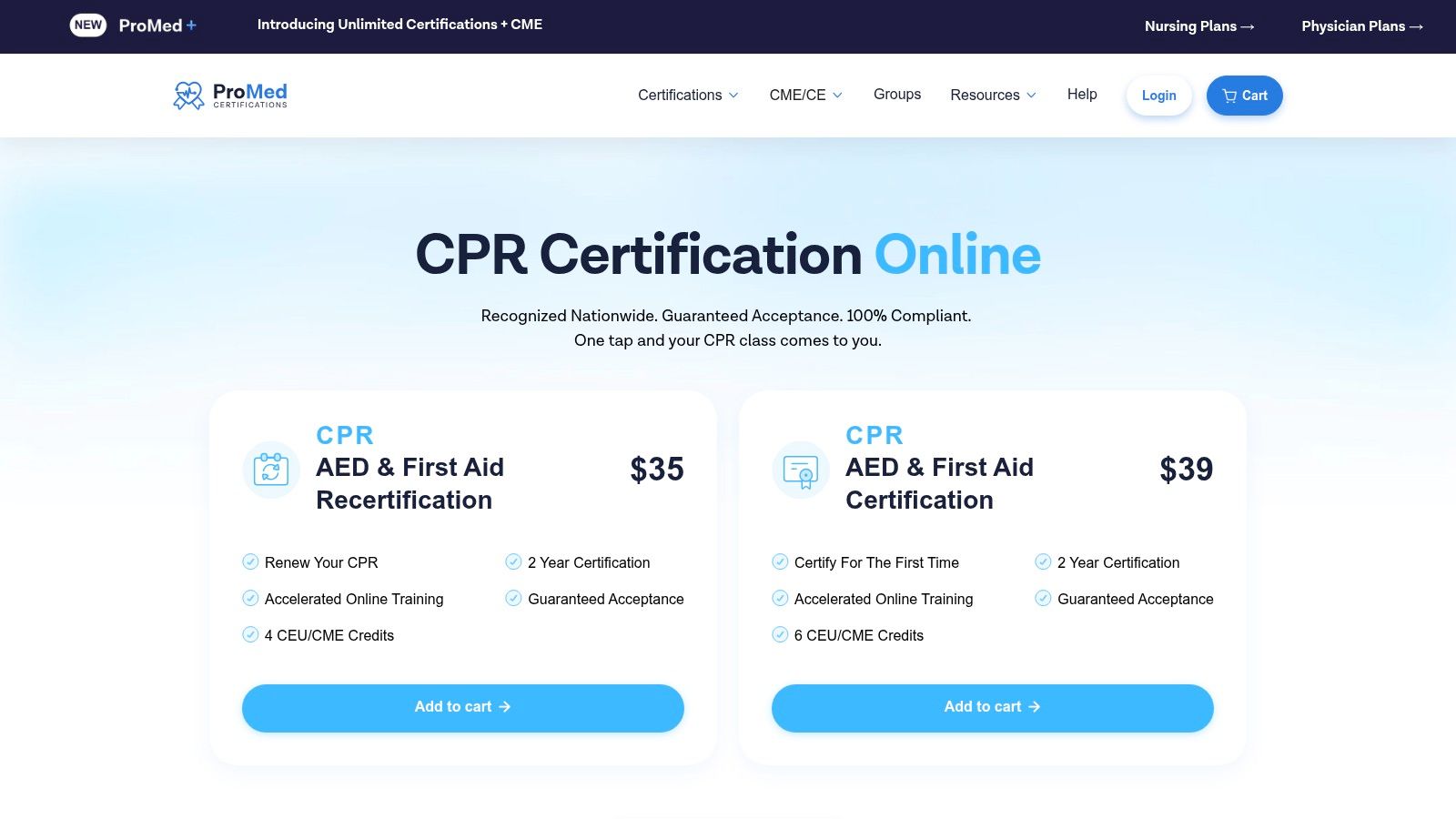
ProMed describes review material, an examination, and a certification card delivered through its online pathway. The practical appeal is avoiding a scheduled classroom trip when the receiving organization accepts this training format and credential.
The limitation matters just as much. Don't substitute a general CPR, AED, and first aid card for a named BLS or advanced life support requirement without written approval. Similar subject matter doesn't establish equivalent credential status.
Compare total effort, not just course access
For a busy physician, online education can remove travel and reduce time away from clinical work. Compare those advantages with the whole task: studying, completing assessments, obtaining the right documents, and satisfying any practical requirement.
Flexibility isn't merely a marketing consideration. In a study of online CME satisfaction, 45.7% agreed and 18.1% strongly agreed that online CME was more flexible than conventional education. Those responses describe learner experience, not a guarantee about any individual certification.
When assessing this option, make the administrative questions concrete:
- Intended use. Is the card for workplace onboarding, a clinic policy, or another specified purpose?
- Credential match. Does the receiving organization accept this exact course instead of a differently named credential?
- Practical assessment. Is an observed skills component required separately?
- Completion record. Can you obtain the documentation your organization requests?
- CME eligibility. Is physician credit explicitly designated, rather than inferred from the course topic?
For a clinic owner, these checks can prevent unnecessary repeat training. For an employed physician, a short conversation with medical staff services can establish which pathway to purchase.
Choose the right combination of study and skills
Online education can match classroom learning quality without replacing every form of practical assessment. The sensible comparison is between complete learning pathways, including whatever skills demonstration the role requires.
Review course content with a practical purpose. Identify what you need to recognize, explain, and perform, then ask how the course assesses each part.
The recommendation is straightforward: choose this resource for an accepted CPR, AED, and first aid requirement. Choose a different credential when your employer names one, and use physician CME separately when you're documenting continuing medical education. ProMed's online approach offers convenience, but the credential's intended use must determine the purchase.
4. Neonatal Resuscitation Certification
Choose neonatal training because your clinical role requires it, not because you're collecting general education hours. Neonatal Resuscitation Certification is ProMed's online certification pathway for this subject. Evaluate it against the exact requirements of the department, facility, or credentialing organization receiving the card.
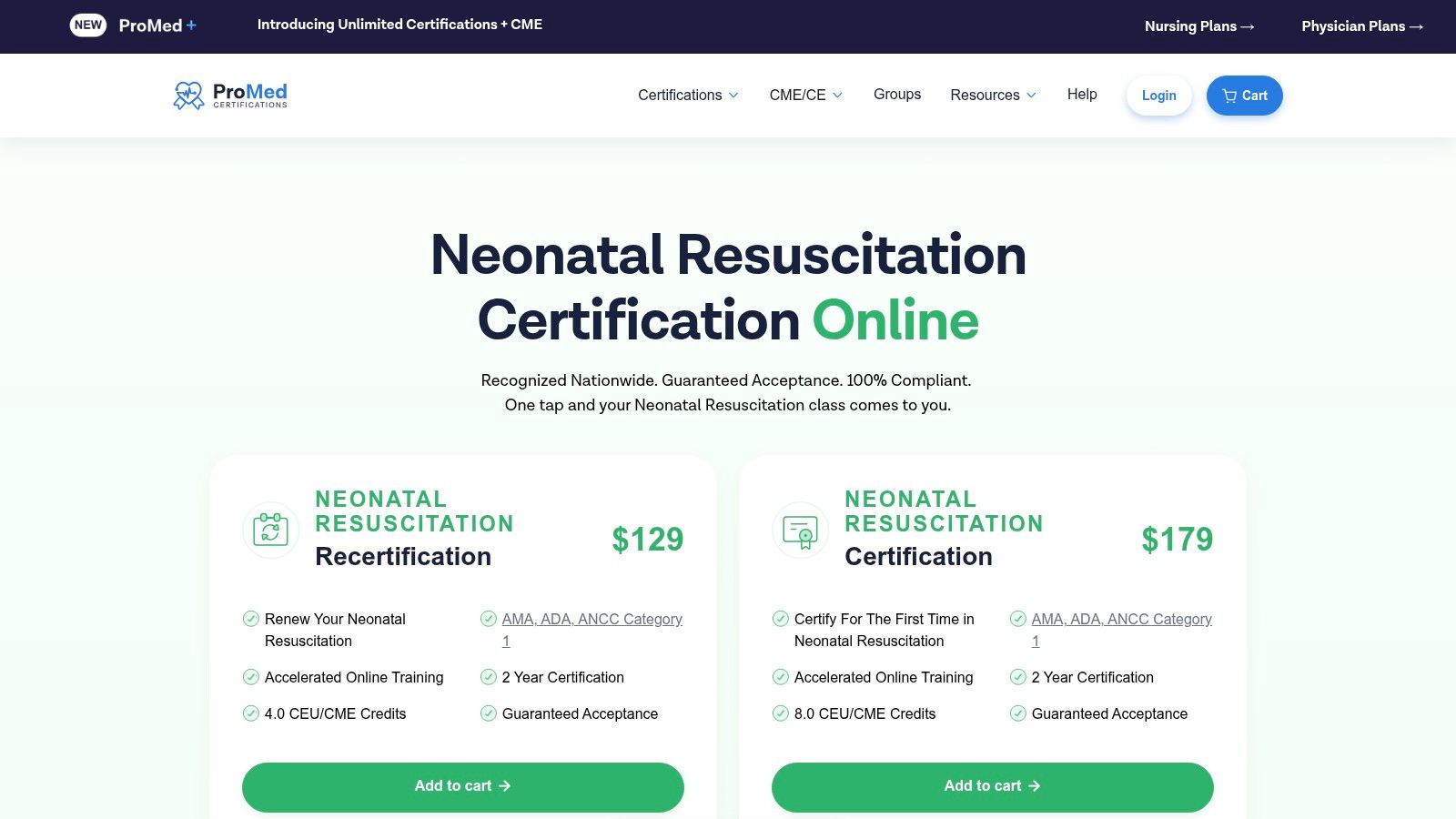
The product description presents review material, an examination, and a certification card. It doesn't establish that the credential is interchangeable with every other neonatal training program or that it awards physician CME.
For physicians considering this option, program identity matters as much as delivery format. Ask whether your workplace accepts this particular certification or requires another named program and assessment process.
Focus on transfer to clinical practice
A resuscitation course should support more than document collection. After studying, identify how you'll apply the material within your team's procedures and what additional rehearsal your workplace expects.
A systematic review and meta-analysis of CME barriers, available as a preprint, identified inappropriate topics, time demands, cost, and lack of follow-through as recurring obstacles. Its practical relevance is clear: completing education and applying it are separate tasks.
Use the course selection process to clarify both:
- Role relevance. Does the content match your responsibilities in neonatal care?
- Program acceptance. Has the receiving department approved the issuer and credential?
- Team preparation. Does your facility require simulation or coordinated practice beyond individual study?
- Credit designation. Is CME explicitly available, or are you receiving a separate certification?
- Renewal planning. What expiration and recertification rules apply to the credential your workplace accepts?
Online learning remains a valid, accessible choice. The issue isn't whether a screen makes education legitimate; it's whether the complete pathway meets the professional requirement.
Keep clinical readiness separate from administrative completion
Think of the certification card as a record of the provider's stated completion process. Don't ask it to prove competencies that the course hasn't assessed.
Before enrollment: Confirm the exact neonatal credential your facility requires. Similar course titles aren't enough to establish equivalence.
My recommendation is to consider this resource when neonatal certification is relevant and acceptance has been confirmed. If your institution requires a different named program, observed skills, or simulation, follow that pathway.
For general physician renewal, return to explicitly accredited CME. For neonatal readiness, combine appropriate education with the practical preparation your role demands. That distinction protects both your training investment and the usefulness of the education.
Choose CME That Works Beyond the Checklist
Begin with your state licensing board's current requirements, including credit categories, reporting procedures, required subjects, and completion windows. If you hold multiple licenses, map each separately instead of assuming that acceptance or reporting transfers automatically.
Next, verify the accredited provider, activity-level credit designation, specialty relevance, and expiration rules. Confirm whether you're purchasing CME, nursing CE, or a certification course. A useful course can still be the wrong purchase for a particular requirement.
Recognition isn't always obvious. In a European physician survey discussing CME recognition, 49% reported difficulty determining whether an activity was recognized in their country. For internationally mobile physicians, that reinforces the need to verify acceptance before investing time.
Use this comparison checklist before enrolling:
- Licensure coverage. Match each mandatory subject to an eligible activity.
- Credit availability. Verify the designation and the amount you can claim.
- Mobile access. Test the experience on the device you will use.
- Self-paced completion. Check deadlines, access periods, and assessment requirements.
- Certificate delivery. Confirm what documents you receive and how to retrieve them.
- Automated reporting. Identify supported destinations and verify receipt afterward.
- Retake policy. Review examination rules before starting.
- Employer or board acceptance. Obtain approval for the exact credential when needed.
Reporting deserves its own check. ACCME describes participation reporting to participating state medical boards through its systems in the 2023 annual data report. Don't assume every provider reports every activity to every board.
Online education is valid, accessible, and increasingly established within professional learning. Hospitals, clinics, boards, and organizations still set their own acceptance conditions, and specific roles may require hands-on assessment, simulation, or an in-person component.
Review the physician subscription first for flexible access to its extensive AMA-designated credit library. Separately consider certification training when your role requires a particular credential, and confirm acceptance before purchasing either pathway.
ProMed Certifications offers online physician CME and medical certification courses, including PALS, CPR, and neonatal resuscitation training. Visit ProMed Certifications to compare the physician CME library with separate certification options, then select the course that matches your licensing or employer requirements.

Stay compliant with ProMed+
Certifications included: ACLS, BLS, PALS, CPR & Neonatal Resuscitation
Unlimited continuing education: over 200 hours of accredited CME
All-inclusive: One price. No surprises.
Get certified today

The Advanced Cardiac Life Support (ACLS) is an accredited online medical certification course that teaches medical professionals to respond to nearly all cardiopulmonary emergencies.

The Pediatric Advanced Life Support (PALS) Recertification instructs medical professionals on performing pediatric cardiopulmonary resuscitation in emergencies.

The Basic Life Support (BLS) Recertification is intended to teach healthcare professionals the basic steps of CPR and rescue breathing for adults, children, and infants.

Our online medical certification course for CPR, Automated External Defibrillator (AED), and First Aid is designed to teach adult, child, and infant CPR and AED use.

The Neonatal Resuscitation Certification trains medical professionals in performing resuscitation procedures and life-saving techniques for newborns at the time of delivery.