


A Modern Guide to Continuing Education for Physicians
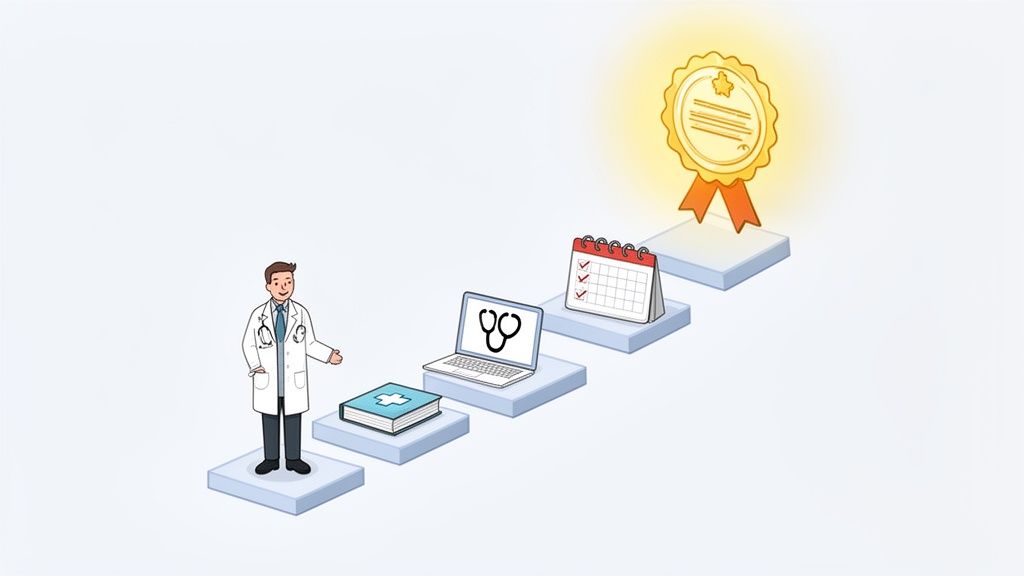
Continuing Medical Education (CME) is more than just a box to check—it's the very engine that keeps modern medical practice moving forward. You can think of it as a career-long software update for your clinical skills, making sure you’re always operating with the latest, most effective protocols. This commitment to lifelong learning isn't just a good idea; it's non-negotiable for improving patient outcomes and adapting to new standards of care.
Why Physician Continuing Education Is a Career Lifeline
In medicine, knowledge has a half-life. What was considered standard practice just a decade ago might be dangerously outdated today. Continuing education for physicians is the bridge connecting your foundational medical school training to the dynamic, real-world demands you face every day with patients. It's a structured way to guarantee you’re armed with the most current clinical insights.
This isn’t just about satisfying a licensing board. It's a strategic professional tool that directly sharpens your ability to deliver the highest possible quality of care.
The Core Purpose of CME
At its heart, CME has a few critical functions that keep you at the top of your game. These goals are universal, whether you're a family physician in a rural clinic or a highly specialized surgeon at a major hospital.
- Maintaining Clinical Competence: Medicine never stands still. CME ensures your skills and knowledge base evolve right alongside new research, diagnostic tools, and therapeutic options.
- Improving Patient Outcomes: When you learn and apply the latest evidence-based practices, you can directly enhance patient safety, nail down diagnoses with greater accuracy, and offer more effective treatments.
- Meeting Regulatory Requirements: State medical boards and specialty organizations mandate CME to verify that physicians remain qualified to practice. Fulfilling these requirements is essential for keeping your license and certifications active.
The old-school view of CME probably brings to mind long weekends spent at conferences or stuffy in-person workshops. While those still have their place, the entire landscape has shifted. The outdated belief that only certain in-person classes, like those from the AHA or American Red Cross, are valid just isn't true anymore.
A huge body of peer-reviewed studies and industry articles now points to one clear conclusion: accredited online education delivers patient care and knowledge retention outcomes that are equal to—and sometimes even better than—traditional in-person formats.
The Shift to Modern, Flexible Learning
Today, online platforms offer a far more convenient and equally effective alternative. Think of it like the jump from broadcast television to on-demand streaming—you're in complete control of when, where, and how you learn. Hospitals, clinics, and entire healthcare systems are increasingly recognizing the validity of accredited online CME and certifications, marking a significant shift in the industry consensus.
This guide will walk you through everything you need to navigate your CME requirements in this new environment. We'll show you how to use modern solutions to make continuing education for physicians a seamless and genuinely rewarding part of your career, not just another logistical headache.
Decoding Your CME Requirements
Trying to get a handle on Continuing Medical Education (CME) requirements can feel like you’re trying to solve a puzzle with pieces from three different boxes. You’ve got rules from your state medical board, another set from your specialty board, and then other regulatory bodies chiming in. It’s enough to make anyone’s head spin.
But let’s cut through the noise. The core goal behind all of it is simple: to make sure you’re staying on top of your game as a competent, effective clinician. The great news is that keeping up with these requirements is much less of a headache than it used to be, all thanks to modern, accredited online providers.
Let's break down the essentials so you have a clear roadmap for staying compliant.
Understanding the Credit System
The term you'll see everywhere is AMA PRA Category 1 Credit™. Just think of this as the gold standard for physician continuing education. These are the credits awarded for activities that have met the tough standards of the Accreditation Council for Continuing Medical Education (ACCME).
That ACCME accreditation is your seal of approval. It guarantees the educational material is evidence-based, clinically relevant, and completely free of any commercial bias. When your state or specialty board asks for CME, this is almost always what they’re talking about—these high-quality, verified learning hours.
Where Do the Rules Come From?
Your specific CME obligations are a blend of requirements from a few key players. To keep your license and certification, you have to satisfy all of them.
- State Medical Boards: Every single state has its own licensing board with its own set of rules. For instance, California physicians need 50 hours every two years, but over in Texas, it’s 48 hours for the same timeframe. Many states also mandate specific topics, like pain management or medical ethics.
- Specialty Boards: On top of state requirements, your specialty board (like the American Board of Internal Medicine or the American Board of Surgery) runs its own Maintenance of Certification (MOC) program. These programs come with their own distinct CME criteria.
- Federal Mandates: Every so often, federal laws create new educational requirements for all physicians. The recent DEA MATE Act is a perfect example, requiring all DEA-registered practitioners to complete training on substance use disorders.
This layered system is what fuels the entire CME industry. In major markets like North America, which accounted for 38.21% of the global share in 2024, these strict licensure rules are the primary driver. Most states demand physicians earn a set number of CME credits—often around 50 hours annually or biennially—to maintain their certification.
Common CME Requirements by State
While you should always double-check the exact rules for your state, a common baseline is somewhere between 20 and 50 hours of AMA PRA Category 1 Credits™ per one- or two-year licensing cycle.
Here's the most important thing to remember: Your board doesn’t care about the format of the CME. Whether you’re sitting in a conference hall or taking a course online from your living room makes no difference. What matters is that the provider is ACCME-accredited and the activity awards official AMA PRA Category 1 Credits™.
If you’re curious about the different ways to knock out these hours, you might find our guide on 8 ways to earn CME credits helpful, as it covers a bunch of flexible options.
The old-school belief that only in-person events from a handful of organizations "count" is completely outdated. Accredited online education is fully recognized and accepted by boards across the country, giving you a convenient and equally valid way to meet your professional duties.
The Inevitable Shift to Online CME
The idea that in-person courses are the gold standard for medical education is an outdated relic. Let’s be clear about something the evidence has shown for years: for continuing education for physicians, online formats deliver equal, and often better, outcomes in knowledge retention and practical application. Peer-reviewed studies consistently support the effectiveness of online learning, highlighting superior or equivalent results for patient care and learner flexibility.
This isn’t about trends; it’s about tangible wins for busy physicians. Imagine having an entire accredited medical library at your fingertips, accessible 24/7 around your clinical schedule, without the hassle and cost of travel. This isn’t some future concept—it's the reality of modern online CME.
Putting You in Control of Your Education
Think of it like the shift from broadcast TV to on-demand streaming. It puts you in the driver's seat. Instead of rearranging your life for a rigid conference schedule, you can fit your required learning into the small pockets of time that actually exist in your day. For physicians trying to maintain a work-life balance while staying clinically sharp, that flexibility is a game-changer.
This isn't just a niche movement. It’s an industry-wide embrace of a smarter, more efficient way to learn. Institutions and physicians alike are realizing that the quality of education comes from its content and accreditation, not its delivery method. The focus is now on what truly matters: effectiveness and accessibility, two areas where online platforms have a clear advantage.
The Myth of In-Person Superiority
For years, there was a stubborn belief that only certain big-name providers, like the American Heart Association (AHA) or the American Red Cross, offered valid certifications, and that you had to be there in person. This is simply not true anymore.
What state and specialty boards actually care about is accreditation.
As long as a course is from an ACCME-accredited provider and awards AMA PRA Category 1 Credits™, it meets the highest standard for quality and validity. It doesn’t matter if you complete it in a lecture hall or on your laptop at home. The industry is evolving toward broader online acceptance, and ProMed is at the forefront of this change, delivering convenience and credibility.
This infographic helps paint a picture of what's driving the CME landscape.
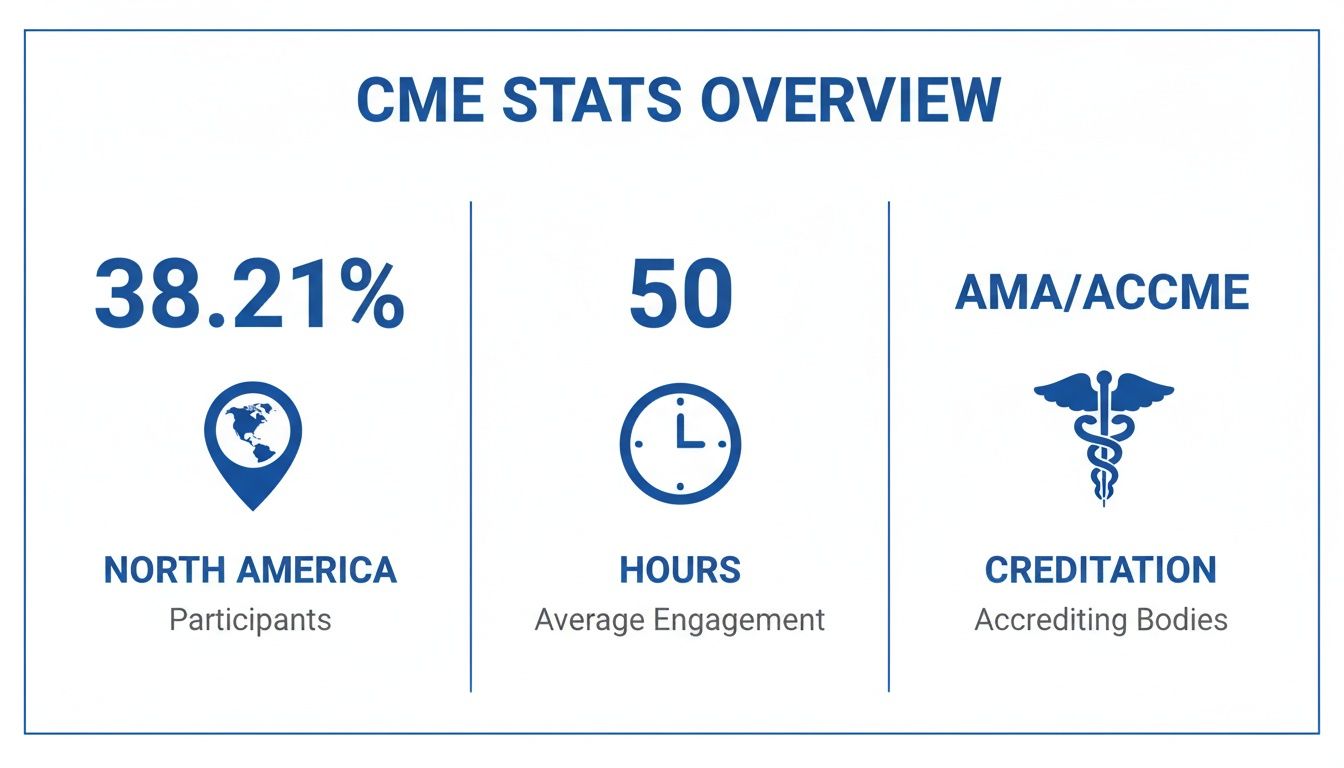
The data makes it obvious: stringent requirements, especially in North America, are fueling the demand for CME that’s both high-quality and easy to access.
The core takeaway is this: Technology has officially closed the gap between in-person and online learning. Well-designed digital courses now offer interactive, evidence-based content that promotes better knowledge retention and application in clinical practice.
The numbers don't lie. E-learning has completely reshaped physician education, capturing a massive 42.19% of the global CME market in 2024, all thanks to its unmatched flexibility. This means physicians can complete mandatory training—like the 8 hours of opioid education or DEA MATE Act requirements—anytime, anywhere. It’s no surprise this has been shown to boost completion rates by 30-40%.
The Future of Medical Learning Is Here
The benefits of online CME go way beyond just convenience. Digital platforms can offer learning experiences that traditional formats simply can't replicate. And as the technology gets better, so do the tools. We're already seeing innovations like virtual reality for medical training emerge, offering incredibly immersive and effective ways for healthcare professionals to learn.
To see just how different the two approaches are, let's compare them directly.
Comparing Online CME vs Traditional In-Person Training
This table breaks down the key differences and shows why so many physicians are making the switch to modern online platforms.

When you choose an accredited online provider like ProMed, you’re not just getting your credits. You're choosing a future-focused solution that respects your time, cuts your costs, and provides a learning experience that’s just as good as—and often better than—the old way of doing things.
How to Choose High-Quality CME Providers
In a crowded market, finding truly valuable CME can feel like searching for a needle in a haystack. With so many options popping up, how do you separate the genuinely effective educational experiences from the marketing noise? This section is your practical playbook for making smart choices about your continuing education.
The goal isn't just to find any CME activity; it's to identify providers that deliver relevant, evidence-based content that respects your time and meaningfully sharpens your clinical skills. This is especially true when you're fulfilling mandatory training, like the DEA's substance use disorder requirement.
Look for the Accreditation Seal of Approval
Before you even think about the course content, your first checkpoint should always be accreditation. This is the single most important factor in determining the quality and legitimacy of any CME provider.
In the United States, the gold standard is accreditation from the Accreditation Council for Continuing Medical Education (ACCME). When a provider is ACCME-accredited, it means they’ve been put through the wringer and passed a rigorous evaluation process.
This seal of approval is your guarantee that the educational content is independent, free from commercial bias, and built on a foundation of valid, evidence-based science. It’s how you know the credits you earn will actually be recognized by state medical boards and specialty boards.
A common misconception is that only big names like the AHA or the American Red Cross offer valid certifications. That's an outdated way of thinking. The format—whether it’s online or in-person—doesn’t matter. What matters is the ACCME accreditation backing the course, which ensures it is a valid, accessible, and widely accepted option.
Evaluate the Content's Relevance and Quality
Once you've confirmed accreditation, it's time to dig into the content itself. High-quality CME should feel like it was made for you, helping you solve the real-world clinical challenges you face every day and improve patient outcomes.
To make an informed choice, ask yourself these questions:
- Is the content evidence-based? The best providers don't just state facts; they cite current research and clinical guidelines. A basic understanding of systematic literature review methodology can help you critically assess the evidence behind any educational program.
- Is it relevant to your specialty? General CME is fine, but the real value comes from courses that address the specific needs and latest advancements in your field.
- Is the format engaging? Let's be honest, nobody wants to sit through a dry, passive lecture. Modern online platforms use interactive modules, case studies, and self-assessment tools to make learning stick.
This demand for specialty-specific, high-quality content is fueling major growth in the industry. The U.S. CME market was valued at USD 3.35 billion in 2024 and is projected to hit USD 4.67 billion by 2030. Oncology is currently leading the charge, as specialists seek out targeted education on immunotherapies and precision medicine to tackle complex cases.
Prioritize Flexibility and Convenience
Your time is your most valuable resource. The best continuing education for physicians respects that by offering maximum flexibility, and this is where online providers really shine.
Look for platforms that give you:
- 24/7 Access: The ability to learn on your own schedule—whether that's between patients, during your lunch break, or late at night—is a game-changer.
- Self-Paced Learning: You should be in control. Good platforms let you pause, rewind, and review tricky topics as many times as you need without feeling rushed.
- Multi-Device Compatibility: Top-tier providers make sure their content works flawlessly whether you're on a desktop, tablet, or your smartphone.
By focusing on these three pillars—accreditation, content quality, and flexibility—you can confidently choose a CME provider that not only meets your requirements but becomes a true partner in your professional growth. If you want to dive deeper into the nitty-gritty, check out our guide on understanding CME accreditation.
Simplify Your Career with an All-Access CME Solution
Let’s be honest. Juggling multiple platforms, tracking different deadlines, and paying for one-off courses just to stay compliant is a massive headache. Managing your continuing education shouldn't feel like a second job.
The fix isn't finding just another course. It's about finding a single, integrated platform that transforms your CME from a burden into a seamless part of your professional life. Imagine having one trusted resource that handles everything so you can get back to what actually matters: your patients.
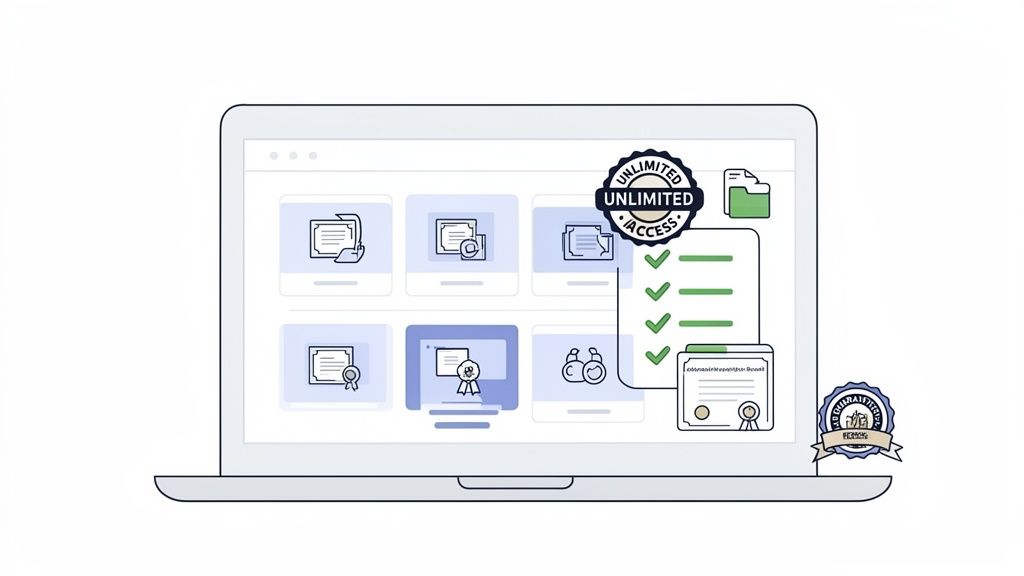
What an All-in-One Platform Looks Like
A true all-access solution goes way beyond a simple course catalog. It’s an entire ecosystem built around the real-world demands of a busy physician. Instead of trying to piece together your requirements from different providers, you get a single subscription that covers all your bases—efficiently and without breaking the bank.
This approach is built on a few key pillars:
- Unlimited Access to a Full CME Library: You get the keys to a deep library of accredited content—often over 200 hours' worth—spanning a huge range of specialties. This frees you up to explore topics relevant to your practice without ever worrying about per-course fees.
- Bundled Certifications: Your required certifications like ACLS, PALS, and BLS shouldn't be a separate hassle. An integrated platform bundles these essential life-support courses right into your subscription, saving you a surprising amount of money and administrative legwork.
- Automated Credit Reporting: The soul-crushing task of manually submitting credits is officially over. The best platforms automatically report your completed hours to boards like CE Broker, making sure your records are always accurate and up-to-date without you lifting a finger.
This model completely changes the game. It shifts the focus from just chasing credits to genuine, accessible learning that actually fits your life.
The ProMed Advantage: Convenience and Credibility
At ProMed, we built our all-access CME solution around a simple idea: your education should empower you, not overwhelm you. We deliver a single, powerful subscription that combines a comprehensive CME library with all the vital certifications you need, including ACLS, PALS, and BLS. Our courses are future-focused, aligned with industry shifts, and committed to quality education.
Our platform is designed from the ground up to eliminate the friction points we all know too well.
The core principle is straightforward: provide everything a physician needs for compliance and professional growth in one place, backed by an unwavering commitment to quality and flexibility. The industry is evolving, and your educational tools should, too.
But this isn't just about convenience. It’s about trust. We know that the validity of your credentials is non-negotiable, which is why our entire library is ACCME-accredited, guaranteeing acceptance by state and specialty boards. The old belief that only legacy organizations like the AHA or Red Cross offer valid certifications is simply outdated; accreditation is the true measure of quality, making online options just as good as in-person.
To give you complete peace of mind, we’ve built in features that put your needs first:
- Flex Expire™: This unique feature lets you choose when your certification period begins. You can maximize its validity and align it perfectly with your recertification schedule.
- 100% Money-Back Guarantee: We stand behind our courses, period. If for some reason your employer doesn't accept your ProMed certificate, you get a full refund—no questions asked.
- Automated Reporting: We handle the paperwork. Your credits are reported directly to CE Broker and other state boards so you can stay focused on your work.
An all-access platform is more than a service; it's a strategic career tool. It streamlines your responsibilities, saves you money, and gives you back your most valuable asset: time. By choosing an integrated solution, you're not just checking a box—you're investing in a smarter way to manage your professional development. Explore our all-in-one ProMed Physician CME + Certification subscription to see just how simple it can be.
Your Questions About Physician CME Answered
Navigating the world of Continuing Medical Education can feel like its own specialty. Between credit requirements, provider types, and tracking, it’s easy to get bogged down in the details. Let’s clear up the confusion.
We’ve pulled together the most common questions physicians ask, giving you straightforward answers so you can make smart decisions about your professional development with confidence.
Are Online CME Credits Accepted by State Medical Boards?
Yes, absolutely. This is probably the biggest myth still floating around in physician continuing education. The overwhelming majority of state and specialty boards fully accept CME credits from providers accredited by the ACCME, whether the course is online or in a conference hall.
The format just doesn't matter—accreditation is the key. There's a lingering, outdated belief that only big, in-person events or a few legacy providers like the AHA or American Red Cross are valid, but that's simply not the reality anymore. Nationally accredited online providers like ProMed Certifications build their courses to meet the same rigorous, evidence-based standards your board requires for license renewal. Online formats are a valid, accessible, and widely accepted way to meet your requirements.
How Many CME Credits Do I Need Each Year?
This is the classic "it depends" answer, but for a very good reason. The number of CME credits you need is dictated by two different bodies: your state medical board and your specialty board.
- State Requirements: Most states require somewhere between 20 to 50 CME hours a year or over a two-year licensing cycle. Many also have mandates for specific topics, like pain management or medical ethics.
- Specialty Requirements: Your specialty board has its own Maintenance of Certification (MOC) program, which comes with a separate set of CME criteria you have to meet to stay board-certified.
It is critical that you check the specific rules for both your state licensing board and your specialty board. The good news? Modern online CME platforms are often designed to help you find and track these different requirements, taking a lot of the guesswork out of the process.
What Is the Difference Between Category 1 and Category 2 Credits?
Getting this straight is fundamental to managing your CME. The simplest way to think about it is that Category 1 is formal and verified, while Category 2 is informal and self-reported.
AMA PRA Category 1 Credit™ is the gold standard. It's the type most commonly required for your license and certifications. These credits come from activities certified by an ACCME-accredited provider, which guarantees the content is high-quality, evidence-based, and free from commercial bias.
On the other hand, AMA PRA Category 2 Credit™ is what you claim for activities that improve your medical knowledge but weren't formally accredited. This could be anything from reading medical journals and teaching residents to conducting research. Almost every board requires the majority of your credits—if not all of them—to be Category 1.
Can One Subscription Cover My CME and Required Certifications?
With the right provider, yes. Physicians have traditionally been stuck sourcing CME from one place and life-support certifications (like ACLS, PALS, or BLS) from another. It’s an inefficient, expensive, and administratively clumsy way to handle things.
A few forward-thinking online platforms now bundle everything you need into a single, all-access subscription. This integrated approach is easily the most efficient and cost-effective way to stay on top of all your educational requirements.
An all-in-one subscription can give you:
- Unlimited access to a full library of accredited CME courses.
- Essential certifications like ACLS, PALS, and BLS included at no extra cost.
- Automated credit reporting to boards like CE Broker.
This modern approach saves a huge amount of time, money, and hassle, letting you focus on patient care instead of compliance paperwork.
Is Online Learning as Effective as In-Person Training?
This question gets right to the heart of how much medical education has changed. A large and growing body of peer-reviewed research has confirmed it: online learning is just as effective as—and in some cases, better than—traditional in-person training for CE.
Study after study shows that well-designed online courses lead to equal or superior outcomes in:
- Knowledge Retention: Being able to learn at your own pace and revisit complex topics is a powerful way to make learning stick.
- Clinical Skill Application: Interactive case studies and simulations in online courses help you directly translate new knowledge into practice.
- Learner Flexibility: When you can learn on your own schedule, you’re naturally more engaged and better able to absorb the material.
The consensus across the healthcare industry has shifted. Hospitals, clinics, and regulatory boards increasingly recognize that quality education is about the content and accreditation, not the delivery method. Accredited online CE and certifications are credible, convenient, and powerful tools for lifelong learning, and their acceptance is gaining traction daily.
At ProMed Certifications, we are at the forefront of this change, providing physicians with a future-focused solution that delivers both convenience and credibility. Our all-in-one CME and certification bundles are designed to simplify your career, giving you unlimited access to accredited education that fits your life. Discover how ProMed can streamline your professional development today.
.avif)
Stay compliant with ProMed+
Certifications included: ACLS, BLS, PALS, CPR & Neonatal Resuscitation
Unlimited continuing education: over 200 hours of accredited CME
All-inclusive: One price. No surprises.
Get certified today

The Advanced Cardiac Life Support (ACLS) is an accredited online medical certification course that teaches medical professionals to respond to nearly all cardiopulmonary emergencies.

The Pediatric Advanced Life Support (PALS) Recertification instructs medical professionals on performing pediatric cardiopulmonary resuscitation in emergencies.

The Basic Life Support (BLS) Recertification is intended to teach healthcare professionals the basic steps of CPR and rescue breathing for adults, children, and infants.

Our online medical certification course for CPR, Automated External Defibrillator (AED), and First Aid is designed to teach adult, child, and infant CPR and AED use.

The Neonatal Resuscitation Certification trains medical professionals in performing resuscitation procedures and life-saving techniques for newborns at the time of delivery.

.png)
.png)
.png)