


Online CPR Certification for Healthcare Providers: A Guide

Getting your online CPR certification for healthcare providers is more than just a convenience—it's a smart, efficient, and widely accepted way to keep your credentials current. This lets you tackle coursework built on the latest ILCOR guidelines from anywhere, fitting critical training into a schedule that’s already packed, all without sacrificing an ounce of quality.
Why Online CPR Is a Smart Move for Healthcare Professionals
Let’s get one thing straight: accredited online CPR certification isn't a lesser alternative. It's a powerful and legitimate standard for today’s fast-paced healthcare world. For years, there's been a stubborn, outdated belief that only traditional, in-person classes from a handful of legacy providers like the AHA or American Red Cross are valid.
That is simply no longer true.
.png)
The healthcare industry is evolving, and that includes how we train. More and more hospitals, clinics, and state licensing boards are recognizing the value and effectiveness of high-quality online training. In fact, a growing body of peer-reviewed studies and industry articles supports this shift, with many finding that self-paced, online learning leads to equal or even superior knowledge retention compared to a one-off classroom lecture. The general consensus is moving forward, and ProMed is at the forefront of this change.
The Clear Shift to Digital Learning
The world of CPR certification has completely transformed with the rise of online platforms. Think about it: online first aid training courses have seen a huge 40% jump in registrations in just the last three years. That’s not a small trend; it's a major shift in how medical professionals handle their continuing education.
For any healthcare provider, the legitimacy of a certification is non-negotiable. It's about trust and patient safety. Understanding the core principles of how to create a certification program that builds trust shows you exactly why accredited online providers are so meticulous about their standards and curriculum. They have to be.
The advantages of online training become undeniable when you compare them side-by-side with the traditional approach.
Online vs In-Person CPR Training for Healthcare Providers
Here’s a quick breakdown of how modern online certification stacks up against traditional in-person classes, highlighting the equal quality and superior flexibility of online formats.
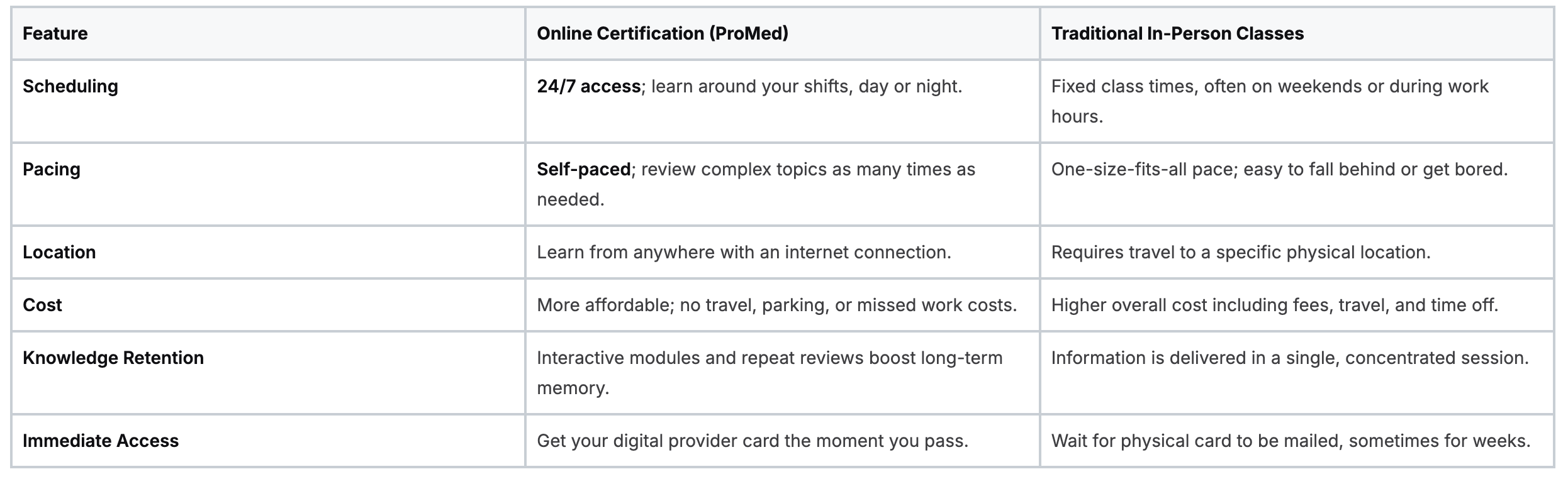
The choice becomes clear when you see the benefits laid out. Online learning is built for the reality of a healthcare professional's life, delivering the same high-quality education in a more efficient format.
Real-World Benefits You Can Count On
Opting for an online certification isn’t just about following a trend. It’s about making a practical, future-focused choice that supports your career and restores work-life balance.
- Unmatched Flexibility: Finally, you can fit your training around a chaotic shift schedule. Need to study at 2 AM after a long day? Go for it. Prefer a quiet weekend morning? The course is ready when you are.
- Deeper Knowledge Retention: Let's be honest, in a fast-paced classroom, it’s easy to miss something. Online, you can pause, rewind, and re-watch videos on complex topics like ACLS algorithms or drug dosages until you have them down cold. Studies show this leads to outcomes for patient care and knowledge retention that are equal or superior to in-person formats.
- Significant Time and Cost Savings: Say goodbye to the hassle and expense of driving to a training center, finding parking, and taking a day off work. High-quality training is delivered right to you, saving you both time and money.
The bottom line is that accredited online certifications deliver the exact same life-saving knowledge, just in a format that’s far more efficient and accessible for busy professionals. Providers like ProMed Certifications are leading this change, offering a credible, modern solution for maintaining your essential credentials. You can dig deeper into the 6 reasons to get your medical certification online in our full guide.
Choosing Your Course: BLS vs. Standard CPR
Navigating the world of CPR certification can feel a little confusing at first, but figuring out which course you need is simpler than you might think. For anyone working in a clinical role, the choice is clear: Basic Life Support (BLS).
If you're a nurse, physician, EMT, dental professional, or any other hands-on provider, BLS is your non-negotiable standard. It's the certification built specifically for the high-stakes environment of a professional rescue.
Why Healthcare Providers Need BLS
Standard CPR courses are fantastic for the general public—think teachers, coaches, or office staff. They cover the absolute essentials for responding to a cardiac arrest emergency. What they don't cover is the advanced, team-based approach that's critical in a clinical setting.
BLS goes much deeper, teaching the specific skills you'll actually use on the job:
- Team-Based Resuscitation: BLS trains you to work as a seamless part of a multi-rescuer team, coordinating compressions and breaths for maximum effect.
- Advanced Airway Management: You'll get hands-on with devices like a bag-valve-mask (BVM) to provide ventilations—a core skill that standard CPR doesn't touch.
- High-Performance CPR Metrics: The course is laser-focused on hitting precise metrics for compression depth, rate, and recoil, ensuring you're delivering care that meets the latest ILCOR guidelines.
Think of it like this: standard CPR prepares a bystander to help, while BLS prepares a professional to lead and function within a medical team. An administrative staff member in a hospital might only need standard CPR, but the ER nurse managing a code absolutely needs BLS.
Making the Right Choice with Confidence
Picking the correct online CPR certification for healthcare providers from the start means you're investing your time and money wisely. By choosing BLS, you're ensuring your credentials will meet employer and state board requirements, heading off any compliance headaches down the line. It's the professional-grade certification for those on the front lines of patient care.
Choosing the wrong course can lead to wasted effort and a credential your employer won't accept. If you work in any clinical capacity, always default to BLS. It’s the only way to be certain you have the comprehensive skills your role demands.
For more guidance, check out our complete guide on how to choose the best online BLS course.
At ProMed Certifications, our BLS program is built from the ground up for healthcare providers, delivering the accredited, guideline-compliant training you need in a flexible online format.
How Online Skills Verification Actually Works
This is probably the biggest question we get from healthcare providers about online CPR certification: How can you possibly learn and prove your hands-on skills through a screen?
It’s a valid concern. After all, CPR is a physical, tactile skill. The good news is that modern online verification methods are designed to be just as rigorous as any in-person class, and they’re increasingly recognized by employers who demand quality training.
This isn’t about just watching a few videos and getting a certificate. Reputable online courses use structured, interactive modules that break down every single step, from proper chest compressions to using a bag-valve-mask.
The process is a logical one, starting with your professional role and ending with a certification that proves you're ready to act.
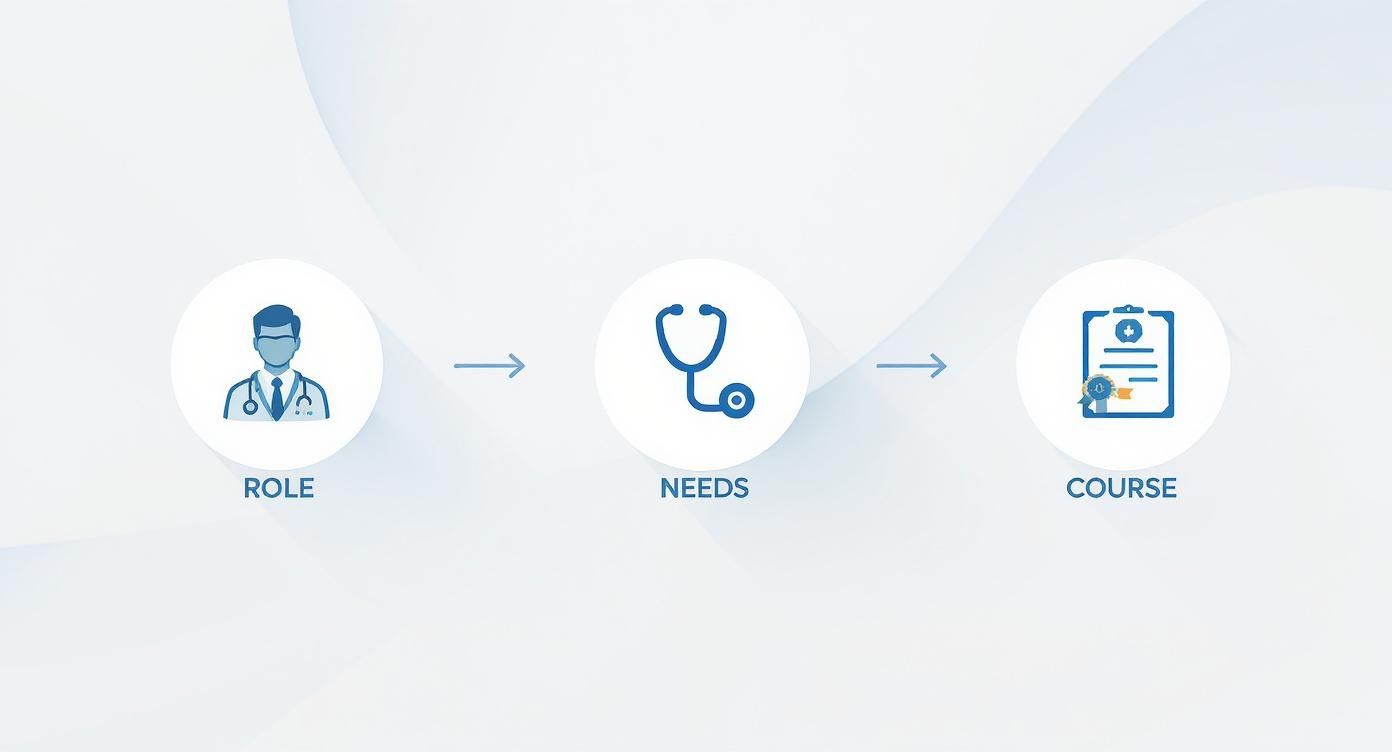
This flow highlights how choosing the right certification isn't a guess—it's a direct path from understanding your clinical responsibilities to meeting patient care standards with a valid, accredited credential.
Blended Learning: The Best of Both Worlds
One of the most popular and trusted methods out there is the blended learning model. It’s the perfect mix of online flexibility and a quick, in-person skills check.
Here’s the breakdown:
- Online Didactic Portion: You'll tackle all the cognitive learning on your own schedule. That means watching video lectures, going through the digital manuals, and passing the written exam—all from your computer or tablet.
- In-Person Skills Session: After you've mastered the online material, you schedule a brief, in-person session with a certified instructor. This isn't a grueling, all-day class. It’s a focused check-off where you physically demonstrate your skills on a manikin to prove your competency.
This model is incredibly efficient and satisfies employers who want to see a documented, hands-on assessment.
Fully Remote Skills Verification
Another option that's gaining significant traction is fully remote skills verification. This lets you complete your entire certification from home, using technology to bridge the distance.
Typically, you'll use a CPR manikin kit. Then, you'll connect on a live video call with an instructor who guides you through the skills. They watch your technique in real-time, providing immediate feedback on your compression depth, rate, and hand placement. It’s a demanding and interactive evaluation that ensures you meet the exact same standards as an in-person class.
The core takeaway here is that "online" does not mean "no hands-on." Both blended and remote verification methods are built to confirm your practical competence, making them credible and valid alternatives to traditional training.
The proof is in the results. Data shows that these online training models prepare professionals exceptionally well. With a 98% success rate for those who complete their training, the numbers speak for themselves. In fact, among healthcare workers, 69% felt more prepared and 63% felt more confident to act in an emergency after getting certified this way. You can learn more about these CPR training outcomes and see for yourself why these methods are becoming the new standard.
Getting Your Online Certification Approved by Your Employer
This is where the rubber meets the road. After choosing an online CPR certification for healthcare providers, you need to be certain your employer will actually accept it. The good news? The old, rigid mindset of only accepting cards from a couple of legacy organizations is fading as the industry evolves.
Today, what truly matters to employers and state boards are quality, compliance, and provable skills. The conversation has thankfully shifted from who issued the card to what standards the training meets. This is a welcome change that recognizes the quality and convenience of modern online education, demonstrating that online certifications are just as good as in-person.
What Really Matters for Acceptance
When you present your certification, you should feel confident, not nervous. The key is choosing a provider that makes it easy to prove their legitimacy. Before you enroll in any online course, you must verify a few things.
- National Accreditation: This is your non-negotiable starting point. Accreditation from a recognized body proves the provider is held to high educational standards and undergoes regular, impartial reviews. It's the bedrock of credibility.
- Adherence to ILCOR/AHA Guidelines: Your training must be built on the most current scientific evidence. Reputable providers will state clearly that their curriculum follows the latest International Liaison Committee on Resuscitation (ILCOR) and American Heart Association (AHA) guidelines for CPR and ECC.
- A Legitimate Hands-On Skills Component: A valid certification must include a verifiable skills assessment, whether it's a blended model with an in-person check-off or a live, remote webcam evaluation. This is what proves you can physically perform high-quality CPR when it counts.
When you can confidently walk into an HR department and show that your certification is nationally accredited, based on the latest AHA guidelines, and includes a hands-on skills check, you've checked all the boxes. A provider like ProMed Certifications gives you everything you need for employer acceptance right from the start.
To make this even easier, use this checklist to vet any online provider you're considering.
Provider Acceptance Checklist
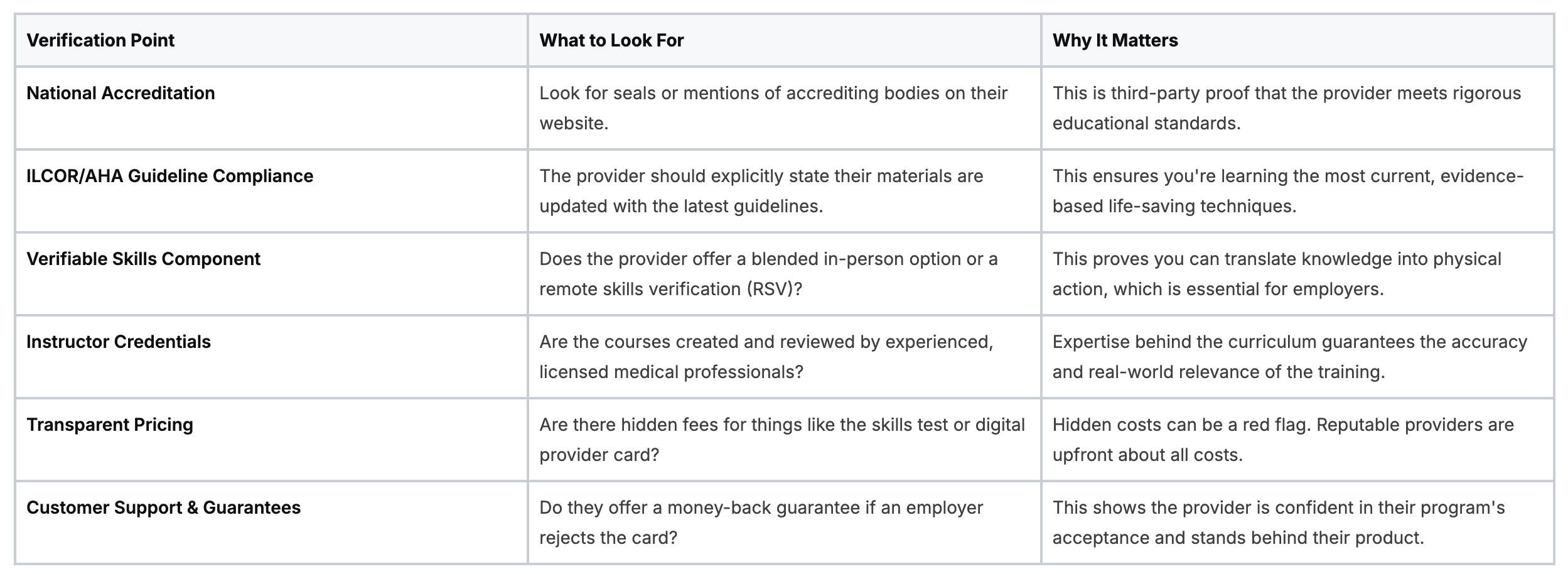
By ticking these boxes, you're not just getting a certification; you're getting peace of mind.
How to Talk to Your Manager
If you're still feeling unsure, a quick conversation with your manager or HR department can clear everything up. But how you ask the question matters.
Don't just ask, "Do you accept online CPR?" That can be a loaded question that invites a knee-jerk "no" based on outdated beliefs.
Frame it with the quality markers in mind. Try asking this instead:
"Does our facility accept certifications from nationally accredited providers whose courses follow the latest ILCOR/AHA guidelines and include a hands-on skills verification?"
This approach completely changes the conversation. It focuses on the standards of quality, not just the delivery method. It shows you’ve done your homework and are committed to credible, effective training. For more specific advice, check out our guide on ensuring your employer will accept a ProMedCert provider card.
Understanding the bigger picture of certification is also helpful. A comprehensive guide to global compliance certification can offer valuable context on why these standards matter so much across different industries. By focusing on accreditation and guideline compliance, you’re aligning yourself with the future of professional education and making sure your credentials are rock-solid.
Managing Your Digital Certificate and Renewals with Ease
You passed your exam—fantastic! Now it's time to get proof of your hard-earned online CPR certification for healthcare providers into the right hands. Thankfully, modern online platforms have made this a million times easier than it used to be.
Gone are the days of anxiously checking the mailbox for weeks, waiting for a physical card. With a provider like ProMed, your digital certificate and wallet card are ready for download the second you pass. You can instantly save, print, or email your credentials straight to your employer, HR department, or credentialing manager. No more delays in updating your compliance records.

This digital-first approach also makes it incredibly simple to update your professional profiles. It's easy to upload the digital file to your resume, LinkedIn profile, or personal portfolio to keep everything current.
Staying Ahead of Expiration with Automated Renewals
Most BLS and CPR certifications for healthcare professionals are valid for two years. In the chaos of a busy clinical setting, it's shockingly easy for that expiration date to sneak up on you, often leading to a last-minute panic to get recertified.
This is a problem modern certification platforms were built to solve. Instead of having to rely on a calendar reminder you set two years ago, you can count on automated renewal notifications to have your back. ProMed, for instance, sends out email and text reminders well before your card expires, giving you plenty of runway to complete your recertification course.
This simple feature turns your certification management from a recurring headache into a seamless, automated process. It ensures you stay compliant without adding yet another task to your plate.
The need for these skills isn't slowing down. The global first aid training market hit USD 4,812.90 million in 2023 and is expected to climb to USD 7,694.95 million by 2032. This growth is fueled by the demand for certified healthcare providers, especially considering that over 356,000 people in the U.S. experience an out-of-hospital cardiac arrest each year. You can discover more insights about the first aid training market and its impact.
Making Recertification Effortless
When it's time to renew, the process is just as straightforward as your initial certification. Most providers offer streamlined recertification courses that zero in on guideline updates and core skill refreshers. This respects your existing knowledge and, most importantly, saves you time.
You just log in, go through the updated material at your own pace, and pass the exam to instantly get your new provider card. It's a smart approach that keeps you current with the latest life-saving techniques without blowing up your schedule.
Still Have Questions About Online CPR?
If you're thinking about getting your online CPR certification for healthcare providers, it's totally normal to have some questions. The world of continuing medical education is always shifting, and it's smart to do your homework. We’ve pulled together some of the most common questions we get from medical pros like you and answered them directly.
The bottom line is this: high-quality, accredited online training isn't just a convenient shortcut; it's an effective and completely valid option for today's healthcare providers. The old idea that only in-person courses from legacy organizations are legitimate is quickly fading as more institutions recognize the value of flexible, evidence-based online learning.
Is an Online BLS Card Valid for Nurses?
Yes, an online BLS card is absolutely valid for nurses, with a critical caveat: it must come from a nationally accredited provider and include a legitimate, hands-on skills verification. The best online programs are built to meet the exact same rigorous standards as a traditional classroom course, covering the identical curriculum guided by ILCOR/AHA recommendations.
The way the information is delivered is different, but the core competencies, clinical knowledge, and life-saving skills you walk away with are the same. This proves that online formats are just as good as in-person for achieving the necessary skills and knowledge.
How Can I Be Sure My Hospital Will Accept It?
This is the big one, right? The answer comes down to choosing a quality provider and communicating smartly. First off, only choose a provider that stands behind its program with a clear acceptance guarantee. That tells you they're confident in their accreditation and curriculum.
Before you even enroll, you can check with your HR department or credentialing manager. But here’s a tip: don’t just ask if they accept "online CPR." That’s a vague question that often gets a knee-jerk "no" based on outdated industry myths.
Instead, ask this:
"Does our facility accept certifications from nationally accredited providers whose courses follow the latest ILCOR/AHA guidelines and include a verifiable hands-on skills component?"
Framing it this way shifts the conversation from the method of delivery to the quality standards, which is what employers actually care about. Reputable providers like ProMed Certifications hit every one of these points, making acceptance a non-issue as the industry evolves toward broader online acceptance.
Are Online Courses As Effective for Learning?
The evidence here is overwhelmingly positive. Numerous peer-reviewed studies have shown that self-paced online learning can lead to equal, and sometimes even superior, knowledge retention than cramming everything into a traditional one-day class.
Think about it. In a classroom, information comes at you fast, and if you miss something, you're out of luck.
With an online course, you have the power to pause, rewind, and re-watch complex video demonstrations until you've truly mastered the concept. This ability to learn at your own speed is a massive advantage that directly translates to better recall, superior patient care outcomes, and more confidence when you’re faced with a real emergency.
At ProMed Certifications, we're proud to be part of this evolution in medical education. We deliver the convenience you want with the credibility and quality your career demands. All of our courses are nationally accredited, built on the latest guidelines, and backed by a 100% acceptance guarantee. We are at the forefront of this change, delivering convenience and credibility.
Ready to see for yourself? Explore our accredited online certification courses and experience a smarter way to stay certified.
.avif)
Stay compliant with ProMed+
Certifications included: ACLS, BLS, PALS, CPR & Neonatal Resuscitation
Unlimited continuing education: over 200 hours of accredited CME
All-inclusive: One price. No surprises.
Get certified today

The Advanced Cardiac Life Support (ACLS) is an accredited online medical certification course that teaches medical professionals to respond to nearly all cardiopulmonary emergencies.

The Pediatric Advanced Life Support (PALS) Recertification instructs medical professionals on performing pediatric cardiopulmonary resuscitation in emergencies.

The Basic Life Support (BLS) Recertification is intended to teach healthcare professionals the basic steps of CPR and rescue breathing for adults, children, and infants.

Our online medical certification course for CPR, Automated External Defibrillator (AED), and First Aid is designed to teach adult, child, and infant CPR and AED use.

The Neonatal Resuscitation Certification trains medical professionals in performing resuscitation procedures and life-saving techniques for newborns at the time of delivery.

.png)
.png)
.png)