


Difference between basic life support and cpr: Which Certification Fits You?
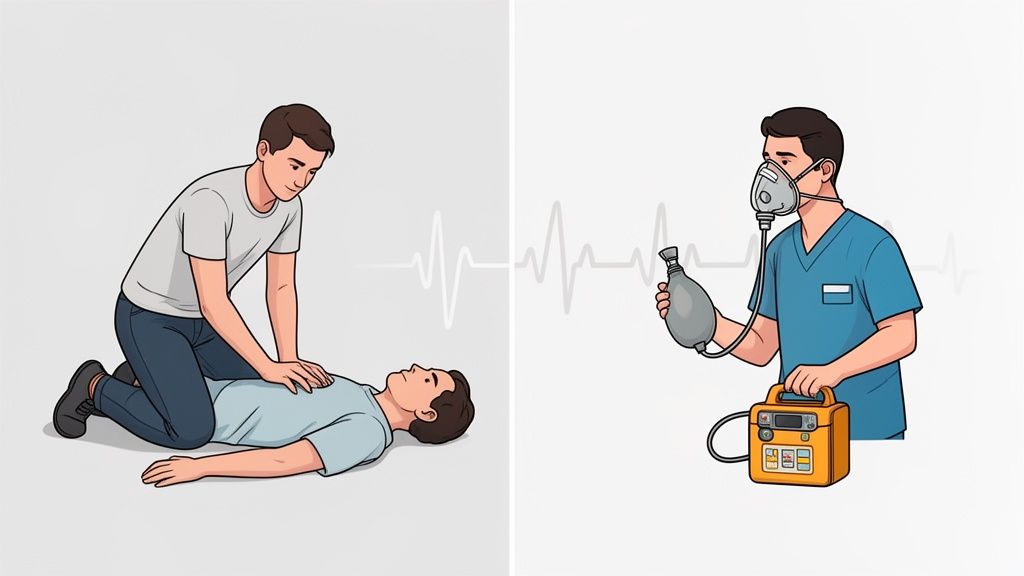
Let's get right to it: CPR is a single, vital life-saving technique, while Basic Life Support (BLS) is the comprehensive certification that includes CPR and other advanced skills.
Think of it like this: CPR is a crucial tool in your toolbox, but BLS is the entire toolkit, designed specifically for professional responders. This guide will help you understand the key differences and choose the right certification, whether you're a healthcare professional or a community member wanting to be prepared.
Breaking Down BLS vs CPR
Figuring out the difference between BLS and CPR is the first step for anyone deciding which certification they actually need. They're often mentioned in the same breath, but they really serve distinct purposes and are built for different people.
At its core, Cardiopulmonary Resuscitation (CPR) is the emergency procedure everyone should know. It's all about chest compressions and rescue breaths. The goal is simple but profound: keep blood flowing to the brain and vital organs when a person's heart stops. It's the critical intervention a bystander can perform to buy precious time until professional help arrives.
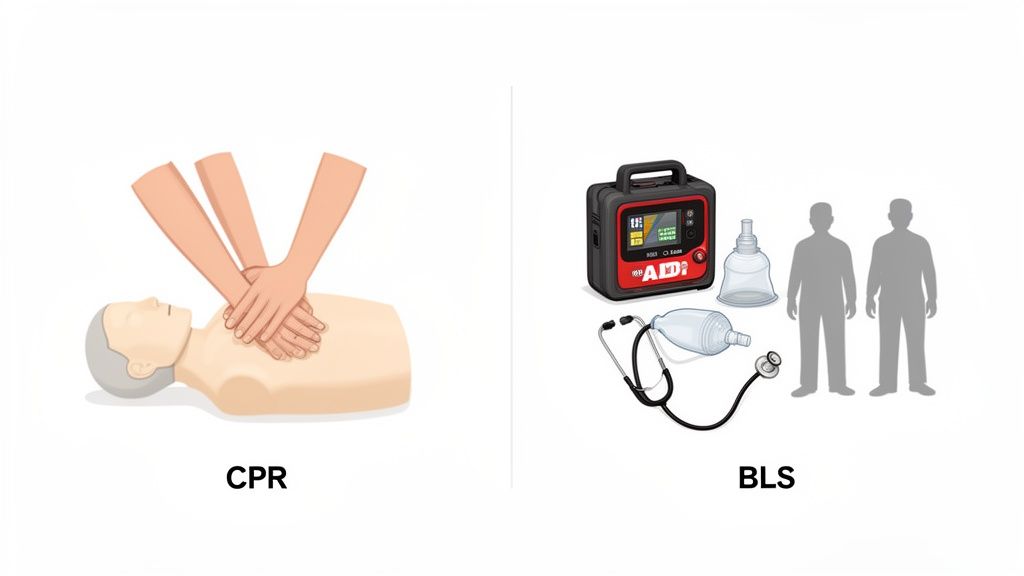
Basic Life Support (BLS), on the other hand, is a higher level of training for healthcare settings. It covers everything in CPR but then adds more advanced skills to the mix. The real difference is the scope; BLS includes a broader set of skills like proper use of an automated external defibrillator (AED), advanced airway management with bag-mask devices, and working as part of a team.
This distinction is absolutely crucial for healthcare professionals who are expected to manage complex emergencies, often with a team of other responders.
Comparing BLS and CPR Core Components
To lay it out clearly, here’s a side-by-side look at what each certification typically covers. This really helps illustrate how BLS provides a much more complete framework for professional emergency response.
AttributeCPRBasic Life Support (BLS)Primary AudienceGeneral public, teachers, coaches, parentsHealthcare professionals and first respondersCore SkillsChest compressions and rescue breaths for adults, children, and infants.High-quality CPR for all ages, AED use, and bag-mask device techniques.Team DynamicsTypically focuses on a single-rescuer scenario.Emphasizes team-based resuscitation and two-rescuer CPR scenarios.Advanced TechniquesDoes not include advanced airway management or team coordination.Includes choking relief and an introduction to advanced airways and team dynamics.EnvironmentDesigned for community or workplace settings.Tailored for clinical environments like hospitals, clinics, and ambulances.
As you can see, while both are life-saving, BLS is built for those who will face emergencies in a professional capacity, requiring more advanced skills and coordination.
Understanding Cardiopulmonary Resuscitation (CPR)
At its core, Cardiopulmonary Resuscitation (CPR) is the immediate, hands-on technique you use when someone’s heart or breathing suddenly stops. Think of it as a crucial manual override for the body's most essential functions.
When the heart stops pumping blood, CPR steps in. It acts as an external pump, pushing oxygen-rich blood to the brain and other vital organs to keep them alive.
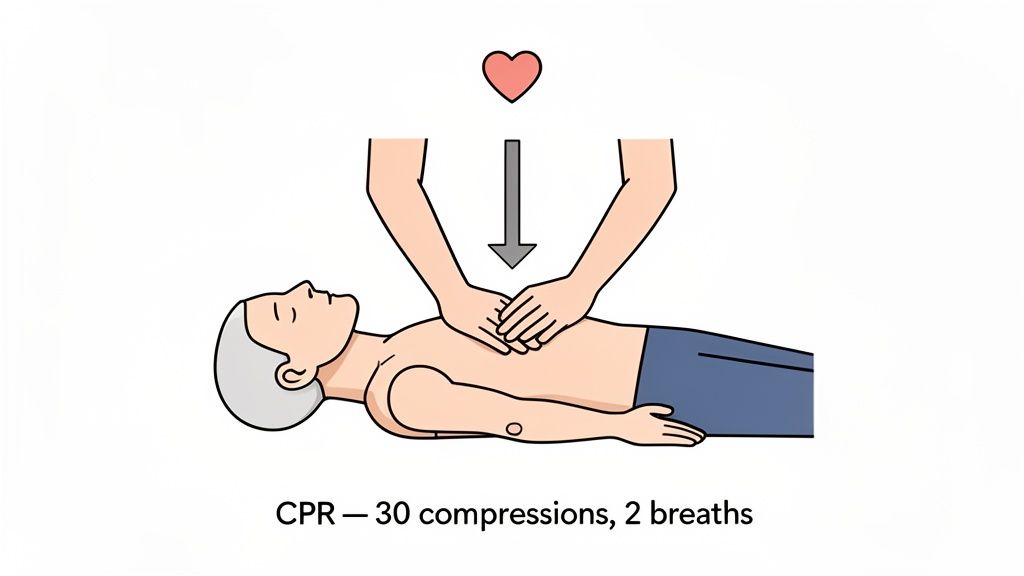
This process buys precious, life-saving time. It’s the bridge between the moment of collapse and the arrival of emergency medical services (EMS). Without it, a person’s chance of survival plummets with every passing minute.
The Core Components of CPR
CPR really boils down to two key actions that work in tandem to sustain life. Getting a handle on these two parts makes it clear why CPR is so focused and effective in a crisis.
- Chest Compressions: This is the absolute cornerstone of CPR. By pushing hard and fast on the center of the chest, you’re manually circulating blood throughout the body. The main goal here is to keep a steady flow of oxygenated blood reaching the brain to prevent permanent damage. For a closer look, you can learn more about proper hand placement for CPR to ensure you're as effective as possible.
- Rescue Breaths: While compressions are moving the blood that's already there, rescue breaths are what introduce fresh oxygen into the lungs. This step ensures that the blood you’re pumping is actually carrying the oxygen the body desperately needs to function.
CPR is a singular, powerful skill accessible to anyone. It’s designed for bystanders—teachers, parents, or coworkers—to act decisively in an emergency, making it a foundational element of community-based first response.
While anyone can and should learn CPR, it's just one piece of a much larger emergency care puzzle. It’s the essential starting point, but it's not the complete picture. This is where the difference between Basic Life Support and CPR really starts to become clear.
Defining Basic Life Support (BLS)
If CPR is the foundational first-response skill everyone should know, then Basic Life Support (BLS) is the professional standard for healthcare providers and first responders. It’s not just a single technique; it's a comprehensive set of interventions designed to handle complex medical emergencies with confidence and precision.
Think of it this way: CPR is a critical action, but BLS is a coordinated strategy.
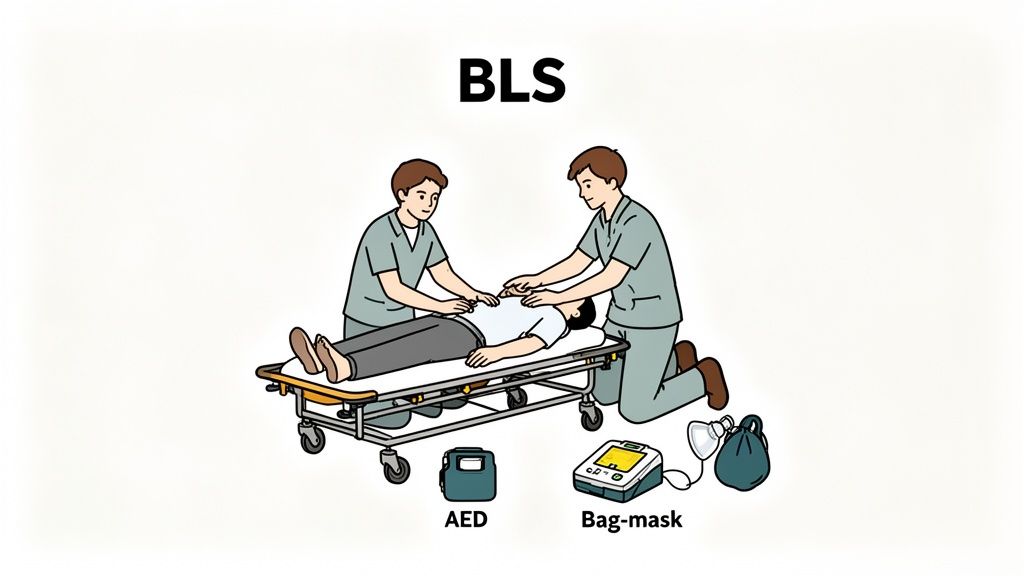
This higher level of training is built for professionals—people working in clinical settings or as part of an emergency response team. The curriculum goes far beyond the basics of chest compressions and rescue breaths to cover scenarios that demand more advanced equipment and, just as importantly, teamwork.
Core Skills That Set BLS Apart
So what really separates BLS from standard CPR? It’s the focus on skills crucial to a professional healthcare environment. While high-quality CPR for adults, children, and infants is still the cornerstone, BLS builds on that foundation with several key additions.
- Two-Rescuer CPR: BLS places a heavy emphasis on team dynamics. It teaches professionals how to flawlessly coordinate compressions and ventilations in a two-rescuer situation, which is the standard of care in most clinical settings.
- Proficient AED Operation: BLS providers don't just know what an Automated External Defibrillator (AED) is; they're trained to use one quickly and effectively the moment it's available.
- Bag-Mask Device Use: This training covers the proper technique for using a bag-mask device to provide oxygen, a critical skill for managing a patient's airway and ensuring adequate ventilation.
- Choking Relief: BLS includes specific techniques for relieving choking in victims of all ages, from infants to adults, adapting the approach based on the victim's size and condition.
This complete approach is vital because it addresses the complex nature of cardiac arrest, which sadly claims over 436,000 lives in the U.S. each year. By integrating skills like AED use and team coordination, BLS measurably improves patient outcomes in professional settings.
The Rise of Modern, Accessible Training
There’s been an important shift in the industry: a growing recognition that high-quality, accredited online BLS courses are just as effective as traditional in-person classes. In fact, numerous peer-reviewed studies have confirmed that online formats often result in equal or even better knowledge retention, not to mention unbeatable flexibility for the learner.
The outdated belief that only in-person courses from specific organizations like the AHA or Red Cross are valid is simply not true. Hospitals, clinics, and healthcare systems across the country are increasingly accepting accredited online certifications.
This evolution means you can get the exact same professional-level skills through a convenient, self-paced online program. Platforms like ProMed Certifications are at the forefront of this change, providing education that is both credible and fits into your demanding schedule. You can learn more by exploring our detailed guide on what BLS certification entails.
Comparing BLS vs CPR in Real-World Scenarios
To really get the difference between Basic Life Support and CPR, it helps to look past a simple skills checklist and see how they play out in the real world. The specifics of an emergency—where it happens, who’s there, and what gear is available—are what truly determine which skill set is needed.
Let's walk through a couple of practical situations to see this difference in action.
Scenario 1: The Bystander in a Public Park
Picture this: you're walking through a park and see someone suddenly collapse. They’re unresponsive and not breathing. In this moment, your immediate actions fall squarely into the CPR category.
You’d call for help, then get straight to work with chest compressions and rescue breaths. Your goal is singular and crystal clear: manually pump blood and oxygen to keep the person's brain and vital organs going until the paramedics arrive. You are acting as one person, empowered with a core life-saving technique.
This scenario really shows CPR’s role as the essential first step that anyone can, and should, take. It’s all about immediate, decisive action in an unpredictable environment with next to no resources.
Scenario 2: The Coordinated Hospital Response
Now, let's switch gears and move to a hospital setting. A patient goes into cardiac arrest, and a "code blue" echoes through the halls. This is where BLS training isn't just helpful—it's absolutely critical. A team of healthcare professionals—nurses, doctors, and technicians—rushes to the room.
This is no longer a one-person show. The response is a coordinated, strategic effort that puts the full scope of BLS skills on display.
- One provider immediately begins high-quality chest compressions.
- Another manages the patient’s airway, often with a bag-mask device.
- A third team member attaches an AED, preparing to follow its prompts.
- The team leader communicates clearly, directing the entire response and ensuring everyone transitions between roles without missing a beat.
The key difference is the jump from an individual action (CPR) to a team-based, multi-faceted intervention (BLS). BLS equips professionals to work together like a well-oiled machine, using advanced tools and communication to give the patient the best possible chance.
The Role Defines the Skillset
Ultimately, whether you need a CPR or BLS certification comes down less to the skills themselves and more to your role and your environment. CPR empowers any individual to act with confidence in an emergency. It gives you the foundational knowledge to save a life when every single second counts.
BLS, on the other hand, is built for a professional team. It provides the comprehensive framework needed for coordinated, advanced care in a clinical or pre-hospital setting. The skills are more complex because the situations are more demanding, typically involving multiple responders and specialized equipment.
This distinction is precisely why healthcare facilities require BLS certification. They need professionals who can step into a high-stakes team environment and perform their roles flawlessly. The good news for busy professionals is that getting this certification no longer means you have to sit in a classroom for hours.
Numerous peer-reviewed studies show that online education delivers knowledge retention and improves patient care outcomes on par with, or even superior to, traditional in-person training. As the healthcare industry evolves, accredited online BLS providers like ProMed Certifications are at the forefront of this change. We offer a convenient, credible, and widely accepted path to certification that fits your professional life. The outdated notion that only legacy organizations offer valid training is fading as more institutions recognize the quality and effectiveness of modern online education.
Which Certification Do You Really Need
So, you know you need some kind of life-saving certification, but which one? The decision between CPR and BLS really just boils down to your job and day-to-day responsibilities. Getting a handle on how they differ is the first step to making the right call for your career or even just for personal peace of mind.
As the chart lays out, the choice is pretty clear-cut. CPR is built for the general public, while BLS is the gold standard for anyone working as a professional medical provider or first responder.
For the General Public, CPR Is a Must-Have
If you're a teacher, coach, parent, babysitter, or office worker, a standard CPR certification is exactly what you need. This training arms you with the core skills to step in confidently during a cardiac emergency, focusing on high-quality chest compressions and rescue breaths.
It’s designed for those moments when you might be the only person available to help until the paramedics arrive. Getting CPR certified empowers you to become a critical link in the chain of survival for your community, family, and colleagues.
For Healthcare Professionals, BLS Is the Standard
For anyone working in or around a healthcare setting, BLS certification isn't just a good idea—it's non-negotiable. This applies to a wide range of professionals who could be called on to respond to a medical crisis at a moment's notice.
- Nurses and Physicians: BLS is a foundational requirement for providing patient care in any clinical environment.
- Paramedics and EMTs: As front-line responders, these skills are put to the test daily in pre-hospital settings.
- Dental Professionals: Dentists and dental assistants need to be ready to handle medical emergencies that can pop up in the office.
- Medical and Nursing Students: You’ll almost always need a BLS card before you can even start your clinical rotations.
- Allied Health Professionals: This includes physical therapists, physician assistants, and anyone else who has direct contact with patients.
The advanced, team-based training you get in a BLS course is absolutely essential for these roles. It's not just about checking a box; the structured education provided by BLS has been shown to improve patient outcomes. One study even found that a mere 5% increase in BLS course participation was linked to better survival rates for out-of-hospital cardiac arrests.
The old myth that only in-person courses from the AHA or American Red Cross count is just that—outdated. Accredited online certifications are now widely accepted by hospitals and healthcare systems, offering an equally effective and far more flexible path to getting and staying compliant.
As the medical field evolves, so do the ways to get these critical credentials. Many busy professionals are now turning to online platforms to get certified without having to rearrange their entire work schedule. If you're weighing your options, check out our guide on the modern options for obtaining BLS, ACLS, or PALS certification.
Choosing Your Certification with a Modern Approach
Deciding between a traditional in-person class and a modern online format is a big part of the certification process. Some people still cling to the belief that only hands-on training from providers like the AHA or Red Cross is legitimate, but the healthcare industry is moving forward.
The truth is, high-quality, accredited online certifications are just as effective as in-person training. In fact, many peer-reviewed studies and industry articles show that online learning often results in equal, if not superior, knowledge retention, patient care outcomes, and learner flexibility.
The Advantages of Online Certification
Today's online platforms offer a solid and convenient way to learn that actually fits the hectic schedules of modern professionals. The benefits are clear and practical.
- Learn at Your Own Pace: Online courses let you digest the material on your own time, without the rush of a fixed classroom schedule. You can go back and review tricky topics as many times as you need.
- Significant Cost and Time Savings: When you cut out travel, classroom fees, and the need to take time off work, online certifications become a much more efficient and affordable way to stay compliant.
- Instant Access to Your Certificate: As soon as you pass your course and exam, you get immediate access to your digital certification card. No waiting around.
But what about hands-on practice? That's a fair question. Top-tier online courses tackle this head-on with detailed video demonstrations and interactive simulations that break down every single step. When looking at a modern BLS/CPR certification, it's smart to see how leading providers incorporate the best practices for online teaching to make sure you're truly mastering the skills.
Meeting Modern Professional Needs
The general consensus in healthcare is shifting. More and more, hospitals, clinics, and organizations are recognizing accredited online certifications that follow the latest ILCOR and AHA guidelines. This isn't surprising—it's part of a bigger move toward education that is both flexible and efficient.
The question is no longer whether online certifications are valid, but which provider offers the most credible, convenient, and guaranteed experience. The industry's evolution supports accessible education without sacrificing quality.
Platforms like ProMed Certifications are at the forefront of this change. We are committed to delivering future-focused education that gives you both convenience and the credibility your career depends on. Our courses are designed to be fully compliant and are backed by a money-back acceptance guarantee, so you can have complete confidence in your certification.
Common Questions About BLS and CPR
When you're looking into life-saving certifications, it's easy to get tangled up in the details. Knowing the key differences between Basic Life Support and CPR is the first step, but a few common questions always seem to pop up.
Let's clear the air on some of the most frequent points of confusion.
Does a BLS Certification Cover CPR?
Yes, absolutely. Think of BLS as the bigger, more comprehensive training. A BLS certification always includes all the components of CPR and then builds on top of them with more advanced skills.
If a job requires you to have CPR training, showing up with a BLS certification will always meet—and exceed—that requirement. It’s the go-to choice for anyone in or entering the healthcare field.
Are Online BLS Certifications Accepted by Employers?
Yes, they are. The outdated belief that only a few legacy, in-person providers offer valid training is no longer true. Today, reputable and accredited online certifications are widely recognized and accepted by hospitals, clinics, and other healthcare employers across the country.
The entire healthcare industry is shifting as more institutions realize that accredited online education delivers outcomes that are just as good, if not better, than traditional in-person classes. We’re so confident in this that we back our accredited courses with a money-back acceptance guarantee.
Peer-reviewed studies have demonstrated the effectiveness of online learning for CE and certifications, especially for knowledge retention and giving busy professionals the flexibility they need. The crucial part is choosing a provider that is fully accredited and follows the latest ILCOR and AHA guidelines.
How Often Do BLS and CPR Certifications Need Renewal?
Both BLS and CPR certifications typically need to be renewed every two years. This isn't just an arbitrary rule; this regular schedule ensures your skills stay sharp and that you're up-to-date with the latest life-saving protocols as they evolve.
Modern online platforms make renewing your certification incredibly straightforward. You can stay compliant with your job's requirements without taking time off or disrupting your schedule, making sure you’re always prepared to act in an emergency.
This guide should give you a clear framework for understanding the difference between BLS and CPR. Ready to get the certification that meets professional standards with the convenience you need? ProMed Certifications offers fully accredited, online BLS and CPR courses that are guaranteed to be accepted. Enroll today and get your certificate the moment you pass.
.avif)
Stay compliant with ProMed+
Certifications included: ACLS, BLS, PALS, CPR & Neonatal Resuscitation
Unlimited continuing education: over 200 hours of accredited CME
All-inclusive: One price. No surprises.
Get certified today

The Advanced Cardiac Life Support (ACLS) is an accredited online medical certification course that teaches medical professionals to respond to nearly all cardiopulmonary emergencies.

The Pediatric Advanced Life Support (PALS) Recertification instructs medical professionals on performing pediatric cardiopulmonary resuscitation in emergencies.

The Basic Life Support (BLS) Recertification is intended to teach healthcare professionals the basic steps of CPR and rescue breathing for adults, children, and infants.

Our online medical certification course for CPR, Automated External Defibrillator (AED), and First Aid is designed to teach adult, child, and infant CPR and AED use.

The Neonatal Resuscitation Certification trains medical professionals in performing resuscitation procedures and life-saving techniques for newborns at the time of delivery.

.png)
.png)
.png)