


Fluid Resuscitation Guidelines: A Clinician's Guide
.png)
A septic patient arrives in the emergency department with hypotension, poor peripheral perfusion, and a rising lactate. The team reaches for intravenous fluid, but the next question matters just as much as the first bolus: Is this patient likely to benefit from more fluid, or will additional volume cause harm?
That question sits at the center of modern fluid resuscitation guidelines. Sepsis, hemorrhage, and uncomplicated hypovolemia can all produce shock, but they don't respond to the same strategy. This guide breaks down the differences, explains the major targets in plain language, and shows how clinicians can use reassessment rather than habit to guide treatment.
Why Fluid Resuscitation Guidelines Matter in Critical Care
In a resuscitation bay, a patient with shock rarely arrives with a neat label attached. The blood pressure may be low, the skin may be cool, the mental status may be altered, and the cause may still be unclear. A clinician has to decide whether the circulation needs crystalloid, blood products, vasopressors, or a combination of therapies.
Fluid resuscitation guidelines provide a shared starting point. They help teams act quickly while avoiding the older assumption that more volume is always better. The modern approach treats fluid as a medication. It has an indication, a dose, a response, and potential adverse effects.

From volume expansion to targeted resuscitation
A major milestone came with the 2016 Surviving Sepsis Campaign update, which strongly recommended at least 30 mL/kg of intravenous crystalloid within 3 hours for adults with sepsis-induced hypotension or lactate at least 4 mmol/L. The recommendation was carried forward in later guidance and became a recognizable early-fluid target in emergency departments, intensive care units, and sepsis bundles worldwide.
That target isn't a permission slip for unlimited infusion. It establishes an early response while the team identifies the infection source, evaluates perfusion, and determines whether the patient remains fluid responsive. A patient with septic vasodilation may need fluid and vasopressor support. A patient with uncontrolled bleeding may deteriorate if large crystalloid volumes raise pressure before hemorrhage is controlled.
Practical rule: Start with the shock mechanism, not the fluid bag.
Why education must match bedside complexity
Guidelines are easier to apply when you understand the physiology behind them. A strong evidence-based practice framework helps clinicians connect recommendations with patient context, clinical examination, and reassessment.
Online CE and certification make that learning more accessible without reducing it to a lower standard. Interactive cases, repeated review, and self-paced study let busy professionals revisit the distinction between sepsis and hemorrhage until the decision pattern becomes familiar. Accredited online education is also gaining acceptance among hospitals, clinics, and healthcare organizations, so the outdated idea that only an in-person AHA or American Red Cross class can be valid no longer reflects every accepted training pathway.
Understanding the Basics of Fluid Resuscitation
Think of the circulation as a leaking bucket. Before adding water, you need to ask why the bucket is leaking, whether the leak can be repaired, and whether more water will reach the tissues. Fluid resuscitation works best when clinicians match the fluid type, amount, and timing to the underlying problem.
Crystalloids and colloids
Crystalloids contain small dissolved molecules that move through the vascular space and interstitial space. Balanced crystalloid solutions are commonly used because guidelines identify crystalloids as first-line therapy for sepsis and septic shock. The goal isn't to fill every compartment. It's to support circulating volume while the team treats the cause of shock.
Colloids contain larger molecules intended to remain in the intravascular space longer. Albumin may have a selective role in particular situations, but routine early resuscitation has moved away from colloids. The broader shift reflects a preference for simpler, evidence-based crystalloid strategies rather than automatic use of older volume-expansion approaches.

Choosing the right category
Use these questions to organize the initial decision:
- Crystalloid first: Is the patient experiencing sepsis-induced hypoperfusion or another state where intravascular volume support is appropriate?
- Selective colloid use: Does the patient have a specific clinical context in which albumin may be considered, rather than receiving it automatically?
- Blood products for blood loss: Is hemorrhage reducing oxygen-carrying capacity and circulating volume at the same time?
That last distinction is critical. A liter of crystalloid doesn't replace lost red blood cells or clotting factors. In hemorrhagic shock, the treatment plan must address blood loss, coagulation, temperature, and surgical or procedural control of bleeding.
Online learning supports this foundation because you can pause a fluid comparison, retake an assessment, and revisit the physiology without waiting for a classroom date. For professionals caring for newborns, Neonatal Resuscitation Certification is described by ProMed as a 100% online certification with review material, an exam, and card delivery in as quick as one hour or less.
Sepsis Resuscitation Protocols and Evidence-Based Targets
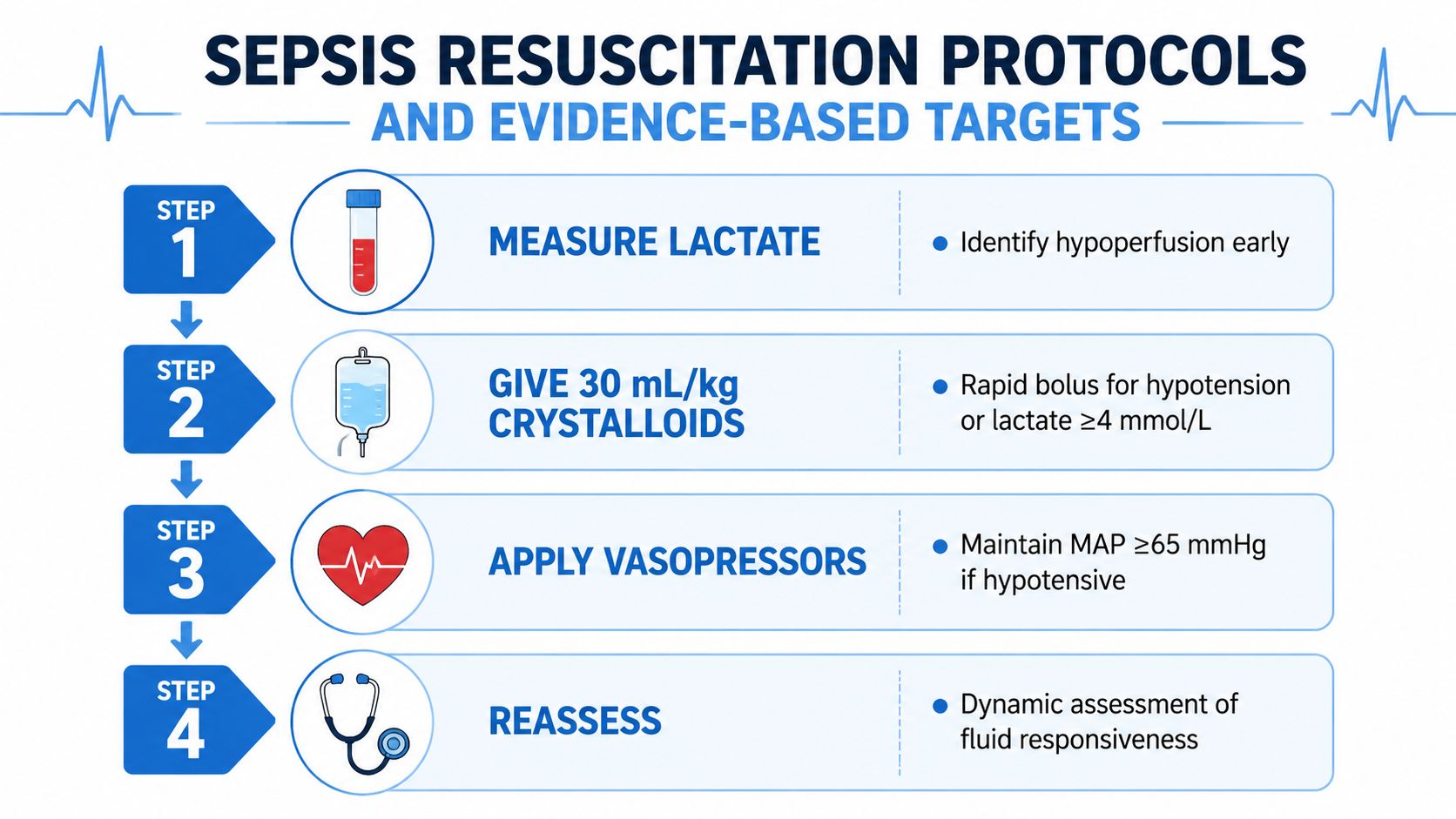
A patient with septic shock may remain hypotensive after an initial fluid bolus. That moment separates protocol-based action from ongoing clinical judgment. For adults with sepsis-induced hypoperfusion or septic shock, major guidelines recommend immediate crystalloid resuscitation, typically at least 30 mL/kg during the first 3 hours, when sepsis-induced hypotension or lactate at least 4 mmol/L is present. Crystalloids remain the first-line fluid choice.
Treat that volume as an initial threshold, not an automatic finish line. One patient may improve after the first bolus. Another may need vasopressors for persistent hypotension, while a third may show ongoing hypoperfusion despite receiving the expected volume. The bedside response determines the next intervention.
A practical sepsis sequence
- Measure lactate and assess perfusion. Lactate can indicate hypoperfusion, but interpret it with the examination and the wider clinical picture.
- Administer initial crystalloid. Give the early guideline-supported volume when the patient meets the relevant criteria, while considering comorbidities and fluid-overload risk.
- Support pressure when needed. Persistent hypotension may call for vasopressors rather than repeated fluid loading.
- Reassess dynamically. Check changes in stroke volume, perfusion, blood pressure, mental status, and other clinical endpoints.
Fluid should work like a measured adjustment, not an open tap. In a large analysis of 25,513 patients with sepsis, mortality exceeded the predicted rate when more than 6 liters were administered during the first 24 hours. Mortality increased by 2.3% for each additional liter beyond that level, supporting cautious, reassessment-driven care.
The 2026 Surviving Sepsis Campaign update contains 129 total statements, including 46 new statements, with greater emphasis on definitive recommendations and dynamic measures. This reflects a shift from protocol-only care toward decisions guided by physiology. It also shows why sepsis and trauma cannot share one automatic fluid rule. Sepsis often begins with early crystalloid support, while hemorrhagic shock requires attention to bleeding, clot formation, and blood replacement.
The same structured, reassessment-driven approach is reinforced in programs such as neonatal resuscitation certification, where rapid intervention sequences are practiced until they become automatic. Medication readiness matters when fluids do not restore circulation. Reviewing medications on a crash cart connects fluid decisions with the wider resuscitation sequence.
Trauma and Hemorrhagic Shock Resuscitation Strategies
Trauma creates a critical divergence in fluid resuscitation guidelines. In sepsis, early crystalloid supports circulation during profound vasodilation and relative intravascular depletion. In uncontrolled hemorrhage, large crystalloid volumes can dilute clotting factors, worsen hypothermia, and increase pressure against an unstable clot.
That means the same automatic fluid rule shouldn't be applied to septic shock, hemorrhagic shock, and uncomplicated hypovolemia. The cause of shock determines whether the immediate priority is restoring circulating volume, preserving a forming clot, replacing blood, or controlling the source.
Permissive hypotension and its limits
For severe trauma with ongoing bleeding, restrictive or permissive-hypotension strategies are guideline-supported. European trauma guidance targets a systolic blood pressure of 80 to 90 mmHg until hemorrhage is controlled. This approach aims to provide enough perfusion for essential organs without using high pressure to disrupt clot formation.
Severe traumatic brain injury is the important exception. In that setting, clinicians must preserve cerebral perfusion, and the cited trauma guidance recommends maintaining a mean arterial pressure at or above 80 mmHg. The brain injury changes the pressure goal, so the trauma team must identify it early.
Blood replacement instead of crystalloid loading
Hemorrhagic shock involves more than loss of water. The patient may lose red cells, plasma, platelets, and heat. Replacing only crystalloid can restore a number on the monitor while leaving oxygen delivery and coagulation impaired.
Current trauma-oriented discussions increasingly favor balanced blood-product resuscitation over large crystalloid volumes. A 2026 trauma-related guideline presentation highlights 1:1:1 blood-product ratios, while a 2025 prehospital review recommends restricting fluids during uncontrolled bleeding to minimum blood-pressure targets and considering vasopressors when fluids aren't enough.

Burns add another layer because the size of the injury helps determine the resuscitation plan. Clinicians who need a practical refresher on how to estimate TBSA with the rule of nines can use that framework alongside local burn protocols and specialist consultation.
Online certification is well suited to these contrasts. A case-based module can place septic shock and hemorrhagic shock side by side, then require you to explain why a large crystalloid bolus may be reasonable in one scenario and harmful in the other. That flexibility is valuable for clinicians who need focused review without leaving the workplace for a classroom session.
Monitoring Fluid Responsiveness and Clinical Endpoints
A patient can remain hypotensive after fluids have stopped helping. The key question is whether another dose will increase forward blood flow, or add volume that the heart cannot use. In practical terms, fluid responsiveness resembles testing a pump before adding more water. You briefly change venous return, measure what happens, and then decide whether another bolus has a reasonable target.
A bedside workflow
Begin with one question: Will additional fluid improve effective circulation? Use a dynamic maneuver or measurement when the clinical setting allows it.
- Passive leg raise: Elevating the legs shifts venous blood toward the chest for a short time. A measurable rise in stroke volume supports possible preload responsiveness.
- Fluid challenge with a measured endpoint: If a bolus is appropriate, define the expected response first. Reassess stroke volume, pulse pressure, blood pressure, and perfusion instead of repeating boluses automatically.
- Stroke volume variation: In selected mechanically ventilated patients, respiratory variation in stroke volume can provide information about preload responsiveness.
- Pulse pressure variation: Respiratory changes in pulse pressure may also help identify patients likely to respond, although interpretation depends on ventilation and patient conditions.
Sepsis guidance favors dynamic assessment rather than relying on physical examination or static measurements alone. Passive leg raise or a fluid-bolus response can be assessed through stroke volume, stroke volume variation, pulse pressure, or pulse pressure variation, as noted earlier.
The same measurement can lead to opposite decisions in different shock states. In sepsis, vasodilation may leave a patient responsive to carefully assessed fluid. In hemorrhagic trauma, ongoing blood loss means crystalloid may dilute clotting components and delay blood-product resuscitation. A favorable temporary blood-pressure change does not correct either the infection or the bleeding source.
Look beyond a single monitor value
Clinical endpoints show whether perfusion is improving:
- Lactate trend: Serial values can help track resolution of hypoperfusion, but fluids should not continue automatically until lactate normalizes.
- Mental status: Improved alertness may indicate better cerebral perfusion. New confusion requires renewed assessment.
- Urine output: Kidney perfusion and renal function add useful context, but urine output must be interpreted with the whole clinical picture.
- Capillary refill and skin findings: These are supportive signals, not proof of fluid responsiveness by themselves.
- Blood pressure and vasopressor need: A pressure increase is useful, yet it does not establish normalized tissue perfusion.
For physicians who need structured, on-demand education, ProMed+ Physician CME offers a dynamic streaming library with over 200 AMA PRA Category 1 Credits™ to support state licensure mandates. Online case practice can be just as effective as classroom review when it requires clinicians to connect each measurement with the next treatment decision.
Common Pitfalls and the Value of Online Certification
The most common mistake is treating a guideline target as a permanent order. The initial sepsis volume has a purpose, but a patient may later need vasopressors, source control, blood products, or a different diagnostic pathway. Continuing fluids without checking response turns a useful intervention into an avoidable exposure.
Errors that deserve deliberate practice
- Using one shock protocol for every patient: Sepsis and trauma point in different directions because their physiology differs.
- Ignoring fluid intolerance: Heart failure, kidney dysfunction, pulmonary edema, and worsening oxygenation should change the risk calculation.
- Relying on static signs alone: Blood pressure and heart rate matter, but they don't reliably predict whether another bolus will improve stroke volume.
- Forgetting the source: Fluid can't fix uncontrolled bleeding or an untreated infection. Definitive treatment must proceed alongside hemodynamic support.
- Delaying vasopressors while chasing a number: Persistent vasodilatory shock may require vascular support rather than more crystalloid.
Clinical habit: Before every additional bolus, name the expected benefit and the measurement that will tell you whether it occurred.
The same deliberate-practice principle applies to continuing education. Peer-reviewed evidence doesn't support the outdated belief that online learning is inferior to classroom instruction. A meta-analysis of internet-based learning in the health professions found large positive effects compared with no intervention for knowledge, skills, and learner behaviors or patient effects. Compared with non-internet formats, the differences were generally small, suggesting similar effectiveness. The meta-analysis reports a pooled knowledge effect size of 1.00, skills effect size of 0.85, and learner behavior or patient effect effect size of 0.82.
A separate systematic review found that 12 of 50 studies reported significantly higher knowledge gains online, while 27 found no significant difference or mixed results. Among 29 studies measuring satisfaction, 20 found no difference and 4 favored online learning.
Evidence isn't perfectly uniform. One review found that e-learning may make little or no difference compared with traditional education for some patient outcomes, behaviors, skills, or knowledge, while another review found it was at least as effective as traditional learning and superior to no instruction for improving healthcare professional behavior.
Spaced learning adds another advantage. A 2024 systematic review found spaced online education superior to massed online education for post-intervention knowledge, with a standardized mean difference of 0.32. The review also concluded that spaced education improved knowledge, skills, confidence, and clinical practice change.
Online CE and certification are flexible, accessible, and increasingly accepted by healthcare institutions. AHA and American Red Cross courses remain recognized options, but they aren't the only possible pathways. ProMed Certifications offers online medical certification courses, including ACLS, PALS, BLS, CPR, and neonatal resuscitation, allowing healthcare professionals to study at their own pace and revisit material as needed.
Putting It All Together and Next Steps for Your Career
Fluid resuscitation begins with a simple question: What caused the shock? From there, the decision becomes more precise.
- Sepsis: Start with guideline-supported crystalloid resuscitation, then reassess dynamically and add vasopressor support when indicated.
- Trauma with uncontrolled bleeding: Limit crystalloid exposure, protect clot formation, pursue hemorrhage control, and use blood products when appropriate.
- Severe traumatic brain injury: Avoid applying permissive hypotension without considering the need to preserve cerebral perfusion.
- Any shock state: Define the expected response before giving more fluid, then measure whether the patient improved.
The most capable clinicians don't memorize one universal bolus. They recognize patterns, understand the physiology, and adjust treatment as new information arrives. That skill grows through repeated exposure to realistic cases, current guidance, and focused review.
Online CE and certification provide that learning pathway without requiring a fixed classroom schedule. The evidence supports online formats as comparable to traditional learning in many settings, while spaced, self-paced study can make it easier to retain difficult distinctions. Hospitals, clinics, and professional organizations are increasingly recognizing accredited online education as a practical part of ongoing competence.
Build confidence with the shock scenarios that matter most in practice through ProMed Certifications, including flexible online ACLS, PALS, BLS, CPR, and neonatal resuscitation courses. Visit ProMed Certifications to review available options and strengthen your preparation for fluid decisions, vasopressor use, and high-stakes resuscitation care.
.avif)
Stay compliant with ProMed+
Certifications included: ACLS, BLS, PALS, CPR & Neonatal Resuscitation
Unlimited continuing education: over 200 hours of accredited CME
All-inclusive: One price. No surprises.
Get certified today

The Advanced Cardiac Life Support (ACLS) is an accredited online medical certification course that teaches medical professionals to respond to nearly all cardiopulmonary emergencies.

The Pediatric Advanced Life Support (PALS) Recertification instructs medical professionals on performing pediatric cardiopulmonary resuscitation in emergencies.

The Basic Life Support (BLS) Recertification is intended to teach healthcare professionals the basic steps of CPR and rescue breathing for adults, children, and infants.

Our online medical certification course for CPR, Automated External Defibrillator (AED), and First Aid is designed to teach adult, child, and infant CPR and AED use.

The Neonatal Resuscitation Certification trains medical professionals in performing resuscitation procedures and life-saving techniques for newborns at the time of delivery.

.png)
.png)
.png)