


CPR Certification for Teens: Quick Guide
.png)
A weekend-long classroom course from the American Heart Association or American Red Cross isn't the only valid path to CPR certification for teens. Accredited online education can deliver the same essential knowledge, current guidance, testing, and practical preparation, while fitting around school, sports, family responsibilities, and part-time work.
CPR matters because a bystander may need to act before emergency responders arrive. The American Heart Association says immediate CPR can double or triple survival after out-of-hospital cardiac arrest, and hands-only CPR for a teen or adult uses 100 to 120 chest compressions per minute. This guide will help teens and parents understand age readiness, compare course formats, complete certification, and keep skills fresh.
Why Online CPR Training Is Just as Valid
Many families still assume that only an in-person AHA or American Red Cross class counts. That belief made more sense when digital courses were limited to passive videos and basic quizzes. Modern online certification is different. Accredited programs can combine current clinical content, interactive lessons, knowledge checks, exams, and structured review.
The broader healthcare education field has already moved toward digital learning. A review of 77 systematic reviews found that digital education commonly measures knowledge, skills, attitudes, and satisfaction, demonstrating how established online formats have become in healthcare training. A separate review covering 93 studies and 16,895 participants concluded that online and blended learning may be equivalent to self-directed or face-to-face education for practicing physicians, with digital learners often achieving similar or higher post-intervention scores (systematic review of online medical education).
What makes an online course credible
A valid online course should clearly identify its educational standards, assessment process, certification documentation, and renewal expectations. It should also explain whether the learner must complete a practical demonstration, video assessment, or another skills component for a particular school or employer.
Hospitals, clinics, schools, and youth organizations increasingly recognize accredited online continuing education and certifications. That shift resembles online drivers education, where students also learn important safety decisions through structured digital lessons.
Online learning also removes barriers that have nothing to do with CPR competence. A teen can study in shorter sessions, revisit difficult explanations, and avoid losing an entire weekend to travel and classroom scheduling.
The important distinction isn't online versus in-person. It's credible, well-designed education versus weak education. A traditional classroom can be excellent, but sitting in a room doesn't automatically make a course more rigorous.
Age Requirements and Physical Readiness
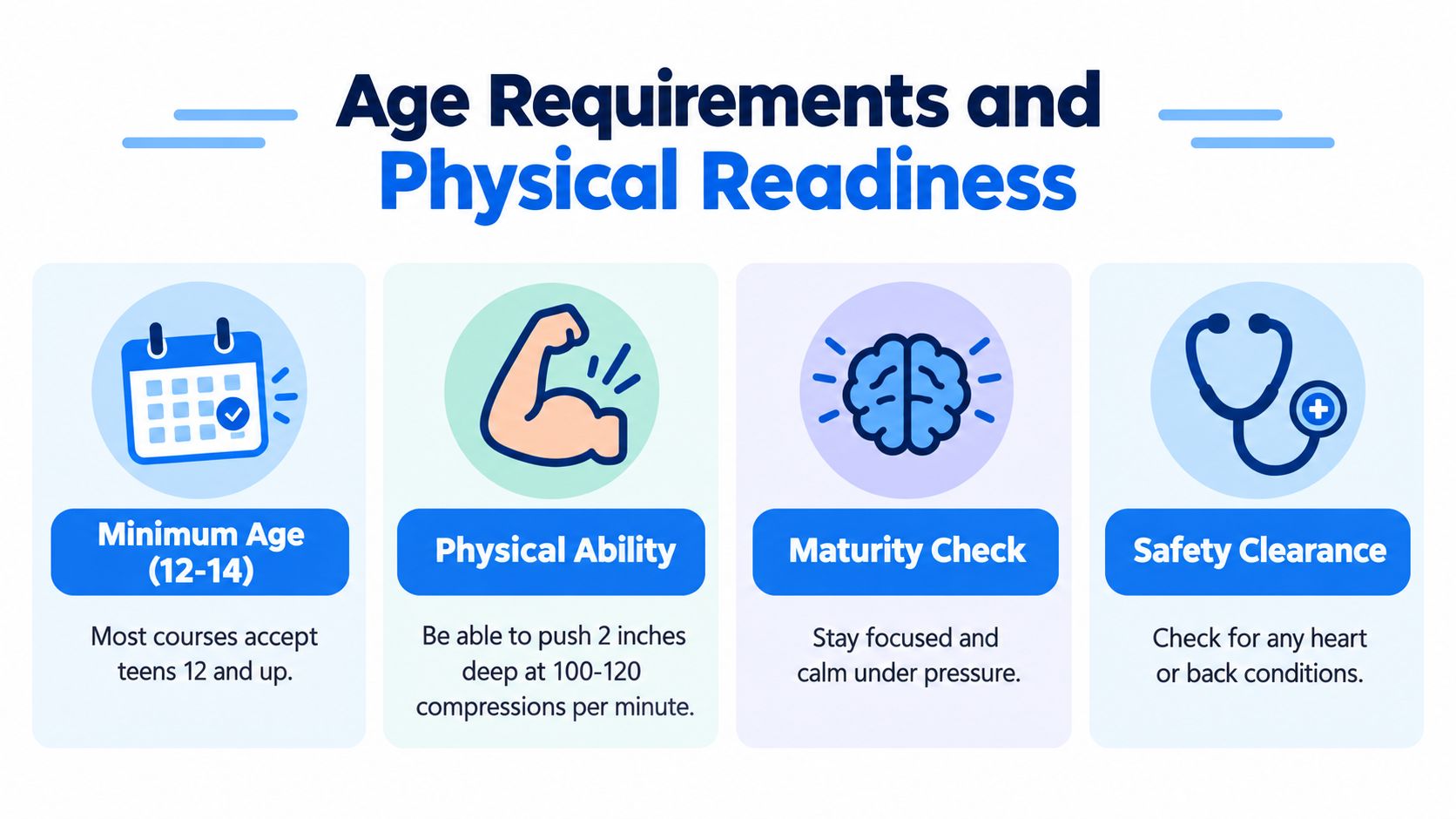
A teenager does not need to spend an entire weekend in a classroom to begin learning CPR. The American Heart Association states that there is no minimum age requirement for learning CPR, and children as young as nine can learn and retain these skills. The same guidance says children 12 years old or older can be taught effective CPR and defibrillation. Teens therefore have a suitable foundation for structured training, including an accredited online course that lets them review lessons when needed.
Readiness involves more than a birth date. A student should be able to focus on instructions, recognize an emergency, call for help, and stay calm during practice. Physical readiness matters too. Effective compressions require body weight, a steady rhythm, and repeated pressure until another responder takes over or the situation changes. The skill works like a repeated movement drill: correct positioning and rhythm matter more than physical strength alone.
What teens should expect during practice
For a teen or adult who suddenly collapses outside a hospital, hands-only CPR focuses on firm, rapid chest compressions. The target is 100 to 120 compressions per minute, as described by the American Heart Association. Students can review hand placement, rhythm, and depth with this practical guide to chest compressions.
Parents should contact the course provider if a teen has a condition affecting the heart, back, joints, stamina, or ability to kneel and press repeatedly. Such a condition may not prevent participation, but the provider can recommend an appropriate adaptation or skills arrangement.
Families seeking a digital course covering CPR, AED, and first aid can review CPR AED & First Aid Certification, described as a 100% online certification. Its course snapshot says learners can review the material, complete the exam, and receive their card in as quick as one hour or less.
The purpose is practical: help a teenager recognize an emergency, start an appropriate response, and coordinate the physical skills needed to help.
Comparing Online and In-Person Course Formats
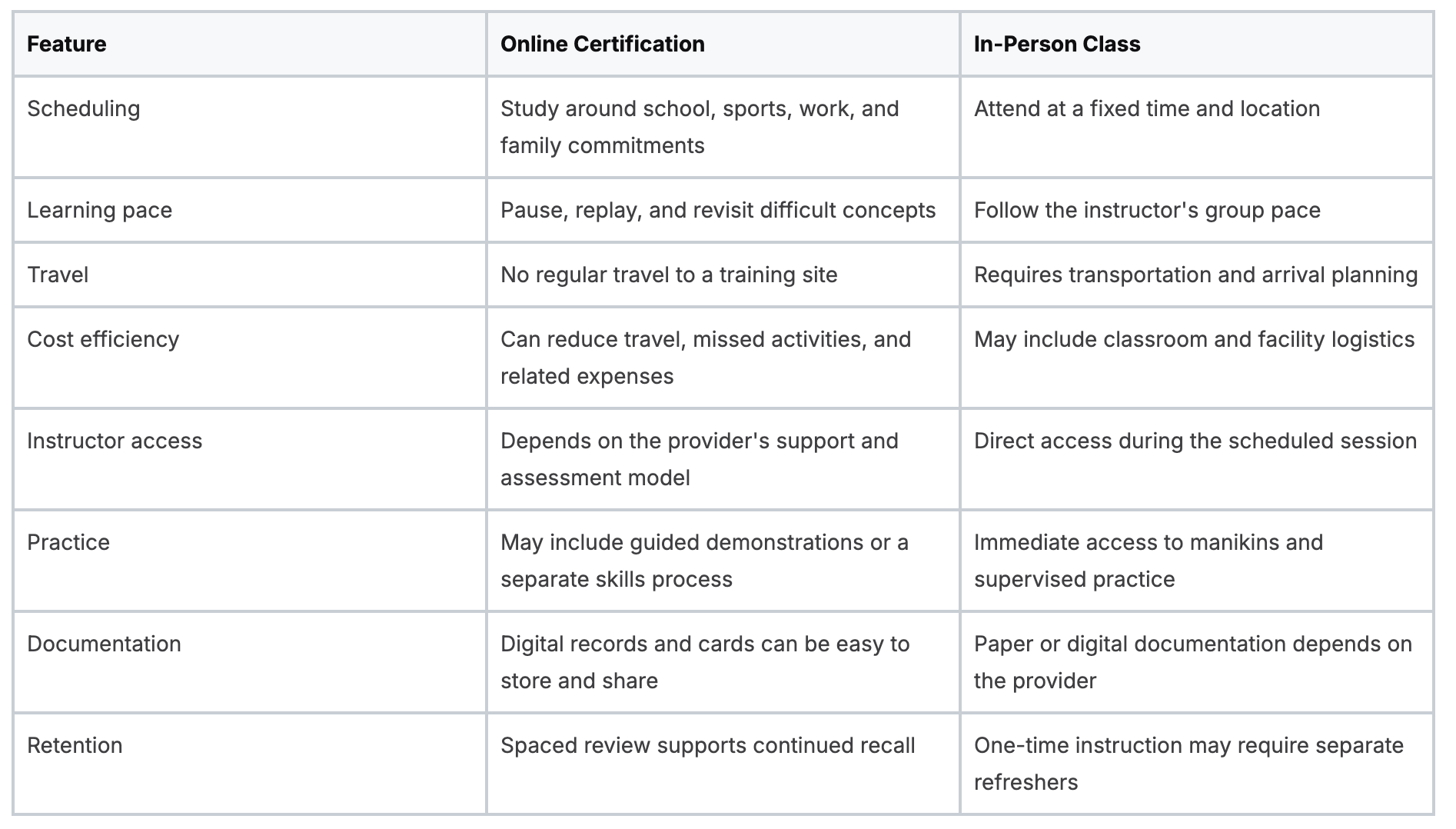
Online and in-person courses can both work well, but they solve different scheduling and learning problems. A classroom gives students immediate access to an instructor and physical equipment. An online course gives students control over timing, repetition, and location.
The strongest digital programs also use more than a single long lecture. A 2024 systematic review and meta-analysis found that spaced online education was superior to massed online education for post-intervention knowledge, with a standardized mean difference of 0.32, and concluded that digital education can improve knowledge, skills, confidence, and practice change (systematic review of spaced digital education). That matters for teens because a short review after the initial course may be more useful than trying to remember one dense session months later.
Matching the format to the requirement
Before enrolling, ask who will accept the certification. A school, summer program, babysitting employer, or sports organization may have its own rules about accreditation, skills testing, course scope, and documentation.
Healthcare learners may also encounter a separate course category. BLS Certification is described as a 100% online BLS certification that learners can complete anywhere and anytime within their schedules. That option is intended for BLS requirements, so a teen should choose it only when the requesting organization specifically asks for BLS.
Online certification isn't automatically superior in every circumstance. In-person practice can help learners who need physical coaching. Still, the evidence supports digital and blended learning as legitimate educational formats, and online study is often the more practical choice for a motivated teen who needs flexibility.
Steps to Get Certified and Prove Your Skills
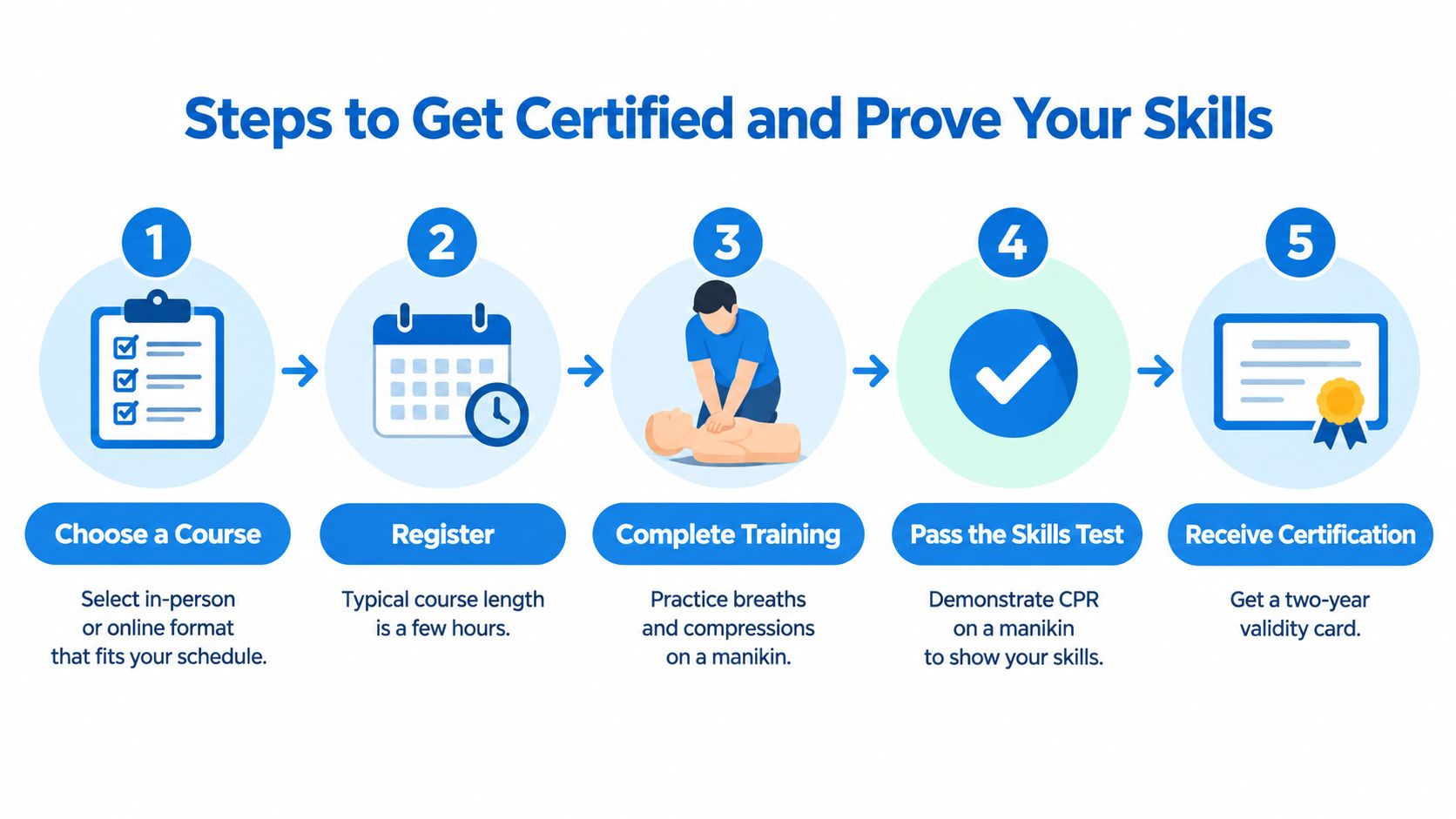
Getting certified becomes easier when you treat it as a checklist rather than a mysterious process. The exact sequence varies by provider, but a responsible learner should confirm the course requirements before beginning.
1. Choose a course that matches the purpose
Start with the organization that needs proof. A school may want general CPR and AED training. A childcare role may require CPR and first aid. A healthcare pathway may require BLS or another provider-specific credential.
Check the course description for:
- Content: Confirm that it covers the emergency skills you need, such as CPR and AED use.
- Assessment: Look for a clear exam, skills evaluation, or other required demonstration.
- Recognition: Ask the school, coach, or employer whether it accepts that provider.
- Documentation: Confirm what certification card or completion record you'll receive.
2. Register and complete the learning modules
Enter your information accurately, then work through the lessons rather than skipping directly to the exam. Interactive modules should explain scene safety, emergency recognition, compressions, AED use, and the decisions that connect those actions.
Take notes on anything that feels uncertain. Online learning is especially useful here because you can pause, replay, and review a concept before moving forward.
3. Pass the exam and complete any skills requirement
A knowledge exam checks whether you understand the correct response. If the course includes a practical component, follow the instructions for demonstrating compressions or other techniques on a manikin or through the provider's approved process.
The CPR certification exam guide can help learners understand why preparation matters. Don't treat the test as a memory game. Use it to confirm that you can recognize an emergency and choose the correct next action.
Here's a helpful preparation routine:
- Review the sequence: Know what to do first, including checking safety and activating emergency help.
- Practice the rhythm: Use the recommended compression rate during supervised practice.
- Explain your choices: If a question feels tricky, identify what the scenario is asking before selecting an answer.
- Save your records: Keep the completion email, certificate, and card together.
4. Present proof clearly
Download the digital card or certificate as soon as it becomes available. Save it in a secure folder, print a copy if requested, and send the exact document to the school, coach, or employer.
A digital credential is easier to share, but acceptance still depends on the organization's policy. Ask for confirmation before submitting it, especially if the activity has a formal medical or safety requirement.
Meeting School and Extracurricular Requirements
Teens often pursue CPR certification for a concrete reason. A health class may require it. A babysitting opportunity may prefer it. A lifeguarding, camp, scouting, volunteering, or sports program may ask for documented emergency training.
The certificate alone doesn't guarantee acceptance. Requirements differ between schools, districts, employers, and organizations, so the student should ask for the policy in writing before enrolling. Confirm the approved provider, course title, subject coverage, certification documentation, and whether an in-person skills check is required.
Questions to ask before enrollment
- Does the organization accept online certification? Don't rely on a friend's experience or an old school handout.
- Which course does it require? CPR, CPR and AED, first aid, BLS, or a broader combination may have different purposes.
- What proof must you submit? The organization may request a card, certificate, transcript, or verification record.
- When must the training be current? A valid-looking card may not meet a rule about recent completion.
- Does the activity require a specific renewal cycle? Record the relevant date in a phone calendar and keep a backup copy.
The need for freshness deserves special attention. In a high-school intervention, only 29.5% of students performed chest compressions before training, compared with 99.2% after training. At a four-month follow-up, 99% still performed correct chest compressions. The result supports a simple habit, learn the skill, practice it, then schedule a short refresher within three to four months.
Why one certificate isn't the whole solution
Another randomized trial involving 220 high school students found that real-time visual feedback produced a 20% higher compression score at training completion than standard training. The advantage continued at 10 and 28 weeks, but not at 52 weeks. The same study found that correct compression rate and depth weakened during later follow-up, showing why brief repetition matters.
A teen interested in a more advanced healthcare course may see ACLS Certification listed as an online option. ACLS serves a different educational purpose from basic teen CPR, so the student should follow the exact requirement rather than choose a more advanced title just because it sounds impressive.
Taking the Next Step Toward Saving Lives
CPR certification for teens is more than a résumé line. It gives a student a practiced response for a moment when another person may be unresponsive and ordinary bystanders may hesitate.
The training gap remains substantial. A major U.S. parent survey found that only 20% of parents said their teen had CPR training, while just 7% said their teen had been trained to use an AED (national survey on teen CPR preparedness). Yet 93% of parents said they'd want a trained teen to help during an emergency, although 34% would want that only if no adult was available. Those findings reveal both support for teen readiness and uncertainty about when teens should act.
Training helps replace uncertainty with a clear plan:
- Recognize the emergency and check whether the scene is safe.
- Call for emergency help and follow the dispatcher's directions.
- Begin appropriate CPR when a teen or adult suddenly collapses.
- Use an AED when available and follow its spoken or visual prompts.
- Continue until professional help takes over or the situation changes.
Online education makes that preparation easier to fit into real student life. It also supports review, repetition, and flexible pacing, while accredited providers can offer recognized documentation for the organization that requested it. In-person classes remain useful for learners who want direct coaching, but they aren't the only credible choice.
Choose a course that matches the requirement, study actively, verify your skills, and schedule refreshers before the knowledge becomes distant. A prepared teen may be the person who starts the response when every second matters.
ProMed Certifications offers online CPR, AED, and First Aid certification that lets learners review the material, complete the exam, and receive a card in as quick as one hour or less. Visit ProMed Certifications to choose an online course that fits your schedule and take a practical step toward being ready to help.
.avif)
Stay compliant with ProMed+
Certifications included: ACLS, BLS, PALS, CPR & Neonatal Resuscitation
Unlimited continuing education: over 200 hours of accredited CME
All-inclusive: One price. No surprises.
Get certified today

The Advanced Cardiac Life Support (ACLS) is an accredited online medical certification course that teaches medical professionals to respond to nearly all cardiopulmonary emergencies.

The Pediatric Advanced Life Support (PALS) Recertification instructs medical professionals on performing pediatric cardiopulmonary resuscitation in emergencies.

The Basic Life Support (BLS) Recertification is intended to teach healthcare professionals the basic steps of CPR and rescue breathing for adults, children, and infants.

Our online medical certification course for CPR, Automated External Defibrillator (AED), and First Aid is designed to teach adult, child, and infant CPR and AED use.

The Neonatal Resuscitation Certification trains medical professionals in performing resuscitation procedures and life-saving techniques for newborns at the time of delivery.

.png)
.png)
.png)