


DEA Renewal CME Requirements: A Practical Guide
.png)
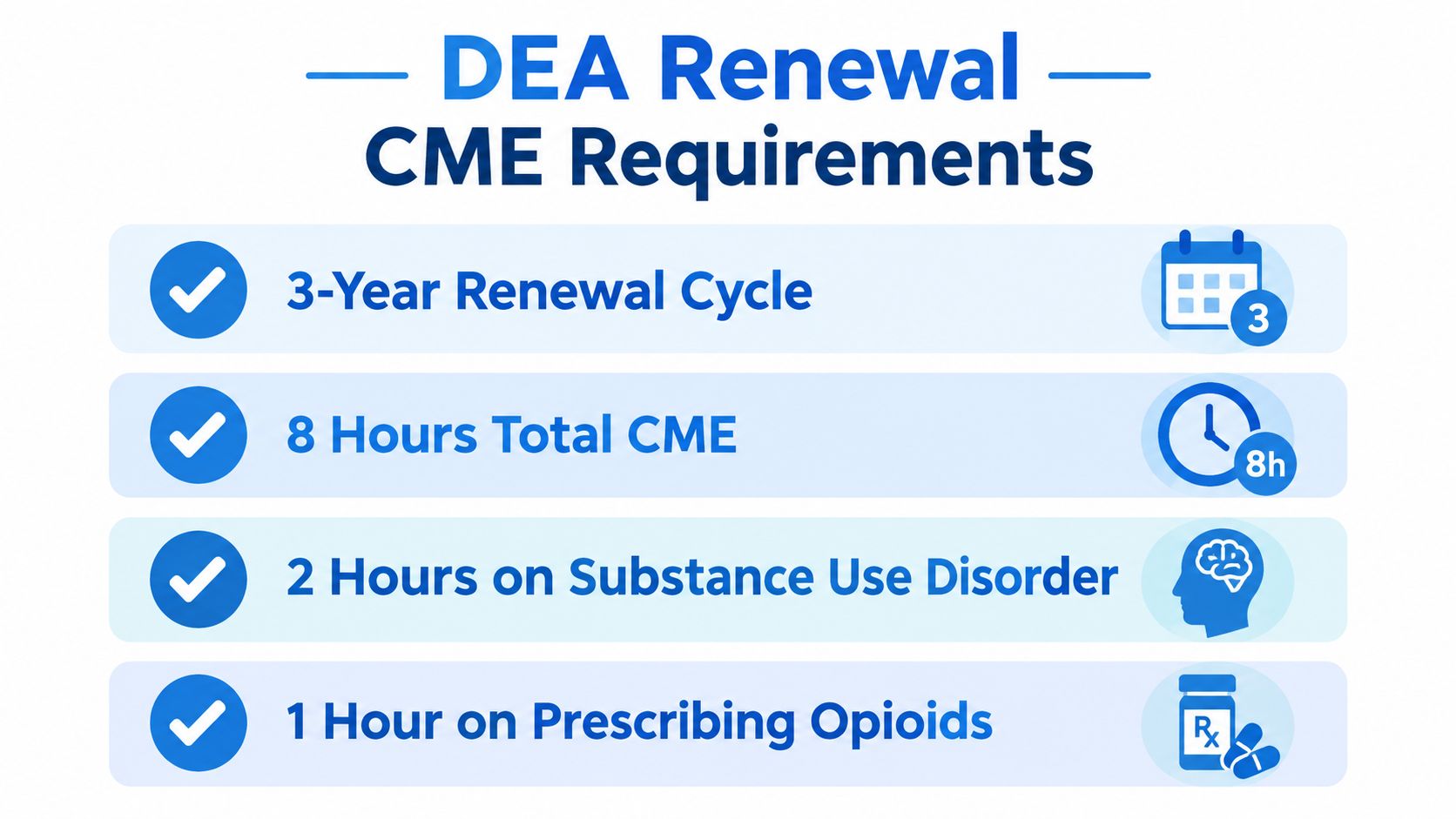
The MATE Act requires a one-time 8 hours of training for most DEA-registered practitioners who prescribe controlled substances. Once you've completed the training and attested to it, future DEA renewals don't require repeating the 8 hours.
You may encounter the requirement while renewing a DEA registration during a busy clinical week, often as a checkbox that seems simpler than the rule behind it. The practical question is whether your prior education already qualifies, what records you should keep, and whether an online course is acceptable. This guide breaks down the federal requirement, common exceptions, documentation habits, and a workable online completion plan.
What DEA Renewal CME Requirements Actually Ask of You
At the three-year registration mark, you log into the DEA renewal system, review your information, and reach a training attestation. The checkbox represents a federal education obligation created by the Medication Access and Training Expansion Act, or MATE Act, which took effect on June 27, 2023. The requirement applies when practitioners submit a new or renewed DEA registration for Schedule II through Schedule V controlled medications. SAMHSA's MATE Act guidance explains the federal training framework and timing.
In plain language, most eligible prescribers need to do three things:
- Complete at least 8 hours of qualifying training on opioid or other substance use disorders, including safe pharmacologic management of dental pain.
- Complete the training by the next scheduled DEA registration submission, rather than immediately on the law's effective date.
- Attest to completion on the DEA application or renewal form.
The obligation generally covers physicians, nurse practitioners, physician assistants, dentists, and other DEA-registered practitioners who prescribe controlled substances. It's tied to federal registration, not to one particular state CME cycle. DEA registrations generally renew every 3 years, so the MATE Act places a one-time educational checkpoint inside a recurring administrative process. DEA's MATE Act FAQ describes the broad scope and attestation approach.
The federal requirement is separate from other renewal tasks
The MATE Act training isn't the same thing as the DEA registration fee, the three-year registration cycle, hospital credentialing, or state license CME. You may need to manage all of these, but completing one doesn't automatically complete the others.
The attestation also isn't a request to upload a certificate every time you renew. You'll usually check a box confirming that you've satisfied the education requirement. Still, retain certificates, course descriptions, and accreditation details in case a regulator or state board asks you to verify your training.
Practical rule: Treat the attestation as a legal statement, not as a routine click. Confirm what counts before submitting the renewal.
Breaking Down the 8-Hour MATE Act Training
The 8 hours don't have to be completed in one sitting. You can complete them cumulatively through multiple sessions, and relevant prior education may count. The University of Iowa's MATE Act CME guidance confirms that training may be accumulated across sessions and discusses the role of prior education.
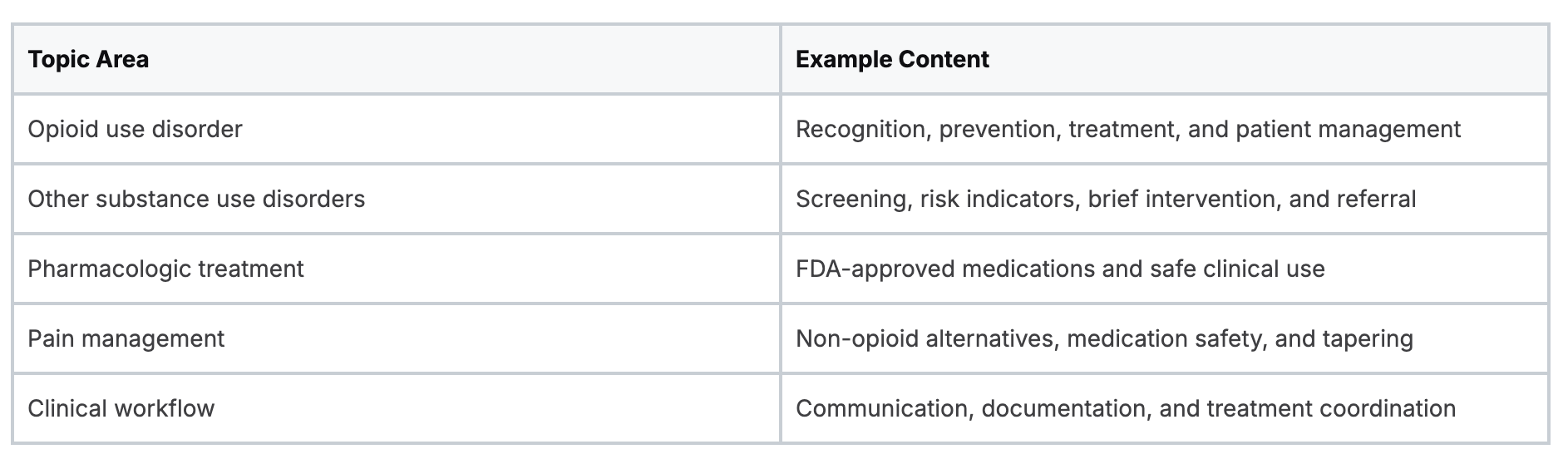
The content should help you recognize substance use disorders, manage patients safely, and connect patients with appropriate treatment. A qualifying activity may address:
- Opioid and substance use disorders: Prevention, recognition, treatment, management, misuse indicators, screening, and referral.
- Medication-based treatment: FDA-approved medications for substance use disorders and the clinical decisions surrounding their use.
- Pain management: Safe pharmacologic treatment of acute and chronic pain, non-opioid options, and tapering strategies.
- SBIRT concepts: Screening, brief intervention, and referral to treatment.
- Prescribing safety: Risk assessment, patient communication, and practical approaches to controlled-substance prescribing.
The exact mix can vary by course. What matters is that your records show the activity's relationship to the required subject matter and that the provider is appropriately accredited or otherwise recognized under the federal framework. Grand rounds, residency or fellowship curricula, classroom instruction, and accredited CME can all be relevant pathways when they're documented and traceable.
Use a topic audit instead of relying on the course title
A course called “pain management” may not cover substance use disorder treatment. Another course may discuss opioid prescribing but omit referral practices or medication treatment. Before enrolling, read the objectives and save the syllabus or activity description.
The addiction medicine training resource can help clinicians place the MATE Act topics in a broader clinical context. A separate CPR AED & First Aid Certification course is described as a 100% online certification for CPR, AED, and First Aid, but CPR education shouldn't be assumed to replace MATE Act substance use disorder training.
Why Online CME Fulfills the Requirement Just as Well
The DEA's federal training rule doesn't require practitioners to sit in a physical classroom. That means an appropriately accredited online activity can be a valid way to complete the education, provided the course covers the required material and produces reliable completion records.
Online learning also fits the realities of clinical work. A rural prescriber may not be able to travel for a weekend seminar. A high-volume practice may struggle to release several clinicians at the same time. Self-paced modules let learners divide education into manageable sessions, return to difficult material, and keep the certificate in a digital record.
The format itself doesn't determine educational quality. A systematic review and meta-analysis of undergraduate medical education found a statistically significant post-test advantage for online learning compared with offline learning, with SMD 0.81, a 95% confidence interval of 0.43 to 1.20, p<0.0001, and n=15. The review found no evidence that offline learning worked better.
Online and in-person formats serve different workflows
In-person education can offer live discussion, networking, and hands-on simulation. Online CME can offer flexible scheduling, lower travel burden, and immediate access to course records. For MATE Act education, which centers on knowledge and clinical decision-making, an online format can be just as effective when the activity is well designed.
A controlled trial involving 5,621 U.S. physicians found that participants in internet CME were more likely to make evidence-based clinical choices. The study reported an average effect size of 0.75 and a 45% increased likelihood of evidence-based decisions in clinical case vignettes. Review the controlled internet CME trial.
The better question isn't “online or in person?” It's “Does this activity teach the required content, support application, and document completion clearly?”
The belief that only American Heart Association or American Red Cross in-person classes are valid is outdated. Those organizations may be relevant to separate BLS, CPR, or employer credentialing requirements, but BLS isn't the same as MATE Act training. Hospitals, clinics, and professional organizations increasingly recognize accredited online CE and certification pathways, while learners continue to value flexibility and accessible records. The broader shift is gradual, but online education is now a routine part of healthcare professional development. For additional context, see how online continuing medical education works.
Documenting, Reporting, and Attesting Your Training
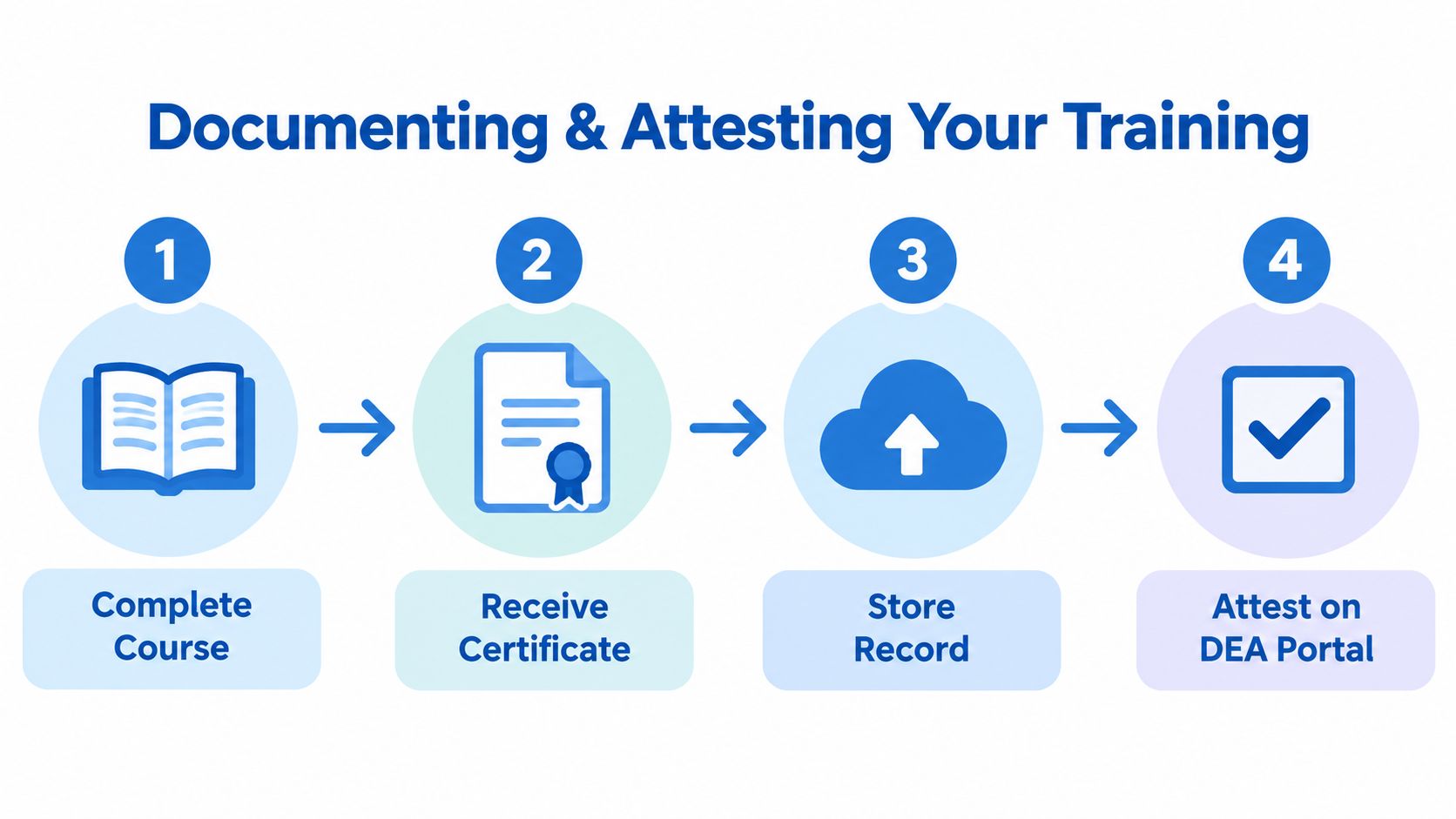
The certificate is the document that connects your completed education to the checkbox on the DEA portal. A useful certificate should identify the provider, activity title, completion date, awarded credit, and accreditation statement. It should also make the activity's MATE Act relevance clear, either on the certificate or in an accompanying course description.
Before you enroll, look for documentation that includes:
- Provider identity: The organization that delivered or accredited the activity.
- Accreditation language: For example, an ACCME, AMA, AOA, AAFP, AANP, ADA, or other applicable accreditation statement.
- Activity title: The exact name should match your saved course record.
- Completion date and credit: Keep the date and the amount of training completed.
- Content evidence: Save objectives, syllabus pages, or a description that maps the activity to MATE Act topics.
The DEA portal and your state board are different systems
The federal process is generally attestation-based. You check the applicable box during a new or renewed DEA registration application rather than uploading certificates as part of every renewal.
State boards and institutions may add their own reporting rules. A state board may request proof during an audit, and an employer may require a separate certificate for credentialing. Don't assume that a federal attestation automatically updates a state licensing file.
A simple file system prevents most last-minute searches. Use a name such as MATE_Training_Provider_Date, save the certificate and course description together, and maintain a secure cloud backup. If your education came from multiple activities, keep a one-page log showing the total and the topics each activity addressed.
Documentation habit: Save the certificate before you close the course window. A completion email is helpful, but the certificate and course description create a stronger record.
For nurses and organizations that need broader reporting support, a CE management platform may offer automated state-board reporting and digital certificates. A CE broker account overview can help clarify how those workflows differ from the federal DEA attestation.
Exceptions and Prior Training That Can Count Toward the 8 Hours
The biggest source of confusion is assuming every practitioner starts from zero. Federal guidance recognizes several pathways through which previous education or professional qualifications may satisfy the obligation. The details matter, so match your background to the official guidance rather than relying on a course advertisement.
Possible pathways include:
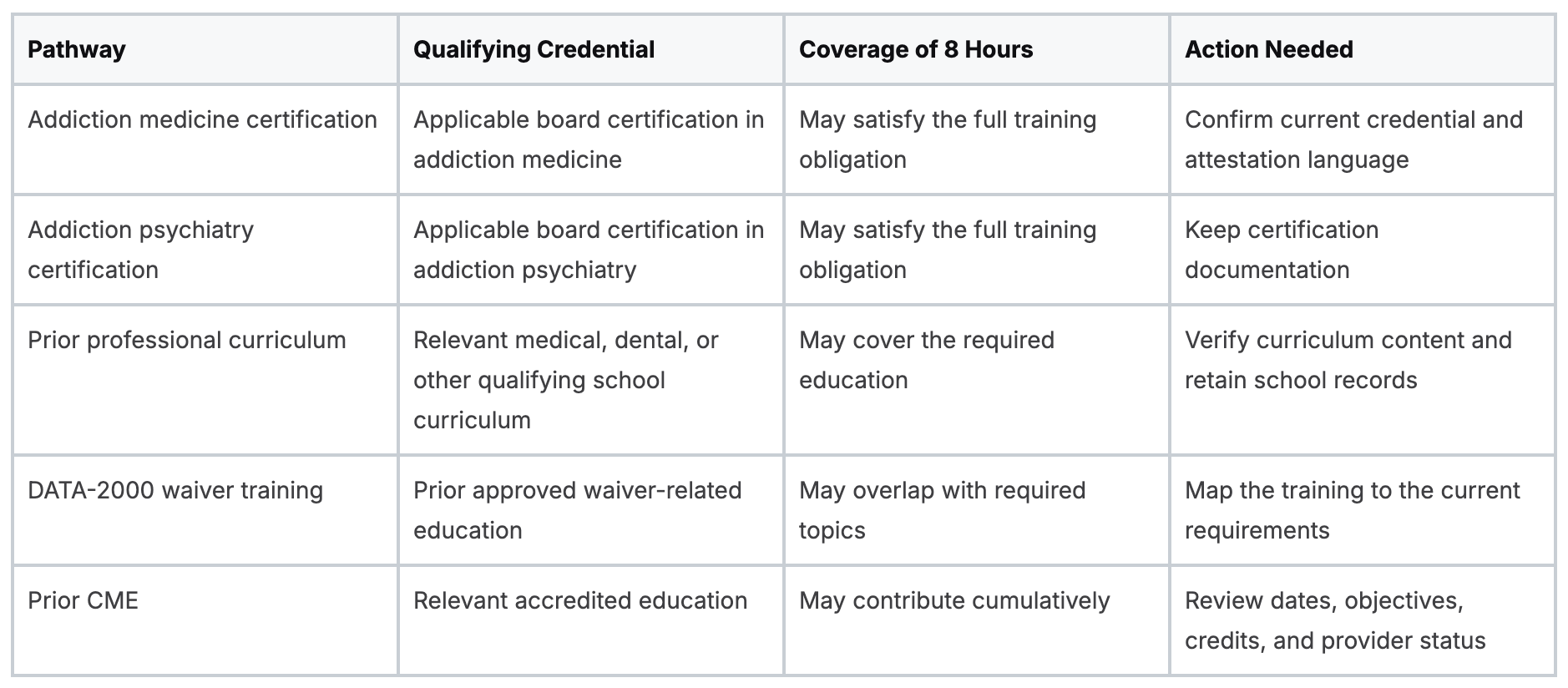
The DEA and professional guidance identify addiction medicine and addiction psychiatry board certification as important exemption pathways. Recent professional school curricula may also qualify when the required material was embedded in the program. The relevant question is not just whether you graduated recently. It's whether your curriculum included the necessary substance use disorder education.
Review DATA-2000 training carefully
A prior DATA-2000 waiver, often called X-waiver training, may overlap with the MATE Act topics. It shouldn't be treated as an automatic answer without checking the training record. The waiver system and the MATE Act requirement are related, but the current attestation still depends on whether your prior education fits the applicable pathway.
Use this self-screening checklist:
- Credential check: Do you hold a qualifying addiction medicine or addiction psychiatry board certification?
- Curriculum check: Did your professional school curriculum include the required substance use disorder content?
- Topic check: Does your prior training address recognition, treatment, medications, pain management, screening, and referral?
- Record check: Can you identify the provider, date, activity, and educational content?
- Gap check: Which topics are missing or unclear?
If your records show partial coverage, a focused online course can close the gap without forcing you to repeat education you've already completed. If the record is ambiguous, contact the accrediting organization or your licensing authority before attesting.
Your Practical Roadmap to Finish DEA Renewal CME Online
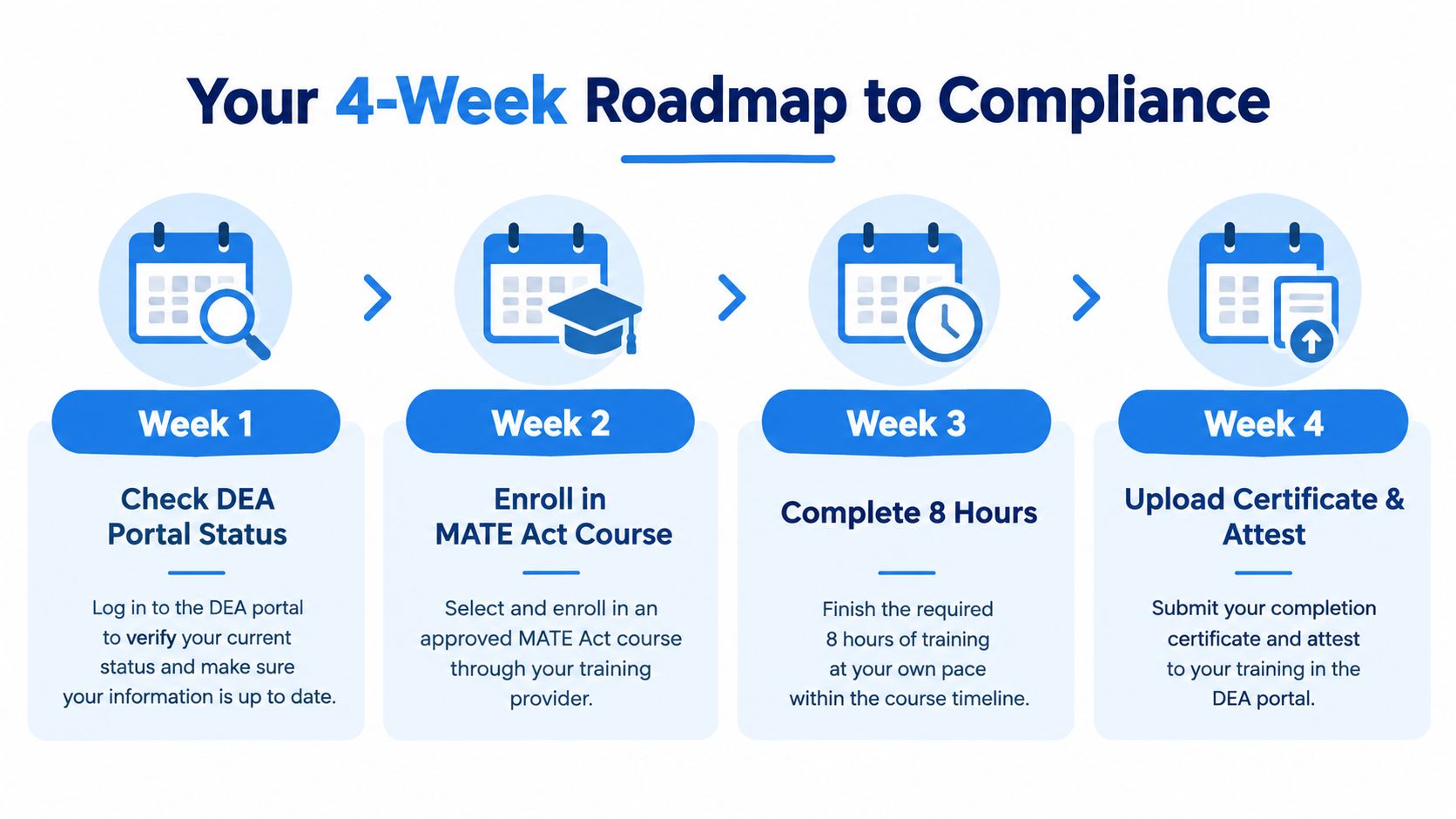
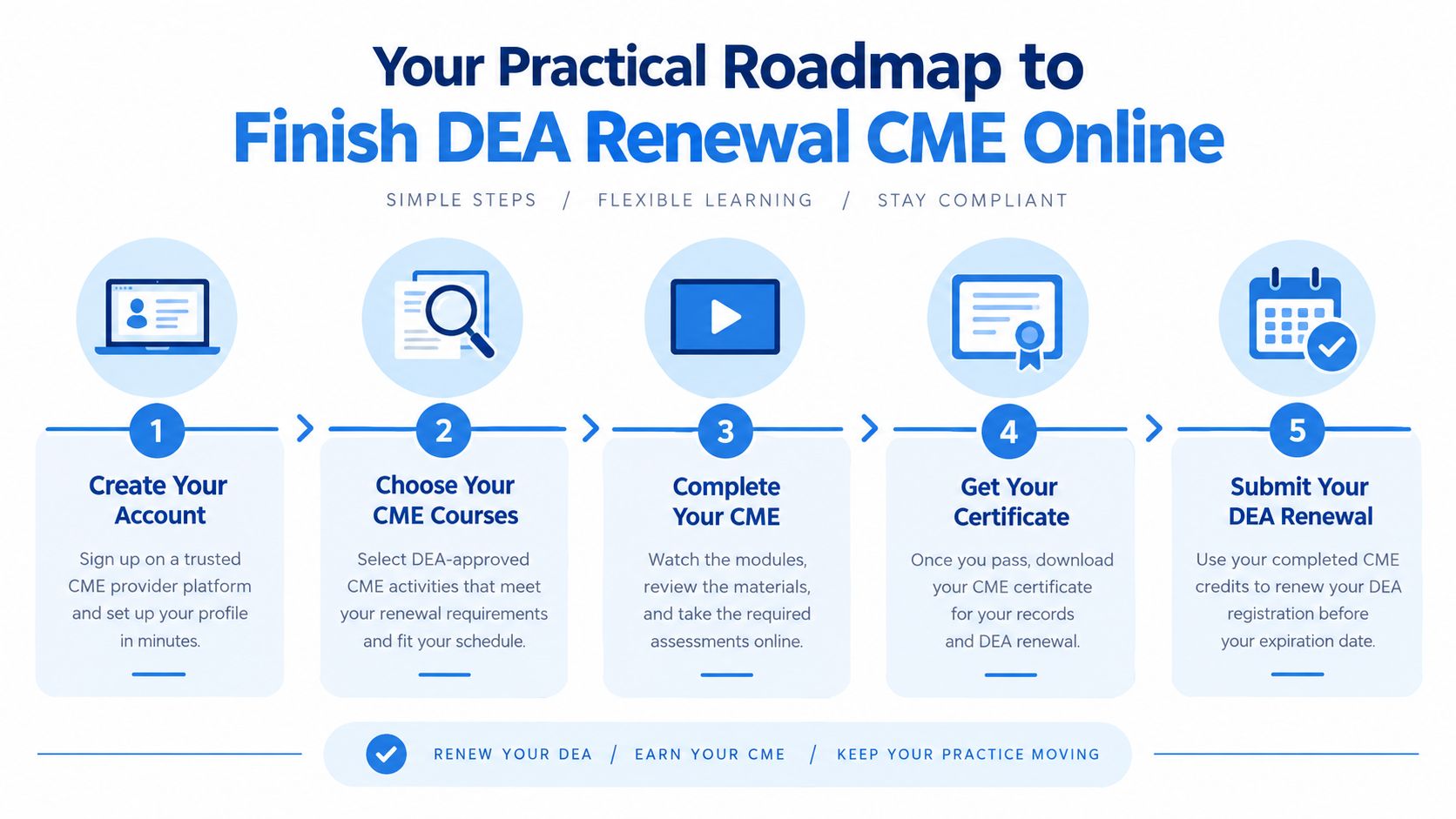
Start by determining whether you need additional training. Review your board certification, school curriculum, DATA-2000 records, and previous CME. Once you know there's a gap, use a short plan that protects clinical time and leaves room for documentation.
A focused 14-day schedule
Day 1: Confirm your DEA registration status and review state-specific CME requirements. Federal compliance doesn't eliminate separate state obligations.
Day 3: Shortlist providers with recognized accreditation, clear MATE Act language, complete learning objectives, and certificates that identify the completed hours.
Day 5: Enroll in an 8-hour MATE Act bundle or combine qualifying activities that collectively cover the required topics. Check whether the platform supports mobile access and lets you learn in separate sessions.
Day 10: Complete modules in 30- to 45-minute blocks during appropriate downtime. Use case-based questions and brief notes to improve recall instead of rushing through slides.
Day 12: Download every certificate, save the course descriptions, and update your education log. Match the certificate name to the activity you completed.
Day 14: Log into the DEA portal when your registration is due, review the attestation carefully, and submit it only after confirming your records.
Choose a course by evidence, not convenience alone
Look for a provider that clearly states:
- Accreditation: The provider or activity identifies the applicable accrediting organization.
- MATE Act alignment: The description names substance use disorder treatment and related required topics.
- Documentation: You receive a certificate and can access a course record after completion.
- Mobile access: You can study on a device that fits your clinical schedule.
- Bundled value: The course structure lets you complete the required education without purchasing unrelated training.
- Learning quality: The activity uses cases, explanations, knowledge checks, or other methods that support application.
Online CE and certifications are valid, accessible, and increasingly accepted across healthcare settings. ProMed's online education and certification options are designed for healthcare professionals who need self-paced access, digital completion records, and a practical way to manage ongoing education. Use the same careful standard for any provider: verify the course content, accreditation, and documentation before you attest.
ProMed Certifications offers online healthcare education and certification options that let professionals study at their own pace and access digital completion records. If you're organizing MATE Act education alongside broader professional requirements, visit ProMed Certifications to review the available courses and choose a documented online pathway that fits your practice.
.avif)
Stay compliant with ProMed+
Certifications included: ACLS, BLS, PALS, CPR & Neonatal Resuscitation
Unlimited continuing education: over 200 hours of accredited CME
All-inclusive: One price. No surprises.
Get certified today

The Advanced Cardiac Life Support (ACLS) is an accredited online medical certification course that teaches medical professionals to respond to nearly all cardiopulmonary emergencies.

The Pediatric Advanced Life Support (PALS) Recertification instructs medical professionals on performing pediatric cardiopulmonary resuscitation in emergencies.

The Basic Life Support (BLS) Recertification is intended to teach healthcare professionals the basic steps of CPR and rescue breathing for adults, children, and infants.

Our online medical certification course for CPR, Automated External Defibrillator (AED), and First Aid is designed to teach adult, child, and infant CPR and AED use.

The Neonatal Resuscitation Certification trains medical professionals in performing resuscitation procedures and life-saving techniques for newborns at the time of delivery.

.png)
.png)
.png)