


Nursing CE Credits Explained for 2026
.png)
Many nurses begin their first renewal cycle with the wrong question: “How many nursing CE credits do I need?” The more useful question is, “Can I prove every credit quickly if my board asks?” State rules, topic mandates, provider approvals, certificates, and reporting systems can turn a simple learning requirement into a documentation problem.
Online continuing education has changed that process. Accredited online courses are a valid, flexible option for nursing CE, and research supports online learning as comparable to classroom instruction for measurable knowledge outcomes. This guide will help you understand the credit math, identify acceptable courses, manage state-specific requirements, and build an audit-ready record without assuming that only in-person training counts.
Why the In-Person Only Myth Costs Nurses Time and Money
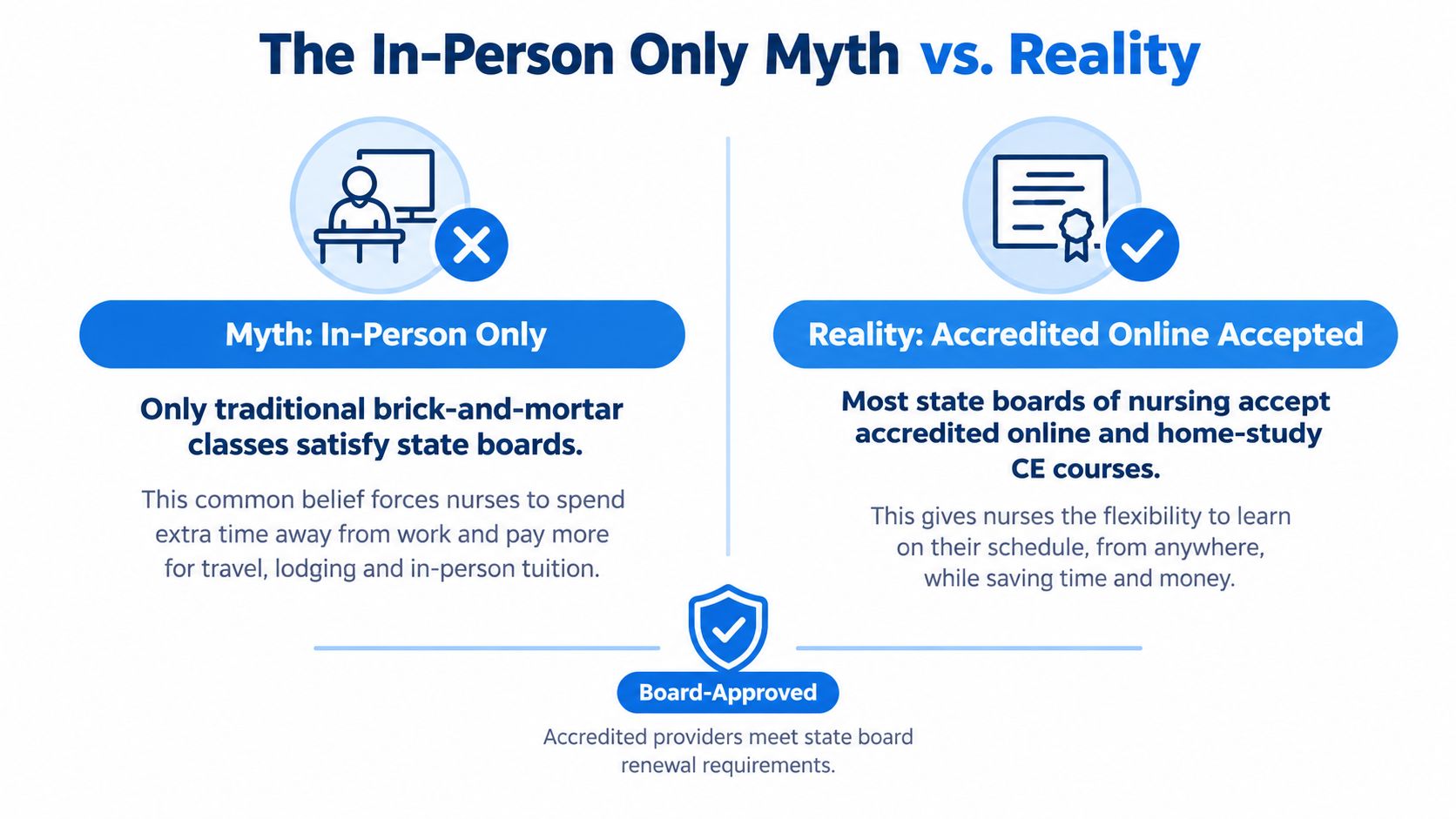
Many nurses still hear that nursing CE credits must come from an in-person American Heart Association or American Red Cross class. That assumption isn't accurate. State boards generally evaluate the provider, accreditation, course content, and documentation, not whether you sat in a physical classroom. Accredited online and home-study CE can satisfy renewal requirements when the activity meets your board's rules.
The distinction matters because a rigid classroom schedule can create practical costs. You may need to arrange childcare, swap shifts, travel after a night shift, or give up clinical hours for a workshop. Online learning lets you study in smaller blocks, revisit difficult material, and download proof as soon as you finish. CE Broker also supports centralized tracking across states, and Florida's nursing board directs nurses to CE Broker for course search and reporting, showing how electronic administration has become part of major renewal workflows. CE Broker's nursing guidance describes service to more than 100 boards and identifies a nurse reporting network spanning 14 states and jurisdictions.
What accreditation actually changes
An accredited online course isn't automatically acceptable everywhere, just as an in-person course isn't automatically acceptable everywhere. You still need to check the state board, the accrediting organization, the course topic, and the certificate details. That verification protects you from paying for education that your jurisdiction won't recognize.
Practical rule: Choose the format that fits your schedule, then verify the approval and reporting requirements before you enroll.
The American Nurses Association helped establish national nursing credentialing in 1973. Nursing certification examinations began in 1974, and accreditation for continuing nursing education in the United States was first established that year. In 1990, ANA created the American Nurses Credentialing Center as a separate nonprofit corporation to manage certification services and examinations. This history shows that nursing education standards are built around competence and accountability, not classroom seating.
Online CE also isn't limited to passive video watching. Strong courses use learning objectives, assessments, evidence-based material, and records that identify the approving organization. The case for online medical recertification is therefore practical, not ideological. A well-designed online activity can be rigorous, documented, and easier for a working nurse to complete correctly.
What Nursing CE Credits Actually Are
Nursing CE credits are approved educational units that nurses complete to maintain licensure or professional certification. Most nurses encounter the terms CE credit, CE hour, and contact hour interchangeably. In ordinary nursing conversations, they usually refer to the amount of structured education completed in an approved activity.
Think of a contact hour as a classroom clock. One contact hour equals 60 minutes of structured instruction, not 60 minutes spent commuting, checking email, or completing an employer orientation. The activity should have a defined educational purpose, measurable learning outcomes, and a qualified provider or accreditor. The Dartmouth Health explanation of contact hours and CEUs distinguishes instructional time from broader continuing education terminology.
The credit is not the certificate
The certificate doesn't create the credit. It proves that you completed an activity that may create credit under the applicable rules. A good completion certificate identifies the nurse, course title, completion date, number of contact hours, and approving or authorizing organization.
Your employer might encourage education, pay for a course, or offer an in-service. Your state board decides whether the activity satisfies licensure renewal. An employer's participation record isn't necessarily a board-approved CE certificate.
A CEU is a different unit. One CEU equals 10 contact hours, so a course promoted as 3 CEUs represents 30 contact hours under that conversion. Nursing boards and certifying bodies commonly track contact hours, which is why you should read the unit printed on the certificate rather than rely on a course's marketing label.
A simple renewal record
Keep one folder, physical or digital, for every renewal cycle. Save the certificate immediately after completion, and store a transcript if the provider supplies one. Use a filename that includes the course name and completion date so you can find it without opening every PDF.
The most reliable habit is to treat each course like a medication administration record. You wouldn't document a dose without the drug, amount, time, and patient. Your CE record needs the equivalent details, because missing metadata can matter during an audit.
How State and Federal Requirements Shape Your Renewal
Nursing renewal rules form a patchwork rather than a single national formula. Most boards require roughly 24 to 30 contact hours every two years for RNs and LPNs, while APRNs commonly face 30 to 50 hours plus pharmacology, depending on the state board. The state-by-state nursing education guide can help you begin your research, but your licensing board remains the final authority.
There is no single federal nursing CE mandate that replaces state rules. Your state board determines the hours, renewal period, mandatory subjects, acceptable providers, and reporting process. A compact license doesn't erase that responsibility. Nurses still need to follow the requirements connected to the applicable state of residence and any additional licenses they hold.
Why the same course plan fails for different nurses
Two nurses can complete the same general CE library and still have different remaining obligations. An RN may need a general contact-hour total, while an APRN may need pharmacology or other advanced-practice content. A nurse with licenses in multiple jurisdictions must map each rule before assuming that one transcript covers everything.
Topic overlays create another layer. Boards may require subjects such as medical errors, jurisprudence, infection control, opioid education, or other mandated topics. These requirements are not interchangeable with general clinical education just because both activities carry contact hours.
Here is a simplified planning table. It illustrates the kind of information you need to verify, not a substitute for current board instructions.
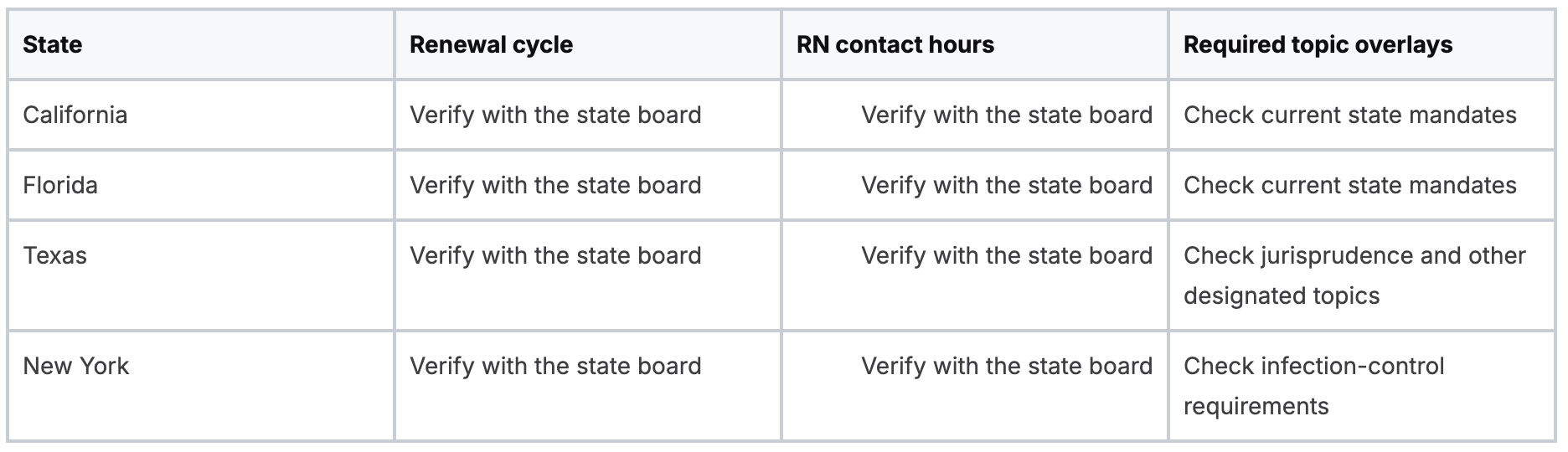
The table uses verification prompts because requirements can change, and unsupported state-specific totals shouldn't be treated as universal facts. CE Broker's nursing information demonstrates the broader problem: reporting arrangements differ across boards and jurisdictions, even when nurses use the same tracking ecosystem.
Build a state grid before buying courses
Write each license in a separate row. Add the renewal date, total hours, mandatory subjects, accepted provider types, reporting method, and certificate-retention rule. Then mark which completed courses satisfy which row.
This approach prevents a common mistake: counting a large general course toward a narrowly required subject. It also exposes gaps early, when you still have time to choose a compliant activity instead of trying to reconstruct your record near renewal.
Understanding Contact Hours and Acceptable Course Types
Credit math becomes easier when you start with the unit printed on the certificate. One contact hour equals 60 minutes of instructional time. One CEU equals 10 contact hours. That means a 0.1 CEU module corresponds to one contact hour, while a 30-CEU requirement would equal 300 contact hours under the formal conversion.
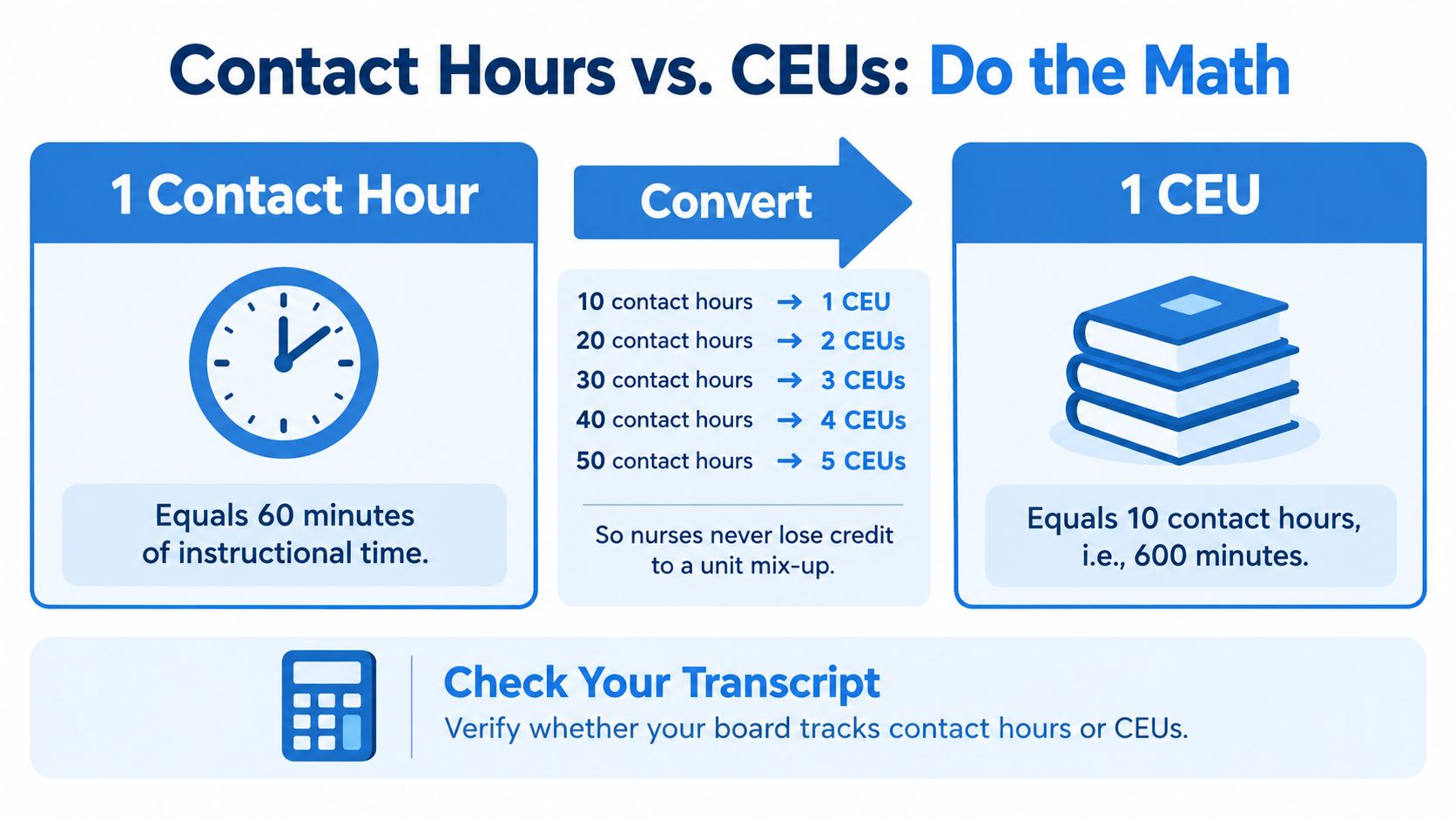
A course advertised as 2.5 credits may represent 2.5 contact hours, but don't assume that without checking the certificate. A provider may use “credit” as a general marketing term while the board expects a specific unit. Record the exact number and unit shown in the completion documentation.
Course types that may qualify
Boards commonly recognize several educational formats when the provider and activity meet their rules:
- Accredited online CE: Self-paced modules, recorded lessons, and assessed courses can be valid when the provider holds the required approval.
- Live education: Conferences, seminars, and scheduled webinars may qualify when the activity is approved and documented.
- Academic learning: Some formal coursework can count, subject to the board's conversion and documentation rules.
- Provider-led training: An employer in-service may qualify if the employer or activity has the required CE provider status.
- Specialty certification education: ACLS, BLS, and PALS may support professional requirements, but acceptance depends on the board and the certification activity.
A PALS Certification course may be completed online through ProMed's platform, with review material, an exam, and a card described as available in as quick as one hour or less. Confirm whether the particular certification meets your board's CE rules before counting it toward renewal.
Activities that often cause trouble
Employer orientation, ordinary on-the-job training, and informal lunch-and-learn sessions may improve practice without producing board-accepted contact hours. The problem isn't that the learning lacks value. The problem is that it may lack an approved provider, defined contact-hour calculation, learning objectives, or a certificate containing the required information.
Keep the educational benefit and the compliance benefit separate. A training session can be excellent for patient care and still not belong in your renewal-hour total.
What the Evidence Says About Online Versus In-Person CE
The idea that online education produces weaker nurses doesn't fit the available evidence. A randomized controlled trial of web-based graduate continuing nursing education in Japan found no significant difference in post-test scores between online and traditional classroom learning. The reported means were 762 for online learning and 794 for traditional learning, with p = 0.51.
A separate study comparing web-based and face-to-face nursing education about AIDS knowledge also found no significant difference between groups in pre-test or post-test scores. The authors concluded that the web-based method was as effective as face-to-face education for that continuing education activity, as reported in the full study.
Format matters less than design
An online course still needs thoughtful instruction. A long video with no assessment may be less useful than a concise module that asks you to apply a protocol to a clinical scenario. The strongest activities connect objectives, content, questions, feedback, and documentation.
A systematic scoping review found that online or blended CPD was associated with improvements in knowledge, skills, performance, confidence, self-efficacy, satisfaction, and attitudes toward learning when compared with on-site learning in the reviewed evidence.
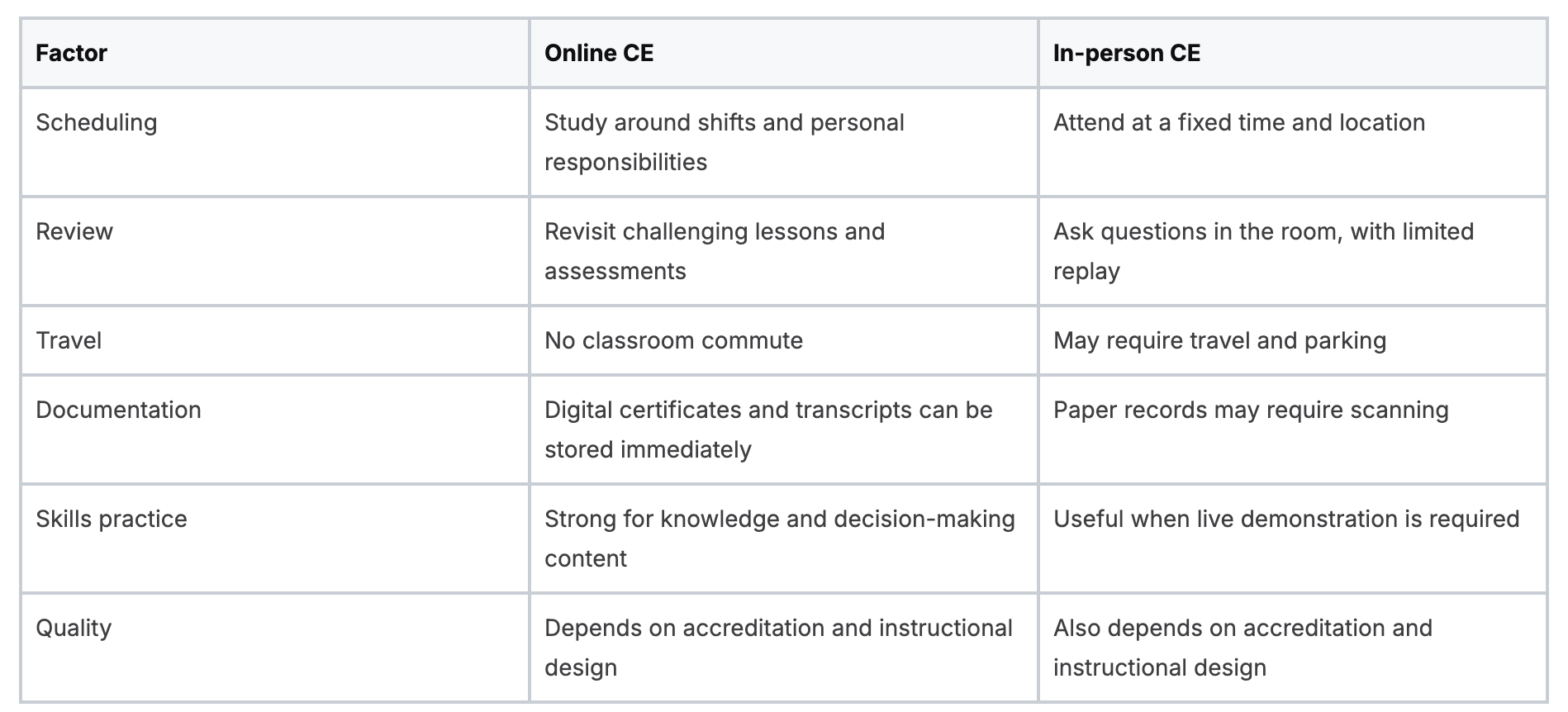
Online learning offers a practical advantage for nurses who need to pause, replay, or return to difficult material such as ECG interpretation or sepsis protocols. A systematic review of e-learning in health sciences education describes self-paced access, geographic flexibility, easier access to learning resources, and self-assessment as factors that can support engagement and retention.
A hands-on skill check is different. Some certifications require live demonstration or competency assessment, so you should read the certification rules rather than assume that every practical skill can be completed through reading alone. For knowledge-focused CE, accredited online delivery is a sound choice. For skills-based certification, follow the specific assessment pathway.
An online ACLS Certification option from ProMed is described as allowing learners to take the course on their own schedule and receive a card in as quick as one hour or less. Check your employer and governing body's acceptance requirements before relying on any certification for a particular role.
Reporting Cycles, Audits, and the Documentation Trap
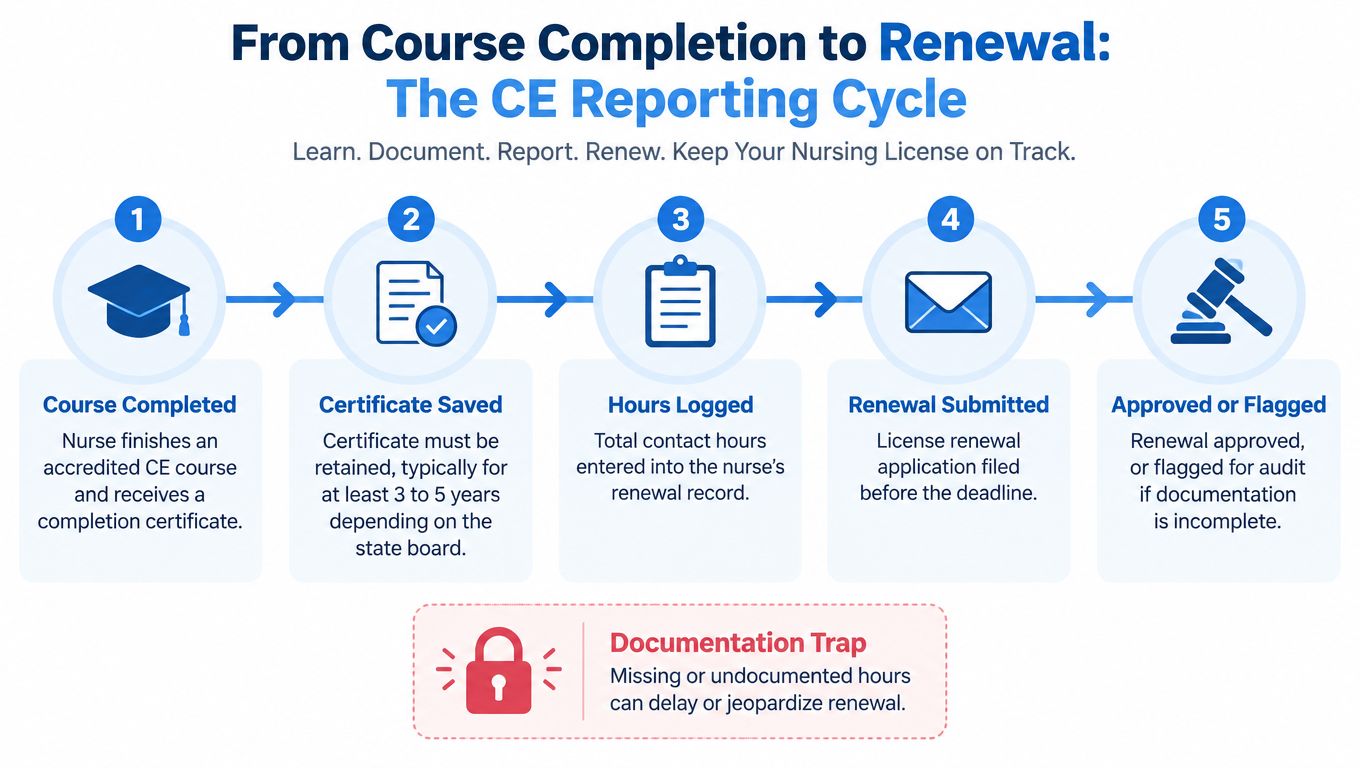
A renewal problem often begins after the nurse has already finished the learning. You complete a course, close the browser, and assume the requirement is settled. Later, the board requests proof, and the certificate is missing a provider identifier, the transcript won't download, or the activity was never accepted for that license.
Reporting rules vary widely. Some boards use direct electronic reporting or platforms such as CE Broker. Others rely on self-attestation and random audits. Kentucky, for example, uses course-by-course reporting with attachments for certain pathways, while Louisiana identifies multiple certificate components needed for an audit. A CE provider also notes that credits may take about 48 hours to process through CE Broker, so completion and visible reporting aren't always simultaneous. The provider's help guidance explains that processing delay.
Treat each course as an audit file
Use this sequence after every activity:
- Finish and verify: Confirm the course title, completion date, contact hours, and approving organization.
- Save the certificate: Download the original PDF and open it to confirm that it isn't damaged.
- Check the transcript: Compare the provider record with your own spreadsheet or folder.
- Confirm reporting: Look for the activity in CE Broker or the applicable state system when direct reporting applies.
- Map the requirement: Assign the course to the correct general or specialty category.
One nurse may complete enough education but lose credit because a certificate omits the required provider number. Another may have a complete transcript but submit unreadable or corrupted PDFs during an audit. These failures aren't learning failures. They're recordkeeping failures.
Audit habit: Never wait until renewal day to discover whether a certificate opens, identifies the accreditor, and matches the board's required fields.
The safest policy is to retain records for the period required by your board and keep an accessible backup. Don't assume the provider will preserve your transcript forever. You remain responsible for demonstrating completion when the board asks.
Choosing a Smarter Way to Earn and Track Your Nursing CE Credits
Manual tracking works until the renewal record becomes complicated. A spreadsheet may show course titles and hours, but it won't necessarily tell you whether a pharmacology requirement is satisfied, whether a provider is approved for a particular state, or whether a certificate contains the right identifier.
An integrated workflow reduces that uncertainty. Look for a platform that combines approved course content with progress tracking, certificate storage, transcripts, and reporting support. The goal isn't to eliminate your responsibility. It's to place the information where you can inspect it before a deadline.
Manual records versus a centralized workflow
With a manual system, you typically:
- Search across emails for completion notices.
- Download certificates from several provider accounts.
- Copy hours into a spreadsheet.
- Check each state board separately.
- Upload documents if an audit occurs.
- Recalculate totals when a course category changes.
A centralized system can make those tasks easier by keeping course history and certificates together. ProMed+ Nursing CE is described as an all-in-one platform for completing CE requirements, with a streaming library, instant certificates, and automated reporting features. Its usefulness still depends on matching each activity to the rules for your license.
The CE Broker account guide can help nurses understand how electronic tracking fits into a broader renewal workflow. Even when reporting is automated, review the posted record. An automated submission can still be attached to the wrong license, category, or jurisdiction.
A practical selection checklist
Before choosing your next provider, ask:
- Approval: Who accredits the activity, and does that approval apply to your board?
- Coverage: Does the catalog include your general hours and mandatory topics?
- Evidence: Are learning objectives, assessments, and qualified faculty identified?
- Records: Can you download certificates and transcripts immediately?
- Reporting: Does the provider report to the required system, and how long can processing take?
- Portability: Will the records remain understandable if you hold licenses in more than one state?
Online-first CE is a sensible default for working nurses because it supports flexible scheduling and digital documentation. It doesn't remove the need to verify rules. It makes that verification easier to manage when the provider presents the course, certificate, and reporting information clearly.
Start by auditing your current hours. Build a state grid, identify missing topics, confirm every certificate, and select one accredited provider for the remaining cycle when that approach fits your licenses. That simple routine shifts renewal from a last-minute scramble to an ordinary part of professional practice.
ProMed Certifications offers online medical certification courses and ProMed+ Nursing CE for nurses who need flexible education and organized completion records. Visit ProMed Certifications to review the available courses, confirm what matches your renewal requirements, and begin building a cleaner, audit-ready CE record.
.avif)
Stay compliant with ProMed+
Certifications included: ACLS, BLS, PALS, CPR & Neonatal Resuscitation
Unlimited continuing education: over 200 hours of accredited CME
All-inclusive: One price. No surprises.
Get certified today

The Advanced Cardiac Life Support (ACLS) is an accredited online medical certification course that teaches medical professionals to respond to nearly all cardiopulmonary emergencies.

The Pediatric Advanced Life Support (PALS) Recertification instructs medical professionals on performing pediatric cardiopulmonary resuscitation in emergencies.

The Basic Life Support (BLS) Recertification is intended to teach healthcare professionals the basic steps of CPR and rescue breathing for adults, children, and infants.

Our online medical certification course for CPR, Automated External Defibrillator (AED), and First Aid is designed to teach adult, child, and infant CPR and AED use.

The Neonatal Resuscitation Certification trains medical professionals in performing resuscitation procedures and life-saving techniques for newborns at the time of delivery.

.png)
.png)
.png)