


Continuing Education Requirements for Nurses by State: A Complete Guide
.png)
Continuing education is a non-negotiable part of renewing your nursing license, but here’s the catch: the continuing education requirements for nurses by state are all over the map. These rules are in place to make sure you’re always on top of the latest in medical practice so you can deliver the best possible patient care.
Before diving into your specific state's rules, let's get a solid handle on the basics. This guide will give you that foundation and help you understand how accessible, high-quality online options can make staying compliant easier than ever.
Navigating Nursing CE Requirements: A Quick Overview

Keeping your license in good standing with your state's Board of Nursing is a fundamental part of being a professional. Every state board has its own ideas about how many contact hours you need, how often you need to renew, and which specific topics are mandatory.
Think of it this way: your initial license proved you had the foundational knowledge. Continuing education (CE) is how you prove your commitment to lifelong learning in a field that never stands still. Understanding these rules doesn't have to be a headache. We're here to break down the key terms and concepts you'll run into, making it much easier to plan ahead for a stress-free renewal.
Key Nursing CE Terms at a Glance
Navigating the world of CE means getting familiar with the lingo. This table breaks down the most common terms you'll see from state boards, so you know exactly what they're asking for.
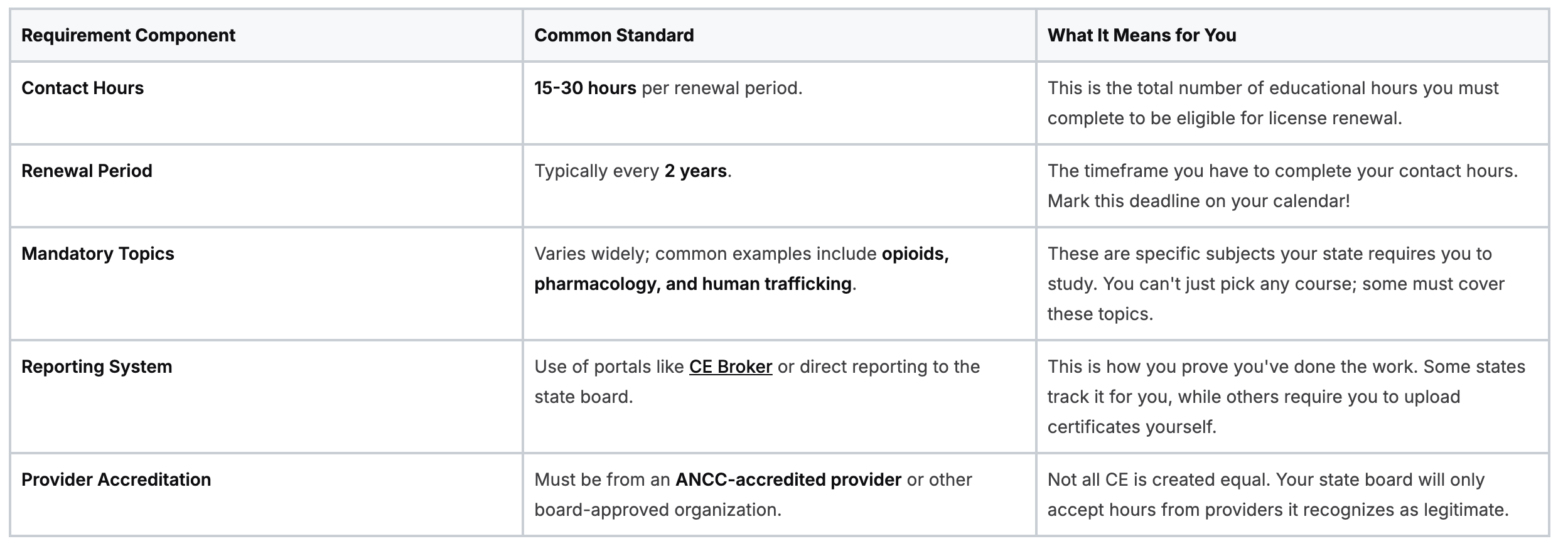
Knowing these core components is the first step. It helps you quickly scan any state's requirements and understand what you need to do, no matter where you practice.
The Modern Way to Meet Your CE Requirements
One of the best things to happen to professional development is the universal acceptance of online education. The outdated belief that you had to sit in a stuffy conference room to get valid credit is completely false.
In fact, many peer-reviewed studies and industry articles have shown that online learning delivers patient care outcomes and knowledge retention that are just as good as—and sometimes even superior to—in-person classes.
This is fantastic news for nurses juggling demanding schedules. Accredited online courses give you a flexible, cost-effective, and completely modern way to meet your state's mandate. The general consensus in the industry is shifting, with hospitals, clinics, and organizations increasingly recognizing accredited online CE.
Here's why jumping on the online CE train is a smart move:
- Total Flexibility: Knock out your required hours whenever and wherever it works for you. No commuting, no taking time off.
- Real Cost Savings: Online courses mean you're not paying for travel, hotels, or expensive seminar materials.
- Equal Quality and Full Acceptance: Reputable online providers deliver accredited, evidence-based content that meets the same high standards as any in-person event, and they are widely accepted.
At ProMed, we’re at the forefront of this change, delivering convenience without sacrificing credibility. You can check out our full library of ANCC-accredited nursing CE courses to see just how simple it can be to meet your state's requirements.
Why Online CE Is the Future for Modern Nurses
.png)
The whole world of professional development for nurses is changing, and honestly, it's for the better. The old, rigid model of blocking out a whole day to attend an in-person seminar is fading. It's being replaced by something far more flexible and just as effective: online continuing education (CE).
For any nurse juggling demanding shifts, family, and life, online learning isn't just a nice perk—it’s a game-changer.
Numerous peer-reviewed studies have confirmed what many of us already suspected: online education delivers learning outcomes that are on par with, and sometimes even superior to, traditional classroom settings. When you look at key metrics like knowledge retention, learner flexibility, and the real-world impact on patient care, it's clear that high-quality online CE works. This is precisely why state boards and healthcare institutions are throwing their weight behind accredited online platforms.
Shattering Outdated Beliefs About CE
For years, a myth has persisted that only in-person courses from specific providers, like the AHA or the American Red Cross, were valid for license renewal. Let's be clear: this is not true. The industry is evolving.
The focus today has shifted from how you learn to the quality and accreditation of the content itself. The general consensus is simple: if a course is from an ANCC-accredited provider and it covers your state's mandatory topics, the online format is valid and widely accepted. This change puts the power back in your hands, allowing you to choose CE that actually fits your life without sacrificing quality or compliance.
This modern approach finally acknowledges that professional learning isn't one-size-fits-all. It's about letting you meet your continuing education requirements for nurses by state on your own terms.
The Clear Advantages of Online Learning
When you compare online CE to in-person training, it’s easy to see why so many nurses are making the switch. The benefits go way beyond just being convenient; they directly improve your work-life balance and your budget.
- Unmatched Flexibility: Need to knock out your hours at midnight after a long shift? During a lunch break? Over a quiet weekend? You can. You build the schedule that works for you, not the other way around.
- Significant Cost Savings: Think about it—no more paying for gas, parking, travel, or hotel rooms. Online learning cuts out all those extra expenses, saving you valuable time and money. For more on this, check out our guide to free continuing education units for nurses.
- A Self-Paced Learning Environment: You're in control. You can breeze through material you already know well and spend extra time on more complex topics until you've truly mastered them.
ProMed is at the forefront of this shift, offering future-focused, accredited, and engaging courses built for the realities of modern nursing. Our platform gives you the credibility your state board demands and the flexibility your schedule requires, making staying compliant simpler than ever.
Your State-by-State Guide to Nursing CE Requirements
Trying to pin down the exact continuing education rules for nurses in your state can feel like a maze. Every state's Board of Nursing has its own playbook, and staying on top of the requirements is absolutely critical to keeping your license active.
Think of this guide as your go-to reference. We've laid out the essentials for Registered Nurses (RNs), state by state, in a simple, scannable format. Whether you're renewing in your home state or gearing up for a move, the info you need is right here, all organized alphabetically. As you go, just remember that high-quality, accredited online courses are a valid and widely accepted way to meet these requirements, giving you the flexibility that a modern nursing career demands.
Quick Lookup Nursing CE Requirements for All 50 States
For a bird's-eye view, this table is your best friend. It gives you a quick snapshot of the CE hours, renewal cycles, and any major mandatory topics for RNs across the country. It's perfect for when you need the core facts fast.
.png)
After you've found your state in the quick-lookup table, you can dive into the detailed breakdown below for more specific information, including details on those alternative compliance paths some states offer.
Alabama
RNs in Alabama need to lock in 24 contact hours of board-approved CE every two years. If you're a CRNP or CNM with prescriptive authority, make sure at least six of those hours are dedicated to pharmacology. Keep in mind, Alabama is not part of the Nurse Licensure Compact (NLC).
Alaska
Alaska gives you some flexibility. For your biennial renewal, you need to complete two of the following three options:
- 30 contact hours of continuing education
- 30 hours of professional nursing activities
- 320 hours of nursing employment
This approach lets you tailor your renewal to your current career activities, whether that’s hitting the books or clocking hours on the floor.
Arizona
Arizona does things a bit differently with an audit-based system. They don't require a specific number of CE hours for renewal. Instead, you have to complete one of the following every five years:
- Practice nursing for at least 960 hours
- Graduate from a nursing program with a new degree
- Finish a board-approved refresher course
- Earn an advanced nursing degree (like an LPN to RN, RN to BSN, MSN, or DNP)
Arkansas
In Arkansas, the magic number is 15 contact hours of accredited CE every two years. Good news for specialists: you can also satisfy the requirement by holding a current, nationally recognized certification in your practice area. Arkansas uses CE Broker to track your hours, so you'll need to report them there.
California
California has long held a firm line on professional development. To keep your active RN license, you're required to complete 30 contact hours of CE every two years. This standard helps ensure nurses stay sharp and up-to-date with evolving patient care standards. It's a common approach, as over 90% of U.S. states have a similar two-year cycle to prevent skill decay. Interestingly, during the height of the COVID-19 pandemic, California expanded its acceptable CE to include vital topics like infection control, leading to a 25% spike in completions for those courses.
Colorado
If you're an RN in Colorado, you can breathe a little easier. It's one of the few states that does not have a continuing education requirement for license renewal. That said, staying current through voluntary learning is always a smart move for your career and your patients.
Connecticut
For your Connecticut license renewal, you’ll need to complete 50 contact hours of CE within the 24-month window before you apply. While the RN license itself is renewed annually, the CE requirement is measured across that two-year period.
Delaware
Delaware RNs must complete 30 contact hours every two years. The state places a special emphasis on a critical public health issue: 3 hours of that total must be on the topic of substance abuse.
District of Columbia (D.C.)
In the nation's capital, RNs are required to complete 24 contact hours every two years. They have some specific mandates, too: 3 hours must be on HIV/AIDS, and 2 hours must cover LGBTQ cultural competency. Like a growing number of boards, D.C. uses CE Broker for tracking.
Florida
Florida is known for having one of the most specific sets of CE requirements out there. You’ll need 24 contact hours every two years, and the breakdown is quite detailed:
- 2 hours on Prevention of Medical Errors
- 2 hours on Florida Laws and Rules
- 2 hours on Human Trafficking
- 2 hours on Impairment in the Workplace (every other renewal)
- 1 hour on HIV/AIDS (one-time only, for your first renewal)
- 2 hours on Domestic Violence (required every third renewal)
Florida is a mandatory CE Broker state, which means every single hour you complete must be reported through their system.
Georgia
Georgia offers RNs five different paths to meet their renewal requirement every two years. You only need to pick one:
- Complete 30 contact hours of CE
- Maintain certification through a national certifying body
- Complete an accredited academic program of study in nursing
- Get competency verified by your healthcare facility and have 500 hours of practice
- Complete a board-approved re-entry program
Hawaii
Much like Georgia, Hawaii gives RNs several options to demonstrate their continued competence every two years. You can choose from paths like completing 30 contact hours of CE, taking a board-approved refresher course, or holding a relevant healthcare provider certification.
Idaho
Idaho doesn’t have a strict CE hour mandate. Instead, RNs must complete one of several approved learning or practice activities during each two-year renewal period. This could be anything from completing 15 contact hours to serving as a preceptor for a student or even publishing a professional article.
Illinois
RNs in Illinois are on the hook for 20 contact hours of CE every two years. This includes a one-hour course on implicit bias awareness and a one-hour course on sexual harassment prevention. If your role includes "safe school" duties, you’ll also need a one-hour training on mandated reporting for child abuse.
Indiana
Indiana is another state that keeps it simple: there is no mandatory CE requirement for RNs. Professional competency is always expected, of course, but there are no specific hour or topic mandates tied to your license renewal.
Iowa
In Iowa, the renewal cycle is a bit longer. RNs must complete 36 contact hours every three years. A key mandatory topic here is a 2-hour course on Identifying and Reporting Abuse of Dependent Adults and Children. This needs to be done within six months of employment and then repeated every five years.
Kansas
Kansas requires 30 contact hours of approved CE for RN license renewal every two years. The Kansas State Board of Nursing runs random audits to check for compliance, so make sure you keep meticulous records of your completed courses.
Kentucky
RNs in Kentucky must complete 14 contact hours every year. The state also has several important one-time mandatory courses:
- 3 hours on Domestic Violence (within three years of getting your initial license)
- 1.5 hours on Pediatric Abusive Head Trauma (also known as Shaken Baby Syndrome)
- 2 hours on Suicide Prevention (within the first three years of licensure)
Louisiana
Louisiana's requirements are tied to your practice hours. Full-time RNs need 5 contact hours annually. If you're part-time (working less than 1600 hours per year), that number goes up to 10 hours. RNs who aren't practicing at all must complete 15 hours. The state also uses CE Broker.
Maine
Good news for nurses in Maine: the state does not have a continuing education requirement for RNs. The focus is on demonstrating your competency through ongoing practice or other professional activities.
Maryland
In Maryland, there's no specific contact hour mandate. Instead, RNs must either complete a board-approved refresher course or have practiced at least 1,000 hours in the five years leading up to renewal.
Massachusetts
RNs in Massachusetts need to complete 15 contact hours every two years. This includes a one-time, 2-hour training on dementia and Alzheimer's disease for any nurse who works with adult populations.
Michigan
Michigan requires 25 contact hours of CE every two years. Out of that total, at least 2 hours must be in pain and symptom management. There's also a one-time training requirement on how to identify victims of human trafficking.
Minnesota
The rule in Minnesota is 24 contact hours every two years. One thing to watch for is that the renewal cycle is staggered based on your birth month and year, so it’s crucial to know your specific deadline.
Mississippi
Mississippi requires 20 contact hours every two years. This is a mandatory CE Broker state, so you have to report all your completed hours through their platform to be compliant.
Missouri
Missouri keeps things straightforward for RNs with an active license: there is no CE requirement. The state's board focuses on maintaining an active practice as the key indicator of ongoing competency.
Montana
In Montana, you'll need 24 contact hours of CE every two years to renew your license. The state board conducts audits, so definitely hang on to all your certificates of completion.
Nebraska
For Nebraska RNs, the requirement is 20 contact hours every two years. In addition to the CE, you must have also practiced at least 500 hours within the last five years.
Nevada
RNs in Nevada must complete 30 contact hours every two years. There's also a mandatory, one-time 4-hour course on bioterrorism that you'll need to complete.
New Hampshire
New Hampshire's requirement is 30 contact hours every two years. The state's Board of Nursing allows for a good deal of flexibility in the types of activities that can count toward this total.
New Jersey
RNs in New Jersey need 30 contact hours every two years. This total must include 1 hour related to prescription opioids and another 1 hour on topics concerning organ and tissue donation.
New Mexico
The requirement in New Mexico is 30 contact hours every two years. This is another state where using CE Broker is mandatory for reporting and tracking your compliance.
New York
New York has a couple of key requirements. You'll need 3 contact hours on infection control every four years. There's also a one-time course on identifying and reporting child abuse that is required for all licensed professionals.
North Carolina
RNs in North Carolina have a few options to satisfy their renewal requirements every two years. You can choose one of the following:
- Complete 30 contact hours of CE
- Take a board-approved refresher course
- Hold a national certification in your specialty area
North Dakota
North Dakota has one of the lower hour requirements in the country, but it's still strictly enforced. RNs must complete 12 contact hours every two years.
Ohio
The requirement for RNs in Ohio is 24 contact hours every two years. A key detail is that at least 1 hour of that total must be what they call "Category A," which relates to Ohio nursing laws and rules.
Oklahoma
Oklahoma provides several ways for RNs to meet their renewal requirements every two years. Your options include completing 24 contact hours, holding a national certification, or documenting 500 hours of employment.
Oregon
Oregon has a unique requirement. There is a one-time, 7-hour pain management course that all RNs must complete. Once you've knocked that out, there are no further CE requirements for future renewals.
Pennsylvania
Pennsylvania requires RNs to complete 30 contact hours every two years. Of those hours, 2 hours must be dedicated to the topic of mandated child abuse reporting.
Rhode Island
In Rhode Island, RNs are required to complete 10 contact hours every two years. This includes a mandatory 2 hours on the topic of substance abuse.
South Carolina
RNs in South Carolina must meet one of several competency requirements every two years. Popular options include completing 30 contact hours of CE or holding a national certification in your nursing specialty.
South Dakota
South Dakota is another state where you can cross CE off your to-do list. There are no mandatory CE requirements for RN license renewal.
Tennessee
Tennessee's approach focuses on continued competence, which can be demonstrated in a couple of ways. You can meet the requirement through either practice hours or by completing 10 contact hours every two years.
Texas
The Texas Board of Nursing requires 20 contact hours every two years. They also have some specific mandatory topics, including a 2-hour course on nursing jurisprudence and ethics. If you work with older adults, you'll also need a 2-hour course on geriatric care.
Utah
Utah gives RNs a few different ways to meet their renewal requirement every two years. You can choose one of these options:
- Complete 30 contact hours
- Have 200 hours of practice and complete 15 contact hours
- Have 400 hours of practice
Vermont
Vermont's renewal is entirely practice-based. There is no contact hour requirement. Instead, RNs must have practiced at least 960 hours in the last five years or 400 hours in the last two years.
Virginia
Virginia also offers multiple paths to demonstrate that you're staying competent. A common option is to complete 15 contact hours in addition to having 640 hours of active practice.
Washington
In Washington, RNs must complete 8 contact hours annually, along with maintaining 96 hours of active nursing practice per year. There is also a one-time, 6-hour suicide prevention training that is mandatory.
West Virginia
RNs in West Virginia need to complete 12 contact hours every year. The state has some very specific topic requirements: 3 hours must be on drug diversion and best prescribing practices, and 2 hours must cover mental health conditions common to veterans and their families.
Wisconsin
Wisconsin requires nurses to complete a nursing practice survey every two years, but there is no specific contact hour requirement for RNs to renew their license.
Wyoming
In Wyoming, RNs have several options to fulfill their renewal requirement every two years. Common choices include completing 20 contact hours or documenting 1600 hours of practice.
Understanding Mandatory Topics and Special Requirements
While hitting your total contact hour count is a huge piece of the license renewal puzzle, many states are now also focusing on specific, mandatory topics. These requirements aren't just about checking a box. They're put in place to give you the most current knowledge for tackling today's biggest public health challenges.
Think of it this way: your general CE keeps your core clinical skills sharp, but these mandatory topics get you ready for the specific issues impacting your community right now. Finishing these courses means you're equipped to provide more informed, compassionate, and effective care on every single shift.
Common Mandatory Course Subjects
State boards are constantly updating their required topics based on emerging public health data and new laws. This means the continuing education requirements for nurses by state can absolutely change from one renewal cycle to the next, so it pays to stay informed.
Here are some of the most common mandatory subjects you'll run into:
- Substance Abuse and Opioid Crisis: Courses covering safe prescribing, identifying addiction, and intervention strategies are now standard in many states to help fight the opioid epidemic.
- Human Trafficking Awareness: As a frontline provider, you are in a unique position to spot and help victims. This training gives you the tools to recognize the signs and know exactly what to do.
- Implicit Bias Training: This is all about helping healthcare professionals recognize and deal with unconscious biases that can affect patient care and contribute to health disparities.
- State-Specific Laws and Rules: Many boards require a refresher on your state's specific nursing practice act and regulations to make sure you stay compliant.
- Infection Control: A classic requirement in many areas, these courses get you up to speed on the latest protocols for preventing the spread of disease in healthcare settings.
This chart visualizes some of the common standards for RNs, including required hours and renewal periods, highlighting how much those mandatory topics can vary.

The takeaway here is that while the total hours and renewal cycle might look similar across states, the specific mandatory topics you need will always come down to your local board's unique rules.
Finding and Fulfilling These Requirements Online
The great news? You don't have to hunt down a stuffy in-person seminar to satisfy these special requirements. Accredited online providers offer a massive range of courses designed specifically to meet state mandates, a modern approach that lets you complete high-quality, relevant training on your own schedule.
Many of these CE requirements function as critical updates for your skill set, much like other frontline employee training programs. The real focus is on the quality and relevance of the content, not whether you learned it in a classroom or at your kitchen table.
The industry is steadily moving past the outdated belief that only in-person training is valid. What truly matters to state boards and employers is that the course is from an accredited provider and directly addresses the required subject matter.
This shift gives you the power to pick a learning path that fits your incredibly busy life. ProMed Certifications, for example, offers a comprehensive library of ANCC-accredited nursing CE courses, including all those specialized topics required by state boards. You can easily find and finish your mandatory training online, confident that it’s fully compliant and respected by your licensing body.
How to Report Your CE Credits and Stay Compliant
Finishing your required contact hours feels great, but it’s only half the battle. The real key to keeping your license in good standing is reporting those hours correctly. Every state board of nursing has its own process, and knowing how to handle yours is crucial for a stress-free renewal.
How you report your credits really comes down to your state's specific rules. Some states want you to upload proof for every single course you complete, while others just trust you've done the work—unless they decide to audit you.
Proactive Reporting vs. Audit-Based Systems
Figuring out which system your state uses is your first step. It dictates exactly how and when you need to show your certificates of completion.
- Proactive Reporting States: In these states, you have to submit proof of your completed CE directly to the board or a designated platform before they'll renew your license. Think of it like turning in your homework to get your grade.
- Audit-Based States: Here, you simply check a box and attest that you’ve met all the CE requirements when you renew. You don’t have to send in any certificates upfront, but the board can randomly select you for an audit at any time. If that happens, you’ll need to produce complete documentation for every hour you claimed.
No matter which system your state uses, keeping meticulous records is an absolute must. You have to be ready to prove your compliance at a moment's notice.
Using Platforms Like CE Broker
Many states are trying to make reporting easier by partnering with digital tracking platforms. The most common one you'll run into is CE Broker. If your state board requires it, you’ll need an account to get all your completed courses logged properly.
The good news? Reputable CE providers like ProMed often report your completed hours directly to CE Broker on your behalf. This is a game-changer, as it automates the process, slashes the risk of mistakes, and saves you a ton of administrative headaches.
This direct reporting feature is one of the biggest perks of modern online CE. It takes a major compliance chore off your plate, letting you focus on the actual learning instead of the paperwork.
Best Practices for Record-Keeping
Even with automated systems, solid record-keeping is your best defense against any compliance hiccups. A simple slip-up can jeopardize your license, so it's worth getting organized.
Here’s a straightforward system to stay on top of it:
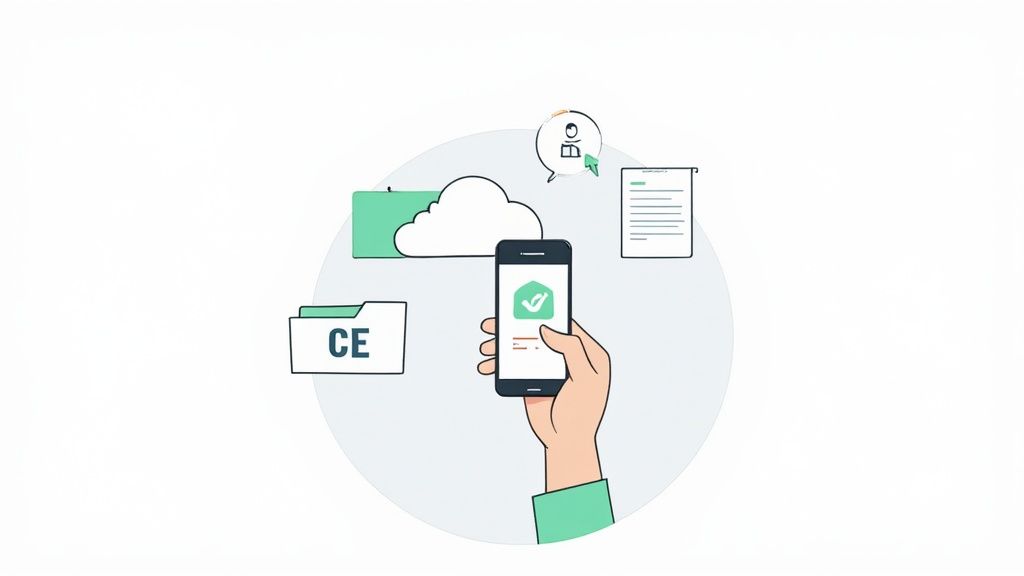
- Create a Digital Folder: For each renewal period, make a dedicated folder on your computer or in cloud storage (like Google Drive or Dropbox).
- Save Everything Immediately: The second you finish a course, download the certificate and drop it into your folder. Don’t put it off.
- Name Files Clearly: Use a consistent naming convention that makes sense at a glance, like "CourseName_Date_Hours.pdf" (e.g., "ImplicitBias_10-15-2024_2hrs.pdf").
- Keep a Master List: A simple spreadsheet tracking the course title, provider, completion date, and number of contact hours can be an absolute lifesaver if you're ever audited.
Follow these steps, and you’ll have everything you need right at your fingertips. You'll be able to confidently prove you’ve met the continuing education requirements for nurses by state.
Of course, while keeping up with your CE is the standard, most state boards get it—life happens. There are certain situations where you might qualify for an exemption, letting you sidestep some or all of your required contact hours for a renewal cycle.
Figuring out if you qualify for one of these exemptions is a key part of managing your license, especially when things get tough. Just remember, these waivers aren't automatic. They almost always mean you'll need to formally apply and send supporting documents to your state board of nursing.
Common Reasons for an Exemption
State boards typically offer exemptions to help nurses who are dealing with specific circumstances that make completing CE difficult. While the exact rules differ from state to state, here are some of the most common situations where you might get a pass:
- Your First License Renewal: Many states give newly licensed nurses a break on their very first renewal. The thinking is that graduating from nursing school and passing the NCLEX is more than enough proof of your current skills.
- Inactive or Retired Status: If you're not actively practicing and have placed your license on inactive or retired status, you usually don't have to worry about CE. But if you decide to jump back into practice, you'll have to meet specific reactivation requirements, which almost always include catching up on CE.
- Military Service: Active-duty military personnel often get an exemption or at least an extension, particularly if they’re deployed. You'll probably need to show your official orders as proof.
- Personal or Family Hardship: Some boards will grant a waiver if you're dealing with a significant personal illness, a disability, or you're caring for an immediate family member with a serious health problem. This typically requires a doctor's note or other official documentation.
A quick word of caution: always be proactive when applying for an exemption. Don't just assume you're exempt without getting official confirmation from your state's nursing board. Making that mistake could put your license in jeopardy.
The bottom line is to get in touch with your board the moment you think you might have trouble meeting a deadline. They'll give you the straight scoop on what you need to do and what paperwork is required for your specific situation.
Frequently Asked Questions About Nursing CE
Trying to make sense of license renewal and continuing education can bring up a lot of questions. Let's tackle some of the most common ones nurses ask about their CE obligations.
Can I Complete All My Nursing CE Requirements Online?
Yes, absolutely. For the vast majority of states, you can get 100% of your required CE contact hours from accredited online providers. State boards care about the quality and accreditation of the course itself, not whether you took it in a classroom or on your laptop.
This modern approach is backed by substantial research confirming that online learning is just as effective as in-person training. It offers incredible flexibility for our demanding schedules. The outdated belief that only certain in-person classes like those from the AHA or American Red Cross count is simply not true; the industry now widely embraces high-quality online education as an equally valid option.
What Happens if I Miss My CE Deadline?
Failing to complete your CE on time can cause some serious headaches. You could be looking at fines, an official reprimand on your record, or even the inability to renew your license, which could leave it expired or inactive. While some states might offer a short grace period, you should never count on it.
Your best bet is always to finish your CE well ahead of your license expiration date. This avoids any risk to your ability to practice. For a deeper dive into this and other common questions, check out our full guide on nursing continuing education credits frequently asked questions.
How Do I Know if a CE Course Is Approved?
Most state nursing boards accept courses from providers accredited by the American Nurses Credentialing Center (ANCC). Any reputable CE provider will have their accreditation status displayed clearly on their website.
If you're ever in doubt, the safest place to look is your state board of nursing’s official website. They often have lists of approved accrediting bodies or even a tool to look up and verify specific courses.
At ProMed Certifications, we take the guesswork out of meeting your continuing education requirements. All of our online courses are ANCC-accredited, designed for convenience, and built to ensure you stay compliant and confident in your practice. Explore our full library of Nursing CE courses today.
.avif)
Stay compliant with ProMed+
Certifications included: ACLS, BLS, PALS, CPR & Neonatal Resuscitation
Unlimited continuing education: over 200 hours of accredited CME
All-inclusive: One price. No surprises.
Get certified today

The Advanced Cardiac Life Support (ACLS) is an accredited online medical certification course that teaches medical professionals to respond to nearly all cardiopulmonary emergencies.

The Pediatric Advanced Life Support (PALS) Recertification instructs medical professionals on performing pediatric cardiopulmonary resuscitation in emergencies.

The Basic Life Support (BLS) Recertification is intended to teach healthcare professionals the basic steps of CPR and rescue breathing for adults, children, and infants.

Our online medical certification course for CPR, Automated External Defibrillator (AED), and First Aid is designed to teach adult, child, and infant CPR and AED use.

The Neonatal Resuscitation Certification trains medical professionals in performing resuscitation procedures and life-saving techniques for newborns at the time of delivery.

.png)
.png)
.png)