


Code Blue Training: A Clinician's Essential Guide
.png)
A code blue can begin with almost no warning. One clinician calls for help, another reaches for the emergency cart, and several people must act at once while the patient's condition changes by the second. In that environment, knowing the algorithm matters, but team coordination, role clarity, and repeated practice matter just as much.
Modern code blue training prepares healthcare professionals to recognize deterioration, begin high-quality resuscitation, communicate clearly, use emergency equipment, and review performance afterward. It also fits the realities of today's clinical workforce. Well-designed online CE and certification programs are valid, accessible, and increasingly accepted alongside traditional classroom options, giving busy professionals a practical way to maintain readiness.
What Is Modern Code Blue Training
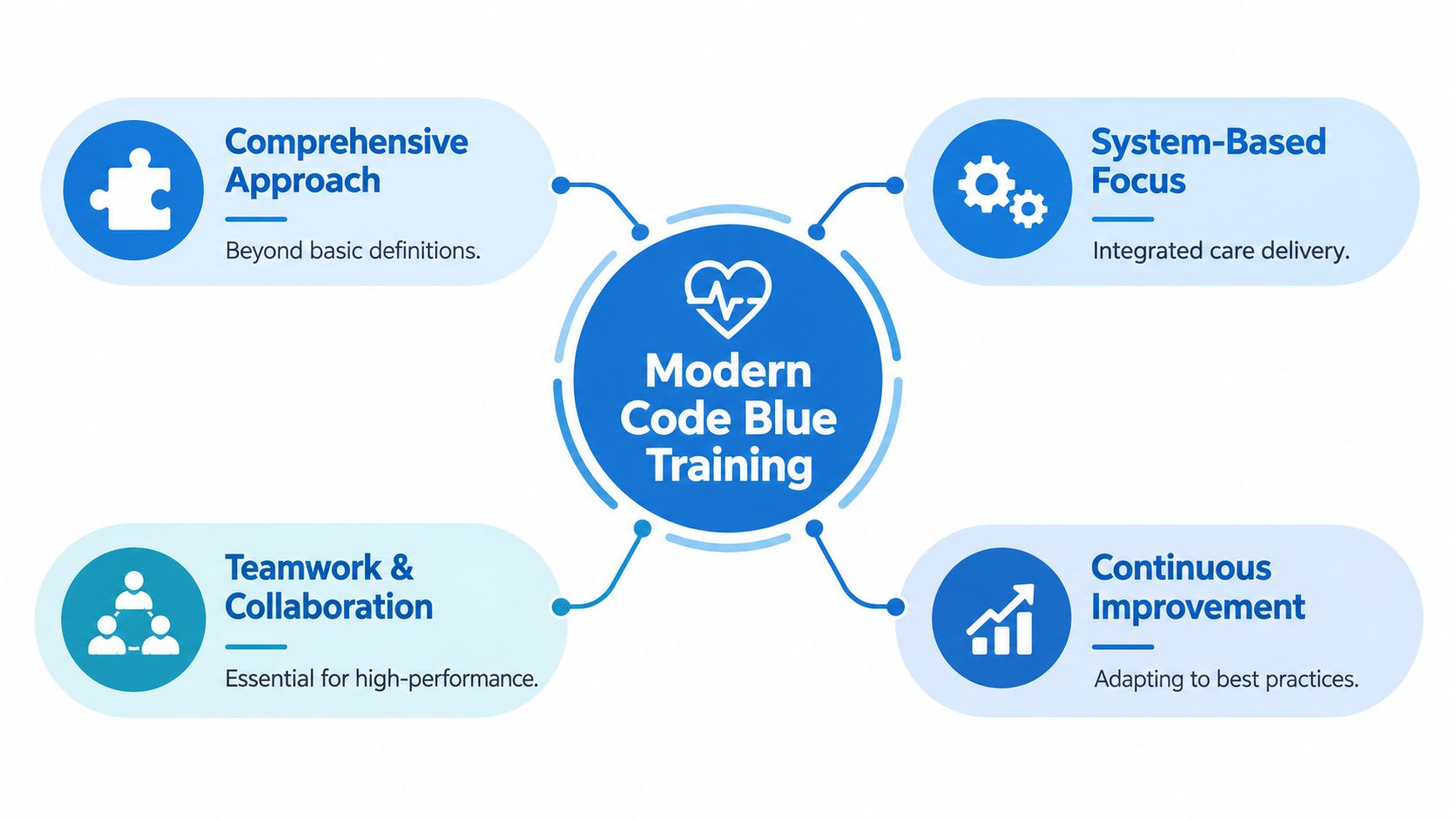
Modern code blue training is more than memorizing an ACLS sequence or watching someone demonstrate chest compressions. It's a system-based approach to cardiac arrest response that combines clinical knowledge, psychomotor skills, communication, leadership, and team performance.
Think of a resuscitation team like a pit crew. The compressor, airway clinician, medication nurse, team leader, and recorder each have a defined task. The team succeeds when those tasks happen in the correct order, with minimal hesitation and clear communication. No one waits for instructions that should already be understood, and no one duplicates another person's work.
A strong program usually develops four connected abilities:
- Clinical recognition: Identifying cardiac arrest, abnormal rhythms, respiratory failure, and reversible causes.
- Technical execution: Performing CPR, defibrillation, airway support, medication administration, and patient assessment.
- Team coordination: Assigning roles, using closed-loop communication, and maintaining situational awareness.
- Performance improvement: Practicing, debriefing, correcting weaknesses, and repeating critical actions.
Why simulation became essential
For many years, clinicians learned resuscitation partly through exposure to real events. That model depended on chance. A resident or nurse might gain valuable experience during an actual arrest, or might go a long period without seeing one.
Duty-hour changes in the early 2000s reduced residents' exposure to real code blue events. An analysis reported that residents in 2008 attended 83% fewer code blue events annually than residents in 2002, while code blue rates fell from 12 to 3.8 per 1,000 admissions, a reduction of about 68%. The historical analysis of resident code blue exposure argued that reduced clinical exposure made deliberate simulation more important for maintaining resuscitation performance.
Simulation solves the exposure problem without waiting for a patient to deteriorate. Educators can create realistic scenarios, observe the team, pause when appropriate, and debrief decisions afterward. Learners can repeat a difficult sequence until it becomes more reliable.
Practical rule: A real emergency is for patient care. A simulation is where the team should discover confusion, equipment problems, and communication gaps.
Online education adds another layer of access. Learners can review algorithms, rhythm recognition, pharmacology, and assessment principles at a convenient time. For CE and certification preparation, an accredited online format can provide the same core knowledge as an in-person lecture while making review easier to fit around shifts, family responsibilities, and changing schedules.
The most effective modern model doesn't treat online and hands-on learning as competing philosophies. It uses online instruction for structured knowledge acquisition and applies that knowledge through practice, skills validation, mock codes, and workplace readiness activities when required by an employer or credentialing pathway.
Key Roles During a Cardiac Arrest Event
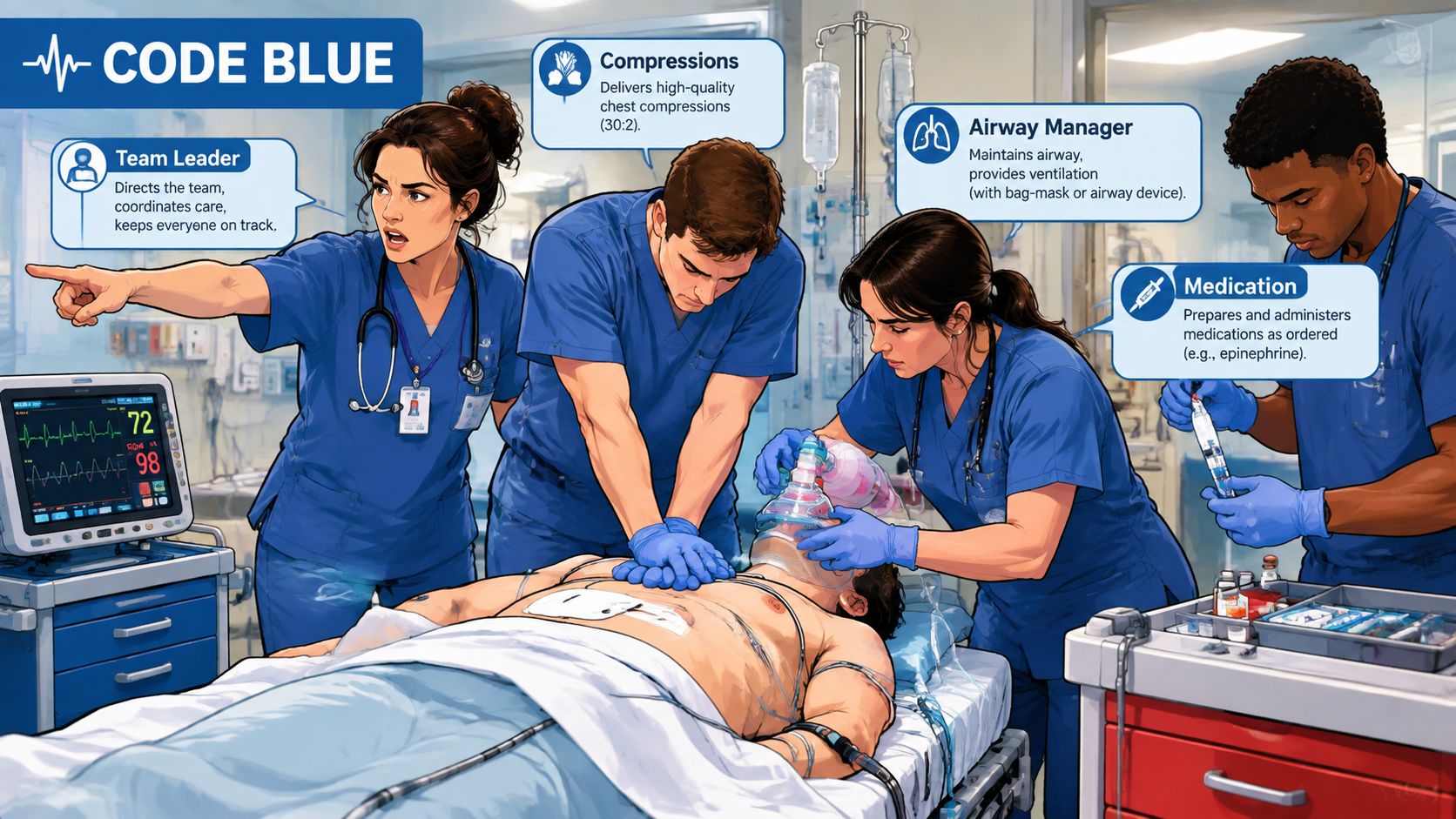
A code blue team works best when every person understands both their own assignment and the boundaries of everyone else's role. Without that clarity, several clinicians may reach for the same equipment while no one records times, prepares medication, or directs the next cycle.
The core team assignments
- Team leader: The leader assigns roles, interprets the clinical picture, prioritizes interventions, and keeps the team aligned with the resuscitation algorithm. They should avoid taking over a technical task unless the situation requires it.
- Compressor: This clinician provides high-quality chest compressions, watches for fatigue, and coordinates compressor changes. Consistent compressions require focus, physical endurance, and attention to interruptions.
- Airway manager: The airway clinician opens and maintains the airway, provides ventilation, monitors oxygenation when available, and communicates airway-related changes to the leader.
- Medication nurse or medication clinician: This person prepares and administers medications according to the authorized protocol, confirms doses and routes, and announces each medication clearly.
- Defibrillator operator: The operator brings the defibrillator or AED, places pads correctly, analyzes the rhythm when directed, charges the device, and confirms that everyone is clear before a shock.
- Recorder: The recorder documents key events, interventions, rhythm checks, shocks, medications, and response. Accurate timing helps the leader evaluate progress and supports later review.
- Additional support: A runner, respiratory therapist, pharmacist, or access clinician may manage supplies, vascular access, equipment, family communication, or documentation, depending on the setting.
These roles are not rigid job titles. Staffing varies between a general ward, emergency department, operating room, and pediatric unit. The principle stays consistent: assign responsibility before the room becomes chaotic.
A useful explanation of role structure appears in this guide to resuscitation triangle roles, which connects leadership, clinical tasks, and communication during an emergency.
Why defined roles change response speed
Simulation-based training makes role confusion visible. In an interprofessional intraoperative code blue study, repeated simulation decreased the time to first chest compression by 14 seconds and reduced time to defibrillation by 49 seconds. The study reported these findings alongside a 53.5% improvement in time to chest compressions after repeat simulation, as described in the study of in situ intraoperative code blue simulation.
Those gains come from practical changes. Team members learn where equipment is stored, who brings the defibrillator, who starts compressions, and how the leader gives an unambiguous command. Debriefing then identifies friction that may not be visible during a classroom discussion.
Online ACLS Certification can support the knowledge portion of this preparation. ProMed Certifications offers a quick and convenient way to get ACLS-certified, with a course that can be completed around a busy schedule. Learners can take the online course, pass the exam, and receive their card in as quick as one hour or less, according to the provided course information.
Inside a Code Blue Training Curriculum
A complete curriculum answers three questions:
- What should the team do?
- How should the team communicate?
- Can each person perform the required action under pressure?
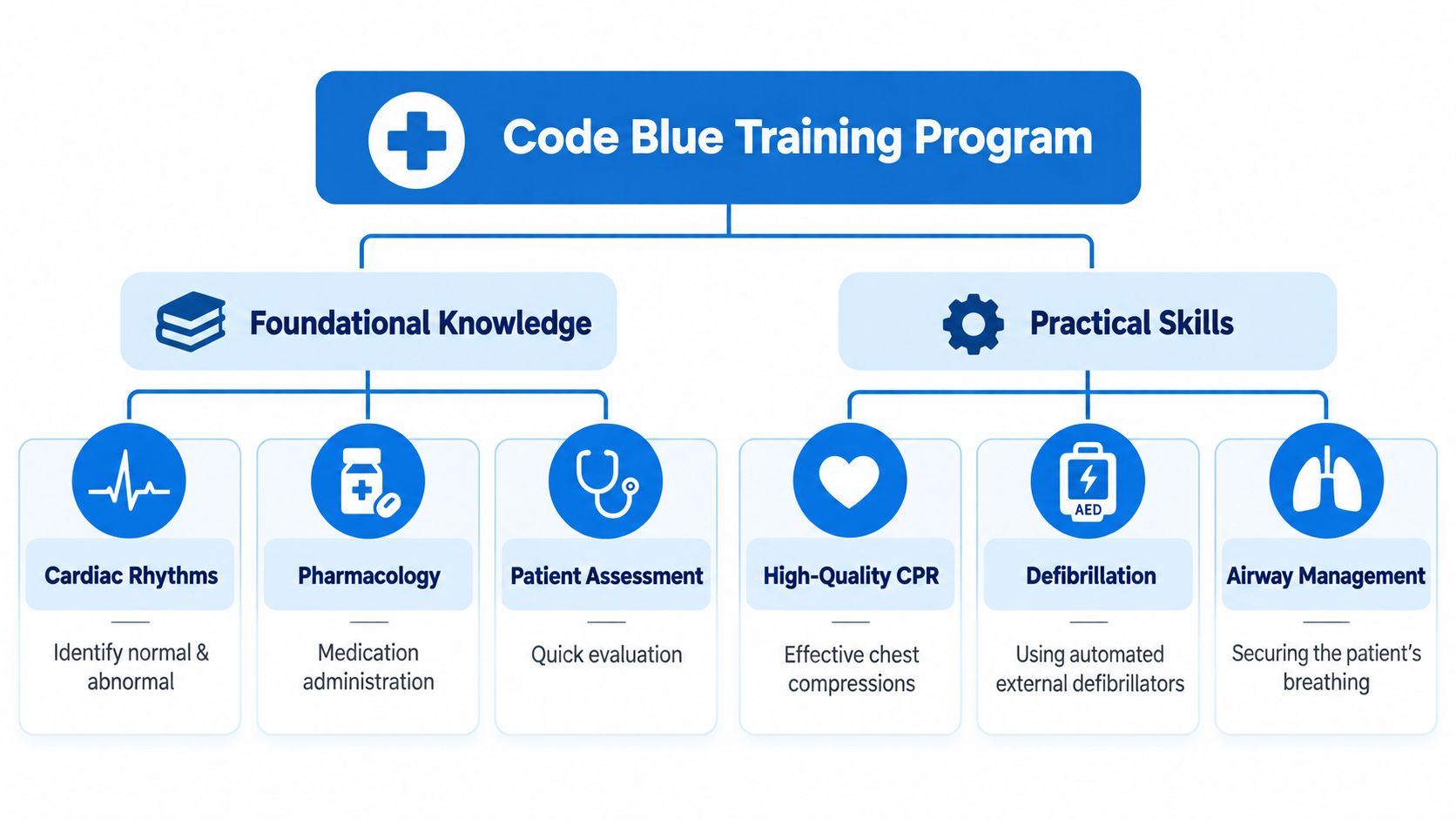
The first question involves foundational clinical knowledge. Learners review BLS and ACLS algorithms, cardiac rhythms, patient assessment, medication principles, airway management, and defibrillation. Algorithms act like a playbook, but clinicians still need to interpret the patient's condition and communicate what they're seeing.
Foundational knowledge
- Rhythm recognition: Learners distinguish rhythms that require immediate defibrillation from rhythms managed through CPR, medication, and continued assessment.
- Patient assessment: Training reinforces rapid evaluation, responsiveness, breathing, pulse checks, and recognition of reversible causes.
- Pharmacology: Learners connect each medication to its purpose, administration sequence, and communication requirements.
- Algorithm navigation: BLS and ACLS pathways provide an organized response when stress makes recall more difficult.
A focused review of important ACLS algorithms can help clinicians organize these pathways before participating in a mock code or certification assessment.
Practical performance
Knowledge becomes useful only when clinicians can apply it smoothly. Training may include chest compression practice, bag-mask ventilation, AED or manual defibrillator operation, airway equipment, vascular access support, medication preparation, and emergency cart organization.
The curriculum should also teach closed-loop communication. A leader gives a direct instruction, the assigned person repeats it, completes the task, and reports the result. That cycle reduces ambiguity. Saying “administer the medication” leaves room for uncertainty. Naming the medication clinician and asking for a clear confirmation creates accountability.
Team dynamics deserve equal attention. Learners should practice speaking up about a rhythm change, identifying a safety concern, requesting a compressor switch, and reporting when a task remains incomplete. These behaviors protect the patient because the leader can't see every detail at once.
A 2022 study of a simulation-enhanced, spaced-learning code blue curriculum found that ACLS algorithm adherence improved from a baseline mean of 71% to a post-training mean of 88%, a statistically significant gain, as reported in the simulation-enhanced code blue curriculum study. The same study assessed team performance over time and included patient-centered outcomes rather than relying only on a written test.
A strong curriculum builds a shared response pattern. The team should know what to do, say what it's doing, and recognize when the plan needs to change.
Online learning works particularly well for the knowledge layer because learners can pause, replay, take notes, and revisit difficult material. BLS Certification from ProMed Certifications provides an online course pathway that lets learners study around their schedules, complete the exam, and receive their card in as quick as one hour or less, according to the supplied course information.
Choosing Your Training In-Person vs Online
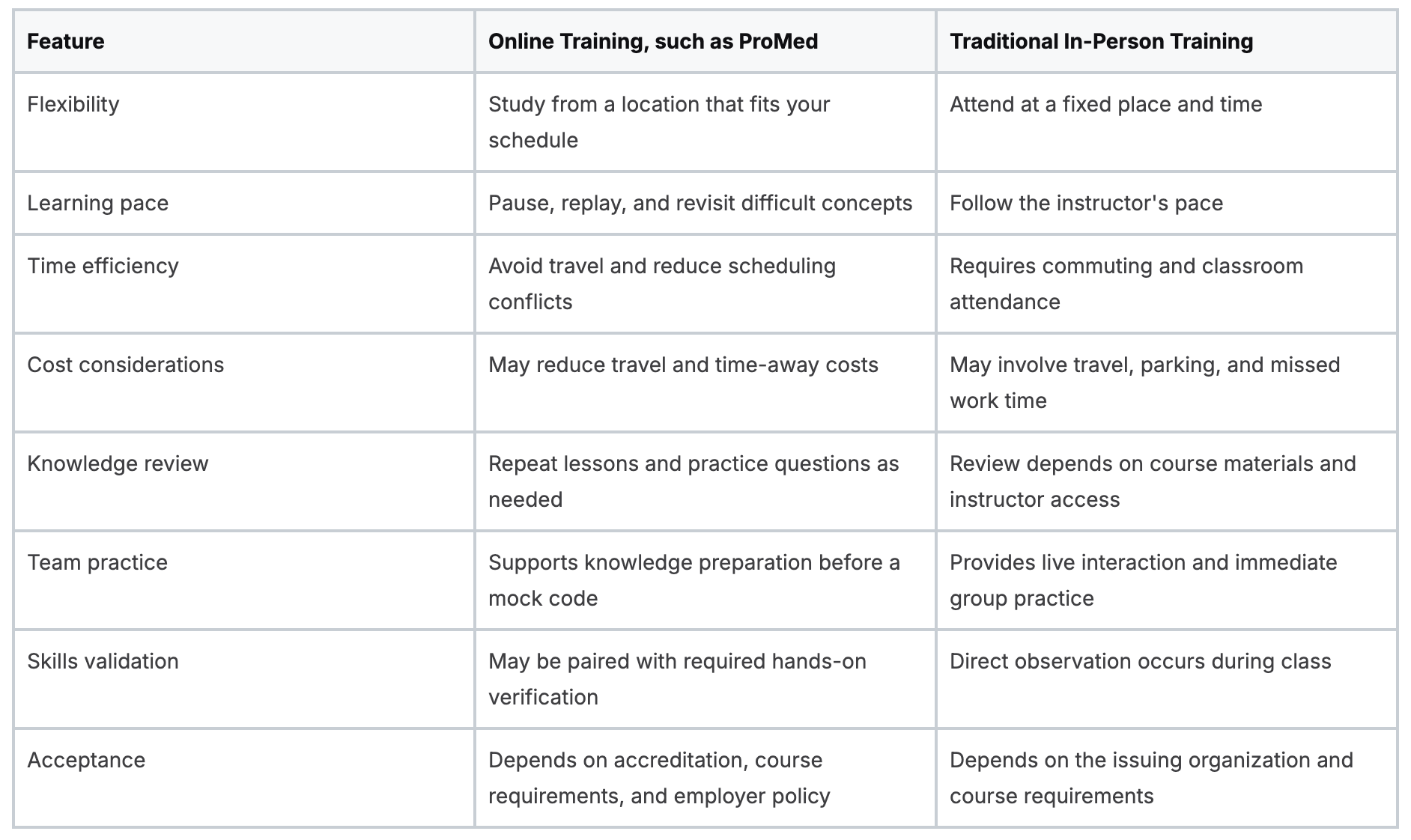
The question isn't whether clinicians learn effectively online. The better question is whether the course is well designed, current, accredited where required, and aligned with the learner's role and employer expectations.
A systematic review of 59 studies involving 6,750 students across medicine, dentistry, nursing, physical therapy, and pharmacy found online eLearning “equivalent, possibly superior” to traditional learning. The review reported that some knowledge tests and skill outcomes favored online learning, while most other comparisons found no significant difference.
That evidence supports a clear position: online CE and certification education can be just as effective as in-person instruction for knowledge and assessment preparation. Online courses also remove travel, reduce time away from work, and let professionals review material when they're alert rather than forcing every learner into the same classroom schedule.
The outdated belief that only American Heart Association or American Red Cross in-person classes are valid doesn't reflect the broader educational environment. AHA and Red Cross courses remain important options, but they aren't the only recognized pathways. Hospitals, clinics, employers, and professional organizations increasingly evaluate the course provider, accreditation, content alignment, completion requirements, and documentation.
The distinction between delivery format and training quality matters. An online course shouldn't pretend that watching a video replaces every hands-on requirement. Instead, a sound program clearly identifies what the learner can complete online and what additional skills verification or workplace practice may be required.
For a practical breakdown of the differences, review in-person vs online medical certification. ProMed's PALS Certification is presented as an online option for busy professionals who want to complete review material, take the exam, and receive their card in as quick as one hour or less, according to the supplied catalog information.
How to Prepare and Maintain Your Readiness
Certification is a milestone, not the end of preparation. Cardiac arrests may be unpredictable, and clinicians can experience long gaps between real events. Without deliberate refreshers, a person may remember the general sequence while hesitating over equipment, medication communication, or role transitions.
A 2026 PubMed study on nursing schedules reported a median of 15 code blues over two years per nurse, with median gaps of 36 days. It also found that 98% of modeled schedules contained at least one gap longer than 90 days, highlighting the risk of skill decay between events, as summarized in the American College of Surgeons discussion of in situ code blue simulation.
Build a repeatable refresh routine
Use a simple maintenance plan that fits your clinical environment:
- Review algorithms: Revisit BLS and ACLS pathways often enough to recognize the next decision point quickly.
- Practice equipment familiarity: Locate the crash cart, defibrillator, airway supplies, oxygen equipment, and documentation tools on your unit.
- Join mock codes: Participate when your organization offers in situ drills, and treat the debrief as a learning activity rather than a judgment.
- Rehearse communication: Practice role assignment, read-back confirmation, escalation, and speaking up when an instruction is unclear.
- Track personal gaps: Note which skills feel uncertain and choose targeted refreshers instead of repeating material you already know well.
- Check local requirements: Confirm renewal, skills verification, and documentation expectations with your employer or licensing body.
Online refreshers are especially useful because they reduce the friction between recognizing a knowledge gap and addressing it. You don't need to wait for a scheduled classroom date to revisit rhythm recognition or medication sequences. A short, focused review can support readiness while protecting time for patient care and rest.
Readiness grows through repetition, not intention. Put review on your calendar before a gap becomes a confidence problem.
Online CE and recertification are valid tools for this process. The 2019 systematic review of postregistration training found that online digital education and blended learning may be equivalent to self-directed or face-to-face learning for practicing physicians, although the review described the evidence quality as very low to low. That means course quality and appropriate skills practice still matter, but the online format itself isn't a reason to dismiss the education.
Get Certified and Stay Prepared with ProMed
Effective code blue training combines algorithm knowledge, technical skill, communication, and ongoing review. Your certification choice should support those needs while fitting your actual work schedule.
A practical approach is to:
- Identify your required credential: Check whether your role calls for ACLS, BLS, PALS, CPR, or another course.
- Confirm acceptance requirements: Review your employer's policy, renewal expectations, and any hands-on verification requirement.
- Choose a current course: Look for content aligned with current resuscitation guidance and clear completion documentation.
- Schedule continued practice: Use online review for knowledge maintenance and participate in mock codes or skills sessions when available.
- Keep records accessible: Store your certification card and CE documentation where you can retrieve them quickly.
ProMed Certifications offers online medical certification courses for healthcare professionals, including ACLS, BLS, PALS, CPR, and Neonatal Resuscitation. Its platform is designed for self-paced learning, and its course information states that learners can complete review material, take exams, and receive course cards through the online pathway.
The larger shift is clear. Healthcare professionals need education that supports patient safety without ignoring demanding schedules. Accredited online CE and certification programs provide a credible, modern option for building knowledge, preparing for assessment, and maintaining readiness between simulations and real emergencies.
Start by reviewing your employer's requirements, then choose the ProMed course that matches your role and current certification needs. Visit ProMed Certifications to explore online ACLS, BLS, PALS, CPR, and continuing education options, and take the next practical step toward staying prepared for a code blue.
.avif)
Stay compliant with ProMed+
Certifications included: ACLS, BLS, PALS, CPR & Neonatal Resuscitation
Unlimited continuing education: over 200 hours of accredited CME
All-inclusive: One price. No surprises.
Get certified today

The Advanced Cardiac Life Support (ACLS) is an accredited online medical certification course that teaches medical professionals to respond to nearly all cardiopulmonary emergencies.

The Pediatric Advanced Life Support (PALS) Recertification instructs medical professionals on performing pediatric cardiopulmonary resuscitation in emergencies.

The Basic Life Support (BLS) Recertification is intended to teach healthcare professionals the basic steps of CPR and rescue breathing for adults, children, and infants.

Our online medical certification course for CPR, Automated External Defibrillator (AED), and First Aid is designed to teach adult, child, and infant CPR and AED use.

The Neonatal Resuscitation Certification trains medical professionals in performing resuscitation procedures and life-saving techniques for newborns at the time of delivery.

.png)
.png)
.png)