


What Is the PCU Unit?
.png)
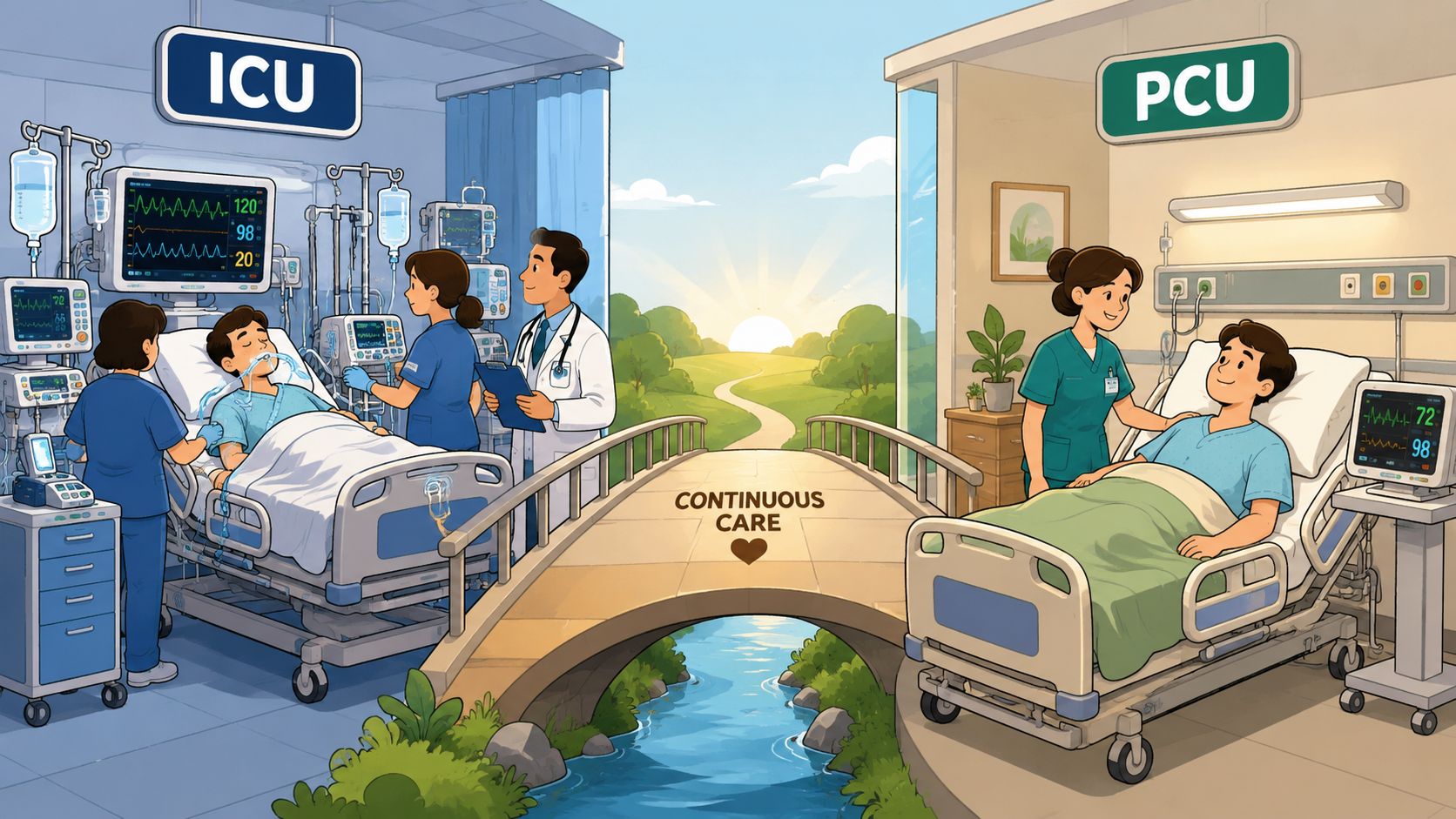
You're checking a unit assignment, reading a transfer note, or orienting yourself for a new patient, and the term PCU keeps showing up. In hospital care, that usually means Progressive Care Unit, a monitored space for patients who are too stable for the ICU but still need more attention than a general floor can give. It's a practical answer to a common clinical problem, matching the right level of surveillance to the right patient.
The phrase pcu unit can be confusing because it doesn't point to just one field. In healthcare, it usually means Progressive Care Unit, but in transportation engineering it can also mean Passenger Car Unit. That ambiguity is one reason readers land on search pages and still feel unsure.
Introduction to Progressive Care Units
A patient leaves the ICU after a rough night, still on telemetry, still needing frequent reassessment, still not ready for a regular med-surg bed. That's where a Progressive Care Unit, also called a step-down or intermediate care unit, fits. It gives nurses the breathing room to watch for deterioration without tying up ICU resources that should stay available for the sickest patients.
Think of PCU as the hospital's careful middle ground. The patient isn't “fine,” but they're no longer at the point where full critical care is required. That middle zone is exactly why PCUs exist, they help hospitals avoid unsafe acuity mismatches while supporting recovery after major surgery or acute worsening of chronic illness.
PCUs also help make the search term what is pcu unit less misleading. A nurse, student, or manager asking that question may be looking for a clinical definition, while an engineer may mean something completely different. Keeping the setting in view prevents mistakes before they happen.
Practical rule: if the patient needs closer surveillance than a general floor can provide, but not full ICU support, you're probably looking at a PCU-level patient.
Role of PCU in Hospital Care
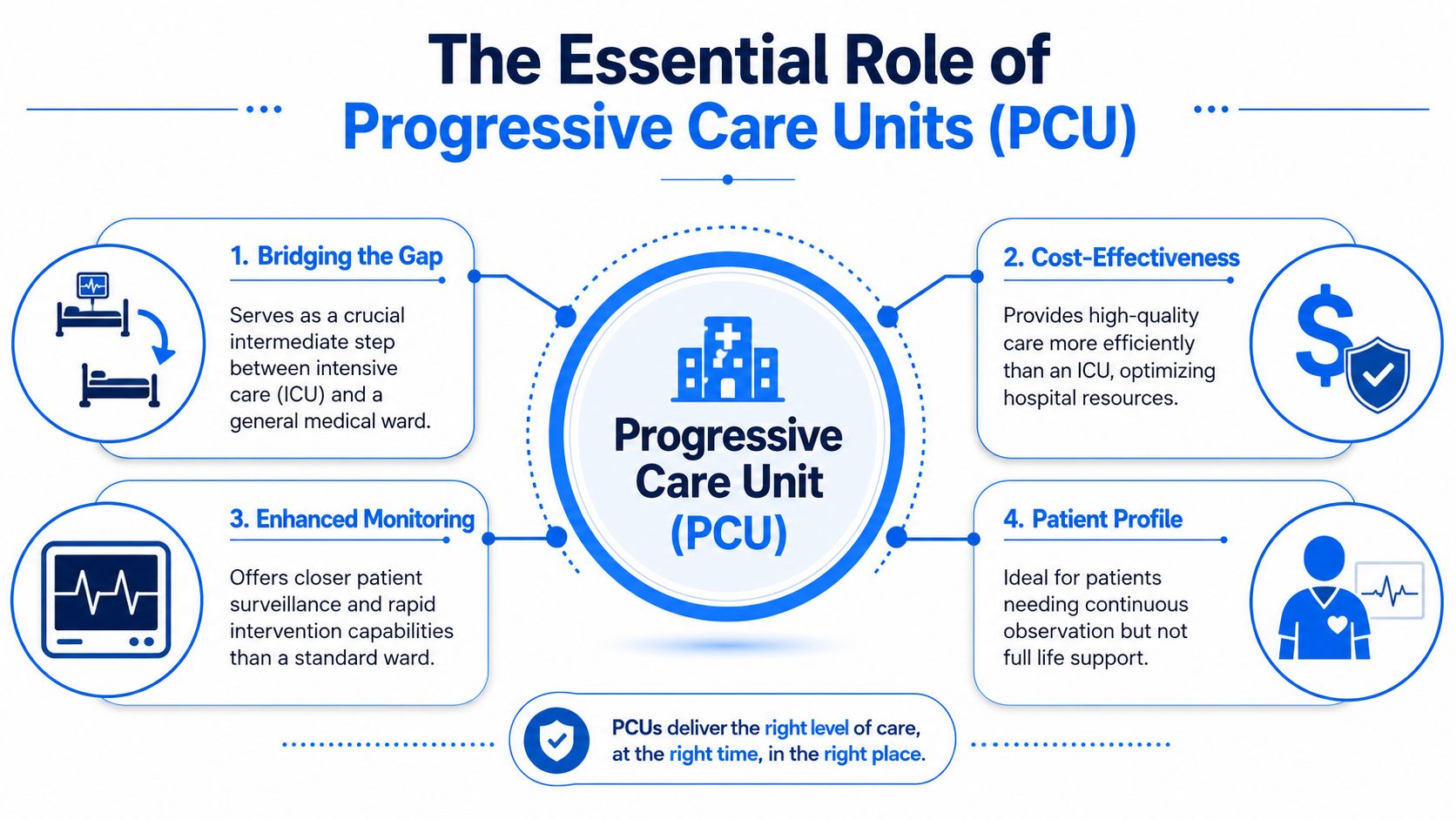
A PCU is not just a room type, it's an operational strategy. AACN describes progressive care units as a way to deliver cost-effective, high-quality, safe care for patients who are not sick enough for ICU-level support but still need close monitoring. In practice, that means continuous or near-continuous observation, quick escalation, and a nursing model built for early recognition rather than rescue care alone.
Why hospitals rely on PCUs
PCUs reduce pressure on two ends of the hospital at once. They protect ICU beds for the patients who need them, and they keep med-surg floors from being overloaded with patients whose conditions still need tighter surveillance. That matters for cardiac pathways, post-procedure observation, heart failure care, and vascular instability, where telemetry and fast reassessment aren't optional extras.
Recent expert content also points out that PCUs are often used after ICU, cath lab, electrophysiology, or cardiac surgery pathways, and that staffing quality affects service-line performance. That nuance matters because a PCU isn't a single universal model, it changes by hospital, specialty, and patient mix. American Cardiology Group's overview of PCU use reflects that operational flexibility.
If your unit education program is being built around this kind of care, a structured CE platform can help staff keep pace with policy and competencies. ProMed+ Nursing CE is described as a streaming platform for continuing education needs, which fits teams that need a steady way to complete CE requirements without leaving the unit short-handed.
What this means at the bedside
A PCU nurse spends more time interpreting trends than waiting for alarms to become emergencies. The work is more proactive than med-surg, but less resource-heavy than ICU. That middle position is what makes the unit so useful, and also why staff education has to stay current.
PCU versus ICU and Med Surgical Units
A new nurse at the bedside may hear three patients described as “sick,” yet each one belongs in a different unit. ICU patients need the closest monitoring and the most complex support. Med-surg patients are stable enough for less frequent intervention. PCU sits between them, both clinically and operationally, which is why it often feels like the bridge between rescue care and routine recovery.
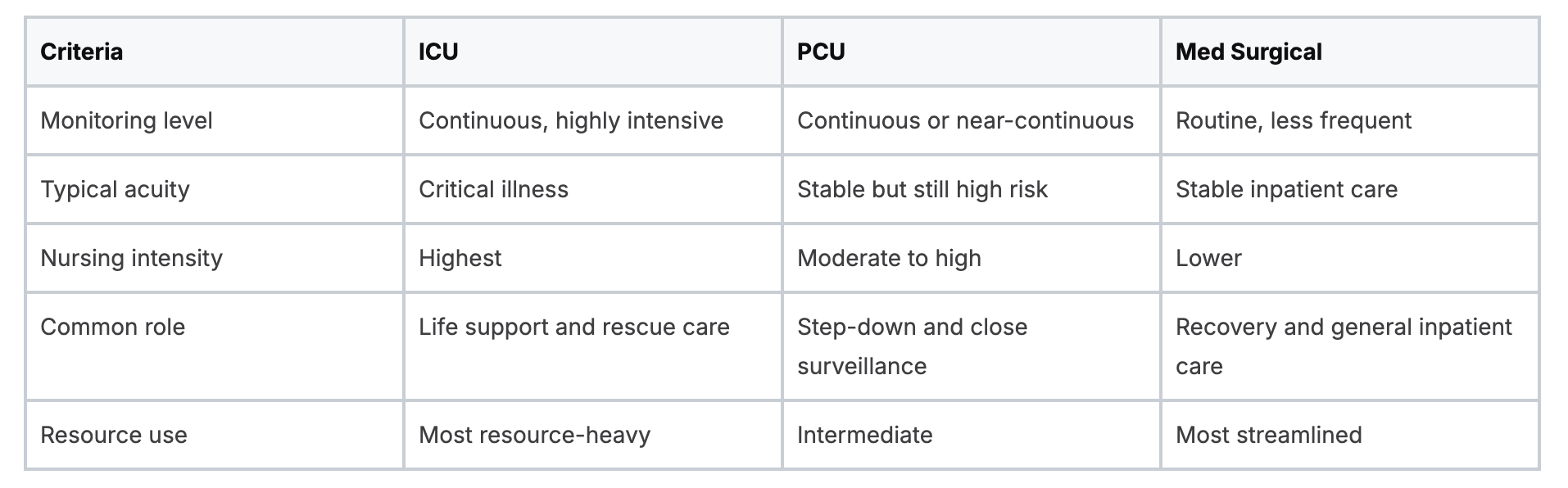
The staffing difference matters just as much as the table. PCU assignments usually call for stronger prioritization than med-surg, because one patient may need rhythm checks, oxygen titration, or quick reassessment while another is stable enough to wait. ICU ratios are typically tighter, often 1:1 or 1:2, while many PCUs use a wider assignment such as 1 nurse for every 3 to 4 patients. That difference shapes how nurses cluster care, watch trends, and decide when to escalate.
A med-surg assignment fits a patient whose course is predictable and whose needs are steady. A PCU assignment fits a patient who still needs rhythm surveillance, titrated oxygen support, or faster escalation if the picture changes. The bed choice follows the patient's risk and how quickly that risk could change, not the diagnosis alone.
A good placement decision protects the patient twice, once by matching acuity to the right unit, and again by keeping hospital flow safer.
Patient Profiles and Common Procedures in PCU
PCUs care for patients who need watchful nursing, not constant life support. That often includes people recovering from major surgery, those with heart failure or arrhythmias, and patients whose chronic illness has flared enough to require closer observation. It's also common to see post-cath lab or electrophysiology patients during the early recovery window.
Common reasons patients land in PCU
- Postoperative recovery: Patients may need frequent vitals, pain control, and trend monitoring after major procedures.
- Cardiac rhythm problems: Telemetry is important when arrhythmias need close observation or medication adjustment.
- Heart failure care: Fluid balance, oxygen needs, and response to therapy can change quickly.
- Respiratory compromise: Some patients need oxygen management and frequent reassessment rather than full ventilatory support.
- Medication titration: Drugs that affect blood pressure, rhythm, or respiratory status often require a setting with faster nursing response.
The key question is whether the patient's condition could shift enough to need rapid intervention. If yes, PCU may be the safer bridge. If not, a med-surg unit may be more appropriate.
What the team watches for
PCU nurses don't just collect data, they interpret change. A patient's oxygen trend, rhythm pattern, blood pressure response, and overall work of breathing tell the story before a formal crisis develops. That's why PCU care rewards pattern recognition and fast communication.
Monitoring Equipment and Staffing Ratios
A PCU room can look calm from the doorway, but the level of watching behind that door is much closer to a control center than a general ward. Patients are stable enough to avoid ICU care, yet fragile enough that small changes in rhythm, breathing, or blood pressure need quick attention. That is why the unit relies on continuous monitoring and careful nursing coverage.
What the equipment is doing
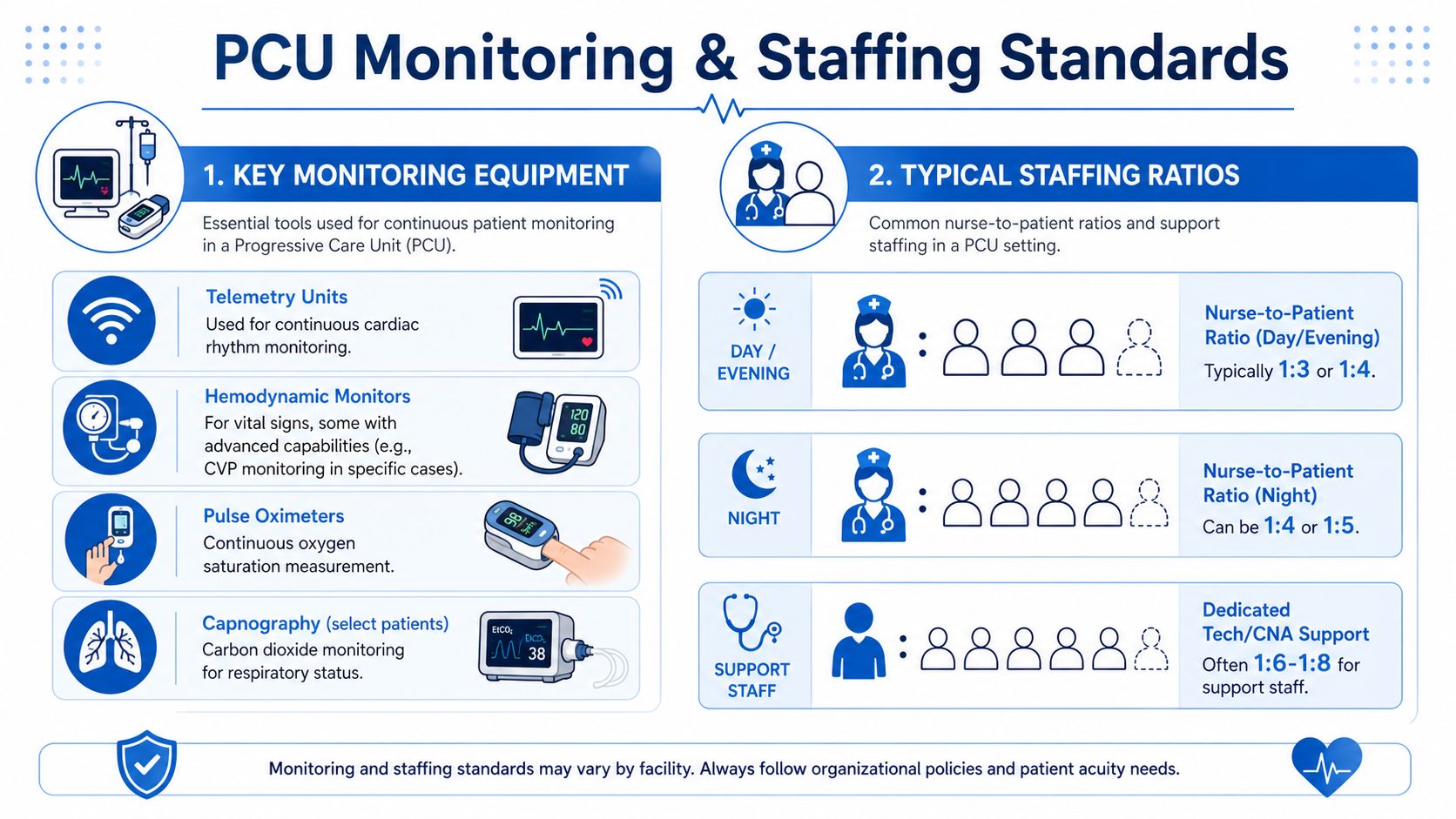
Telemetry watches the heart rhythm all the time, which helps the team catch arrhythmias early and see whether treatment is helping. Hemodynamic monitoring is used in selected cases to follow blood pressure and related trends more closely. Pulse oximetry shows how well the patient is oxygenating, and infusion pumps keep medications moving at the right rate when titration is needed. Some patients also need respiratory monitoring or capnography, especially when breathing status is part of the concern.
Each device plays a different role, but the primary value is in how the team reads the pattern together. A monitor alarm alone does not explain the patient. A rising oxygen requirement, a rhythm change, and a subtle shift in alertness may be the first clues that the bedside nurse uses to intervene before the patient worsens.
For new clinicians, that kind of observation can feel abstract until it is tied to a mental framework. A Glasgow Coma Scale guide helps show how structured bedside scoring turns a patient's level of responsiveness into something the team can track and compare over time. In a PCU, that same habit of careful scoring supports faster recognition of change.
Why staffing has to stay tighter than med-surg
Staffing in PCU usually sits in the middle ground between a general floor and the ICU. A common benchmark is 1 nurse for every 3 to 4 patients, while ICU ratios are often 1:1 or 1:2. With that in-between level of care, and many units add tech or CNA support so routine tasks do not pull nurses away from surveillance.
The ratio alone does not tell the full story. Four step-down patients may still require frequent reassessment, alarm response, medication checks, and careful handoff timing. A unit works best when the staffing model, escalation process, and alarm management all support the nurse's ability to notice change early.
For teams balancing shift work with competency renewal, CPR AED & First Aid Certification is available as a 100% online certification option. That kind of digital pathway can fit the same practical mindset PCU units use every day, keeping staff current while they stay focused on patient monitoring and response.
Admission and Discharge Criteria for PCU
PCU admission starts with one question, does the patient need more surveillance than med-surg can safely provide? If the answer is yes, the next check is whether the patient still falls short of ICU-level need. That balance keeps the unit from becoming either underused or unsafe.
Common admission checks
- Vital signs stability: The patient should be stable enough to avoid full ICU support, but still needs close trending.
- Oxygen requirements: Patients who need ongoing oxygen management may fit PCU if they don't need advanced ventilatory support.
- Medication titration: Blood pressure, rhythm, or fluid-related infusions often belong in a monitored setting.
- Procedural recovery: Recent surgery, cath lab work, or electrophysiology procedures often justify step-down placement.
- Nursing observation needs: If the patient needs frequent reassessment, PCU may be the right bridge.
Discharge from PCU usually means the patient's trends have settled enough for less frequent monitoring. Nurses look for stable oxygen needs, less intensive medication management, and a lower risk of sudden change. That's when the patient can move to med-surg or, in some cases, go home with the right follow-up.
The practical goal is simple. Move the patient out as soon as the higher level of observation is no longer needed, but not before. Good flow protects both safety and capacity.
Staff Certifications and Practical Takeaways
PCU performance depends on how well the team is trained. Nurses in these units typically need solid rhythm interpretation, escalation judgment, and a current life-support foundation, because patients can change faster than on a standard floor. That's why many managers keep a close eye on CE, ACLS, and refresher planning.
Online learning is now a valid path
The old idea that only in-person courses from AHA or the American Red Cross count is outdated. Accredited online CE and certification have become widely accepted across healthcare, and the industry continues to move in that direction. Online formats are often just as effective for knowledge retention and practical readiness because they let clinicians learn at their own pace, revisit content, and fit training around shifts.
That matters in a PCU, where staffing gaps are hard to absorb. Online courses reduce travel time, ease scheduling pressure, and let managers keep competencies current without pulling multiple people off the floor at once. ProMed Certifications' online ACLS option is one example of a digital pathway designed for busy clinicians.
What managers can do next
- Track renewal dates early: Don't wait until a card is close to expiring.
- Match courses to unit needs: Focus on ACLS, BLS, and any specialty refreshers tied to the patient mix.
- Use online CE strategically: It's accessible, consistent, and easier to fit into real schedules.
- Build competency into onboarding: New PCU nurses need a strong start, not just a policy binder.
For a basic skills reminder that pairs well with unit readiness, the Basic Life Support Certification for Nurses resource is a practical internal reference. It fits the same reality PCU teams live every day, which is that training has to be usable on a busy shift, not just on paper.
If you're building PCU confidence for yourself or your team, start with the unit's core demands, rhythm awareness, escalation, and safe monitoring, then choose training that fits your schedule without sacrificing quality. Explore ProMed Certifications for online CE and certification options that support busy clinicians, strengthen unit readiness, and make ongoing education easier to complete.
.avif)
Stay compliant with ProMed+
Certifications included: ACLS, BLS, PALS, CPR & Neonatal Resuscitation
Unlimited continuing education: over 200 hours of accredited CME
All-inclusive: One price. No surprises.
Get certified today

The Advanced Cardiac Life Support (ACLS) is an accredited online medical certification course that teaches medical professionals to respond to nearly all cardiopulmonary emergencies.

The Pediatric Advanced Life Support (PALS) Recertification instructs medical professionals on performing pediatric cardiopulmonary resuscitation in emergencies.

The Basic Life Support (BLS) Recertification is intended to teach healthcare professionals the basic steps of CPR and rescue breathing for adults, children, and infants.

Our online medical certification course for CPR, Automated External Defibrillator (AED), and First Aid is designed to teach adult, child, and infant CPR and AED use.

The Neonatal Resuscitation Certification trains medical professionals in performing resuscitation procedures and life-saving techniques for newborns at the time of delivery.

.png)
.png)
.png)