


Basic Life Support Certification for Nurses: Your 2026 Guide
.png)
Your BLS card is about to expire. Or maybe you just accepted a new nursing role and onboarding sent over a list of required credentials. Either way, the same question shows up fast. What's the smartest way to get basic life support certification for nurses without wasting a day off?
I've watched this shift over the years. BLS used to feel tied to a classroom, a rigid schedule, and a lot of unnecessary friction. That's changed. Nurses now have practical online options that fit real schedules, real staffing pressures, and real life.
That matters because BLS isn't just another checkbox. It's one of the core clinical credentials attached to bedside readiness. If you work in a patient-facing nursing role, you're expected to know how to respond when a patient stops breathing, collapses, or chokes. The credential documents that expectation. The training behind it should prepare you to act.
The good news is that the modern path is much more efficient than many nurses realize. Online learning has become a valid, accessible way to complete certification and renewal, especially when the course is accredited and aligned with current standards. The old idea that only an in-person class from a legacy provider counts isn't accurate anymore.
Why Your BLS Certification Matters More Than Ever
A patient can go from stable to unresponsive in seconds. In that moment, no one cares how busy the unit was or whether your renewal reminder got buried in your inbox. They need a nurse who can start the right response without hesitation.
That is why BLS stays attached to so many nursing roles. Employers expect it to be current, easy to verify, and backed by training that prepares you for real bedside emergencies. For many nurses, it shows up before the job starts, during school admissions, clinical placements, onboarding, or credentialing.
What BLS covers
BLS gives you a repeatable response framework for the emergencies nurses are expected to recognize fast and handle correctly. It works like a fire drill for clinical collapse. The goal is not memorizing a card. The goal is building a response you can perform under pressure.
A solid BLS course trains you to demonstrate provider-level response in high-stakes moments, including:
- High-quality CPR: You need to deliver compressions at the correct depth and rate.
- Effective ventilation: You need to give breaths properly, not just recite the sequence.
- AED use: Setup, pad placement, and safe operation are part of the expected skill set.
- Choking response: Adult and pediatric airway emergencies are included in standard BLS training.
The word “basic” confuses people. The steps are foundational, but the expectation is high. Under stress, even simple actions can feel harder unless you have practiced them enough that the sequence feels familiar.
Practical rule: Treat BLS as a readiness credential, not a paperwork task.
That mindset matters even more now. Nurses change roles more often, float across units, pick up PRN shifts, and move between health systems. Hiring teams want documented competency, quick verification, and fewer delays during onboarding.
This is also why the old in-person-only mindset keeps fading. Busy nurses need training that fits rotating shifts and still meets employer standards. Accredited online courses meet that need well because they let you review, pause, repeat, and test with more control over your time. If you are comparing formats or providers, this guide on how to choose the best online BLS course can help you sort out what employers usually look for.
I have watched this change firsthand. The profession is not lowering the bar. It is getting smarter about how nurses meet it. For many working clinicians, accredited online certification is no longer a backup option. It is the practical default, especially when the provider offers an acceptance guarantee.
Choosing Your Path Online vs In-Person Training
The first decision is format. Most nurses still ask the same question: should I sit in a classroom, or can I do this online?
My answer is straightforward. For many working nurses, online certification is the more practical choice. It's flexible, easier to fit around shifts, and often more efficient. The idea that only AHA or American Red Cross in-person classes are valid is outdated. Those organizations remain important, but they are not the only path nurses consider, and in-person delivery is not the only legitimate format.
Online learning also saves time. According to an AHA journals report on BLS learning formats, online BLS training reduced completion time by 52% compared with traditional classes. The average traditional in-person training time was 4.6 hours, while AHA's BLS Online took 2.4 hours and HeartCode BLS took 2.2 hours. The same report noted 80% preference for online learning due to flexibility and efficiency.
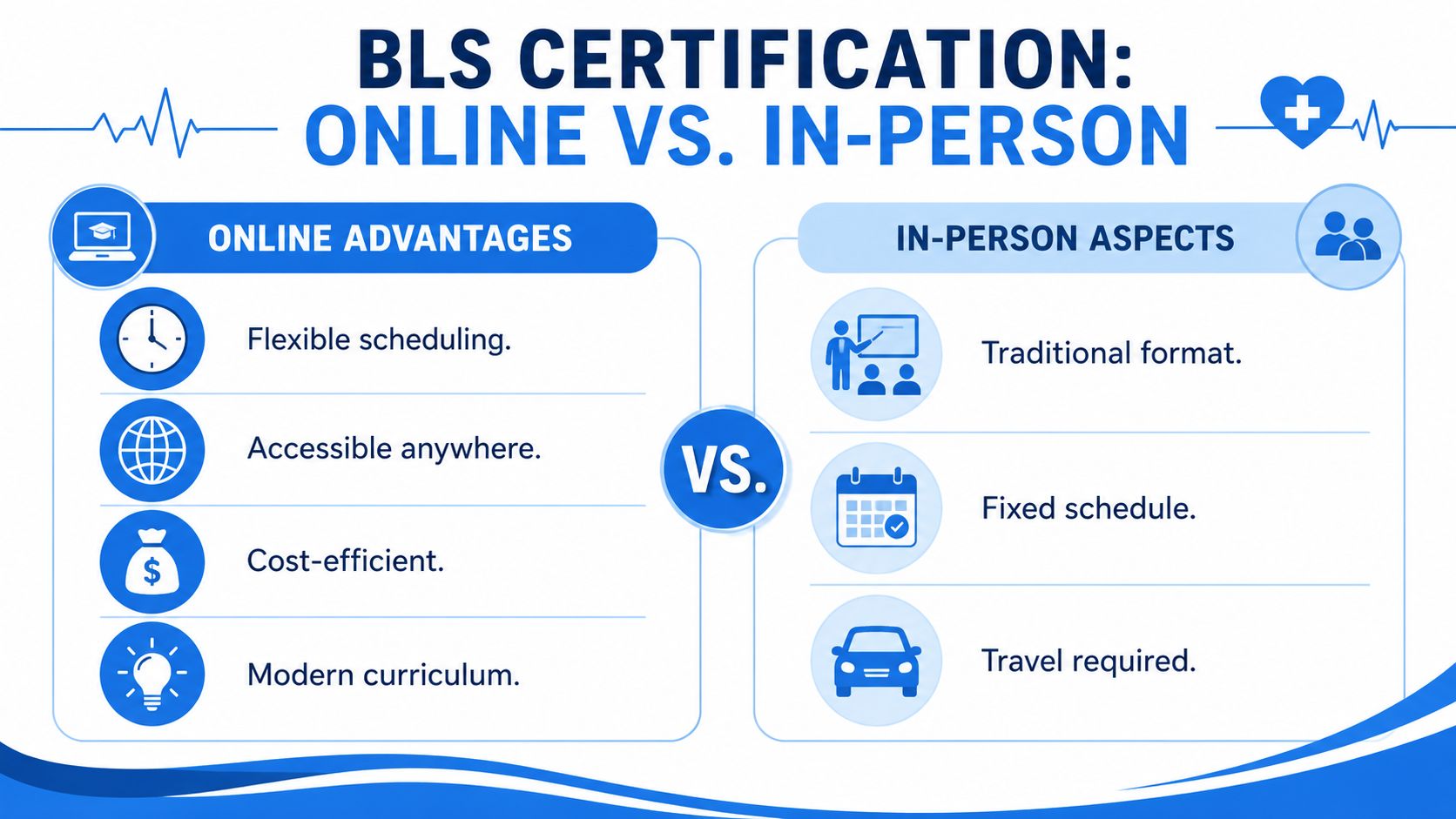
Online and in-person side by side
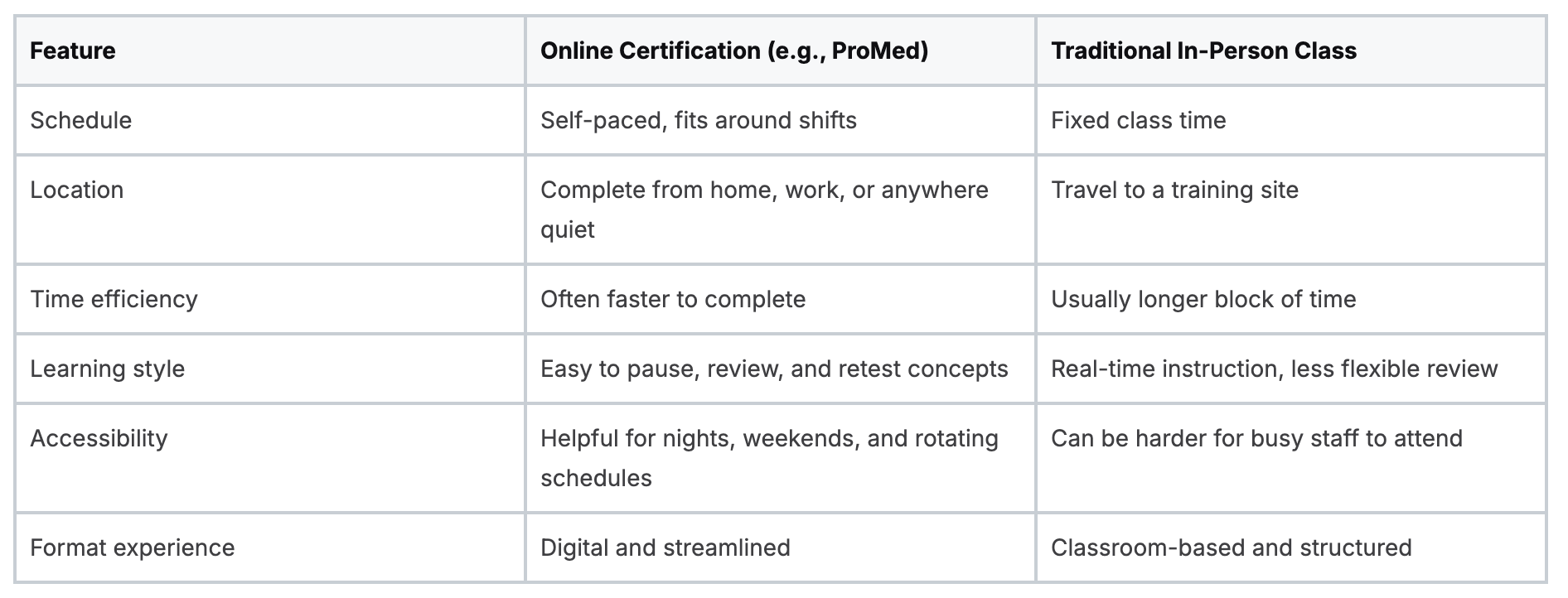
When online makes the most sense
Online works especially well if you:
- Work irregular shifts: Night nurses and PRN staff often can't predict a good classroom window.
- Need a fast renewal path: A shorter format reduces the chance that renewal turns into a last-minute scramble.
- Learn best by repetition: Online modules let you revisit steps without slowing down a room full of people.
One example of the fully online route is BLS Certification, which is offered as a 100% Online BLS Certification and designed to be completed anywhere within a busy schedule. For nurses who need a straightforward renewal option, that kind of format reflects where healthcare education is heading.
Online education isn't the shortcut. For many clinicians, it's the format that removes the outdated barriers.
The Certification Process Explained
You finish a 12-hour shift, open your email, and see a reminder that your BLS card is about to expire. That moment used to mean rearranging days off, finding a class seat, and hoping the timing worked. Now the process is much more direct. For many nurses, it works the way modern clinical training should work. Efficient, clear, and built around real schedules.
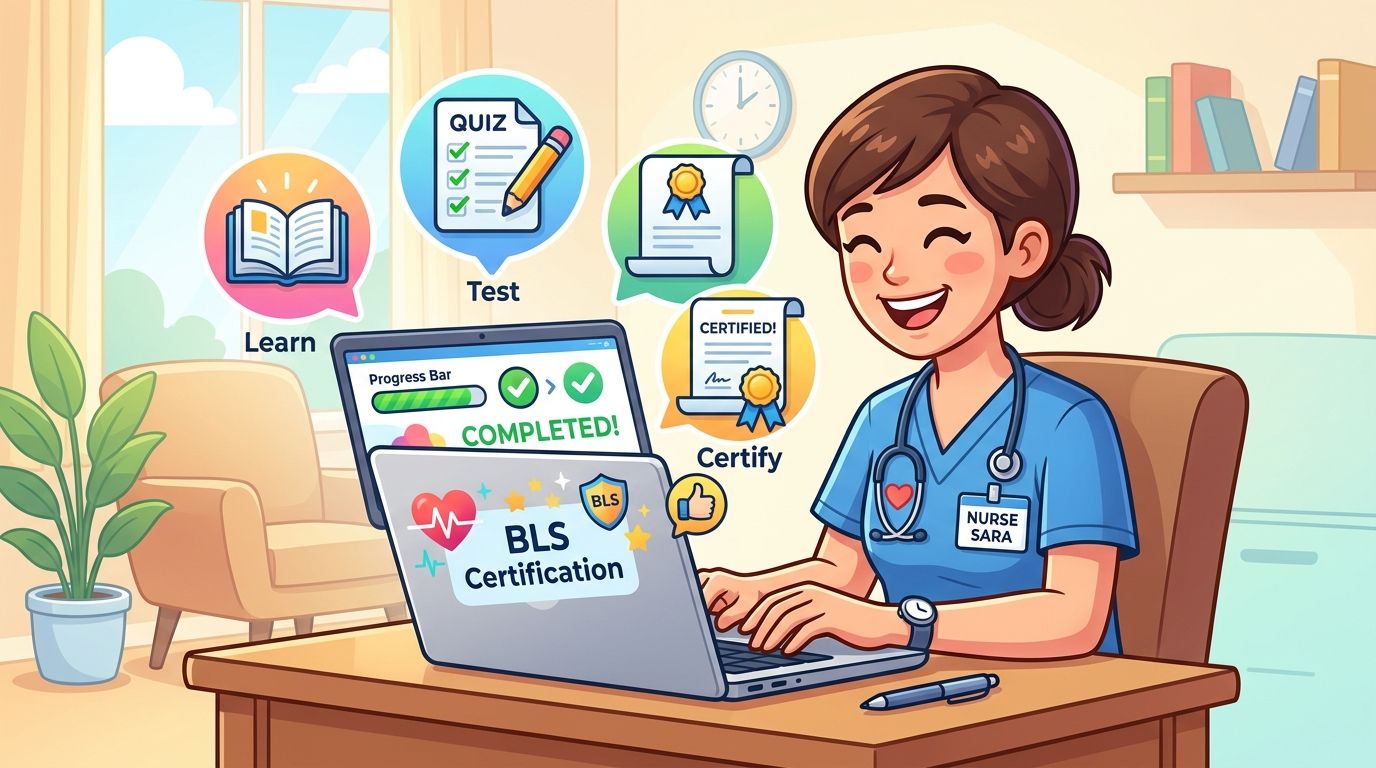
Step 1 Get enrolled and start the course
Most accredited online BLS providers give you access right after enrollment. If your deadline is close or you need updated documentation for onboarding, that speed matters.
Self-paced study fits nursing life well. You can complete one module before work, return to it after report, and review a weak area without sitting through content you already know. It works like charting in stages instead of trying to finish every task in one long block. The progress still counts, and it is often easier to do well.
Step 2 Learn the provider-level essentials
A solid BLS course teaches the actions behind the card. You should see the full response flow nurses use in practice, including adult and pediatric basics, high-quality CPR, ventilation, AED use, and choking relief.
The goal is not memorizing isolated facts. The goal is building a reliable sequence under pressure. That is why good online courses are useful. You can replay a section, review a missed concept, and tighten up the order of steps until the response feels familiar.
As noted earlier, BLS certification is generally valid for two years. If it expires, many providers require full recertification rather than a simple renewal.
Step 3 Take the exam with confidence
The exam portion is usually straightforward if you have worked through the material. Some providers use a written or online test, and some employers may also expect a verified skills component. The format matters less than clarity. You need to know what your employer requires before you enroll.
That point causes a lot of confusion, especially among nurses who were told years ago that only classroom training counted. That is no longer a safe assumption. Accredited online certification is often the practical default for busy clinicians, but acceptance depends on matching the course format to your facility's policy. If you want to confirm that before paying for a course, review how to know whether your employer or facility will accept a provider card.
Step 4 Save your card and track your next renewal
After you pass, save your digital card in more than one place. Keep a copy on your phone, send one to your email, and upload it to your employer's credentialing portal if they use one.
Treat it like any other license document. Easy to find. Ready when asked.
That small habit prevents the last-minute scramble that catches many nurses off guard.
Ensuring Your Certification Is Accepted by Your Employer
This is the concern nurses bring up most often. Not “Can I pass?” but “Will my employer accept it?”
That's a fair question. Employer acceptance doesn't hinge on whether the course felt traditional. It hinges on whether the credential meets the facility's standards and whether the provider can document what the employer requires.
Where the confusion comes from
A 2025 industry report noted that 34% of healthcare employers in major markets had begun rejecting 100% online BLS credentials for new hires if they lacked a verified skills session. That doesn't mean online learning is ineffective. It means some employers are drawing a line between accredited online education and online credentials that don't document the components they expect.
That distinction matters.
What to check before you enroll
Before choosing any provider, confirm these points with your employer or recruiter:
- Required format: Ask whether they accept fully online, blended, or only skills-verified options.
- Accepted organizations or standards: Some employers name specific issuers. Others care more about alignment and documentation.
- Card language: Make sure the certificate clearly identifies the course level and completion details.
The larger point is this. Don't assume “online” is the problem. Often, the issue is whether the course structure matches the employer's policy. Accredited online education is a valid and smart choice. You just need to match the format to the job requirement.
Bottom line: The provider name matters less than whether the credential matches your facility's stated acceptance criteria.
Tips for BLS Success and Renewal
Most nurses don't struggle with motivation. They struggle with time, interruption, and the false comfort of memorizing just enough to pass.
That's why the best preparation is practical, not frantic.
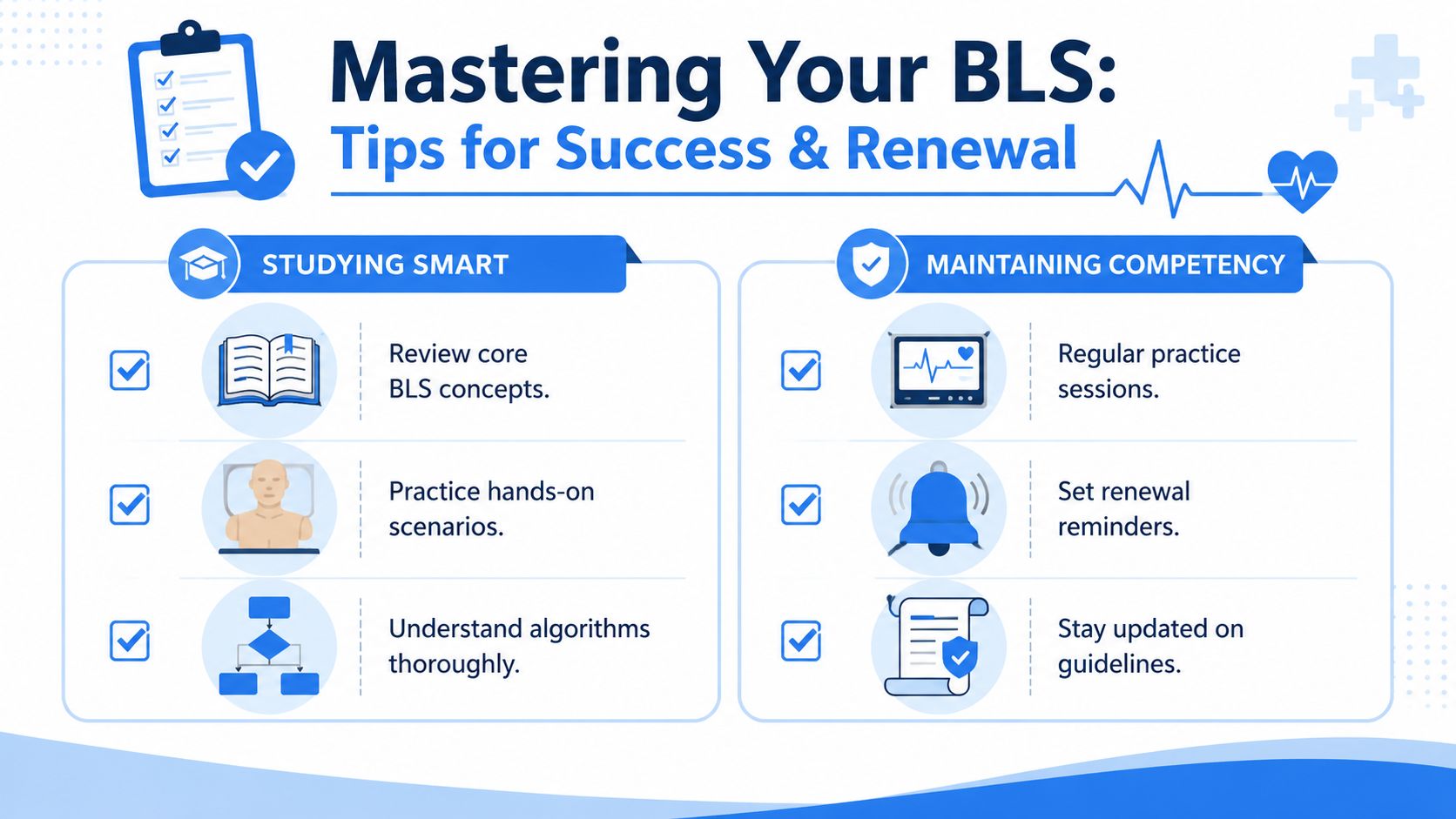
Study for recall, not just recognition
A high pass rate can hide weak performance in real scenarios. Overall BLS pass rates are often 85% to 95%, yet one study found only 15.9% of nurses scored above 80% on skills tests. That gap is the reason good courses should build functional understanding, not just quiz familiarity.
Try these habits:
- Talk through the sequence aloud: If you can explain the steps clearly, you're less likely to freeze under pressure.
- Connect actions to purpose: Don't just memorize compressions and breaths. Know why each step matters.
- Revisit weak sections: Online learning shines here because you can repeat content without embarrassment or delay.
For practical exam prep, this article on passing ACLS, BLS, PALS, or CPR exams the first time gives useful study guidance.
Protect your renewal window
Renewal problems usually come from timing, not difficulty.
Use a simple system:
- Set a reminder well before expiration.
- Store your current card where you can find it fast.
- Complete renewal while your knowledge is still fresh.
That last point matters most. Nurses retain BLS better when renewal feels like reinforcement, not rescue.
Take the Next Step with Your BLS Certification
Nurses don't need more friction. They need training that respects their schedule, keeps them compliant, and supports real clinical readiness.
That's why the old in-person-only mindset no longer fits the profession. Online certification has become a normal, sensible path for busy healthcare workers. It gives you flexibility, supports repeat review, and removes the scheduling bottlenecks that make renewal harder than it needs to be.
If your role also requires advanced cardiac training, ACLS Certification is available in a quick online format that lets you take the course anywhere and complete it within a busy schedule. That's helpful for nurses moving into higher-acuity settings and trying to streamline multiple credential requirements at once.
The practical next step is simple. Check your employer's acceptance criteria, choose the format that matches it, and complete your BLS before the deadline turns into a problem. If online fits your facility's standards, there's no reason to default to an older, less flexible route.
Basic life support certification for nurses should be current, efficient, and easy to manage. That's not lowering the standard. It's aligning the process with how nurses work.
If you're ready to renew or earn your card, ProMed Certifications offers online medical certification courses for healthcare professionals who need a flexible path to BLS and other required credentials.
.avif)
Stay compliant with ProMed+
Certifications included: ACLS, BLS, PALS, CPR & Neonatal Resuscitation
Unlimited continuing education: over 200 hours of accredited CME
All-inclusive: One price. No surprises.
Get certified today

The Advanced Cardiac Life Support (ACLS) is an accredited online medical certification course that teaches medical professionals to respond to nearly all cardiopulmonary emergencies.

The Pediatric Advanced Life Support (PALS) Recertification instructs medical professionals on performing pediatric cardiopulmonary resuscitation in emergencies.

The Basic Life Support (BLS) Recertification is intended to teach healthcare professionals the basic steps of CPR and rescue breathing for adults, children, and infants.

Our online medical certification course for CPR, Automated External Defibrillator (AED), and First Aid is designed to teach adult, child, and infant CPR and AED use.

The Neonatal Resuscitation Certification trains medical professionals in performing resuscitation procedures and life-saving techniques for newborns at the time of delivery.

.png)
.png)
.png)