


Interactive Learning Platform for Healthcare CE
.png)
The most common advice about healthcare certifications is still backwards. Too many clinicians are told that if a course isn't in a classroom, it isn't real, but that belief doesn't match how modern continuing education works. Interactive learning platforms now support accredited online CE and certifications that fit busy schedules, and the evidence base keeps growing around their effectiveness and acceptance.
For healthcare professionals, the question isn't whether online learning is convenient. It's whether it helps you master the material, finish the requirement, and apply the skill when it matters. In many cases, the answer is yes, especially when the platform is built around active participation, feedback, and reporting instead of passive video watching.
Why Online Healthcare Certifications Are Just as Valid
The idea that only in-person AHA or American Red Cross classes count is outdated. Online CE and certification formats are valid, widely used, and increasingly accepted by hospitals, clinics, and healthcare organizations that need reliable training without pulling staff off the floor. Ballotpedia's definition of an interactive learning platform describes teaching through hands-on interaction rather than simple presentation, and it explicitly notes that the term usually applies to online learning while not excluding brick-and-mortar tools.
That matters in healthcare because validity has always been tied to outcomes and acceptance, not just the room where learning happened. When a platform is accredited, tracks completion properly, and aligns with employer expectations, the format itself isn't the problem. The modern standard is shifting toward documented competence, flexible access, and measurable completion.
Why the industry is moving this way
Industry acceptance is growing because online training solves problems that in-person classes can't always solve. Shift workers, rural teams, and clinicians with unpredictable schedules need education that fits real life. Online options also make it easier for employers to train distributed teams consistently, which is why many organizations are moving toward accredited digital CE and certification pathways.
A useful way to think about it is this, online training is no longer a backup plan. It's the format many institutions choose because it's easier to scale, easier to document, and easier for clinicians to finish without sacrificing quality. Research and industry guidance increasingly support that shift, especially when the platform is built for interaction rather than passive viewing.
If you want a broader look at how accredited online medical education fits into CE planning, this overview of continuing medical education online is a good companion read.
Practical rule: if a certification platform can show accreditation, assessment integrity, and accepted reporting, the online format is not a downgrade. It's a different delivery method with the same professional purpose.
What Is an Interactive Learning Platform
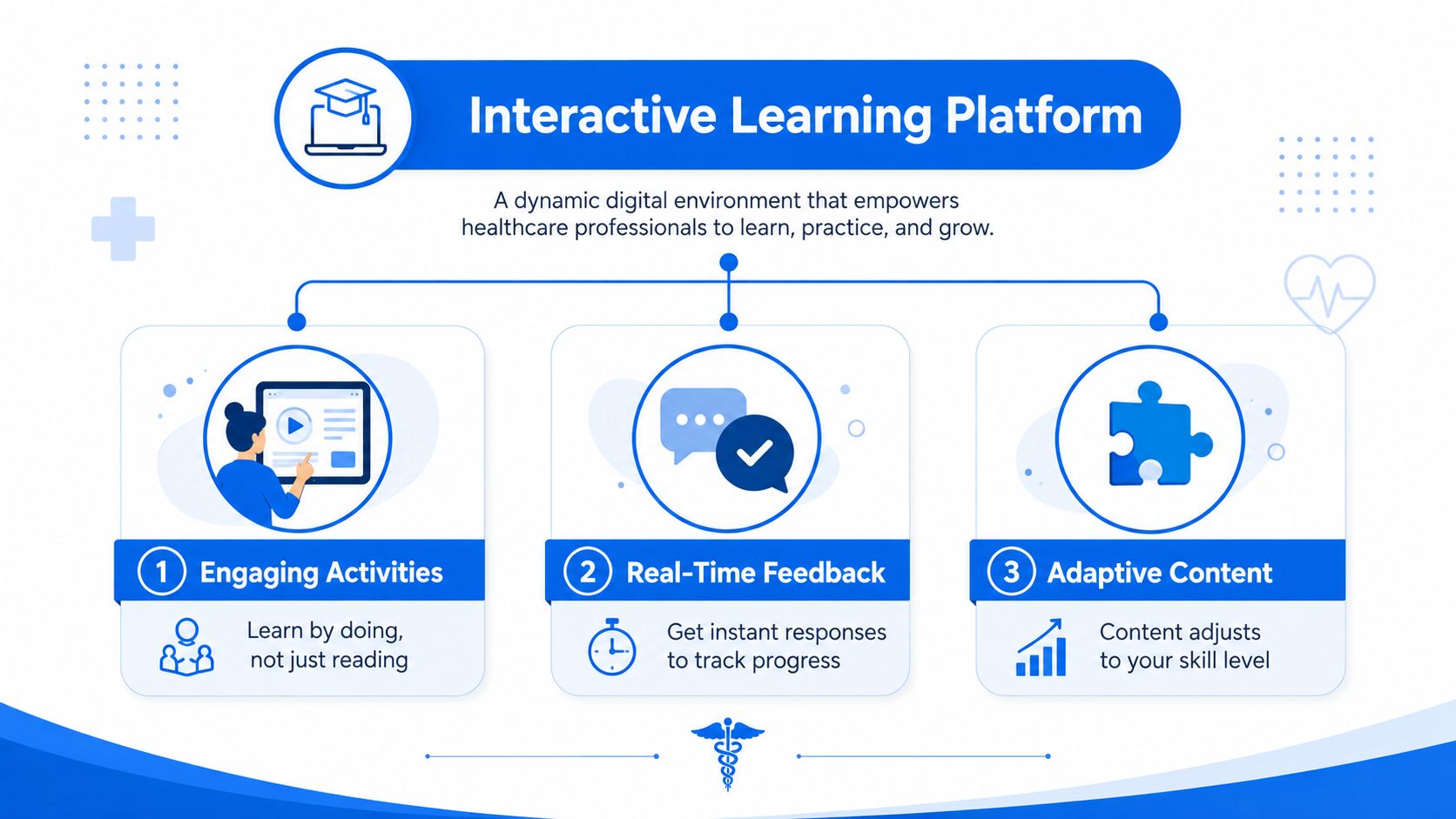
An interactive learning platform is a system that asks you to do something with the material, not just read it. Practicing chest compressions on a mannequin builds memory through action, while reading a paragraph about CPR mostly builds familiarity.
Historically, interactive learning grew out of a shift away from static, lecture-centered e-learning and toward browser-based, visual, simulation-driven systems. Carnegie Mellon's ISLE was designed as a browser-based platform for teaching statistics and data analysis through active engagement with the full data-analysis pipeline, inside and outside the classroom. That evolution also showed up in tools like Seeing Theory, which helped popularize dynamic probability and statistics visualizations for learners and educators.
What interaction looks like in practice
In healthcare CE, interaction usually means a mix of these elements:
- Quizzes and knowledge checks that force recall instead of recognition.
- Simulations and case studies that mirror real clinical decisions.
- Immediate feedback so learners know what they missed right away.
- Adaptive content that responds to how well you're doing.
- Tracking and reporting so completion data can flow back to the LMS.
That's why the best platforms feel closer to supervised practice than to a digital textbook. Discovery Education describes interactive learning as student-centered, hands-on, collaborative, and supported by technology, with learners retaining more and building confidence through the method (Discovery Education). In a clinical setting, that translates well to certification prep, CE refreshers, and algorithm review.
If you're comparing certification options, ACLS Certification is an example of how this can look in practice. ProMed Certifications offers a quick and convenient way to get ACLS-certified, and the course can be taken anywhere within a busy schedule.
Core Features That Drive Better Learning Outcomes
A strong interactive learning platform doesn't depend on flashy design. It depends on the way the system handles content, assessment, and learner feedback. Industry architecture guidance recommends a modular or microservices-based setup, with backend services separated for content delivery, authentication, analytics, and real-time interaction. That separation keeps video, quiz, and reporting tasks from blocking each other, which is especially important in healthcare education where learners expect the course to load quickly and track accurately.
The features that actually matter
The best platforms usually share a few technical traits:
- Modular architecture keeps lessons organized into manageable units, so busy clinicians can finish in small blocks.
- Adaptive assessments adjust based on performance, which makes review more targeted.
- Real-time channels support live collaboration or rapid response when a course includes interactive elements.
- SCORM and xAPI-style tracking help completion, attempts, and learner outcomes sync back to the LMS.
- Offline-first usability matters when connectivity is weak or unpredictable.
That last point gets overlooked often. UNESCO emphasizes digital learning that promotes equity in low-resource contexts, and its Kolibri platform is explicitly designed for offline or limited-connectivity use (UNESCO Kolibri). For healthcare teams, that means the right platform shouldn't assume ideal Wi-Fi everywhere.
Bottom line: interactivity only helps when it solves a real barrier. If a quiz, simulation, or scenario doesn't make the learner clearer, faster, or more accurate, it's just decoration.
Developing good training content also takes more than recording a lecture.
For nurses who need an all-in-one CE experience, ProMed+ Nursing CE is a one-stop streaming platform for continuing education requirements, which shows how CE libraries can be organized around ongoing access rather than one-off classes.
Online vs In-Person Certification Formats Compared
Online and in-person certification formats are often compared as if one must be superior in every situation. In healthcare education, that's too simple. The better question is which format delivers the result you need with the least friction, and for many clinicians, online interactive learning does that just as well, sometimes better.
A widely cited benchmark in the field is that interactive online courses cost about 30% less to produce than traditional courses. Lower production cost matters because it supports more accessible course design, broader catalog depth, and easier updates when guidelines change. WorldMetrics also reports the global e-learning market at roughly $370-400 billion in 2026 and about 1.1 billion users expected by 2029, which shows how online learning has already moved into mainstream education and professional upskilling (WorldMetrics).
Side-by-side comparison
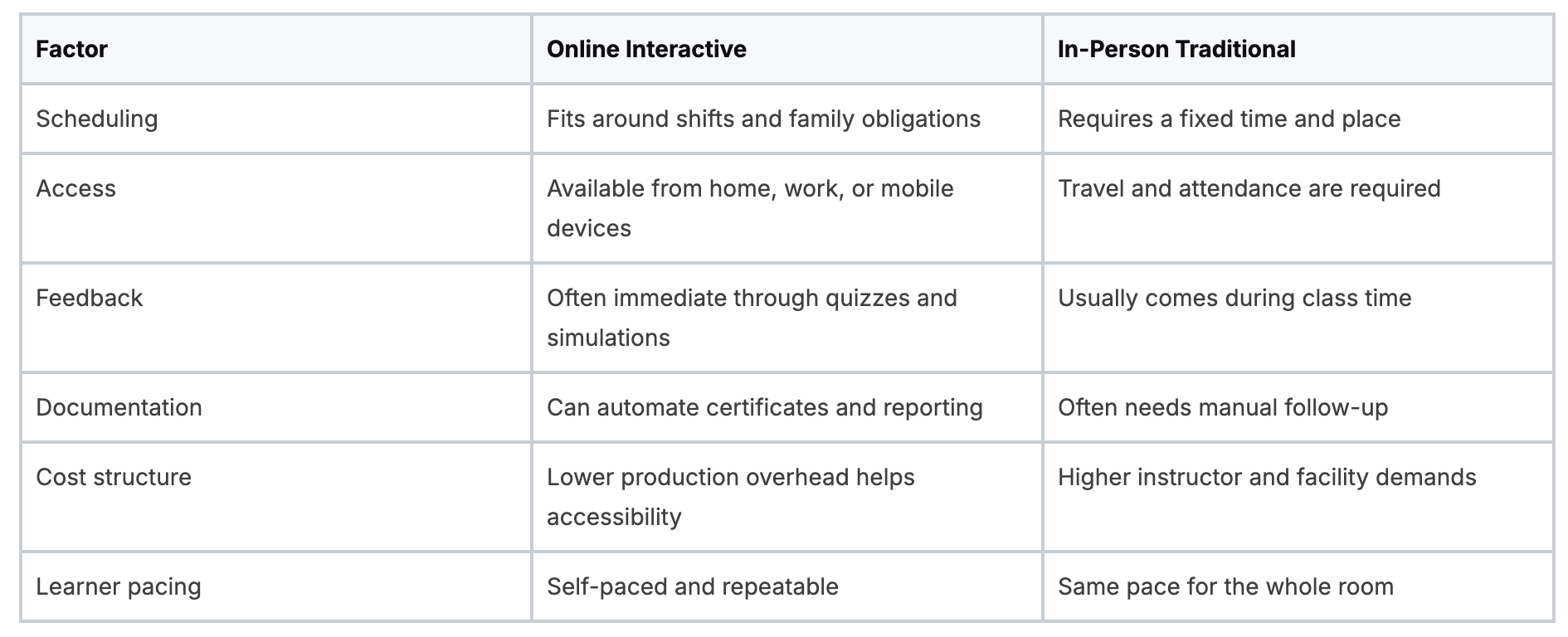
A 2026 peer-reviewed study with 60 U.S.-based students found that an interactive learning platform produced better learning experiences and higher learning outcomes than a digital textbook, with immediate recall medians of 9.5 vs. 8 and means of 9.2 vs. 8.2. It also reported stable recall over time, with nearly identical percentages on immediate recall (77%) and long-term recall (78%). That doesn't prove every online course will outperform every classroom session, but it does support the broader case that interactive formats can match or exceed traditional knowledge retention.
For healthcare CE, the practical advantage is obvious. You can learn without taking a full day off, repeat difficult sections, and complete training in shorter sessions that fit real work patterns. That's why more institutions are treating accredited online education as a normal option, not a compromise.
How to Evaluate an Interactive Learning Platform
The best way to judge an interactive learning platform is to ask whether it removes friction or adds it. If a course is interactive but confusing, hard to access, or weak on reporting, it won't help clinicians who are already stretched thin. For healthcare education, the evaluation process should start with credibility and end with usability.
What to check before you enroll
- Accreditation and recognition: Confirm the course is backed by the right accrediting bodies for your role, such as ACCME, ACPE, or ANCC when relevant.
- Assessment design: Look for quizzes, scenario-based checks, and feedback that match the learning goals.
- Mobile access: Make sure the platform works well on the devices your team uses.
- Reporting tools: Automated completion records and board reporting save real administrative time.
- Offline or low-bandwidth support: This matters for rural staff, shared devices, and spotty internet.
- Acceptance protection: A clear acceptance or refund policy reduces risk for individual buyers and organizations.
UNESCO's guidance on digital learning in low-resource contexts reinforces a key point, access is part of quality, not separate from it (UNESCO digital learning equity). Class also emphasizes regular and substantive interaction, accessibility, and support for non-traditional learners, which is a good reminder that interactivity should reduce barriers rather than create extra work. In other words, a platform should help you finish, not just entertain you.
If you're comparing vendors, how to choose the best online medical certification provider is a practical place to start because it focuses on the questions buyers ask before committing. The best choice usually isn't the flashiest site, it's the one that aligns accreditation, convenience, and reporting with your workflow.
Use this test: if a platform can't explain how it tracks learning, supports access, and fits real clinical schedules, keep looking.
Real-World Applications in Healthcare Education
A nurse finishing CE after a long shift doesn't need another commute. She needs a platform that opens fast, holds attention, and lets her finish the requirement in small pieces. That's where interactive learning fits healthcare best, it respects the way clinicians work.
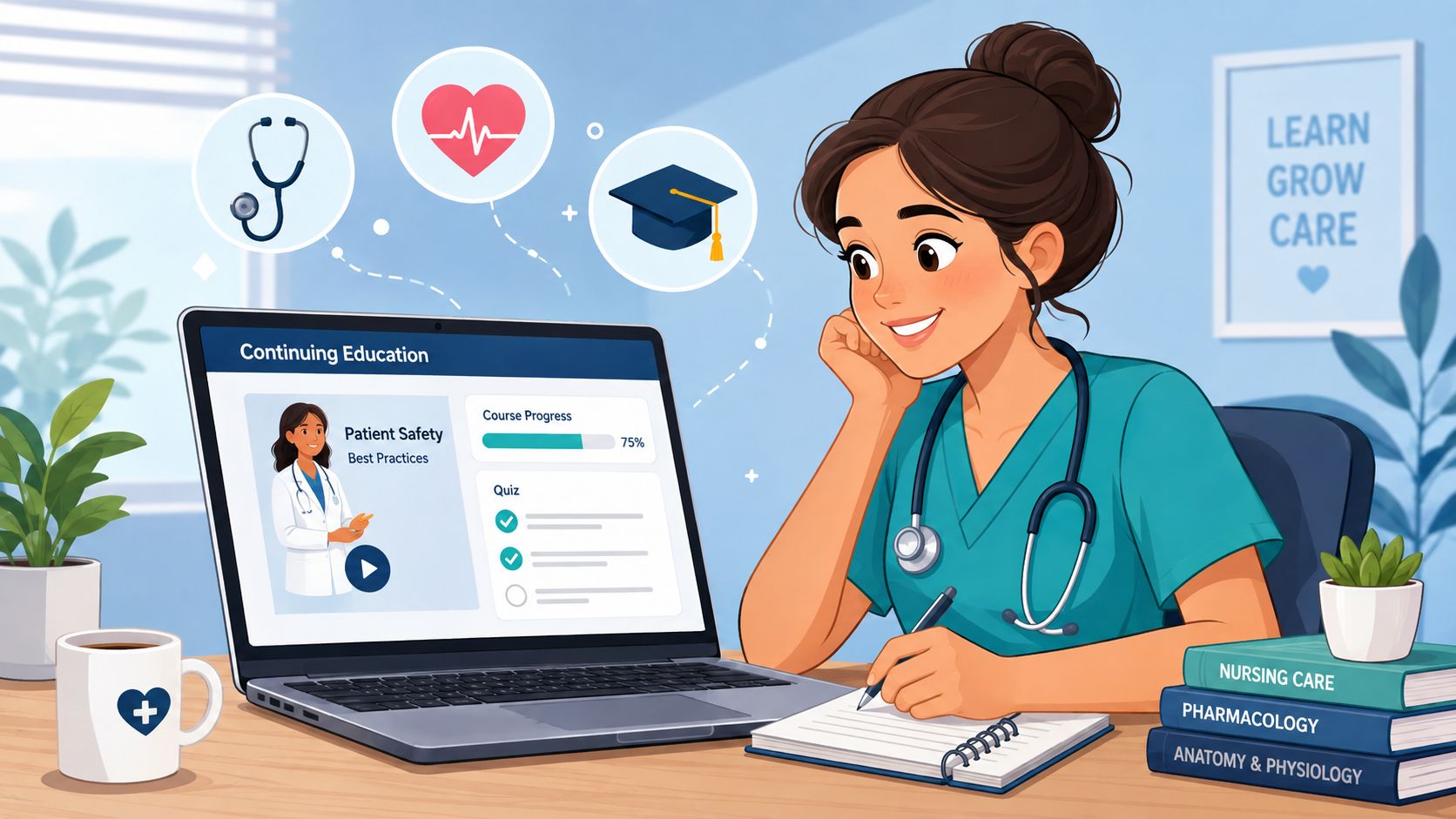
Nurses commonly use online CE for subjects like pharmacology and compliance training because the format lets them work around rotating schedules. Physicians often prefer platforms that automate reporting, since that cuts down on paperwork and reduces the chance of missing a deadline. Medical training organizations also use group portals to manage certifications across entire departments without chasing down each completion manually.
Where interactivity shows up in daily practice
Self-paced certification works well for courses such as ACLS, PALS, BLS, and Neonatal Resuscitation because the learner can repeat key algorithms, review mistakes, and move on only when ready. The same logic applies to recurring CE, where short modules and immediate feedback help busy clinicians stay current without blocking an entire day.
For employers, the value is operational as much as educational. A platform that supports instant certificates, mobile access, and progress tracking keeps training tied to staffing reality instead of forcing staff into a rigid classroom calendar.
Later in the process, the format matters just as much as the content.
That's why interactive online learning keeps gaining ground in healthcare. It fits the work, the learner, and the paperwork burden in one system, which is exactly what most clinicians need.
How ProMed Certifications Delivers the Ideal Platform
The ideal interactive learning platform for healthcare should combine accreditation, self-paced access, assessments that check understanding, and reporting that saves time. ProMed Certifications fits that model with online options for ACLS, PALS, BLS, CPR, and Neonatal Resuscitation, plus nursing CE and physician CME libraries that are designed for ongoing professional development. The platform also emphasizes mobile access, unlimited retakes, and a 100% money-back acceptance guarantee, which addresses the concerns most buyers have when they choose an online path.
That combination matters because it mirrors the way modern healthcare education is changing. Clinicians want recognized online formats that are easier to finish, employers want documentation they can trust, and training teams want systems that scale across departments. ProMed's group portal and automated workflows fit that demand without forcing learners back into old assumptions about what counts as legitimate education.
The bigger point is simple. Online CE and certification aren't a lesser substitute, they're now a practical standard for many healthcare professionals who need flexibility without giving up credibility. If you're ready to compare your options, ProMed gives you a place to start with courses built around convenience, recognition, and modern delivery.
If you're looking for healthcare CE or certification that works around real clinical schedules, visit ProMed Certifications and review the online courses, CE libraries, and certification options available to you. It's a straightforward way to choose training that fits your workflow, supports your requirements, and keeps your education moving without unnecessary disruption.
.avif)
Stay compliant with ProMed+
Certifications included: ACLS, BLS, PALS, CPR & Neonatal Resuscitation
Unlimited continuing education: over 200 hours of accredited CME
All-inclusive: One price. No surprises.
Get certified today

The Advanced Cardiac Life Support (ACLS) is an accredited online medical certification course that teaches medical professionals to respond to nearly all cardiopulmonary emergencies.

The Pediatric Advanced Life Support (PALS) Recertification instructs medical professionals on performing pediatric cardiopulmonary resuscitation in emergencies.

The Basic Life Support (BLS) Recertification is intended to teach healthcare professionals the basic steps of CPR and rescue breathing for adults, children, and infants.

Our online medical certification course for CPR, Automated External Defibrillator (AED), and First Aid is designed to teach adult, child, and infant CPR and AED use.

The Neonatal Resuscitation Certification trains medical professionals in performing resuscitation procedures and life-saving techniques for newborns at the time of delivery.

.png)
.png)
.png)