


Physician Assistant CME Requirements
.png)
You're staring at a deadline, a clinic schedule that won't slow down, and a CME log that needs to be right the first time. That's a common situation for many PAs, and it's why physician assistant CME requirements deserve a clear, practical explanation instead of a pile of vague reminders. The good news is that online learning is not a second-tier option, it's a legitimate, flexible way to meet continuing education needs, and the evidence base keeps supporting it.
Understanding Physician Assistant CME Requirements
A lot of PAs run into trouble because they treat CME like a single rulebook. It isn't. You may be balancing national certification maintenance, state licensure rules, and specialty-specific topics at the same time, and each of those can have different deadlines and credit expectations.
That's where the confusion starts. A PA can be fully aligned with the national certification cycle and still miss a state requirement, or the other way around. The safest approach is to treat CME like a checklist with multiple layers, not one bucket you fill once and forget.
Why online learning belongs in that plan
Online CME gives you something in-person classes rarely can, which is control over time. You can fit learning around clinical shifts, commute gaps, or a quieter evening at home. That flexibility matters because the educational value doesn't disappear when the classroom moves online.
A comparative study of medical specialists found no statistically significant difference in intention gain between in-person and online continuing professional development, and no significant association between course format and behavior reported six months later, which supports online learning as a serious option for outcomes, not a compromise on quality (ACEHP comparative study). That fits with the practical reality many clinicians already see, accredited online education can be efficient, accessible, and clinically relevant.
Practical rule: Don't ask, “Is online CME real?” Ask, “Is this activity accredited and accepted where I need it?”
The old belief that only in-person courses from a few familiar organizations count is outdated. Accreditation and jurisdiction matter far more than whether you sat in a conference room. For many PAs, that means the smartest path is choosing online courses that fit both the national certification cycle and the state board's fine print.
National NCCPA Certification CME Rules
The national benchmark for most PAs is the NCCPA maintenance cycle. Certified PAs must complete 100 CME credits every 2 years, and at least 50 of those credits must be Category 1 CME (NCCPA maintenance cycle). That structure repeats inside a 10-year certification period made up of five two-year cycles, so compliance is less about a single deadline and more about steady pacing across the full window (NCCPA maintenance cycle).

How the NCCPA cycle actually works
The maintenance cycle is easier to manage when you think of it as a rhythm. Every two years, you need the same basic amount of CME. Over the full certification period, that becomes a long-term compliance habit rather than a last-minute scramble.
The NCCPA also ties the process to a fee. PAs must submit a $180 certification maintenance fee by 11:59 p.m. PT on December 31 of the certification expiration year (NCCPA maintenance cycle). That deadline matters because it's part of the same certification maintenance system, not a separate admin detail you can ignore until later.
Why this matters for planning
If you know the cycle, you can plan your learning around your actual work life. Many PAs find it easier to spread credits across the two-year period instead of trying to catch up at the end. That's especially true when your clinical schedule changes, or when your state licensure cycle doesn't line up neatly with the NCCPA timeline.
One option in this space is ProMed+ Physician CME, which offers on-demand access to a dynamic streaming library and over 200 AMA PRA Category 1 Credits™ for physicians, making it relevant when a PA's learning plan includes employer or system-wide education pathways that value broad access and flexibility. The main point is simple, online CME can fit into the maintenance cycle without forcing you to build your schedule around a classroom.
State Licensure CME Variations
State licensure is where many otherwise careful PAs get tripped up. The national NCCPA requirement gives you one baseline, but state boards can be looser, tighter, or more specific depending on where you practice. That's why a single national strategy rarely works on its own.
State rules at a glance

California requires 50 approved CME hours in each 2-year renewal period, while North Carolina requires at least 50 hours every 2 years and adds a 2-hour controlled-substances condition for prescribers (California Board of PAs CME rules). Florida is more demanding at 100 CME hours every 2-year cycle, Washington requires 100 hours with at least 40 as Category 1, and Utah requires 40 hours every 2 years with at least 34 in Category 1 offerings (California Board of PAs CME rules).
A PA who only tracks the NCCPA cycle can still miss a state renewal rule, especially in states that add topic-specific requirements or stricter hour totals.
The real source of confusion
The biggest mistake is assuming certification and licensure are the same thing. They often overlap, but they don't always match. Washington, for example, has a state rule that is more specific about Category 1 content and carryover, while California has moved toward targeted requirements for certain practice settings and older-patient care.
That's why state-specific tracking matters. If you're licensed in one state and certified nationally, you need both numbers in view at once. The safest habit is to keep a state-by-state list in your CME tracker and update it every time you renew.
Understanding CME Activity Types and Credits
A PA can complete the right number of hours and still miss the mark if the credit mix does not fit the rule being measured. The practical goal is to match the activity type to the requirement, so the time you spend on CME counts where it needs to count.

Category 1, Category 2, and specialized credit types
Under NCCPA maintenance, Category 2 credits can satisfy half of the maintenance total, and the system gives extra weight to self-assessment CME and PI-CME, with the first 20 PI-CME credits doubled. That means the same compliance target can be reached through different combinations of courses, much like filling a toolbox with different tools for different jobs.
One PA may rely on conferences and webinars, while another may choose self-assessment modules and practice-improvement work. Both paths can be valid if the credits meet the correct rule set.
Choosing credits with purpose
A simple way to sort the options is to ask what each credit type is designed to show.
- Category 1 CME: Use this for the core requirement, especially when you need structured education that is clearly recognized.
- Category 2 CME: Use this to fill the remaining portion of the NCCPA cycle when the activity is accepted.
- Self-assessment CME: Useful when you want to test recall, not just review content.
- PI-CME: Helpful when learning is tied to practice improvement, and the doubled first 20 credits can make it strategically useful.
State rules can add another layer. California's 2025 geriatric-care requirement for certain primary-care PAs, Alabama's professional-boundaries course, and North Carolina's allowance for cultural-competency and implicit-bias courses if NCCPA-approved show that course selection matters as much as the hour total. In other words, the same online class may help with one requirement and miss another, depending on how the state board or certification rule is written.
ProMed Certifications' CME accreditation details are useful when you are checking whether an online activity fits your documentation needs and credit category. If you also need a fast certification option outside CME, ACLS Certification is one example of a fully online course path that fits a busy schedule, with the class available on demand and completion possible quickly once you are ready.
Documentation Reporting and Audit Preparedness
Earning the credits is only half the job. If your records are messy, incomplete, or hard to retrieve, you can still run into trouble during renewal or audit review. Good documentation turns CME from an anxiety source into a routine file-management task.
What to keep and how to keep it
Your best habit is simple. Save the certificate, keep the course title, note the date completed, and store the accreditation details in one place. Digital portfolios work well because they reduce the chance of losing proof between renewals.
A second habit helps even more. Match each course to the requirement it fulfills while you're still taking it. That way you don't end up with a folder full of credits and no clear proof that they satisfy a specific state or NCCPA rule.
Reporting with less friction
Submit records before they pile up. If your state or certification system uses online logging, enter the course information soon after completion rather than waiting for the end of the cycle. That makes it easier to catch missing data while the certificate is still easy to find.
Keep a single CME folder, but divide it inside by cycle, state, and credit type. That one habit prevents most end-of-year mistakes.
If you receive an audit notice, respond with the exact proof requested. Don't send extra unrelated files unless the board asks for them. Precision matters here, because a clean, well-labeled record set is easier to review and less likely to be questioned.
Exemptions Remediation and Special Cases
A CME calendar can break in ordinary life. Illness, parental leave, travel, or deployment can interrupt even a careful plan, and that is when exemption and remediation rules start to matter. The safer approach is to treat special cases as documentation problems first. If you can show the board the reason, the dates, and the supporting records, you are already closer to a workable answer.

When a special case changes the plan
Some states spell out exceptions or alternate pathways. Oregon exempts licensees in residency training and those serving in the military and deployed outside Oregon for 90 days or longer from CME requirements, and South Dakota lets physician assistants use proof of current NCCPA certification as compliant documentation for its annual PA education rule, according to state CME rules.
That kind of rule change matters because licensure and certification do not always move together. A PA may satisfy one requirement and still need to answer to a state board, much like keeping two calendars for the same job. Role, location, and current status can all change what counts, so the supporting documents matter as much as the course itself.
Remediation is about action, not panic
If you fall short, act quickly and keep the record clear. Some boards offer correction paths, while others are more rigid. The earlier you find the gap, the more room you usually have to fix it without creating a bigger problem.
Shortfalls can also come from topic rules, not just missed hours. California's geriatric-care requirement, Alabama's professional-boundaries course, and North Carolina's allowance for cultural-competency or implicit-bias education show that a special case can mean a required subject inside the normal cycle, not only an exemption from it. For broader ideas on earning credit efficiently, see ways to earn CME credits online, especially if you need to fit state-specific topics into a busy schedule.
The practical lesson is simple. Keep proof of any hardship, note what was missed, and treat special requirements as part of the same CME system. If a board asks for an explanation, a clean file makes the answer easier to show.
Practical Steps to Ensure CME Compliance
A workable CME system doesn't need to be complicated. It just needs to be consistent. The PAs who stay out of trouble usually do a few small things well all year instead of doing everything at the end.
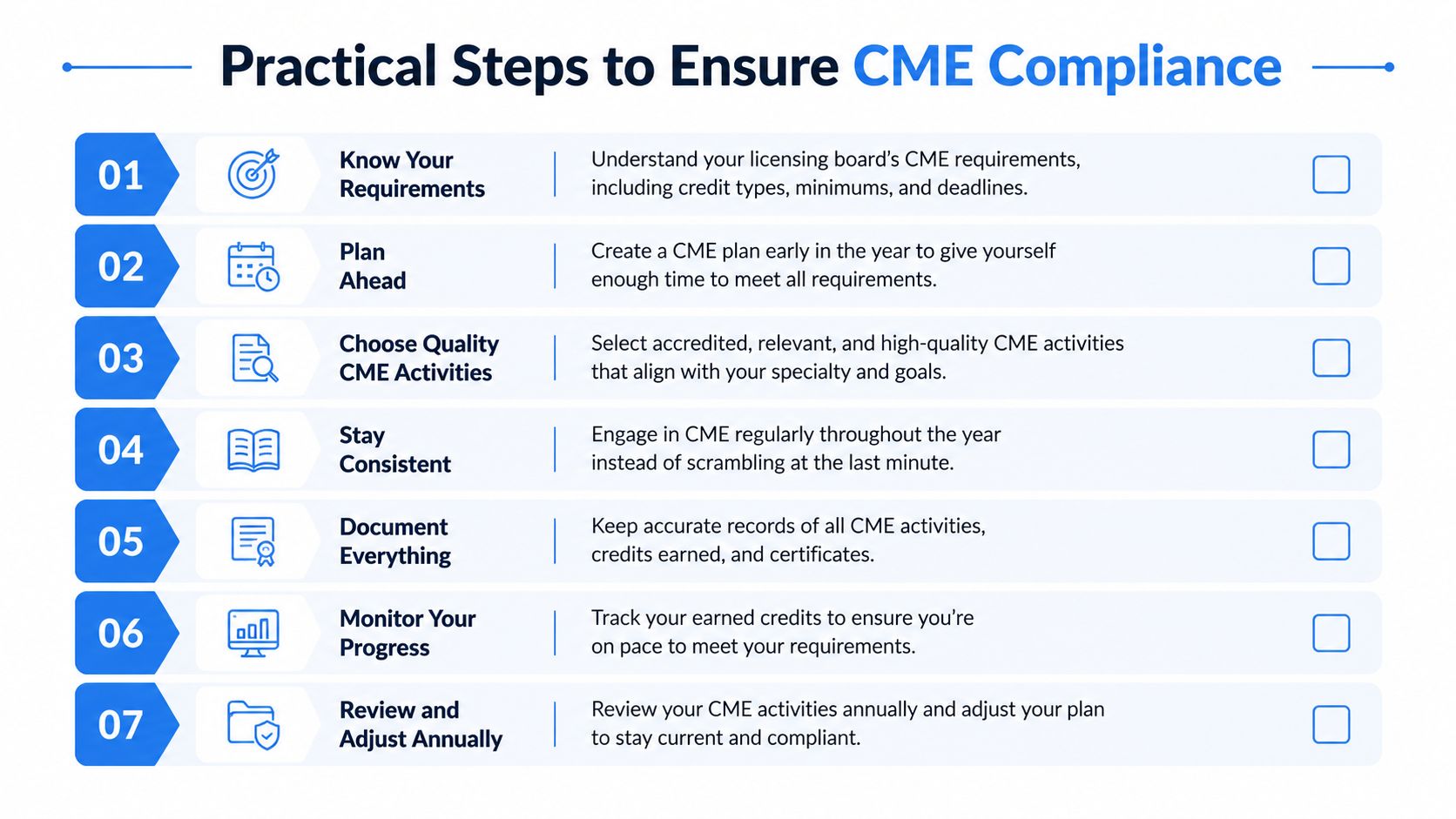
A simple compliance rhythm
Start by mapping your two deadlines, national certification and state licensure. Then break the cycle into quarters or months so you're never trying to earn too much at once. That makes online learning especially useful because you can add a course when you have a window, not when a conference happens to be available.
Use this kind of checklist:
- Set the cycle date: Write down your NCCPA expiration year and your state renewal date.
- Separate the requirements: Keep national certification and state licensure in different tabs or folders.
- Choose the right mix: Use Category 1, Category 2, self-assessment, and PI-CME with intent.
- Log each certificate right away: Don't wait for a pile of PDFs.
- Batch your harder courses: Save longer or more focused modules for low-volume weeks.
- Watch the fee and renewal deadline: The NCCPA maintenance fee has its own cutoff, and that date matters.
- Review the final tally early: Give yourself time to fill any gap before renewal pressure hits.
If you want more ideas for building a usable credit plan, 8 ways to earn CME credits is a useful reference point for course planning and scheduling.
The simplest rule is this. Don't let your CME log become an emergency file. If you handle it monthly, the system stays manageable, and online learning gives you more room to do that without sacrificing clinic time.
ProMed Online Solutions for CME Compliance
Online CME works because it fits the way clinicians live. It lets you learn between shifts, on a laptop or phone, and without sacrificing the quality of the education itself. That flexibility is one reason hospitals, clinics, and individual professionals are increasingly comfortable with accredited digital learning.
ProMed Certifications fits into that shift with a model built around accessibility and documentation. Its physician CME library is described as offering over 200 AMA PRA Category 1 Credits™ on demand, which makes it relevant for practitioners who want a broad course catalog without being tied to travel or a live session schedule. The logic is simple, if your requirements are already split across NCCPA and state rules, the learning format should reduce friction, not add to it.
Why the online model matters here
The strongest argument for online CME is practical. You can complete coursework when your schedule allows, you can revisit material if you need a refresher, and you can choose content that lines up with specialty needs. That's especially valuable when a state adds a topic-specific mandate or your practice demands a different mix of credits from one cycle to the next.
ProMed's online CME approach also reflects where the industry is going. Accredited digital education is no longer treated as a fallback for people who can't attend in person. It's part of the mainstream compliance toolkit.
One more point matters for PAs who also need certification courses outside CME. Online credentials can be just as legitimate as classroom formats when they're accredited and accepted by the relevant board or employer. The important part is match, not location.
If you want a cleaner way to stay current, continuing medical education online is worth reviewing as a model for how digital learning supports busy healthcare schedules without lowering standards.
If you're trying to align national certification, state licensure, and everyday clinical demands, ProMed Certifications offers online CME and certification options that fit real schedules and real compliance needs. Visit ProMed Certifications to explore courses that can help you keep your PA requirements organized and easier to manage.
.avif)
Stay compliant with ProMed+
Certifications included: ACLS, BLS, PALS, CPR & Neonatal Resuscitation
Unlimited continuing education: over 200 hours of accredited CME
All-inclusive: One price. No surprises.
Get certified today

The Advanced Cardiac Life Support (ACLS) is an accredited online medical certification course that teaches medical professionals to respond to nearly all cardiopulmonary emergencies.

The Pediatric Advanced Life Support (PALS) Recertification instructs medical professionals on performing pediatric cardiopulmonary resuscitation in emergencies.

The Basic Life Support (BLS) Recertification is intended to teach healthcare professionals the basic steps of CPR and rescue breathing for adults, children, and infants.

Our online medical certification course for CPR, Automated External Defibrillator (AED), and First Aid is designed to teach adult, child, and infant CPR and AED use.

The Neonatal Resuscitation Certification trains medical professionals in performing resuscitation procedures and life-saving techniques for newborns at the time of delivery.

.png)
.png)
.png)