


RN License Renewal: PA Residents
.png)
You're halfway through a busy shift when you remember your Pennsylvania RN license expires soon. Your CE certificates are scattered across email, an employer portal, and a folder you haven't opened in months. The good news is that RN license renewal in PA becomes much easier when you treat it as a date-based compliance process, not a last-minute paperwork task.
Pennsylvania uses a biennial renewal cycle. You'll need to match your education hours to the correct two-year window, complete the required topics, keep your evidence, and submit the renewal through the state licensing portal. Online CE can make that process more manageable without sacrificing educational quality.
Before You Renew What Pennsylvania Requires for RNs
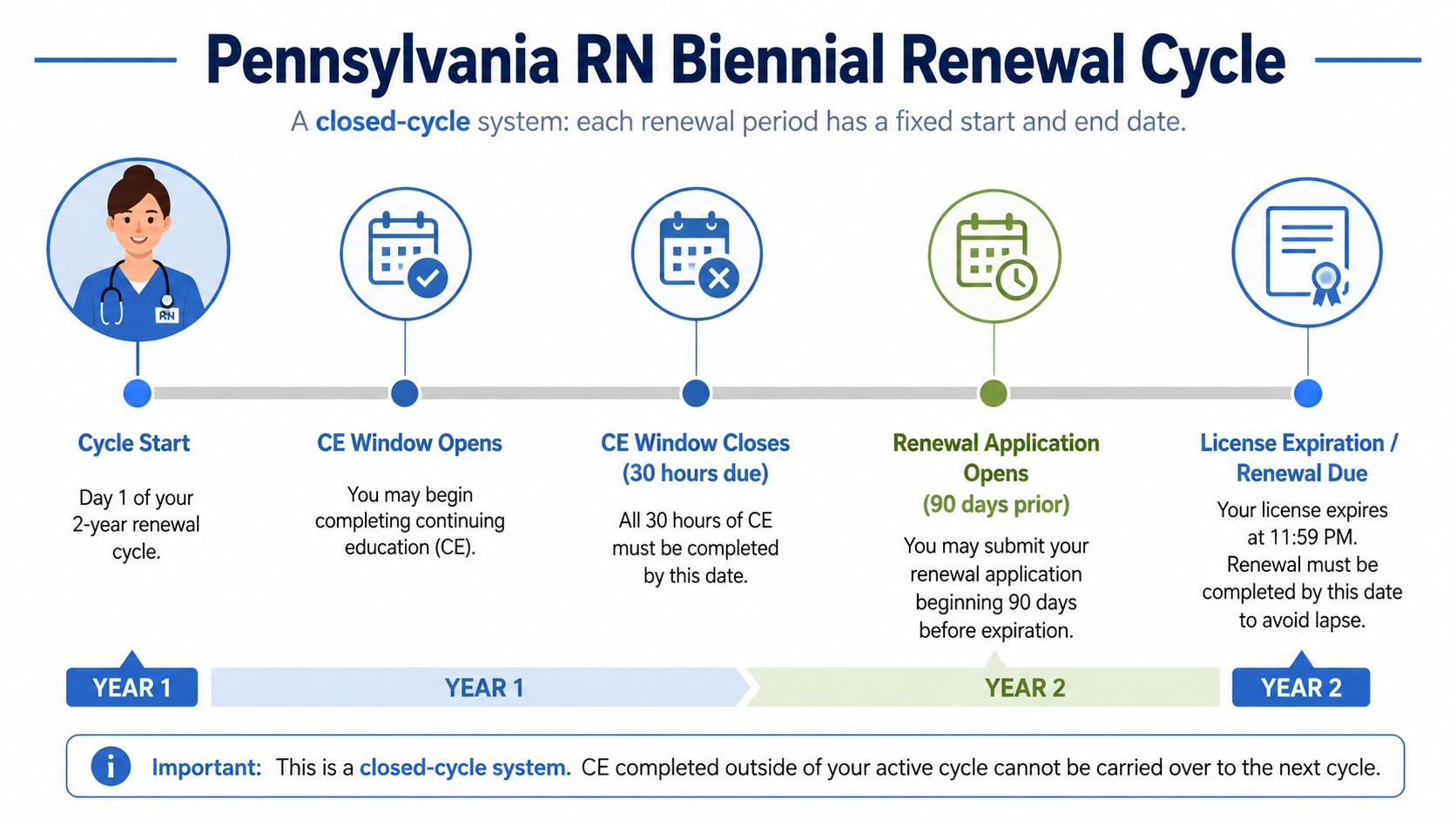
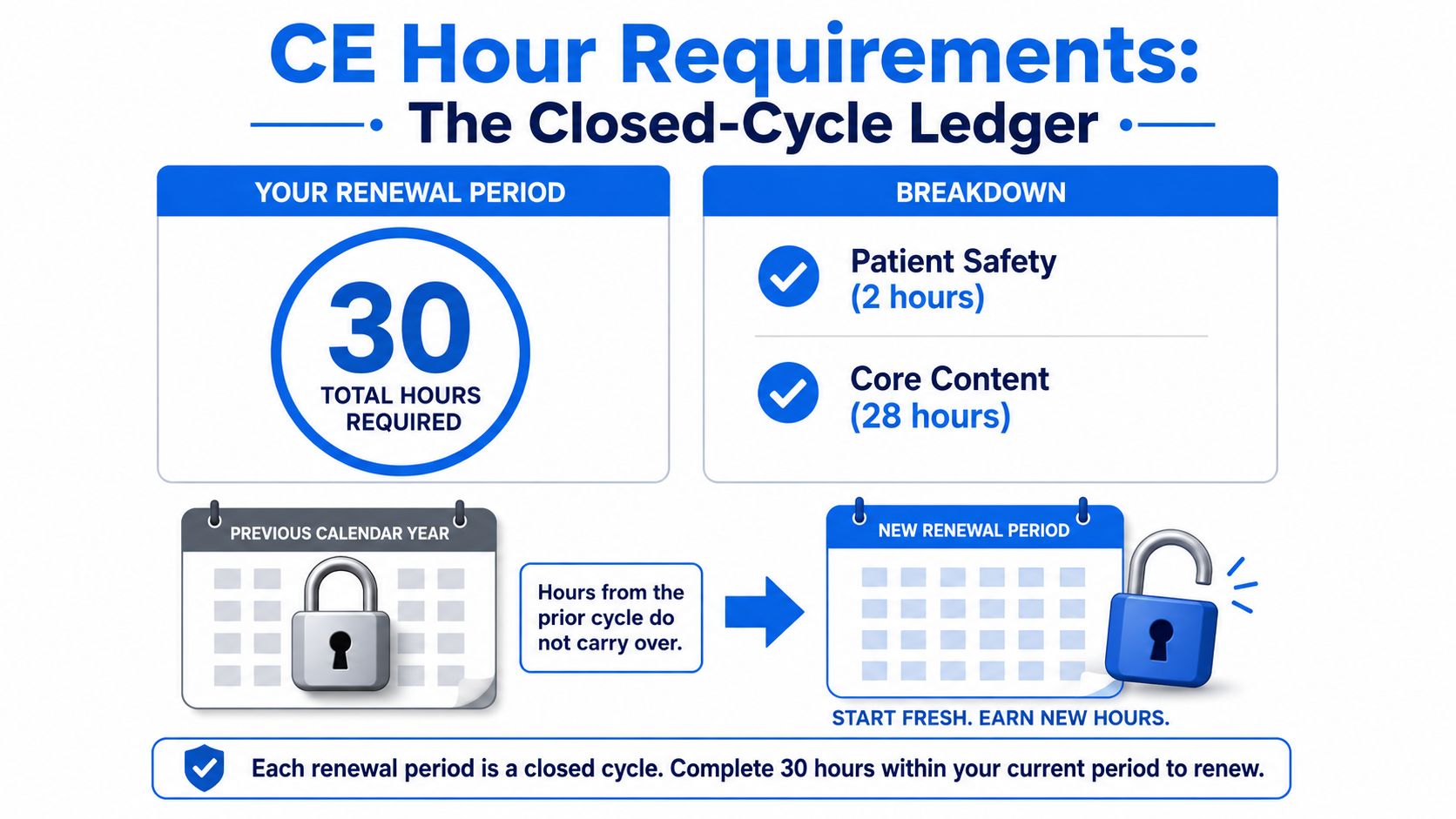
Pennsylvania registered nurses renew their licenses every two years. During each renewal period, you must complete 30 hours of Board-approved continuing education, including at least 2 hours of approved child abuse recognition and reporting training. These requirements apply to the renewal cycle connected to your license expiration date, so the date range matters as much as the total number of hours. Pennsylvania's official RN licensure snapshot confirms the biennial structure and required education.
Think of the cycle like a locked accounting period. You're not building a permanent bank of CE hours that follows your license forever. You're filling the ledger assigned to the current renewal window, then starting a new ledger for the next cycle.
A newer requirement is also entering the framework. Beginning May 1, 2026, all RNs must complete 2 hours of organ donation education one time within 5 years, according to the state guidance. This requirement adds another public-health topic to Pennsylvania's renewal requirements, so nurses should check whether they've already satisfied it before submitting a future renewal.
Build your renewal timeline
Start with your license expiration date. Work backward to identify the two-year period immediately before that date. Every CE activity you plan to use should fall inside that period.
For example, if your license expires at the end of a renewal cycle, a course completed well before the cycle opened may not count. A course completed shortly before expiration may count if it falls within the defined window and meets Board requirements. The certificate date, not the date you happened to save the certificate, is the important detail.
You can use the broader continuing education requirements for nurses by state as a general reference, but Pennsylvania's own Board guidance controls your RN renewal decision.
The safest mindset: Your renewal deadline is the finish line, but your CE window determines which hours can get you there.
This approach helps whether you're renewing for the first time, changing employers, or returning to nursing after time away. You don't need to memorize every rule at once. First identify your expiration date, then map the correct window, then verify the required subjects.
Making Your CE Hours Count and Avoiding Window Mistakes
The most common Pennsylvania renewal mistake isn't forgetting that CE is required. It's counting the wrong CE. Pennsylvania requires 30 Board-approved hours during the two-year period immediately preceding renewal, and hours completed outside that period can't be carried forward. The Pennsylvania RN continuing education FAQ explains the timing rule and the state's documentation expectations.
Use a closed-cycle ledger
Create a simple record with four columns:
- Course date: Record when you completed the activity.
- Provider and title: Note who offered it and what you studied.
- Contact hours: Record the eligible amount.
- Required category: Identify child abuse training or another required topic.
Then compare each completion date with your license's current renewal window. If the course falls before the window opened, place it in the previous ledger. If it falls after the window closed, save it for the next cycle only if the timing and course approval make it eligible there.
Consider three common situations:
You completed CE early. A course completed before your current two-year window opened may not count toward the current renewal. Don't assume that finishing early automatically protects the hours.
You changed employers. Your employer's in-service education may be useful, but you still need evidence that the activity qualifies and occurred within the correct period. Ask the employer or provider for complete documentation before relying on those hours.
Your license lapsed. Don't treat a lapsed license as a routine renewal. Confirm the state's current reactivation or reinstatement process and avoid practicing until your status is clear.
Pennsylvania also distinguishes evidence by activity type. Keep course certificates for courses, transcripts for academic credit, and appropriate documentation for publication or research credits. The Board may select licensees for audit, and the state advises nurses to retain CE records for at least 5 years.
You generally don't send CE certificates with the renewal application. Pennsylvania says certificates should be retained and provided if requested during an audit. That distinction prevents two opposite errors: uploading unnecessary files during renewal or throwing away records because they weren't requested.
A structured online system can help you organize eligible education. ProMed+ Nursing CE provides a streaming platform for continuing education needs, but you should still verify that each course fits Pennsylvania's requirements and your renewal window.
For nurses managing education records across employers and providers, a CE Broker account can also support centralized tracking where applicable. A tracking tool helps with organization, but it doesn't replace checking dates, approved content, and supporting evidence.
Choosing Online CE That Works Just as Well as In Person
Online CE isn't a lesser version of classroom training. For healthcare professionals, online, blended, synchronous, asynchronous, and self-directed learning can all support meaningful professional development when the education is well designed and properly approved. A systematic scoping review reported benefits from distance and hybrid learning across knowledge, skills, performance, attitudes, satisfaction, confidence, self-efficacy, and accessibility.
A separate systematic review of internet-based continuing medical education found online programs were as effective as traditional formats for imparting knowledge, with positive knowledge effects lasting up to 12 months and practice effects lasting up to 5 months. The Journal of Continuing Education in the Health Professions review supports the practical value of electronic education for working clinicians.
Compare the learning experience
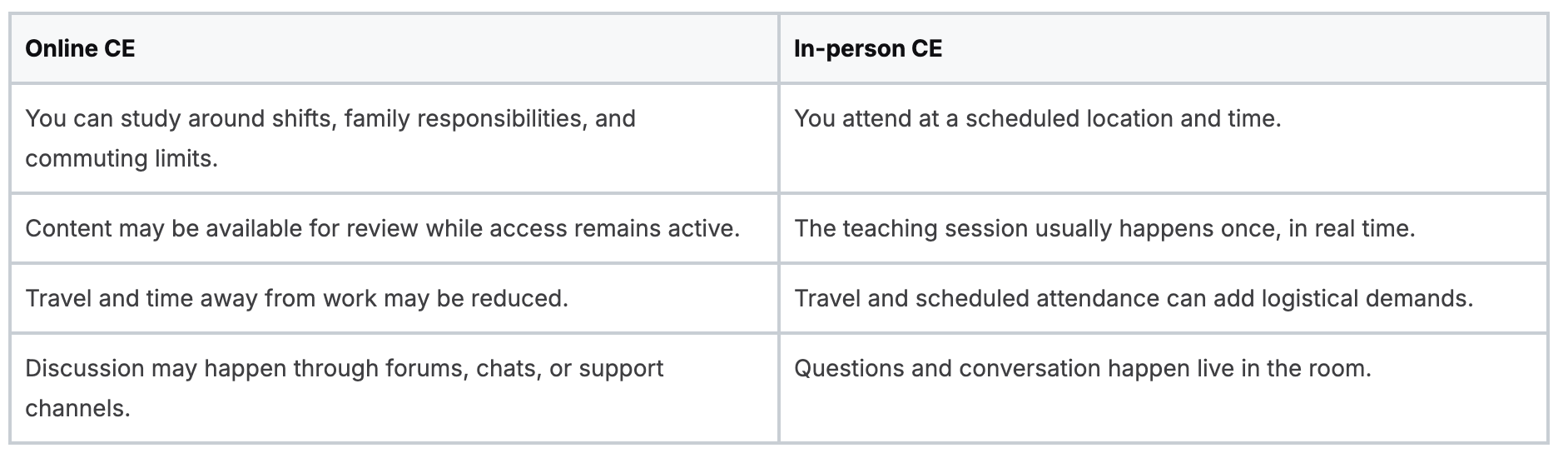
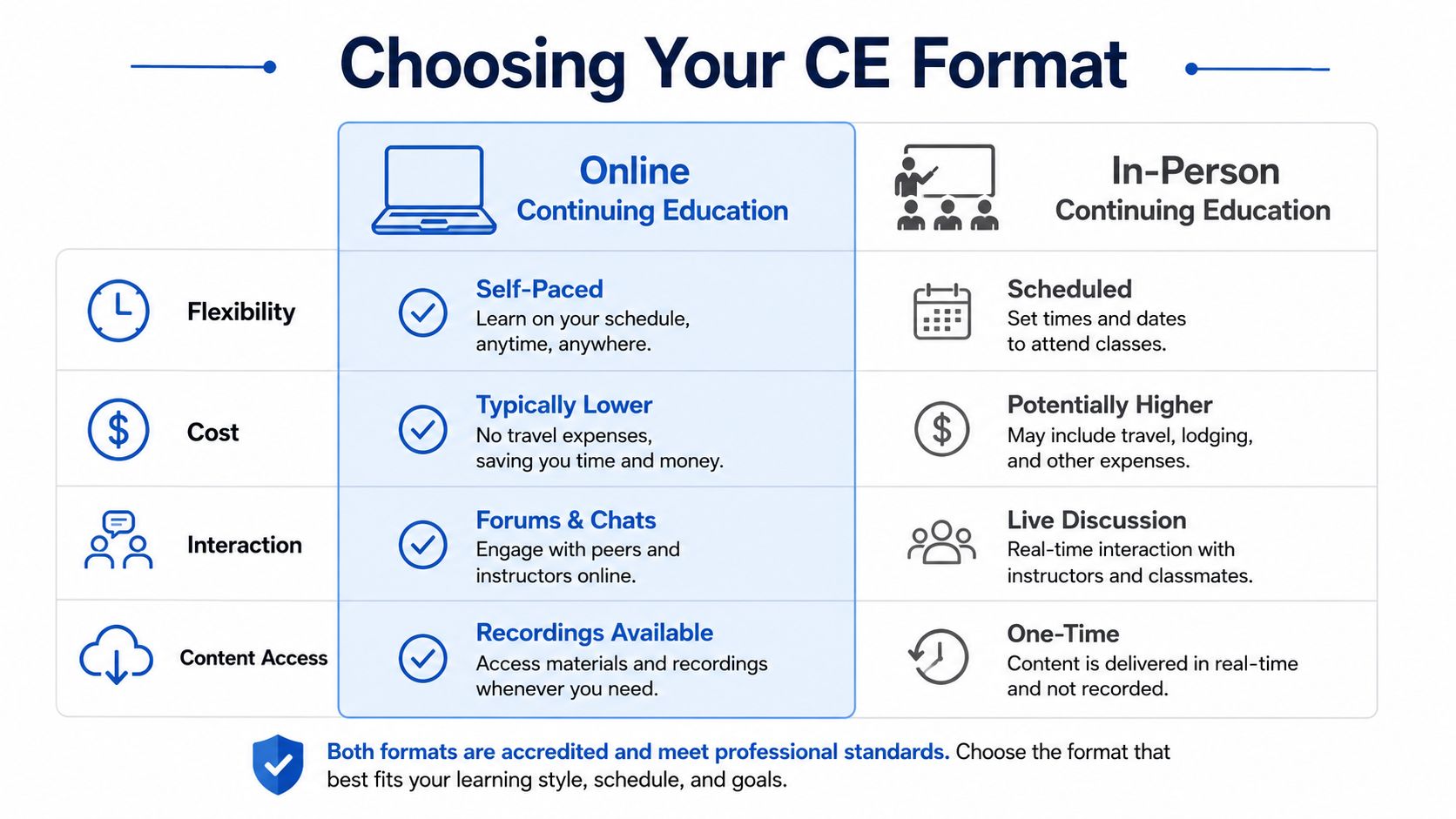
Both formats can be valuable. The better choice depends on your learning preferences, schedule, and the provider's quality controls. For many RNs, online CE removes the biggest barrier, finding a class that fits an unpredictable workweek.
The old belief that only AHA or American Red Cross in-person classes are valid is too broad. Those organizations offer respected education, but they aren't the only possible sources of accepted training. What matters is whether the specific course or certification meets the applicable employer, professional, and regulatory requirements.
That same careful review applies to technology-focused nursing education. If a course discusses clinical software or artificial intelligence, a resource covering key HIPAA requirements for AI can help you evaluate privacy and compliance topics more thoughtfully.
A 2024 systematic review in Human Resources for Health concluded that multiple eLearning approaches support continuous professional development, with asynchronous learning showing strong effectiveness for improving healthcare professionals' knowledge, attitudes, and practices.
Hospitals, clinics, and healthcare organizations are increasingly familiar with accredited online education. The industry is shifting gradually, and professionals now have more ways to complete credible education without assuming that classroom attendance determines quality. You can explore practical selection criteria in this guide to nurse continuing education.
Renewing Through the Pennsylvania Licensing Portal Without Hassle
Pennsylvania RN renewal is completed online through the state's licensing system. Before you begin, gather your license details, current contact information, CE ledger, and payment method. You won't normally upload every CE certificate, but you should be able to attest accurately that you've met the requirements.
Follow the application in order
- Sign in to your account. Use the Pennsylvania licensing portal account connected to your RN license. If you've changed email addresses, make sure you can access the account before the renewal deadline approaches.
- Select the RN renewal application. Confirm that you're working on the correct license. Read each question carefully, especially questions involving compliance, disciplinary matters, or other disclosures.
- Review your personal information. Check your legal name, mailing address, email address, and other profile details. Update incorrect information before submitting so future notices reach you.
- Attest to CE compliance. The attestation is not a substitute for completing the courses. It confirms that your education was completed in the proper period and that you can support the claim if selected for audit.
- Review the fee and payment screen. Check the amount displayed by the portal and use an accepted electronic payment method. Don't close the browser while payment is processing.
- Submit and save confirmation. Save the confirmation page, receipt, and any transaction reference. A screenshot can help if the portal later shows a pending status or you need to contact support.
Troubleshoot before you panic
A portal error doesn't always mean your license renewal failed. First, refresh only after checking whether a confirmation email or payment receipt arrived. Avoid submitting repeated applications until you know whether the first transaction went through.
If the status remains pending, record the date, application details, and any message shown on screen. Contact the appropriate Pennsylvania licensing support channel with that information. Keep your own copy of every confirmation because it creates a clear timeline of what you submitted and when.
Submit only after your CE ledger, profile information, and attestation all agree. A careful review takes less time than correcting an avoidable mismatch.
Timelines Fees and Fixing Common Renewal Problems
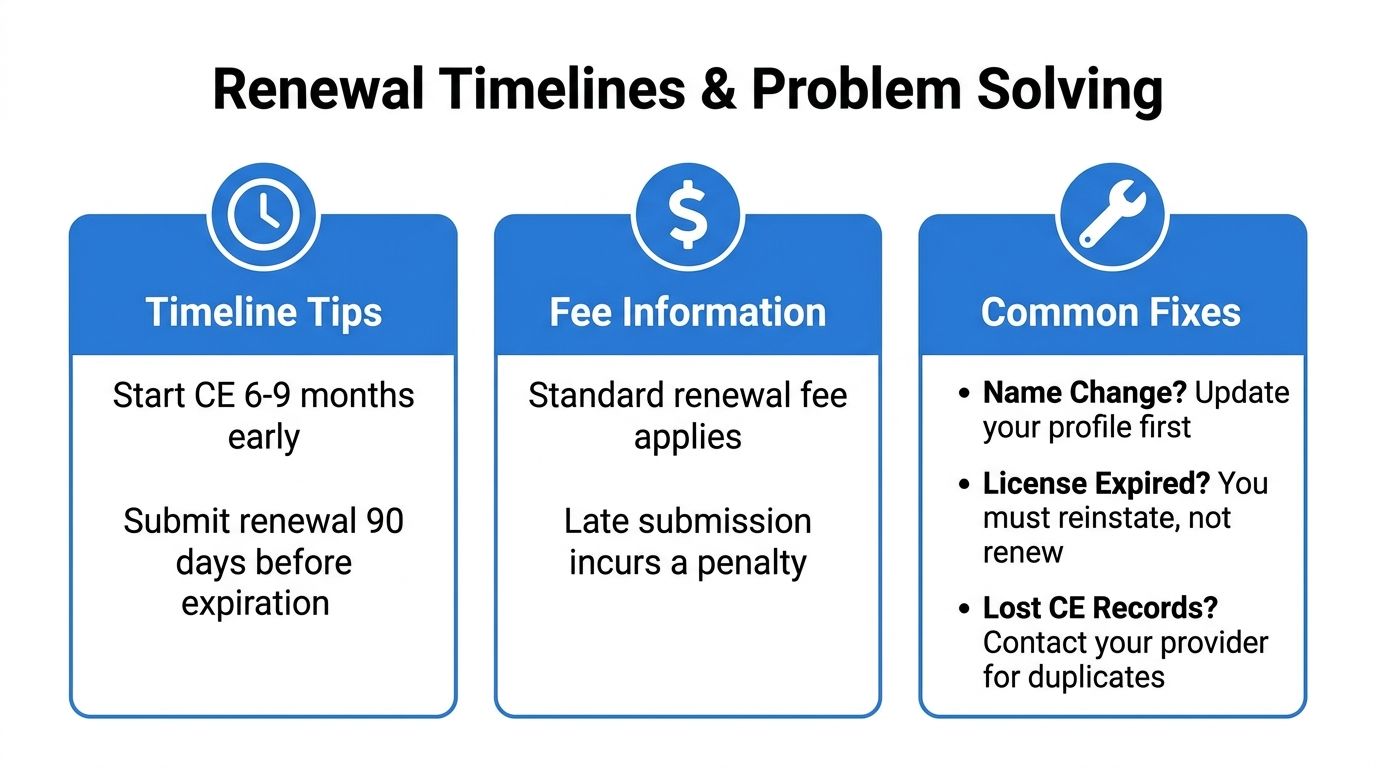
Renewal problems usually come from one of three sources: the nurse starts too late, counts education from the wrong period, or can't produce evidence when the Board asks for it. A calm review of dates and records often reveals the fix.
Pennsylvania's official materials establish the core timing rule, while the portal controls the current application process and displayed fee. Begin your education well before the deadline, and use the state's renewal notice as a reminder rather than your only planning tool. A renewal notice can help, but responsibility for active licensure remains with you.
Match the problem to the right response
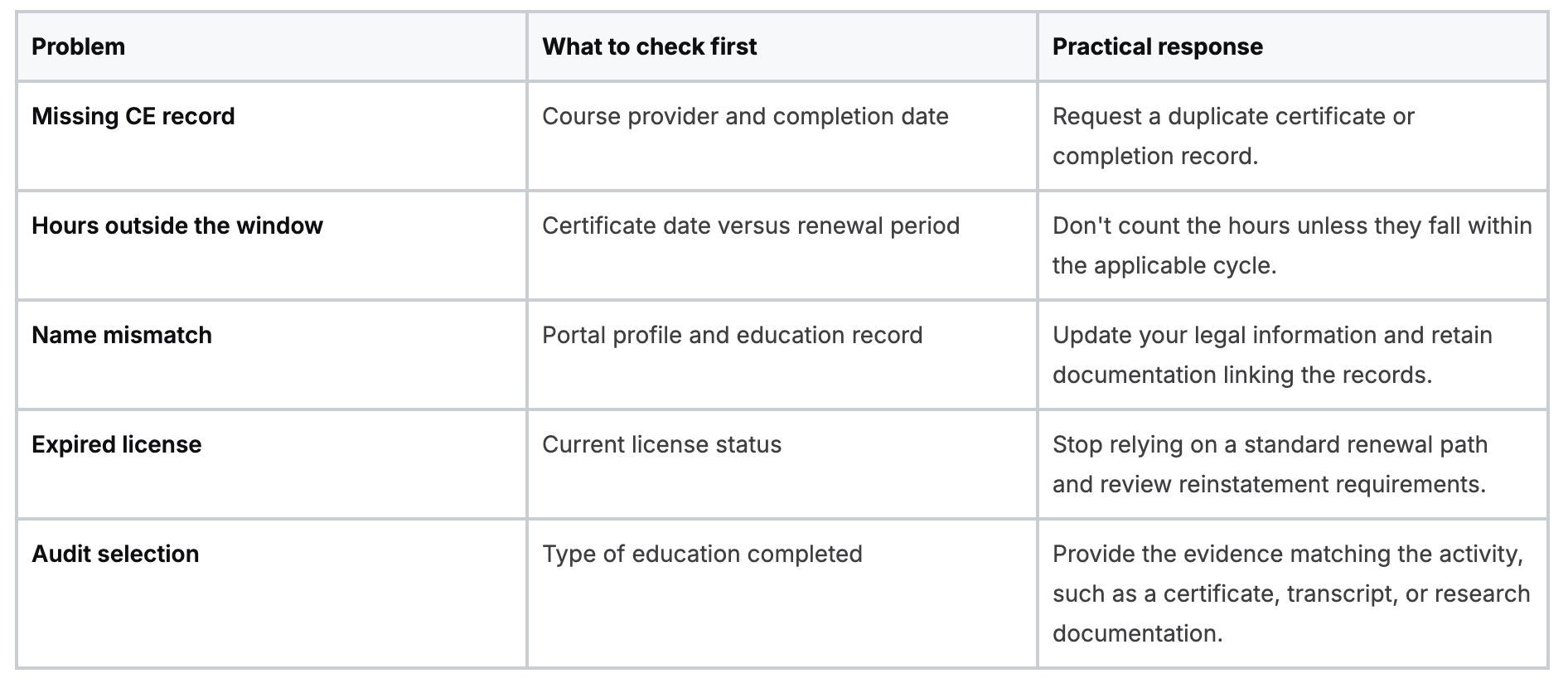
The audit rule deserves special attention. Pennsylvania says you should retain CE certificates for at least 5 years, and the Board may randomly audit licensees. You don't attach those certificates to the ordinary renewal submission, but you must keep them available if requested.
Fees can change, so don't rely on an old screenshot, coworker's memory, or an unofficial checklist. Review the amount shown in the current licensing portal before payment, and save the receipt afterward. If a late or inactive status appears, don't continue practicing based only on an assumption that your application is processing.
For a lapsed license, contact the state or review the current reinstatement instructions. The Board's refusal to renew when compliance hasn't been verified means you should resolve missing CE or documentation before treating the application as complete.
Your Confident Path to On Time Renewal
A successful Pennsylvania RN renewal rests on four habits. Know your expiration date. Treat the two-year education period as a closed ledger. Keep your evidence for the required retention period. Then submit a complete, accurate application through the licensing portal.
Online learning fits this process particularly well because you can complete education around clinical responsibilities and revisit material when needed. Research supports online CE as an effective option for knowledge development and professional practice, not merely a convenience substitute for classroom attendance. The format still matters less than the provider's approval status, course quality, documentation, and fit with your Pennsylvania requirements.
Your renewal plan can be simple: map the dates, complete the right education, preserve the evidence, and verify the portal confirmation.
Before you submit, ask yourself:
- Dates: Do all counted activities fall inside the correct renewal window?
- Topics: Have you completed the required child abuse education, along with any applicable newer requirement?
- Records: Can you retrieve certificates, transcripts, or other supporting documentation?
- Portal: Did you review your profile, attest accurately, pay the displayed fee, and save confirmation?
That checklist turns renewal from an anxious deadline into a repeatable professional routine. The next cycle will be easier if you begin your ledger immediately after renewal and store each record in one consistent location.
ProMed Certifications offers online healthcare education and certification courses, including nursing CE and certifications such as ACLS, BLS, PALS, CPR, and Neonatal Resuscitation. Visit ProMed Certifications to explore flexible options for completing education and staying prepared for your next Pennsylvania RN renewal cycle.
.avif)
Stay compliant with ProMed+
Certifications included: ACLS, BLS, PALS, CPR & Neonatal Resuscitation
Unlimited continuing education: over 200 hours of accredited CME
All-inclusive: One price. No surprises.
Get certified today

The Advanced Cardiac Life Support (ACLS) is an accredited online medical certification course that teaches medical professionals to respond to nearly all cardiopulmonary emergencies.

The Pediatric Advanced Life Support (PALS) Recertification instructs medical professionals on performing pediatric cardiopulmonary resuscitation in emergencies.

The Basic Life Support (BLS) Recertification is intended to teach healthcare professionals the basic steps of CPR and rescue breathing for adults, children, and infants.

Our online medical certification course for CPR, Automated External Defibrillator (AED), and First Aid is designed to teach adult, child, and infant CPR and AED use.

The Neonatal Resuscitation Certification trains medical professionals in performing resuscitation procedures and life-saving techniques for newborns at the time of delivery.

.png)
.png)
.png)