


A Nurse's Guide to Continuing Education Essentials

Let's be honest, for many nurses, "continuing education" can sound like a chore—just one more box to check off a never-ending to-do list to keep your license active. But what if we looked at it differently? Instead of a requirement, think of it as a commitment to lifelong learning that keeps your clinical skills razor-sharp and your knowledge base rock-solid in a field that changes at lightning speed. This guide will help you navigate CE with confidence and see it as the powerful career tool it is.
Why Nurse Continuing Education Is More Than a Requirement
High-quality nurse continuing education isn't about busywork. It’s designed to build on the solid foundation you already have, introducing you to the latest evidence-based practices, new technologies, and evolving treatment protocols. This isn't just theory; it directly impacts your ability to deliver incredible patient care and confidently tackle new challenges as they arise.
When you embrace CE as an opportunity rather than an obligation, you empower yourself. You're not just maintaining your license; you're refining your expertise, boosting your confidence in high-stakes scenarios, and even opening doors to explore new specialties. It's your professional toolkit, and every course is an upgrade.
A Commitment to Excellence and Patient Safety
At its heart, nurse CE is all about protecting the public. By staying current, you ensure your patient outcomes are grounded in the most up-to-date medical science. It’s a serious commitment.
This dedication is reflected in the massive growth of the global nursing education market, which is projected to jump from $28.2 billion to a staggering $49.4 billion by 2034. That huge leap shows just how much the industry values continuous learning as the key to solving health challenges worldwide.
This commitment goes beyond just clinical skills. Staying informed about the latest in health and wellness is essential for providing holistic care and keeping up with practices that are constantly evolving.
Building Your Career and Confidence
Beyond just meeting requirements, CE is a powerful engine for your career. Every course you complete adds another layer to your professional skill set, making you a more valuable and versatile member of any healthcare team.
Think about the real-world benefits:
- Sharpens Critical Thinking: New material keeps your mind agile and hones your problem-solving abilities right at the bedside.
- Introduces New Technologies: CE courses often cover emerging medical tech and digital health tools, getting you ready for the future of patient care.
- Opens Doors to Specialization: A few focused CE courses can be the perfect first step toward earning a new certification or shifting into a specialized field like critical care or diabetes education.
When you start seeing CE as an investment in yourself, it stops being a requirement and becomes a genuine opportunity to lead, innovate, and provide the absolute best care possible.
Navigating State CE Requirements and Credits
Jumping into the world of nurse continuing education can feel a bit like learning a new language. You'll hear terms like "CEUs" and "contact hours" thrown around, and it seems like every state has its own unique rulebook for renewing your license. Let's break it all down and make it simple.
Think of CE credits as the currency that keeps your nursing license active. Just like different countries use different currencies, each state board sets its own exchange rate—meaning, the specific number of hours you need and the topics you absolutely have to cover.
Understanding Credits and Contact Hours
The two terms you'll run into most often are contact hours and Continuing Education Units (CEUs). They might sound similar, but they represent different values. Luckily, it's a pretty straightforward conversion:
- 1 Contact Hour: This usually represents 50-60 minutes of actual learning time. Most state nursing boards talk in terms of contact hours when listing their requirements.
- 1 CEU: This is simply equal to 10 contact hours.
So, if your state requires 30 contact hours for renewal, that’s the same as 3.0 CEUs. Always double-check which term your state board uses, but you’ll find that requirements are most frequently listed in contact hours.
Why State Rules Vary So Much
Every state’s Board of Nursing operates on its own to protect the public within its borders. Because of this, CE requirements are designed to address local health priorities and legislative mandates. That’s why you'll see such big differences from one state to the next.
For instance, one state might mandate a two-hour course on pain management because of the opioid crisis, while another requires training on spotting human trafficking. These specific, mandatory topics are in addition to the total number of general contact hours you need.
Key Takeaway: Never assume the rules are the same across state lines. What works for a nurse in California almost certainly won't meet all the requirements for a nurse in Florida. Your first and last stop for accurate info should always be your state's Board of Nursing website.
Common Types of State Requirements
While the exact details are all over the map, most state requirements fall into a few general categories. Knowing what these are can help you know what to look for when planning your CE.
The table below gives you a snapshot of what you might encounter. It really highlights why you need to check your local rules.

Since these rules can—and do—change, staying on top of them is part of the job. For a really detailed breakdown, you can explore our guide on continuing education requirements for nurses by state.
The good news is that modern CE platforms make this whole process much easier. Many offer state-specific course packages and automated tracking tools that take the guesswork out of compliance. This helps ensure you're not just earning credits, but earning the right credits, making your license renewal smooth and stress-free.
The Smart Shift to Online Continuing Education
Let's start by busting an old myth: the outdated belief that only in-person training is truly valid for professional development. The reality is that accredited online education is not only just as effective—it's now the modern standard for busy nursing professionals, and for good reason. For many, it's a far better, more practical solution.
Numerous peer-reviewed studies and industry articles confirm that online learning delivers equal, and sometimes superior, outcomes in knowledge retention, patient care application, and learner flexibility. The outdated idea that only courses from legacy organizations like the AHA or American Red Cross are acceptable is simply untrue. The industry is evolving, and hospitals, clinics, and healthcare systems across the country increasingly recognize the credibility of accredited online certifications.
Unmatched Flexibility for Your Demanding Schedule
One of the biggest draws of online CE is the incredible flexibility. Unlike classroom courses with rigid schedules, online programs let you learn whenever and wherever it works for you—whether that’s on your lunch break, after a grueling shift, or on a quiet weekend.
This flexibility is often thanks to models like asynchronous learning, where you move through the material at your own pace. You can revisit complex topics as needed without feeling rushed by a group or held back by a slow lecture.
Think of it like this: Instead of arranging your entire life around a single workshop, you fit your education seamlessly into the pockets of your life. This self-paced approach cuts down on stress and actually helps you absorb and retain the material better.
The ongoing nursing shortage makes this kind of accessible education more critical than ever. Facing a worldwide shortage of 5.9 million nurses in 2021 and persistent vacancies, healthcare systems need efficient training solutions. Online platforms are a huge part of the answer, with usage in nursing programs on track to exceed 75% by 2025. The market’s projected growth to $49.4 billion just highlights the trend—organizations are investing in flexible education to support a workforce stretched thin.
Significant Cost and Time Savings
Choosing online CE isn't just a win for your schedule; it's also a smart financial move. When you don't have to travel for an in-person class, you sidestep a whole range of hidden expenses.
Think about the costs that come with a traditional course:
- Travel Expenses: You save money on gas, parking, or public transit.
- Time Off Work: No need to burn precious PTO or take unpaid leave to sit in a classroom.
- Course Fees: Online courses are often more affordable because providers have lower overhead.
Those savings add up fast, freeing you to invest your resources where they matter most—in high-quality education that directly benefits your career and your patients. It’s no surprise that more nurses are looking for ways to get the most from their CE investments, including finding options for free continuing education units for nurses.
A Future-Focused Approach to Professional Growth
The shift to online learning is part of a bigger change in how the healthcare industry views professional development. It's a clear acknowledgment that modern professionals need modern solutions that are effective, efficient, and credible.
At ProMed, we’re at the forefront of this change, delivering convenience and credibility. Our courses are designed to give you the convenience of online learning without ever compromising on quality. We ensure our curriculum meets the highest standards and is backed by the accreditations that count, so you can be completely confident that your hard work will be recognized. By embracing online CE, you're not just checking a box—you're getting ready for the future of healthcare.
How to Choose a Trusted CE Provider
With so many options out there for nurse continuing education, trying to pick the right provider can feel like a chore. Not all CE platforms are the same, and your choice really matters when it comes to getting credits your state board will actually accept.
You have to look past the flashy websites and zero in on what’s truly important: accreditation, quality, and relevance to your practice. Think of it like choosing a new stethoscope; you want something reliable, precise, and trusted by other pros in the field. The same logic applies here. Putting your time and money into a solid online platform ensures your efforts pay off.
The Gold Standard Accreditation
This is the big one. The single most critical factor to look for is accreditation, and for nursing, the gold standard is approval from the American Nurses Credentialing Center (ANCC).
When a provider is ANCC-accredited, it’s a stamp of approval. It means their courses have been put through a tough review process and meet the absolute highest standards in nursing education. This accreditation is your peace of mind—it guarantees that the credits you earn will be accepted by virtually every state Board of Nursing. It takes all the guesswork out of the equation.
If you're looking at a provider and their accreditation status is vague or they aren't clearly ANCC-approved, consider it a major red flag.
A Practical Checklist for Vetting Providers
Once you've confirmed that all-important ANCC accreditation, you can dig a bit deeper to find the perfect fit. A great provider doesn’t just sell courses; they offer a smooth, supportive learning experience from the moment you sign up.
Here’s a simple checklist to help you evaluate your options:
- Course Relevance and Variety: Do they have a good mix of topics that apply to your specialty? Look for a library that covers your mandatory subjects but also has courses that genuinely interest you and can help you advance your career.
- Platform Ease-of-Use: Is the website or app easy to navigate? A clunky, confusing platform just adds stress. You want to focus on learning, not fighting with the technology.
- Customer Support: What happens if you get stuck? A good provider has accessible, helpful customer support to quickly answer your questions, whether it's about course material or a technical glitch.
- Transparent Pricing: Are the costs laid out clearly? Steer clear of providers with hidden fees. Look for simple subscription models or bundles that give you good value without any nasty surprises.
Taking the time to properly size up your options is worth it. For a more detailed walkthrough, check out our complete guide on how to choose the best online medical certification provider, which has even more tips for making a smart choice.
Choosing a trusted provider like ProMed means you're investing in a platform committed to quality. We make sure our courses are not only ANCC-accredited but also engaging, relevant, and convenient, so you can meet your requirements with total confidence.
Simplifying Your Career with CE Bundles
Picture this: One plan, one place, one simple subscription to manage every single one of your CE and recertification needs. No more last-minute scrambles. No more juggling a dozen different deadlines. That’s the reality of a modern CE and certification bundle.
Instead of hunting down individual CE courses from one provider and then trying to schedule separate life support certifications somewhere else, a subscription model rolls everything into one. It gives you unlimited access to a huge library of CE topics plus all the essential certifications you need to keep, like BLS, ACLS, and PALS. Think of it as your all-access pass to professional compliance.
The Power of a One-Stop Shop
For any busy nurse, keeping track of multiple renewal deadlines for different credentials is a constant headache. A bundled subscription is designed to fix that, centralizing your entire educational plan to simplify your career, not complicate it.
The benefits are immediate and incredibly practical:
- Predictable Budgeting: One annual fee covers everything. You can say goodbye to surprise costs for that last-minute certification class you forgot about.
- Time Efficiency: You’ll save countless hours by not having to search for, vet, and buy courses from a handful of different providers.
- Total Peace of Mind: With automated renewal reminders and a single platform holding all your certificates, you never have to worry about accidentally falling out of compliance again.
This approach gives you back your most valuable asset: time. You get to focus on your patients and your own well-being, confident that your professional requirements are completely handled.
Fostering Continuous Career Growth
A CE bundle isn’t just about checking boxes; it actively encourages you to grow. With unlimited access to a wide range of courses, you have the freedom to explore new topics that spark your interest or align with where you want to take your career.
Maybe you’ve been wanting to learn more about diabetes education, dive into advanced cardiac care, or get up to speed on new pharmacology guidelines. A bundle removes the financial barrier, letting you build a broader, more robust skill set at your own pace.
This freedom is incredibly important in today’s nursing landscape. It supports the trend toward higher education and advanced skills that the profession demands.
The data backs this up. Between 2015 and 2022, the share of RNs holding a bachelor's degree jumped from 43.4% to 51.1%. During that same period, those with a master's grew from 15.8% to 17.9%.
The result? Nearly 72% of the entire RN workforce now holds a baccalaureate degree or higher. This reflects a massive demand for advanced skills—a demand that online bundles are perfectly positioned to support.
Ultimately, choosing a bundled approach is just a smarter strategy for managing your professional development. It combines the convenience you need with the quality you deserve, making it easier than ever to stay current, compliant, and ready for whatever comes next.
A Simple Workflow for Tracking Your CE Credits
You’ve finished your courses and earned your credits—congratulations! But the job isn’t quite done. The final, crucial step is documenting and reporting everything correctly.
This part of the process is often dreaded, but it doesn't have to be a source of stress. Having a simple workflow can make all the difference between a last-minute scramble and a smooth, confident renewal.
Let's walk through how to stay organized, from creating a dedicated digital folder for your certificates to using a simple spreadsheet. More importantly, we'll show you how today's best online nurse continuing education platforms can automate most of this work for you, giving you total peace of mind.
Setting Up Your Manual Tracking System
Even with the best automated tools, having your own backup system is just plain smart. Think of it as your personal command center for license compliance—it gives you full control and a quick reference whenever you need it.
A simple system is all you need:
- A Digital "Certificates" Folder: Create a folder on your computer or cloud storage (like Google Drive or Dropbox) just for your CE. As soon as you complete a course, download the certificate and save it with a clear file name, like "Pain_Management_2_Hours_ProMed_Oct2024.pdf".
- A Tracking Spreadsheet: A basic spreadsheet can work wonders. Create columns for the course title, provider, completion date, contact hours earned, and your license's expiration date. This gives you a clean, at-a-glance view of your progress.
- Calendar Reminders: Don't just track dates—make them actionable. Set reminders on your calendar for three months, one month, and one week before your license is due for renewal. This prevents any last-minute surprises.
The Power of Automated Platforms
While a manual system is a great safety net, modern CE platforms are designed to completely eliminate this administrative headache. They build the workflow right into their systems, saving you time and cutting down the risk of human error.
For busy nurses, this automation is a game-changer.
Features like digital certificate storage and automated reporting to boards like CE Broker can make compliance feel almost effortless. For example, when you complete a course with an integrated provider, your credits are often reported for you automatically. No more uploading PDFs or manually typing in course details.
This graphic shows how a modern, bundled approach to CE and certifications streamlines the entire renewal process from start to finish.
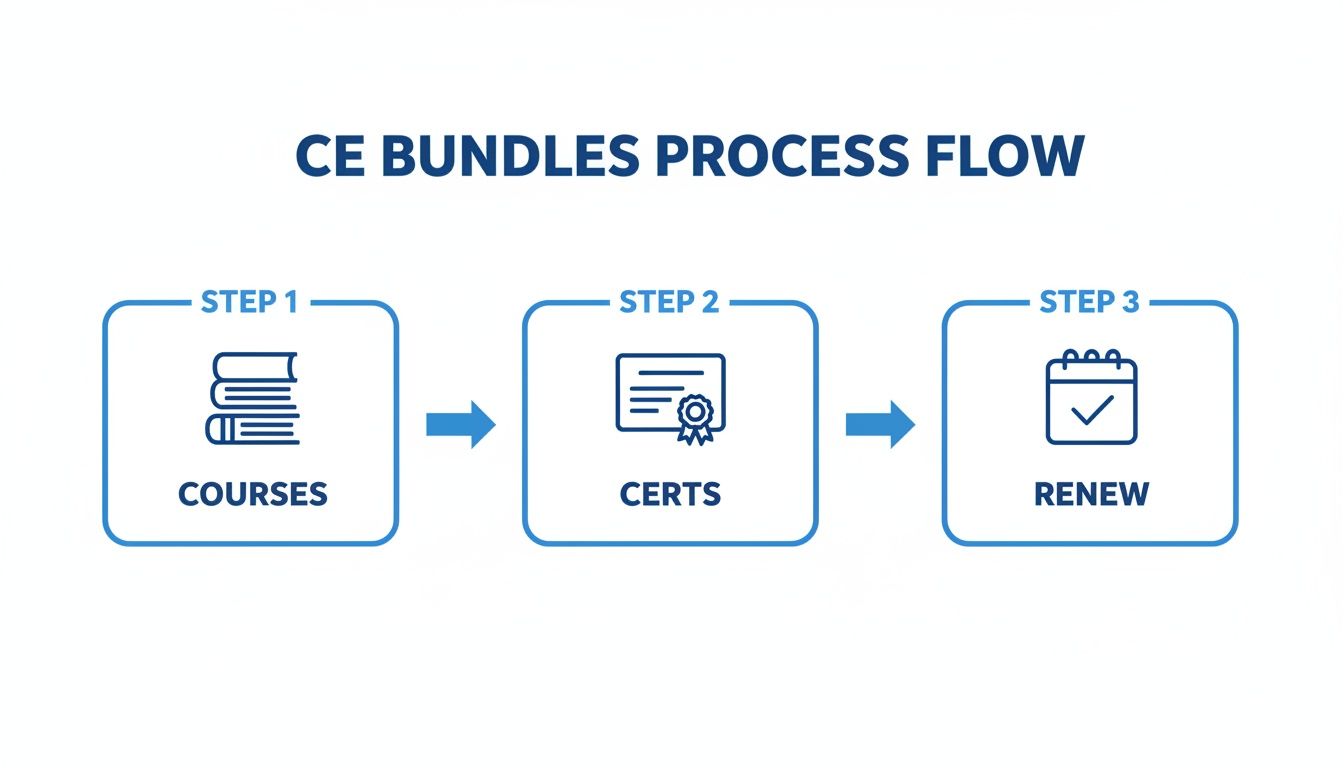
It’s easy to see how an integrated system simplifies taking courses, earning certifications, and managing renewals all within a single, connected workflow.
Putting It All Together for Stress-Free Renewals
By combining a simple personal tracking system with the power of an automated platform, you create a foolproof method for managing your nurse continuing education. You really get the best of both worlds: the control of a manual system and the convenience of modern technology.
Key Insight: The goal is to make tracking a background process, not a front-and-center chore. The right tools allow you to focus on what truly matters—learning and patient care—while your compliance runs smoothly on its own.
Ultimately, this kind of workflow transforms license renewal from a stressful event into a simple, predictable part of your professional life. Platforms like ProMed are built to deliver this experience, ensuring your focus remains on growing your skills, not on paperwork.
Got Questions About Nurse CE? We’ve Got Answers.
Jumping into the world of nurse continuing education can feel like learning a new language. Between state board rules, credit types, and provider choices, it's easy to get turned around. Let's clear up some of the most common questions nurses have so you can manage your career with total confidence.
Think of this as your go-to cheat sheet for making smart, simple decisions about your professional development.
Is Online Nurse Continuing Education Really Accepted by My State Board?
Yes, absolutely. The overwhelming majority of state nursing boards fully accept CE credits from providers accredited by national bodies like the American Nurses Credentialing Center (ANCC). The key factor isn't the format (online vs. in-person) but the provider's accreditation status. As long as you choose an ANCC-accredited provider, you can be confident that online courses are a 100% valid and widely accepted way to meet your state's requirements.
Do I Have to Take Courses from the AHA for My BLS or ACLS Certification?
No, this is a common misconception. While the AHA is a well-known provider, it is not the only valid option for life support certifications. Many accredited online providers offer courses built on the exact same evidence-based ILCOR and AHA guidelines. The industry is evolving, and healthcare organizations are increasingly accepting these equivalent, accredited online certifications.
The Modern Standard: The industry consensus is shifting. The primary concern for employers and state boards is whether the training meets current scientific guidelines and is provided by a credible, accredited organization—not which specific company issued the card. Online formats are just as good as in-person when the curriculum is sound.
How Do I Find the Specific CE Requirements for My State?
Your first and best resource should always be your state's Board of Nursing website. It is the official source of truth. There, you'll find the precise number of contact hours you need, your renewal cycle dates, and any mandatory topics, such as courses on ethics or substance abuse.
To make things even easier, many modern CE platforms now offer state-specific course bundles and requirement trackers. These tools are designed to take the guesswork out of compliance, helping you find and complete exactly what your license renewal calls for.
What Is the Difference Between a CEU and a Contact Hour?
It’s easy to get these two mixed up, but the math is simple. One Continuing Education Unit (CEU) equals ten contact hours. A "contact hour" usually represents about 50 to 60 minutes of learning.
You'll find that most nursing boards list their requirements in contact hours. So, if your state requires 30 contact hours, that’s the same as 3.0 CEUs. Always double-check which term your board uses, but you'll almost always see "contact hours" in the nursing world. Knowing this difference helps you track your progress accurately.
This guide should lay the framework for tackling your CE requirements with a fresh perspective. At ProMed Certifications, we’re at the forefront of the shift to modern, flexible learning. Our ANCC-accredited platform gives you a huge library of CE courses and certification bundles built for your needs, complete with automated reporting and a 100% acceptance guarantee. We’re committed to delivering convenience and credibility, so you can focus on what you do best.
.avif)
Stay compliant with ProMed+
Certifications included: ACLS, BLS, PALS, CPR & Neonatal Resuscitation
Unlimited continuing education: over 200 hours of accredited CME
All-inclusive: One price. No surprises.
Get certified today

The Advanced Cardiac Life Support (ACLS) is an accredited online medical certification course that teaches medical professionals to respond to nearly all cardiopulmonary emergencies.

The Pediatric Advanced Life Support (PALS) Recertification instructs medical professionals on performing pediatric cardiopulmonary resuscitation in emergencies.

The Basic Life Support (BLS) Recertification is intended to teach healthcare professionals the basic steps of CPR and rescue breathing for adults, children, and infants.

Our online medical certification course for CPR, Automated External Defibrillator (AED), and First Aid is designed to teach adult, child, and infant CPR and AED use.

The Neonatal Resuscitation Certification trains medical professionals in performing resuscitation procedures and life-saving techniques for newborns at the time of delivery.

.png)
.png)
.png)