


Professional Development Hours Explained for Healthcare Pros
.png)
A nurse staring at a renewal deadline doesn't need more jargon. You need a clear answer to one question, what counts, what doesn't, and how do you prove it when the board asks?
Professional development hours are the compliance currency behind that answer. They're the way licensing bodies, employers, and accrediting organizations measure ongoing learning, and they're usually based on contact time, not just the fact that you sat through something. That's why a course certificate matters so much, it turns learning into something you can document, renew with, and defend in an audit.
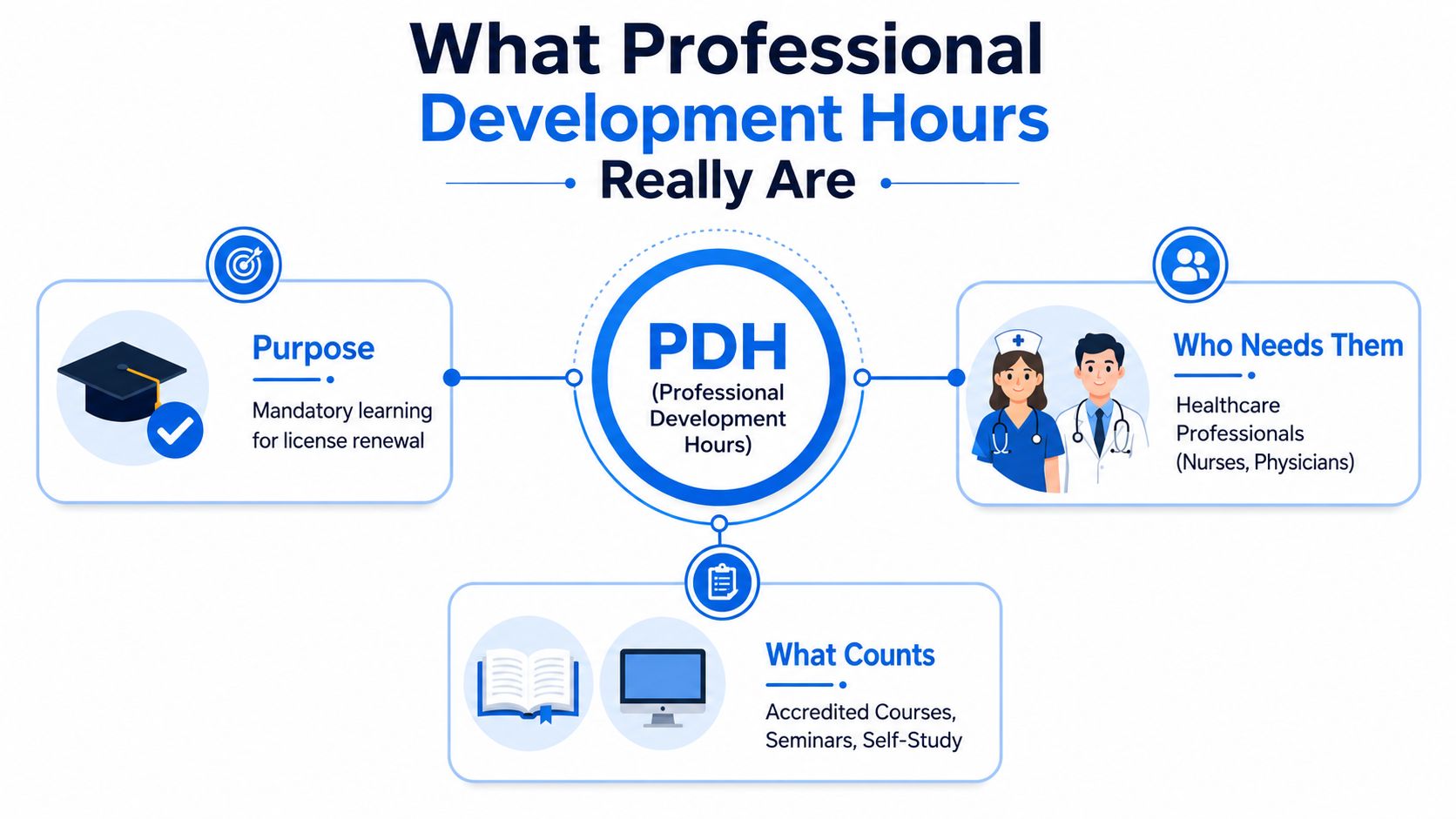
The simplest way to think about PDH is this, it's a standardized count of approved learning time. In teacher research, professional development hours have long been measured as clock-hour participation in structured instruction, excluding breaks and social time, and that same logic is what keeps renewal systems consistent across professions and jurisdictions. The Stanford policy review also notes that in a national teacher sample, the average reported number of professional development hours was 43.9 hours over the previous 12 months, and 51% of teachers reported at least 14 hours of content-focused PD on the subjects they teach, which shows that hours have always been used as both a volume measure and a quality signal. Stanford's professional development review is a useful reminder that the number alone never tells the whole story, relevance matters too.
For healthcare professionals, that's the practical point. A certificate isn't just a souvenir from a course, it's evidence that you completed an accredited activity within the right time frame and in the right format. If you've ever had a renewal notice in one hand and a stack of loose certificates in the other, you already know why the system exists.
The term also helps separate real compliance from casual learning. A helpful starting point for nurses is ProMed's nursing continuing education guide, because it shows how renewal requirements connect to accredited learning in plain language.
How PDH, CE, and CME Fit Together
Healthcare professionals often use PDH, CE, and CME as if they mean the same thing, but the labels point to different audiences and accrediting systems. The activity itself may be similar, a webinar, an online module, a workshop, but the credential you're renewing determines what the certificate needs to say.
Think of PDH as the umbrella term for hour-based professional learning tied to licensure or credential maintenance. CE, or continuing education, is the common label in nursing and allied health. CME, continuing medical education, is the physician-specific version. A course can absolutely count in more than one system if the accreditation lines up, but the title on the certificate usually follows the profession that issued or recognized it.
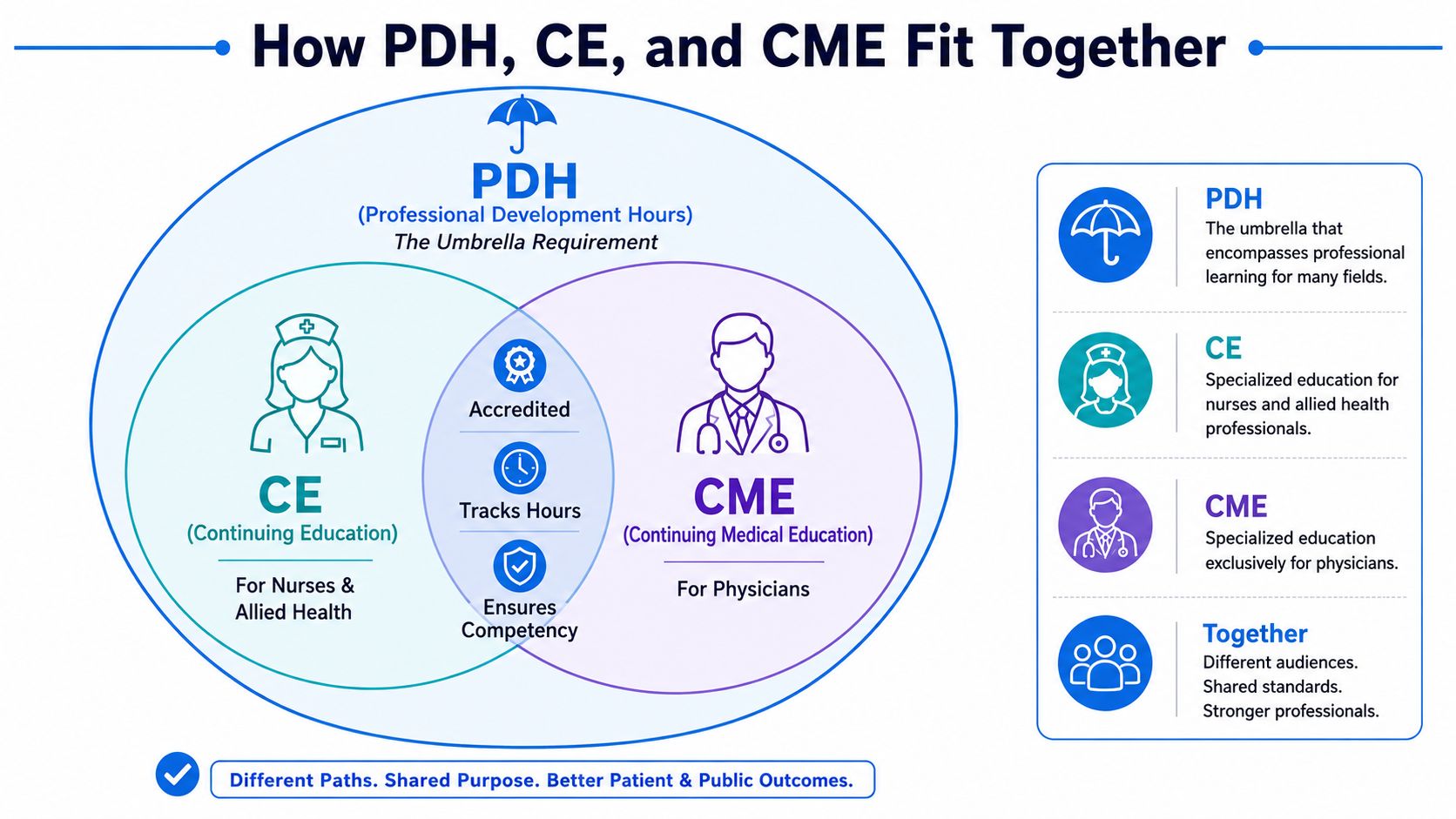
What each label usually means
- PDH, the broad compliance label. It shows up in systems that count structured contact hours for renewal or recertification.
- CE, the nursing and allied-health label. It's the language most boards and providers use for licensed clinical professionals.
- CME, the physician label. It's tied to physician education and board-facing renewal frameworks.
The overlap is the part people miss. Accredited, tracked, documented learning can satisfy professional development obligations even when the naming convention differs. That's why a physician may complete a CME course while a nurse completes CE on the same topic, and both can be legitimate within their own systems.
A practical example helps. The physician library at ProMed+ Physician CME is described as a dynamic streaming library of clinical curricula with access to over 200 AMA PRA Category 1 Credits™, accessible on demand. That kind of structure fits the same hour-based logic described in the regulatory frameworks above, because the key question is still whether the learning is accredited and documented.
If you want a deeper dive into digital physician learning, this online CME overview from ProMed is a solid companion read. The bigger point is simple. The alphabet soup looks confusing at first, but once you know your profession and your board, the label usually tells you exactly how the hours are being counted.
How a PDH Is Actually Counted
Counting PDH gets easier once you stop thinking in broad calendar time and start thinking in contact time. In many regulated systems, one professional development hour equals one verified hour of instruction or study, but the exact minute count matters. Maine defines 1 PDH as 1 contact hour using a 50-minute instruction and 10-minute break model, and it says no activity lasting less than one half-hour can be counted. Maine's PDH guidance is a good example of why tiny fragments often don't survive an audit.
What usually counts and what usually doesn't
- Counts: Accredited coursework, structured seminars, and other approved contact-hour activities.
- May count: Self-study or online work, if the governing board allows it and the provider documents it properly.
- Usually doesn't count: Breaks, lunch, networking time, and informal discussion that isn't part of the approved instruction.
- Often gets discounted: Very short activities that fall below the board's minimum time block.
That minute-level detail sounds fussy, but it protects both the learner and the board. It keeps a 30-minute informational session from being inflated into a full hour, and it keeps a full day of instruction from being padded with lunch and hallway chatter. In ASME's PDH guidance, a seminar running 8 a.m. to 5 p.m. with a one-hour lunch yields 8 PDH, which shows how carefully actual instruction time is separated from the rest of the day. PDH can't exceed the actual contact clock hours.
Practical rule: if the certificate doesn't show the contact time clearly, save yourself trouble and get clarification before renewal season.
Rules also get weighted in some professions. Engineers Australia requires 150 hours over three years, including at least 50 hours in the engineer's area of practice, 10 hours in risk management, and 15 hours in business or management. Engineers Australia's CPD policy shows why “hours” alone don't tell the full story, because content mix matters too. South Dakota uses a different model, requiring 30 PDH per biennium with at least 20 technical PDH and no more than 10 management PDH. That kind of structure is common enough that anyone tracking hours should read their board's category rules before assuming a completed course will fit everywhere.
If you're comparing nursing-focused platforms, ProMed+ Nursing CE describes itself as a one-stop online CE platform with streaming access to accredited content, which is the kind of setup that can make contact-hour tracking easier when you're trying to keep your records clean.
Typical PDH Requirements for Healthcare Professionals
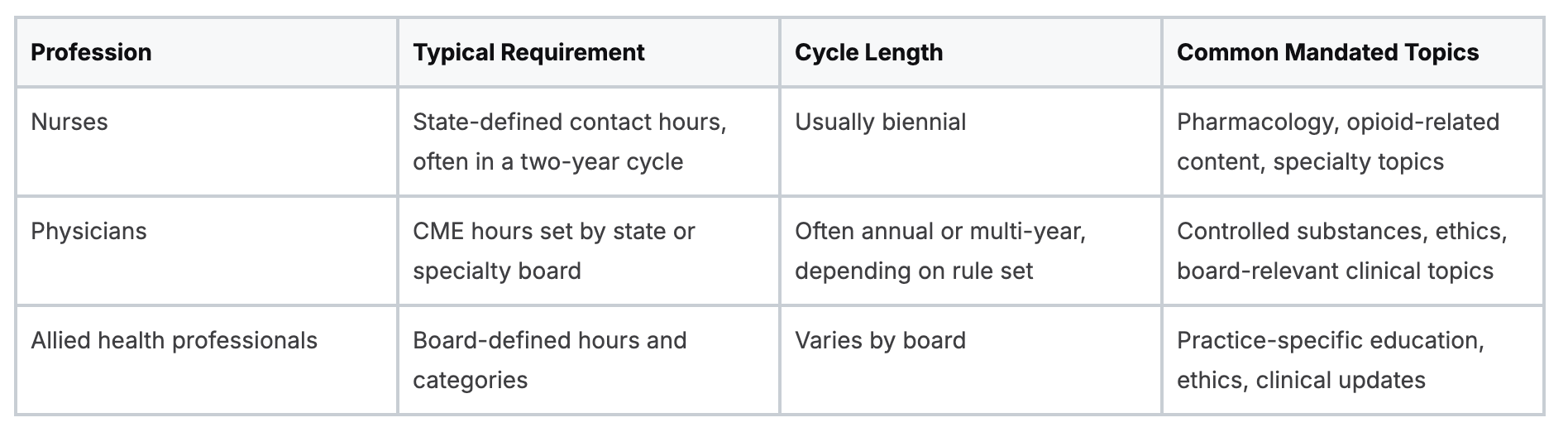
The question is not how many hours people need in general. It is what a specific board expects from a specific license type. Requirements change with the profession, the renewal cycle, and sometimes the topic mix that has to appear on the record.
Nurses often renew on a two-year cycle, and many state boards ask for a set number of contact hours with topic rules such as pharmacology or opioid-related education. Physicians usually work under a CME framework rather than a nursing CE framework, and state mandates can add topic-specific items, especially around controlled substance prescribing. Allied health professionals may face biennial or triennial systems that are easier to overlook in casual conversation, but they still bind practice in the same way.
Common pattern to check first
- Your profession. Nursing, medicine, engineering, education, or another regulated field.
- Your renewal cycle. Biennial, triennial, or a longer cycle.
- Topic categories. Ethics, pharmacology, risk management, substance prescribing, or practice-specific content.
- Employer overlay. Hospital or clinic policies can add requirements above the board minimum.
Some boards are very precise about how hours fit into each bucket. Texas Administrative Code § 463.35 requires 40 hours of professional development per renewal period, including 6 hours in ethics and 6 hours in cultural diversity or competency, and it allows up to 10 hours to carry forward if those hours are not needed for renewal. That kind of rule shows why planning has to go beyond the total number and include the content mix.
Minnesota uses a similar compliance mindset. Its continuing education rules require most licensees or certificate holders to obtain 24 PDH, with 2 hours in ethics, and those ethics hours cannot be carried forward as ethics hours. A PDH is no less than 50 minutes, and the work has to fit within the two-year period before biennial renewal. Minnesota's continuing education page is a good reminder that the timing of completion can matter as much as the title on the certificate.
One practical way to keep the whole plan straight is to map the board rule, the course record, and the certificate together before renewal season. If you are comparing nursing-focused platforms, ProMed+ Nursing CE describes itself as a one-stop online CE platform with streaming access to accredited content, and that setup can make contact-hour tracking easier when you want your records clean. For a broader look at approved digital education formats, see online continuing medical education options. The same logic applies whether you are building a new renewal plan or checking whether a course will fit a very specific board category.
Why Online PDH, CE, and CME Are Fully Valid
The old line that only in-person AHA or American Red Cross classes count is outdated. It's also too narrow for how healthcare education works now. Accredited online learning is widely accepted when the provider, content, and documentation meet the board's rule set.
That shift isn't just about convenience. Large organizations have been using fewer formal learning hours per employee in recent years, while the cost of each hour has risen, according to ATD's benchmark reporting. ATD reported 13.7 formal learning hours used per employee in 2024, down from 17.4 in 2023 and about 35 in 2020, and the average cost per learning hour rose to $165 in 2024, up 34% from $123 in 2023. ATD's 2025 Talent Development Benchmarks and Trends helps explain why online formats keep gaining traction, they reduce friction without forcing professionals to give up entire days.
Why the industry keeps moving online
- Flexibility: You can finish courses around shifts, call schedules, and family responsibilities.
- Documentation: Digital certificates are easier to store, search, and submit.
- Access: Learners in rural or understaffed settings don't have to travel for every renewal.
- Repeatability: Replaying a module can help with retention, especially for complex clinical topics.
That's the practical reason hospitals, clinics, and accrediting bodies keep expanding acceptance of online options. The point isn't that in-person training is bad, it's that a well-designed accredited course can teach the same concepts and produce the same documentation, without requiring everyone to be in the same room.
How to Track, Document, and Report PDH
A good PDH plan starts with selection and ends with a clean transcript. In between, every step should leave a record you can hand to a board reviewer without scrambling through email folders at midnight. The easiest mistake is to finish a course and assume the certificate will stay findable forever. It won't, unless you store it well.
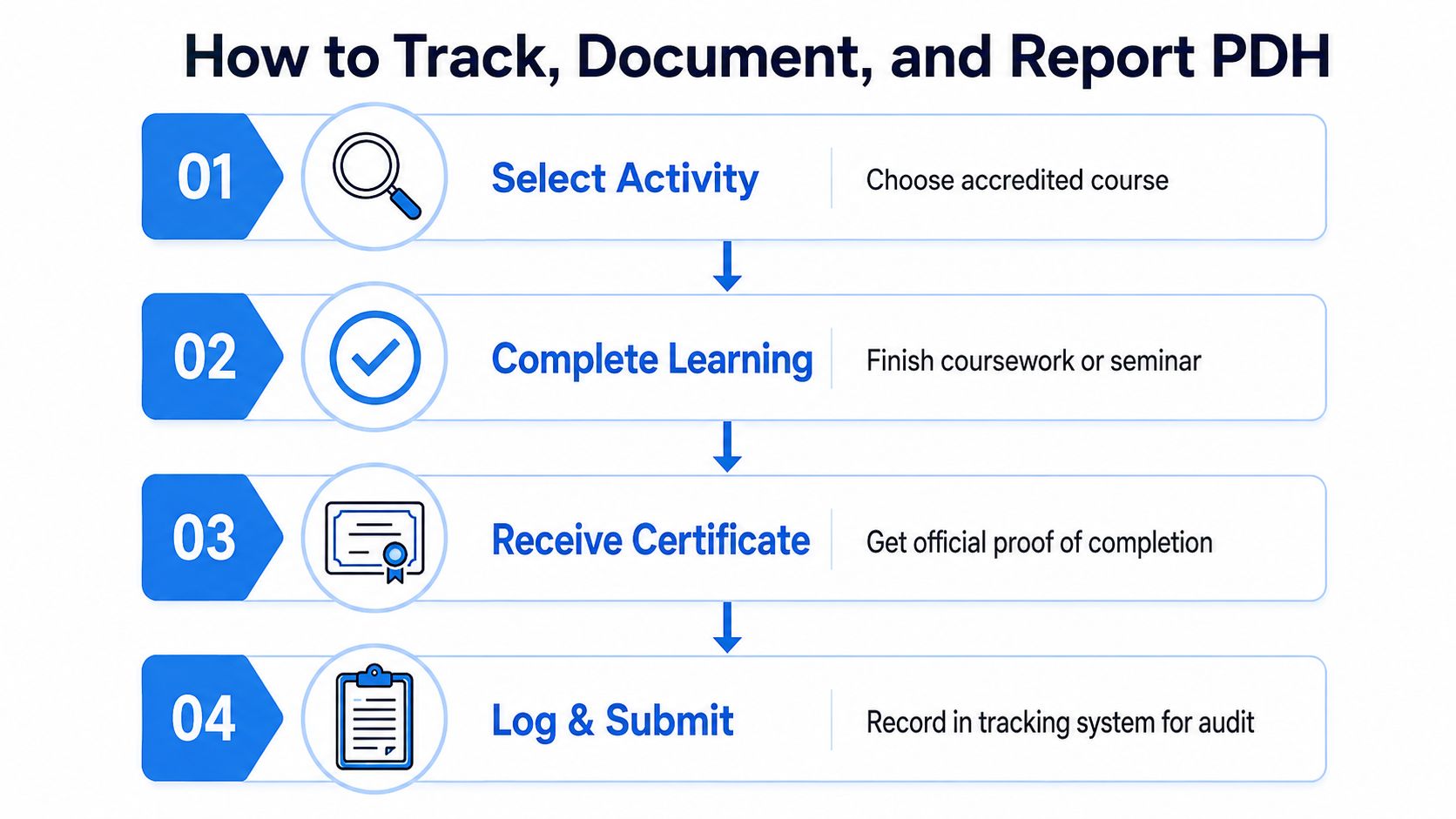
A clean workflow makes audits less stressful
- Select the activity. Choose an accredited course that matches your board's rules.
- Complete the learning. Finish the seminar, webinar, or module fully.
- Save the certificate. Check that it shows the title, date, hours, provider, and accrediting body.
- Log and submit. Enter the hours in your tracking system and report them where required.
That sounds simple, but the details matter. A compliant certificate should identify the course title, completion date, contact hours, provider, and approving organization. If your board uses automatic reporting tools, set those up early. If it relies on self-reporting, keep your own transcript and back it up outside your primary device.
Keep one master folder for every renewal cycle, then duplicate it to a second secure location. Most people only regret documentation after they're asked for it.
A board-approved workflow can also be helped by tools outside the classroom. The main thing is consistency, because a neat record-keeping system is what makes online learning easy to defend when a reviewer asks for evidence.
For nurses who use reporting platforms, CE Broker account setup guidance can help you understand how automated reporting fits into the bigger process. Once you know where your hours are stored and how they're transmitted, the renewal cycle gets much less chaotic.
How ProMed Certifications Fits Into Your PDH Plan
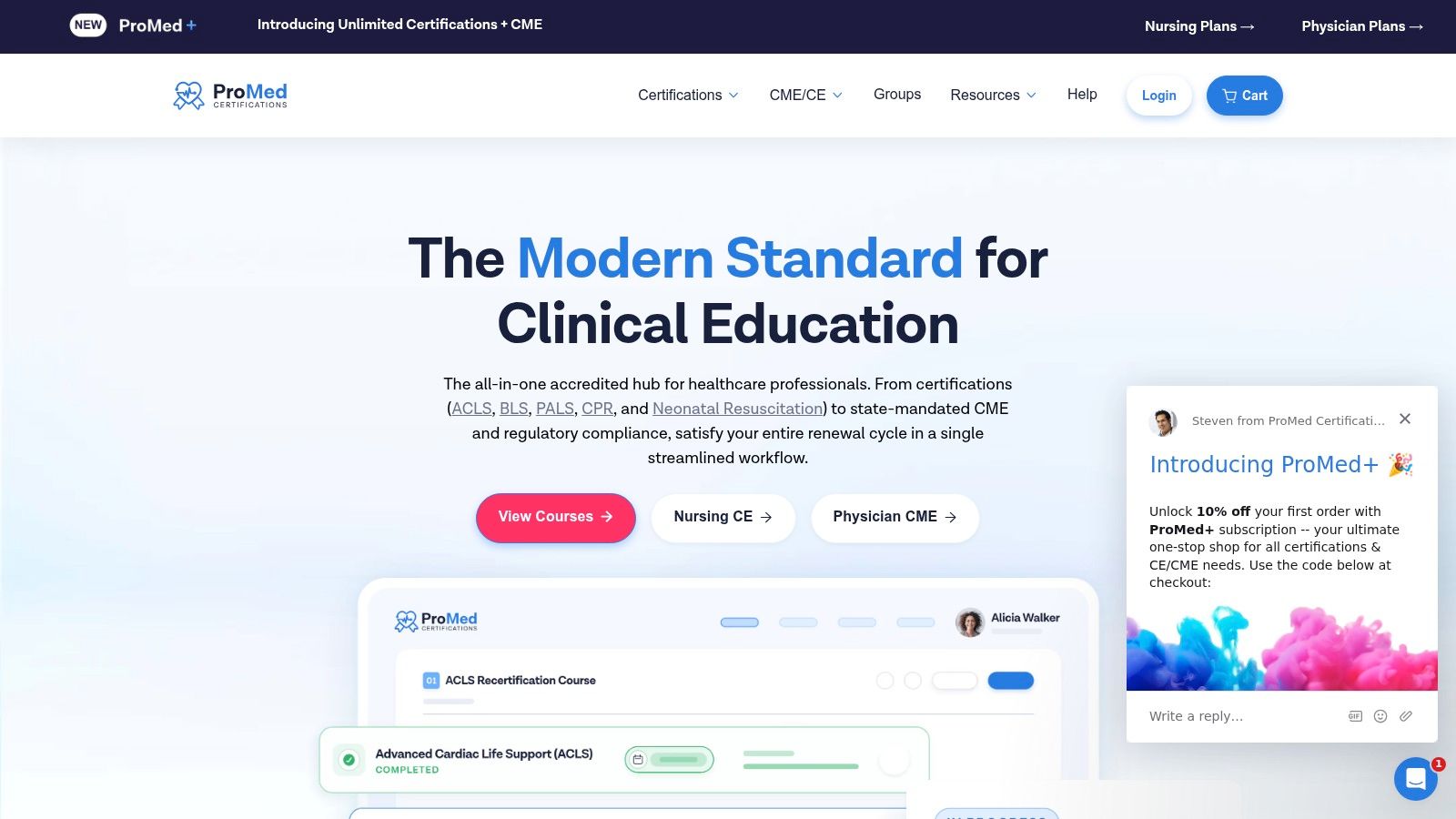
A workable PDH plan needs two things, accredited hours and a clean record of them. ProMed Certifications offers online medical certification courses for healthcare professionals, and its CE and CME libraries are built around that same practical need, finish the learning, keep the proof, and move on with the renewal cycle. The platform's nursing CE program is described as a streaming platform for meeting CE requirements, and the physician CME option gives clinicians access to on-demand credit-bearing learning.
That setup matters for people who need renewal hours and life-support credentials in the same year. ProMed's course ecosystem includes ACLS, BLS, PALS, CPR, and Neonatal Resuscitation, so one study plan can support licensure-related education and employer-mandated certification needs at the same time. When a renewal deadline and a clinical credential deadline land close together, that overlap reduces the number of separate providers you have to manage.
What makes the workflow easier
- Instant digital certificates give you proof of completion without waiting for mail or manual processing.
- Automated reporting to CE Broker and state boards lowers the chance that a completed course never reaches your record.
- Unlimited retakes reduce pressure from test anxiety and awkward scheduling.
- On-demand access fits around shifts, travel, and family obligations.
A simple comparison helps here. In-person training often leaves you with paper to file, emails to chase, and a calendar to coordinate. An online system like ProMed keeps the course, certificate, and reporting path in one place, so the administrative part of PDH does not grow into a separate project.
If you are comparing providers, ProMed's nursing and physician offerings are a clear example of how online learning now fits mainstream compliance. The question is not whether the course is online. The question is whether the course structure matches the renewal rule set you have to satisfy, and whether the record it leaves behind will hold up when someone asks for proof.
Handling Audits, Expired Credits, and Common Edge Cases
Every PDH plan eventually hits an exception. A certificate disappears, a course finishes after the deadline, an employer applies its own documentation rules, or an audit notice arrives while your week is already packed. The right response is steady and practical, keep the record clean, check the rule set, and document any correction.
Audit requests are easier to answer when the file includes the original certificate, the course title, the completion date, and the contact hours. If a board allows carryover, confirm whether the hours may roll forward as general credit or whether category-specific hours, such as ethics, must remain in the period where they were earned. That distinction matters because some boards treat ethics as a separate bucket, and the same hour may satisfy one requirement while failing another.
Common edge cases to resolve early
- Missing certificate: Contact the provider right away and ask for a replacement copy.
- Expired or late-reported credit: Check whether the board accepts late documentation or expects a new activity.
- Employer questions about online learning: Show the accreditation, the contact hours, and the certificate, then point to the format the board accepts.
- Cross-state moves: Review the new board's rules instead of assuming your old credits transfer in the same way.
Carryforward is allowed in some systems, but the limits and categories can change from one rule set to another. Some boards permit only a specific number of hours to roll over, while others separate general credit from ethics or other required topics. The safe reading is simple, carryover gives you permission to use certain hours later, but it does not make every hour portable in every jurisdiction.
Review your transcript before the board does. If a course title is vague, a completion date is missing, or the credit total does not match the certificate, correct it right away. Small paperwork gaps are easy to fix early, and much harder to explain after a renewal problem starts.
.avif)
Stay compliant with ProMed+
Certifications included: ACLS, BLS, PALS, CPR & Neonatal Resuscitation
Unlimited continuing education: over 200 hours of accredited CME
All-inclusive: One price. No surprises.
Get certified today

The Advanced Cardiac Life Support (ACLS) is an accredited online medical certification course that teaches medical professionals to respond to nearly all cardiopulmonary emergencies.

The Pediatric Advanced Life Support (PALS) Recertification instructs medical professionals on performing pediatric cardiopulmonary resuscitation in emergencies.

The Basic Life Support (BLS) Recertification is intended to teach healthcare professionals the basic steps of CPR and rescue breathing for adults, children, and infants.

Our online medical certification course for CPR, Automated External Defibrillator (AED), and First Aid is designed to teach adult, child, and infant CPR and AED use.

The Neonatal Resuscitation Certification trains medical professionals in performing resuscitation procedures and life-saving techniques for newborns at the time of delivery.

.png)
.png)
.png)