


Online Nursing Certification Programs Guide
.png)
Online nursing certification programs get talked about as if you have to choose between convenience and credibility. That's the wrong frame. For most CE and certification needs, online formats are valid, flexible, and widely accepted, and the key question is where the online portion ends and where supervised clinical or testing requirements still begin.
That boundary matters because nurses don't need marketing slogans, they need a clean way to sort through options. Some credentials are built almost entirely around digital learning and exam completion, while others pair online coursework with in-person intensives, clinical hours, or skills validation. If you understand that split, you can pick a program that fits your schedule without guessing at whether it will satisfy an employer, a board, or your own professional standards.
What an Online Nursing Certification Program Actually Is
The simplest definition is this. An online nursing certification program is a credential path delivered through digital coursework, online exams, or a mix of online study and required hands-on components. It's built for already-licensed nurses, not for someone starting from zero and trying to earn a first nursing license.
That distinction matters because people often lump all nursing education together. A prelicensure nursing degree still needs labs and clinical experience, while certification is usually about proving or expanding competence after licensure. As the broader nursing education field has shifted, online formats have become a structural part of training rather than a side option, and many nurses now complete at least part of their education online. NCSBN aggregate data shows that the share of nurses who completed part of their initial degree online or through distance learning rose sharply in the later cohort it tracked.
Two very different program types
One version is short-form and highly practical. These are life-support and related credentials such as BLS, ACLS, PALS, NRP, and CPR, where the content is often delivered online and the finish line is usually an exam or skills check.
The other version is longer and more academic. These are post-master's or post-doctoral nursing certificates for nurses who already hold advanced education and want a narrower specialty layer, often with a current RN license and prior graduate preparation. Universities that offer these tracks usually require an MSN or doctoral nursing degree, an active unencumbered RN license, and sometimes a minimum GPA, which keeps the program aligned with advanced practice expectations. Walden's nursing certificate model is a good example of this specialization layer, with roughly 20 to 30+ quarter credits focused on specialty coursework rather than repeating the full nursing foundation.
Practical rule: if a program promises advanced nursing outcomes but never mentions licensure, clinical hours, or supervised practice, slow down and read the fine print.
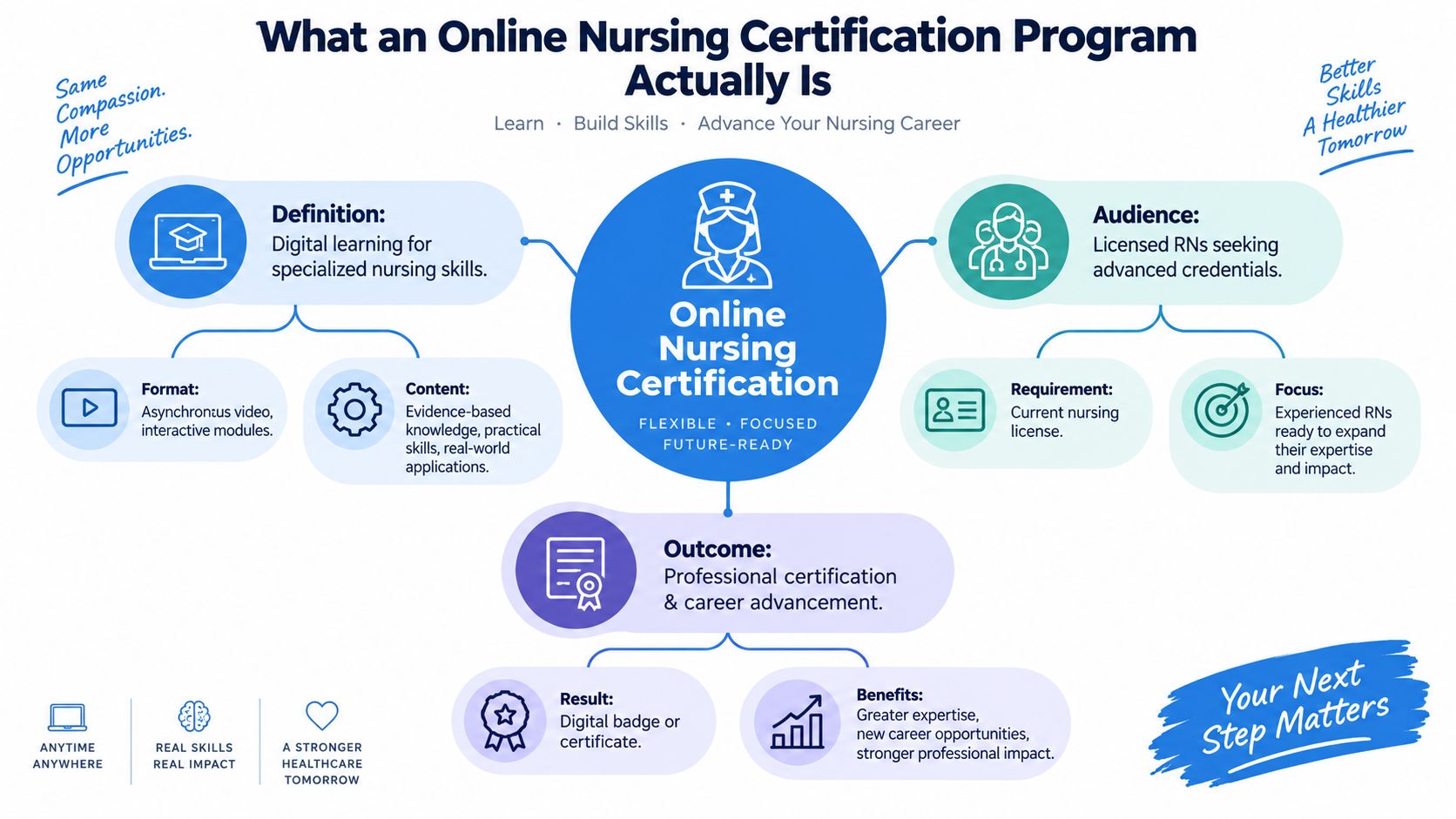
The useful question isn't “Is it online?” It's “What part is online, and what still has to happen in person?” That's the difference between a quick CE-style credential and an advanced practice certificate that still depends on supervised clinical performance. For a plain-language overview of how ProMed positions its certification options, see introducing ProMedCert and online medical certifications.
Common Types and Requirements You Will Encounter
Once you sort out the basic definition, the next step is matching the program to the nurse's actual job need. Some options are built for recurring compliance, some for specialty practice, and some for academic progression. If you're comparing providers, it helps to group them before you look at individual course pages.
The major categories
Foundational life-support credentials are the ones most nurses recognize first. These include BLS, ACLS, PALS, CPR, and similar emergency-response training. They're widely used because they support routine workplace readiness, and employers often want them renewed on a predictable cycle. For that reason, many nurses treat them as continuing education plus certification bundled together.
Post-licensure specialty certificates are different. They're usually for nurses who already have an MSN or doctoral degree and want a focused expansion into areas like nurse education, family practice, or psychiatric-mental health practice. These programs tend to have admissions gates like active RN licensure, prior graduate study, and supervised clinical expectations.
CE bundles sit in the middle. They're useful when you need ongoing credits plus certification maintenance, especially if your job requires multiple renewals over time. A large workforce depends on that kind of flexible structure, which is one reason online pathways have become so normal across nursing. The 2022 National Survey of Registered Nurses found that 70.3% of the U.S. RN workforce held a life-support certification and 37.1% held a resuscitation certification, while 40.2% of nurses, or 1,750,277 RNs, had completed a second degree or advanced certificate after entering the profession. HRSA nursing education and training report
What admissions usually look like
For advanced certificates, the gatekeeping is straightforward. You'll commonly see an active unencumbered RN license, a prior MSN or doctoral degree, and in some cases a GPA threshold. Georgetown's post-graduate nursing certificates show the other side of the equation too, with online coursework, in-person Objective Clinical Intensives, and local clinical placement hours, ranging from 16 to 27 credits and 600 to 1,000+ clinical hours depending on specialization.
If you're comparing a faster credential like ACLS Certification, read the format first. ProMed's ACLS option is presented as a quick online pathway where you can take the course anywhere, complete it on your own schedule, and receive the card in as quick as one hour or less, which makes sense for nurses who need a time-efficient renewal path.
If a credential is tied to bedside practice, expect the program to prove competence somewhere beyond the screen.
For a focused look at foundational emergency credentials, ProMed's overview of basic life support certification for nurses is a useful reference point. The main thing to remember is that the right program depends on your current license level, not on whichever option looks shortest on the homepage.
Accreditation, State Boards, and Employer Acceptance
Acceptance is the part most nurses worry about, and for good reason. The online format itself isn't the problem. The issue is whether the provider is recognized, whether the credential aligns with state rules, and whether the employer accepts the documentation format.
What acceptance really means
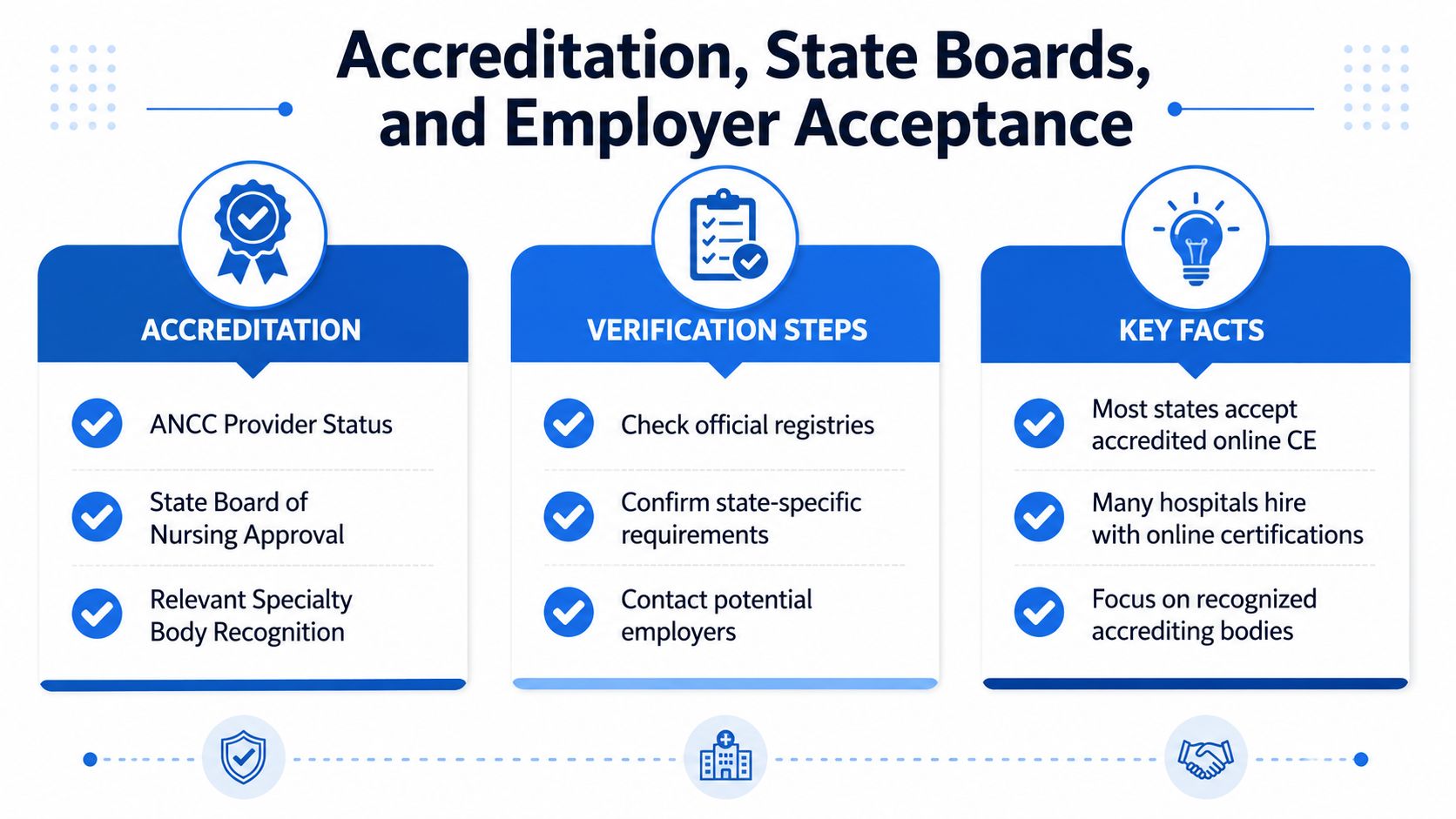
For continuing education, accreditation usually means the course comes from a provider recognized by a body such as the ANCC or by a state board of nursing. For other health-profession education, different accrediting bodies can matter, but the nurse's practical question stays the same, is this provider recognized where I work and where I'm licensed? State rules can differ, which is why a program that works in one jurisdiction may need a second look in another. A practical state-by-state reference point is continuing education requirements for nurses by state.
A fast verification routine
Use a short checklist before you enroll.
- Check the provider's status: look for the accrediting body named on the course page, not just broad marketing language.
- Confirm your state's rules: verify whether your board accepts that CE format or specialty certificate.
- Read the disclaimer carefully: acceptance guarantees, if offered, should explain what happens if an employer rejects the credential.
- Ask your employer directly: compliance teams care about documentation, renewal timing, and whether the certificate is digital, printable, or automatically reported.
- Look for reporting support: automated reporting can save you paperwork when your board or tracking system needs it.
Some providers build that reporting into the workflow. ProMed+ Nursing CE is described as a one-stop online CE platform with streaming access, instant certificates, and automated reporting to CE Broker and state boards, which is the kind of operational detail busy nurses should look for when they compare options.
The bigger point is that acceptance is increasingly format-neutral when the credential comes from a recognized provider. The online course is not the thing that makes a certification weak. Weak verification does.
A provider can be online-first and still be acceptable if the accreditation, board alignment, and employer documentation all line up. That's the standard worth applying every time.
Online vs In-Person Training Side by Side
The best comparison isn't “Which format is better?” It's “Which format gives me the same outcome with less disruption?” For most working nurses, that answer leans online, because the flexibility is real and the educational standard doesn't disappear just because the lecture moved to a screen.
What changes, and what doesn't
Online programs usually deliver theory through synchronous video, asynchronous modules, virtual simulations, and online exams. That setup fits shift work, family obligations, and irregular scheduling far better than a fixed classroom calendar. In-person training can still be useful for live demonstrations or team practice, but it often asks nurses to sacrifice more time for the same knowledge gain.
The clinical side is where people get confused. Licensure-bound tracks still require in-person hours, supervised practice, or local placement, and that's true even when the didactic part is fully online. The presence of offline requirements doesn't make the online format lesser. It means the program is preserving the hands-on standards that nursing demands.
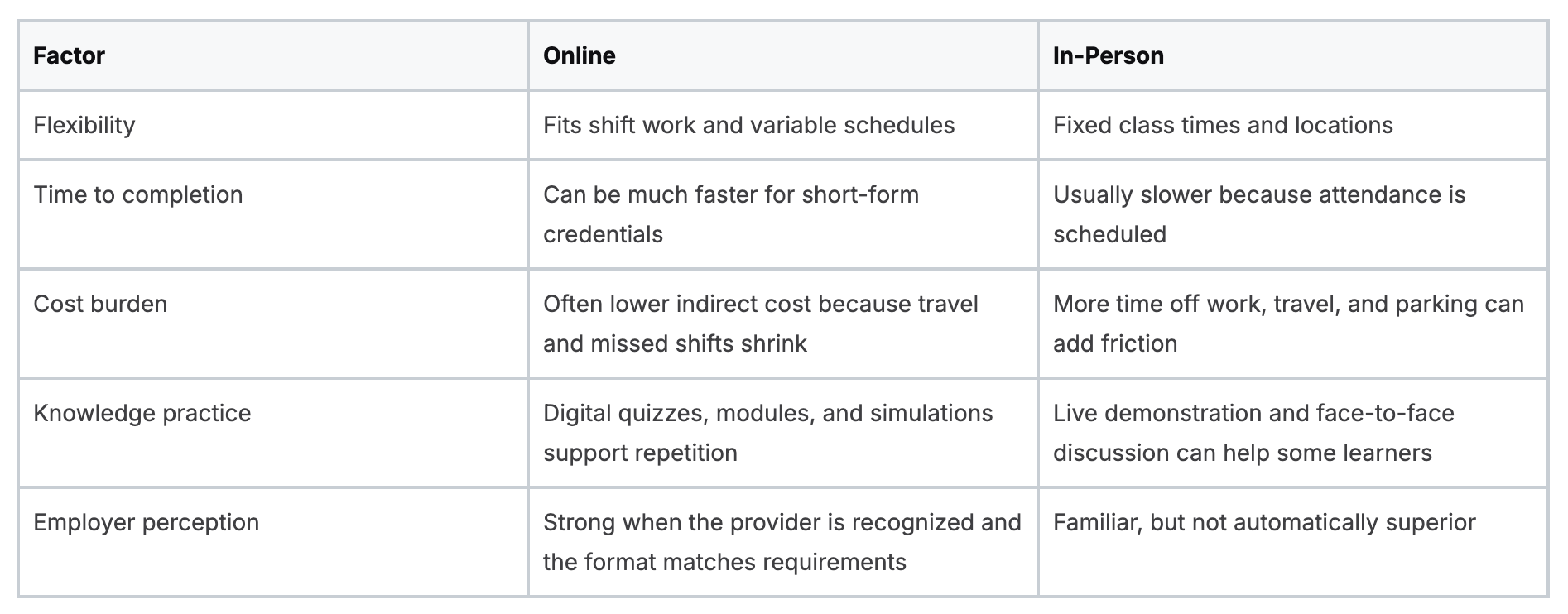
For timing, some online nursing certificate programs can be completed in three to six months, while standard programs often take one to two years, especially part-time.
What nurses usually notice first
A nurse finishing an ACLS renewal online doesn't lose the value of the credential just because the review happened at home. The gain is less disruption, faster completion, and easier scheduling around nights or weekends. If the course is accredited and the completion record is clear, the employer usually cares more about competency and documentation than about the delivery method.
A useful example is PALS Certification, where ProMed describes a 100% online review and exam flow designed around busy schedules. That kind of format helps nurses stay current without turning one required certification into a whole day of logistics.
Short version: online works best when the goal is focused competency, not seat time.
The old habit of treating in-person as the only serious option doesn't fit today's nursing workflow very well. The question now is whether the program preserves standards while making the process easier to complete.
Why AHA and Red Cross Are Not the Only Recognized Options
The idea that only in-person AHA or American Red Cross classes count is outdated. Those organizations are familiar, and familiarity makes people trust them, but familiarity is not the same thing as exclusivity. Nursing education and certification have moved toward broader recognition of accredited online options, especially when the provider documents competency clearly and the credential lines up with board or employer expectations.
The workforce has already changed
Online learning is no longer unusual in nursing. National nursing education reporting shows that 972 programs participated in 2021 to 2022, with 124,912 enrolled students and 9,653 full-time faculty, and online or hybrid delivery remained a substantial part of the picture. That matters because the profession itself is increasingly trained through blended and online formats, not just in lecture halls.
The survey results point in the same direction. Nearly half of nurses educated between 2016 and 2020 completed part of their initial degree online or through distance learning, compared with a much smaller share from the earlier cohort. That is normalization in plain language. The workforce is already used to digital study, so acceptance of accredited online certification has a stronger footing than older assumptions suggest.
What actually deserves your attention
The key issue is not whether a course was online. It is whether the provider is recognized and whether the credential is the right type for the job. If you need a resuscitation or life-support credential, the delivery method can be online as long as the provider and documentation fit the requirement. If you need an advanced practice certificate, then the question becomes whether the program includes the supervised clinical work the specialty demands.
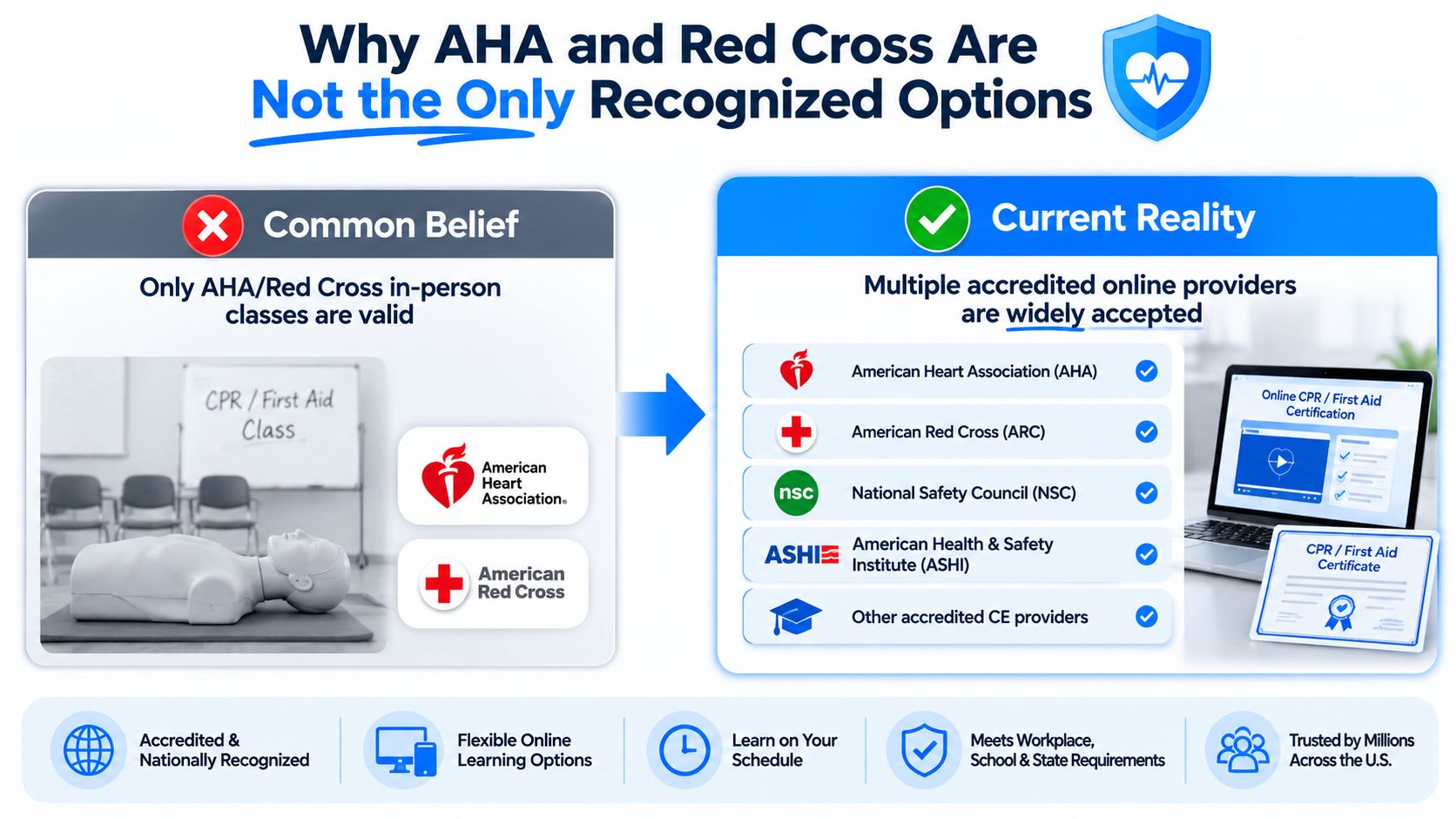
That is why blanket “only AHA or Red Cross counts” advice misses the point. The more useful standard is whether the credential is accredited, accepted by the board, and documented in a way your employer can use. For a broader clinical overview of CPR-related training and its place in nursing education, see CPR certification in the context of modern online delivery.
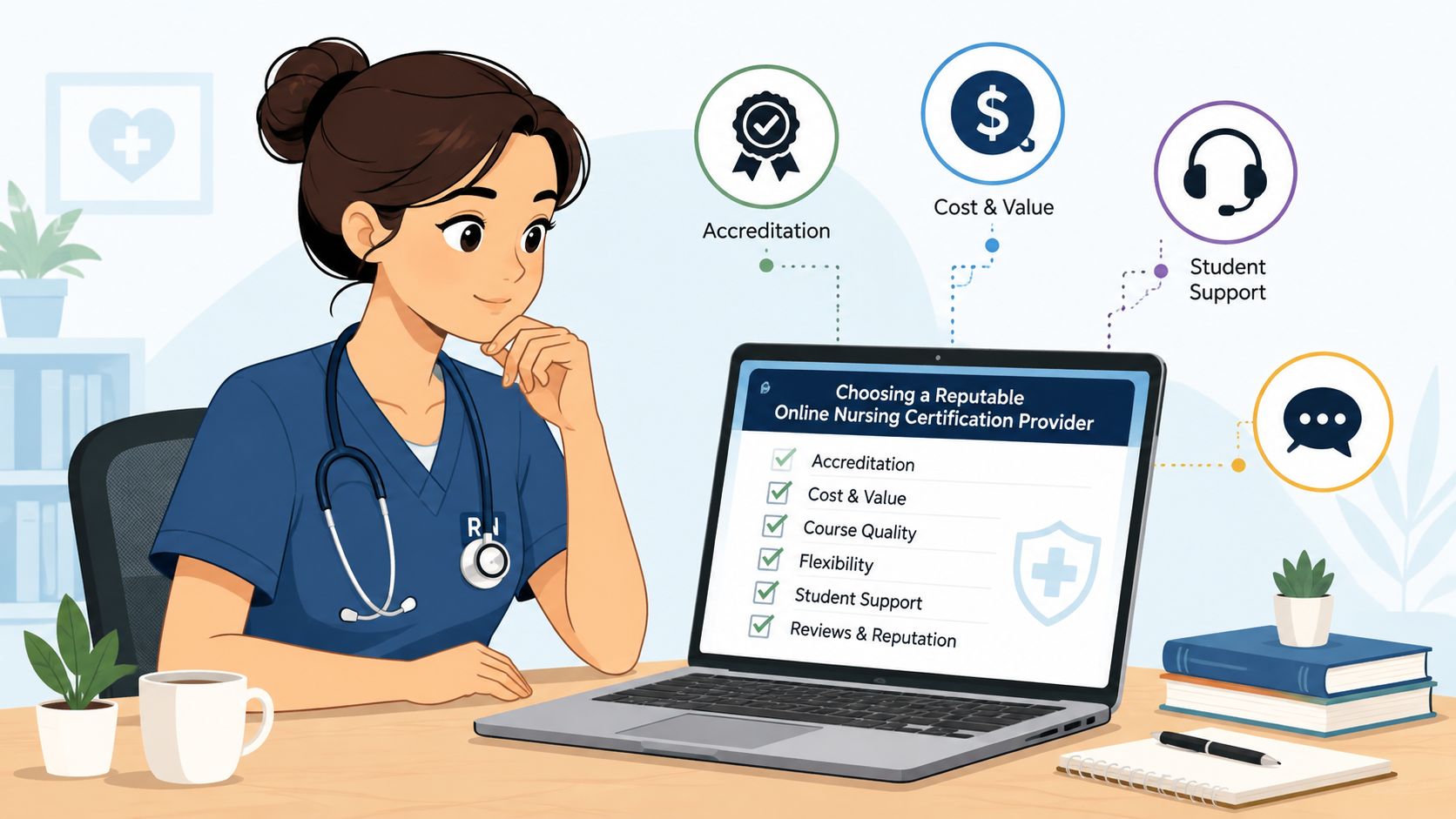
How to Choose a Reputable Online Provider
A good provider makes the decision easy to verify. A weak provider buries key facts until checkout. The safest way to compare options is to look for transparency first, then convenience, then proof that the completion record will work for your board or employer.
The five-minute check
Start with the accreditation statement. If the provider can't clearly name its recognized body, don't assume the credential will be accepted. Then check whether the platform gives you instant access, mobile use, unlimited retakes, and a digital certificate you can download or forward right away.
After that, look for the compliance details. The best providers tell you whether they report to CE Broker or state boards, whether they offer acceptance guarantees, and whether they support group enrollment for facilities. If you're managing your own renewals, those features save time. If you're managing a team, they reduce admin friction.
A reputable provider answers the awkward questions before you pay.
Match the format to the timeline
Speed matters, but only if the course still fits your requirement. Some online certificates can be finished in a few months, while more advanced specialty tracks stretch into a year or more because of clinical work and academic depth. That spread is normal, so you shouldn't compare a short CE renewal with a post-master's specialty certificate as if they solve the same problem.
A provider's workflow should also match your device habits. If you study on a phone during breaks, mobile access matters. If you need repeated practice before testing, unlimited retakes matter. If your board expects tracked hours, automated reporting matters more than flashy course pages.
Use the fit test
- License level: Does the program match where you are now, not where you hope to be later?
- Timeline: Can you realistically finish it without disrupting work?
- Recognition: Will your board and employer accept it?
- Delivery: Does the course explain what's online and what still happens in person?
- Documentation: Will you get a certificate, transcript, or reporting record in the format you need?
That's the logic behind choosing a provider you can trust. For some nurses, the right fit will be a focused certification like ProMed ACLS course. For others, it will be a broader CE platform that covers recurring requirements in one place.
Group Options and Where Nursing Education Is Headed
Hospitals and training managers have a different problem than individual nurses. They need to track renewals, assign courses, and keep records clean across a whole team. Group portals solve that by putting assignments, completion status, and recertification in one place instead of scattering them across spreadsheets and email threads.
That shift fits the direction nursing education is already moving. Hybrid models, short in-person skills sessions, and stackable CE-plus-certification bundles are all practical responses to the reality of modern work. Nurses need education that fits around care delivery, not the other way around.
For managers, the value is operational. For nurses, the value is flexibility without losing rigor. The online model works when the provider handles the logistics well and the credential stays aligned with board or employer requirements.
The future of nursing certification isn't less serious. It's more portable.
If you're an individual nurse, the next step is to choose a credential that matches your license level and your actual job duties. If you're a manager, the next step is to standardize the renewal path so your team isn't chasing deadlines one by one. Either way, online certification is no longer a compromise. It's a practical format for the way nursing works now.
If you're ready to compare online nursing certification options with a provider that offers course access, certification pathways, and CE in one place, visit ProMed Certifications and review the programs that match your role, schedule, and renewal needs.
.avif)
Stay compliant with ProMed+
Certifications included: ACLS, BLS, PALS, CPR & Neonatal Resuscitation
Unlimited continuing education: over 200 hours of accredited CME
All-inclusive: One price. No surprises.
Get certified today

The Advanced Cardiac Life Support (ACLS) is an accredited online medical certification course that teaches medical professionals to respond to nearly all cardiopulmonary emergencies.

The Pediatric Advanced Life Support (PALS) Recertification instructs medical professionals on performing pediatric cardiopulmonary resuscitation in emergencies.

The Basic Life Support (BLS) Recertification is intended to teach healthcare professionals the basic steps of CPR and rescue breathing for adults, children, and infants.

Our online medical certification course for CPR, Automated External Defibrillator (AED), and First Aid is designed to teach adult, child, and infant CPR and AED use.

The Neonatal Resuscitation Certification trains medical professionals in performing resuscitation procedures and life-saving techniques for newborns at the time of delivery.

.png)
.png)
.png)