


Nursing Assistant Continuing Education: 2026 Guide
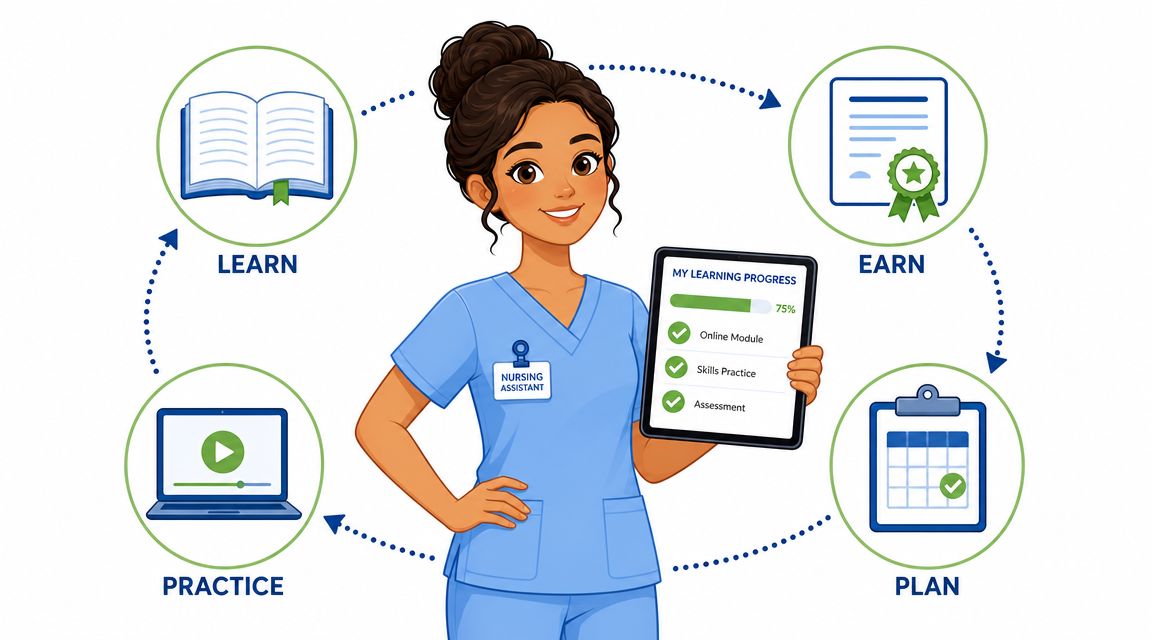
You're probably here because renewal is hanging over your head. Maybe you've got a folder full of half-finished courses, a vague idea of what your state wants, and just enough time after a long shift to wonder if any of it will count.
That's a common spot for nursing assistants. The rules can feel scattered, the terminology is inconsistent, and old advice still circulates in break rooms and group chats. The good news is that nursing assistant continuing education gets much easier once you separate the actual requirements from the noise.
Why Your Continuing Education Matters
A lot of nursing assistants treat CE like an administrative chore. Get the hours, save the certificate, move on. That mindset is understandable, but it misses the bigger value.
Your work changes with every patient, every facility, and every care setting. Continuing education helps you stay sharp in the places that matter most: communication, safety, observation, documentation, infection prevention, abuse recognition, and day-to-day judgment. Those aren't abstract skills. They shape the quality of care people receive from you on a busy shift.
The career picture matters too. The U.S. Bureau of Labor Statistics reports that nursing assistants earned a median annual wage of $39,530 in May 2024, and employment is projected to grow 2% from 2024 to 2034, with about 211,800 openings each year on average over the decade, largely due to workers retiring or moving into other roles (BLS nursing assistant outlook). That means this role remains essential, and staying current helps you stay competitive in a field with steady turnover and constant need.
CE is more than a renewal box
Think of CE as maintenance for a skill-based profession.
You learned the basics in your state-approved training program and competency exam. Continuing education builds on that foundation so your knowledge doesn't sit still while practice expectations keep moving. A short course on patient safety, charting habits, or infection control can tighten up how you work almost immediately.
Practical rule: If a course helps you do safer, clearer, more consistent patient care, it's serving the real purpose of CE, even when you're also taking it for compliance.
Why busy CNAs often feel stuck
Most frustration comes from three pain points:
- Unclear rules: One state may require annual distribution of hours, while another focuses on different timing or topics.
- Uncertain course approval: Many CNAs worry they'll spend time on training that won't count.
- Last-minute panic: Waiting until renewal season turns a manageable process into a scramble.
If your role includes infection prevention responsibilities, it also helps to understand how facilities think about designing infection control programs as part of staff education and risk reduction.
For a broader look at how CE fits into professional growth, ProMed also has a useful overview of nurse continuing education.
Decoding Your State CEU Requirements
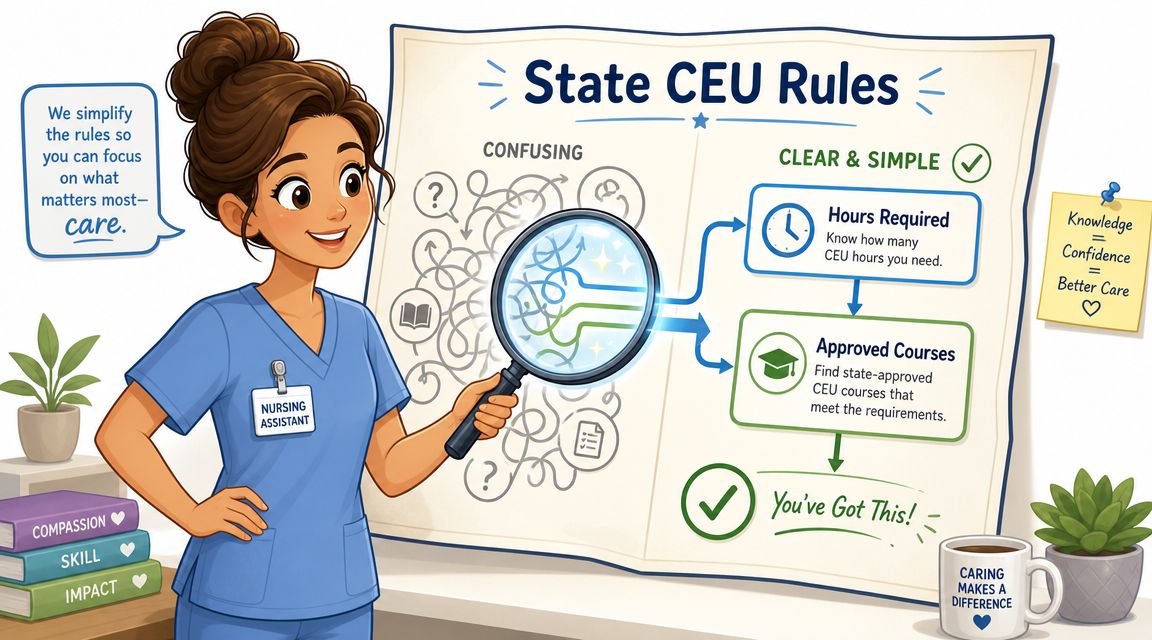
State rules look complicated until you break them into a few basic parts. Most nursing assistant continuing education requirements come down to the same questions: How many hours do you need? Over what time period? Are certain topics required? How much can be completed online?
Once you know those four answers, the rest becomes a paperwork exercise instead of a guessing game.
The four things to check first
Start with your state nurse aide registry or the agency that manages CNA renewal. Look for these details:
- Total required hours: This is the full amount you must complete for the renewal cycle.
- Renewal period: Some states organize CE over a two-year period.
- Topic rules: Certain states require content tied to patient protection or care processes.
- Format limits: Some states accept online learning freely, while others set boundaries.
That last point matters more than many people realize. Online learning is no longer a side option. In many states, it's built directly into the compliance structure.
California gives you a clear model
California is one of the easiest examples to study because the rules are specific. The California Department of Public Health states that CNAs must complete 48 hours of CE every 2 years, with at least 12 hours completed each year, and up to 24 hours may be completed through an approved online computer training program. CNAs also report completed hours on the renewal form, CDPH283C (California CNA online continuing education guidance).
That tells you several useful things right away:
- Timing matters: You can't always wait until the end of the cycle.
- Online learning counts: Approved online coursework is part of the framework, not an exception.
- Documentation matters: Completion has to be reported properly, not just finished.
If your state language mentions approved providers, approved topics, renewal forms, or annual minimums, read those words literally. They usually define what counts and what doesn't.
A simple way to read your own state rules
When you open your state page, don't read it like legal text. Read it like a checklist.

If you work across state lines, don't assume one course package covers every requirement automatically. Multi-state work often creates the biggest compliance confusion because acceptance, timing, and online limits may differ.
A good reference point for comparing requirements is this state-focused guide on continuing education requirements for nurses by state. Even if your role is CNA-specific, the state-by-state mindset is the right one.
Finding Accredited Providers and Approved Courses
Once you know what your state requires, the next question is simple: Who can provide courses that count? Outdated advice causes the most trouble at this point.
Many nursing assistants still hear that only legacy in-person classes from a few household names are valid. That isn't a reliable rule for continuing education. What matters is whether the course meets your state's approval standards and whether the provider can document that clearly.
What approval really means
A useful starting point is the training model behind the profession itself. The federal long-term-care baseline sets nurse aide training at 75 hours of state-approved training, including at least 16 hours of supervised practical or clinical training. States then build continuing education requirements on top of that baseline. The same framework also helps explain why some employer in-service training can count, but only when the content is health care related, mapped to required categories, and documented properly (PHI state nurse aide training requirements).
That leads to a practical point many CNAs miss. Approval is not about whether a class happened in a classroom. Approval is about whether the content, provider status, and documentation fit your state's rules.
What to look for before you enroll
Use this short screening list before paying for any course:
- Provider transparency: The provider should explain accreditation or approval clearly, not hide it behind vague wording.
- Course relevance: Topics should match your state's required subject areas if your state names them.
- Completion records: You should receive a certificate or other formal proof of completion.
- Support for verification: The provider should make it easy to confirm whether a course is accepted.
If your employer offers annual in-service education, don't assume it automatically counts. Ask whether the training is mapped to renewal requirements and whether you'll receive documentation you can keep.
The in-person myth needs to go
For CE, online delivery is often the most sensible format for a working nursing assistant. You can review content after a shift, repeat difficult modules, and avoid travel. None of that makes the education less valid. It makes it more usable.
A provider like ProMed's accreditation page is a good example of what to check. You want to see exactly how accreditation and course recognition are described so you can compare that information against your state rules.
Don't choose a CE provider because the brand sounds familiar. Choose one because the approval pathway is clear and the documentation holds up if you're ever asked to prove completion.
Online vs In-Person CE A Modern Comparison
The old argument says in-person education is automatically better because someone stood at the front of the room. For nursing assistant continuing education, that assumption doesn't hold up well in real life.
What usually matters more is whether you can complete the course, understand the material, revisit what you missed, and keep records without friction. On those points, online CE often fits the working CNA far better.
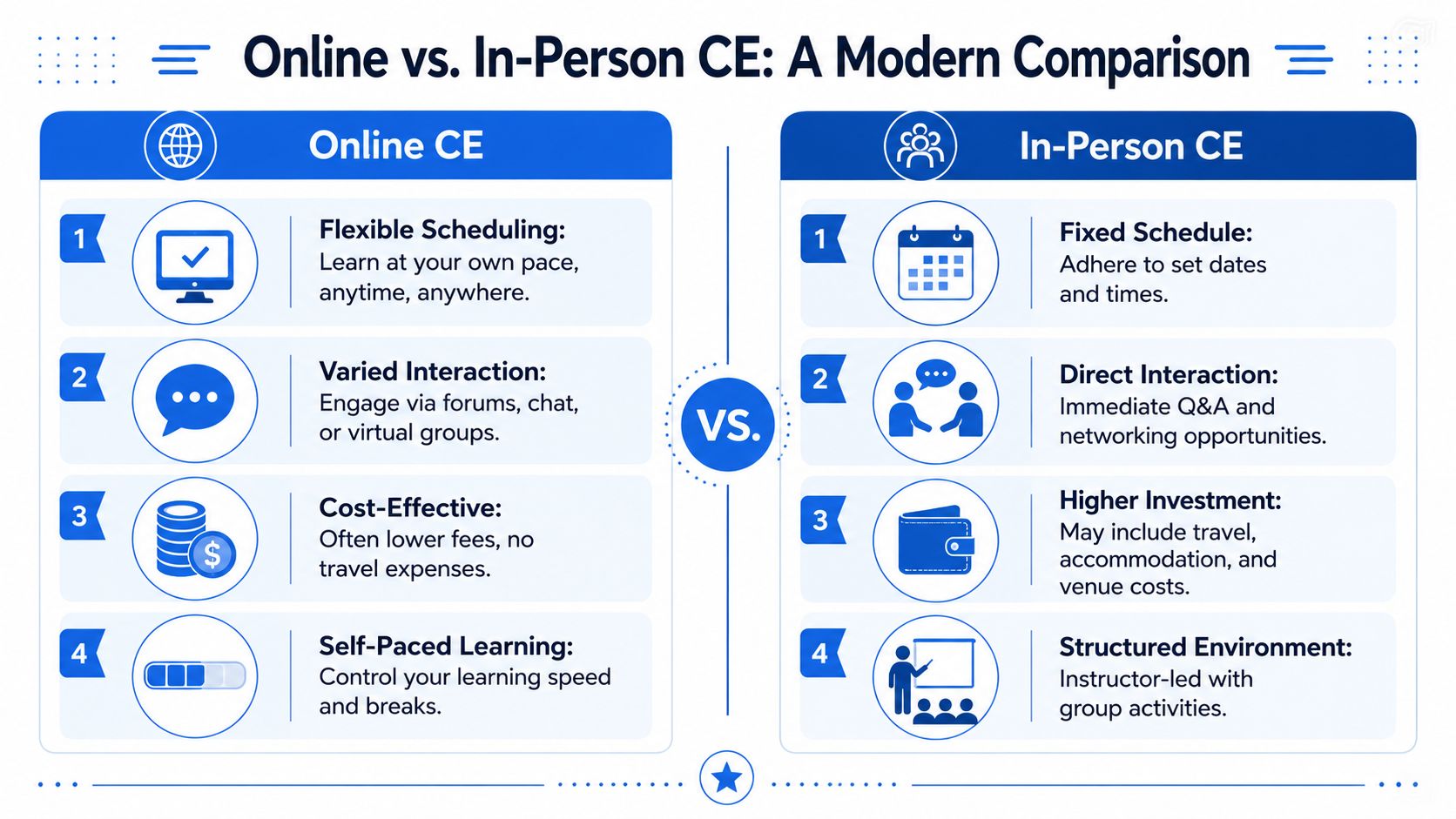
A direct comparison

That table explains why many CNAs eventually prefer online options. If you work nights, rotate weekends, pick up extra shifts, or balance family care, fixed classroom dates can make even a short course harder than it needs to be.
Why online learning fits nursing assistants so well
A nursing assistant's schedule rarely stays neat. Online CE lets you build learning around your life instead of building your life around a class calendar.
That can look like:
- Finishing a module after a shift when the house is quiet
- Reviewing one topic twice because a patient-care concept needs repetition
- Using a phone, tablet, or laptop instead of arranging travel
- Downloading or saving certificates immediately after completion
In-person classes still have a place. Some people like the structure, and some employers organize group training that makes sense on site. But that doesn't make in-person necessarily superior. It just makes it one format among several.
What quality really looks like
Quality in CE comes from clear instruction, relevant topics, accurate assessment, and usable documentation. It doesn't come from folding chairs in a conference room.
A modern CE course respects how healthcare workers actually learn. It gives you access, clarity, and proof of completion without wasting your time.
Online education also helps challenge another lingering myth. AHA and American Red Cross in-person classes are not the only valid learning pathways in healthcare education. For continuing education and many certification contexts, accredited online options are widely used because they meet professional needs with less disruption.
If your goal is efficient compliance without sacrificing substance, online is often the logical choice.
How to Streamline Your CEU Compliance
Compliance becomes stressful when you treat it like an annual emergency. It becomes manageable when you turn it into a routine.
The biggest challenge for many CNAs isn't finding education. It's tracking what counts, when it was completed, and whether it fits a specific state rule. Guidance discussing Michigan's nurse aide CE rule effective March 23, 2026 notes a requirement of 12 hours annually, including care planning and abuse-and-neglect content, for 24 total hours over the two-year period. The same guidance also highlights a broader problem for CNAs: tracking state-by-state acceptance, online limits, and documentation for audit-proof reporting (Michigan and state-specific CNA CE guidance).
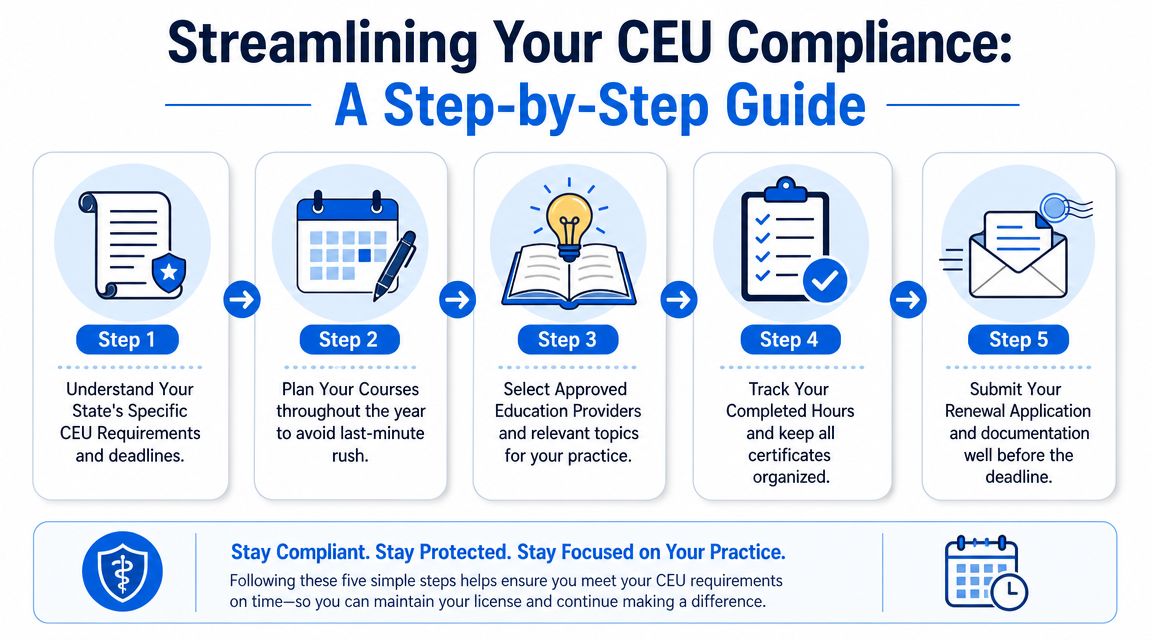
A simple system that works
You don't need complicated software to stay organized. Start with a repeatable process.
- Write down your renewal deadline
Put it in your phone calendar and set reminders well ahead of time. - Break your hours into smaller blocks
A little CE spread across the year is easier than a large batch at the end. - Choose topics with a purpose
If your state requires certain subjects, handle those early. Then add courses that support the kind of patients you care for most often. - Save proof immediately
Download each certificate as soon as you finish the course. - Review your log every few months
A quick check prevents ugly surprises.
Tools that reduce last-minute scrambling
A plain spreadsheet works well. So does a digital folder with subfolders by year and topic. If you prefer one system instead of several, an all-in-one platform can help by combining courses, certificates, and tracking in one place.
Some education platforms also report to services such as CE Broker where applicable, which can reduce manual recordkeeping. That doesn't remove your responsibility to verify acceptance, but it can cut down on administrative clutter.
Workflow reminder: The best CE system is the one you'll actually maintain after a long shift. Simple beats elaborate every time.
Documentation and Renewing Your Certification
Completing the hours is only part of the job. Renewal goes smoothly when your records are clean, easy to find, and matched to your state's process.
Most renewal problems come from missing proof, forgotten dates, or assumptions that a provider kept everything for you. Always keep your own records. Think of your documentation as professional insurance. If a state board or employer asks for proof, you want it ready in minutes.
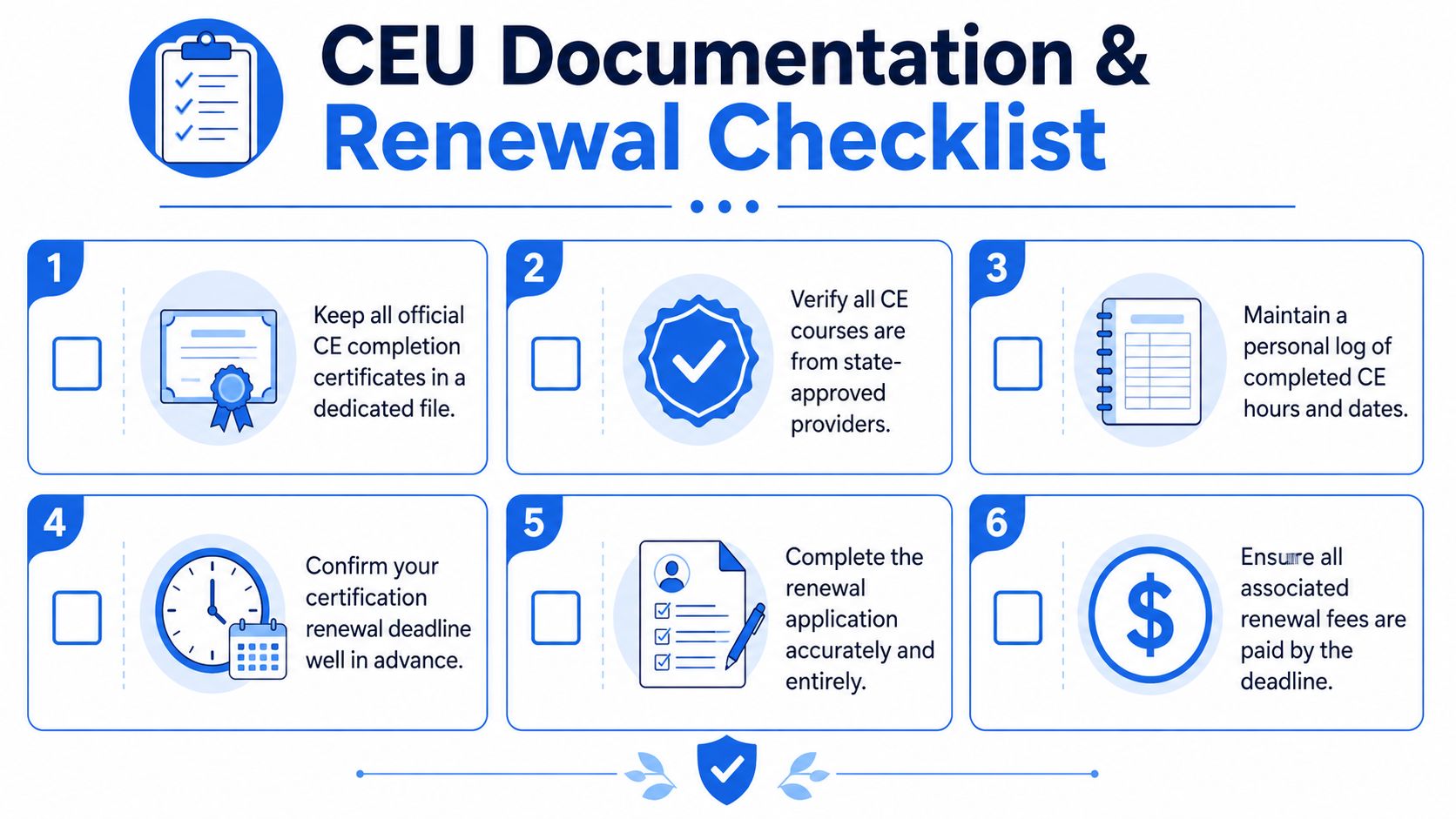
Your renewal file should include
Create one digital folder for each renewal cycle. Inside it, save:
- Completion certificates: Keep the official certificate from every approved course.
- A simple course log: Record the course title, provider, completion date, and hours earned.
- State-specific notes: Save a screenshot or PDF of your state rules at the time you completed the courses.
- Renewal submission records: Keep confirmation emails, form copies, or payment receipts if applicable.
That folder can live in cloud storage, on your computer, or both. The important part is consistency.
A low-stress renewal checklist
When renewal time gets close, run through this list:
- Confirm your deadline: Don't rely on memory.
- Check your hour totals: Make sure the numbers line up with your state's timing rules.
- Review topic requirements: If your state names required content, verify you met it.
- Match certificates to your log: Small errors are easier to fix before submission.
- Submit early if possible: Early submission gives you time to correct a mistake.
Some states require you to report completed CE directly on a renewal form or through an online portal. Others rely on record retention unless you're audited. Either way, your safest move is to behave as if you'll need to prove everything.
A well-kept digital file turns renewal from a stressful event into a routine task.
Common Nursing Assistant CEU Questions
Can one long course cover my whole renewal period
Sometimes a long course can cover a large share of your hours, but it may not satisfy everything by itself. Some states spread requirements across time, not just total hours. If your state expects annual completion patterns or specific topics, one course may leave gaps.
If I work in more than one state, do I need separate CE
You may. Multi-state work creates some of the most confusing CE situations because each state can define acceptance, timing, online limits, and required topics differently. Don't assume one certificate package will satisfy every state automatically. Compare each state's rules directly.
Does my employer's in-service training automatically count
Not always. Employer training can count when it aligns with required subject matter and is documented properly. If your facility offers in-service education, ask two questions: Is this training accepted for renewal in my state, and will I receive proof I can keep?
Are online courses really valid for nursing assistant continuing education
Yes, when they fit your state's approval rules. Online CE is part of modern compliance, not a shortcut. The key is choosing approved or appropriately accredited coursework and keeping your records organized.
What if I'm close to my deadline and still missing hours
Start by checking your exact remaining requirement, including any topic-specific rules. Then choose approved courses you can complete quickly and document right away. Don't wait for the perfect package. Get compliant first, then improve your system for the next cycle.
What's the smartest way to avoid CE stress next time
Treat CE like a monthly or quarterly habit instead of an end-of-cycle event. A small amount of planning, one reliable tracking method, and prompt certificate storage usually solve most of the problem.
If you want a simpler way to handle healthcare education online, take a look at ProMed Certifications. It offers online courses and certifications for healthcare professionals in a format that fits busy schedules, which can make ongoing learning and recordkeeping much easier to manage.
.avif)
Stay compliant with ProMed+
Certifications included: ACLS, BLS, PALS, CPR & Neonatal Resuscitation
Unlimited continuing education: over 200 hours of accredited CME
All-inclusive: One price. No surprises.
Get certified today

The Advanced Cardiac Life Support (ACLS) is an accredited online medical certification course that teaches medical professionals to respond to nearly all cardiopulmonary emergencies.

The Pediatric Advanced Life Support (PALS) Recertification instructs medical professionals on performing pediatric cardiopulmonary resuscitation in emergencies.

The Basic Life Support (BLS) Recertification is intended to teach healthcare professionals the basic steps of CPR and rescue breathing for adults, children, and infants.

Our online medical certification course for CPR, Automated External Defibrillator (AED), and First Aid is designed to teach adult, child, and infant CPR and AED use.

The Neonatal Resuscitation Certification trains medical professionals in performing resuscitation procedures and life-saving techniques for newborns at the time of delivery.

.png)
.png)
.png)