


ACLS Meaning: What It Is and How to Get Certified
ACLS stands for Advanced Cardiac Life Support, also called Advanced Cardiovascular Life Support by the AHA, and it's a standardized set of emergency protocols for cardiac arrest and related cardiovascular crises. In the United States, out-of-hospital cardiac arrest has been reported at more than 350,000 cases, with 46.1% of bystanders providing CPR and overall survival around 12%. That's why ACLS exists, to turn chaotic minutes into organized, life-saving action.
If you landed here wondering whether ACLS means the knee ligament, the answer is no. In healthcare, ACLS is about resuscitation, rhythm recognition, defibrillation, airway support, IV access, and emergency drugs, not orthopedics or network security. Once you know which meaning applies, the rest of the topic becomes much easier to follow.
What Does ACLS Stand For and Mean
ACLS means Advanced Cardiac Life Support. The American Heart Association also uses the broader branding Advanced Cardiovascular Life Support, but the meaning in clinical practice stays the same, a structured emergency framework for adult resuscitation and peri-arrest care.
That acronym causes real confusion because ACL can also mean the anterior cruciate ligament, and in networking it can mean an access control list. If you were looking for the knee ligament or a firewall rule set, this isn't the right page. If you're in healthcare, though, ACLS is the language of code response, rhythm checks, and rapid intervention.
Practical rule: if the conversation is about CPR, defibrillation, or emergency medications, ACLS is the right meaning.
ACLS is not a single action. It's a protocol stack, a coordinated sequence of skills that helps teams move from recognition to treatment without wasting time. In that sense, it's more like a checklist built for high-pressure moments than a standalone “advanced” badge.
The AHA's ACLS course is designed for those critical moments, including cardiac arrest, stroke, and acute coronary syndromes, where delays can quickly change the outcome. For a plain-language companion list of the common terms you'll hear around the course, see the ACLS acronym guide. Once you understand that ACLS is a system, not a single maneuver, the rest of the certification starts to make sense.
Who Needs ACLS and Why It Was Created
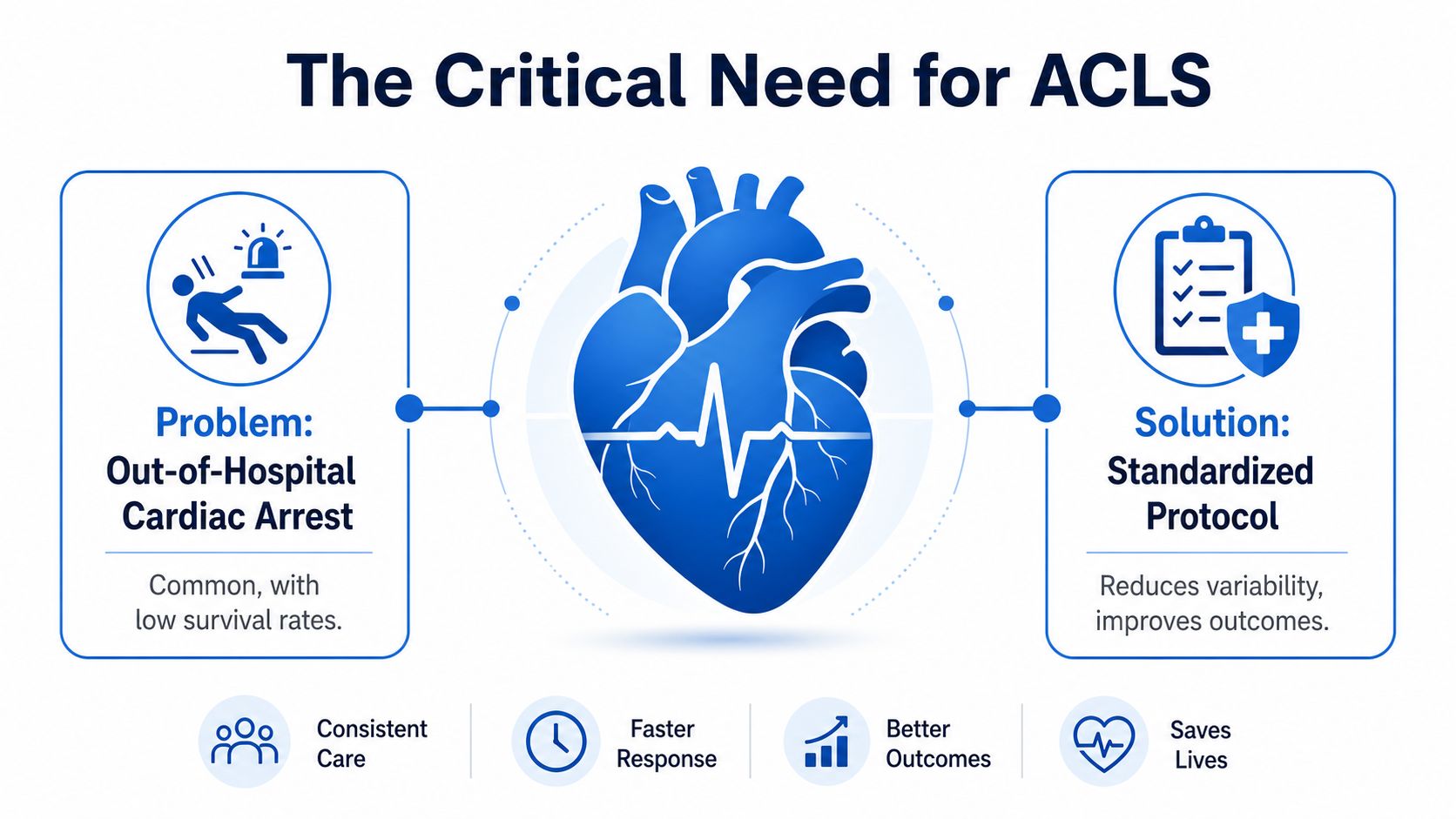
ACLS grew out of a very real problem. Cardiac arrest happens fast, survival is low, and outcomes depend on whether the team can recognize collapse, start CPR, defibrillate when appropriate, and move through the rest of the resuscitation steps without hesitation. That's why the ACLS framework was built, to reduce variation in care when seconds matter.
The historical evidence behind that design is striking. In a classic out-of-hospital cardiac arrest analysis using 611 cases, 15 of 22 patients with all four favorable predictors, witnessed arrest, ventricular fibrillation, lay CPR, and paramedic response under 4 minutes, were discharged alive, a 70% discharge rate. By contrast, only 1% of patients with the least favorable profile survived to discharge. Those numbers show why early recognition and fast response are central to ACLS, because the order and timing of actions matter as much as the actions themselves. (PubMed)
Who typically needs it
ACLS is most relevant for clinicians who may lead or join a resuscitation team. That often includes:
- Emergency physicians who manage unstable patients in the ED.
- Critical care and ICU nurses who respond to sudden deterioration.
- Paramedics and EMS clinicians who treat arrest and peri-arrest events in the field.
- Hospital-based respiratory and allied health staff who work in code situations.
- Other clinicians whose employer or board requires it for their role.
The exact requirement depends on the workplace, specialty, and local licensing rules. Some roles need ACLS on day one, while others use it as a preferred credential for higher-acuity care settings.
ACLS also builds on BLS, basic life support. It doesn't replace chest compressions, early ventilation, or team coordination, it assumes those skills are already in motion. If you want a role-based comparison of what certification fits where, this ACLS, BLS, and PALS overview helps sort it out.
ACLS Certification is one modern way clinicians complete the coursework and receive a card on a schedule that fits a busy shift life. For some teams, that convenience matters because certification work has to fit between patient care, not interrupt it.
Core Skills and Protocols in ACLS
Think of ACLS like a cockpit checklist. The pilot doesn't stop to improvise every step under pressure, the crew follows a sequence that compresses decision time and reduces error. ACLS works the same way in a code, especially when a team is trying to move from recognition to intervention without drifting off course.
What the protocol stack actually includes
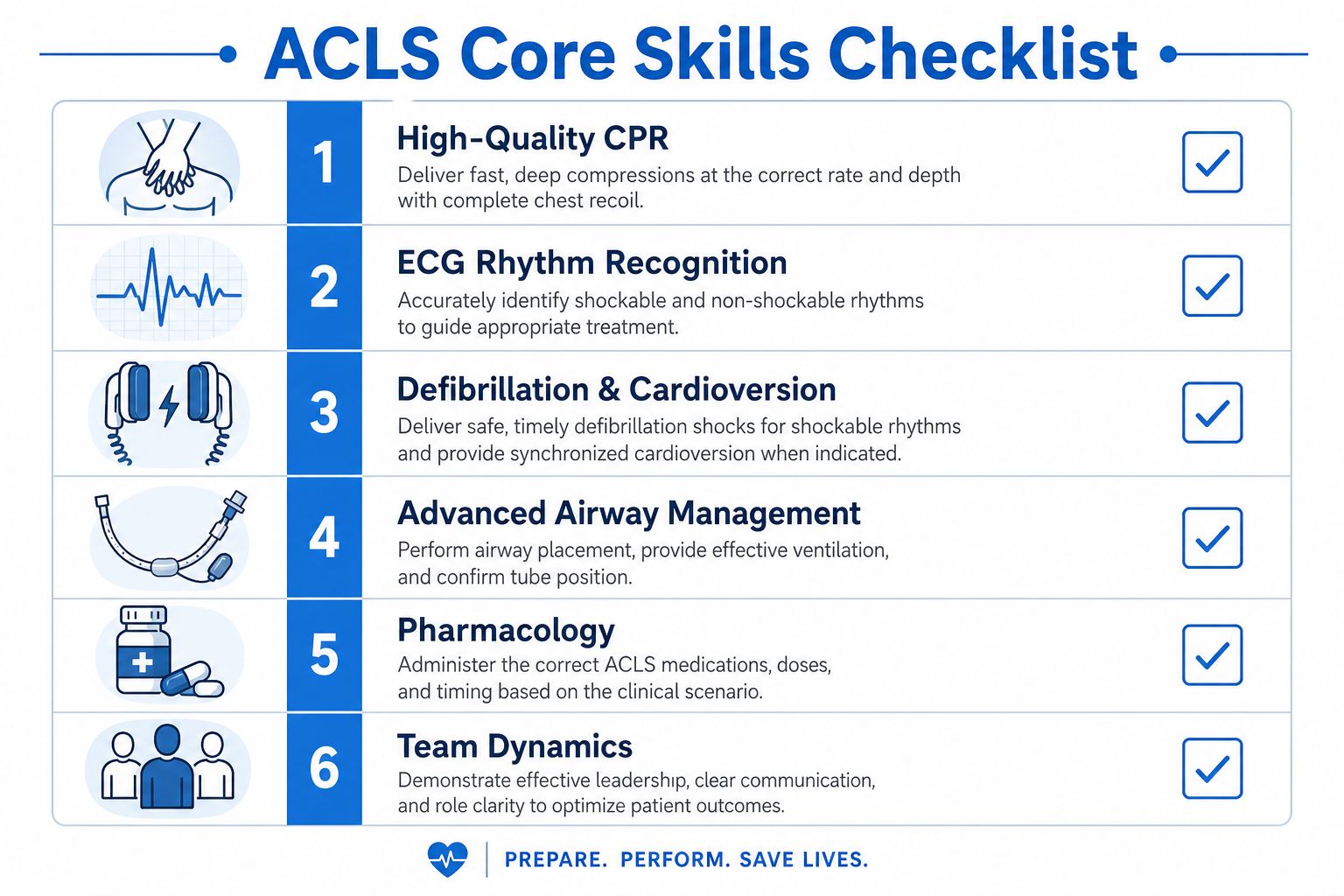
ACLS trains clinicians to do the things that change the next few minutes:
- High-quality CPR, with strong compression depth, rate, and minimal interruptions.
- ECG rhythm recognition, so you can tell the difference between VF, pulseless VT, PEA, asystole, bradycardia, and tachycardia.
- Defibrillation and synchronized cardioversion, used when the rhythm calls for an electrical intervention.
- Advanced airway management, including intubation and supraglottic devices when ventilation is failing.
- IV and IO access, so fluids and drugs can get in quickly.
- Emergency pharmacology, such as epinephrine, amiodarone, and adenosine, used according to the rhythm and clinical state.
Each skill connects to a real moment. A witnessed arrest calls for immediate compressions and rhythm analysis. A shockable rhythm demands fast defibrillation. Symptomatic bradycardia may require pacing and medication support. Post-ROSC care shifts the focus from restarting circulation to stabilizing it.
The point of ACLS isn't to make every clinician act the same way. It's to make the team respond in a coordinated way when the rhythm tells a different story than the vitals do.
A useful way to think about rhythm work is to pair ACLS with a disciplined pulse check and a clean mental picture of perfusion.
Inventory matters because ACLS is not “advanced” just by title. It's advanced because it asks you to recognize patterns, choose the next intervention, and keep the team moving under pressure.
How ACLS Differs from BLS and PALS
BLS, ACLS, and PALS belong to the same family, but they're not interchangeable. The simplest way to sort them is by audience, scope, and skill depth.
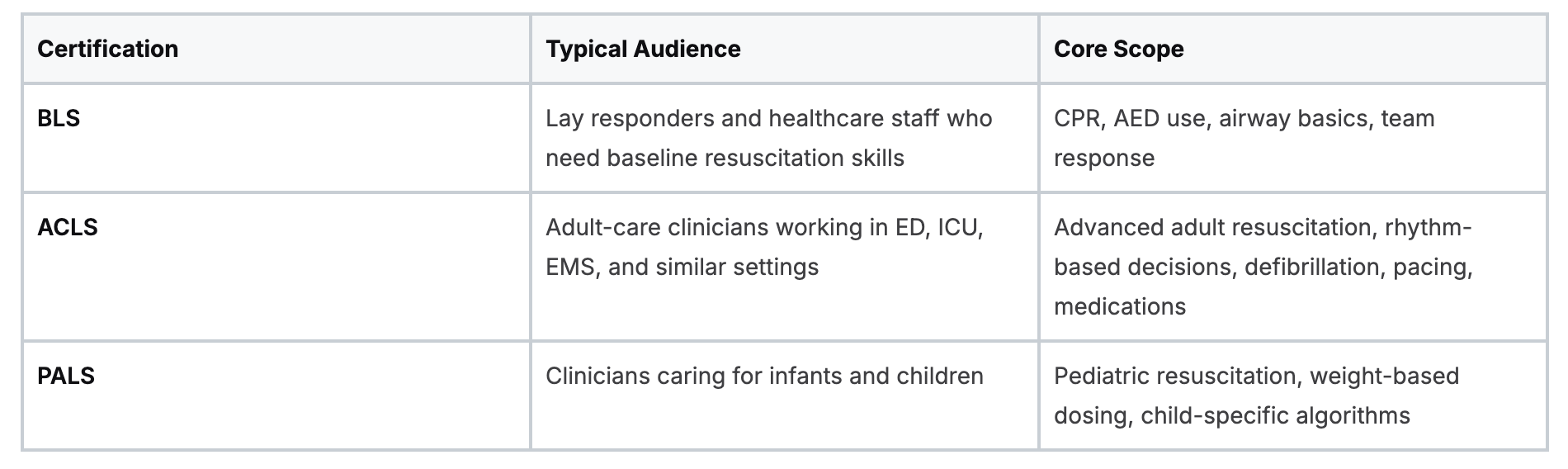
BLS is the foundation. It covers the first actions any responder should know, especially compressions, AED use, and ventilation support. ACLS sits on top of that base and assumes you already understand how to start resuscitation and work in a team.
PALS uses the same overall logic as ACLS, but it adapts the approach to pediatric physiology. That means weight-based dosing, child-centered assessment, and algorithms that reflect infant and child emergencies rather than adult ones.
Plain-language difference: BLS gets the response started, ACLS sharpens the response for adult critical events, and PALS does the same for children.
The key nuance many beginners miss is that ACLS depends on BLS. It doesn't replace the basics. If chest compressions aren't high quality, or if the team can't keep the airway and circulation moving, advanced steps won't help much.
For a side-by-side explanation of how those pathways fit together, this ACLS versus BLS breakdown gives a useful deeper comparison. If you're choosing a certification for your current role, the right question isn't “Which one sounds harder?” It's “Which one matches the kind of patient I'm expected to help?”
Certification, Recertification, and Course Format Options
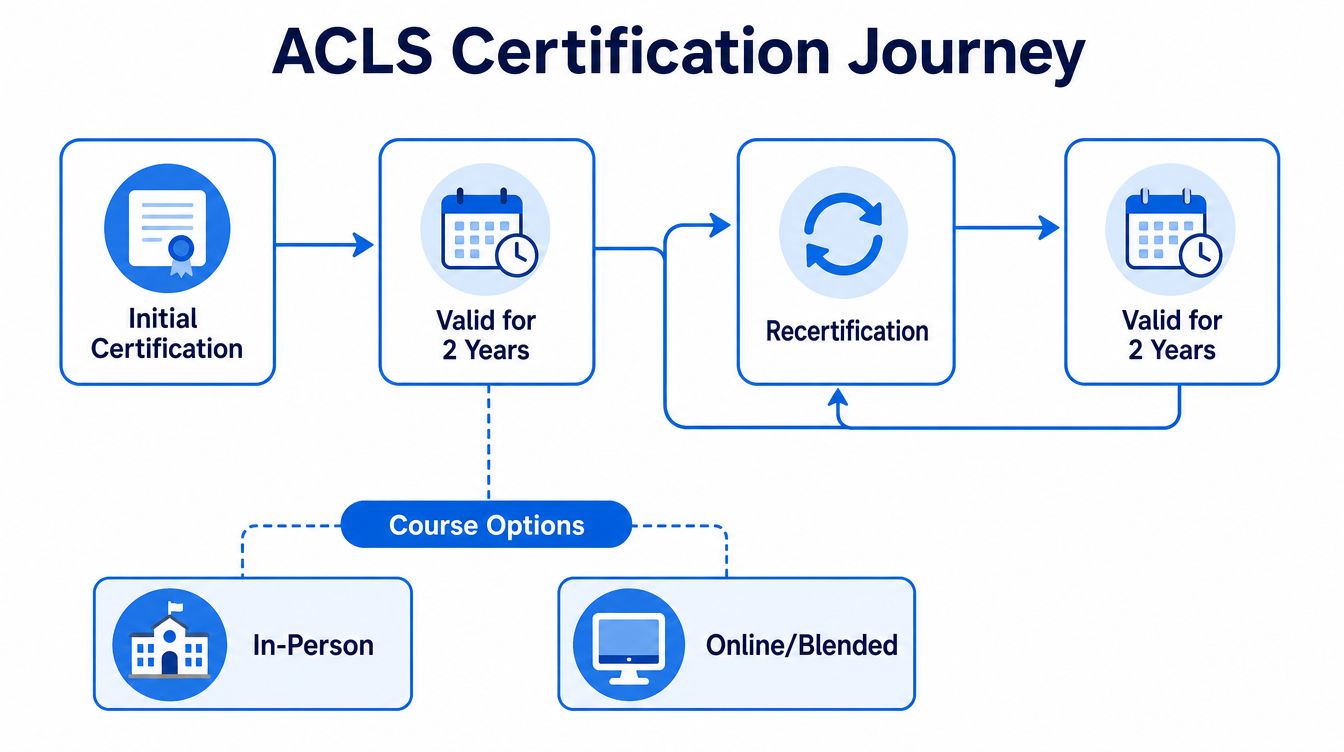
ACLS certification is typically treated as a two-year cycle, and renewal follows the same rhythm. First-time certification and recertification both cover the same AHA science, so the difference is usually your starting point, not the standard of training. That matters because the card is about current competence, not just having passed once before.
The format choice is broader than many people think. The AHA offers two training methods, HeartCode blended learning and classroom training, and says both formats teach the same American Heart Association science and result in the same ACLS Course Completion Card. That makes the format a matter of schedule, access, and learning style, not of legitimacy.
How the common formats differ
- In-person classroom training gives you live instructor interaction and a shared skills environment.
- Blended learning lets you complete the cognitive portion online and then finish the skills check as required.
- Fully online programs with a separate skills session are often chosen by clinicians who need flexibility and don't want to lose time to a fixed class date.
Recent evidence supports that flexibility. A 2018 systematic review in BMJ Open found that for health-profession education, e-learning was comparable to no intervention and to traditional learning across knowledge, skills, behavior, and patient outcomes in many studies, and it often improved convenience and standardization. A 2023 systematic review and meta-analysis in The Lancet Digital Health concluded that digital education can be effective across outcomes, with some studies showing non-inferior or sometimes superior results depending on the setting and skill. Those findings back up what many clinicians already experience, online learning can be just as effective as in-person training when the program is built well.
If you're organizing your credentials, it also helps to know where documentation belongs on a resume or profile. This resume placement guide is useful when you're listing recertification dates and course names clearly.
ProMed Certifications also offers an online ACLS route that fits the same modern model of access and schedule control, with a course flow designed around self-paced completion. The practical point is simple, format choice should help you finish, not force you into a rigid calendar that doesn't fit clinical life. For a broader look at course pathways, see the available ACLS, BLS, and PALS options.
The Online vs In-Person ACLS Myth
A lot of clinicians still hear that only in-person classes from the AHA or Red Cross count. That belief is outdated. Accredited online and blended ACLS education is now accepted in many hospitals, clinics, EMS systems, and group healthcare organizations, because the question has shifted from where you sat to whether the training meets the right standard.
The evidence base supports that shift. The 2018 BMJ Open systematic review found that e-learning in health-profession education was comparable to traditional learning across several learner outcomes in many studies, and the 2023 Lancet Digital Health meta-analysis found digital education can be effective, with some outcomes showing non-inferior or even superior results depending on the context. That lines up with what institutions want, reliable content, consistent delivery, and training that busy clinicians can complete without losing clinical coverage.
Why acceptance is expanding
Hospitals and clinics aren't just buying convenience. They're responding to a training model that can standardize science, reduce scheduling friction, and make it easier for staff to stay current. In practice, online ACLS is often attractive because it fits night shifts, rotating schedules, and recertification deadlines better than a fixed classroom date.
Bottom line: online doesn't mean lesser, it often means more accessible, and the quality depends on the curriculum and accreditation, not the room you're sitting in.
That is the reason the industry is moving. Medical employers want compliance, but they also want people to complete the course on time. A well-designed online ACLS program can support both, especially when it uses the same science and leads to the same completion outcome as the classroom pathway.
What ACLS Means for You and How to Get Started
ACLS means you're learning a protocol-driven response system for adult emergencies, not collecting a title. It works best when it sits on top of solid BLS habits, clean rhythm recognition, and calm teamwork. In real practice, ACLS doesn't override judgment, it gives your team a sharper way to act when the patient's condition is changing minute by minute.
A simple way to move forward is to check four things:
- Confirm your role requirement. See whether your employer, specialty, or board expects ACLS.
- Choose the right format. Pick in-person, blended, or online based on your schedule and the way you learn best.
- Decide on initial certification or renewal. Your starting point changes the course path, not the standards.
- Plan for the renewal cycle. Keep the two-year rhythm in mind so you're not scrambling near the deadline.
The modern reality is that online CE and certification options are part of how healthcare education works now. They're accessible, flexible, and widely used by busy clinicians who still need strong, current training. That's why ProMed Certifications fits naturally into this conversation, it provides an online path for clinicians who want to complete ACLS on a schedule that matches real clinical life.
If you're ready to turn the meaning into action, choose the format that fits your week and get started with your ACLS course. A clear, current credential helps you stay ready for the code cart, the monitor, and the moments when the team needs a steady hand.
ProMed Certifications offers online ACLS, BLS, PALS, CPR, and other healthcare certification options built for busy schedules and self-paced completion. If you want a flexible way to stay current without giving up quality, visit ProMed Certifications and choose the course path that fits your role.
.avif)
Stay compliant with ProMed+
Certifications included: ACLS, BLS, PALS, CPR & Neonatal Resuscitation
Unlimited continuing education: over 200 hours of accredited CME
All-inclusive: One price. No surprises.
Get certified today

The Advanced Cardiac Life Support (ACLS) is an accredited online medical certification course that teaches medical professionals to respond to nearly all cardiopulmonary emergencies.

The Pediatric Advanced Life Support (PALS) Recertification instructs medical professionals on performing pediatric cardiopulmonary resuscitation in emergencies.

The Basic Life Support (BLS) Recertification is intended to teach healthcare professionals the basic steps of CPR and rescue breathing for adults, children, and infants.

Our online medical certification course for CPR, Automated External Defibrillator (AED), and First Aid is designed to teach adult, child, and infant CPR and AED use.

The Neonatal Resuscitation Certification trains medical professionals in performing resuscitation procedures and life-saving techniques for newborns at the time of delivery.

.png)
.png)
.png)