


Fowler Position Bed: A Practical Guide for Clinicians
.png)
You're in a room with a fresh post-op patient, a charge nurse is calling for Fowler's, and your hand pauses over the bed controls. The order sounds simple, but the choice between 30 degrees, 45 degrees, and 60 degrees changes how the patient breathes, how much pressure lands on the sacrum, and whether that patient slides into shear. A good bedside nurse doesn't guess here. A good bedside nurse reads the body, checks the task, and sets the angle with purpose.
That's the skill this guide builds. You'll learn how to choose the right Fowler position bed setup, how to support the body so the patient doesn't slide, and how to tell when Fowler's helps and when it adds risk. You'll also see why online CE and certification learning is now a practical, accepted way to keep that bedside judgment sharp, because the field keeps moving toward flexible, accredited options that fit real schedules.
A Quick Story From the Bedside
A new graduate gets a post-op patient on nights. The charge nurse says, “Put him in Fowler's.” The new grad looks at the bed controls and hesitates. Thirty degrees feels too flat. Sixty feels too upright. The patient is awake, a little short of breath, and still guarded from surgery, so the angle matters right away.
That pause is common. It's also where small mistakes start. If the bed is too low, the patient may struggle to expand the chest. If the head is too high without knee support, the patient can slide down and take shear across the sacrum. If the angle doesn't match the task, feeding, breathing, and comfort all change.
Practical rule: don't treat “Fowler's” like one fixed posture. Treat it like a range you match to the patient's breathing, procedure, and tolerance.
By the end of a shift like that, you want the decision to feel automatic. You should be able to choose the right Fowler variant, support the body correctly, document the actual angle, and spot the moments when another position is safer. That's the difference between knowing the term and using it well at the bedside.
What a Fowler Position Bed Actually Is
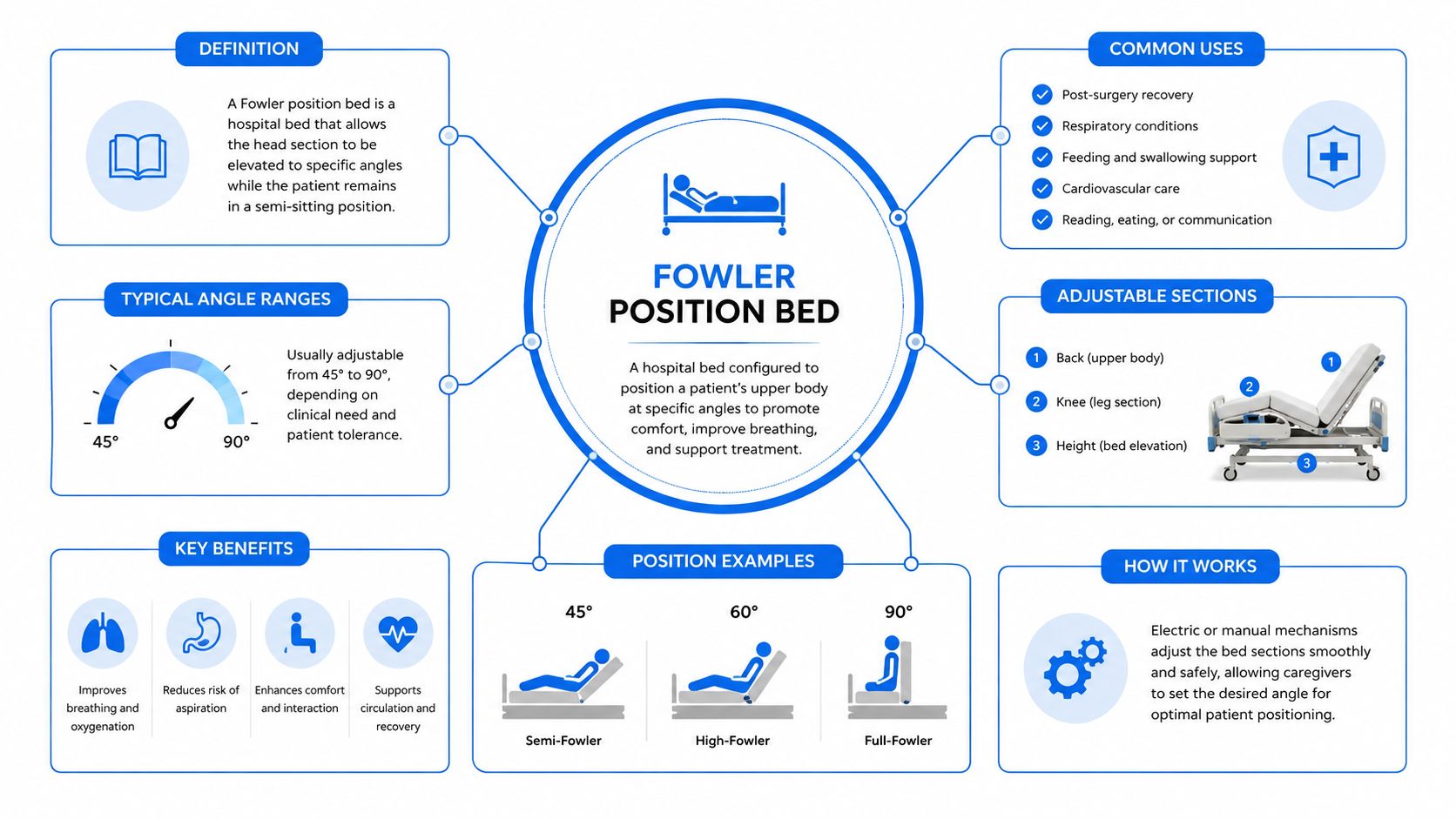
A Fowler position bed is a bed that lets you raise the head and upper torso while the patient stays supine. In plain language, the person is still lying on the back, but the upper body is lifted into a semi-upright posture, and the knees may stay straight or bend slightly. The position is named for George Ryerson Fowler, who published on the “elevated head and trunk posture” in 1900 to improve drainage in peritonitis, because positioning was already being used as treatment, not just comfort. Historic England's record shows how that drainage logic became part of modern postoperative care.
Think of the bed like an articulated recliner rather than a flat slab. The backrest lifts, the knee section can flex, and the frame is built to hold those changes safely. A published Fowler bed specification describes a dual-section perforated top with separate screw levers for the backrest and kneerest, which is a good reminder that this is a positioning tool, not just furniture.
What to notice in the hardware
A hospital-grade Fowler bed is usually built around a semi-articulating platform with independent back and knee sections. Published specifications show working loads around 180 kg to 225 kg, with many models able to raise the backrest to roughly 70° to 80°. Those details matter because the body's center of mass shifts when the head of the bed goes up, and the frame has to stay stable while that happens.
The basic idea is simple. The bed gives you the mechanical range, but the angle gives you the clinical effect. A bed can look the same from across the room and still behave very differently depending on whether it's set at low, semi, standard, or high Fowler's.
The Four Angles Every Nurse Should Know
A new nurse can hear “Fowler's” and miss the part that matters most, the angle. The patient's comfort, breathing effort, swallow safety, and pressure load all change as the head of the bed moves. Clinical references separate the posture into low Fowler's, semi-Fowler's, Fowler's, and high Fowler's, and each setting has a different bedside job. StatPearls describes Fowler's as one of the most common resting positions in inpatient and emergency settings, with the head of the bed typically between 45 and 60 degrees.
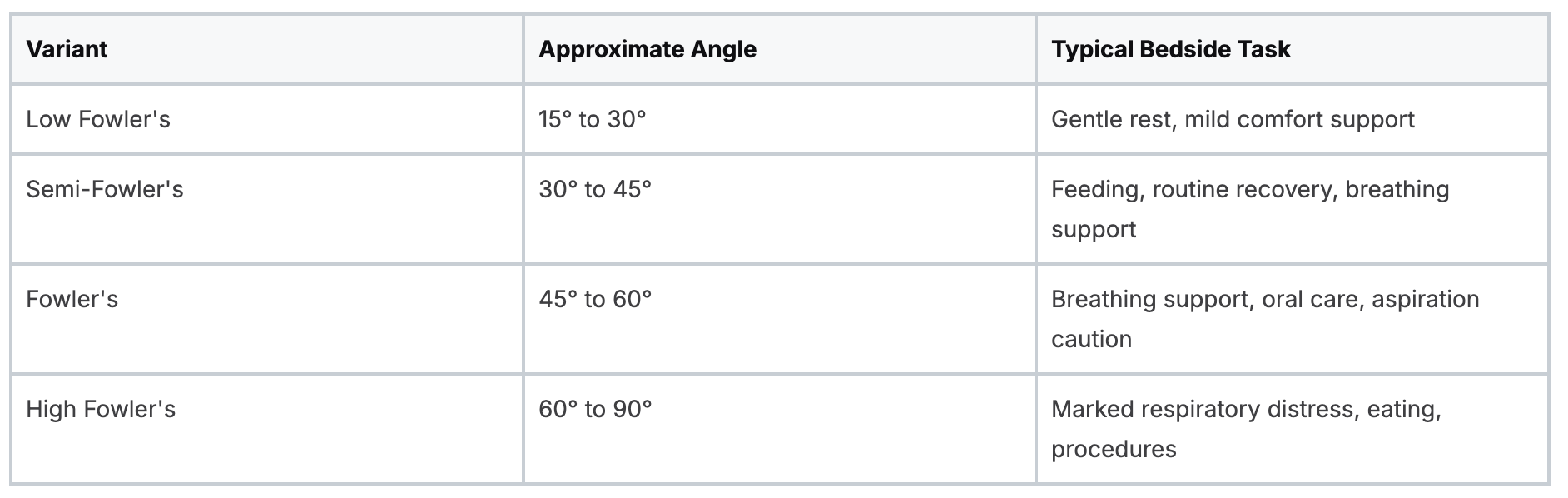
Low Fowler's keeps the torso only slightly raised. That small lift can ease comfort without asking much from the patient's core muscles or shifting too much weight onto the sacrum. Semi-Fowler's gives more lift and is often the practical middle ground for routine bedside care, especially when a patient needs to eat, recover, or rest with less abdominal pressure on the chest. ProMed Certifications' oxygen therapy administration guidance fits this same bedside logic, because breathing support often improves once the upper body is supported instead of lying flat.
Fowler's usually means the backrest is up enough to make a clear difference in breathing mechanics. At this angle, the diaphragm has more room to move, and oral care or swallow-related tasks are easier to manage with a patient who can sit more upright. High Fowler's is the steepest setting in this group. It is the closest to a sitting posture and is often chosen when the patient needs the most help with breathing, eating, or a procedure at the bedside.
How the angle changes the body
As the head of bed goes up, the diaphragm meets less abdominal pressure and the lungs have more room to expand. Breathing often feels easier for that reason. The trade-off is just as important. The steeper the angle, the more the patient may slide down the mattress, and the more pressure can build at the sacrum, coccyx, scapulae, and occiput.
That is why the angle has to match the task. A swallow check, tube feeding, or a patient with dyspnea each points to a different level of elevation. The nurse has to choose the setting that fits the job and still protect skin, alignment, and comfort. A charted angle is part of the intervention. “In Fowler's” alone is too vague when the body mechanics change with every 15-degree shift.
Why Clinicians Use Fowler's at the Bedside
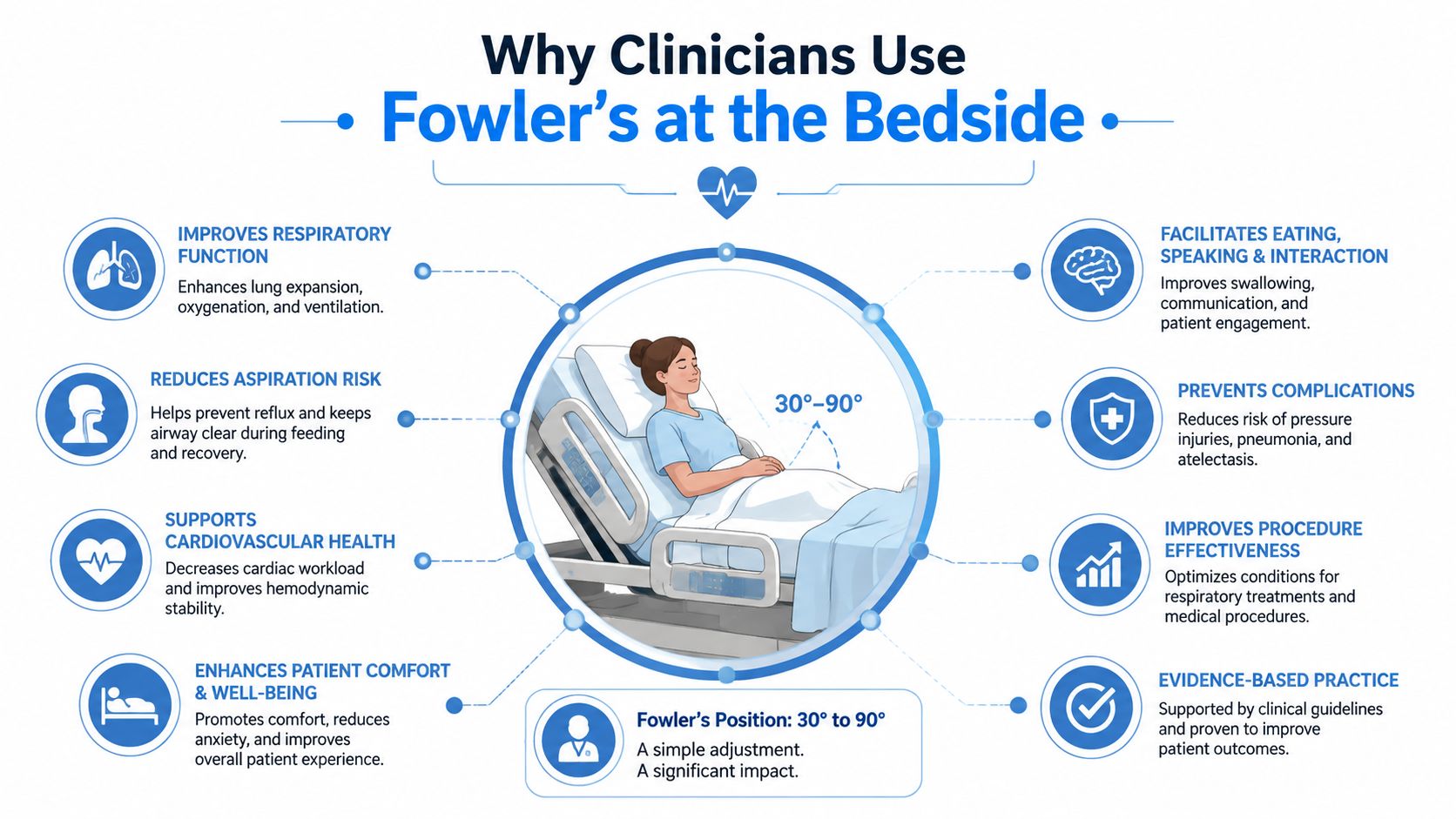
A bedside nurse reaches for Fowler's when the task needs the upper body supported and the patient still needs to stay aligned in bed. It helps with breathing, eating, recovery, and routine care without forcing the person fully flat. That makes it a practical choice in inpatient and emergency settings, where the bed has to adapt quickly to changing needs. Standard Fowler's usually sits in the 45 to 60 degrees range, so that is the posture many clinicians picture when they use the term.
Breathing is the first reason
When a patient is short of breath, raising the head of the bed reduces abdominal pressure on the diaphragm and gives the chest a little more room to expand. At the bedside, that often looks like a patient who can speak in fuller phrases, clear secretions with less strain, and rest without working so hard to breathe. Standard or high Fowler's usually helps more than a flat position when the main goal is respiratory support.
The angle matters. A low or semi-Fowler's setup may be enough for mild discomfort, while higher angles are often better when the patient needs more help moving air in and out. If you are matching positioning with respiratory care, the nursing guidance on oxygen therapy administration fits naturally with this same logic.
Feeding and aspiration risk are the second reason
Semi-Fowler's or a higher angle is the familiar setup for oral intake and enteral feeding because gravity helps keep material where it belongs. For the patient who tires easily, a moderate angle can protect the airway without asking the body to work as hard as full sitting. The position gives the swallow a little more safety margin, especially when the patient needs time, pacing, or extra supervision.
This is also where bedside judgment matters. A patient who can tolerate a stronger angle may do better with standard or high Fowler's, while another patient may need only a modest lift to reduce aspiration risk and keep the meal or tube feed comfortable. The right choice is the one that supports the task and the patient's endurance at the same time.
Recovery and comfort round it out
Post-op patients often tolerate Fowler's better than a flat bed because it eases abdominal tension and makes grooming, talking, and coughing less awkward. A patient after abdominal surgery may feel less guarded with a slight elevation than with a fully supine posture. That is why the same setup shows up so often in routine nursing care, not just in obvious breathing problems.
Comfort is not a small detail. When the torso is supported, the patient can often relax the shoulders, turn the head more easily, and participate in care with less grimacing. In that sense, Fowler's works like a bedside compromise. It gives the team access to breathing support, feeding safety, and post-op comfort without losing the ability to adjust the bed for the next task.
Risks and When to Avoid Fowler's
Fowler's is useful, but it's not universal. If the patient has a suspected spinal injury, keep the torso aligned and flat unless the provider has given a different order. If the patient is hemodynamically unstable or hypotensive, elevation can worsen perfusion. Recent abdominal or cranial surgery also demands that you follow the surgeon's exact angle instructions rather than defaulting to a standard posture.
The long-hold problem
The classic warning about Fowler's isn't that the position is bad. It's that the position becomes risky when it's held too long without support. A report cited by the Indian Medical Gazette notes that among hospitalized patients, 30% had thrombi in the calf veins, and the rate rose to 60% in patients confined to bed for more than two weeks. The same source warns that Fowler's, when maintained with a pillow behind the knees or with the soles pressing into the mattress, may promote thrombosis in those areas.
Pressure and shear are the other quiet problem. Once the head of the bed rises, gravity pulls the patient downward. The sacrum and coccyx take more load, the heels can dig in, and the shoulders and occiput can take extra pressure too. Without repositioning, Fowler's can be comfortable for a short period and irritating, or harmful, over time.
Bedside habit: if you keep Fowler's up, you owe the patient support, a skin check, and a plan to reassess. A raised backrest without follow-through is how comfort turns into breakdown.
Bedside Safety Checks Before You Crank the Bed
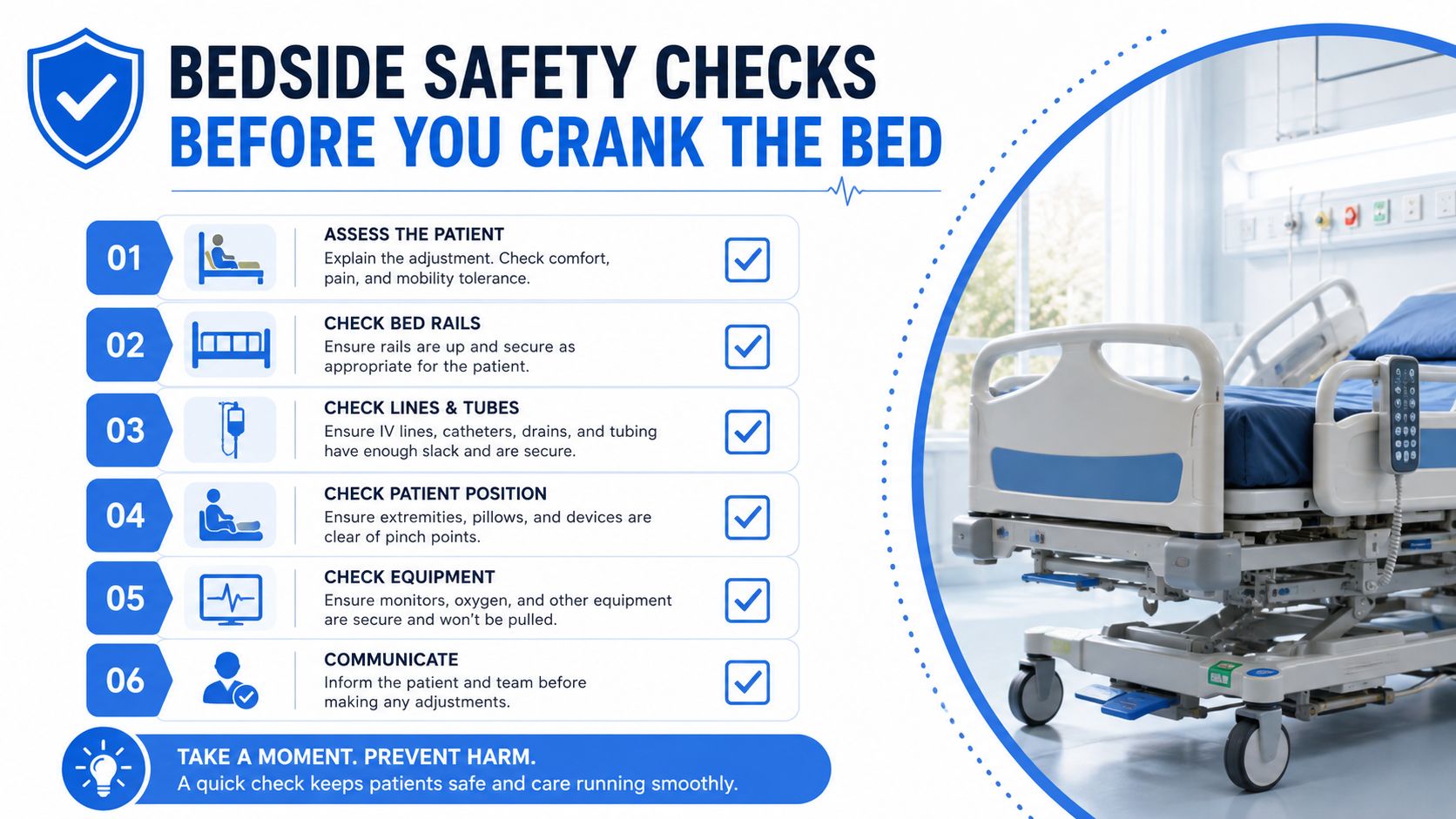
Start before the bed moves. Lock the wheels, lower the bed to a working height, verify the order, and tell the patient what you're about to do. That quick pause reduces fear, lets the patient help if they can, and gives you a chance to confirm the task before the angle changes.
The checks that prevent trouble
- Verify the angle: match the backrest and knee-rest setting to the ordered variant, not just the word “Fowler's.”
- Add support early: place pillows or supports under the head, arms, lower back, thighs, and ankles so the patient doesn't slide.
- Watch the lines: make sure tubing, drains, IV lines, and catheters have slack before you raise the bed.
- Check restraints carefully: if restraints are used, they should be appropriate and not over-tightened.
- Inspect tolerance: look at breathing, skin, and facial comfort before you walk away.
- Document the result: record the exact angle, the supports used, skin findings, and any concerns you escalated.
If you're reviewing broader positioning habits for safe patient handling, the nursing guide on BLS basics and positioning best practices fits well here. For physicians who need continuing education alongside bedside practice, ProMed+ Physician CME provides a fully online option with over 200 AMA PRA Category 1 Credits™ and a streaming library designed for licensure requirements.
Modifications for Special Populations
Bariatric patients need extra attention to the working load and the width of the support surface, because sliding becomes more likely when the torso rises. Geriatric patients often do better at semi-Fowler's with firm lumbar support and frequent small shifts, since high angles can fatigue them quickly.
Pediatric patients still use the same angle language, but their body proportions and supports are different, so airway protection stays the main concern. For intubated or post-surgical patients, the bed angle has to fit the ventilator plan, sedation level, and surgical-site protection, which is why team coordination matters. If you need a broader respiratory cross-check, the discussion of CPAP and CHF connects well with upright positioning and breathing support.
Putting It All Together at the Bedside
Use the angle, not the label. Match low, semi, standard, or high Fowler's to the task, add support before the patient starts to slide, and screen for the times when flat alignment or a different posture is safer. Confirm, position, inspect, and document. Then move on knowing the bed did what you intended.
ProMed Certifications offers accredited online courses for nurses and other healthcare professionals who need flexible renewal and skills review. If you want to reinforce positioning, documentation, and bedside judgment with current training, visit ProMed Certifications and choose the course that fits your schedule.
.avif)
Stay compliant with ProMed+
Certifications included: ACLS, BLS, PALS, CPR & Neonatal Resuscitation
Unlimited continuing education: over 200 hours of accredited CME
All-inclusive: One price. No surprises.
Get certified today

The Advanced Cardiac Life Support (ACLS) is an accredited online medical certification course that teaches medical professionals to respond to nearly all cardiopulmonary emergencies.

The Pediatric Advanced Life Support (PALS) Recertification instructs medical professionals on performing pediatric cardiopulmonary resuscitation in emergencies.

The Basic Life Support (BLS) Recertification is intended to teach healthcare professionals the basic steps of CPR and rescue breathing for adults, children, and infants.

Our online medical certification course for CPR, Automated External Defibrillator (AED), and First Aid is designed to teach adult, child, and infant CPR and AED use.

The Neonatal Resuscitation Certification trains medical professionals in performing resuscitation procedures and life-saving techniques for newborns at the time of delivery.

.png)
.png)
.png)