


Oxygen Therapy Administration: A Clinical Guide
.png)
You're on the ward, the monitor alarms, and a patient's saturation is slipping. Someone reaches for oxygen right away. That instinct is often right, but the next question matters just as much: how much oxygen, through which device, and to what target?
That's where oxygen therapy administration becomes a clinical skill rather than a reflex. New residents often learn the hardware quickly. The harder part is the judgment. A nasal cannula, a simple mask, or a reservoir mask can all be appropriate, but only if they match the patient in front of you.
If you think of oxygen as “just air,” it's easy to overdo it. If you think of it as a drug with an indication, dose, target, and side effects, your decisions become safer and more precise.
Why Precise Oxygen Delivery Matters
At 2 a.m., two patients may both show an SpO2 of 88%, yet one needs a small, careful increase in oxygen and the other may need a very different target altogether. That is the part of ward care that trips up new clinicians. The number alone does not tell you how aggressively to treat, how tightly to control delivery, or when extra oxygen may create a new problem.
Precise oxygen therapy administration starts with a simple habit: prescribe oxygen to a target, not to a feeling of urgency. In real practice, the gap between guideline and bedside behavior often appears here. A patient after cardiac arrest, a patient with COPD, and a previously healthy patient with pneumonia can all become less safe if oxygen is given generously without a clear endpoint.
Oxygen is a medication, not a default
Oxygen saves lives, but it still needs a dose, a route, and reassessment. The same way you would not write “give fluids” without deciding how much and why, you should not apply oxygen without deciding what saturation range you want and what risk you are trying to avoid.
A useful teaching line for interns is this: oxygen should be ordered with the same discipline as insulin or a vasopressor. You need the right patient, the right amount, and follow-up to see whether the treatment is helping or overshooting.
Patients with clear clinical features of low oxygen levels may need immediate support, especially if they are confused, cyanotic, or working hard to breathe. If you need a quick refresher on clinical features of hypoxia, review them before you rely on the pulse oximeter alone. The treatment goal is adequate oxygenation for that specific patient, not the highest saturation the monitor can display.
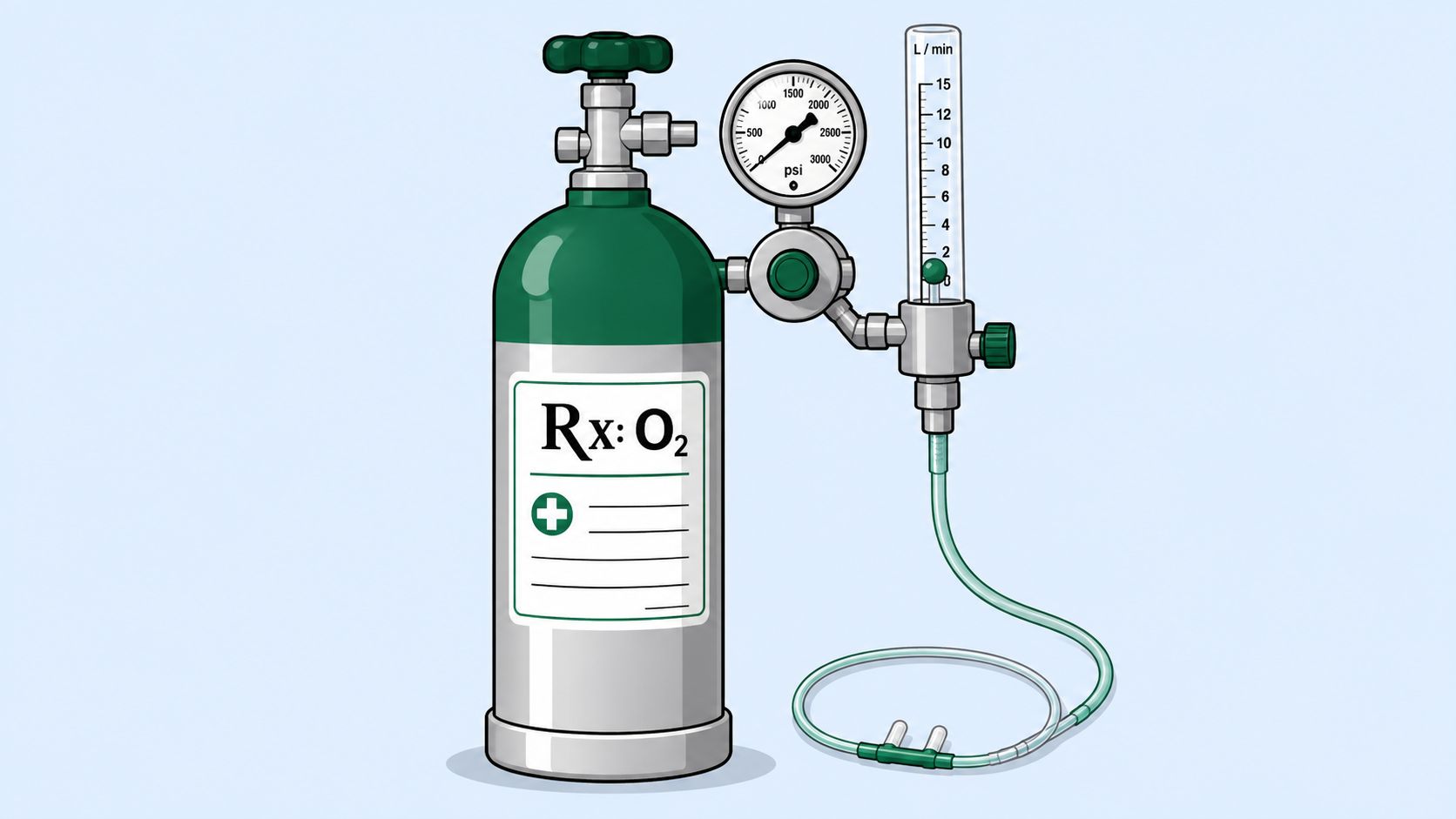
Why “more oxygen” can backfire
New residents often assume a higher flow rate adds a margin of safety. On the ward, that shortcut can mislead you.
Too little oxygen leaves tissues under-supplied and puts organs at risk. Too much oxygen can produce hyperoxemia, and hyperoxemia is not harmless. Excess oxygen can worsen outcomes in some settings, particularly when tight control matters, such as post-cardiac arrest care or in patients at risk for carbon dioxide retention.
That is why target ranges matter. In a patient with COPD, for example, pushing the saturation well above the intended range can contribute to rising carbon dioxide and a slower recognition of clinical decline. In a patient recovering from cardiac arrest, indiscriminate high oxygen exposure may work against the neurologic recovery you are trying to protect. The lesson is practical. The “best” SpO2 is the one that meets the patient's physiologic need without drifting into avoidable excess.
Practical rule: Aim for the correct SpO2 target for the patient in front of you, then adjust deliberately to stay there.
Precision is part of routine care
Oxygen often gets added during a hectic moment, then left running as the shift moves on. That is where trouble starts. A liter flow that was appropriate during transport may be unnecessary an hour later. A non-rebreather applied in distress may need to be stepped down once the patient stabilizes. If no one revisits the order, temporary support turns into unexamined treatment.
Experienced clinicians build a short mental checklist. What is the target saturation? Has the patient reached it? Is the current device giving more control or less than this situation requires? Does this diagnosis call for tighter titration than usual?
That approach improves safety because it closes the gap between “oxygen started” and “oxygen managed.” On the ward, that difference is where good technique becomes good clinical judgment.
Matching the Patient to the Device
It is 2 a.m. on the ward. One patient is talking comfortably with an SpO2 a little below target. Another is upright, anxious, and using every accessory muscle to breathe. Both “need oxygen,” but giving them the same device would miss the fundamental clinical question. How much oxygen does this patient need, and how precisely do you need to deliver it?
That is the habit to build early. Device selection is not just about what is nearby or what usually works. It is about matching the interface to the patient's physiology, the pace of illness, and the risk of overshooting the target in groups such as COPD or post-cardiac arrest patients.
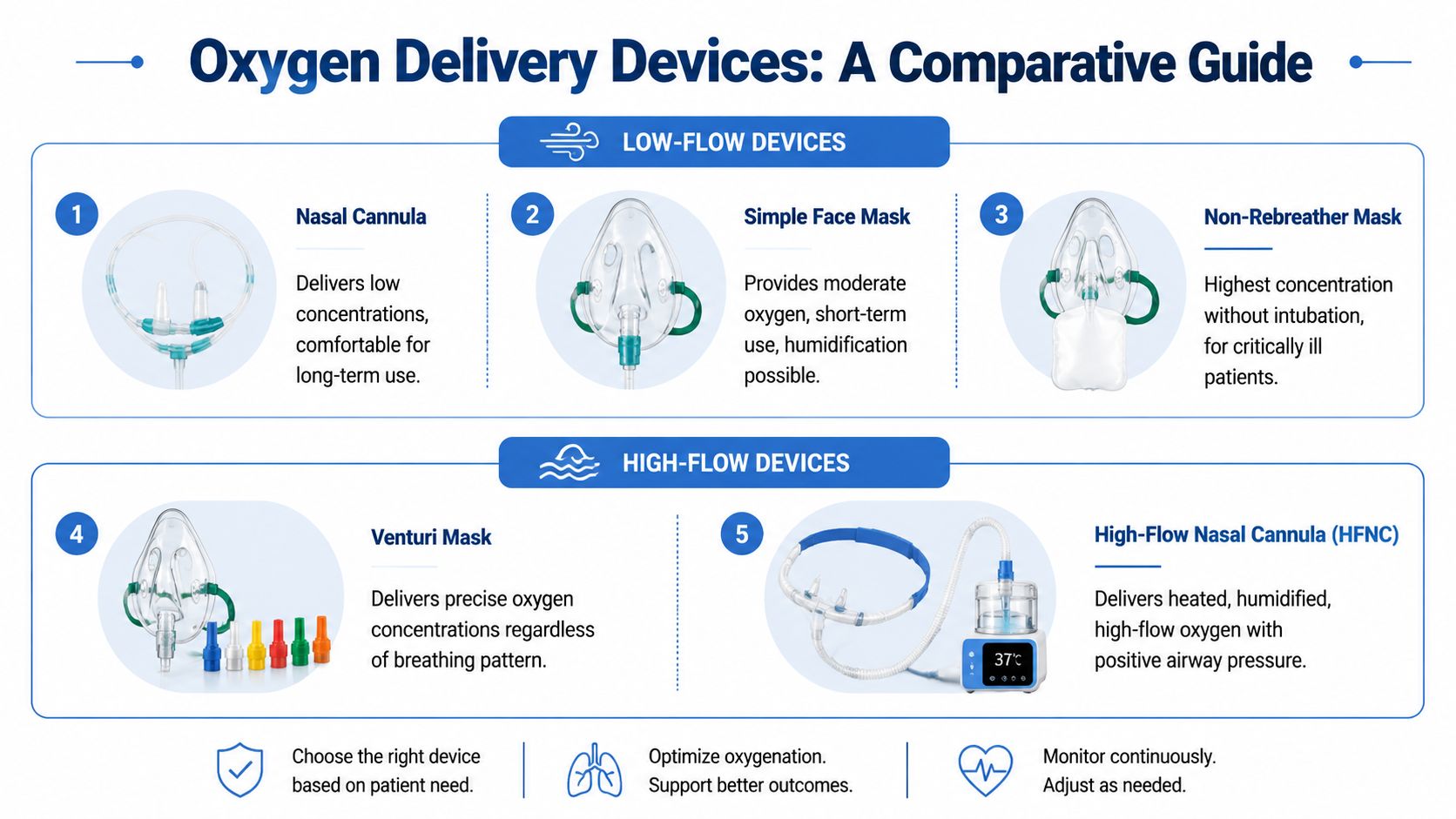
Start with the clinical picture, then choose the device
A useful bedside question is simple: do you need modest support, rapid rescue, or tight control?
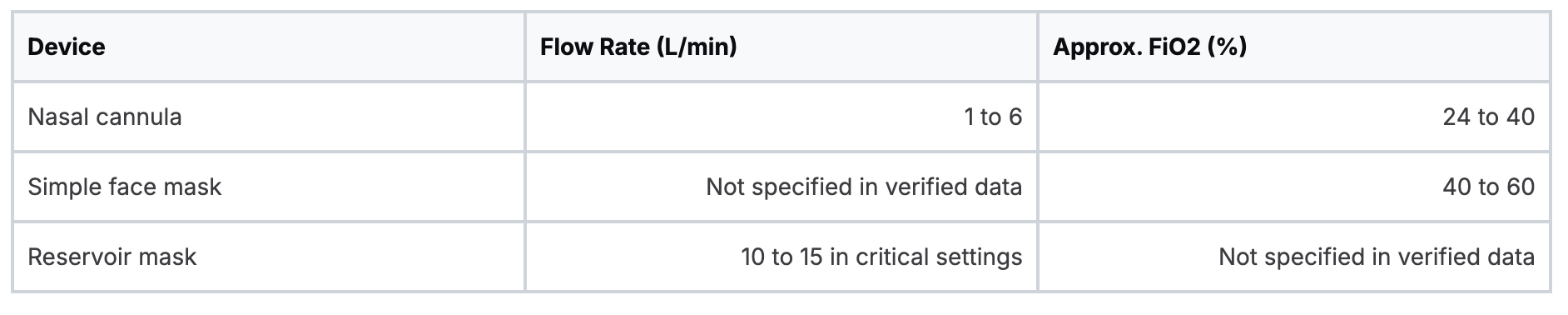
The nasal cannula is the usual starting point for mild hypoxemia in a stable patient. According to the British Thoracic Society emergency oxygen guidance, nasal cannulas deliver an approximate FiO2 of 24% to 40% at 1 to 6 L/min. Patients usually tolerate them well, and they can still eat, talk, and clear secretions without much interruption.
The simple face mask increases delivered oxygen when a cannula no longer meets demand. It can provide roughly 40% to 60%. Use it for the patient who needs more than low-flow nasal support but does not yet need the highest concentration available.
If you are deciding whether a patient is still compensating or is crossing into a more dangerous pattern, this review of respiratory distress versus respiratory failure is a practical refresher.
Here is a quick bedside summary.
Use high-concentration devices for severe hypoxemia
A reservoir mask belongs in the first-response category. If the patient is cyanotic, exhausted, or has marked hypoxemia, this device gives you high-concentration oxygen quickly while you assess, call for help, and prepare for the next step in respiratory support.
At the bedside, it helps to view the first device as a bridge. You are buying time and improving oxygenation while you gather better information. A low-flow device in a crashing patient delays correction. A high-concentration device in a stable patient may be more than the situation requires.
A short demonstration can help cement what these interfaces look like in practice.
Precision devices matter in the patients you can hurt by overshooting
New residents often learn the basic ladder of cannula, mask, reservoir mask. The harder lesson is knowing when “more oxygen” is not the safest answer.
Venturi masks are useful when you need a set oxygen concentration rather than a rough estimate. That makes them especially helpful in patients at risk from over-oxygenation, including those with known or suspected hypercapnic respiratory failure. In those cases, precision is the point.
High-Flow Nasal Cannula, or HFNC, fills a different role. It delivers heated, humidified oxygen at high flow and can improve comfort while providing more support than standard low-flow systems. On many wards and step-down units, it serves patients who need close observation and substantial oxygen support without immediate escalation to more invasive therapy.
A practical way to remember the choices:
- Use a nasal cannula for mild oxygen needs in a stable patient.
- Use a simple face mask when the patient needs more oxygen than a cannula can reliably provide.
- Use a reservoir mask for severe hypoxemia and urgent correction.
- Use a Venturi mask when the target must be controlled carefully.
- Use HFNC when the patient needs high-flow, humidified support with close reassessment.
Monitoring supports that precision. Pulse oximetry helps, but only if you interpret it in context.
The practical takeaway is straightforward. The best device is the one that gets the patient to the correct saturation target safely, with enough control for the diagnosis in front of you. On a busy ward, that is where guideline knowledge turns into careful oxygen administration.
The Art of Titration and Monitoring
A new resident gets called to the ward for a patient whose saturation has fallen into the low 80s. Oxygen goes on, the monitor climbs, and the room relaxes. Ten minutes later, the patient is drowsier, breathing less effectively, and the numbers no longer tell the full story. That is the moment titration stops being a routine task and becomes careful clinical practice.
Starting oxygen is the easy part. Adjusting it with precision, especially in patients at risk of hypercapnia or in those who need tightly controlled oxygen targets after major events such as cardiac arrest, is where bedside skill matters.
Titration works like steering a car on a narrow road. Small corrections keep you on course. Large, delayed corrections create instability. On the ward, that means you assess, start support, check the response, adjust, and reassess at planned intervals instead of leaving oxygen at the first setting that produced a better number.
A practical titration sequence
In severe hypoxemia, the first move is often aggressive. The Open Anesthesia Journal review on oxygen delivery describes an approach that begins with a 15 L/min reservoir mask for SpO2 below 85%, followed by stepwise down-titration once the patient stabilizes and can maintain the intended saturation range.
That last step gets missed in real practice. A device that was appropriate during the first unstable minutes may be excessive an hour later. Precision means giving enough oxygen for the condition in front of you, then reducing support once the immediate danger has passed.
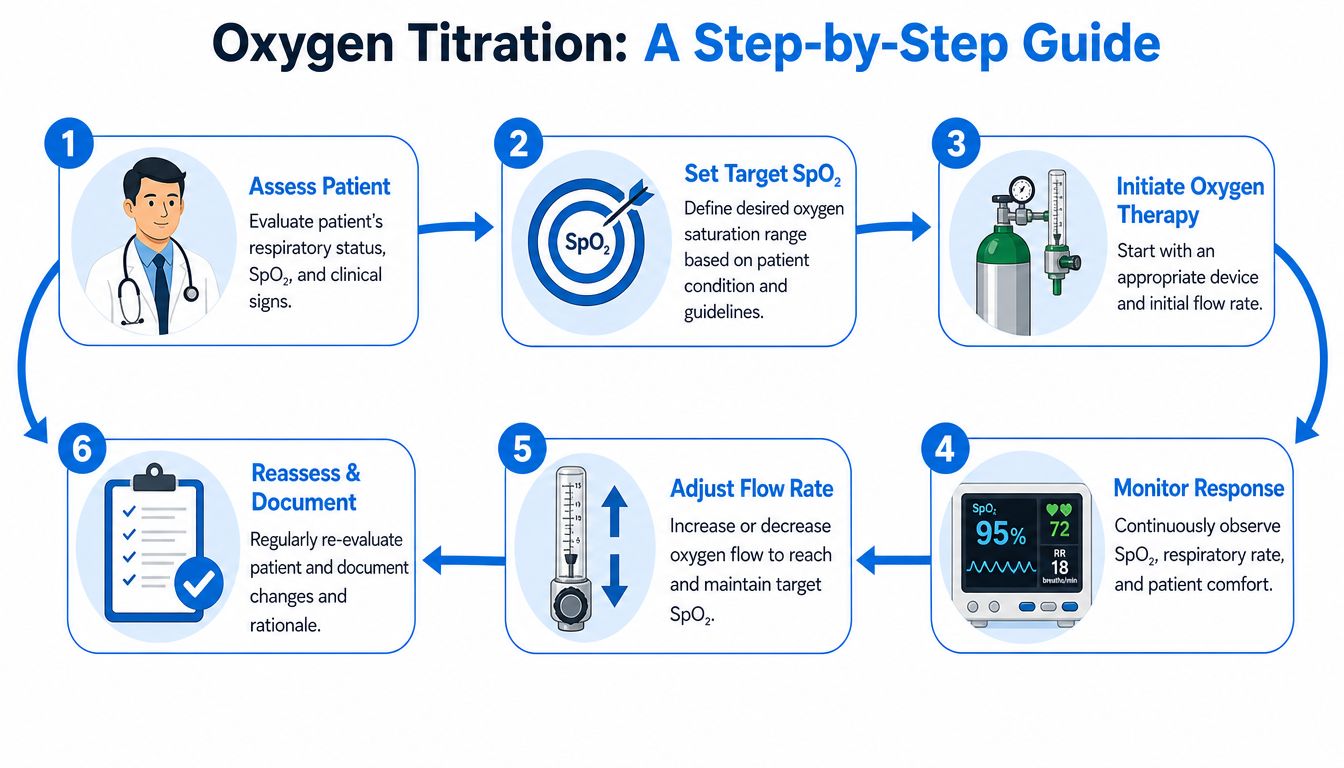
At the bedside, a reliable sequence looks like this:
- Start with the patient, not the monitor. Check work of breathing, respiratory rate, mental status, color, and whether the oximeter waveform appears believable.
- Set a target saturation range before you adjust the flow. This matters most in patients where over-oxygenation can cause harm, such as those with COPD or suspected hypercapnic respiratory failure.
- Choose the least device needed to hit that target reliably. If the patient needs a higher-support device first, plan to step down once stable.
- Reassess soon after every change. A treatment that works at minute one may be inappropriate at minute fifteen.
- Document the response clearly. Record the device, flow or FiO2, current SpO2, respiratory findings, and the target you are aiming for.
SpO2 is useful, but it does not answer every question
Pulse oximetry gives you speed. It does not give you the whole respiratory picture.
SpO2 reflects oxygen saturation, not ventilation. A patient can have an acceptable saturation while tiring, hypoventilating, and retaining carbon dioxide. That gap between a reassuring number and a worsening patient is where errors happen, particularly on busy wards where trend monitoring can replace direct reassessment if the team is not careful.
Keep one teaching point in mind: treat the monitor as one instrument in the room, not the final judge. If the patient is more somnolent, using accessory muscles, or speaking less despite a decent SpO2, your evaluation has to widen.
Capnography can help when ventilation is the concern. A quick review of waveform capnography in clinical monitoring fits well alongside oxygen titration skills because it helps you recognize when oxygenation and ventilation are moving in different directions.
When ABG becomes mandatory
Some patients improve on the pulse oximeter and still worsen physiologically. COPD is the classic ward example, but it is not the only one. Any patient with possible hypercapnia, reduced consciousness, or an unclear response to therapy deserves a lower threshold for blood gas assessment.
As noted earlier from the same source, arterial blood gas analysis is mandatory once stabilization occurs to determine whether pCO2 is greater than 6 kPa and to adjust the target range accordingly.
For new residents, I teach it this way:
- Pulse oximetry tells you how well hemoglobin is saturated at that moment.
- ABG tells you whether ventilation, carbon dioxide clearance, and acid-base status are acceptable.
- Repeat bedside assessment tells you whether the patient is safer.
Put together, those three checks close the gap between guideline language and real-world oxygen practice. That is the art of titration.
Safety Checks and Troubleshooting Common Issues
When oxygen “isn't working,” the problem is often the setup, not the prescription.
That's good news. Bedside problems are frequently fixable in seconds if you check the system before you escalate the flow or change devices. I teach this as a pre-flight routine. Do it every time, especially when you inherit a patient mid-shift.
Your pre-application check
Before you place or adjust oxygen, run through these basics:
- Confirm flow at the source. Make sure the meter is turned on and set where you think it is.
- Inspect the tubing path. Look for kinks, compression under bed rails, disconnections, or water collecting in low loops.
- Check the humidifier if present. Nursing protocols commonly include verifying bubbles in the humidifier and feeling oxygen at the outlet before applying the device.
- Examine mask or cannula position. A displaced cannula or poorly seated mask can reduce delivery.
These checks matter because oxygen delivery systems fail in ordinary ways. Tubing gets bent. Connections loosen. Moisture accumulates.
What to do when saturation drops on oxygen
If a patient's SpO2 falls despite oxygen, don't jump straight to “they need more liters.” Work the problem in order.
First, reassess the patient. Look at respiratory effort, mentation, and whether the pulse oximeter waveform seems believable. Then check the equipment from wall to patient.
A quick bedside troubleshooting sequence:
- If the tubing is kinked or disconnected, correct that first and reassess.
- If the mask seal is poor, reposition it and check whether the patient is mouth-breathing or removing it intermittently.
- If the device is too low-acuity for the situation, escalate the interface rather than just inching the flow upward on an inadequate setup.
- If the patient is tiring, call for help early. Oxygen delivery can't fix impending ventilatory collapse by itself.
Oxygen failure is sometimes patient deterioration, but it's often equipment failure or device mismatch. Check both before you assume the worst.
Common bedside pitfalls
A few mistakes recur over and over in early practice:
- Leaving a simple mask at an insufficient flow
- Missing water in dependent tubing loops
- Not noticing that the patient has pulled the cannula halfway out
- Treating the pulse oximeter as infallible
- Failing to document the target saturation and reason for the current device
The safest clinicians are not the ones who never see problems. They're the ones who notice small problems before they become emergencies.
Special Populations and High-Risk Scenarios
A common ward mistake looks harmless at first. A patient's saturation is low, oxygen goes on, the monitor number rises, and everyone relaxes. In certain groups, that “better-looking” number can hide a worse physiologic problem.
Oxygen therapy, rather than a simple device choice, becomes a precision task. New residents usually need the most support with three situations: patients with COPD or other hypercapnic risk, patients after cardiac arrest, and patients whose oxygen problem reflects severe lung injury rather than a simple oxygen deficit.
COPD and hypercapnic risk
For patients at risk of Type 2 respiratory failure, the target is narrower for a reason. Expert guidance supports an SpO2 goal of 88% to 92% in this group, because excessive oxygen can worsen carbon dioxide retention and raise the risk of harm.
That target often feels counterintuitive early in training. You see a saturation of 89%, your instincts want 98%, and the monitor seems to invite you to keep turning the flow up. Resist that reflex. In these patients, oxygen is more like a medication with a narrow therapeutic window than a comfort measure you can keep increasing.
At the bedside, use a controlled approach. Start with the lowest setup likely to reach the ordered target range. Reassess after each adjustment rather than stacking changes quickly. Once the patient is more stable, use blood gas data to confirm that the saturation goal is helping oxygenation without pushing the patient further into hypercapnia.
Post-cardiac arrest care
Post-ROSC care exposes one of the biggest gaps between guideline knowledge and real-world habit. Many clinicians were taught to leave patients on very high oxygen concentrations after circulation returns, as if more oxygen must always mean more protection.
Current teaching has moved away from that approach. The StatPearls NCBI review on oxygen therapy notes that evolving 2024-2025 AHA guidelines warn that excessive oxygen after CPR can worsen neurological recovery, and hyperoxemia may negatively affect neurologic outcomes following cardiopulmonary resuscitation.
The practical lesson is simple. Once oxygenation is restored, 100% oxygen should prompt reassessment. It should not become the unattended default.
Picture the patient who arrives from a resuscitation bay with return of spontaneous circulation, a secured airway, and an SpO2 now well above target. The danger is not only undertreatment. Overtreatment can also injure. In this group, careful downward titration matters because brain recovery depends on avoiding both hypoxemia and unnecessary hyperoxia.
ARDS, transport, and neonatal care
In severe lung injury, oxygen alone cannot solve a mechanics problem. A patient with ARDS may need a broader lung-protective strategy, including low tidal volume ventilation and attention to airway pressures, because the issue is not merely a lack of oxygen at the wall outlet. It is impaired gas exchange across injured lungs.
Transport creates a different challenge. The target may stay the same, but the delivery environment changes. Portable tanks empty, tubing connections loosen, and aircraft or transfer equipment may use different oxygen systems than what clinicians are used to on the ward. For background on that setting, this guide to in-flight oxygen systems offers useful context.
Neonates deserve their own mental category. Their physiology changes quickly, equipment sizing is unforgiving, and adult oxygen habits do not transfer cleanly. If you need a refresher, Neonatal Resuscitation Certification is available as 100% Online Neonatal Resuscitation Certification. The course is designed so clinicians can review the material, complete the exam, and receive their card in a short time.
Across all three scenarios, the pattern is the same. Do not ask only, “What device should I put on?” Ask, “What saturation range is safest for this patient, and what are the risks if I overshoot?” That question closes the dangerous gap between guideline knowledge and bedside practice.
Advance Your Practice with Modern Training
A new resident on a night shift can usually name the oxygen devices. The harder part is choosing the right target, adjusting in small steps, and knowing when a patient needs less oxygen rather than more. That bedside judgment improves with practice, feedback, and training that reflects what happens on the ward, especially in patients where over-oxygenation can cause harm.
Modern continuing education can help close that gap between guideline knowledge and real-world titration. Online courses are now widely used across healthcare, and many accredited programs fit shift work far better than a fixed classroom schedule. That matters for oxygen therapy because the skill is not memorizing a flow rate. It is learning to match the target range to the patient in front of you, then reassessing before small errors turn into larger ones.
Research supports online learning as a practical option. A review of virtual training for health professionals found readiness and proficiency benchmarks were reached at 12% to 14% higher rates, with $399 per-clinician savings and a 44% reduction in overall expense compared with in-person training. In occupational health and safety education, in-person learners scored only 2.5% higher than online instructor-led learners. The training providers did not consider that difference meaningful in practice.
The appeal is practical. Nearly 75% of students say flexibility is the main reason they choose online education, and some online medical assistant programs can be completed in 6 to 8 months while leading to the same career outcomes. Industry reporting also describes how online learning helps clinicians stay current with new practices and maintain patient-care skills while balancing work demands.
For oxygen therapy, the best training focus is narrow and practical. A good course should teach how to set target saturations for different populations, how to reassess after each adjustment, and how to avoid reflexively turning oxygen up without asking why the saturation fell. That is the gap many clinicians recognize in practice. Device knowledge is the starting point. Precision titration is the part that protects patients.
If you need to refresh cardiac and critical care skills, advanced cardiovascular life support certification is one example of a fully online option. ProMed Certifications states that learners can complete the course on their own schedule and receive a card quickly after passing the exam.
Strong oxygen practice grows from repetition, case-based learning, and careful review of the patients who do not fit the simple script. For a flexible way to keep those decisions sharp, explore ProMed Certifications for online medical certifications and continuing education built for busy healthcare professionals.
.avif)
Stay compliant with ProMed+
Certifications included: ACLS, BLS, PALS, CPR & Neonatal Resuscitation
Unlimited continuing education: over 200 hours of accredited CME
All-inclusive: One price. No surprises.
Get certified today

The Advanced Cardiac Life Support (ACLS) is an accredited online medical certification course that teaches medical professionals to respond to nearly all cardiopulmonary emergencies.

The Pediatric Advanced Life Support (PALS) Recertification instructs medical professionals on performing pediatric cardiopulmonary resuscitation in emergencies.

The Basic Life Support (BLS) Recertification is intended to teach healthcare professionals the basic steps of CPR and rescue breathing for adults, children, and infants.

Our online medical certification course for CPR, Automated External Defibrillator (AED), and First Aid is designed to teach adult, child, and infant CPR and AED use.

The Neonatal Resuscitation Certification trains medical professionals in performing resuscitation procedures and life-saving techniques for newborns at the time of delivery.

.png)
.png)
.png)