


Medical Board CME Guide 2026: State Requirements & Online CE
.png)
You're ready to renew your medical license, but your CME transcript doesn't tell the whole story. One state may accept a broad range of accredited activities, while another may require specific subjects, credit categories, or documentation. If you also maintain specialty-board certification, the requirements can become even harder to separate.
Medical board CME is no longer a once-a-cycle scramble. It's part of an ongoing professional system that connects licensure, specialty certification, clinical learning, and auditable records. The good news is that you can manage it with a clear workflow, and accredited online education is now a practical, evidence-supported alternative to classroom training.
Understanding Your Medical Board CME Obligations
Renewal week arrives, and a physician finds that the credit total looks sufficient, but several certificates omit the credit category. One course covers ethics, while the state requires a different subject or format. A specialty-board certificate is current, yet its relationship to state CME remains unclear. This situation is common because licensure and specialty certification operate as related, separate tracks.
Medical board CME requirements serve more than one purpose. State boards use continuing education to support current knowledge, professional responsibility, and safe practice. Specialty boards, including programs shaped by newer ABMS continuous certification standards, assess ongoing learning and performance within a field. Hospitals and employers may add credentialing expectations of their own.
Treat these obligations like separate lanes on the same road. Your license, specialty certification, and workplace credentials may accept some of the same education, but each can require different evidence and deadlines.
A license is an ongoing responsibility
A state medical license must remain active under the issuing board's rules. Those rules may include:
- General education: Broad CME that supports professional knowledge and clinical practice.
- Specialized subjects: Topics such as ethics, pain management, controlled substances, or patient safety.
- Documentation: Certificates, transcripts, activity details, and completion dates.
- Renewal timing: A deadline that may not match your specialty-board schedule.
- Certification alignment: Additional activities connected to maintenance of certification.
The Federation of State Medical Boards comparison reinforces the basic lesson: requirements differ by jurisdiction. Physicians practicing across state lines must check each board's current rules rather than assume one completed course satisfies every obligation.
Practical rule: Treat every state license as its own compliance file, even when the same course contributes to more than one requirement.
Select CME by asking more than, “How many credits do I have?” Ask which board accepts the activity, which category it fills, and what record you may need later. High-quality online CME can make that process easier through searchable transcripts, downloadable certificates, and flexible study. Online delivery does not replace compliance review. Its value depends on whether the activity meets the applicable accreditation and board requirements.
State-by-State CME Hour Mandates and Variations
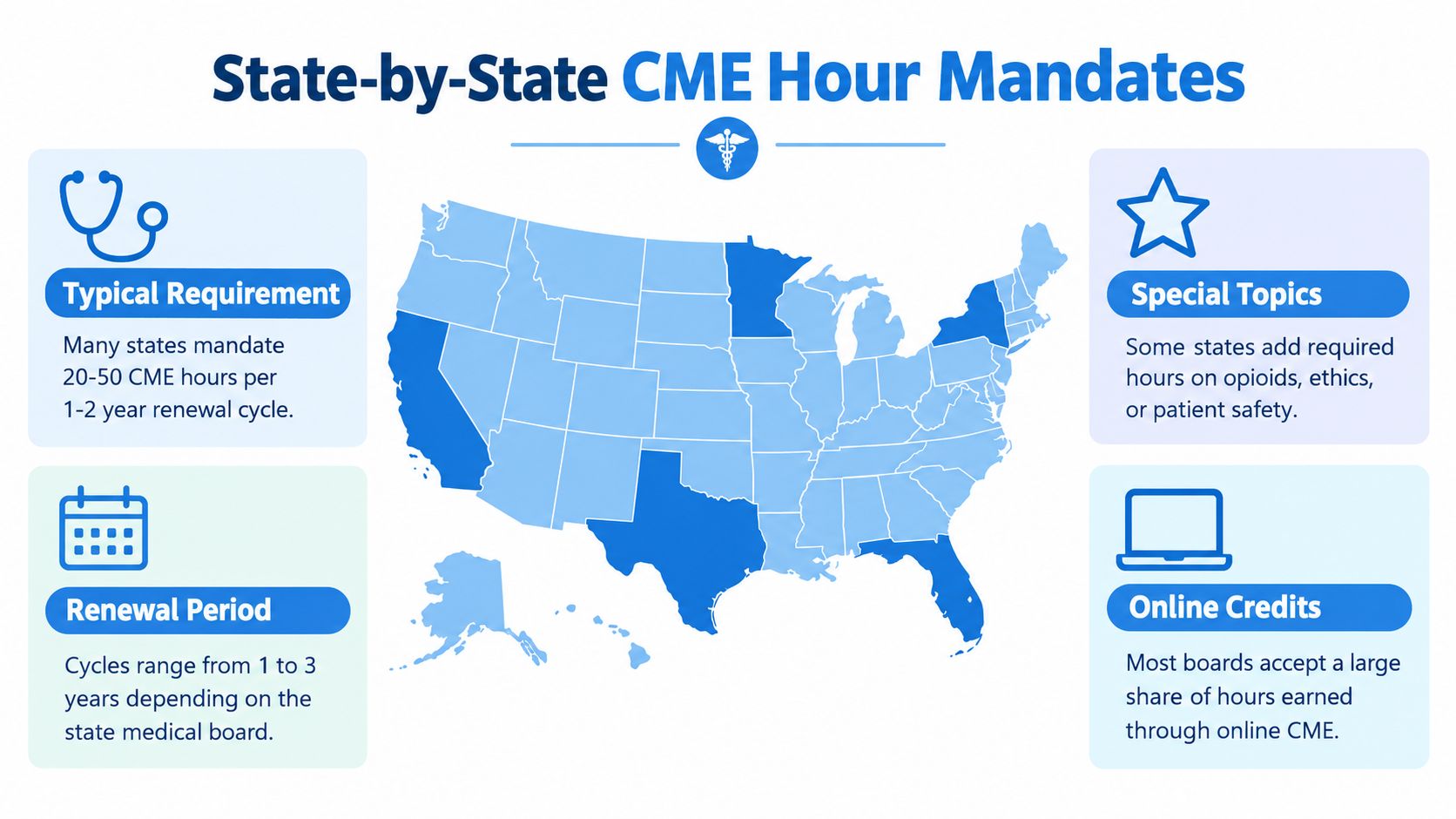
A physician renewing licenses in Florida and another state may face two different CME calendars, credit categories, and subject rules. The United States has no single CME schedule for physicians. State boards set their own requirements, and the differences matter when one transcript must support several licenses.
In the FSMB comparison of 67 medical and osteopathic licensing boards, 63 boards, approximately 94%, required substantial CME FSMB state CME comparison. The comparison also shows that many boards add content-specific requirements, while others recognize approved activities beyond conventional course hours. A national checklist can therefore create a false sense of completion. A physician may meet a general credit total and still miss a topic, category, or accepted-equivalent rule.
How the numbers differ
The comparison includes substantially different schedules. Florida guidance requires 38 hours every two years, including a two-hour medical-errors course. Other jurisdictions require 50 credits every two years, with some specifying that at least 25 must be Category 1. These models cannot be treated as interchangeable.
Review each license against five factors:
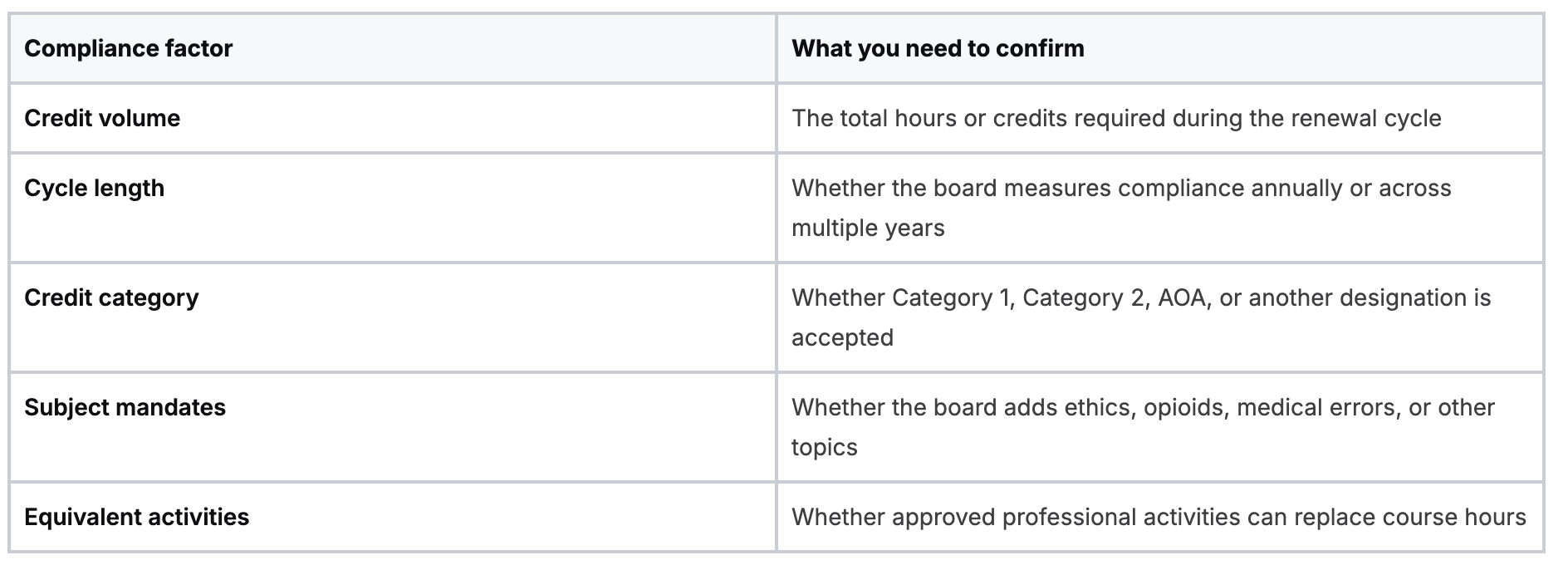
State compliance may also sit alongside specialty-board expectations under newer continuous certification standards. Physicians who track both systems can choose education that supports licensure while keeping professional development organized.
A safer approach for multiple licenses
Start with the official board page for every state where you hold a license. Record the renewal date, total requirement, accepted credit types, mandatory subjects, and reporting method. Then compare your transcript with each state separately, as though each license had its own file.
High-quality online CME can make this process easier by offering topic-specific activities without conference travel. Flexible access helps physicians fit learning around clinical responsibilities, while searchable records and downloadable certificates support later verification. Acceptance still depends on the applicable board's rules.
The practical test is whether an activity is accredited, relevant, properly documented, and accepted by your board. Online CME can meet those standards when physicians verify the course before completion and retain the required records. That approach turns shifting state rules into a manageable workflow and supports compliant, forward-thinking practice.
Decoding Content Requirements and Specialized Training
Meeting the total hour requirement is only the first checkpoint. A physician can complete enough general CME and still fall short because the transcript lacks a required subject. State boards may attach specialized education to the broader credit obligation, so course selection needs more precision.
Use this decision matrix before enrolling:
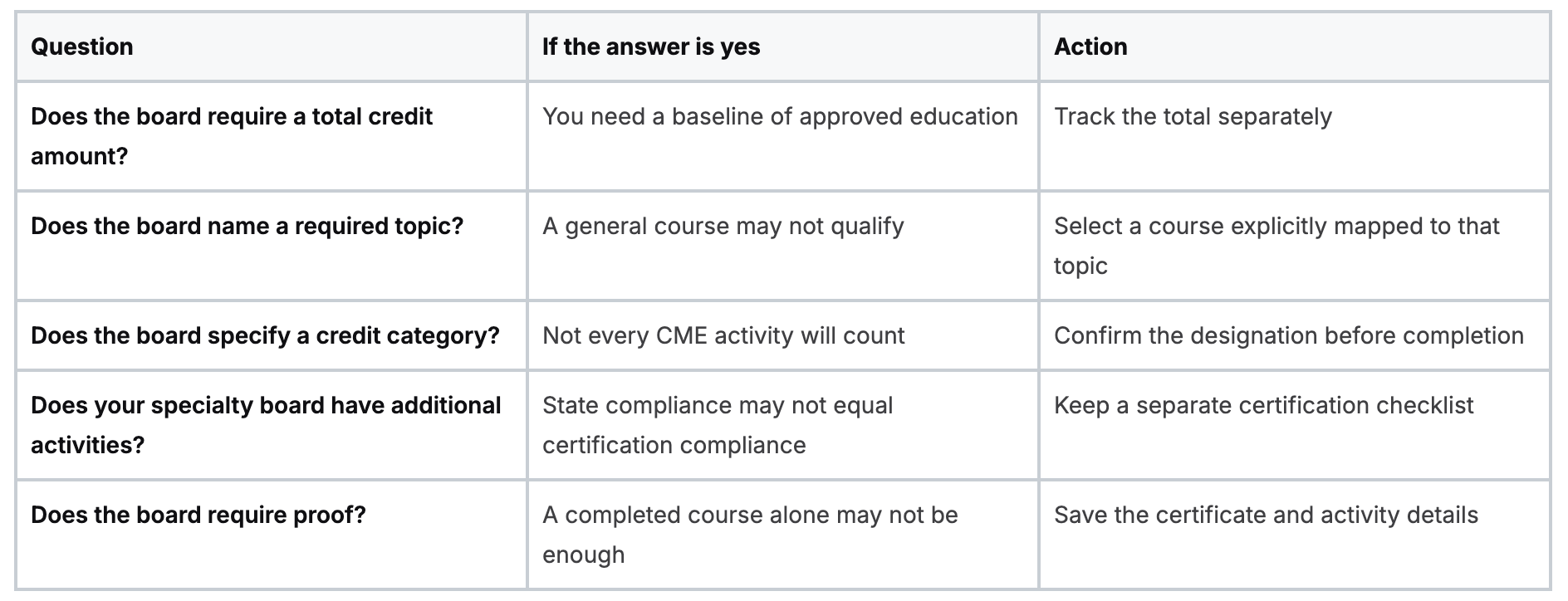
Content-specific mandates can include pain management, controlled substances, ethics, medical errors, and other state-designated subjects. The FSMB comparison identifies these kinds of requirements across state boards, which is why a broad “all-purpose CME” approach can leave gaps.
Separate general credits from targeted credits
Create two transcript categories. The first is general CME, which supports the overall credit total. The second is specialized CME, which documents a required topic and its designation.
For example, if your board requires education related to controlled substances, don't rely on a course title that merely mentions prescribing in a brief description. Check the activity objectives, credit designation, completion evidence, and the board's accepted language.
Cultural competency can also appear as a separate obligation. A focused resource such as this guide to cultural competency CME can help you identify the educational purpose and documentation details before you select an activity.
Confirm the activity before you spend the time
Before starting a course, write down:
- The state requirement it is intended to satisfy.
- The required topic or category.
- The accrediting organization or accepted provider type.
- The certificate details you expect to receive.
- The deadline for completing and reporting it.
This small check prevents a common mistake, choosing an interesting course first and trying to prove its relevance later. Online education makes targeted selection easier because course descriptions, objectives, assessments, and certificates are available before you begin.
Navigating the Shift to Continuous Certification Standards
Specialty certification is moving away from the idea that one examination can represent professional competence indefinitely. Revised standards from the American Board of Medical Specialties took effect on January 1, 2024. They require ABMS member boards to define both participation and performance requirements for continuing certification.
Each member board must determine, at intervals no longer than five years, whether a diplomate meets the requirements to retain certification. The standards also require annual primary-source verification of an unrestricted medical license and public reporting of certification status and history, as described in the ACCME 2024 annual data report.
CME is one part of a larger system
Continuing certification commonly brings together:
- Lifelong learning: Education that keeps specialty knowledge current.
- Self-assessment: Structured reflection on knowledge or practice gaps.
- Assessment: Activities that test understanding or clinical judgment.
- Practice improvement: Documented efforts to improve care processes or outcomes.
- Professional standing: Current licensure and publicly verifiable certification status.
That structure changes the daily habit that serves physicians best. Don't wait until renewal season to search through email attachments. Save each certificate when you finish the activity, record the specialty relevance, and note whether it contributes to state licensure, continuing certification, or both.
Certification is no longer a single date on a credential. It's a record of ongoing participation, assessment, and professional standing.
CME and MOC may overlap, but they aren't automatically interchangeable. The Category 1 Credit™ activities follow defined requirements and should support physicians' knowledge, skills, professional performance, and professional relationships. It also notes that at least half of credit applied toward the Physician's Recognition Award should be within the physician's specialty or practice area.
Your workflow should therefore label every activity by purpose. A course can be clinically valuable without satisfying a particular board category. Accurate labels make that distinction visible before a deadline creates pressure.
The Proven Effectiveness of Online Continuing Medical Education
A physician finishes a late shift with a choice: travel to a classroom or complete a carefully designed activity online. The better option depends on the learning goal and the applicable rules, not on the setting alone. Sound content, meaningful assessment, useful feedback, and reliable completion records can support learning in either format.

A systematic review in the BMJ found that digital education produced a statistically significant, moderate knowledge improvement compared with no intervention. The standardized mean difference was 0.85, with a 95% confidence interval of 0.16 to 1.54, based on three studies and moderate-quality evidence. Compared directly with traditional learning, digital education showed a small, non-statistically significant advantage, with a standardized mean difference of 0.23 and a 95% confidence interval from −0.12 to 0.59, also across three studies. The BMJ systematic review concluded that digital education was at least as effective as traditional learning for knowledge outcomes, while offering flexibility and accessibility.
The format isn't the learning outcome
A separate systematic review found little difference between online instruction and face-to-face workshops or lectures. For knowledge, the estimated difference was 0.04 versus workshops, with a 95% confidence interval from −0.28 to 0.36, and 0.22 versus lectures, with a 95% confidence interval from −0.08 to 0.51. The evidence quality was very low, so these findings do not support exaggerated promises. They do challenge the assumption that physical attendance automatically produces better learning. The review of online training for healthcare professionals supports choosing a format according to objectives, resources, expertise, and intended reach.
The American Heart Association and American Red Cross offer recognized programs, but they are not the only sources of valid healthcare education. An in-person class is not automatically more acceptable than an accredited online activity. Check the requirements of the relevant employer, licensing board, or certifying organization before enrolling.
For physicians balancing 2024 ABMS continuous certification requirements with state-specific mandates, this evidence supports selecting accredited online activities that satisfy both systems without duplicating effort. State rules may change while certification standards continue to develop, so online acceptance must be checked against the exact board and program requirements. This integrated check turns flexibility into compliant professional development.
Online learning also suits clinical work. Physicians can study around shifts, revisit difficult material, and avoid travel. Hospitals, clinics, and professional organizations increasingly recognize accredited digital education when governance and documentation are strong. A guide to continuing medical education online can help compare formats and requirements.
A quality platform should show measurable objectives, a knowledge check or participation record, post-activity evaluation, financial-relationship disclosure, and a durable certificate. Online CE and certifications are valid, accessible, and widely accepted when they meet the applicable standards.
Evaluating Spaced Learning Versus Intensive Workshops
A single intensive workshop can be useful when you need concentrated instruction, live interaction, or hands-on practice. But massing all learning into one session can make it harder to revisit complex material later. Spaced learning takes a different approach by distributing education across separate study periods.
A systematic review of spaced online continuing professional development included 17 studies involving 2,701 practicing clinicians across disciplines and specialties. Ten studies reported significant knowledge gains, seven reported significant changes in clinician behavior, four found increased confidence, and three identified significant and sustained improvements in clinical skills. The review included five randomized controlled trials providing Level II evidence. The systematic review of spaced online CPD also reported that only two studies identified positive patient-outcome improvements, so online education shouldn't be presented as an automatic guarantee of better patient care.
A practical comparison
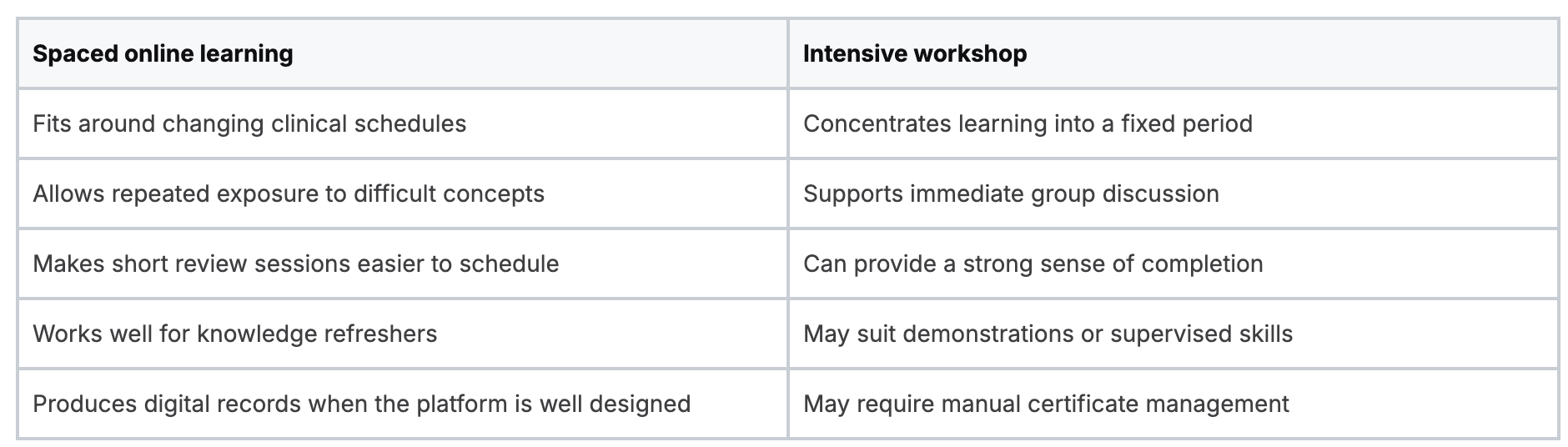
The newer evidence also favors deliberate spacing for retention. A 2024 systematic review and meta-analysis comparing spaced digital education with massed online education found superior post-intervention knowledge for spaced delivery, with a standardized mean difference of 0.32, a 95% confidence interval of 0.13 to 0.51, and nine studies with moderate-certainty evidence. It found a retention advantage with a standardized mean difference of 0.38 and a 95% confidence interval from 0.10 to 0.65. These findings appear in the 2024 review of spaced digital education.
The best choice depends on the objective. For guideline updates and recurring knowledge review, online spaced education is a strong option. For a required hands-on demonstration, follow the specific organization's rules. Online and in-person formats can both be effective, and neither should be judged by location alone.
Building a Reliable Workflow for CME Documentation
A completed course only helps during an audit if you can prove what you completed, when you completed it, and which credit it awarded. Your documentation system should make those answers available without searching through old inboxes or asking a provider to recreate a certificate.
Build the record as you learn
Use one secure digital folder for each license or professional credential. Within that folder, keep a master spreadsheet or transcript with these fields:
- Activity title: Use the exact certificate wording.
- Provider: Record the accredited organization.
- Completion date: Match the date shown on the certificate.
- Credit designation: Identify AMA PRA Category 1 Credit™, AOA credit, or another accepted category.
- Specialty relevance: Note whether the activity supports your practice area.
- Required topic: Mark ethics, opioids, patient safety, or another mandate.
- Evidence: Store the certificate, assessment result, and reporting confirmation.
The ACCME criteria for accredited CME emphasize identifying learners' gaps, designing activities to change competence or performance, using suitable formats, and evaluating whether those changes occurred. They also require valid content and independence from commercial influence. Your records should reflect those quality signals rather than showing only a time total.
Reconcile before renewal
At a regular interval, compare your personal transcript with the board or tracking portal. Look for duplicate activities, missing credits, incorrect license numbers, and courses assigned to the wrong category. Download certificates even when a provider reports completion for you.
If your broader professional files are scattered across systems, a resource covering best medical records retrieval services may help you understand how structured retrieval and record organization work. CME records aren't the same as clinical records, but the same principle applies: reliable retrieval depends on consistent identifiers and careful organization.
Keep documentation for the period required by your board or employer. Don't assume that a centralized transcript eliminates your responsibility. A board may receive a report while your own account still contains the evidence needed to resolve a discrepancy.
Adapting to New Automated Compliance Reporting Systems
Automated reporting can reduce paperwork, but it changes where errors occur. Instead of mailing or uploading every certificate directly to a board, physicians may depend on a tracking organization, specialty-board record, or data exchange. A missing identifier or delayed transmission can make completed education appear incomplete.
Mississippi illustrates this transition. Beginning February 27, 2026, physicians no longer submit CME documentation directly to the board. Compliance is verified through an approved tracking organization or active specialty-board certification, while the underlying requirement remains 40 Category 1 hours per two-year cycle, according to the Mississippi State Board of Medical Licensure update.
Texas is scheduled to begin mandatory CE tracking for all medical-board licensees on September 1, 2026, according to the verified compliance information supplied for this guide. Because that change is future-dated, physicians should confirm the implementation details with the Texas Medical Board before relying on a new reporting workflow.
Automation still needs human review
Use this reconciliation sequence:
- Confirm the accepted tracker: Identify the organization and credit categories your board recognizes.
- Match your identity: Check your legal name, license number, and professional identifiers across accounts.
- Review transmission status: Look for provider reporting delays or activities that remain pending.
- Compare categories: Make sure a reported credit is assigned to the category your board requires.
- Save certificates: Keep your own evidence even when reporting is automated.
- Check the board portal early: Resolve discrepancies before the renewal deadline.
A centralized report isn't automatically a complete report. One state may accept a category that another excludes, and one specialty-board record may not satisfy every state topic mandate. The CE Broker account guidance can help physicians understand the account-management issues that arise when digital reporting becomes part of compliance.
Online education supports this shift because certificates, transcripts, and activity metadata can move through digital systems more efficiently than paper records. It still requires accurate data matching and active oversight.
Empowering Your Career with Flexible CME Solutions
A modern CME solution should remove administrative friction without weakening educational standards. That means searchable clinical content, clear objectives, assessments, immediate documentation, and access that fits around patient care. It also means choosing activities that map to your state, specialty, and employer requirements instead of collecting credits without a plan.
An online subscription model can make that routine easier. You can select relevant courses when a knowledge gap appears, return to material when your schedule allows, and retain certificates in a consistent digital record. Flexible access is especially useful for physicians managing more than one license or combining state CME with specialty certification activities.
What to look for in a platform
Prioritize features that support compliance and learning together:
- Accredited content: The provider should clearly identify its accreditation and credit designation.
- Board-relevant subjects: Course descriptions should show how topics relate to clinical practice.
- Assessment records: You should receive evidence of completion and any required evaluation.
- Accessible delivery: Mobile and self-paced options can reduce scheduling barriers.
- Reporting support: Automated transmission is helpful, but personal recordkeeping should remain possible.
- Transparent certificates: Each certificate should identify the activity, provider, date, and credit awarded.
ProMed Certifications is one online option for physicians seeking a digital CME library, self-paced access, instant certificates, and reporting support. The platform also offers a combined CME and certification pathway, so professionals can manage continuing education and selected healthcare certifications through one account. As always, verify that each activity meets the specific requirements of your board and employer.
Medical board CME is moving toward continuous learning, digital verification, and better alignment between education and practice. Physicians who maintain accurate records and choose accredited online activities can meet that shift with less disruption and greater control over their professional development.
ProMed Certifications offers online physician CME with self-paced access, digital certificates, and courses designed to support state licensure and ongoing professional learning. Visit ProMed Certifications to review the available CME and certification options, then match each course to your board's current requirements before enrolling.
.avif)
Stay compliant with ProMed+
Certifications included: ACLS, BLS, PALS, CPR & Neonatal Resuscitation
Unlimited continuing education: over 200 hours of accredited CME
All-inclusive: One price. No surprises.
Get certified today

The Advanced Cardiac Life Support (ACLS) is an accredited online medical certification course that teaches medical professionals to respond to nearly all cardiopulmonary emergencies.

The Pediatric Advanced Life Support (PALS) Recertification instructs medical professionals on performing pediatric cardiopulmonary resuscitation in emergencies.

The Basic Life Support (BLS) Recertification is intended to teach healthcare professionals the basic steps of CPR and rescue breathing for adults, children, and infants.

Our online medical certification course for CPR, Automated External Defibrillator (AED), and First Aid is designed to teach adult, child, and infant CPR and AED use.

The Neonatal Resuscitation Certification trains medical professionals in performing resuscitation procedures and life-saving techniques for newborns at the time of delivery.

.png)
.png)
.png)