


Hazardous Material Handling: A Healthcare Pro's Guide
.png)
You're halfway through a shift. A coworker points to a small puddle near a chemo prep area, and nobody is fully sure what it is yet. That moment matters. In healthcare, hazardous material handling rarely looks dramatic. It usually looks like a mislabeled bottle, a leaking specimen container, a splash during cleaning, or waste placed in the wrong bin.
Most clinical staff won't become hazmat specialists, and you don't need to. But you do need to know what to recognize, what not to touch, when to isolate an area, and when to call for help. That's what keeps patients safe, protects your team, and keeps your facility compliant.
Confusion often starts because people lump every kind of hazmat training into one big category. A nurse, lab tech, physician, transporter, and environmental services worker don't all need the same depth of training. That gap matters. Some employees need awareness-level recognition. Others need function-specific handling skills. A smaller group needs transport-focused training under DOT rules. When employers blur those levels, people either get under-trained or overwhelmed.
Your Role in Hazardous Material Safety
Hazardous material handling is part of daily clinical work, even if your badge doesn't say “safety officer.” If you administer chemotherapy, process lab samples, clean patient areas, handle disinfectants, manage pharmaceuticals, or move waste containers, you already interact with materials that can harm skin, lungs, eyes, or the environment when handled incorrectly.
That's one reason the scale of this issue matters. In the United States, large quantity generators produced approximately 35.9 million tons of hazardous waste in 2021. In a hospital setting, that scale shows up in smaller, everyday decisions made by ordinary staff.
What your job really requires
Most staff need to do four things well:
- Recognize hazards early so an unlabeled liquid, damaged container, or missing lid doesn't become “someone else's problem.”
- Follow the local process for PPE, containment, and notification.
- Protect the chain of care so patients, visitors, and coworkers aren't exposed.
- Document what happened when an incident or near miss occurs.
Think of hazardous materials the same way you think about medication safety. You wouldn't give a drug without confirming the patient, dose, and route. The same mindset applies here. First identify. Then handle.
Practical rule: If you can't identify the material, don't improvise the response.
The first response is often simple
If you find an unlabeled puddle or container, your first move usually isn't cleanup. It's control.
- Pause the activity nearby.
- Keep others away from the area.
- Check for clues without touching the material, such as location, label fragments, nearby supplies, or a matching open container.
- Notify the right person, usually your supervisor and the department process owner.
- Use your facility spill procedure, not memory alone.
That sounds basic, but basics prevent injuries.
A lot of new staff assume hazardous material handling belongs only to transport teams or outside responders. In hospitals, that's not true. You may never load a hazmat truck, but you still need role-specific safety habits for the materials you use every day. That distinction sits at the heart of the training gap in healthcare.
How to Identify Hazardous Materials Correctly
Correct identification comes before gloves, cleanup, or disposal. If you skip this part, everything else becomes guesswork. In practice, you have two main tools: the container label and the Safety Data Sheet, or SDS.
Consider checking both the medication label and the patient chart. One gives you quick recognition. The other gives you the full story.
Start with the label
A proper label gives you immediate, high-value information. Look for the product name, hazard warnings, signal words, and visual hazard symbols. Even before you open a cabinet or move a container, the label should help you answer simple questions:
- What is it
- What can it do
- What basic precautions apply
- Who should handle it
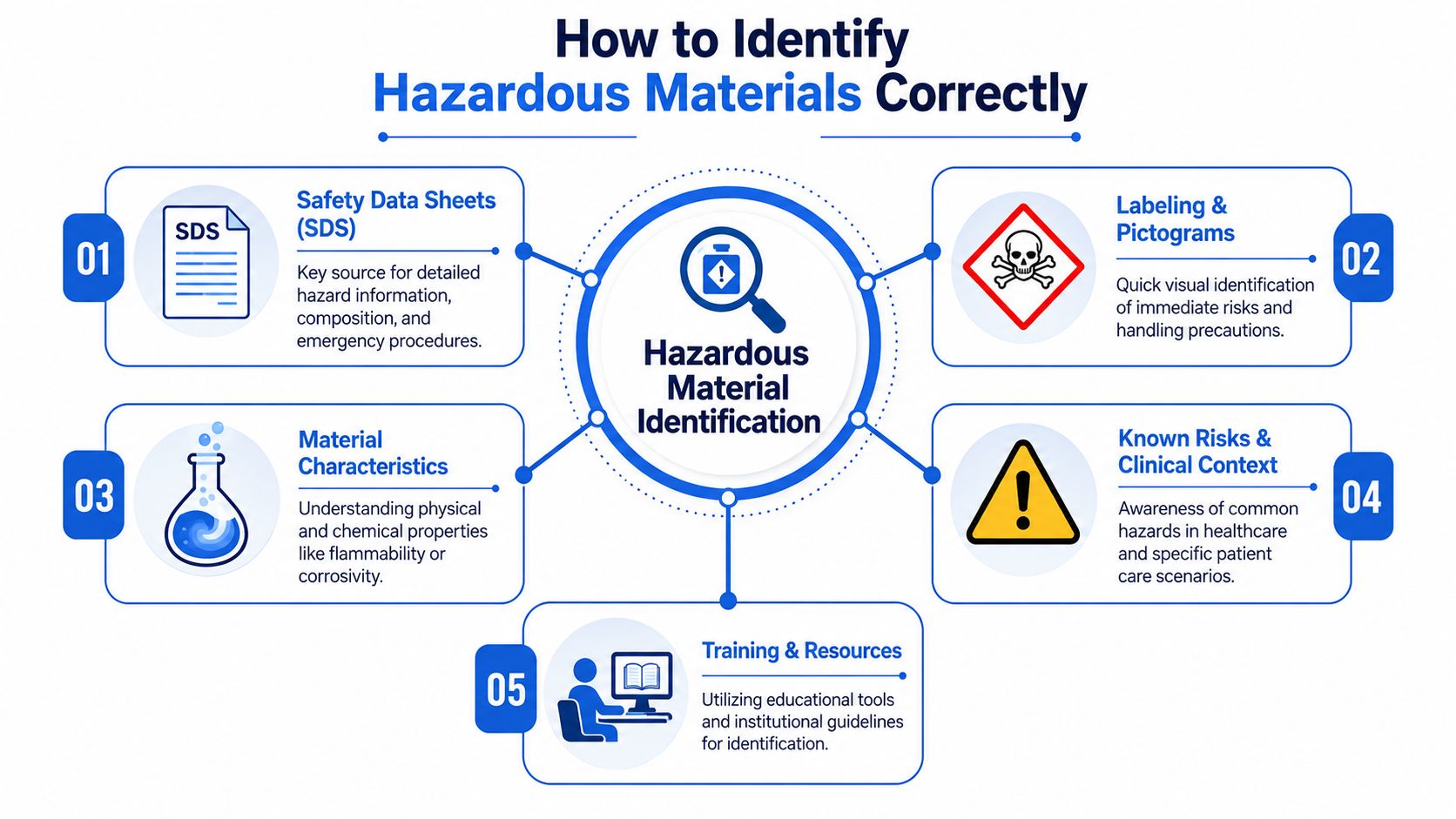
Facilities that follow strict handling protocols starting with SDS review and label verification can achieve up to a 94% reduction in spill incidents and prevent 88% of cross-contamination events.
Read the SDS like a clinician
Many people overcomplicate the SDS. You don't need to memorize every section. You need to know where to look first.
Use this quick scan:
- Section 1 and the label match. If the product name on the SDS doesn't match the container, stop there.
- Section 4 gives first aid measures. This matters if exposure has already happened.
- Section 5 covers fire-fighting measures. That's especially useful for flammables.
- Section 6 addresses accidental release measures. This is your spill-response starting point.
- Section 8 explains exposure controls and PPE. This tells you what barrier protection suits the hazard.
Use the clinical context
Sometimes the room tells you as much as the container. A drip near pathology storage is different from residue beside a sterilant, and both differ from a spill in oncology. Context helps, but context doesn't replace confirmation.
If the label is missing, damaged, or unreadable, treat the situation as higher risk until the material is identified.
If you want a simple refresher on exposure risks from harmful substances in care settings, ProMed's overview of common toxins in healthcare and everyday environments is a useful companion read.
This same logic applies in broader emergency training. For example, ACLS Certification through ProMed Certifications is offered in a fully online format that staff can complete on their own schedule, and that same flexible model works well for hazard recognition education because clinicians often need repeat access to reference material, not just a one-time classroom session.
Safe Handling and Storage Protocols
Once you know what the material is, the next question is simple. How do you work with it without creating a second problem?
Good handling starts before your hands touch anything. You check the PPE, the workspace, the ventilation, and the nearby materials. The safest staff member in the room is usually the one who prepares well, not the one who reacts quickly.
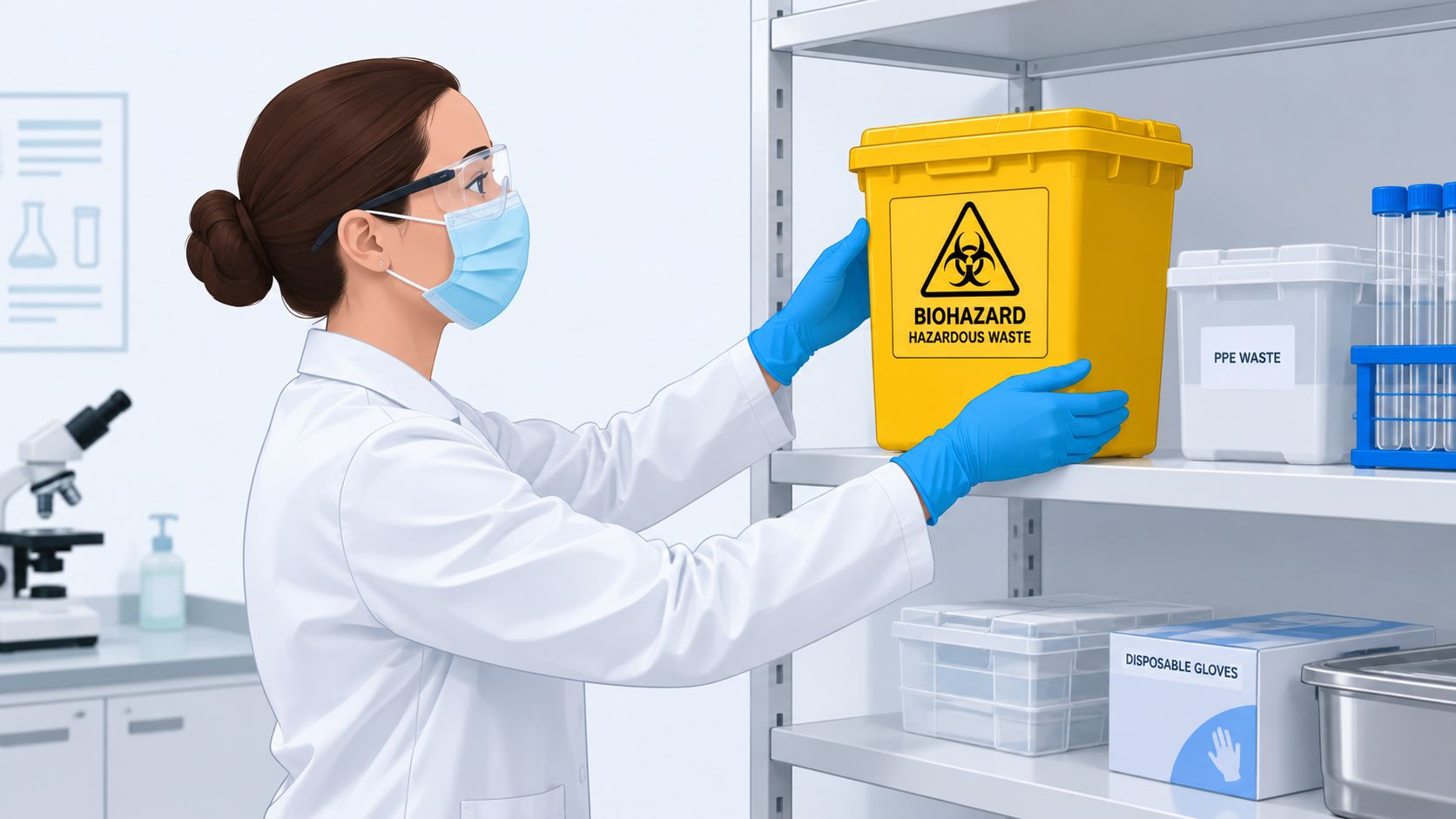
Match PPE to the task
“Wear gloves” is too vague to be useful. Hazardous material handling requires PPE that fits the exposure route and the chemical class involved.
A practical way to think about PPE is in tiers:
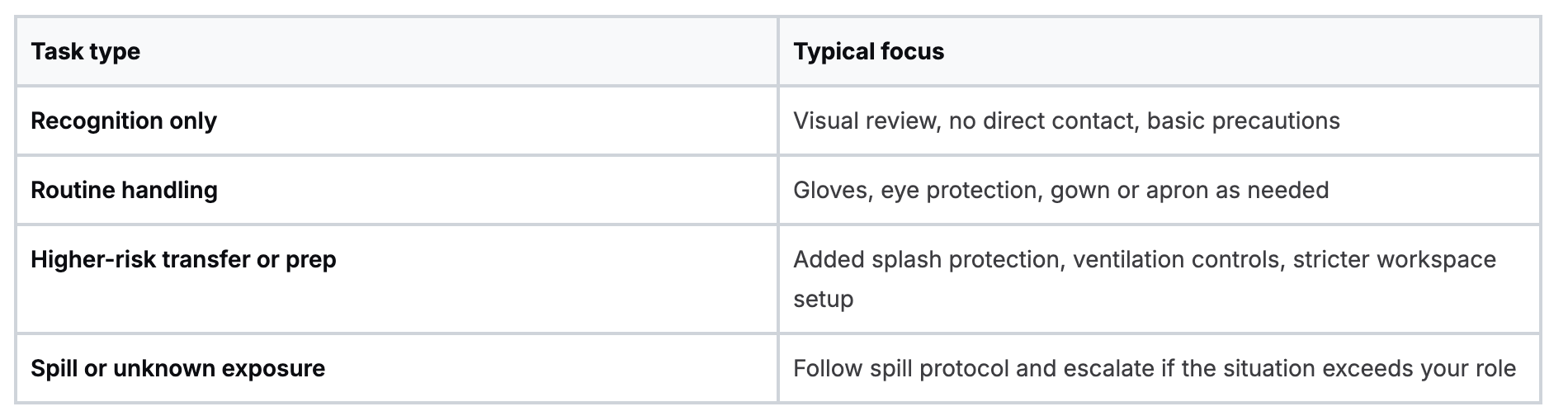
The SDS should guide the final choice. Your local policy should define what's standard for your unit.
Engineering controls matter more than people realize
Staff often focus on PPE because it's visible. Engineering controls do much of the essential safety work in the background.
Examples include:
- Enclosed systems that limit direct contact
- Local exhaust ventilation to reduce dangerous vapors
- Controlled storage areas with surfaces designed for cleanup
- Secondary containment to catch leaks before they spread
Store incompatibles apart
Think of storage like separating two patients who will only escalate each other. The problem isn't either one alone. The problem is what happens when they meet.
Strong acids and strong bases should be separated by hazard category. Containers need stable shelving, clear access, and protection from tipping or puncture. Secondary containment adds another layer of protection.
A common pitfall is stacking containers above manufacturer height recommendations, which causes a 42% increase in tipping, puncture, or breakage incidents leading to uncontrolled releases, according to HER Center guidance on hazardous material practices.
This is also why storage rooms shouldn't become overflow closets. Extra boxes, crowding, and makeshift stacking create preventable risk.
For staff who also handle infectious waste and sharps, this companion guide on bloodborne pathogen precautions in clinical settings fits naturally alongside chemical safety practices.
Responding to Spills and Incidents
Even well-run units have spills. The goal isn't perfection. The goal is a calm, repeatable response.
When staff panic, they either rush in without protection or freeze because they're unsure whether they're allowed to act. A small spill response works best when everyone knows the first few moves.
Use the SAFE approach
A simple memory tool is SAFE:
- Secure the area so patients, visitors, and other staff don't walk through it
- Assess the material using labels, SDS information, and the surrounding context
- Find the right equipment such as the unit spill kit and required PPE
- Escalate if needed when the spill is unknown, large, vapor-producing, or outside your training
That final step is important. You do not need to prove competence by handling every incident yourself.
A confident response often means stopping early and calling the right team.
Know when not to clean it up
Some spills are manageable at the unit level. Others are not. If the source is unknown, the container is compromised, ventilation seems inadequate, or symptoms appear in exposed staff, isolate and escalate.
For teams reviewing physical containment options, secondary containment solutions from Material Handling USA offer practical examples of how facilities reduce spread after leaks or transfer failures.
Incident follow-up is part of the response
After immediate control, someone needs to answer three questions:
- Who was exposed
- What material was involved
- What failed in the process
That's where real learning happens. A missing label, overfilled container, rushed handoff, or poor storage layout usually sits behind the event.
For physicians who need broader, on-demand clinical education, ProMed+ Physician CME provides access to over 200 AMA PRA Category 1 Credits™ and supports completion of state licensure mandates through a streaming library of clinical coursework. That kind of flexible format also reflects where healthcare education is heading more generally. Busy clinicians need training they can revisit when incidents reveal a knowledge gap.
Disposal Transport and Record Keeping
Hazardous material handling doesn't end when the task is done. The material still has to move through the building, enter the correct waste stream, wait in the proper holding area, and leave a paper trail that makes sense later.
Many otherwise careful teams often slip. They handle the material well at the bedside or bench, then lose discipline at the bin, cart, or logbook.
Waste segregation is a safety step
Different containers exist for a reason. They help keep incompatible or regulated waste out of the wrong stream and protect downstream staff from surprise exposure.

A simple mental model helps:
- Red containers or bags usually signal biohazard waste
- Yellow containers are commonly used for chemotherapy-related waste in many facilities
- Other designated bins may be used for pharmaceutical, chemical, or mixed regulated waste based on local policy
Your organization's policy always controls the final answer. Color systems vary. What shouldn't vary is the habit of checking before disposal.
Internal transport needs its own rules
Moving hazardous material from one room to another sounds minor, but transport inside the facility creates its own exposure points. Hallways, elevators, handoffs, and temporary staging areas all add risk.
A sound internal transport process usually includes:
- Closed, appropriate containers that won't leak during movement
- Stable carts that reduce tipping
- Clear route planning so material doesn't pass through crowded areas unnecessarily
- Restricted temporary storage until pickup or processing
Records protect the facility later
People sometimes treat logs as busywork. They're not. Documentation proves what the material was, where it went, who handled it, and whether procedures were followed.
That matters for compliance, but it also matters when something goes wrong. If a container leaks in temporary storage or waste ends up in the wrong stream, accurate records let the facility trace the problem back to the point of generation.
Good records turn a confusing incident into a solvable one.
Record keeping also supports prevention. Patterns appear in the paperwork first. Repeated relabeling, recurring transport delays, or frequent container substitutions often point to a broken process upstream.
As a cross-industry reminder that disposal details can prevent fires and secondary incidents, even non-clinical sectors emphasize careful handling of contaminated materials. This practical piece on safe disposal of oily rags from Farm & Country Insurance is a useful example of how small disposal mistakes can create larger hazards.
Choosing the Right Hazmat Training for Your Role
Healthcare organizations frequently get tangled at this point. They hear “hazmat training” and assume everyone needs the same course, the same schedule, and the same credential. That's not how real workplaces function.
The key issue is the tiered training gap. Some employees only need awareness. Others need function-specific handling instruction because they work directly with hazardous drugs, chemicals, or waste. A smaller group involved in regulated transport needs the more formal transport-focused training framework.
One size doesn't fit healthcare
Federal transport rules often dominate the conversation, but they don't describe every hospital role well. The result is confusion. Staff who only need to recognize labels and basic risks may be over-trained in transport rules, while staff with hands-on exposure may still lack site-specific instruction on the actual substances they handle.
That gap is documented in federal training discussions. The PHMSA framework focuses on transport employees and recurring requirements, while healthcare employers still need to decide how to scale awareness and function-specific instruction for non-transport staff. In that same discussion, 40% of non-transport staff may lack specific site-oriented training on the exact chemicals they use daily, according to PHMSA-related guidance on hazardous materials training requirements.

Online education fits this reality well
Healthcare still carries an outdated belief that only in-person classes from AHA or the American Red Cross count as legitimate learning for certifications and continuing education. That's not true. Accredited online education is widely used, increasingly accepted, and often a better fit for the way clinicians learn.
Peer-reviewed evidence supports that position. A meta-analysis of medical education found that online learning groups achieved significantly higher post-test scores for knowledge and skill outcomes than offline learning, with a standardized mean difference of 0.81.
Other healthcare education research points in the same direction. Some studies show online formats performing better, some show practical equivalence, and clinicians often prefer the flexibility of online learning. For CE and certification work, that matters. People retain more when they can review content on demand, complete training around real shifts, and revisit procedures after a near miss or policy update.
What staff should look for in training
Choose education based on the role, not the loudest vendor.
- Awareness-level staff need hazard recognition, labels, SDS basics, and reporting steps.
- Function-specific staff need handling, storage, spill response, and disposal procedures tied to the materials in their department.
- Transport-focused roles need the training required for duties that affect transportation safety.
If your organization is building a broader preparedness plan, ProMed's article on emergency response team training in healthcare settings is a useful next read because it places role clarity and practical readiness in the same conversation.
The broader industry is moving toward flexible, accredited online learning because it solves a real operational problem. Busy healthcare workers need valid education that fits clinical schedules without lowering standards. That's why online CE and certifications keep gaining traction across hospitals, clinics, and healthcare organizations.
If you're updating staff education or reviewing your own credentials, ProMed Certifications offers online medical certification courses designed for healthcare professionals who need flexible access to training. Its platform includes certifications such as ACLS, PALS, BLS, Neonatal Resuscitation, and CPR, along with continuing education options that can fit role-specific learning plans in modern clinical settings.
.avif)
Stay compliant with ProMed+
Certifications included: ACLS, BLS, PALS, CPR & Neonatal Resuscitation
Unlimited continuing education: over 200 hours of accredited CME
All-inclusive: One price. No surprises.
Get certified today

The Advanced Cardiac Life Support (ACLS) is an accredited online medical certification course that teaches medical professionals to respond to nearly all cardiopulmonary emergencies.

The Pediatric Advanced Life Support (PALS) Recertification instructs medical professionals on performing pediatric cardiopulmonary resuscitation in emergencies.

The Basic Life Support (BLS) Recertification is intended to teach healthcare professionals the basic steps of CPR and rescue breathing for adults, children, and infants.

Our online medical certification course for CPR, Automated External Defibrillator (AED), and First Aid is designed to teach adult, child, and infant CPR and AED use.

The Neonatal Resuscitation Certification trains medical professionals in performing resuscitation procedures and life-saving techniques for newborns at the time of delivery.

.png)
.png)
.png)