


Emergency Response Team Training: A Complete Guide for Success
When a crisis hits—whether it’s a medical emergency or a natural disaster—who is your first line of defense? That's where Emergency Response Team (ERT) training comes in. This guide will help you transform a dedicated group of your employees into a coordinated unit ready to manage a crisis effectively.
Their job is to stabilize the incident, preserve life, and protect property long before professional help can arrive on the scene.
Understanding the Role of an Emergency Response Team
An Emergency Response Team isn't just a handful of good-willed volunteers. It’s a formally structured team trained to deliver an immediate, skilled response when things go wrong. You hope you never have to call on them, but their readiness is absolutely non-negotiable for a safe and resilient workplace.
Their mission is crystal clear and boils down to a few core responsibilities. Let's break down what an ERT is trained to do when an emergency unfolds.
Core Responsibilities of an Emergency Response Team

Ultimately, a well-trained ERT ensures that the crucial first few minutes of a crisis are managed with confidence and competence, not chaos.
The Growing Need for Formal Training
The demand for properly trained teams is skyrocketing. The global emergency response training market was valued at around $2 billion in 2025 and is on track to hit $3.5 billion by 2033. This isn't just a number; it’s a clear signal that awareness and safety regulations are pushing organizations across all sectors to invest in preparedness.
This growth underscores a vital point: formal emergency response team training is what turns good intentions into life-saving actions. Without it, a response can quickly become disorganized and ineffective.
An ERT acts as the crucial bridge between the moment an incident occurs and the arrival of professional emergency services. Their training determines how effective that bridge is.
Modernizing ERT Education
For a long time, the only accepted path for ERT education was through in-person classes from legacy providers like the AHA or American Red Cross. But the industry has moved on. Peer-reviewed studies now consistently show that accredited online certifications deliver equal, and sometimes even better, results in knowledge retention and skill application. The general consensus is shifting, with hospitals and clinics increasingly recognizing accredited online certifications.
Modern online training provides a flexible, cost-effective, and accessible way to give your team the knowledge they need to respond confidently. At ProMed, we champion this future-focused approach. Our convenient and credible online certifications are built for the demands of today’s professionals and are widely accepted, providing the critical knowledge base for a truly prepared ERT.
The Foundation of a High-Performing ERT
A top-tier Emergency Response Team isn't just a group of people with a shared first aid kit and a checklist. It’s a cohesive unit forged under pressure, built on a foundation of core competencies that let them function seamlessly when everything is on the line.
Think of it like this: these competencies are the load-bearing pillars of your entire emergency plan. If any one of them is weak, the whole structure is at risk. These are the elements that transform a collection of skilled individuals into a truly effective, life-saving team.
The Four Pillars of ERT Excellence
A truly prepared ERT has to be strong in four key areas. Each one is absolutely critical for managing a crisis with clarity and confidence.
- Clear Communication: This is all about getting critical information across quickly and without any confusion. During an emergency, a garbled command or a vague update can breed chaos. Clear instructions, on the other hand, save lives.
- Technical Proficiency: These are the hands-on, practical skills everyone thinks of—things like administering first aid, performing CPR, or correctly using an AED. Mastery here has to be second nature.
- Decisive Leadership: Every team needs someone who can make the tough calls under immense pressure, delegate tasks without hesitation, and keep the scene under control until professional responders take over.
- Adaptability and Problem-Solving: Let's be honest: no crisis ever goes exactly by the book. Team members have to be able to think on their feet, react to sudden changes, and find workable solutions to problems nobody saw coming.
These pillars don't stand alone; they support each other. Great leadership means nothing if the team lacks the technical skill to follow orders, and incredible skills are wasted if communication completely breaks down.
Communication: The Link That Holds It All Together
Of these four pillars, communication is often the one that makes or breaks an entire response.
Imagine a fire alarm goes off. With poor communication, you might get conflicting evacuation instructions or a critical delay in calling 911. It's a recipe for disaster.
Now picture a team with solid communication protocols. The leader gives calm, direct commands. Team members provide clear, quick status updates. One person is designated to meet first responders, giving them accurate information the second they arrive. That coordinated dance is the hallmark of effective emergency response team training.
Building Competencies With Modern Training
Getting these foundational skills dialed in requires consistent, high-quality education. This is where modern online training platforms really shine. Flexible, self-paced modules let team members master technical skills like CPR and first aid on their own schedule, which research suggests can lead to much better long-term knowledge retention.
This approach ensures everyone shows up to hands-on drills already having a firm grasp of the fundamentals. The demand for this kind of accessible, effective training is exploding. The global incident and emergency management market is expected to jump from $145.9 billion in 2025 to $250 billion by 2034, and the training sector is a huge piece of that growth.
An ERT's performance is a direct reflection of its training. When every member is confident in their skills and understands their role, the team can operate as a single, effective unit.
Of course, training is only part of the equation. Having clear, actionable policies is crucial for any high-performing ERT. If you need help developing solid guidelines for your team, you can learn how to effectively write policies to create that vital structure. These competencies are also deeply tied to team dynamics, especially in high-stakes medical events. To see how this plays out in a clinical setting, you can read about the 5 elements of effective team dynamics in ACLS and apply those principles to your own team.
Choosing Your Training: In-Person vs. Online
When it comes to emergency response team training, there's a stubborn myth floating around that only hands-on, in-person courses from legacy providers like the AHA or American Red Cross are the real deal.
Let's be clear: that’s an outdated way of thinking. The world of healthcare and safety training has changed, and accredited online certifications aren't just catching up—they're often setting a higher standard for quality and real-world effectiveness. The truth is, modern online education is a powerful and efficient way to build a top-tier ERT, delivering critical knowledge without compromising on quality.
The Shift Toward Flexible Learning
Slowly but surely, the industry is waking up to the huge value of online formats. More and more hospitals, clinics, and organizations are accepting accredited online certifications because the proof is impossible to ignore. Peer-reviewed studies have consistently shown that online learning delivers results that are just as good as—and sometimes superior to—what you get in a traditional classroom.
This is especially true when it comes to patient care outcomes and knowledge retention. When your team members can learn at their own speed, they can really dig into complex topics and review tricky concepts as needed. This leads to deeper understanding and far more confidence when a real emergency strikes. It's about building a rock-solid foundation of knowledge before they ever step into a hands-on drill.
Comparing Online vs In-Person ERT Training
So, how do you decide what's right for your team? The choice often boils down to balancing effectiveness with the practical constraints we all face—time, budget, and scheduling. To make it easier, let's put the two formats side-by-side.
The table below breaks down the key differences to help you see which approach best fits your organization's needs.
FeatureOnline TrainingIn-Person TrainingFlexibilityLearn anytime, anywhere, on any device. Perfect for busy schedules and shift workers.Fixed class schedules that require travel and time off from work.Cost-EffectivenessSignificantly lower costs with no travel, lodging, or venue fees. Often more affordable per person.Higher costs due to instructor fees, facility rentals, travel expenses, and printed materials.PacingSelf-paced learning allows individuals to review complex topics as needed, improving comprehension and retention.Group-paced, which may be too fast for some learners and too slow for others.ConsistencyStandardized curriculum ensures every team member receives the exact same high-quality information.Instructor variability can lead to differences in content delivery and quality.AccessibilityImmediate access to course materials and certifications upon completion.Requires waiting for the next available class, which could delay training.
As you can see, the advantages of online training are compelling. It offers a modern solution that aligns perfectly with the operational realities most organizations are navigating today. For a more detailed look, check out this breakdown of in-person vs. online medical certifications to see how these formats compare across a range of courses.
The image below gives a great visual of how different training approaches impact team performance, especially when comparing traditional drills to the kind of virtual simulations often paired with online learning.
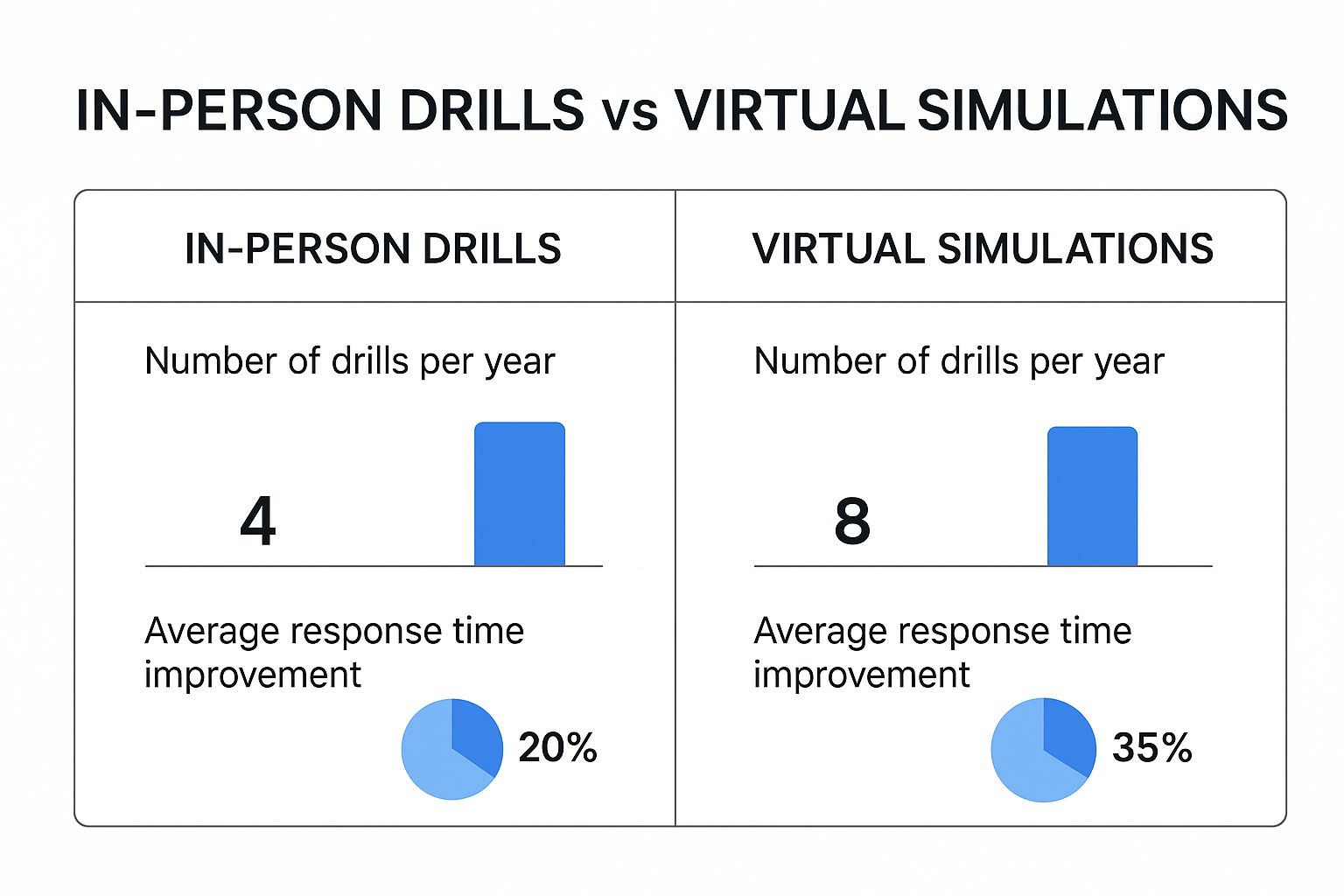
The data makes it pretty clear: the higher frequency and more immersive practice you get with virtual simulations often lead to much better response times.
ProMed: The Future-Focused Choice
At ProMed, we’re proud to be at the forefront of this shift. We stand behind our accredited online certifications 100%, because we know they work. Our courses are built by medical experts and constantly updated to reflect the latest life-saving guidelines, so you can be confident you’re getting credible, high-quality education aligned with industry shifts.
The best training isn’t defined by a physical classroom. It’s defined by the quality of its content, its accessibility, and the confidence it builds in your team. Online learning delivers on all three.
Choosing an online format isn't about taking a shortcut. It's a strategic move to give your team life-saving skills in the most efficient and effective way possible. It’s a choice that respects their time, your budget, and the urgent need for a well-prepared emergency response team.
Building Your ERT Training Curriculum
.png)
A truly effective Emergency Response Team is built on the back of a powerful curriculum. Think of it as the blueprint for readiness—it’s the structured plan that methodically transforms willing volunteers into a skilled, coordinated unit ready to act.
A great curriculum isn't just a laundry list of topics. It's a progressive journey. It starts by building a solid foundation of knowledge and then layers on specific, life-saving skills. The good news? High-quality, accredited online platforms have made this much easier. They can deliver the essential knowledge base your team needs, ensuring everyone masters the theory before ever stepping into a practical drill.
What Are the Foundational Knowledge Modules?
Before anyone learns how to apply a tourniquet or handle a fire extinguisher, they need to grasp the big picture. These foundational modules establish the why behind every action the team will take.
- Emergency Action Plans (EAPs): This is ground zero. Team members have to know your organization's specific EAP inside and out. Training needs to cover every detail, from evacuation routes and shelter-in-place procedures to the exact roles each ERT member plays in different emergencies.
- Incident Command System (ICS): In a crisis, chaos is the real enemy. The ICS provides a standardized, hierarchical structure for managing any incident, big or small. This training ensures everyone knows who's in charge, who to report to, and how to communicate clearly, preventing the kind of confusion that costs precious seconds.
Don't mistake these for simple background info. They are the operating system for your entire emergency response.
What Are the Core Skill-Based Trainings?
Once that foundation is poured and set, it's time to build practical competencies. This is where your team learns the skills they need to intervene safely and make a real difference. Modern online courses are fantastic for this, using interactive videos and detailed simulations to teach critical techniques. A comprehensive emergency response team training curriculum should always cover these bases:
- First Aid and Medical Response: This is often the most critical function of an ERT. Key skills include CPR/AED usage, bleeding control (including tourniquet application), and basic first aid for common injuries like burns and fractures.
- Fire Safety and Evacuation: Team members must be trained to spot fire hazards, properly use a fire extinguisher, and guide colleagues through a safe and orderly evacuation.
- Hazardous Material (HazMat) Awareness: This module teaches responders how to recognize, identify, and report hazardous substances without putting themselves in harm's way. It's about knowing when to act and, just as importantly, when to back off and call in the specialists.
- Basic Search and Rescue: If there's a structural collapse or a chaotic evacuation, ERT members may need to conduct simple, light-duty searches. This training covers safe search techniques and how to operate effectively in teams.
High-quality training isn't defined by its location; it's defined by its content and its ability to build real confidence. Interactive online modules have proven to be just as effective at teaching these core skills as any traditional classroom.
Addressing the Human Element
There's an often-overlooked—but absolutely vital—part of any ERT curriculum: training that addresses the psychological toll of a crisis. Your responders are not immune to stress and trauma. Including a module on psychological first aid is essential. This training teaches team members how to provide immediate emotional support to colleagues in distress. Just as importantly, it gives them the tools to manage their own stress during and after an incident. This focus on mental well-being is the hallmark of a truly modern and responsible training program.
By weaving together foundational principles, specific skills, and psychological preparedness, you create a curriculum that builds not just a capable team, but a resilient one. It’s this holistic approach that ensures your ERT is ready for anything.
Turning Knowledge Into Real-World Readiness
Nailing an online certification is a fantastic start, but it's just that—a start. True emergency readiness isn't about what you know; it's about what you can do when the pressure is on. It’s forged in the moment, turning textbook knowledge into pure muscle memory. This is where practical drills and simulations come in, forming the backbone of any serious emergency response team training program.
Think of it like this: training is a continuous cycle, not a one-and-done event. The real goal is to shrink the gap between knowing the right steps and executing them instinctively. Regular, hands-on practice cements the high-quality, foundational knowledge from online courses and makes it real.
From Tabletop Exercises to Full-Scale Drills
Drills aren't one-size-fits-all. They come in different flavors, each designed to stress-test a unique part of your emergency plan. By mixing and matching these exercises, you build a team that's as strategically sharp as it is technically skilled.
- Tabletop Exercises: Picture a guided brainstorming session around a crisis. Team members talk through a simulated emergency, debating their next moves. These are perfect for ironing out communication plans and testing decision-making without the logistical headache of a live drill.
- Functional Drills: These are more hands-on, zeroing in on one specific function of your ERT. You might run a drill just to practice evacuating the building or to test how the medical team responds to a simulated injury. It's about perfecting one piece of the puzzle at a time.
- Full-Scale Simulations: This is the main event—as close to a real crisis as you can safely get. A full-scale drill pulls in multiple ERT functions, uses realistic props like simulated smoke or volunteer "victims," and often involves coordinating with outside agencies. It’s the ultimate test of your entire response system.
Creating a No-Fault Learning Environment
The best drills happen in a "no-fault" zone. The point isn't to point fingers; it's to find the cracks in the plan, not the people. When your team feels safe enough to make mistakes, those slip-ups become incredibly powerful learning moments.
A thorough debrief after every drill is non-negotiable. This is where you hash it out: What went well? What threw us for a loop? How can we make the plan better? This feedback loop is the engine of continuous improvement. Proper hospital emergency training and who needs it is an absolute must for any healthcare facility for this reason.
The Role of Technology in Modern Drills
How we train for emergencies has changed dramatically. New tech is making practice more realistic and accessible than ever before. Things like AI and virtual reality (VR) simulations can create deeply immersive training environments, letting responders walk through complex scenarios in a completely safe, controlled setting. These tools are the perfect complement to the foundational knowledge gained online.
A drill is a controlled experiment in crisis. Every outcome, expected or unexpected, provides valuable data to make your team stronger and your workplace safer.
To really bridge the gap from theory to reality, you have to combine practical application with analysis of real-world events. For instance, digging into the learnings from the Silkyara Tunnel Rescue offers priceless lessons that can directly shape future training drills. It's this combination of solid education and recurring, practical exercises that builds an ERT that isn't just trained, but truly prepared.
Your Top ERT Training Questions, Answered
As you start piecing together an emergency response team training program, some questions will naturally pop up. It happens to everyone. Let's walk through some of the most common ones to clear things up and help you move forward.
Are Online ERT Certifications As Good As In-Person Ones?
Yes, they are. The outdated belief that only a physical classroom can provide valid training is a myth. Today, fully accredited online certifications are just as effective and widely accepted across healthcare and safety industries. This isn't just an opinion; peer-reviewed studies and industry articles consistently support that online learning leads to equal or even superior knowledge retention and skill mastery. The industry is evolving, and hospitals, clinics, and organizations are increasingly embracing the flexibility and quality of online education.
How Often Should Our Emergency Response Team Train?
Think of training as an ongoing commitment, not a one-and-done event. A solid initial certification is absolutely the first step. It gives your team the critical foundation they need to act when it matters most.
But skills get rusty without practice. That's just human nature. After that initial training, you'll want to schedule annual or semi-annual refresher courses. You also need to run regular drills and simulations to keep those skills sharp, lock in procedures, and make sure your team is always ready to respond without hesitation.
What's the Very First Step to Creating an ERT?
Before you do anything else, you need to conduct a thorough risk assessment of your workplace. You can't possibly prepare for a hazard you haven't identified. Think of it as a diagnostic check-up for your organization's safety.
Once you have a crystal-clear picture of the potential risks, the next steps fall into place:
- Get management on board: You'll need their support and the necessary resources to make it happen.
- Find your team members: Look for people who are reliable, calm under pressure, and truly committed.
- Get them trained: Enroll your new team in a comprehensive training program to give them the skills and confidence they need.
Do We Have to Use AHA or Red Cross?
Absolutely not. While the American Heart Association (AHA) and the American Red Cross are household names, they are not the only legitimate providers of life-saving training. The outdated belief that they are the only valid options can seriously limit your access to high-quality, convenient education. Many other accredited organizations offer top-notch training that is just as effective and widely accepted. When you're picking a provider, focus on the quality of the curriculum, proper accreditation, and the flexibility of the training platform—not just brand recognition. The industry consensus has shifted to valuing quality and results over a specific logo.
Ready to build a team that can respond with confidence? ProMed Certifications offers fully accredited, 100% online courses designed for the flexibility and quality that modern teams need. We're at the forefront of this change, delivering convenience and credibility. Explore our group certification solutions today.
.avif)
Stay compliant with ProMed+
Certifications included: ACLS, BLS, PALS, CPR & Neonatal Resuscitation
Unlimited continuing education: over 200 hours of accredited CME
All-inclusive: One price. No surprises.
Get certified today

The Advanced Cardiac Life Support (ACLS) is an accredited online medical certification course that teaches medical professionals to respond to nearly all cardiopulmonary emergencies.

The Pediatric Advanced Life Support (PALS) Recertification instructs medical professionals on performing pediatric cardiopulmonary resuscitation in emergencies.

The Basic Life Support (BLS) Recertification is intended to teach healthcare professionals the basic steps of CPR and rescue breathing for adults, children, and infants.

Our online medical certification course for CPR, Automated External Defibrillator (AED), and First Aid is designed to teach adult, child, and infant CPR and AED use.

The Neonatal Resuscitation Certification trains medical professionals in performing resuscitation procedures and life-saving techniques for newborns at the time of delivery.

.png)
.png)
.png)