


Guedel Airway Insertion Guide for Clinicians
.png)
A patient lies unresponsive after anesthesia, overdose, seizure, or cardiac arrest. Their chest may stop rising effectively even though nothing obvious blocks the mouth. The relaxed tongue has fallen backward toward the pharynx, further narrowing the passage where air needs to move.
That's the problem a Guedel airway, also called an oropharyngeal airway or OPA, is designed to address. This guide walks through guedel airway insertion step by step, with special attention to the point that causes many avoidable errors: adult and pediatric techniques are not interchangeable. It also explains why choosing the device, checking the patient's response, and reassessing ventilation matter as much as insertion itself.
Understanding the Purpose of a Guedel Airway
The Guedel airway is a curved device inserted through the mouth. Its distal portion rests near the base of the tongue and mechanically helps maintain a channel for air. It doesn't pull oxygen into the lungs, protect against aspiration, or replace ongoing airway assessment. Its role is simpler and more specific: it helps keep a relaxed tongue from obstructing the pharynx in an unconscious patient.
Arthur Guedel, an American anesthesiologist, first described the device in 1933. The design solved a basic anatomical problem with a standardized bedside tool, and modern single-use plastic versions remain common in anesthesia, emergency care, resuscitation, and airway-management training. The historical design is still recognizable, even though earlier devices used rubber and metal rather than today's plastic construction. The Wood Library-Museum's history of Guedel oral airways provides useful context for how this device became part of routine airway practice.
Clinical purpose: An OPA is useful when the patient is unconscious and lacks an effective gag reflex. It isn't a routine airway device for someone who's awake, resisting, coughing, or gagging.
Start with the patient, not the device. Assess responsiveness, breathing, airway sounds, and the presence of protective reflexes. If spinal injury is a concern, a jaw-thrust maneuver may be part of the initial airway approach, as described in this guide to the jaw thrust maneuver.
A patient with an intact gag reflex may retch or vomit when the airway touches the posterior pharynx. That response can create aspiration risk and worsen airway compromise. Patients who are conscious or semi-conscious generally need a different airway strategy, clinical judgment, and close monitoring. For readers exploring broader breathing-related care outside acute airway management, a resource on how to find non-invasive sleep apnea treatment addresses a separate, longer-term problem and shouldn't be confused with emergency OPA use.
Sizing the Airway Correctly for Any Patient
An OPA that fits poorly can fail before it ever reaches the mouth. Begin by comparing the device's length with the distance from the center of the mouth or maxillary incisors to the angle of the mandible. The measurement is an estimate of how far the airway should extend to lift the tongue without extending too far into the pharynx.
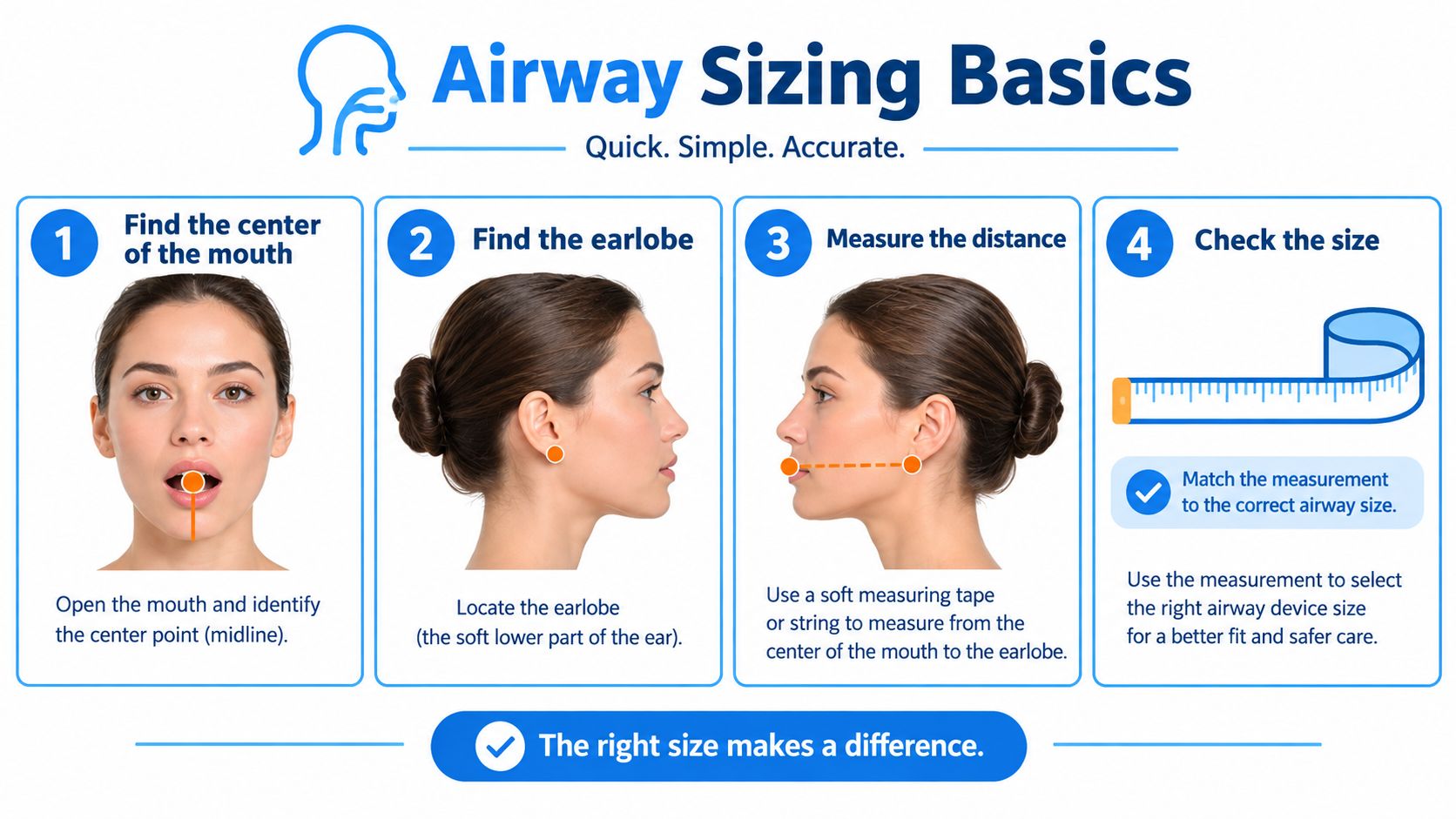
Why the landmarks matter
Place the airway alongside the patient's face. The flange should correspond approximately with the lips when the distal tip reaches toward the mandibular angle. Don't treat color coding or a labeled size as a substitute for anatomy, because manufacturers may use different color systems.
An airway that's too short may sit against the tongue without lifting it. Instead of opening the passage, it can allow the tongue to remain posterior and continue obstructing airflow. An airway that's too long can contact or displace the epiglottis, irritate deeper structures, and worsen obstruction.
The standard facial measurement is useful, but it isn't perfectly predictive, especially in children. A 2023 prospective observational MRI study assessed 94 anesthetized, spontaneously breathing children aged 12 years or younger, with a mean age of 4.7 years. Only 47.9% of inserted airways were properly sized, defined as having the distal tip within 10 mm of the epiglottis without contacting it. The study classified 23.4% as undersized and 28.7% as oversized. The PubMed study also found that the facial landmark method predicted proper sizing in 41.2% of participants, while a weight-based formula reached a modeled probability of 61.7%, not certainty.
Make size an initial estimate
After choosing the airway, be ready to evaluate whether it improves ventilation. Tongue protrusion occurred in 59.1% of children with undersized airways compared with 15.6% of children with properly sized devices in that study. No airway required replacement and no clinical problems were encountered, but the findings reinforce a practical rule: measure first, then verify function.
This sizing discipline belongs in broader pediatric emergency preparation as well. Learners completing PALS Certification should connect the measurement landmark with direct observation, ventilation assessment, and age-appropriate insertion technique rather than memorizing a device color alone.
Adult Insertion Technique and Best Practices
Adult guedel airway insertion begins with a safety decision. Use the device only when the patient is sufficiently unconscious and doesn't have an effective gag reflex. Position the patient supine. Extend the head and neck when clinically appropriate, while following spinal precautions or other clinical considerations when they apply.
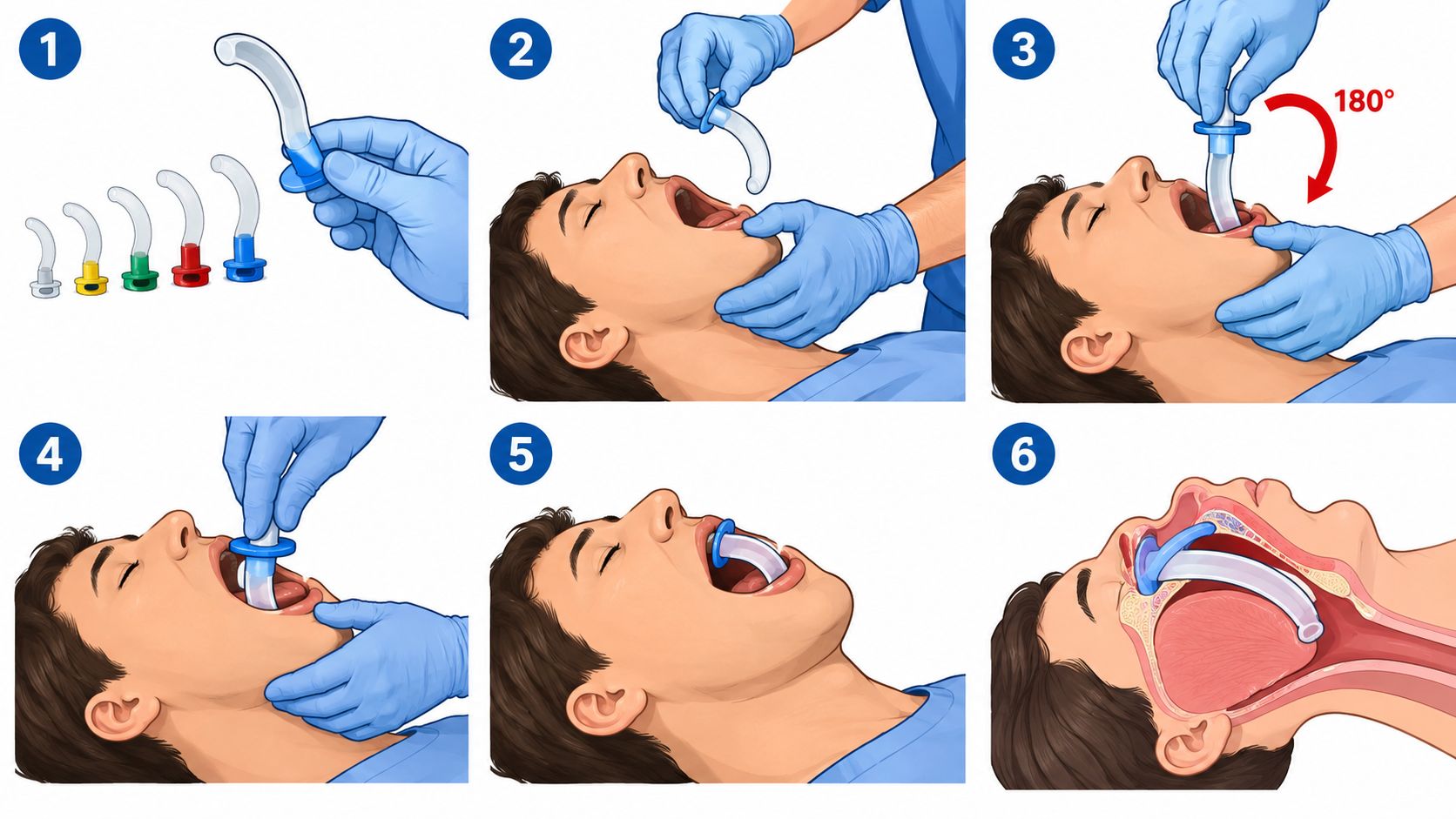
The adult sequence
- Open the mouth carefully. Inspect for secretions, vomit, blood, loose material, or visible obstruction. Use suction when clinically indicated.
- Lubricate the airway. Apply a small amount of water-soluble lubricant. Excess lubricant can make handling difficult, so use only enough to reduce friction.
- Orient the device. In adults and older children, hold the airway with its concavity initially facing upward. Advance it along the hard palate.
- Rotate at the posterior palate. When approximately one third of the device has entered the mouth and the tip reaches the posterior palate, rotate it approximately 180 degrees. This allows the curve to follow the tongue rather than pushing the tongue backward.
- Advance gently. Continue until the flange rests against the lips. Never force the device past resistance.
- Ventilate and reassess. Check chest rise, air movement, oxygenation, airway sounds, and resistance during bag-mask ventilation.
The rotation should feel controlled, not forceful. Resistance, tissue contact, bleeding, or a new deterioration in ventilation should stop the sequence. An incorrectly sized or overly advanced airway can injure the palate, pharynx, lips, or other soft tissues. Procedural guidance also emphasizes removing the airway and returning to face-mask ventilation if the patient doesn't improve clinically, because the device itself may be worsening obstruction. The retrieval-airway guideline supports this reassessment-based approach.
An ACLS Certification course can place this airway skill within a wider resuscitation framework, including bag-mask ventilation, rhythm management, and team-based response. The insertion technique still requires hands-on practice and adherence to your organization's clinical standards.
Pediatric Insertion Differences You Must Know
Children aren't just small adults. Their airway structures and proportions make the adult rotation method potentially harmful, especially in younger patients. For children younger than approximately 8 years, pediatric guidance generally recommends inserting the OPA under direct vision with the concavity facing downward and using a tongue depressor rather than rotating the device.
Adult and pediatric approaches side by side

Use the measured size, open the mouth gently, and keep the tongue under direct control. A tongue depressor helps move the tongue forward while you guide the airway along its natural contour. Advance until the flange rests at the lips. Don't twist, turn, or invert the device in infants and children, because rotation can cause soft-tissue injury or posterior tongue displacement.
Pediatric safety rule: The technique that helps adults pass over the tongue can push the tongue backward in a smaller child.
The patient's response remains decisive. An OPA is inappropriate when a child has an intact gag or cough reflex, clenches the mouth, resists, or begins gagging. Remove it if the child coughs, retches, vomits, or regains protective airway reflexes. If mouth opening is limited, don't force the jaw or the device. Reassess the airway and select an appropriate alternative under local protocol.
The age distinction belongs alongside the broader sequence of pediatric resuscitation, not as an isolated maneuver. A resource on the pediatric chain of survival can help place airway decisions within a complete response.
Troubleshooting Complications and Reassessing Ventilation
A flange resting at the lips doesn't prove that the OPA is working. It only shows that the external end has reached the expected position. The true test is functional: can you move air effectively, and does the patient tolerate the device?
Use a repeating assessment loop after insertion:
- Observe chest rise. Look for visible, symmetrical movement during bag-mask ventilation.
- Assess air movement. Listen for improved airflow and changes in airway sounds.
- Feel resistance. Increasing resistance may indicate obstruction, poor positioning, or a problem with the mask seal.
- Check oxygenation. Use available monitoring and the patient's clinical response.
- Inspect the mouth and flange. Confirm that the device hasn't migrated or become displaced.
- Respond to deterioration. Reposition, resize, remove, or escalate according to the clinical situation.
If ventilation doesn't improve, don't keep advancing the airway. Remove it and return to face-mask ventilation while reassessing head position, jaw support, suction needs, and the possibility of another airway strategy. An airway that's too short may leave the tongue obstructing the passage. One that's too long may contact deeper structures and worsen obstruction.
Gagging, coughing, retching, vomiting, or active resistance are clear warnings. Remove the OPA immediately when these responses indicate that protective reflexes are present. Avoid forceful advancement because it can injure the palate, pharynx, lips, or other soft tissues. The device also doesn't protect against aspiration, so airway care must include ongoing observation and appropriate suction.
For practical preparation, BLS Certification can connect airway adjunct use with basic resuscitation and bag-mask ventilation.
Advancing Your Airway Management Skills Online
Online education is now a valid way to prepare for knowledge-based CE and certification work. The outdated belief that only in-person American Heart Association or American Red Cross classes can produce acceptable learning isn't supported as a universal rule. Acceptance depends on the employer, regulator, credentialing organization, and practical assessment requirements, but those organizations aren't the only recognized options.
A 2024 meta-analysis of online versus offline preclinical medical education concluded that online learning was as effective as offline instruction. The peer-reviewed review supports using structured digital education for concepts such as airway selection, contraindications, age-specific technique, and post-insertion assessment.
Why the format works
Online learning can make difficult procedures easier to revisit. You can pause an insertion demonstration, review the pediatric distinction, and return to assessment questions without losing the pace of a classroom group. Spaced learning also matters. A systematic review found that spaced digital education improved postintervention knowledge compared with massed online study, with a standardized mean difference of 0.32 and a 95% confidence interval of 0.13 to 0.51. Knowledge retention also favored spaced online education, with a standardized mean difference of 0.38 and a 95% confidence interval of 0.10 to 0.65. The JMIR review reported no observed heterogeneity in that retention analysis.
The evidence doesn't mean every online course is automatically sufficient for every hands-on skill. A workplace-learning review found that 85.5%, or 47 studies, measured learner satisfaction or reaction, 27.3%, or 15 studies, measured attitudes, and 30.9% measured knowledge or skills. The systematic review also noted limited evidence for higher-level patient and organizational outcomes. A Cochrane review found little or no difference between e-learning and traditional learning for patient outcomes, professional behavior, or knowledge, while the effect on skills remained unclear. The Cochrane review supports a balanced conclusion: online formats are just as effective for many knowledge-based components, while practical competencies may still require demonstration when a credentialing body or employer requires it.
ProMed+ Nursing CE provides an online platform for continuing education, allowing nurses to complete CE requirements through a streaming library. Its future-focused model reflects the industry's gradual shift toward accessible, accredited digital education for hospitals, clinics, and individual professionals.
ProMed Certifications offers online courses for healthcare professionals, including airway-related preparation through BLS, ACLS, PALS, and continuing education pathways. Visit ProMed Certifications to review the available options, strengthen your guedel airway insertion knowledge, and choose a learning format that fits your clinical responsibilities.
.avif)
Stay compliant with ProMed+
Certifications included: ACLS, BLS, PALS, CPR & Neonatal Resuscitation
Unlimited continuing education: over 200 hours of accredited CME
All-inclusive: One price. No surprises.
Get certified today

The Advanced Cardiac Life Support (ACLS) is an accredited online medical certification course that teaches medical professionals to respond to nearly all cardiopulmonary emergencies.

The Pediatric Advanced Life Support (PALS) Recertification instructs medical professionals on performing pediatric cardiopulmonary resuscitation in emergencies.

The Basic Life Support (BLS) Recertification is intended to teach healthcare professionals the basic steps of CPR and rescue breathing for adults, children, and infants.

Our online medical certification course for CPR, Automated External Defibrillator (AED), and First Aid is designed to teach adult, child, and infant CPR and AED use.

The Neonatal Resuscitation Certification trains medical professionals in performing resuscitation procedures and life-saving techniques for newborns at the time of delivery.

.png)
.png)
.png)