


Continuing Education for Nurses in Florida: A Complete 2026 Guide
.png)
Your renewal reminder shows up in your inbox, and the first reaction is usually the same. You’re glad it’s time to keep your license current, but you also know Florida CE can feel more complicated than it should.
Most nurses aren’t confused about the idea of continuing education. They’re confused about the details. How many hours do I need this cycle? Which courses are mandatory? Can I do them online? Will they show up in CE Broker? And if I pick the wrong bundle, am I setting myself up for an audit problem later?
That’s where many Florida nurses lose time. Not on the learning itself, but on sorting through conflicting advice.
The good news is that ceu for rn in florida is manageable when you break it into a few clear decisions. You need to know your renewal cycle, your mandatory topics, how reporting works, and how to choose an approved online provider that fits real nursing life. If you want a separate overview of the renewal process itself, this Florida nursing license renewal guide is also helpful.
Navigating Your Florida RN License Renewal
Florida license renewal tends to create stress because the rules are specific, not because they’re impossible. Most of the anxiety comes from trying to remember what applies every renewal, what applies only sometimes, and what has to be tracked electronically.
A simple way to think about it is this. Your renewal has two parts. First, you complete the right continuing education. Second, you make sure that education is properly reported and categorized.
Why Florida CE feels harder than it should
Florida doesn’t just ask for general nursing education. It also requires certain state-mandated topics. Some of those topics repeat every cycle, while others show up on a staggered schedule. That’s where nurses often get tripped up.
Online learning has made this much easier than it used to be. You no longer have to block off a classroom day, commute, or wait for a local schedule to work around your shifts. For working nurses, online CE is often the most realistic way to stay compliant without turning renewal into a second job.
Practical rule: The format of the course isn’t the issue. Approval, accreditation, and correct reporting are what matter.
A calm way to approach renewal
If you’re staring at your deadline and feeling behind, don’t start by shopping randomly for courses. Start by answering three questions:
- What renewal group am I in
- Which mandatory topics apply to me this cycle
- Will my provider report directly to CE Broker
Those three answers solve most of the confusion.
Many nurses still hear outdated advice that only in-person education “counts.” That isn’t how modern CE works. Florida nurses can complete approved continuing education online, and for many people it’s the cleaner, more reliable option because it pairs learning with digital tracking.
Florida RN CEU Requirements You Must Know
You sit down after a long shift, open your renewal checklist, and immediately hit the question that trips up many Florida nurses. Do I just need 24 hours, or do I need certain courses inside those 24 hours too?
The answer is both.
Florida RN renewal works like a bucket with labeled slots. You need the full bucket of CE hours for each biennial renewal period, and some of those hours must be placed into specific state-required topics. Most RNs need 24 contact hours each renewal cycle. Every third renewal, the total becomes 26 hours because 2 hours of Domestic Violence education are added.

The courses Florida expects you to track closely
A simple way to avoid mistakes is to split your CE into two groups. First, the courses Florida specifically names. Second, the remaining hours you can complete through approved nursing education that fits your practice.
For most Florida RNs, the recurring required topics include:
- Florida Laws and Rules: 2 hours each renewal
- Prevention of Medical Errors: 2 hours each renewal
- Human Trafficking: 2 hours each renewal
A few topics follow a staggered schedule, which is where confusion usually starts:
- Recognizing Impairment in the Workplace: 2 hours every second renewal
- Domestic Violence: 2 hours every third renewal
- HIV/AIDS: 1 hour one time for first-time renewal
If you also hold an APRN license, a 3-hour course on Safe and Effective Prescribing of Controlled Substances is part of that advanced practice requirement. This guide stays focused on RNs, but dual-role nurses should check both sets of obligations before assuming one course package covers everything.
Florida RN Mandatory CEU Courses and Frequency

How to think about the rest of your hours
Once those required topics are accounted for, the remaining hours are more flexible. That is good news for working nurses, because it means you can choose approved education that matches your unit, patient population, or current role instead of forcing yourself through unrelated material.
Online learning often fits best here. If you work nights, rotate weekends, or are balancing family responsibilities, self-paced courses let you complete the remaining hours in smaller blocks instead of giving up an entire day. For a wider view of how Florida compares with other states, this guide to continuing education requirements for nurses by state can help.
A practical rule helps: complete the fixed state topics first, then fill the rest of your hours with approved courses that are useful in your real practice.
Know your renewal group before you buy courses
Florida renewal dates are staggered, so a coworker’s deadline may have nothing to do with yours.
The state groups licenses by renewal schedule:
- Group 1 RN/APRN licenses expire April 30 of even years
- Group 2 RN/APRN licenses expire July 31 of even years
- Group 3 RN/APRN licenses expire April 30 of odd years
- LPN licenses expire July 31 of odd years
That matters because your “every second renewal” or “every third renewal” topics depend on your own renewal history, not on what another nurse on your unit happens to be completing this year.
The part that causes the most mistakes
Many nurses do not miss renewal because they ignored CE. They miss it because they completed general hours and overlooked one required topic tied to a specific cycle.
Keep a simple personal record with:
- Your last renewal date
- The mandatory courses you completed during that cycle
- Whether your next renewal triggers a second- or third-cycle requirement
That small habit removes a lot of uncertainty. It also makes online CE much easier to use with confidence, because you can choose courses based on your exact gap instead of guessing and hoping the package is right.
The Truth About Online CEUs and Provider Accreditation
Online CE is valid. For many nurses, it’s the most practical format available.
That still surprises people because healthcare has long carried the assumption that “serious” education must happen in a classroom. But for continuing education, the true standard isn’t whether you sat in a hotel conference room or completed a module from your tablet after a shift. The essential standard is whether the course comes from a properly accredited, approved provider and whether it fulfills the right requirement.

Format doesn’t determine quality
A weak in-person course is still weak. A well-designed online course can be clear, efficient, and easier to retain because you can pause, repeat, and complete it on your own schedule.
That matters in nursing, where shift work, family responsibilities, and rotating schedules make fixed-seat classes hard to attend. Online CE lets you fit education into real life instead of rearranging your life around a classroom date.
It also helps with accuracy. When you complete online courses through an integrated provider, your records are usually cleaner, certificates are easier to retrieve, and reporting is less likely to get lost in the shuffle.
What actually matters when choosing a provider
If you’re trying to judge whether an online CE option is legitimate, look at these points first:
- Accreditation: Check whether the provider is ANCC-accredited or otherwise appropriately approved for nursing CE.
- Florida-specific course availability: Make sure the provider offers the mandatory topics you need, not just general nursing content.
- CE Broker reporting: Prefer providers that report completed hours electronically.
- Course labeling: The course should clearly identify the requirement it fulfills, especially for staggered mandates.
- Access model: Busy nurses often do better with self-paced access than with live scheduled sessions.
The old AHA-or-Red-Cross-only mindset
One of the most persistent myths in healthcare education is that only a small handful of traditional organizations count. That isn’t true for nursing CE.
For continuing education, what matters is that the coursework is accepted, accredited, and properly reported. The logo on the course page is not the whole story. Plenty of online providers offer valid, high-quality education that healthcare professionals and employers recognize.
If a course is accredited, approved, and correctly reported, the fact that you took it online doesn’t make it less legitimate.
Why many nurses prefer online CE
The practical advantages are easy to understand:
- Scheduling freedom: You can complete coursework before work, after a night shift, or in short blocks on days off.
- Less disruption: No travel, parking, or time spent waiting for a live session to start.
- Faster documentation: Certificates are typically available right away.
- Easier review: You can revisit material instead of relying on one live presentation.
That doesn’t mean in-person learning has no place. Some nurses prefer the classroom environment. But preference and validity are different questions. Online CE for Florida nurses is a normal, accepted path when the provider meets the right standards.
How to Report Your Hours with CE Broker
You finish a late-night online course after a long shift. The certificate hits your inbox right away, so it feels done. Then renewal season gets closer, you log into CE Broker, and the course is not there. That moment is what makes many Florida nurses anxious about CE. The course may be valid and completed, but if the reporting trail is unclear, confidence disappears fast.
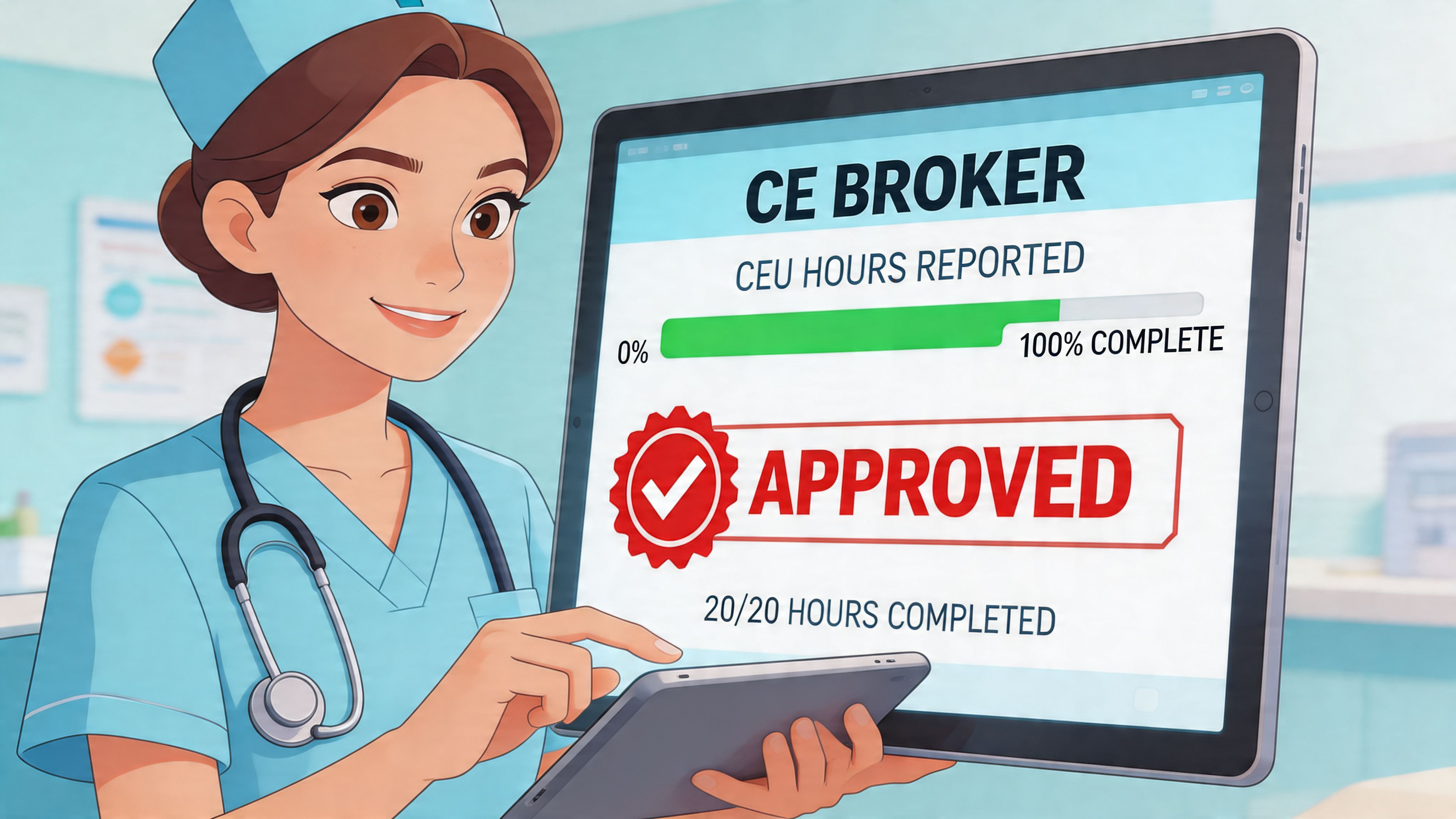
CE Broker is the system Florida nurses use to verify what has been reported toward renewal. A good way to view it is as your license renewal dashboard. Your course provider may teach the material, but CE Broker is where you confirm the state can see it.
Why electronic reporting matters
Online learning has made CE much more flexible, but flexibility only helps if the recordkeeping is clear. That is why many nurses prefer providers that report completions directly to CE Broker. It cuts out one of the most common points of confusion, which is assuming a certificate in your email means the state record is already updated.
There are two separate steps. First, you complete the course. Second, the completion has to appear in the tracking system you rely on for renewal. Those steps often happen close together, but they are not the same thing.
A simple way to use CE Broker
You do not need to check CE Broker every week or treat it like a complicated compliance project. A steady routine works better.
Use it for three practical checks:
- Confirm your license and profile details are correct
- Review your transcript after each completed course posts
- Check that required topics are listed in the right category before renewal
If you have never set it up before, this CE Broker account guide for nurses explains the process in plain language.
What your transcript should tell you
Your transcript should answer a few basic questions without making you hunt for the information:
- Do my completed hours appear?
- Are Florida-required topics marked correctly?
- Is anything pending or missing?
- Am I counting on a certificate that still has not been reported?
That last question causes more stress than nurses expect. Completing a course and proving it has been reported are related, but they are different tasks. CE Broker helps you verify the second one.
The easiest strategy for busy nurses
For a busy RN, the least stressful setup is usually an online provider that reports to CE Broker for you automatically. It is similar to direct deposit versus carrying a paper check to the bank yourself. Both can work, but one leaves fewer chances for delay, forgetfulness, or a missing step.
One example is ProMed Certifications, which offers ANCC-accredited nursing CE, Florida-required topics, and automated CE Broker reporting as part of its online CE platform. That kind of arrangement is useful for nurses who want a simpler process with fewer manual tasks.
The easier your reporting process is, the easier it is to spot a problem early and fix it before renewal pressure builds.
When to check
A calm schedule usually works better than a last-week scramble:
- After each course: confirm it posted
- A few months before renewal: review whether your required topics are showing correctly
- Before you submit renewal: make sure nothing is missing, uncategorized, or still pending
This is the part many nurses overlook. CE Broker is not just there for emergencies. It works best as a quick verification habit, especially if you are using modern online CE and want the convenience of flexible learning without guessing whether everything was reported properly.
Common Pitfalls and How to Avoid License Disruption
You finish your CE courses, log in to review your renewal record, and realize one required topic is missing or posted under the wrong category. That is how license trouble usually starts in Florida. Not with neglect, but with a small administrative miss that shows up at the worst time.

A lot of nurses assume the hard part is finishing the hours. Often, the harder part is making sure each course fits the right Florida requirement, in the right renewal cycle, and appears correctly in the system. Online learning has made CE far more flexible, which is a good thing. It has also made it easy to click into a course that sounds right without confirming that it satisfies your exact renewal need.
The staggered-topic trap
This is the mistake I see most often. A nurse buys a broad CE package, completes the hours, and assumes the package covers every required topic due that cycle. Sometimes it does. Sometimes it does not.
Florida includes staggered requirements, so not every mandatory topic comes due at every renewal. That is where confusion builds. A course can be useful, accredited, and fully legitimate, yet still not be the course you need right now.
Two examples that commonly trip people up are:
- Recognizing Impairment in the Workplace, which is due every other renewal
- Domestic Violence, which is due every third renewal
If you do not track your own cycle, a generic bundle can give you a false sense of security.
Three errors that create the most last-minute stress
1. Assuming "all-in-one" means "all due now."
A bundle may include Florida topics, but your renewal depends on timing, not just availability. The course library and your personal cycle are two different things.
2. Trusting the course title without checking the category.
This is similar to grabbing the right medication class but the wrong dosage. The label may look close enough at first glance, but close enough is not what protects your license. A nursing CE course can be high quality and still fail to meet a Florida-specific mandate.
3. Waiting until renewal week to review your record.
If a provider needs to correct reporting, or if you need to take a different required topic, time matters. A problem found early is usually manageable. A problem found at the deadline feels much bigger than it is.
A simple way to stay organized
You do not need a complicated spreadsheet or a color-coded binder.
A single renewal note works well if you update it as you go. Keep it on your phone, in a notes app, or wherever you already track work tasks.
Include:
- Your renewal date
- Each course completed
- Which courses satisfy Florida-mandated topics
- Which staggered requirements were due this cycle
- Whether each item appears correctly in CE Broker
That last point matters more than many nurses expect. Hours alone do not tell the whole story. Categories and timing do.
Track what the course satisfies, not just that you took it.
What to do if something looks wrong
Start with the basics. Check the course certificate, the exact course title, and how the completion appears on your transcript. If the issue looks like a reporting delay or posting error, contact the provider promptly and keep a copy of your certificate.
If the bigger concern is whether the course meets the Florida requirement you thought it did, do not wait and hope it will count. The safer choice is to complete the correct course before your deadline. That may feel repetitive, but certainty is better than guessing when your license is on the line.
This is one area where modern online CE can reduce stress. Reputable providers usually make certificates easy to access, course details easy to verify, and corrections easier to request than with older paper-heavy systems. The flexibility is real. You just want to pair that flexibility with a quick verification habit.
Habits that protect your license
A few routines prevent most problems:
- Complete required Florida topics early in your cycle
- Review each completion for the correct requirement
- Keep your own renewal note instead of relying on memory
- Pay special attention to every-other-renewal and every-third-renewal topics
- Treat unclear transcript entries as problems to fix now, not later
Most renewal trouble comes from preventable paperwork and timing errors, not from nurses refusing to do the work. If you use online CE with a little structure, the process becomes much easier to manage. That is the goal. Fewer surprises, clearer records, and renewal done with confidence instead of last-minute worry.
The ProMed Advantage Simplifying Your Florida CEU Compliance
Once you understand Florida’s rules, the practical question becomes simple. Which kind of CE setup creates the fewest chances for error?
For most nurses, the answer is an all-in-one online system rather than piecing courses together from multiple places. When your CE lives in one account, your records are easier to review, your required topics are easier to find, and your renewal feels more manageable.
What a practical CE platform should offer
A useful Florida CE solution should do more than host classes. It should reduce admin work.
Look for these features:
- Florida-required topics in one library
- ANCC-accredited content
- Self-paced mobile access
- Instant certificates
- Automated reporting to CE Broker
- Clear labeling of what each course satisfies
When those pieces are in place, online CE stops feeling like a compliance puzzle and starts feeling like routine professional maintenance.
Why integrated access matters
Many nurses don’t struggle with learning the material. They struggle with the hunt. One provider has general education. Another has a required topic. A third has a certification course. By the time you’ve patched everything together, you’re managing multiple passwords, certificates, and reporting timelines.
An integrated platform removes that friction. It also fits the way nurses learn now. Short sessions between shifts, mobile review on breaks, and self-paced modules at home are normal. That’s not a lesser version of education. It’s a practical one.
A realistic fit for working nurses
ProMed’s nursing CE platform offers more than 200 hours of ANCC-accredited content, including Florida mandatories and automated CE Broker reporting, based on the publisher information provided for this article. It also includes flexible online access and options that pair CE with certifications like ACLS, BLS, PALS, CPR, and Neonatal Resuscitation.
For nurses who want fewer accounts and less paperwork, that kind of structure is often easier to maintain over the long term.
The larger point is broader than any single provider. The strongest modern CE options are online, accredited, and designed around the reality that nurses need education to fit their schedules, not compete with them.
Frequently Asked Questions About Florida RN CEUs
Florida renewal questions usually show up in the fine print, not the basics. These are the situations nurses ask about most often.
Can I complete all my Florida RN CEUs online
Yes, as long as you use an approved, accredited provider and the courses satisfy Florida requirements. Online CE is a valid format for nursing continuing education. What matters is approval, accreditation, and proper reporting.
Do I need the same mandatory courses every renewal
Not exactly. Some mandatory topics repeat every cycle, while others are staggered. That’s why nurses should track not just total hours, but which requirement was satisfied in which renewal period.
What if I finished a course but don’t see it in CE Broker
Check your transcript before assuming everything is fine. If a completion is missing, contact the provider and compare your certificate details with what appears in your account. A missing post is easier to fix early than near the deadline.
Are online CEUs less accepted than in-person ones
No. That idea is outdated. For CE, the issue isn’t online versus classroom. The issue is whether the education is legitimate, accredited, and accepted for your licensing requirement. Many nurses choose online learning because it’s easier to fit around shifts and family responsibilities.
Do I need to keep my certificates if courses are reported automatically
Yes, keeping your own records is still smart. Automated reporting helps, but your certificates are part of your professional documentation. Save them in one folder and make sure the course title matches the requirement you intended to fulfill.
What if I’m not sure whether this is my Domestic Violence or Impairment cycle
Don’t guess. Review your previous renewal records and compare them with your CE Broker transcript. If you still can’t tell, it’s safer to verify before the deadline than to assume a generic bundle covered the right staggered topic.
Is the first renewal different from later renewals
Yes. First-time renewal can include one-time requirements such as HIV/AIDS. Nurses often get confused because advice from coworkers may reflect a later-cycle renewal, not a first one. Always base your plan on your own renewal history.
Can I mix certification coursework with CE learning
In many cases, nurses use a combination of CE courses and certification-related education depending on what the provider offers and how the material is accredited. The key is to confirm that the activity counts toward your nursing CE requirement and is reported correctly.
Renewal gets easier once you stop treating it like a one-time scramble. A good online CE routine, a quick transcript check, and a simple record of your staggered topics usually remove most of the stress.
If you want a simpler way to handle Florida renewal, ProMed Certifications offers online nursing CE with Florida-required topics, ANCC-accredited coursework, instant certificates, and CE Broker reporting built into the workflow. For busy nurses, that kind of setup can make ceu for rn in florida much easier to manage with confidence.
.avif)
Stay compliant with ProMed+
Certifications included: ACLS, BLS, PALS, CPR & Neonatal Resuscitation
Unlimited continuing education: over 200 hours of accredited CME
All-inclusive: One price. No surprises.
Get certified today

The Advanced Cardiac Life Support (ACLS) is an accredited online medical certification course that teaches medical professionals to respond to nearly all cardiopulmonary emergencies.

The Pediatric Advanced Life Support (PALS) Recertification instructs medical professionals on performing pediatric cardiopulmonary resuscitation in emergencies.

The Basic Life Support (BLS) Recertification is intended to teach healthcare professionals the basic steps of CPR and rescue breathing for adults, children, and infants.

Our online medical certification course for CPR, Automated External Defibrillator (AED), and First Aid is designed to teach adult, child, and infant CPR and AED use.

The Neonatal Resuscitation Certification trains medical professionals in performing resuscitation procedures and life-saving techniques for newborns at the time of delivery.

.png)
.png)
.png)