


How to Renew Your Nursing License: A Quick & Easy Guide

Keeping your nursing license active isn't just a box to check off a to-do list; it's the foundation of your professional practice. The entire process is designed to make sure every nurse stays competent, compliant, and legally cleared to provide patient care. This guide will help you navigate each step with confidence.
Why Your Nursing License Renewal Is a Big Deal
Honestly, renewing your license is more than just administrative paperwork. It’s a critical part of our professional responsibility as nurses. This regular cycle ensures we're all keeping our skills sharp and our knowledge current, which leads directly to safer and more effective care for our patients.
Think of it as a professional checkpoint. Every couple of years, the renewal process confirms your commitment to lifelong learning and staying aligned with the latest evidence-based practices. For most of us, the biggest piece of this puzzle is getting our continuing education (CE) credits in on time.
The Core Steps of Renewal
While every state board has its own quirks, the renewal journey generally follows the same basic path. Knowing what to expect ahead of time can turn a potentially stressful task into a smooth, straightforward one.
Here’s what you’ll typically need to tackle:
- Verify Your Eligibility: First things first, you need to confirm your license is in good standing and that you meet all the baseline criteria your state board requires.
- Complete Continuing Education (CE): This is where you'll complete a specific number of educational hours to stay on top of clinical knowledge and best practices.
- Submit Your Application: You'll fill out the official renewal application, which is almost always done through your state nursing board's online portal.
- Pay the Renewal Fee: The final step is submitting the required fee to process and finalize your application.
Successfully knocking out these steps ensures you don't have any interruptions in your ability to work. Let's be real—the CE component is usually what takes the most time and planning. To get a head start, it's always a good idea to check out options for free continuing education units for nurses and see what's out there.
To help you visualize the process from start to finish, here's a quick summary of what to expect.
Nursing License Renewal At a Glance
This table breaks down the essential parts of the renewal process, giving you a clear picture of what's involved.
Renewal ComponentTypical RequirementKey ActionEligibility CheckActive, unencumbered licenseLog into your state board portal to confirm your status.Continuing Education20-30 contact hours per 2-year cycleComplete accredited CE courses and save your certificates.Application SubmissionOnline form via state board websiteFill out all required fields accurately before the deadline.Fee Payment$50 - $150+Pay via credit/debit card through the online portal.VerificationInstant or within 1-2 business daysCheck your license status on the state's public verification site.
Having a mental map like this makes the whole renewal process feel much more manageable. Now, let's dive into each of these components so you know exactly what to do.
Navigating Continuing Education Requirements
Continuing Education (CE) is the absolute cornerstone of your nursing license renewal. It’s how you stay sharp and up-to-date with evolving practices, which is critical for providing the best possible patient care. But let’s be real—juggling contact hours, finding accredited providers, and keeping track of it all can feel like a second job.
Most states have their own Boards of Nursing that set the rules, and a huge part of that is requiring CEs or a certain number of clinical practice hours to renew. In fact, according to the National Council of State Boards of Nursing (NCSBN), over 90% of U.S. states mandate continuing education for renewal. It's a clear sign of a nationwide commitment to keeping our skills fresh and ensuring patient safety.
The Myth About In-Person Classes
There's a persistent, outdated belief that only in-person classes from providers like the AHA or American Red Cross are valid for CE. This is simply not true anymore. As the healthcare industry modernizes, so has the acceptance of high-quality online education.
Today, online CE is a powerful and widely recognized way to meet your renewal requirements. Many peer-reviewed studies and industry articles support the effectiveness of online learning, showing that outcomes for patient care and knowledge retention are equal, and often superior, to traditional classroom formats.
Why Online CE is a Lifesaver for Nurses
Let's face it, our schedules are demanding. The flexibility of online learning is a total game-changer. Instead of blocking off a whole weekend and rearranging your life for a seminar, you can knock out your required hours whenever and wherever it works for you.
Here’s a quick look at how the two stack up:
FeatureOnline CEIn-Person CEScheduleOn your terms: Learn whenever you have a spare moment.Rigid: You're locked into specific dates and times.CostBudget-friendly: No extra costs for travel, parking, or hotels.Pricey: Factor in travel, food, and potentially taking time off work.Learning StyleSelf-paced: Rewatch lectures and review materials as much as you need.One-shot deal: The lecture happens once, and that's it.AccessibilityInstant: Log in from your laptop, tablet, or phone.Location-based: You have to physically travel to the class.
This isn't just a trend; it's a fundamental shift. The industry consensus is evolving, with hospitals, clinics, and professional organizations increasingly recognizing accredited online providers for their convenience and quality.
The old idea that only in-person training counts is on its way out. What really matters now is the quality of the education and whether it’s properly accredited, not the format. High-quality online CE is specifically designed to meet the same tough standards set by state nursing boards.
Making Sure Your Courses Actually Count
When you're picking courses to satisfy your renewal hours, one thing matters more than anything else: accreditation. Your state board of nursing has a specific list of accrediting bodies it recognizes, and you need to make sure your provider is on it. One of the most common and respected is the American Nurses Credentialing Center (ANCC).
Before you sign up for anything, just run through this quick checklist:
- Look for Accreditation: Any reputable provider will have their accreditation info displayed clearly on their website. If you have to hunt for it, that's a red flag.
- Double-Check with Your Board: Pop over to your state board's website. They should have a list of approved accrediting bodies you can cross-reference.
- Find an All-in-One Solution: Using a platform that offers a ton of state-approved nursing CE courses can make your life so much easier. You’ll know that every course you take is already compliant.
By choosing accredited online courses, you can be confident you’re meeting your requirements with top-notch education that actually fits into your life.
Okay, you've knocked out your Continuing Education (CE) hours. Now for the last little bit of admin work: the renewal application itself.
I know, I know—this is the part that feels like a chore. But once you know what to expect, it’s really just a matter of checking a few boxes. Let’s walk through it so you can get it done and get on with your life.
Finding and Filling Out the Online Application
First things first, you'll need to head over to your state's official board of nursing portal. If you don't have it bookmarked, a quick search for "[Your State] Board of Nursing" will get you right where you need to be.
Once you're logged in, the process is usually pretty straightforward. You'll start by updating your personal information. This is critical—make sure your name, address, and all your contact details are current. A simple typo or an old address can cause surprisingly annoying delays.
The application will then guide you through a few sections. You'll confirm your details, answer some standard questions about your professional conduct, and, of course, formally attest that you’ve completed all your required CE hours.
Take a second to double-check every single field before you click "next." It's so easy to breeze through and miss something small.
A Quick Pro Tip: Keep your CE certificates in a dedicated digital folder. Even if your state's application doesn't ask you to upload them right away, many boards conduct random audits. If you get picked, you'll have to provide proof of completion, and having everything organized makes it a non-issue.
This is a clean illustration showing a nurse completing their CE requirements online, a crucial step before starting the application.
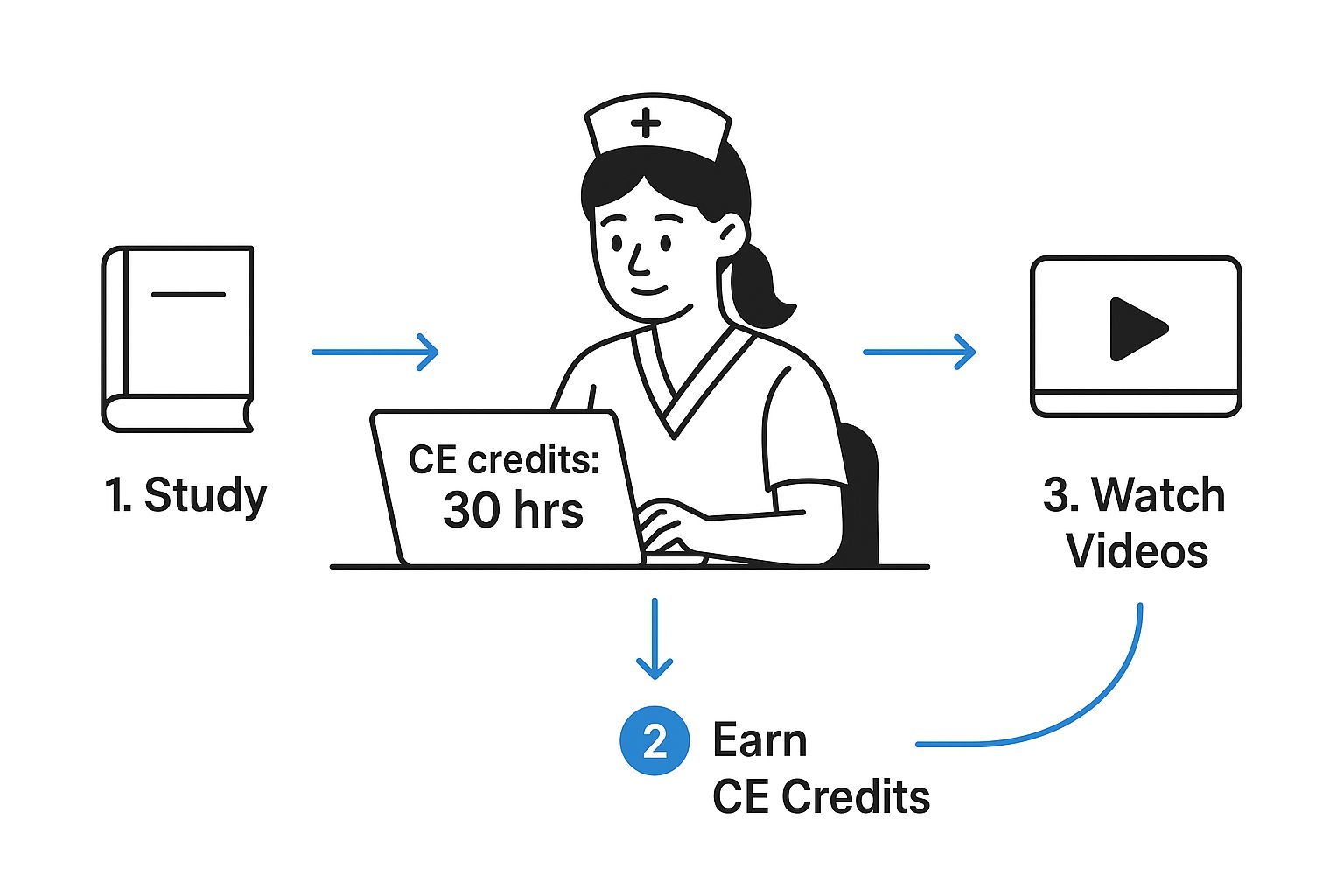
This visual highlights that modern, flexible online options are a key part of the renewal journey for today's nurses.
Finalizing, Paying, and Confirming
The home stretch is just paying the fee and hitting submit. Most boards take credit or debit cards online. One of the most common hiccups I've seen is a failed payment because of an expired card. Just give your card details a quick once-over to make sure they're correct. A simple thing like that can put your whole renewal on hold.
After you've paid, you should get a confirmation email and a receipt. Save this. It’s your proof that you’ve done your part.
So, how do you know it's official? You can typically check your renewed license status within a few business days. Just hop onto your state board’s website or use a national database like Nursys to verify it.
The best advice I can give is to submit your application well before the deadline. It builds in a buffer for any unexpected snags and saves you the stress of worrying about a license lapse.
And with that, you’re done! You can get back to what actually matters—caring for your patients.
Getting to Grips With State-Specific Renewal Rules
While the basic idea of renewing your nursing license is the same everywhere, the actual nitty-gritty details can change dramatically the moment you cross a state line. Every state’s Board of Nursing has its own playbook, and you absolutely have to know their specific rules to stay compliant. This is especially true if you’re a travel nurse or juggling licenses in multiple states.
Think of it like a standard care plan. The goal—keeping your license active—is universal, but the interventions are tailored to the specific "patient," which in this case is the state you're practicing in. And these aren't just minor differences; they can seriously affect how you prep for renewal.
Key Differences in State Requirements
You'll quickly notice that state requirements can go in completely different directions, especially when it comes to a few key areas. For instance, one state might just ask for a general number of CE hours, while another gets super specific about the exact topics you need to cover.
Here are the most common variations to keep on your radar:
- Mandatory CE Topics: A lot of states have a list of required courses. In Florida, for example, you have to complete CEs on human trafficking, domestic violence, and medical error prevention. Over in Texas, they mandate courses on jurisprudence and ethics.
- Practice Hour Requirements: Some states offer an alternative to piling up CE credits. Texas is a good example here, too—they let you meet renewal requirements by clocking a certain number of practice hours. It's a great option for nurses who are already working full-time in a clinical setting.
- Renewal Cycles: The renewal timeline isn't one-size-fits-all. A two-year cycle is pretty standard, but don't assume. California, for instance, has RNs renew every two years, but the deadline is tied to your birth month.
This isn't just a U.S. thing. Globally, there's a huge push for continuing professional development to make sure nurses are ready for modern healthcare challenges. This trend really underscores why staying current is so important—a principle you can see reflected in all the different requirements set by state boards.
How to Handle Multi-State and Compact Licenses
If you're practicing under the Nurse Licensure Compact (NLC), things work a bit differently. With a multi-state license, you only have to worry about renewing your license in your primary state of residence (PSOR). That’s the state you legally call home.
But here’s the catch: you still have to follow all the renewal rules of your home state, including any of those state-specific mandatory courses. Even though your license lets you work in other NLC states, it's your home state’s rulebook that matters for your renewal application.
Now, if you’re a travel nurse working in a non-compact state, you’ll need to get and maintain a single-state license just for that location. This can mean you’re suddenly juggling multiple renewal deadlines and completely different sets of CE requirements. Organization is everything. The best advice I can give is to bookmark your state’s Board of Nursing website and treat it as the ultimate source of truth for every deadline, fee, and required CE.
Common Renewal Mistakes and How to Avoid Them
Even the most organized nurse can hit a snag during license renewal. Trust me, it happens. Knowing the common pitfalls ahead of time is the absolute best way to make sure the process is smooth and stress-free. A simple oversight can lead to frustrating delays, extra fees, or even a temporary lapse in your ability to practice.
The consequences of missing your renewal deadline can be a real headache. At best, you might get slapped with a hefty late fee. At worst, your license could be suspended or moved to inactive status, which legally prevents you from working until it's reinstated. That process often means more paperwork, more fees, and sometimes even extra CE requirements.
.png)
Misinterpreting CE Requirements
One of the biggest tripwires I see is misunderstanding Continuing Education rules. It’s so easy to assume all CE hours are created equal, but many states have very specific mandates. For example, a nurse might complete 30 hours of great general nursing courses, only to find out their state required two of those hours to be on substance abuse and another on human trafficking. Ouch.
Another common slip-up is taking courses from a non-accredited provider. The world of nursing education has changed—the old idea that only in-person training from legacy organizations like the AHA is valid is long gone. High-quality online CE is just as effective and widely accepted, but you must verify that the provider is recognized by your state board. Always look for ANCC accreditation or other board-approved credentials before you sign up and pay for a course.
Submitting an Inaccurate Application
Small errors on your application can cause big headaches. I'm talking about a simple typo in your license number, an old mailing address you forgot to update, or an expired credit card for the payment. These seem like tiny details, but they can get your application flagged or outright rejected, grinding the whole process to a halt.
The demand for skilled nurses is always growing, and renewal protocols are constantly evolving to ensure high standards of patient care. In the U.S. alone, about 194,500 registered nurse positions open up each year, making efficient license renewal essential for maintaining a stable workforce.
To sidestep these common errors, make yourself a pre-submission checklist. It’s a simple step that can save you a world of trouble.
Your Pre-Submission Checklist:
- CE Check: Did I complete all the topic-specific courses my state requires?
- Accreditation Verified: Is my CE provider approved by my state's Board of Nursing?
- Personal Info: Is my name, address, and contact information 100% correct and up to date?
- License Number: Did I double-check my license number for typos? No, really, check it again.
- Payment Method: Is my credit card info current and not expiring next week?
By taking just a few extra minutes to review everything, you can confidently hit ‘submit’ knowing you've dodged the most common renewal landmines.
Your Nursing License Renewal Questions Answered
Even when you have a solid plan, a few specific questions always seem to pop up during the nursing license renewal process. Let's tackle some of the most common ones I hear from nurses to make sure you feel completely prepared.
What Happens If I Miss My Nursing License Renewal Deadline?
Missing your deadline can snowball into a serious headache. Most state boards will give you a grace period—often around 30 days—where you can still renew, but you’ll get hit with a late fee.
But if you miss that grace period? Your license will likely become inactive or even suspended. That means you cannot legally practice as a nurse until you get it sorted out. Reinstatement usually involves much higher fees, extra CE hours, and sometimes a whole new background check. It's just not worth the stress; renewing early is always the best policy.
Can I Use the Same CE Courses for Multiple State Licenses?
For the most part, yes, you can. The trick is to use a provider whose courses are accredited and recognized by every single state where you hold a license. Courses accredited by the ANCC, for example, are the gold standard and are accepted pretty much everywhere.
However—and this is a big one—you still have to meet the specific topic requirements for each state. For instance, Florida might require a course on human trafficking, while Pennsylvania mandates one on child abuse reporting. You have to check each state board’s unique rules to ensure your CE plan covers all your bases.
How Do I Know If an Online CE Provider Is Legitimate?
A legitimate online provider will be completely upfront about its accreditations; you shouldn't have to dig for that information on their website. The old-school belief that only in-person training from organizations like the AHA or Red Cross is valid is long gone. High-quality online education is now widely recognized as just as effective, if not more convenient.
To be sure, look for accreditations from respected bodies like the ANCC. You can also double-check by cross-referencing the provider with your state board’s list of approved options. Reputable platforms like ProMed are at the forefront of this change, delivering education that meets these standards, giving you a credible and flexible way to get your CEs done.
How Far in Advance Should I Start My Renewal?
I always tell nurses to start the process at least 90 days before their license is set to expire. This gives you a comfortable amount of time to figure out your state’s requirements, complete your CE courses without cramming, and get your application submitted.
Starting early also builds in a buffer for any unexpected hiccups, like a glitch in the online portal or a question from the board about your application. Procrastination is the biggest enemy of a smooth renewal. To stay on top of things, it's also a great idea to learn about how to get notified when it's time to recertify so you never risk missing a deadline.
At ProMed Certifications, we make meeting your continuing education requirements simple with fully accredited, 100% online courses. Our platform is designed for busy healthcare professionals like you, offering the flexibility to learn on your schedule while ensuring you get the high-quality education your state board demands. Stay compliant and confident with ProMed. Explore our CE and certification courses today!
.avif)
Stay compliant with ProMed+
Certifications included: ACLS, BLS, PALS, CPR & Neonatal Resuscitation
Unlimited continuing education: over 200 hours of accredited CME
All-inclusive: One price. No surprises.
Get certified today

The Advanced Cardiac Life Support (ACLS) is an accredited online medical certification course that teaches medical professionals to respond to nearly all cardiopulmonary emergencies.

The Pediatric Advanced Life Support (PALS) Recertification instructs medical professionals on performing pediatric cardiopulmonary resuscitation in emergencies.

The Basic Life Support (BLS) Recertification is intended to teach healthcare professionals the basic steps of CPR and rescue breathing for adults, children, and infants.

Our online medical certification course for CPR, Automated External Defibrillator (AED), and First Aid is designed to teach adult, child, and infant CPR and AED use.

The Neonatal Resuscitation Certification trains medical professionals in performing resuscitation procedures and life-saving techniques for newborns at the time of delivery.

.png)
.png)
.png)