


What Does SP Mean?
.png)
You're probably here because you saw SP in a chart, text, message thread, or form and paused for a second. That pause matters. In healthcare, two letters can change your interpretation of a note, a handoff, or a patient's history.
The question What does SP mean doesn't have one answer. It has a context problem. In clinical charting, it often points to one meaning. In lab work, secure messaging, casual staff texts, and business systems, it can mean something completely different. The safest approach is to read the setting first, then decode the abbreviation.
What SP Means and Why It Matters
A common real-world problem looks like this. You review a chart and see S/P appendectomy. Later, someone messages that “the SP in room 4 needs follow-up.” Those may not mean the same thing at all.
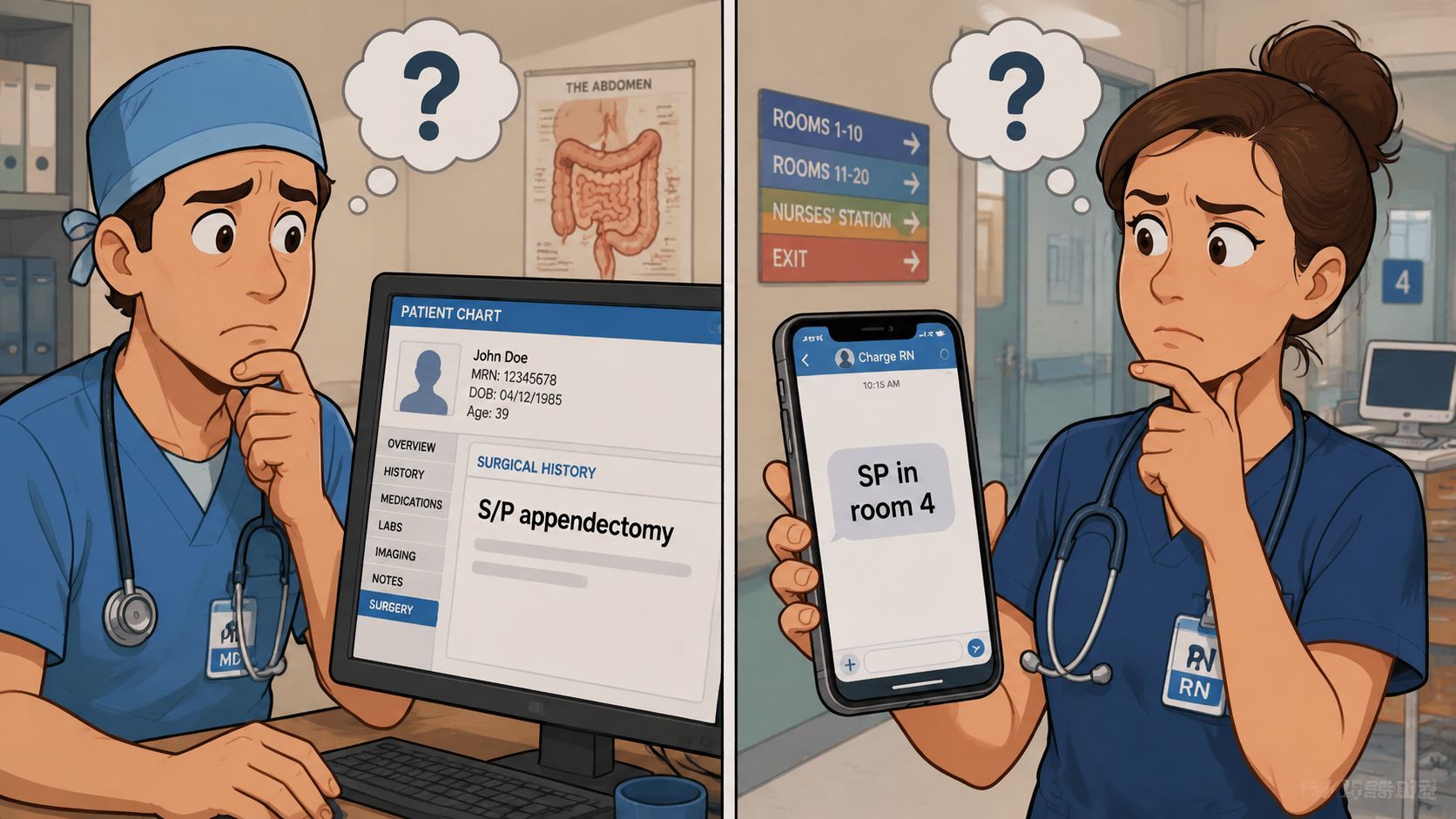
In healthcare settings, abbreviation meaning often shifts between formal documentation and informal communication. Existing content on this topic rarely addresses that overlap, even though healthcare teams may mix clinical uses such as species or specific with informal slang like special person or special powers in staff messaging.
Why context changes everything
Think of SP like a label on an unlabeled medication syringe. The letters alone aren't enough. You need surrounding information before you can act safely.
Here's the practical framework:
- Look at the setting: A chart note, pharmacy message, billing system, and text thread each favor different meanings.
- Check punctuation: S/P often signals one medical use, while SP without the slash may suggest another.
- Read the full sentence: Nearby words usually tell you whether the term refers to patient history, precautions, anatomy, lab terminology, or casual slang.
- When unsure, write it out: Full terms reduce risk and help the next clinician read your note correctly.
Practical rule: If an abbreviation can be read two ways, it shouldn't stand alone in patient-facing documentation.
Clear communication isn't just a style preference. It supports safer handoffs, cleaner records, and faster decision-making. That matters whether you're a nurse documenting a procedure, a physician reviewing history, or a student trying to make sense of shorthand during training.
Understanding S/P for Status Post in Medical Charting
In clinical documentation, S/P most often means status post. It tells you that a patient has already experienced a procedure, diagnosis, or event.
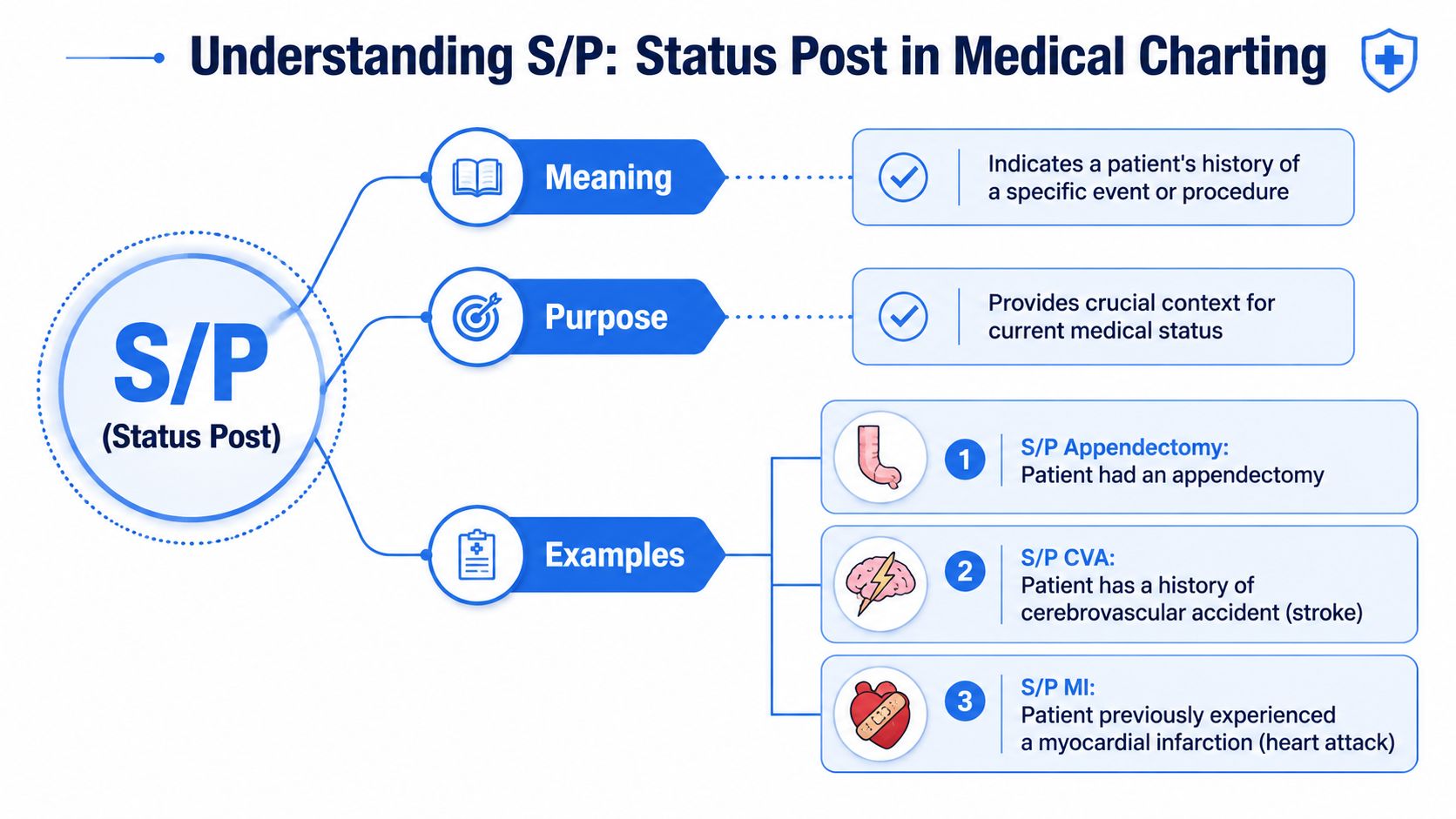
What status post actually means
The easiest way to remember it is this. Status post works like a timestamp in the medical record. It says, “This happened before now, and it still matters.”
Examples you may see include:
- S/P appendectomy
- S/P CABG
- S/P MI
- S/P CVA
Each one signals prior history, not a new event happening in the moment.
How clinicians use it
A note that says S/P MI means the patient previously had a myocardial infarction. A note that says S/P CABG means the patient has undergone coronary artery bypass grafting. That background changes how you think about symptoms, medications, monitoring, and risk.
A few plain-language examples help:
- S/P appendectomy: The appendix has already been removed.
- S/P MI: The patient has a past heart attack in their history.
- S/P CVA: The patient has a prior cerebrovascular accident, or stroke.
- S/P joint replacement: The patient previously had that orthopedic procedure.
When you read S/P, don't ask, “What's happening now?” Ask, “What already happened that shapes care today?”
That distinction is why this abbreviation matters so much. If you misread it, you can misunderstand the patient's timeline.
Why this matters for training and review
This kind of shorthand is one reason ongoing education matters. Clinicians need repeated exposure to common abbreviations in realistic settings, not just memorization lists. For physicians who want structured review, ProMed+ Physician CME offers a fully online library that fulfills 100% of state licensure mandates and includes unlimited access to over 200 AMA PRA Category 1 Credits™ on demand.
The larger point is simple. A clear grasp of terms like S/P helps you read charts faster and document with less ambiguity.
Decoding Other SP Abbreviations in Healthcare
Not every SP in healthcare means status post. That's where people get tripped up. The same letters can point to infection control, anatomy, laboratory language, or informal shorthand depending on the setting.
Common Medical Meanings of SP

The challenge isn't that any one meaning is obscure. The challenge is that several are plausible at once.
Where clinicians often misread it
A chart note usually pushes you toward status post. A microbiology discussion may point toward species. A nursing note about PPE and hygiene may suggest standard precautions. In quick staff messages, the meaning may drift even further from formal medical language.
That gap between formal and informal use causes confusion in everyday work.
For broader review of high-yield emergency and critical care terminology, ProMed also maintains an ACLS acronyms and abbreviations reference that's useful when you need a quick refresher.
A safer way to chart
Use abbreviations sparingly when:
- The audience is mixed: New staff, float nurses, students, and cross-cover clinicians may read the note differently.
- The term has multiple valid meanings: SP is a strong example.
- The decision is high stakes: Medication, diagnosis, transport, and escalation notes need less ambiguity, not more.
If the term could slow someone down, spell it out once. That tiny extra step often saves time for the next person.
Common SP Meanings in Texting Gaming and Finance
Outside healthcare, SP can mean something entirely different. That matters because clinicians don't communicate only in charts. They also use email, learning platforms, secure chat tools, gaming communities, and business systems.
In casual online use
In texting or online slang, SP may be informal and highly context-dependent. It can refer to a person, a joke, or an inside phrase within a group. That's one reason short messages between coworkers can become muddy fast. A casual message may make sense to the sender and still be unclear to the receiver.
In gaming, SP often refers to Spell Power or another game-specific stat. If you spend time in gaming spaces, you may recognize it instantly there and still need to reset your interpretation when you're back in clinical documentation.
In business and regulatory language
In finance, one standardized meaning of SP is selling price. It plays a central role in pricing and margin calculation, and in tax systems such as the European Union VAT framework, the selling price is used as the basis for the tax base, as described in this overview of SP as selling price.
Another major meaning is service provider. In business, telecom, IT, and regulatory settings, SP is commonly used for an entity delivering a service. One broad language reference also identifies SP as service provider.
Why this matters for healthcare workers
The takeaway isn't that you need to memorize every non-medical definition. It's that abbreviation habits travel with us.
- A billing email may use SP for selling price
- An IT message may use SP for service provider
- A lab discussion may use SP for species
- A chart almost certainly needs more precision than any of those
That's why “What does SP mean?” is really a context question, not a vocabulary quiz.
Preventing Errors with Clear Documentation
Abbreviation confusion becomes a patient safety problem when a reader acts on the wrong meaning. That's why strong documentation habits matter. They protect patients, reduce back-and-forth, and support cleaner handoffs.
What clearer charting looks like
When a term is ambiguous, write the full phrase at least once. If you dictate notes, say punctuation and spacing clearly so abbreviations don't blur together.
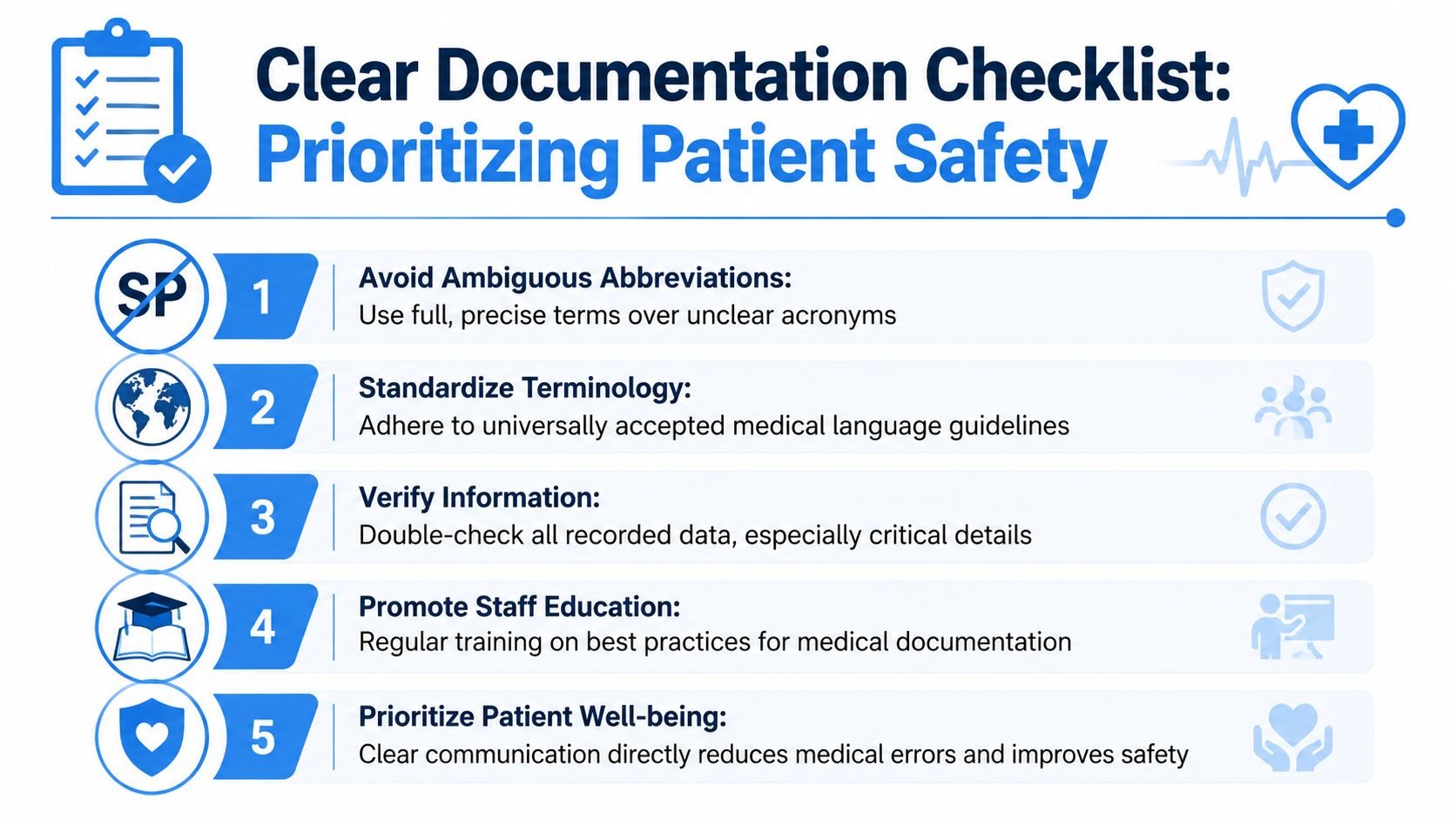
A simple checklist helps:
- Spell it out first: Write “status post” before using S/P later in the same note.
- Match the audience: A specialist may understand shorthand that a broader care team won't.
- Review dictated text: Voice tools can drop slashes, punctuation, or capitalization.
- Use standard terms: Familiar wording travels better across departments.
- Teach the habit early: New clinicians benefit from explicit feedback on abbreviation safety.
Why online education fits this problem
Clear documentation is a learned skill. It improves with repetition, examples, and feedback. That's one reason online education works well for CE and certification. You can revisit scenarios, pause on tricky terminology, and train at the moment you need reinforcement.
A 2020 systematic review in Medical Education concluded that fully online medical education achieved equivalent or superior outcomes compared with face-to-face training in knowledge retention, skill acquisition, and learner satisfaction.
That aligns with what many clinicians already see in practice. Online formats give you flexibility, reduce travel burden, and let you study with less disruption to shifts and family life. They aren't a lesser substitute for in-person education. In many cases, they're a better fit for how healthcare professionals learn.
If you're early in practice and trying to tighten your charting habits, this article on mistakes nurses make when starting out is a useful companion read.
Advancing Your Career with Clear Communication
Knowing what SP means is a small skill with wide impact. It helps you read charts accurately, communicate more clearly, and avoid preventable confusion across teams. Those are career skills, not just test skills.
Healthcare education is changing too. The old assumption that only in-person classes from AHA or the American Red Cross count is outdated. CAMTS and many U.S. hospital systems explicitly recognize accredited online BLS and ACLS courses as valid for staff credentialing when they meet AHA-based guidelines.
That shift matters because communication skills, charting accuracy, and certification upkeep all depend on accessible training. Online CE and certification formats let clinicians learn when they're alert, repeat complex material, and stay current without the friction of travel and rigid scheduling.
For nurses who want a practical way to keep building those skills, ProMed offers nurse continuing education resources that fit modern clinical schedules. That kind of flexible learning supports the larger goal here. Better understanding, cleaner documentation, and safer care.
The strongest clinicians don't just know the right abbreviation. They know when not to use one.
If you want a practical next step, explore ProMed Certifications for online courses and certification options that support clear, up-to-date clinical practice without requiring an in-person schedule.
.avif)
Stay compliant with ProMed+
Certifications included: ACLS, BLS, PALS, CPR & Neonatal Resuscitation
Unlimited continuing education: over 200 hours of accredited CME
All-inclusive: One price. No surprises.
Get certified today

The Advanced Cardiac Life Support (ACLS) is an accredited online medical certification course that teaches medical professionals to respond to nearly all cardiopulmonary emergencies.

The Pediatric Advanced Life Support (PALS) Recertification instructs medical professionals on performing pediatric cardiopulmonary resuscitation in emergencies.

The Basic Life Support (BLS) Recertification is intended to teach healthcare professionals the basic steps of CPR and rescue breathing for adults, children, and infants.

Our online medical certification course for CPR, Automated External Defibrillator (AED), and First Aid is designed to teach adult, child, and infant CPR and AED use.

The Neonatal Resuscitation Certification trains medical professionals in performing resuscitation procedures and life-saving techniques for newborns at the time of delivery.

.png)
.png)
.png)