


Virginia Board of Nursing Continuing Education Requirements
.png)
For most Virginia RNs and LPNs, license renewal usually comes down to either 30 contact hours of continuing education or 15 contact hours plus 640 hours of active nursing practice during the two-year renewal cycle. If you're an APRN, the requirements are different and more specific.
If your renewal date is getting close, you're probably doing what many nurses do. Opening a few tabs, comparing provider websites, and trying to figure out what the Virginia Board of Nursing expects. The rules aren't impossible, but they do get confusing fast, especially when people oversimplify them.
A lot of that confusion comes from two places. First, nurses hear a short version of the rule and miss the details that matter in an audit. Second, many still assume in-person training is the only safe option. It isn't. Online CE is a valid, practical path, and the broader healthcare industry has steadily moved toward accepting accredited online education because it fits real nursing schedules without lowering educational quality.
Your Guide to Virginia Nursing CE Requirements
The Virginia Board of Nursing continuing education requirements matter for one reason above all else. You need a clean, documented way to renew without guessing. That means knowing which renewal path fits your work situation, choosing education that relates to your practice, and keeping records in a way that won't become a headache later.
For most nurses, the stress isn't the learning itself. It's the uncertainty around questions like these:
- How many hours do I need
- Do online courses count
- What does active practice mean
- What should I save in case I'm audited
Those are fair questions. Virginia gives nurses more than one path to show continued competency, which is helpful, but that flexibility can also feel like too many moving parts. It's like choosing between two routes to the same destination. One route is straightforward and education-heavy. The other mixes education with documented work experience. Both can work, but only if you choose the one you can prove.
If you like comparing broader state rules before you commit to a course plan, this state-by-state nurse CE overview can help put Virginia in context. If you want a wider perspective on study habits, licensure topics, and course planning, it's also worth taking time to explore nursing education topics that support day-to-day professional growth.
Practical rule: The easiest renewal path is usually the one you can document without chasing paperwork at the last minute.
That point becomes especially important with Virginia's active practice option. On paper, it sounds simple. In real life, many nurses discover too late that proving those hours takes more care than expected.
Understanding the Core Requirements for RNs and LPNs
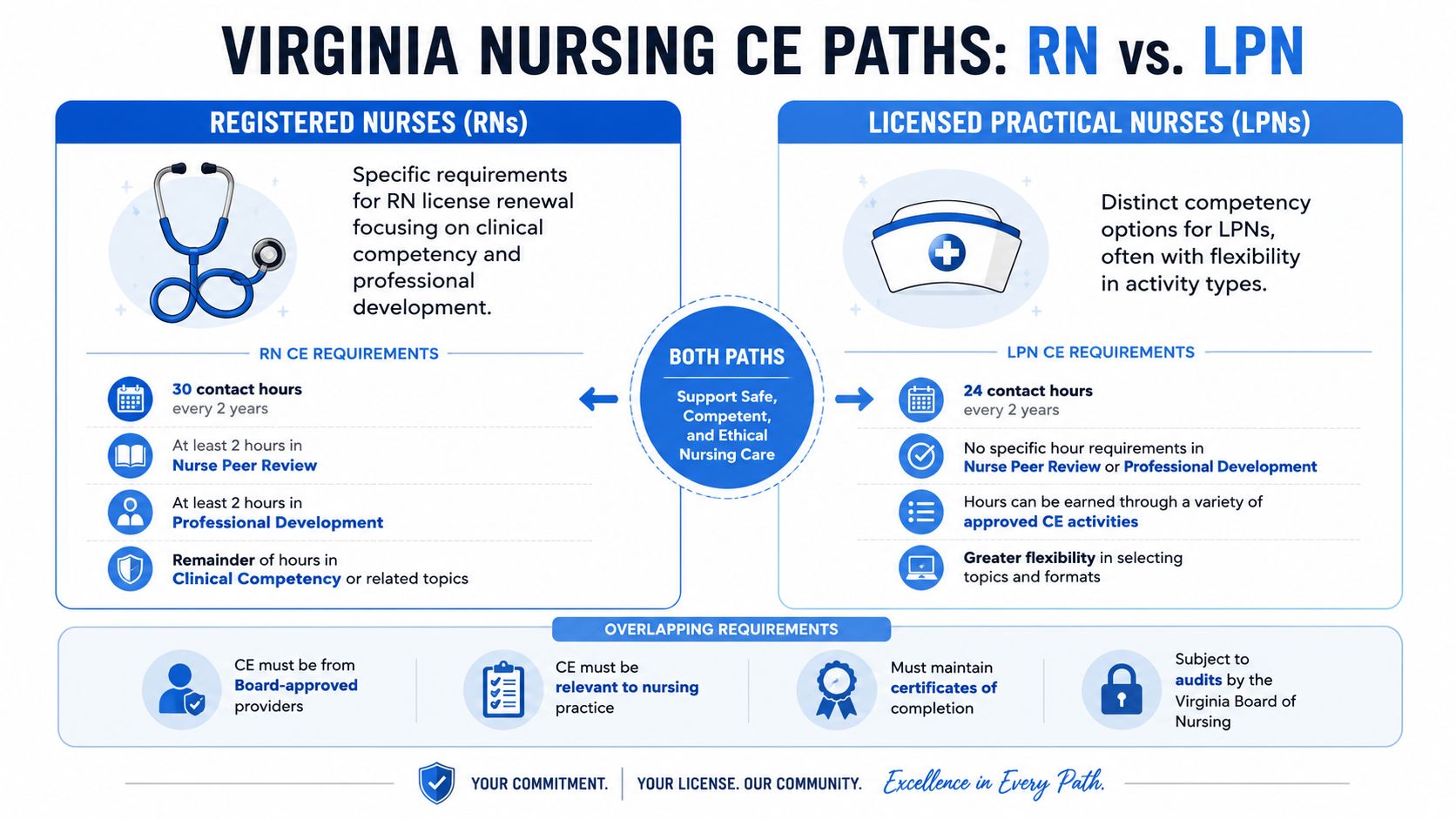
Virginia gives RNs and LPNs several continued competency options, but the two most common are the ones most nurses talk about. According to the Virginia nursing CE requirement summary from NetCE, all Registered Nurses and Licensed Practical Nurses in Virginia must complete one of nine verified learning options every two years, with the most common route being 30 contact hours of CE relevant to nursing practice, or 15 contact hours of CE plus exactly 640 hours of active practice as a nurse within the previous two-year renewal cycle. The same source also notes that nurses must keep original proof of completion for two years following renewal and provide it within 30 days if the Board requests it for an audit.
The two most common renewal paths
Think of the requirement as a fork in the road.
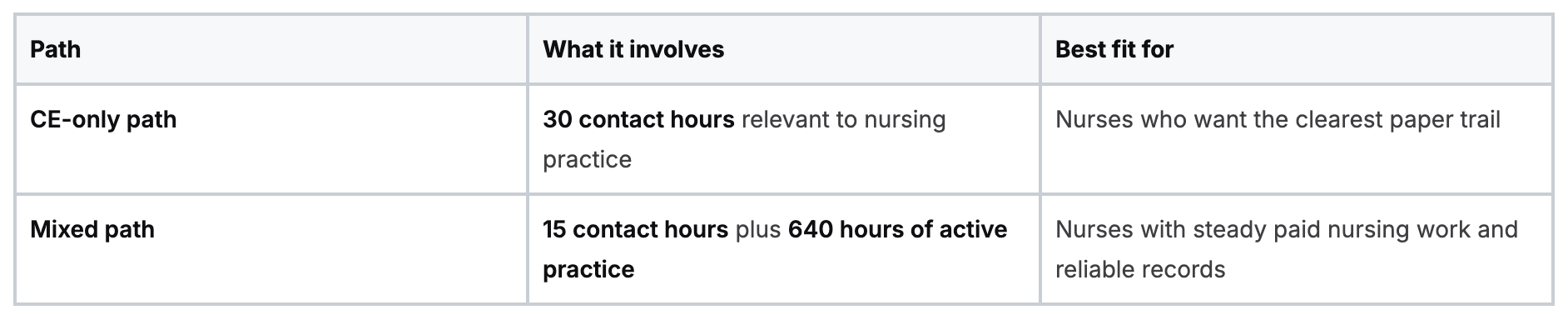
The first path is usually easier to manage. You complete the coursework, save your certificates, and keep everything organized.
The second path can work well too, but only if your work history is easy to verify. If your schedule is irregular, split across roles, or partly remote, this option takes more attention.
What counts in plain language
A contact hour is the amount of continuing education credit awarded by an approved activity. The key point isn't just the number. The Board expects the education to be relevant to the practice of nursing.
Active practice means paid nursing work. That's the practical part many people miss. It isn't just being licensed, being available, or doing occasional unpaid tasks. If you're using the reduced CE route, your work history needs to support it.
Some nurses prefer the full CE route not because they lack practice hours, but because certificates are often easier to store and retrieve than employment records.
For nurses who want a single platform for tracking coursework, ProMed+ Nursing CE is described as an all-in-one streaming option built to help nurses fulfill CE requirements.
A simple way to choose
Use the mixed path only if all three statements are true:
- Your nursing work was paid
- Your total active practice clearly reaches 640 hours
- You can produce records if the Board asks
If one of those feels shaky, the 30-hour CE path is often the cleaner and less stressful choice.
Navigating CE Rules for Advanced Practice Nurses
APRNs in Virginia play by a different set of rules. The requirements are more specialized because the scope of practice is broader, and for many APRNs, prescribing responsibilities add another layer of accountability.
According to Virginia APRN CE requirements summarized by Nursing CE Central support, APRNs licensed on or after May 8, 2002 must complete 40 contact hours in their specialty area every two years, unless they maintain current national certification in that specialty as an alternative compliance path. The same source states that APRNs with prescriptive authority must complete an additional 8 hours in pharmacology or pharmacotherapeutics every two years, and 2 of those 8 hours must relate specifically to prescribing controlled substances.
What makes APRN renewal different
For APRNs, renewal isn't just about general professional development. It's tied closely to specialty competence.
That means your education should match your actual area of practice. A family nurse practitioner, psychiatric nurse practitioner, or nurse midwife shouldn't assume a general nursing CE bundle automatically checks every box. The Board's framework is more precise for advanced practice.
Here's the simplest way to view it:
- Specialty requirement: focus on your advanced practice area
- Prescriptive authority requirement: add pharmacology education
- Controlled substances subset: make sure part of that pharmacology training directly addresses controlled substance prescribing
Where APRNs get tripped up
The most common mistake isn't usually a total lack of CE. It's assuming that all CE hours can be counted the same way.
They can't.
If you have prescriptive authority, pharmacology isn't optional add-on learning. It's its own required category. If part of your professional development also includes emergency response education, ACLS Certification is one online option nurses often use because it can be completed on a flexible schedule. Just remember that role-based certifications and Virginia license renewal requirements are related topics, not interchangeable categories.
Your APRN renewal record should show a deliberate match between your license, your specialty, and the subjects you completed.
That alignment matters. When your records are organized by category instead of stored in one large folder, renewal gets much easier.
Choosing Approved CE Courses and Providers
A lot of outdated advice still circulates. Some nurses are told that only in-person classes from the AHA or American Red Cross are valid, or that online education is somehow second-tier. That isn't an accurate way to think about modern nurse education.
Virginia's general RN and LPN renewal rules focus on relevant continuing education and documentation. They do not say that only one brand of classroom training counts for every situation. In healthcare education, accredited online learning has become a normal part of compliance and professional development.
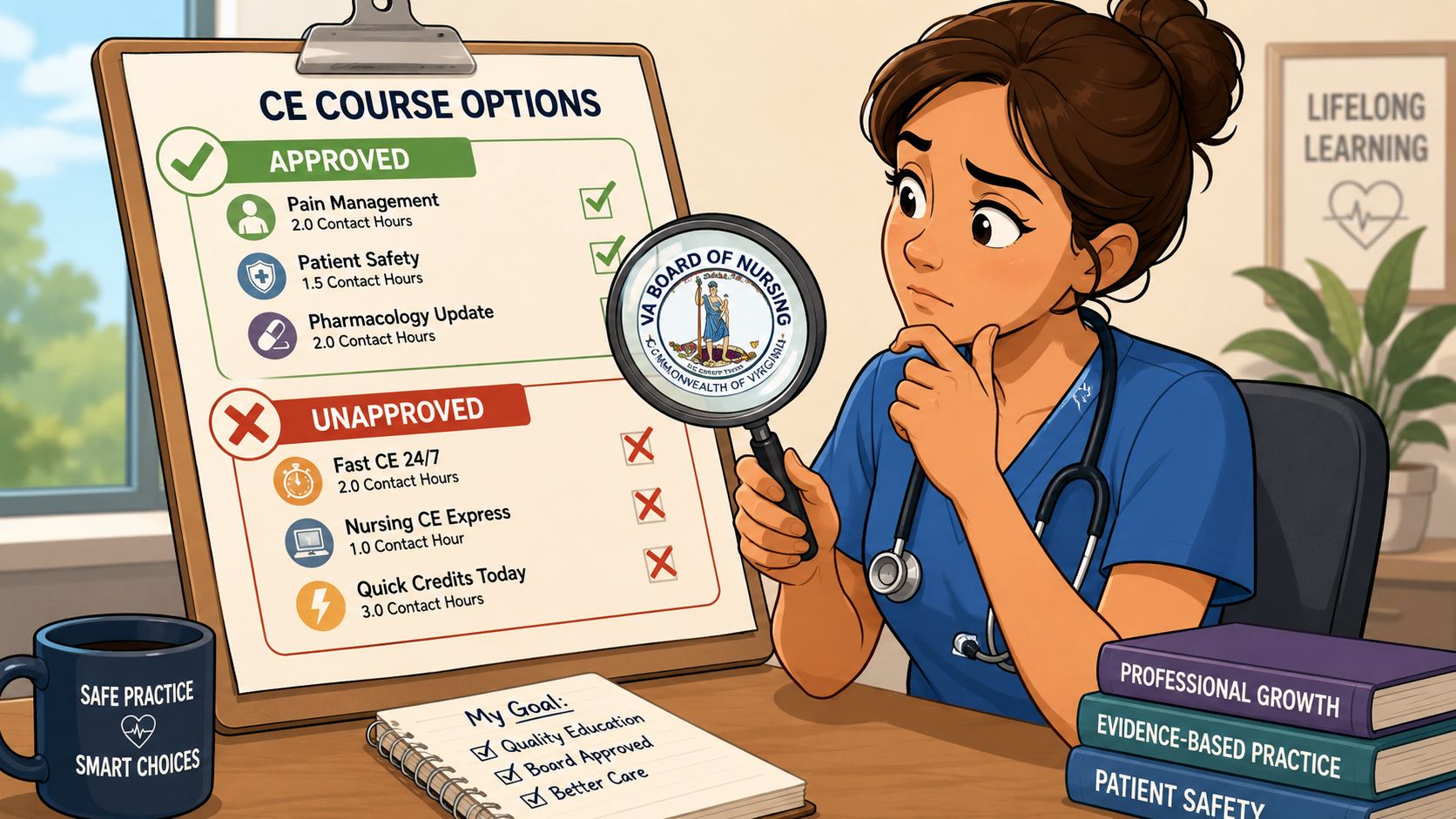
Online CE is not the lesser option
Peer-reviewed evidence supports what many nurses already know from experience. A study indexed on ScienceDirect comparing online and in-person clinical nursing education found that learners in online formats achieved statistically equal competency development outcomes, with no significant difference in skill acquisition or knowledge retention compared with in-person settings.
That matters because CE is about staying competent, not about sitting in a particular type of room.
Online formats also fit how nurses live and work:
- Self-paced access: You can study around shifts, family responsibilities, and overtime.
- Consistent delivery: Everyone gets the same core content without depending on a local classroom schedule.
- Easier repeat review: You can revisit material before an exam, renewal, or return to practice.
What to look for in a provider
Use a short checklist before you enroll.
- Relevance first: The course should connect to nursing practice or your specialty area.
- Clear certificate process: You should know how completion is documented before you start.
- Accessible format: If your schedule changes constantly, on-demand learning is usually the safer choice.
- Recognized structure: Accredited online providers are widely used across hospitals, clinics, and healthcare organizations.
The broader industry has been moving toward online acceptance for years because it solves a real access problem. Nurses need education that doesn't force them into rigid class times every renewal cycle.
A short explainer can help if you're still comparing delivery formats:
The AHA and Red Cross myth
AHA and American Red Cross programs are recognized options in many contexts, but they are not the only recognized options for healthcare education. That's the key distinction. Employers, boards, and clinical settings often care about whether training is accredited, appropriate, and documented. They don't always require one single in-person source.
If your role also involves pediatric emergency education, PALS Certification is one example of a fully online option that reflects this shift toward accessible, credible digital learning.
How to Document and Report Your CE Hours
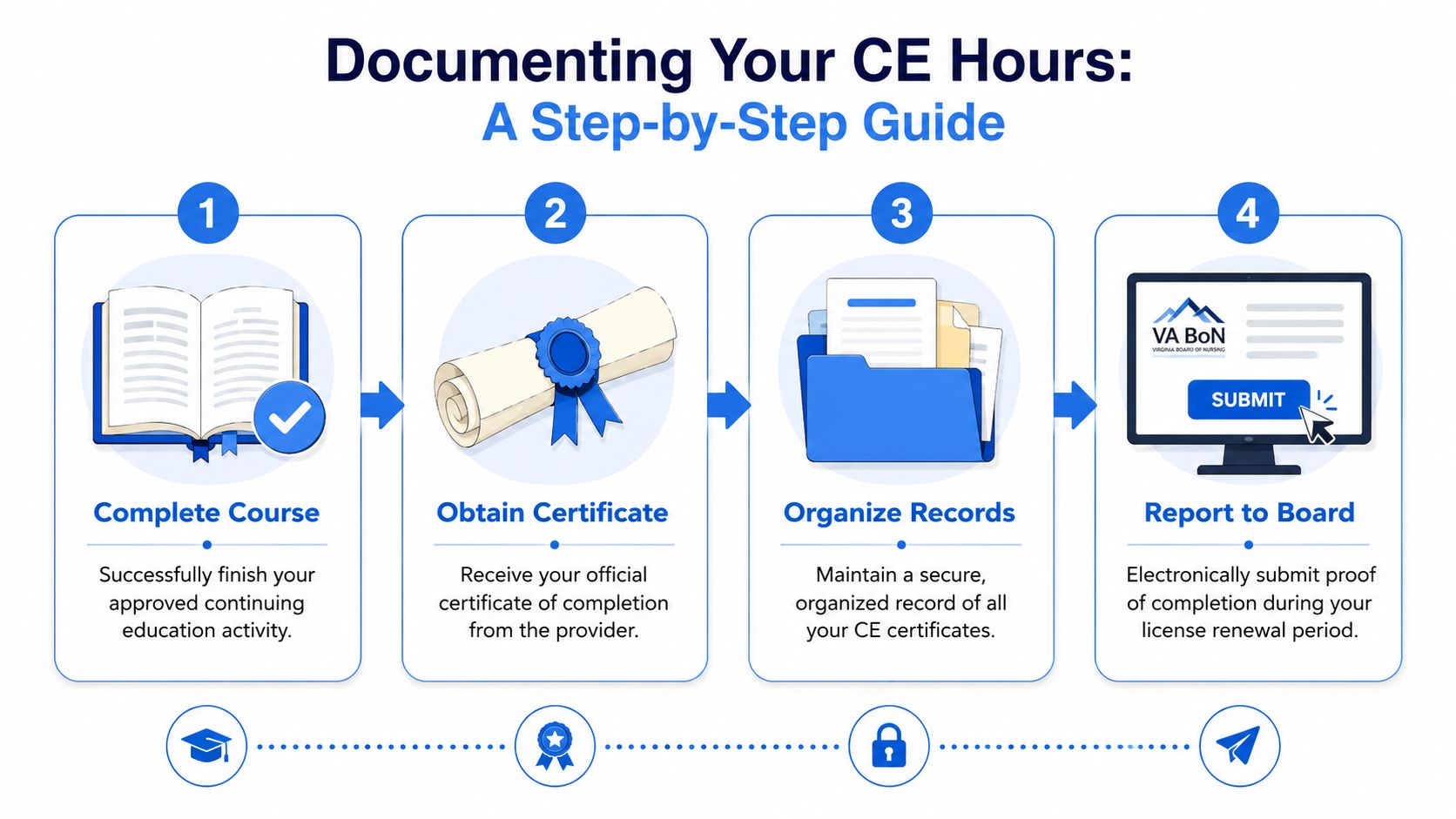
Finishing the course is only half the job. The other half is proving you met the requirement if anyone asks. In Virginia, that proof matters more than many nurses expect, especially if you're audited or if you're using the active practice route.
The active practice option has a hidden risk
The reduced CE path sounds appealing. Fewer education hours, plus your normal work. But the weak point is documentation.
A 2023 NCBI review noted that states like Virginia penalize nurses who have 640-hour gaps by requiring re-testing, and the review identified this as a risk faced by 12% of non-full-time nurses annually. The same discussion warns that the 15-hour option is conditional on verifiable compensated nursing practice, which can create a real trap for part-time, telehealth, or otherwise nontraditional workers.
That doesn't mean you should avoid the option automatically. It means you should only rely on it if your records are solid.
If your employer can't easily verify your paid nursing work, the "shorter" option can become the harder one.
What to keep on file
Keep your records as if an audit letter could arrive tomorrow. That mindset makes renewal much simpler.
- Certificates of completion: Save the original version from each CE provider.
- Practice records: If you're using active practice, keep payroll records or employer documentation that supports compensated nursing work.
- Renewal folder: Store everything for the full retention period the Board expects.
- Reporting access: Make sure you can log in to any reporting tool you use before renewal season.
Some nurses use digital folders by renewal cycle. Others prefer a CE platform that stores certificates automatically. If you're sorting out electronic reporting and account setup, this guide to managing your CE Broker account can help you avoid last-minute login and tracking problems.
A simple audit-proof habit
Create one folder for each renewal cycle. Inside it, keep:
- Your completed course certificates
- Any specialty or pharmacology records
- Work verification documents if you chose the active practice route
- A note showing what requirement each item satisfies
That small step prevents the common problem of having the education but not the proof.
Your Simple Plan for Stress-Free Compliance
A common renewal mistake looks like this: you open your calendar a few weeks before your deadline, realize you still need to confirm your requirement path, and then spend more time hunting for records than completing the requirement itself. Virginia renewal gets much easier when you treat it like routine charting. Small entries along the way prevent a stressful clean-up at the end.

A practical renewal rhythm
The goal is simple. Decide early whether you are meeting renewal through continuing education, active practice, or another allowed option, then finish the proof before renewal season gets busy.
TimeframeWhat to doEarly in the cycleChoose your renewal path and create one folder for all recordsMid-cycleFinish part of your CE while topics are still relevant to your workBefore renewalConfirm your totals, check every certificate, and make sure any practice-hour documentation is easy to verify
This timing matters for one reason. The active practice option can look shorter on paper, but it is only simpler if your employer records are clear and available. If there is any doubt about what you can document quickly, online CE is often the cleaner path because you control the timeline and keep the proof yourself.
Online learning also solves an outdated assumption some nurses still hear, that in-person courses are somehow more legitimate. They are not automatically better for compliance. If the course and provider meet the requirement, online CE counts the same way and usually fits real nursing schedules much better.
How to make your system easier
A low-stress plan usually comes down to a few repeatable habits:
- Choose courses with a purpose: Pick topics that match your role, patient population, or practice setting.
- Complete hours in short sessions: One course during a quiet afternoon is easier than a last-minute weekend sprint.
- Save proof right away: Download the certificate the same day and place it in your renewal folder.
- Use flexible online access: Study before a night shift, on a day off, or whenever your schedule opens up.
ProMed Certifications offers online medical certifications and nursing CE options for healthcare professionals who need a schedule-friendly format.
Keep renewal boring. Boring means organized, documented, and finished on time.
That is the whole strategy. Pick your path early, use online CE when you want the most direct and trackable option, and keep your records together as you go. Compliance stops feeling confusing when each step has a clear place and a clear purpose.
.avif)
Stay compliant with ProMed+
Certifications included: ACLS, BLS, PALS, CPR & Neonatal Resuscitation
Unlimited continuing education: over 200 hours of accredited CME
All-inclusive: One price. No surprises.
Get certified today

The Advanced Cardiac Life Support (ACLS) is an accredited online medical certification course that teaches medical professionals to respond to nearly all cardiopulmonary emergencies.

The Pediatric Advanced Life Support (PALS) Recertification instructs medical professionals on performing pediatric cardiopulmonary resuscitation in emergencies.

The Basic Life Support (BLS) Recertification is intended to teach healthcare professionals the basic steps of CPR and rescue breathing for adults, children, and infants.

Our online medical certification course for CPR, Automated External Defibrillator (AED), and First Aid is designed to teach adult, child, and infant CPR and AED use.

The Neonatal Resuscitation Certification trains medical professionals in performing resuscitation procedures and life-saving techniques for newborns at the time of delivery.

.png)
.png)
.png)