


How to Update CPR Certification Online Without the Hassle
.png)
The popular advice says CPR renewal is just about finding the fastest class. That misses the core question. Update CPR certification online is a compliance decision, because the right course has to match your employer's rules, your role, and whether your current card is still active.
That's why online renewal has moved from convenience option to normal workflow for a lot of clinicians. CPR certifications generally run on a 2-year cycle, so renewal is usually about recertification, not starting from scratch. Online formats fit that reality well, since learners can pause, resume, finish quizzes remotely, and receive a digital card by email after passing.
The bigger point is simple. The old belief that only in-person AHA or Red Cross classes count is too narrow. Acceptance now depends on the setting, and some institutions explicitly recognize hybrid or skills-based pathways while rejecting online-only cards. A good renewal choice starts with that distinction, not with the checkout button.
For a broader overview of the online model in healthcare, the online CPR certification for healthcare providers article gives useful context on how digital credentialing fits into modern practice.
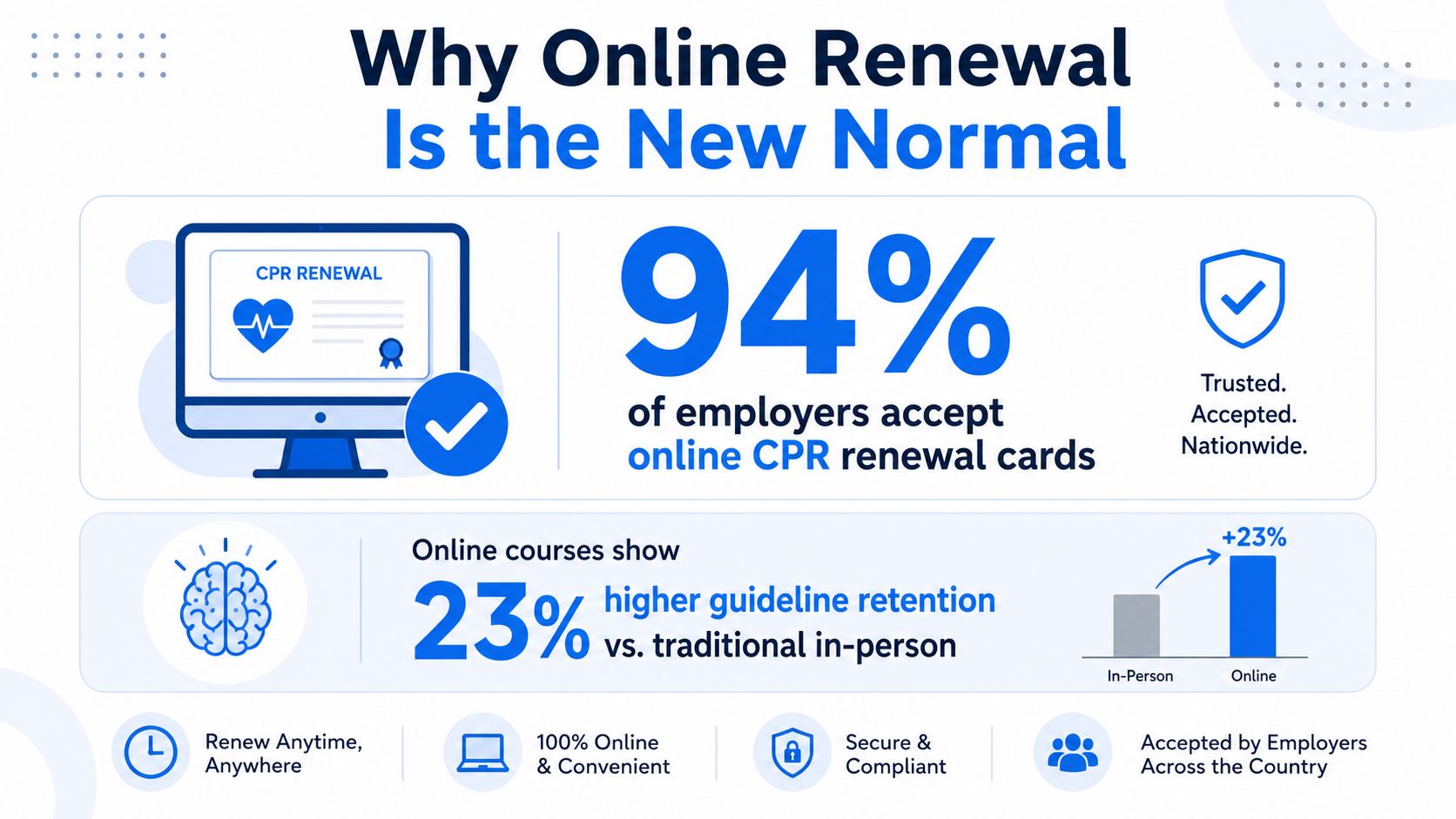
Why Online Renewal Is the New Normal
Online CPR renewal stopped being a fringe option once employers, credentialing teams, and clinicians realized the workflow made sense. If a card is still active, the renewal path can be shorter than a first-time class, because the learner is refreshing knowledge instead of building it from zero. That matches how people work, on shifts, between patients, or around family and commute time.
The shift is about access, not shortcuts
A systematic review of 29 countries found that the share of laypeople ever trained in CPR ranged from 3% to 79%, with a median of 40% and an interquartile range of 28.5% to 60.0% (PMC review). That spread tells you why flexible formats matter. If training access is uneven, then a model that removes scheduling friction has real value.
The same review found that electronic CPR refreshers did not improve skill scores at 1 year compared with a mailed brochure, but they did increase confidence and intent to perform CPR (PMC review). That matters because it pushes us toward structured online education, not random convenience content. Online renewal works best when it's aligned to current guidelines and paired with a real assessment.
Practical rule: if a course is just a video with no meaningful knowledge check, it's not the same thing as guided recertification.
The industry is also moving toward digitized maintenance. The National Registry of Emergency Medical Technicians requires recertification applications to be submitted online by midnight on the day the certification expires (NREMT), which is a good example of how compliance itself is becoming digital even when final approval still depends on approved education.
If you're trying to stay current while working, online renewal is no longer a compromise. It's the format that best fits how modern credentialing operates.
What to Verify Before You Enroll Anywhere
Before you pay for anything, check the rules around your specific card. CPR credentials are commonly valid for about two years, and many healthcare-provider renewals should start weeks to 1 to 2 months before expiration to avoid a gap. That timing matters more than people think, because a late renewal can turn a routine recertification into a full reset.
Start with your current card and your employer's policy. If your employer or board only accepts a blended format, an online-only class won't solve your problem. The Red Cross notes that renewal may require blended learning or a local class, while the AHA emphasizes convenience and remote access for online training, which shows why acceptance has to be checked in context (Red Cross renewal guidance).
Build a quick pre-enrollment checklist
- Confirm your expiration date: if the card is close to expiring, don't wait for a busy week at work to decide.
- Check acceptance rules: look for employer, state board, licensure, or facility language that names online, blended, or in-person requirements.
- Gather your documentation: prior certificate details, license number, and any HR contact info you may need later.
- Verify the course type: some roles need a skills check, and skipping that step can make the card unusable.

You'll also run into credentialing language that looks similar but isn't identical. AHA-aligned means the content follows the guidelines, while AHA-issued means the certifying body is specifically issuing the card. That distinction can decide whether HR accepts your paperwork.
For a simple example of a fully online option, CPR AED & First Aid Certification is described as 100% Online Certification for CPR, AED & First Aid with review material, an exam, and a card available in as quick as one hour or less. That kind of snapshot is useful only if the format fits your exact requirement, so treat it as a model, not a universal answer.
Choosing the Right Course Type for Your Role
A CPR card is not interchangeable just because the acronym is familiar. A bedside nurse, a dental hygienist, an EMT, and an office manager may all need CPR-related training, but the course title and validation step can differ. If you choose the wrong category, you may finish quickly and still fail compliance.
Match the course to the job, not to the marketing
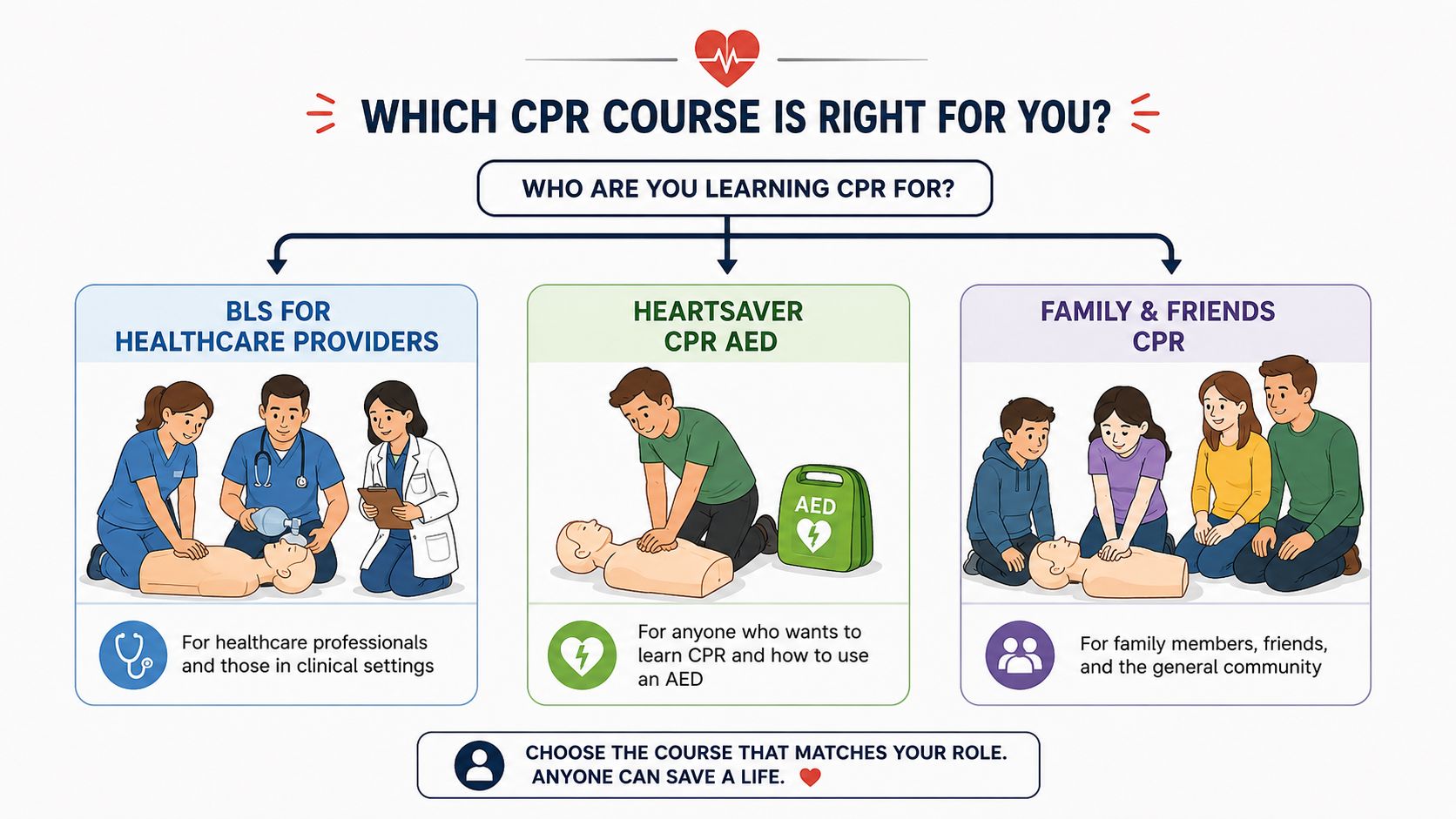
BLS is the clearest fit for many healthcare roles, especially where team-based resuscitation and higher-level patient care are expected. BLS Certification is presented as a 100% Online BLS Certification option, with online coursework, an exam, and a card available in as quick as one hour or less. That's useful when the role calls for BLS and the employer accepts the format.
CPR/AED fits broader workplace needs, community-facing jobs, and roles where the requirement is basic life support awareness rather than provider-level resuscitation. First Aid is often added when the job description asks for emergency response beyond chest compressions and AED use. These are different needs, so don't treat them like interchangeable menu items.
- Healthcare provider roles: often point to BLS language.
- General workforce roles: often ask for CPR/AED.
- Higher-acuity pediatric or neonatal roles: may require layered credentials such as PALS or NRP, depending on the setting.
The BRPT has already shown how narrow some acceptance rules have become. Effective January 1, 2026, it will no longer accept online-only BLS/CPR certifications, and it will accept only in-person certifications with a live or skills component, hybrid certifications with a live component, the AHA RQI pathway, and mannequin-based live skills components (BRPT). That's a reminder that role and regulator still decide what “valid” means.
If you're comparing provider-level options, the BLS certification online guide gives a more focused look at how BLS renewals are handled in digital formats.
A useful shortcut is to read your job posting like a compliance document. If it says BLS, don't buy CPR/AED and hope for the best. If it says CPR/AED plus skills validation, don't assume a fully online card will pass review. Precision saves time.
The Actual Renewal Flow From Login to Certificate
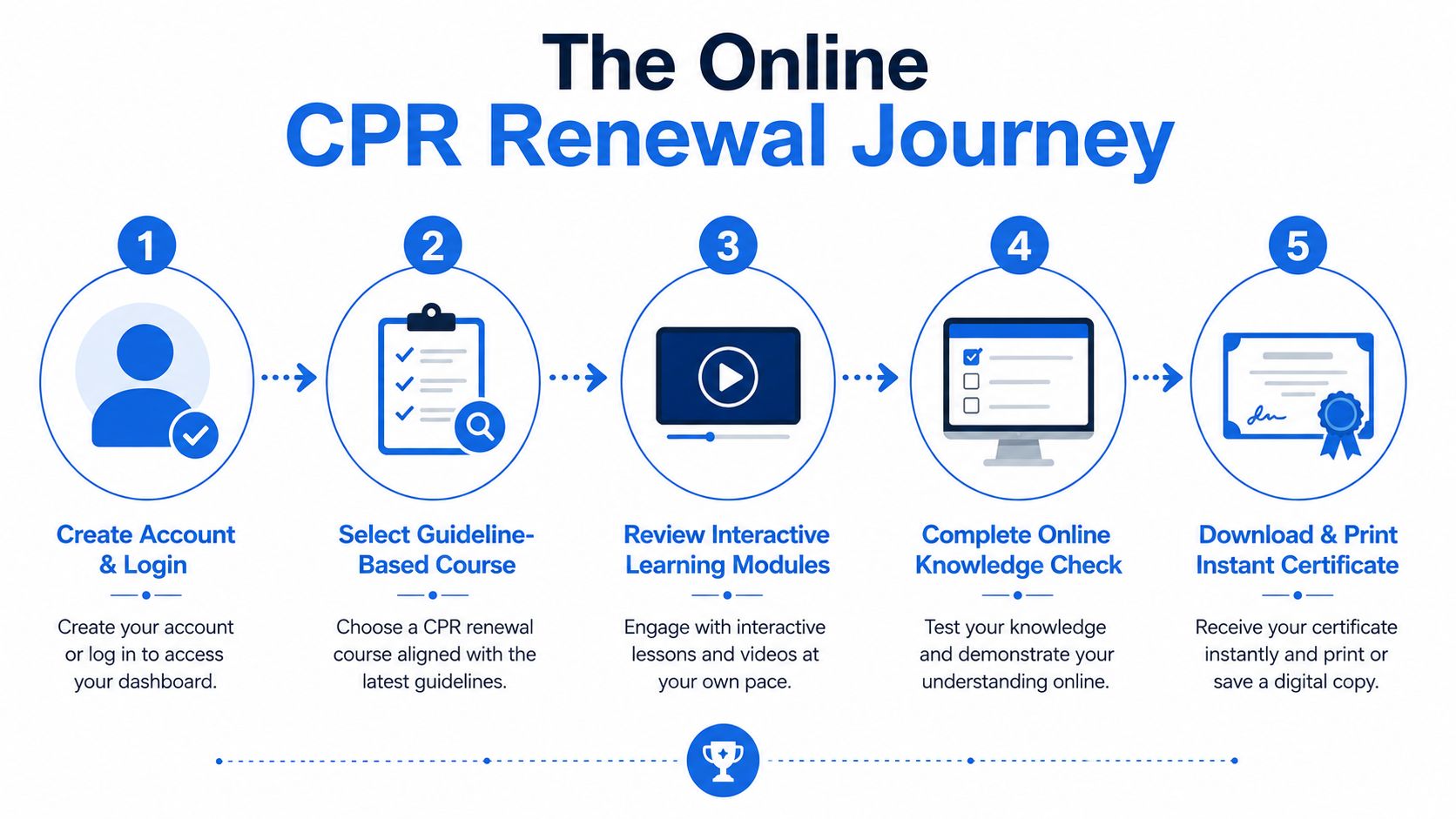
The renewal experience usually begins the same way, with account setup and course selection. You create your login, pick the course that matches your role, and open the guideline review at your own pace. The modern online model is built around asynchronous learning, so you can pause during a shift, come back later, and finish on your schedule.
What happens after you start
You'll work through the review content first, then complete the knowledge check. In a technically accurate online workflow, that review can be fully online, blended with a hands-on skills check, or classroom-based, depending on the credential and the acceptance rules (CPR Certification Now). The key detail is that the online portion is front-loaded with guideline review, not just a quick form.
When a skills component is required, it usually comes after the online learning. That's the part people miss when they assume every digital card is the same. A blended course can still be convenient, but the live validation step is what makes it acceptable in settings that don't recognize online-only renewal.
After the exam, some providers issue a digital card by email, often immediately after passing the assessment. That speed is useful for compliance teams, but it only works if the name on the certificate matches the name on your license. Small mismatches can slow down HR review.
Keep a PDF copy and a wallet-card copy as soon as the certificate arrives, then upload it to your credentialing file right away.
The online process is also easier to manage when the provider offers clear retake rules. ProMed Certifications' ACLS Certification is described as a quick online option with course access anywhere, exam completion, and card delivery in as quick as one hour or less. Even though ACLS is a different credential, the delivery pattern shows what a clean digital workflow looks like when it's built for busy clinicians.
The cleanest renewals feel boring in the best possible way. You study, you test, you receive proof, and you file it before anyone asks.
What a Strong Provider Actually Looks Like
A credible renewal provider doesn't just sell convenience. It gives you current guideline content, a clear assessment path, and a certificate that can survive employer review. That is the difference between a real compliance tool and a certificate mill.
The features that matter most
Look first at the content basis. If the course says it reflects current guidelines, you want that stated clearly, because CPR and BLS work depends on current protocol, not stale teaching. Then check whether the provider explains exactly when a skills check is required, since that step can be the deciding factor for acceptance.
A second filter is assessment design. Unlimited retakes matter because a wrong answer shouldn't force you into a new purchase just to finish compliance. Instant digital delivery matters because you often need proof the same day, especially if HR, staffing, or licensing is already asking for it.
You should also ask about acceptance support. If a provider offers guidance on employer recognition or a money-back policy if the card isn't accepted, that tells you they understand the practical use case. ProMed Certifications is one example of a platform that packages online CPR, BLS, ACLS, PALS, and nursing CE options in a digital format, but the important part is not the brand name. It's whether the provider can show you the course type, assessment method, and documentation trail in plain language.
A quick mental rubric helps:
- Curriculum clarity: does it name the standard the course follows?
- Validation method: does it say whether a skills check is required?
- Delivery speed: can you access proof without waiting on a manual process?
- Acceptance support: does the provider explain what happens if an employer questions the card?
The BRPT policy change is useful here too. It proves that institutions can distinguish between online-only, hybrid, and live-skill formats very specifically (BRPT). So when a site claims “fully online” without explaining its acceptance context, that's a yellow flag, not a selling point.
Timing, Costs, and Submitting Proof to Your Employer
The smartest way to handle renewal is to think in terms of workflow, not purchase. Start early enough to avoid a lapse, choose the right format for your role, and know exactly where the certificate has to go once it's issued. That's how you keep a renewal from turning into a paperwork problem.
Compare the practical tradeoffs
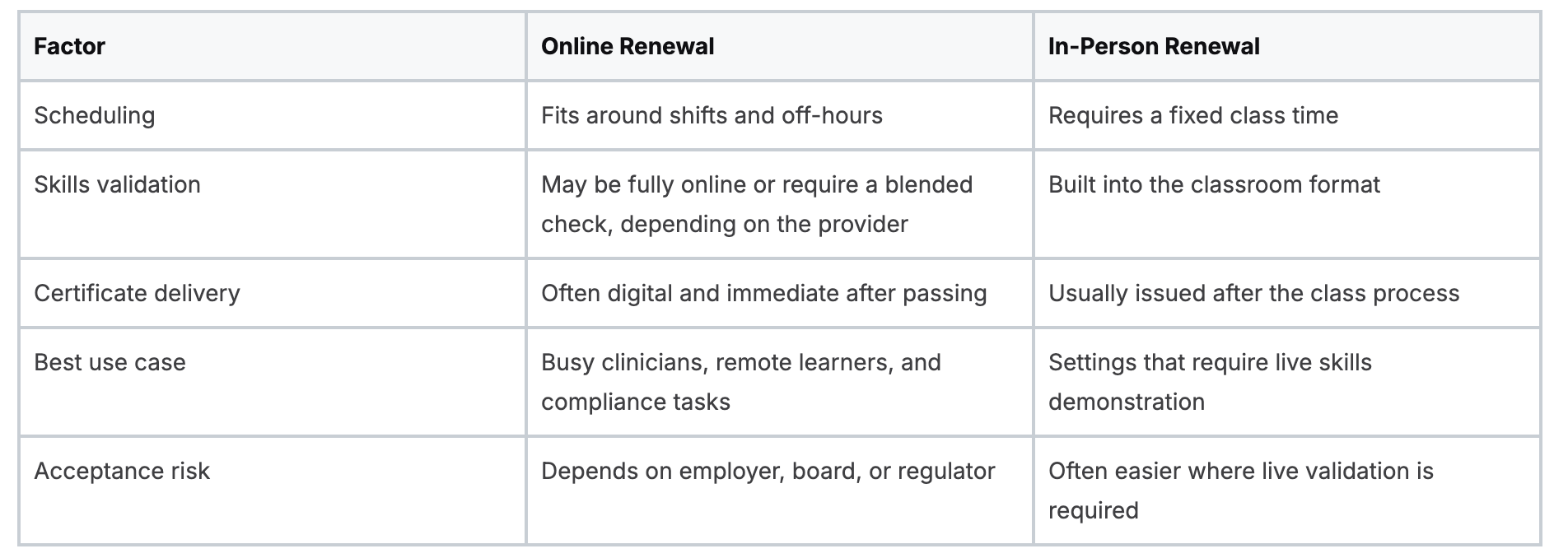
The time advantage of online renewal is obvious, and savings come from fewer scheduling conflicts and less time away from work. That's especially important if your department needs a current card for staffing or audit readiness.
The safest rule is to renew before your card expires, not after someone reminds you.
If you need a concrete example of how employers verify acceptance, the how do I know my employer or facility will accept a ProMedCert provider card page is a useful model for the kind of question you should ask any provider. The key issue is always whether the exact credential will be recognized in your exact setting.
Submitting proof should be straightforward. Send the digital certificate to HR, upload it to your credentialing portal, or file it with the department record if your facility uses an internal compliance tracker. If your manager has never seen an online-issued card before, attach the course description and the acceptance language your employer requires, then keep your original PDF handy.
If your broader education needs are part of the same renewal cycle, ProMed+ Nursing CE is described as a one-stop online CE platform with streaming access. That kind of bundled structure can be useful when you're managing certification and CE in the same compliance window.
Online renewal is not just a faster checkout. It's a cleaner path when the provider, the course type, and the acceptance rule all line up.
If you want a straightforward way to handle renewal without guessing at the next compliance hurdle, visit ProMed Certifications and review the course options that match your role. Their online certification pathways are built for busy clinicians who need proof that's easy to complete, easy to file, and easier to defend when HR asks questions.
.avif)
Stay compliant with ProMed+
Certifications included: ACLS, BLS, PALS, CPR & Neonatal Resuscitation
Unlimited continuing education: over 200 hours of accredited CME
All-inclusive: One price. No surprises.
Get certified today

The Advanced Cardiac Life Support (ACLS) is an accredited online medical certification course that teaches medical professionals to respond to nearly all cardiopulmonary emergencies.

The Pediatric Advanced Life Support (PALS) Recertification instructs medical professionals on performing pediatric cardiopulmonary resuscitation in emergencies.

The Basic Life Support (BLS) Recertification is intended to teach healthcare professionals the basic steps of CPR and rescue breathing for adults, children, and infants.

Our online medical certification course for CPR, Automated External Defibrillator (AED), and First Aid is designed to teach adult, child, and infant CPR and AED use.

The Neonatal Resuscitation Certification trains medical professionals in performing resuscitation procedures and life-saving techniques for newborns at the time of delivery.

.png)
.png)
.png)