


Stylet for Intubation: A Practical Guide for Clinicians
.png)
You're preparing for a high-acuity intubation. The room is busy, the patient's oxygen reserve is limited, and the endotracheal tube feels softer and less controllable than you'd like. A properly selected and shaped stylet can give that tube the direction and stiffness you need, but only when you understand what the device is doing at each point in the sequence.
This guide treats the stylet for intubation as a practical airway skill, not a definition to memorize. We'll connect design choices, bend geometry, first-pass evidence, tube delivery, confirmation, and safe removal for ACLS-trained nurses, EMS providers, anesthesia trainees, nurse practitioners, physician assistants, and physicians refreshing airway technique.
Why Stylet Skills Still Matter at the Bedside
A difficult airway rarely announces itself with perfect timing. You may have a patient with severe respiratory failure, rapidly falling oxygen saturation, limited mouth opening, secretions, or anatomy that looks very different from the airway you practiced on yesterday. In that moment, the stylet isn't a decorative accessory. It's a way to turn a flexible tube into a more controllable instrument.
Video laryngoscopy has improved the view for many clinicians, but a good view doesn't automatically deliver the tube. The tube still has to travel through the mouth, around the tongue and pharynx, and toward the glottic opening. If the distal shape doesn't match that route, the tube can hang up, rotate unpredictably, or force you to abandon a promising attempt.
Practical rule: A stylet should improve tube control without becoming a source of force.
The sequence matters. You'll first select a compatible tube and stylet, prepare and shape the assembly, obtain the laryngeal view, advance the tube under control, confirm tracheal placement, and remove the stylet while stabilizing the tube. Each step solves a different problem. Skipping one can turn a manageable airway into a rushed rescue.
This progressive approach complements broader discussions of airway adjunct selection in advanced airway options and best practices. It also applies beyond one device or one course. ACLS-trained clinicians, EMS teams, and advanced practice providers all need a mental model that works when equipment, patient anatomy, and the laryngoscopic view change.
The aim isn't to replace local protocols, supervised practice, or simulation. It's to help you recognize small errors before they become large airway problems.
What a Stylet Is and Where It Fits in Airway Management
A stylet is a shaped introducer placed inside an endotracheal tube. It gives the tube additional rigidity and lets you create a curve that can follow the path from the mouth toward the vocal cords.
Think of it as a bendable wire inside a soft straw. The straw is still the tube, but the wire lets you point and guide it instead of pushing a floppy tube toward a target.
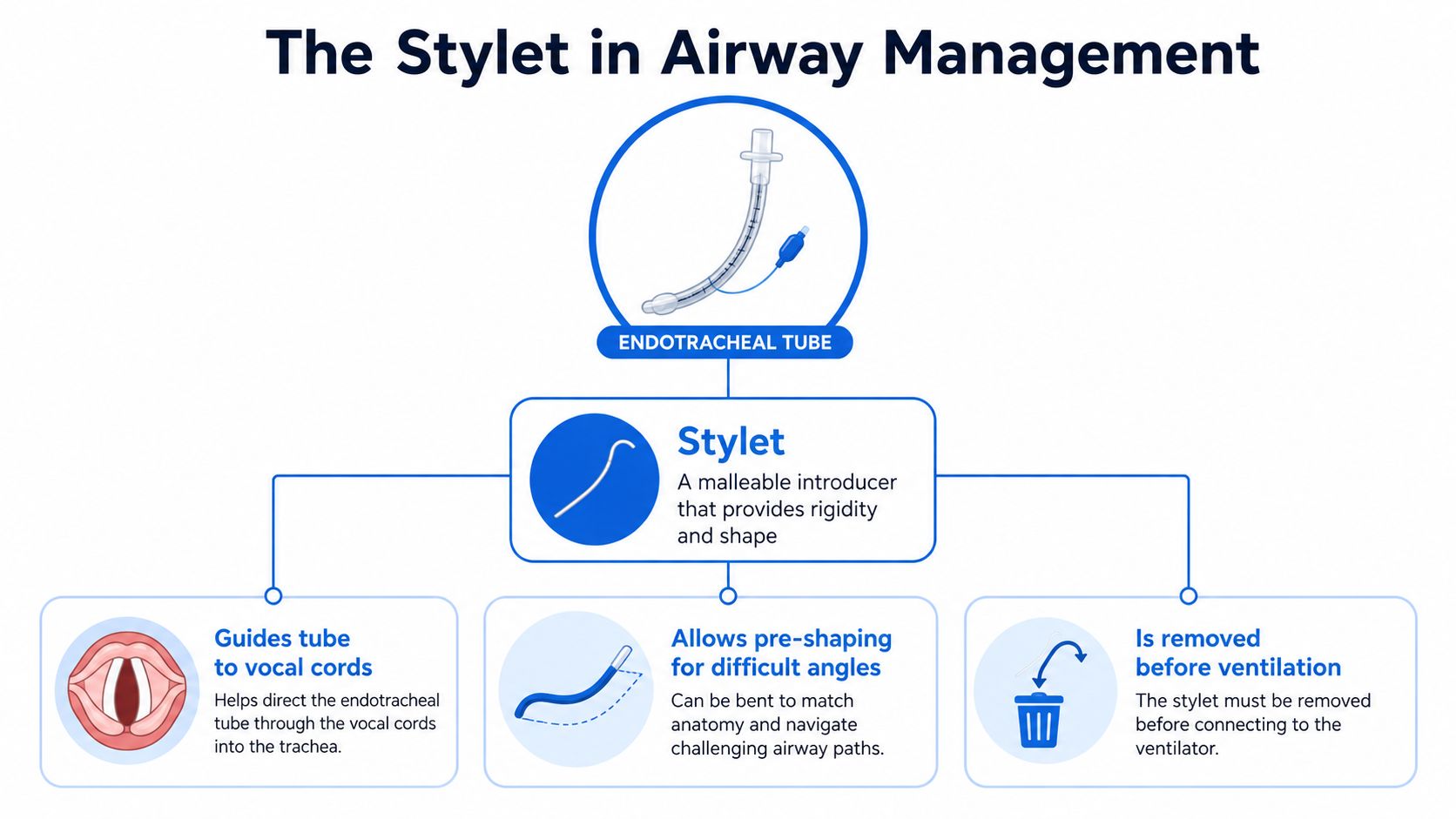
Where it belongs in the sequence
Stylet use fits inside a larger airway workflow:
- Pre-oxygenation: Build oxygen reserve and prepare backup plans.
- Laryngoscopy: Expose the glottic opening with direct or video laryngoscopy.
- Tube delivery: Use the shaped tube to approach and pass the vocal cords.
- Confirmation: Verify tracheal placement with clinical assessment and appropriate monitoring.
- Removal: Withdraw the stylet while holding the tube in position, then ventilate through the tube.
Without a stylet, an endotracheal tube may buckle or drift when you try to direct its tip. That doesn't mean every intubation requires one. Some clinicians prefer a bougie, some use a tube alone in selected situations, and some use a device-specific rigid stylet with video laryngoscopy. The right choice depends on the airway, the laryngoscope, the tube, and your training.
The distinction between airway devices matters. An endotracheal tube is designed for tracheal ventilation, while a supraglottic device such as an LMA sits above the glottis. A clear comparison appears in LMA versus endotracheal tube.
For clinicians maintaining core resuscitation knowledge, ACLS Certification is available online through ProMed Certifications, with course access designed for completion around a busy schedule.
Types, Materials, and Sizes You Will Actually See
Stylets look simple, but construction changes how the tube behaves. Your main decisions involve reusable versus single-use, malleable versus rigid, length, diameter, and whether the device includes lightwand capability.
Reusable adult stylets are commonly malleable aluminum. They can be shaped, adjusted, and used with compatible tubes according to institutional reprocessing policy. Single-use plastic versions reduce the need for reprocessing and may provide consistent stiffness, but their shape and flexibility vary by design.
Lightwand-equipped stylets add transillumination. They can help when direct visualization is limited, but they require familiarity with the device and a suitable environment for recognizing the light pattern. They're not a standard stylet with a bulb attached.
Length and diameter must match the tube and patient. A stylet that's too short won't support the distal tube, while one that's too long may protrude beyond the tube tip and injure tissue. A stylet that's too large can make tube advancement difficult or prevent smooth removal.
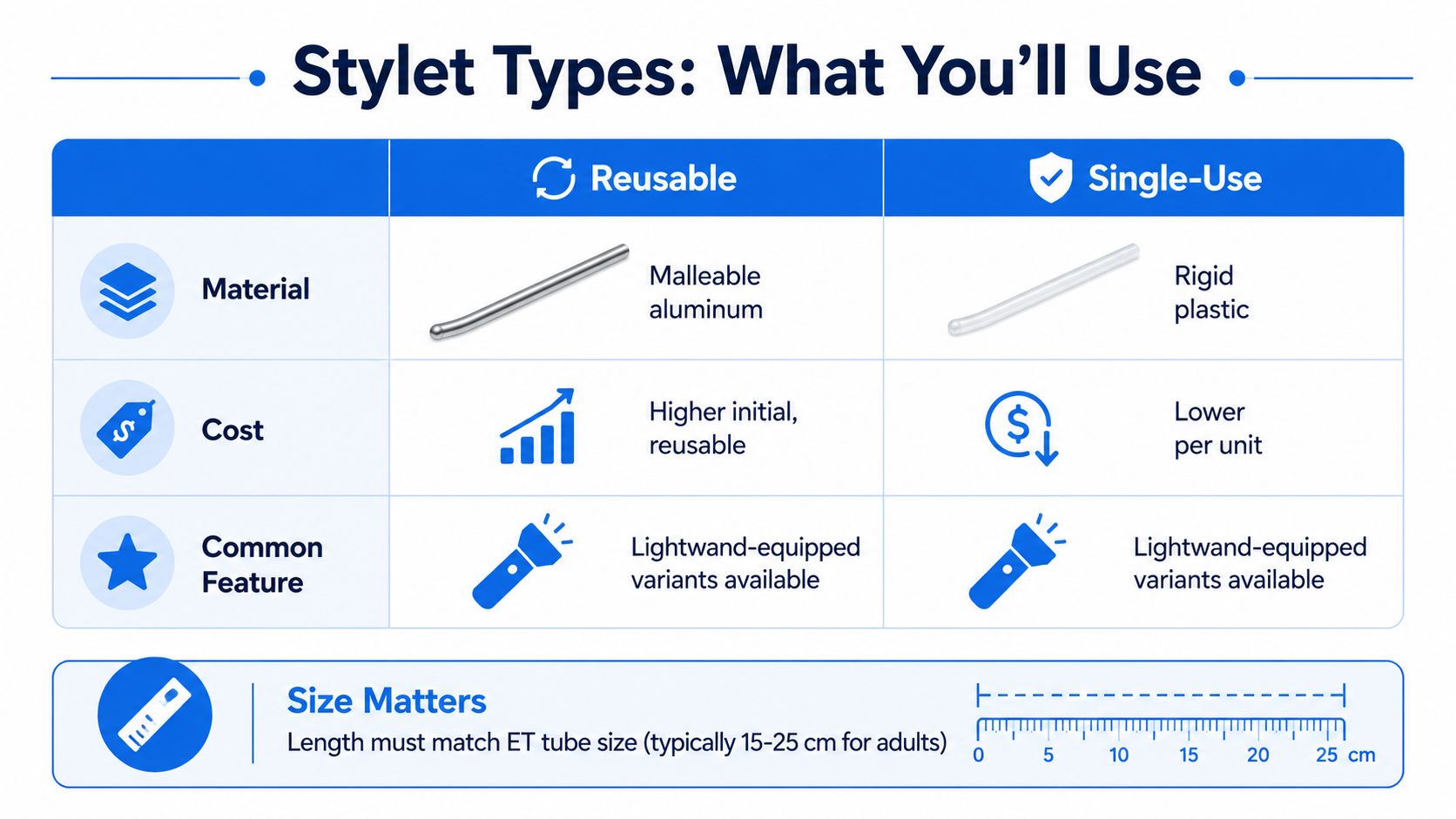
Stylet types at a glance
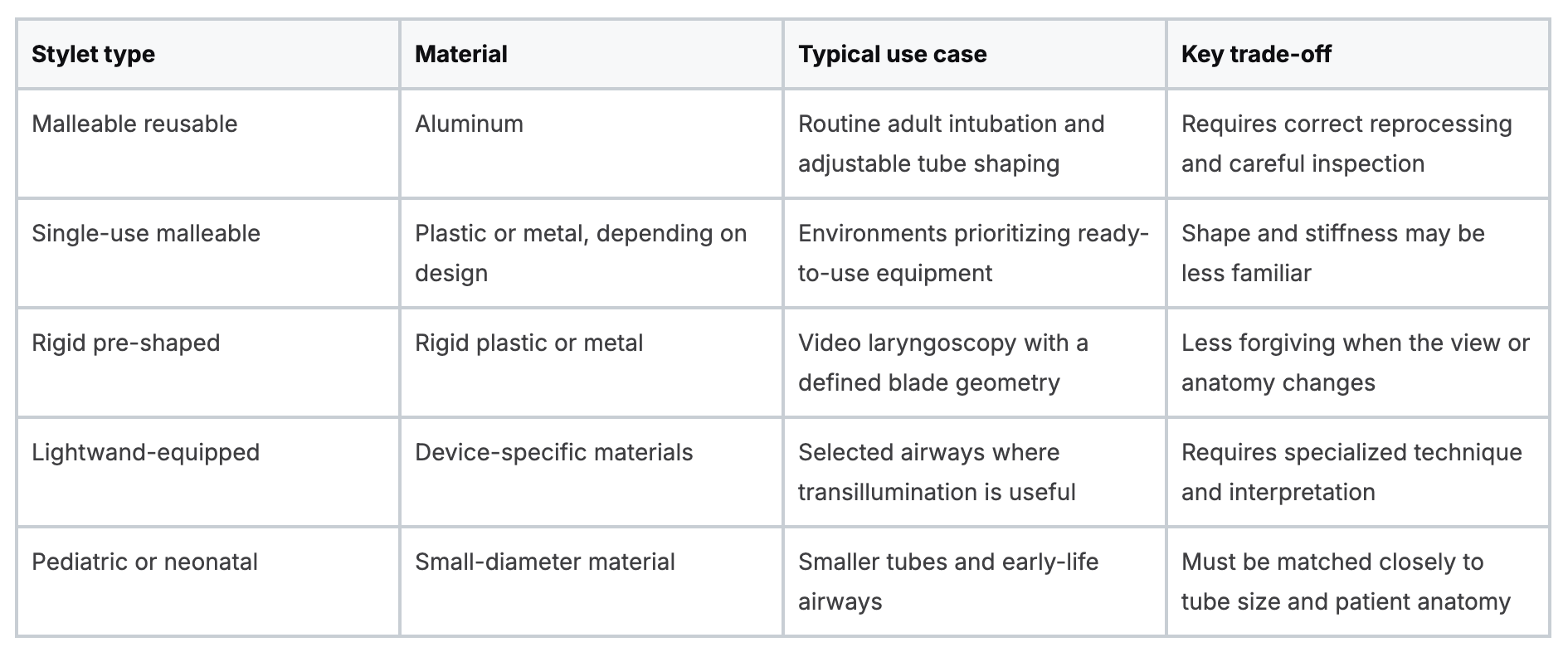
Use this quick selection checklist before opening the tube:
- Compatibility: Confirm that the stylet fits inside the selected endotracheal tube.
- Length: Make sure it supports the tube without extending beyond its distal end.
- Shape: Choose a device that can follow the planned laryngoscope path.
- Condition: Inspect reusable stylets for damage, residue, or loss of coating.
- Patient factors: Consider age, airway anatomy, mouth opening, and the planned rescue strategy.
Neonatal and pediatric airways deserve extra caution because the tube and airway leave less room for error. Clinicians working in those settings may also use Neonatal Resuscitation Certification as an online certification option covering neonatal resuscitation education.
Step-by-Step Technique from Pre-Use Check to Removal
The safest stylet sequence is deliberate and repeatable. Before you touch the patient, confirm the tube size, stylet fit, cuff condition, connector, laryngoscope, suction, oxygen, backup airway, and confirmation equipment.
Prepare the tube and stylet
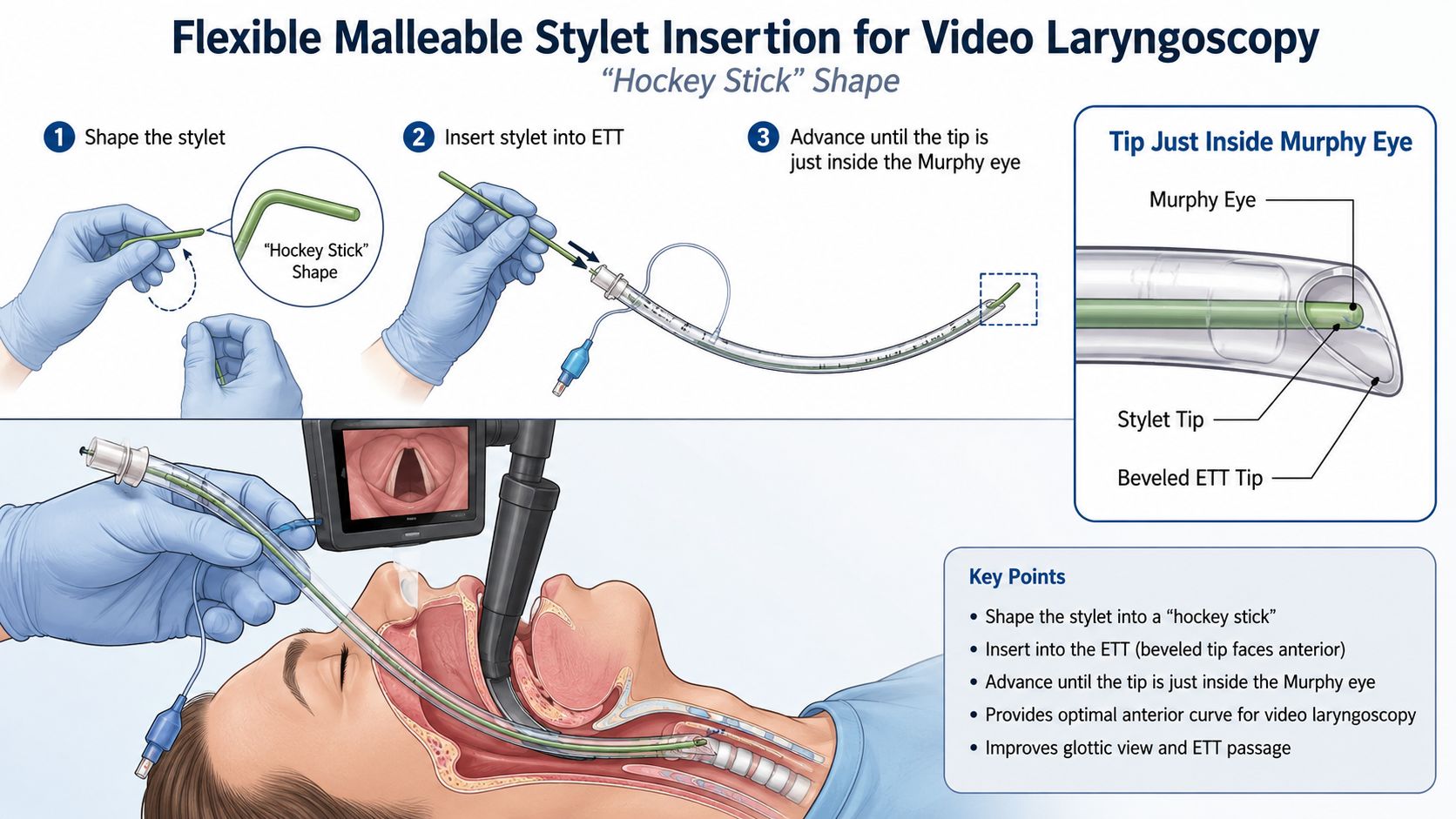
Choose the endotracheal tube according to the patient and local protocol. Insert the stylet smoothly, keeping its distal tip inside the tube and short of the Murphy eye. The Murphy eye is the side opening near the distal end of the tube. The stylet should support the tube without protruding through either opening.
Lubricate the stylet and the external distal portion of the tube with a compatible water-soluble lubricant. Avoid excess lubricant inside the tube, where it can interfere with ventilation or obscure handling.
Shape the distal portion into a gentle curve. Many clinicians use a hockey-stick or anterior curve, often involving the distal 3 to 5 cm of the tube. Keep the curve controlled rather than sharp. Over-bending creates a hook that may catch on the arytenoids or resist passage through the cords.
Deliver and remove
Obtain your laryngoscopic view before advancing the tube. With video laryngoscopy, align the tube curve with the blade and glottic path. Advance the tube under direct observation, keeping the tip controlled and avoiding force when it meets resistance.
A clinical study using the McGrath videolaryngoscope found a shorter mean intubation time with a 60-degree distal angulation than with a 90-degree angulation, 29.3 ± 6.4 seconds versus 32.5 ± 9.4 seconds, with p = 0.022 (study of stylet angulation for routine endotracheal intubation). The practical lesson is simple. More curve isn't automatically better.
Once the cuff has passed through the vocal cords, stabilize the tube firmly at the mouth. Withdraw the stylet completely with a smooth motion. Don't remove it before the tube has passed the cords, and don't leave it in during ventilation.
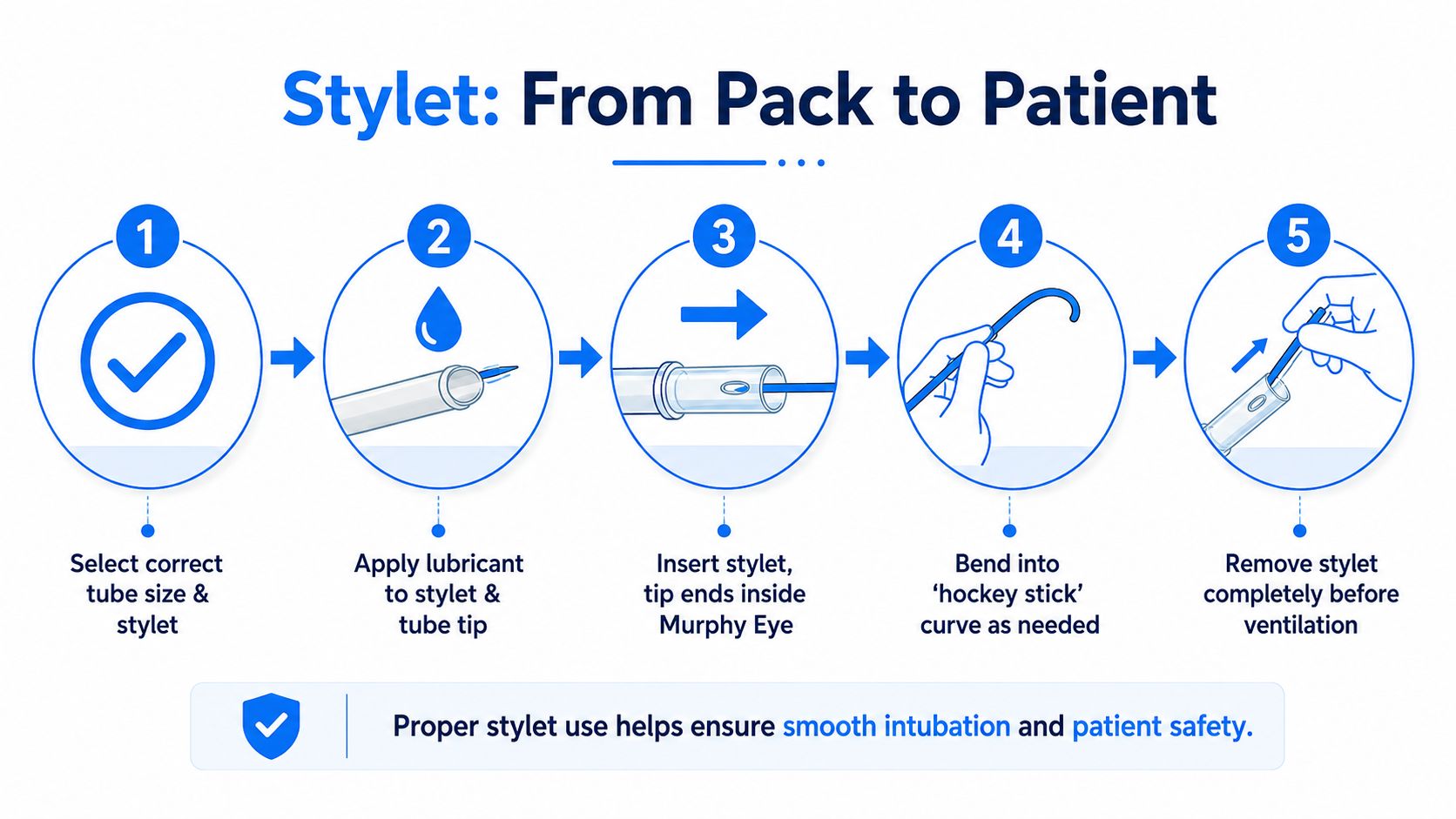
Confirmation follows removal. Use clinical assessment and appropriate monitoring, including waveform capnography when available.
For clinicians reviewing basic resuscitation support alongside airway mechanics, BLS Certification offers an online course format through ProMed Certifications.
Stylets Compared to Bougies and Video Laryngoscopy
A difficult intubation can change character with one tool choice. A video laryngoscope may give you a clear glottic view, while the stylet determines whether the tube can follow that view into the trachea. They address different parts of the same task.
A bougie is a tracheal introducer. It can help when only part of the glottic opening is visible, the airway is anterior, or the plan calls for placing an introducer before advancing the tube. A malleable stylet gives the tube a controllable curve and often works well when the view is strong and the delivery path is direct.
Video laryngoscopy changes the geometry of the approach. With a hyperangulated blade, the screen may show the glottis clearly, yet the tube still has to travel around a steep curve. A compatible stylet, with an appropriate length and bend angle, helps align the tube with that route. Excessive curvature can make advancement harder and can leave the tube tip pointed at the anterior tracheal wall.
Matching tool to airway scenario
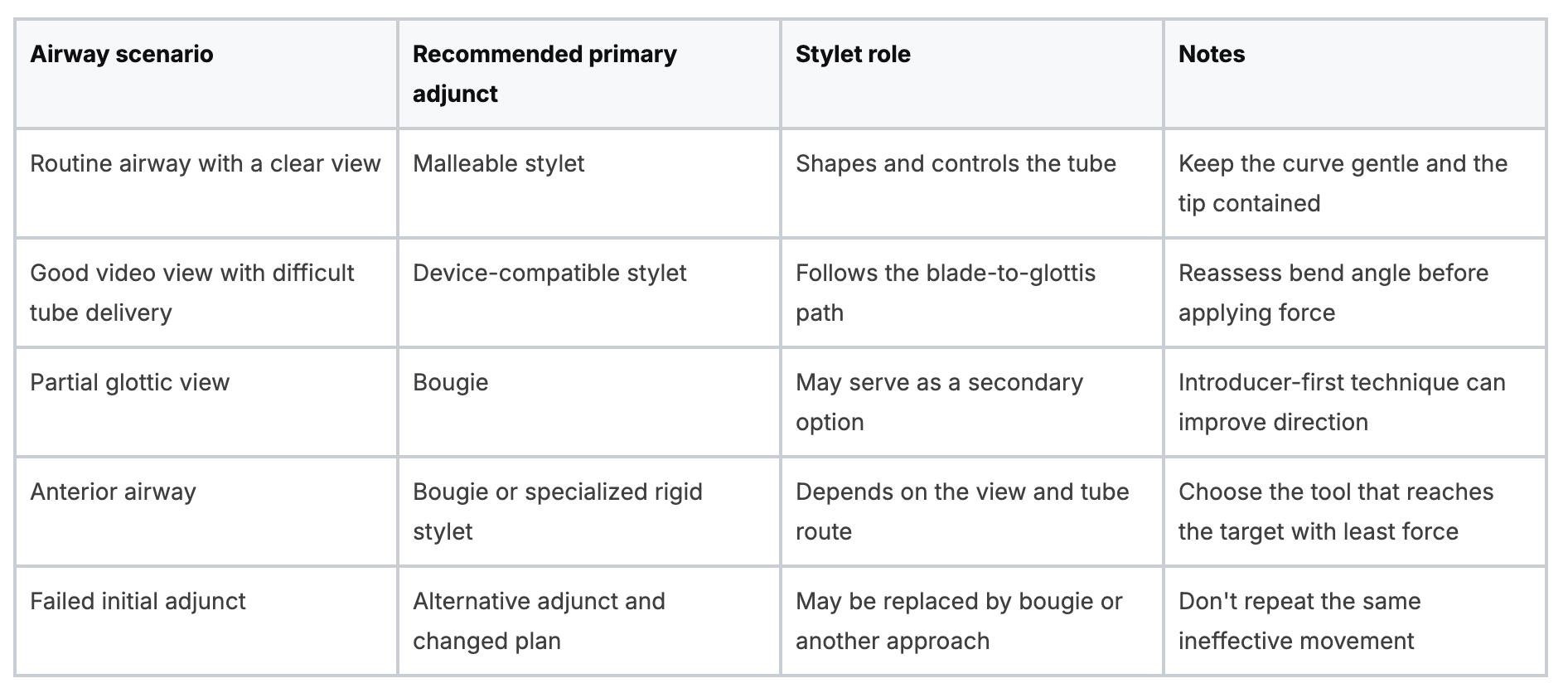
The choice should follow the airway problem, not habit. A clear view with tube hang-up may call for a different bend, a different stylet material, or a bougie. A partial view may favor an introducer because its tip can seek the tracheal opening before the tube follows.
Stop when resistance increases, the view is lost, the tube catches, or the stylet will not withdraw. Reassess the bend, depth, and alignment instead of adding force. Keep the alternative plan ready before the attempt begins.
Clinicians maintaining airway knowledge may use ProMed+ Physician CME, which offers on-demand clinical education and over 200 hours of accredited CME content.
What the Evidence and Guidelines Show
For an adult patient in critical condition, the clearest randomized evidence favors having a stylet ready. A multicenter trial published in 2021 enrolled 999 critically ill adults and compared an endotracheal tube with a stylet against a tube without one.
First-attempt success reached 78.2%, involving 392 patients, with a stylet, compared with 71.5%, involving 356 patients, without one. The absolute difference was 6.7 percentage points. Complication rates were similar, 38.7% versus 40.2%. The practical takeaway is narrow but important: the measurable advantage was first-pass success, not a demonstrated reduction in complications.
Neonatal practice remains less settled. A national survey published in 2018 found that 57% of respondents used a stylet “every time” or “almost every time” they intubated. A later randomized controlled trial involving 200 neonates reported overall success of 81% with a stylet versus 73% without one, but the difference was not statistically significant. Intubation time also differed significantly between groups and conditions.,
What the findings support
The adult data support stylets as a practical adjunct when first-pass success matters. They do not establish that a stylet is better than a bougie or video laryngoscopy for every airway. They also do not replace attention to tube position, bend geometry, or controlled removal.
Design choices still matter. A stylet that is too rigid, too long, or shaped with an overly aggressive curve can make tube delivery slower or less controlled. Simulation should therefore connect material, length, and bend angle to the airway device and the intended tube path, rather than teach one universal shape.
ACLS, difficult-airway, and pediatric instruction should be matched to local protocols, available equipment, scope of practice, and supervised simulation. Online learning can build knowledge and decision-making. Hands-on practice remains necessary for coordination, stylet withdrawal, and team communication.
Common Questions Clinicians Ask During Training
Should every intubation use a stylet?
No. A stylet is useful when you need tube shape and control, but it isn't automatically the best adjunct for every patient. Base the choice on the laryngoscope, airway anatomy, tube, operator experience, and rescue plan.
What shape works best with video laryngoscopy?
Start with the device's intended geometry. A gentle curve may work with a standard blade, while a hyperangulated blade may require a more rigid, device-compatible shape. Avoid assuming that a larger bend produces a better result. The study discussed earlier found slower delivery with excessive angulation.
How can I reduce stylet-related trauma?
Keep the stylet tip inside the tube. Don't use the tube as a lever against the airway, and don't advance through resistance with increasing force. If the tube stops, reassess the view, angle, rotation, and adjunct choice.
When should I use a bougie instead?
A bougie may be the better first adjunct with a limited view, an anterior airway, or a protocol that favors introducer-first placement. A stylet and bougie can both be part of a broader plan, but don't clutter the airway with equipment you can't control.
How does this fit recertification?
Airway courses commonly revisit adjunct selection, tube delivery, confirmation, and failed-attempt planning. Online ACLS and airway refreshers now cover these knowledge areas just as in-person programs do. The evidence supports online learning as equivalent to, and in some outcomes potentially more effective than, traditional formats for healthcare education (systematic review of online eLearning). A separate meta-analysis of 126 studies reported pooled effect sizes of 1.00 for knowledge, 0.85 for skills, and 0.82 for learner behaviors and patient effects compared with no intervention, while differences from non-Internet formats were generally small and not statistically meaningful (meta-analysis of Internet-based learning).
Sharpening Airway Skills and Keeping Certification Current
A reliable stylet habit has three parts: choose a compatible device, shape the tube to the airway path, and remove the stylet only after the tube is secure. Practice those movements in simulation, then connect them to confirmation and backup planning.
Online education is just as effective as in-person training for core healthcare knowledge and skills. A review of online digital education for practicing physicians included 93 studies with 16,895 participants and found online and blended learning may be equivalent to self-directed or face-to-face learning across knowledge, skills, attitude, satisfaction, practice change, and patient outcomes.
Hospitals, clinics, and professional organizations are increasingly recognizing accredited online CE and certifications. The belief that only AHA or American Red Cross in-person classes are valid isn't true. Review your employer and licensing requirements, then choose an accredited format that lets you maintain the knowledge and skills your role demands.
Pick the airway scenario you find hardest, drill the adjunct sequence in your next simulation or online module, and carry that specific focus into your next supervised intubation.
ProMed Certifications offers online ACLS, BLS, PALS, CPR, and Neonatal Resuscitation education designed for healthcare professionals who need flexible certification and continuing education access. Visit ProMed Certifications to choose the course that matches your airway responsibilities and keep your preparation current.
.avif)
Stay compliant with ProMed+
Certifications included: ACLS, BLS, PALS, CPR & Neonatal Resuscitation
Unlimited continuing education: over 200 hours of accredited CME
All-inclusive: One price. No surprises.
Get certified today

The Advanced Cardiac Life Support (ACLS) is an accredited online medical certification course that teaches medical professionals to respond to nearly all cardiopulmonary emergencies.

The Pediatric Advanced Life Support (PALS) Recertification instructs medical professionals on performing pediatric cardiopulmonary resuscitation in emergencies.

The Basic Life Support (BLS) Recertification is intended to teach healthcare professionals the basic steps of CPR and rescue breathing for adults, children, and infants.

Our online medical certification course for CPR, Automated External Defibrillator (AED), and First Aid is designed to teach adult, child, and infant CPR and AED use.

The Neonatal Resuscitation Certification trains medical professionals in performing resuscitation procedures and life-saving techniques for newborns at the time of delivery.

.png)
.png)
.png)