


Pediatric Advanced Life Support Training and Certification
.png)
The most popular advice about pediatric advanced life support training is also the most limiting: many clinicians still assume serious certification must happen in a crowded, in-person classroom. That assumption no longer fits every healthcare professional's schedule, learning style, or clinical setting. Well-designed online education can be just as effective as in-person education for healthcare continuing education and certification, particularly when it combines strong cognitive instruction, practice, feedback, and an appropriate skills evaluation.
PALS matters because children can deteriorate quickly, and their emergency patterns aren't smaller versions of adult emergencies. This guide explains what the training really develops, how online and classroom pathways compare, what evidence says about simulation and retention, and how to choose a credible provider without burning out.
What Pediatric Advanced Life Support Training Really Is
Pediatric Advanced Life Support, or PALS, is a structured curriculum that prepares healthcare professionals to recognize and treat critically ill or injured infants and children before, during, and after cardiac arrest. It isn't just a poster of algorithms on a resuscitation cart. It teaches you how to notice deterioration, organize information, select appropriate interventions, and lead a coordinated response.
Think of PALS as a flight simulator for pediatric emergencies. You learn the controls first, then rehearse decisions while the consequences are safe to observe and discuss. In clinical care, that preparation helps you move from recognition to action without losing the team's shared plan.
How PALS differs from other life support courses
Basic Life Support, or BLS, focuses on immediate recognition of cardiac arrest, high-quality cardiopulmonary resuscitation, and use of an automated external defibrillator when appropriate. Advanced Cardiac Life Support, or ACLS, addresses adult cardiac arrest and other cardiovascular emergencies. PALS applies advanced assessment and resuscitation principles to infants and children, whose anatomy, physiology, causes of deterioration, and medication calculations differ from adults.
PALS training commonly develops three connected abilities:
- Clinical recognition: Identify respiratory distress, respiratory failure, shock, and cardiac arrest early.
- Technical action: Perform airway support, vascular access, rhythm management, medication administration, and resuscitation procedures.
- Team performance: Communicate clearly, assign roles, reassess the patient, and adjust treatment as the situation changes.
The course works best when you understand the reason behind each step. A learner who only memorizes an algorithm may freeze when the patient doesn't fit the standard picture. A learner who understands physiology can use the algorithm as a reliable structure while adapting to the child in front of them.
Who benefits from the training
The immediate beneficiary is the pediatric patient, but the circle is wider. Families need clinicians who can explain what is happening while delivering care. Nurses, physicians, paramedics, respiratory therapists, and other responders need a shared language during stressful events.
PALS is therefore both a clinical knowledge course and an operational team skill. The final test isn't whether you watched the modules. It's whether you can recognize a changing child, make a defensible decision, communicate it, and continue reassessing the response.
A Brief History of PALS and Who Needs It Today
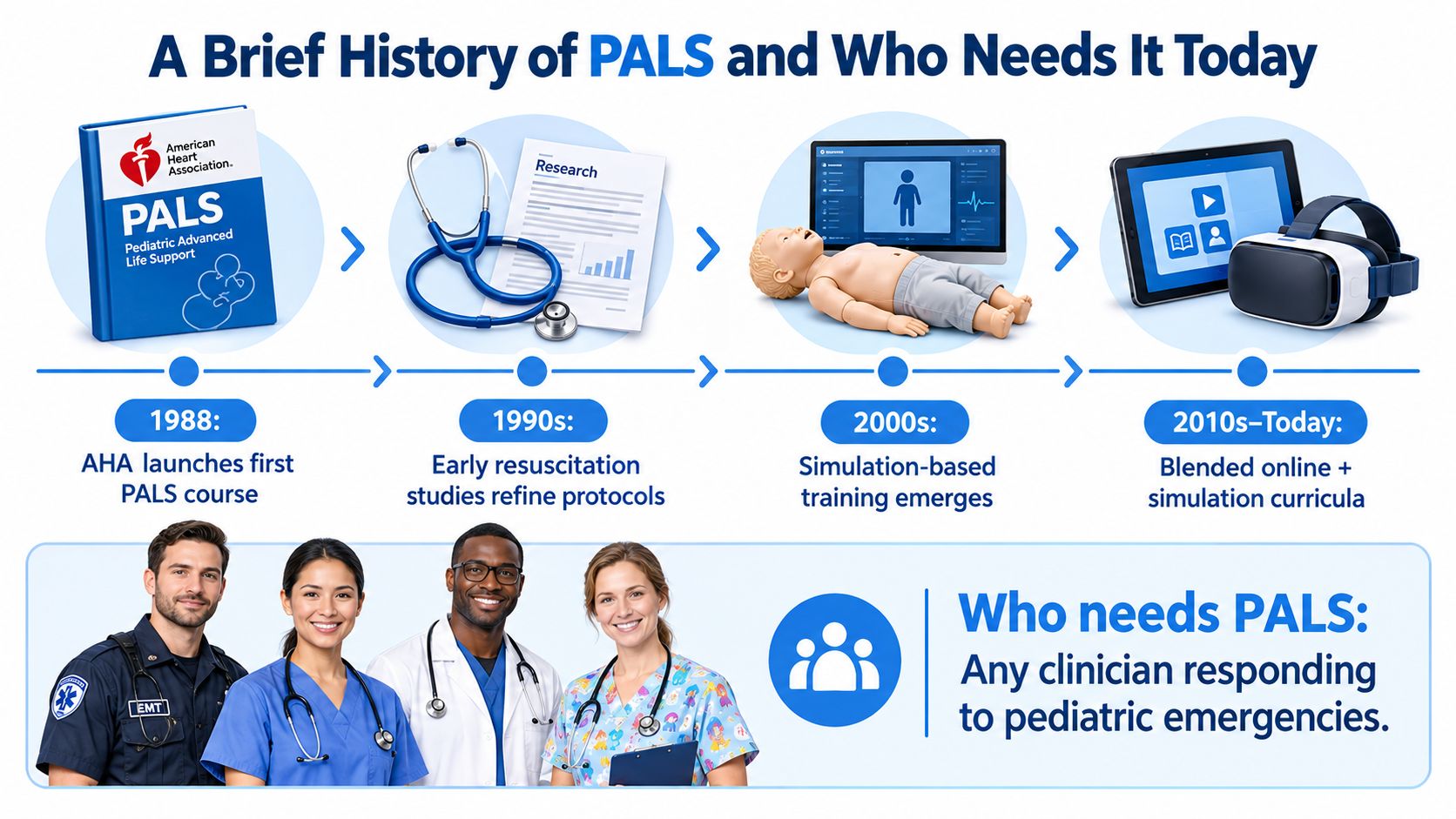
PALS has a long history as a structured pediatric resuscitation program. The American Academy of Family Physicians' historical overview of PALS records that the American Heart Association recommended developing a pediatric advanced life support course in 1983, published the first PALS manual in 1988, and began the first PALS courses that same year. The program underwent major revisions in 1994 and further updates in 1997, reflecting the need for guidance designed around pediatric arrest and shock patterns.
That history matters because it shows PALS was created for a distinct clinical problem, not adapted casually from adult resuscitation. Modern programs continue that tradition by combining evidence-based cognitive education with simulation, deliberate practice, team communication, and skills verification.
Who should consider PALS
PALS is relevant to clinicians who regularly treat children and to professionals who may be first to stabilize a child before transfer. Common learners include:
- Emergency and intensive care nurses: Especially those working in emergency departments, pediatric intensive care units, or mixed units.
- Paramedics and emergency responders: They may manage deterioration before the child reaches a hospital.
- Respiratory therapists: Airway and ventilation decisions are central to many pediatric emergencies.
- Pediatric residents and physicians: The course reinforces structured assessment and team leadership.
- Advanced practice providers: Nurse practitioners and physician assistants may evaluate and stabilize critically ill children.
- Family practice and clinic teams: Outpatient clinicians may need to begin care while arranging emergency transport.
- School nurses and community staff: Their role may involve early recognition, basic stabilization, and clear handoff.
A current BLS foundation is useful, along with a healthcare background or strong anatomy knowledge. Comfort with basic rhythm interpretation also helps, although a good course should teach the concepts rather than assume you already know everything.
For newborn-focused situations, PALS isn't the whole picture. A separate perinatal emergencies training guide can help clinicians compare pediatric emergency preparation with training centered on the period around birth.
For clinicians seeking a fully online option, PALS Certification presents a self-paced route that includes review material, an exam, and access to a certification card after completion.
Core Skills and Curriculum You Will Actually Learn
A strong PALS course turns abstract modules into decisions you can practice. You begin with a rapid first impression, often using the Pediatric Assessment Triangle, which considers appearance, work of breathing, and circulation to the skin. The point isn't to diagnose everything immediately. It's to identify danger quickly and decide how urgently the child needs support.
Assessment before intervention
You'll learn to distinguish respiratory distress from respiratory failure. Distress means the child is working hard to maintain gas exchange. Failure means those efforts are no longer sufficient, and mental status, oxygenation, ventilation, or breathing may be worsening. That distinction changes the urgency and the type of support required.
You'll also examine shock, including compensated and decompensated states. A child may preserve blood pressure for a time while perfusion worsens elsewhere. Treating the numbers alone can delay recognition, so the course connects heart rate, pulses, skin findings, mental status, urine output, and blood pressure into one clinical picture.
Rhythm, airway, and circulation skills
PALS addresses bradyarrhythmias and tachyarrhythmias through structured algorithms. You'll consider whether the rhythm is causing instability, whether the child has a pulse, and which intervention fits the rhythm and clinical condition.
The hands-on curriculum may include:
- Airway management: Positioning, ventilation support, oxygen delivery, and escalation when basic measures aren't enough.
- Vascular access: Peripheral access, intraosseous access, and choosing a route when time matters.
- Fluid and shock management: Matching resuscitation to the suspected cause while reassessing the response.
- Weight-based medication dosing: Using the child's weight and concentration carefully to reduce calculation errors.
- Team communication: Giving clear orders, confirming them aloud, and reporting changes promptly.
Weight-based dosing is easier to understand when you treat the Broselow tape like a color-coded kitchen shelf. Each color organizes equipment and medication information around an estimated weight range, helping the team reach for the right tools quickly. It supports decision-making, but it doesn't replace patient assessment or medication verification.
The PALS algorithms are useful for organizing this knowledge, especially when you practice asking, “What do I know, what threatens the child now, and what must I reassess next?”
The megacode as rehearsal
A megacode is a simulated resuscitation scenario. You may assess a deteriorating child, direct airway support, interpret a rhythm, request access, calculate medication, and coordinate reassessment. The value comes from repetition and feedback, not from watching a demonstration once.
In one emergency medical squad study, PALS-trained teams achieved successful intubation in 85% of cases versus 48% for non-PALS-trained teams. Vascular access success in shock or arrest cases was 100% versus 70%, and intraosseous line placement success was 100% versus 55%. Mortality, however, did not differ meaningfully, 37% versus 32%, which shows that technical competence is important but patient survival depends on many additional factors.
You're ready for a real code when you can perform, communicate, and reassess, not merely recall.
Online vs In-Person PALS Training Compared
Online and in-person PALS training aren't automatically opposites. The meaningful comparison is between high-quality learning design and weak learning design. An online course with clear instruction, realistic cases, feedback, and a valid skills pathway can support the same certification goals as a classroom course. An in-person class can still fall short if learners spend most of the day passively listening.
The strongest online and hybrid options let you study independently, then complete a hands-on evaluation or megacode when required by the provider or employer. That arrangement suits clinicians working nights, rotating shifts, rural facilities, or departments where taking an entire uninterrupted day away from patient care is difficult.
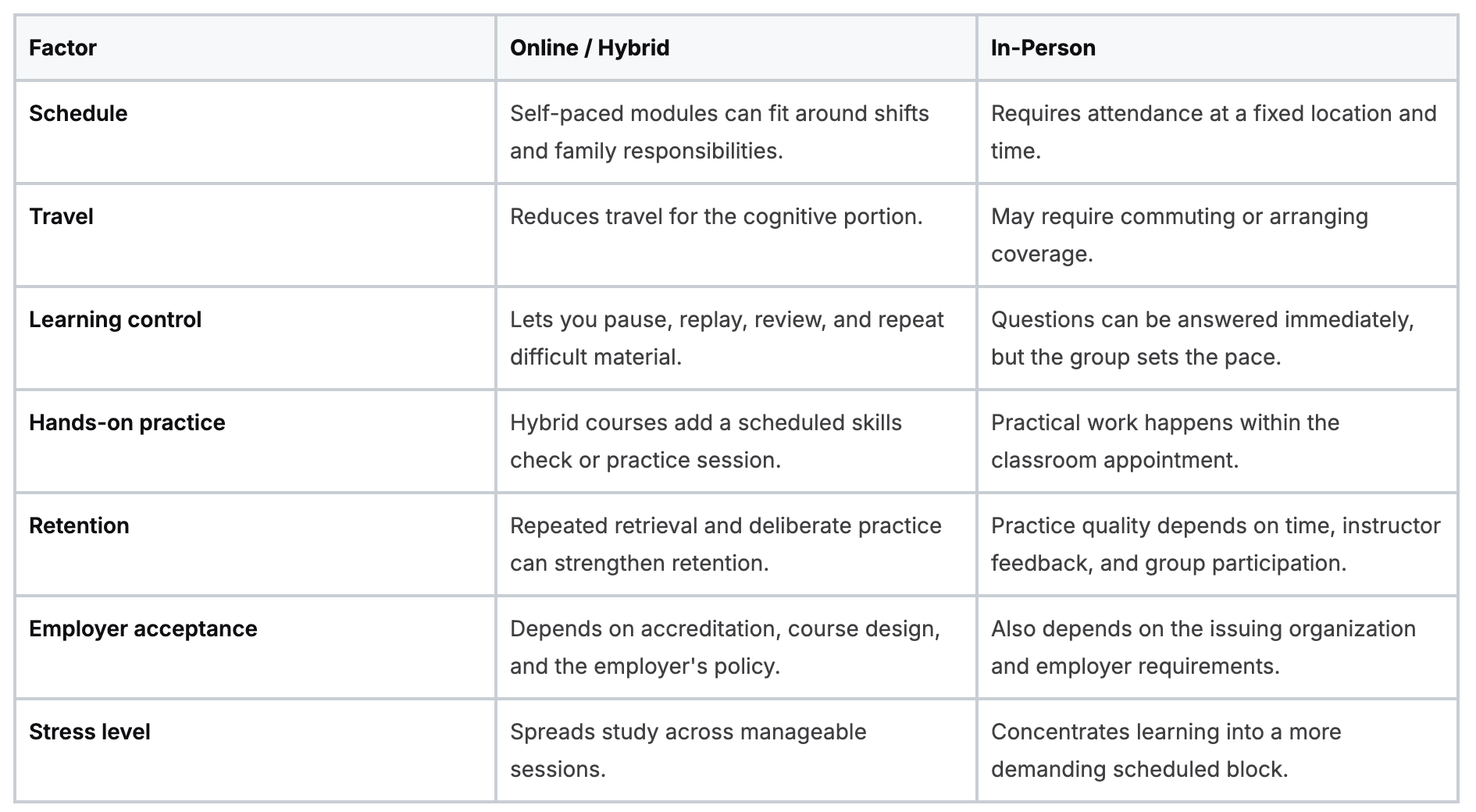
Research supports the educational value of flexible digital learning. A review of healthcare e-learning describes benefits including accessibility, interactivity, flexibility, knowledge management, and cost efficiency, while also noting that learners can review materials as needed. A more recent review reports that e-learning can produce outcomes comparable to, or better than, traditional face-to-face education while supporting self-paced learning. See the review in Professional and patient care outcomes of e-learning in healthcare.
The industry is gradually accepting that online CE and certification aren't automatically lesser options. Hospitals, clinics, and professional organizations increasingly evaluate accreditation, content quality, skills verification, and documentation rather than assuming classroom attendance alone proves competence.
Certification, Recertification, and Renewal Timelines
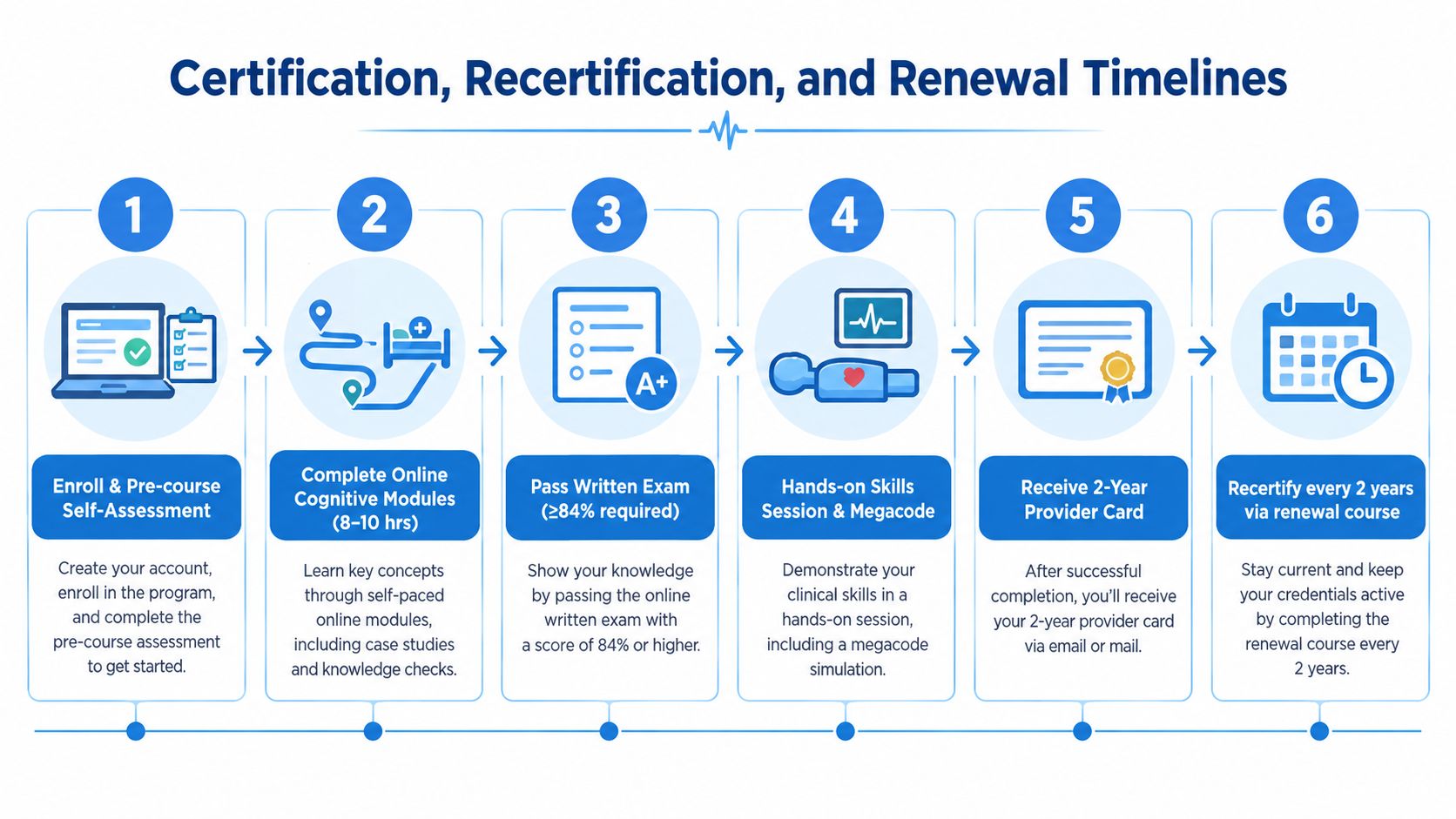
Certification usually follows a sequence, even when the learning itself is online. You enroll, complete a pre-course assessment, work through the cognitive material, pass the written exam, and complete the required skills evaluation or megacode pathway. Your employer may also require documentation showing the issuing organization, completion date, provider number, and expiration date.
Many PALS cards are commonly treated as valid for two years, but you should verify the exact term printed on your card and the policy of your employer or credentialing body. Renewal isn't a repeat purchase. It should refresh clinical reasoning, incorporate current guidance, and give you another opportunity to demonstrate essential skills.
A practical renewal routine
Start checking requirements before your card expires. That gives you time to resolve scheduling problems, employer-specific rules, or missing documentation without creating a credentialing gap.
Use this simple process:
- Confirm the requirement: Ask HR, credentialing, or your clinical manager which providers and skills components they accept.
- Review the card: Record the issue and expiration dates in a secure digital folder.
- Choose initial or renewal training: Recertification may be shorter, but it still needs meaningful review and assessment.
- Complete the exam and skills pathway: Keep the completion record, certificate, and card together.
- Track CE or CME separately: A certification card and continuing education credit may be documented differently.
- Update your employer file: Send a readable digital copy and retain the confirmation.
If a card lapses, don't assume a short review automatically restores it. Your employer or provider may require a new initial course, so clarify the rule before the expiration date.
Clinicians working with children also benefit from understanding the emotional and developmental context of care.
How to Choose an Accredited PALS Provider
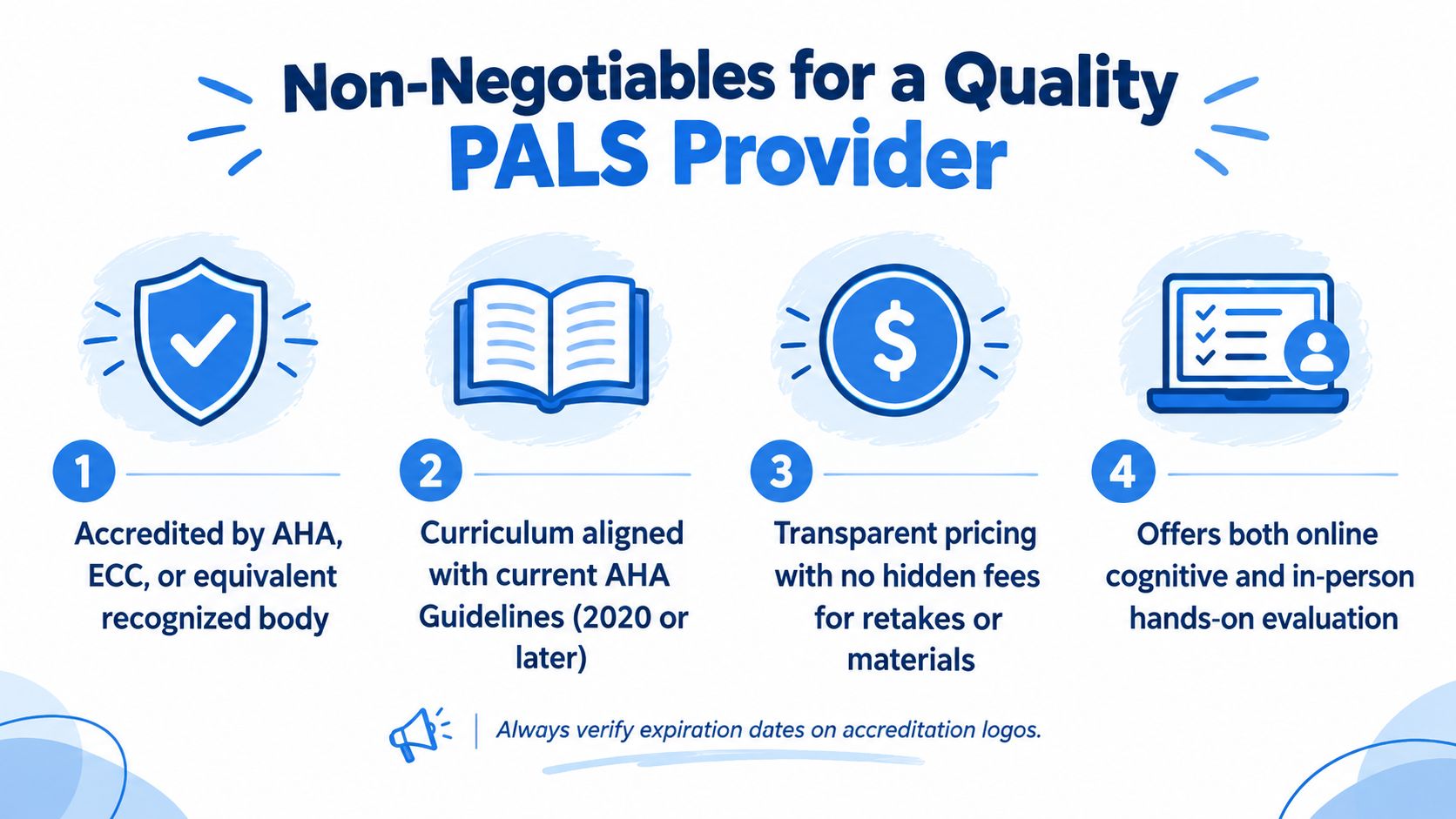
A credible provider makes its requirements easy to inspect. Before you pay or begin, look for accreditation or recognition, current guideline alignment, transparent fees, accessible materials, and a realistic skills assessment pathway. A certificate that lacks verifiable educational standards may not satisfy your employer, even if the course looks polished.
The quality checklist
Recognition comes first. Check the accrediting or recognizing body, and confirm that the credential matches your workplace's policy. The American Heart Association and American Red Cross are familiar choices, but they aren't the only possible recognized options. Employers may accept other accredited programs when the course meets their documented standards.
Content must reflect current guidance. A quality provider should explain which guidelines shape the curriculum and when the content was last reviewed. It should also cover more than standard cardiac arrest algorithms. Current evidence discussions identify gaps involving myocarditis and cardiomyopathy, single-ventricle congenital heart disease, pulmonary hypertension, traumatic cardiac arrest, and nuanced airway and shock management.
The assessment pathway should be visible. Ask whether the course includes cognitive testing, practical skills verification, a megacode, or a combination. Online learning is valid, but a provider shouldn't hide how competence is assessed.
Features that protect busy clinicians
Unlimited retakes, clear study materials, instant access to documentation, and a satisfaction or money-back guarantee can matter when a clinician has limited time and cannot absorb surprise fees. ProMed Certifications offers an online curriculum with self-paced access, unlimited retakes, digital certification documentation, and a money-back guarantee if an employer doesn't accept the certification, according to the publisher's stated program information.
That doesn't mean every learner should choose the same provider. Compare the course against your employer's written requirements, not just a marketing badge.
Practical rule: If a provider won't clearly explain accreditation, assessment, expiration, and employer acceptance, pause before enrolling.
Red flags include an unaccredited certificate, an unrealistic promise that skips skills verification, hidden retake charges, unclear guideline alignment, or no reliable way to contact the provider. Convenience is valuable only when it comes with defensible educational quality.
Practical Tips for Passing the PALS Exam
Cramming feels efficient because it fills a short window with information. It often fails because PALS requires retrieval, sequencing, and clinical judgment. Simulation and deliberate-practice research supports a different approach. In a study using rapid cycle deliberate practice, pediatric resident PALS performance rose from 52% at baseline to 94% immediately after training, then remained 81% at three months.
Use a 7-to-10-day study sprint with daily 30-minute blocks rather than one exhausting session. Your goal is to retrieve the steps aloud, identify weak spots, correct them, and repeat.
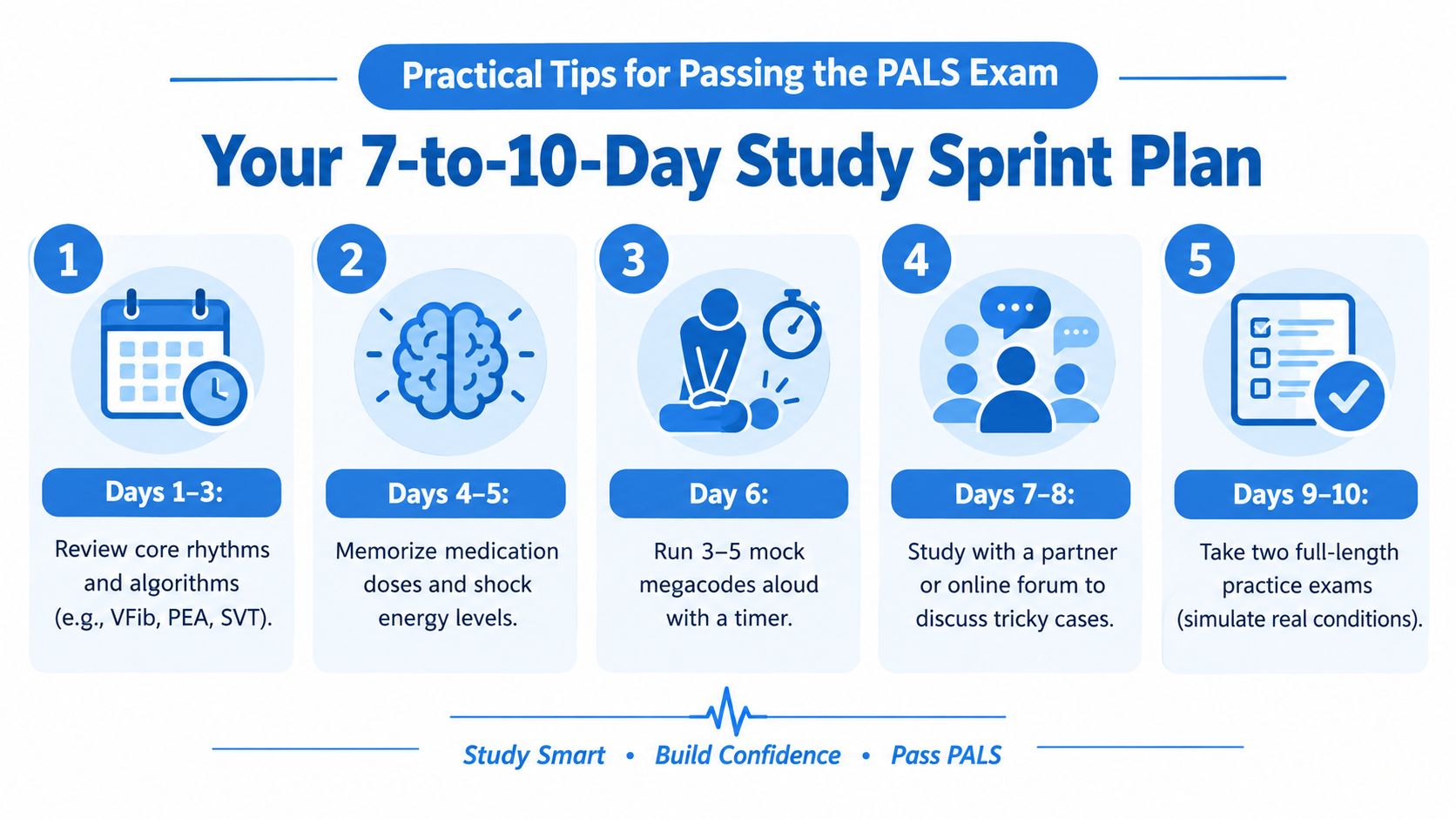
A focused study routine
- Start with recognition: Review the pediatric assessment triangle and practice separating respiratory distress from respiratory failure.
- Work through rhythms: Review the core pediatric rhythm pathways and explain why the patient's stability changes the response.
- Practice medication calculations: Use the dose and concentration provided by your course materials. For any example such as epinephrine, verify the formulation and follow current course guidance.
- Rehearse communication: Say orders aloud, have a partner confirm them, and state when you expect reassessment.
- Use familiar stories: Connect each scenario to a child you might meet in your emergency department, clinic, ambulance, or school setting.
- Practice safely at home: You can rehearse the BLS sequence on a stuffed animal, but don't substitute home practice for formal skills verification.
A pre-test ritual can settle your attention. Review the pediatric algorithms, run through two rhythm strips, and recite the medication calculations your course teaches. Then explain the difference between respiratory distress and failure to a colleague without looking at your notes. If you can't explain it plainly, you probably need another short practice block.
Simulation-based PALS instruction has also demonstrated cognitive benefits. In a randomized trial of high-fidelity simulation, the simulation group improved more than controls, with post-training cognitive performance changes of 11.1 [4.8] versus 4.8 [1.7], P = 0.007.
Before test day, use the PALS practice test to identify gaps. During the exam, breathe slowly, read each question twice, identify the immediate threat, and use process of elimination when several answers seem plausible.
Putting It All Together and Your Next Step
PALS training begins with a specific purpose. It prepares you to recognize a deteriorating infant or child, interpret the clinical picture, intervene according to pediatric principles, and keep a team coordinated under pressure. The history of the program shows why pediatric care needs its own structured approach, while simulation research shows why practice, feedback, and repetition matter.
The format can be flexible without becoming superficial. Online education gives you control over timing, review, and pace. In-person or hybrid skills evaluation can add physical rehearsal and direct observation when required. Research on asynchronous clinician education supports learning that happens at a convenient time and location, which helps professionals balance development with work and personal commitments.
Hospitals and clinics are increasingly looking beyond the old in-person-only assumption. They can evaluate accreditation, curriculum alignment, documentation, and skills verification instead. AHA and American Red Cross classes aren't the only potentially recognized options, but your employer's policy always controls what counts for your role.
Choose an accredited program with transparent requirements and a clear assessment pathway. Pick a start date this week, complete the self-paced modules in short sessions, schedule the skills check if one is required, and save your certificate where HR or credentialing can access it. If your course awards CE or CME, keep that record with your certification documents rather than assuming one replaces the other.
ProMed Certifications offers online PALS certification and other healthcare credentials through a self-paced platform with unlimited retakes and digital documentation. Visit ProMed Certifications to review the PALS course, confirm it fits your employer's requirements, and start building a certification routine that works with your clinical schedule.
.avif)
Stay compliant with ProMed+
Certifications included: ACLS, BLS, PALS, CPR & Neonatal Resuscitation
Unlimited continuing education: over 200 hours of accredited CME
All-inclusive: One price. No surprises.
Get certified today

The Advanced Cardiac Life Support (ACLS) is an accredited online medical certification course that teaches medical professionals to respond to nearly all cardiopulmonary emergencies.

The Pediatric Advanced Life Support (PALS) Recertification instructs medical professionals on performing pediatric cardiopulmonary resuscitation in emergencies.

The Basic Life Support (BLS) Recertification is intended to teach healthcare professionals the basic steps of CPR and rescue breathing for adults, children, and infants.

Our online medical certification course for CPR, Automated External Defibrillator (AED), and First Aid is designed to teach adult, child, and infant CPR and AED use.

The Neonatal Resuscitation Certification trains medical professionals in performing resuscitation procedures and life-saving techniques for newborns at the time of delivery.

.png)
.png)
.png)