


A Guide to Online BLS and ACLS Certification
.png)
The most popular advice about online BLS and ACLS is often too simple: “Only take an in-person class.” That advice no longer reflects how healthcare education works. Online learning can be just as effective as classroom instruction for knowledge and many certification outcomes, while giving busy clinicians more control over timing, review, and access. The important question isn't whether a course is online. It's whether the course matches your role, your employer's policy, current resuscitation guidance, and the hands-on verification your position requires.
A credible online pathway doesn't remove clinical standards. It changes where you learn the didactic material and how you schedule assessment. This guide will help you distinguish BLS from ACLS, compare self-paced and blended formats, interpret the research, and choose a certification route that an employer can verify.
What Online BLS and ACLS Courses Actually Are
Basic Life Support, or BLS, teaches the immediate actions used when someone has cardiac or respiratory arrest. The core skills include high-quality CPR, AED use, basic airway management, and coordinated response. Advanced Cardiovascular Life Support, or ACLS, builds on BLS with a more advanced approach to cardiac arrest, bradycardia, tachycardia, rhythm recognition, medication use, defibrillation, cardioversion, and care after the return of spontaneous circulation.
The word online describes delivery, not a lower standard of content. You'll usually encounter three formats:
- Fully self-paced: You complete digital lessons and a cognitive assessment on your own schedule. Skills verification may be handled through an approved process, depending on the provider and employer.
- Blended learning: You complete the knowledge portion online, then attend a hands-on skills session.
- Live virtual instruction: An instructor teaches through a scheduled online class, with questions, demonstrations, and assessment handled through the platform or a separate skills process.
The guideline history explains why course updates matter. The 2000 International Guidelines for CPR and ECC helped standardize BLS, ACLS, and PALS globally. The 2010 update introduced the C-A-B sequence, placing compressions before airway and breathing, which changed later digital course content and instructor updates. The AHA released its 2020 guideline update online on October 21, 2020, followed by print publication on November 4, 2020. These milestones show that resuscitation education evolves with evidence rather than remaining fixed.
What you'll find inside a legitimate course
A well-built module may include video demonstrations, interactive emergency scenarios, rhythm and algorithm exercises, voice-assisted manikin practice, and a proctored cognitive exam. These tools let you pause, repeat difficult concepts, and make decisions in a simulated sequence instead of passively listening to a lecture.
The hands-on question still matters. A legitimate program should explain whether your course includes an in-person skills check, remote-proctored practical evaluation, or another approved method. The American Heart Association describes BLS and ACLS blended offerings that pair online learning with a hands-on session. (AHA BLS course information)
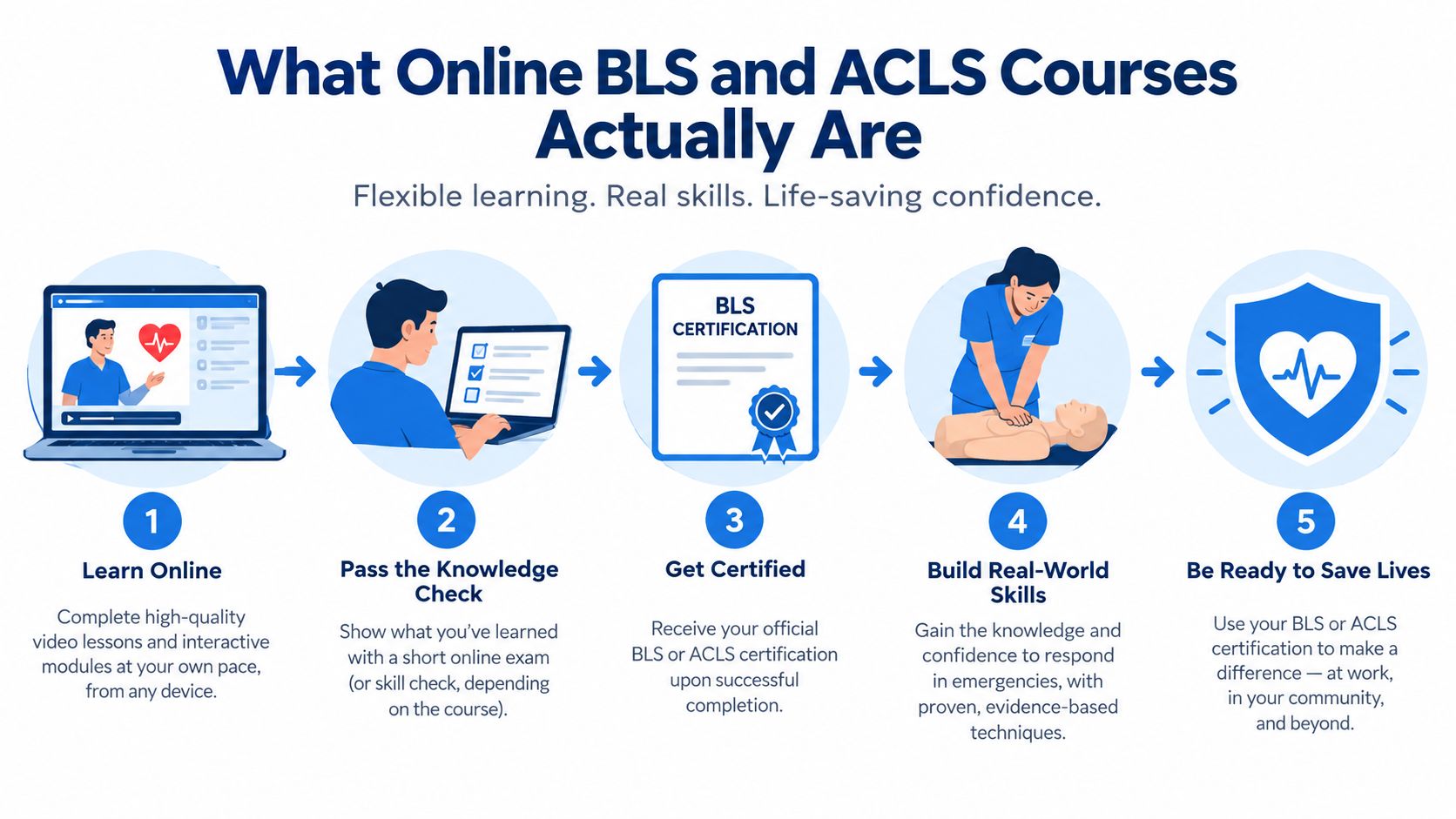
For a plain-language overview of the BLS pathway, see online BLS certification guidance. The practical takeaway is simple: online is a channel for delivering instruction. It isn't a watered-down curriculum.
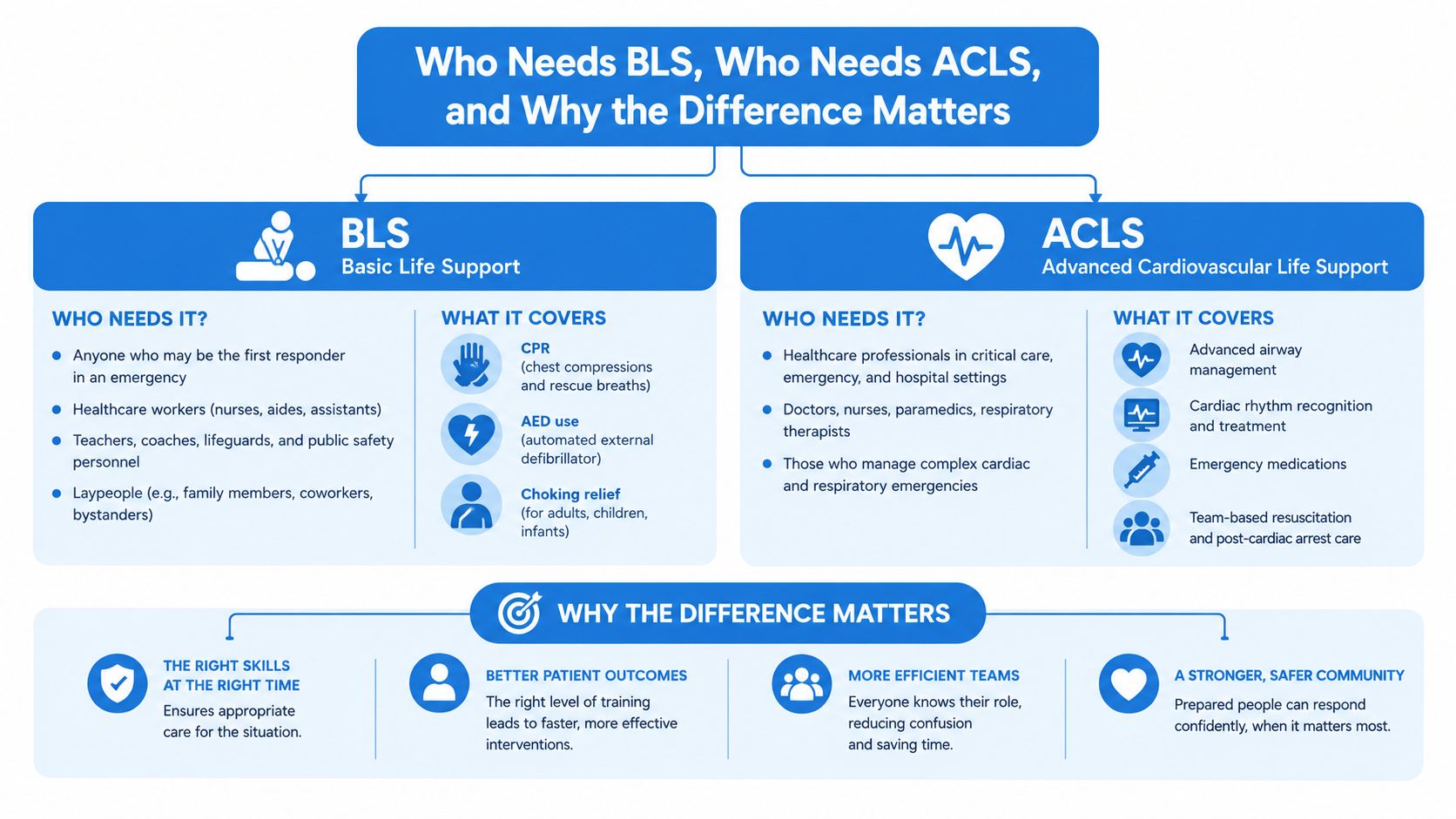
Who Needs BLS, Who Needs ACLS, and Why the Difference Matters
BLS is the foundation for people who may respond first to a deteriorating patient. That includes nurses, medical assistants, dental staff, EMTs, physical therapists, medical students, and hospital employees who work directly with patients. Some organizations also require BLS for staff who aren't bedside clinicians but may encounter an emergency during daily operations.
ACLS is different because it assumes a deeper clinical role. It commonly applies to physicians, advanced practice nurses, paramedics, respiratory therapists in critical care, and nurses working in intensive care, emergency, or coronary care environments. Your job description and facility policy should decide the final requirement, not a generic course advertisement.
The clinical distinction
BLS focuses on the first response:
- Adult, child, and infant CPR
- Single-rescuer and team-based resuscitation
- AED operation
- Basic airway and ventilation support
- Recognition of cardiac arrest and rapid activation of help
ACLS adds clinical decision-making for more complex emergencies:
- ECG rhythm interpretation
- Cardiac arrest algorithms
- Bradycardia and tachycardia management
- Medication and defibrillation concepts
- Synchronized cardioversion
- Post-cardiac-arrest care
- Team communication and role assignment
Think of BLS as the emergency response foundation. ACLS is the advanced team system built on that foundation. Someone preparing for nursing school can use WeekdayDoc RN programs to explore education pathways, then confirm the life-support credential required by the clinical setting.
Practical rule: If the job description names ACLS, a current BLS card alone won't satisfy the requirement.
Employers generally verify the issuing organization, card status, course type, and expiration date. They may accept an AHA eCard regardless of whether the learning portion occurred online, but acceptance policies vary by facility and role. Confirm before enrolling, especially if you're starting a new position or entering a regulated clinical placement.
For foundational training, BLS Certification is described as 100% online. ProMed Certifications states that learners can complete the course, pass the exam, and receive their card in as quick as one hour or less, based on its catalog description.
Side-by-Side Comparison of BLS and ACLS Online Programs
BLS and ACLS aren't interchangeable, even when the same platform offers both. BLS usually takes less time because it addresses foundational response. ACLS requires more preparation because you must connect rhythm recognition, algorithms, medications, defibrillation, and team leadership.
The comparison below is a practical screening tool. Exact requirements vary by provider and employer, so treat the format and acceptance fields as items to verify before payment.
Online BLS vs ACLS Feature Comparison
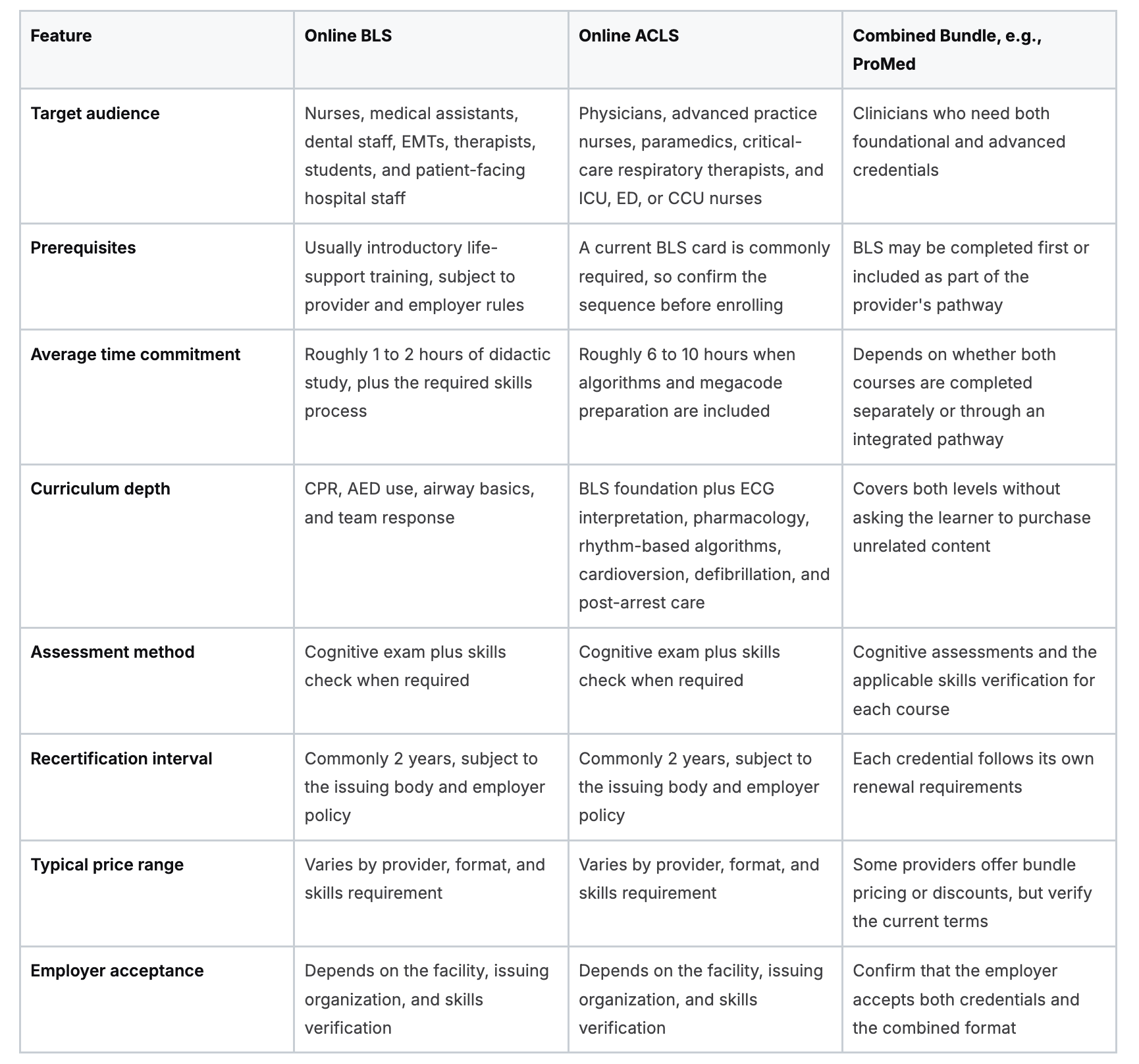
The ordering issue deserves attention. ACLS typically requires a current BLS card, so taking ACLS first can create an administrative problem even if you understand the clinical material. Ask the provider whether BLS must be completed before enrollment, submitted during registration, or held on the day of the skills assessment.
ProMed's ACLS Certification catalog description says learners can complete the online course, pass the exam, and receive a card in as quick as one hour or less. That stated timeline doesn't replace your responsibility to verify employer acceptance or any required practical evaluation.
Choose the bundle only when you need both credentials. If your role requires BLS alone, an ACLS package adds coursework you may not need. If you're moving into critical care, completing both in the correct order may simplify credential tracking.
What the Research Says About Online Versus In-Person Training
The research doesn't support the assumption that classroom attendance automatically produces better learning. A systematic review of online eLearning in health professions found changes in knowledge, skills, attitudes, and satisfaction, and concluded that online learning was equivalent to, and possibly more effective than, traditional learning for knowledge and skills gained. (Systematic review of online eLearning in health professions)
A separate Cochrane review reached a more cautious conclusion. Compared with traditional learning, e-learning may make little or no difference to patient outcomes, professional behavior, or knowledge, while the evidence about skills remained uncertain. That finding is useful because it rejects two extremes. Online learning isn't automatically superior, but in-person attendance isn't automatically superior either.
What comparative studies suggest
Research comparing online and face-to-face BLS or AED instruction has found broadly comparable knowledge and skills outcomes. Some trials showed non-significant trends favoring e-learning, while other work found similar retention across learning formats. One long-term trial also found that BLS performance declined over time, which points to the importance of retraining and refreshers rather than treating certification as a one-time event. (Randomized trial of BLS/AED retention)
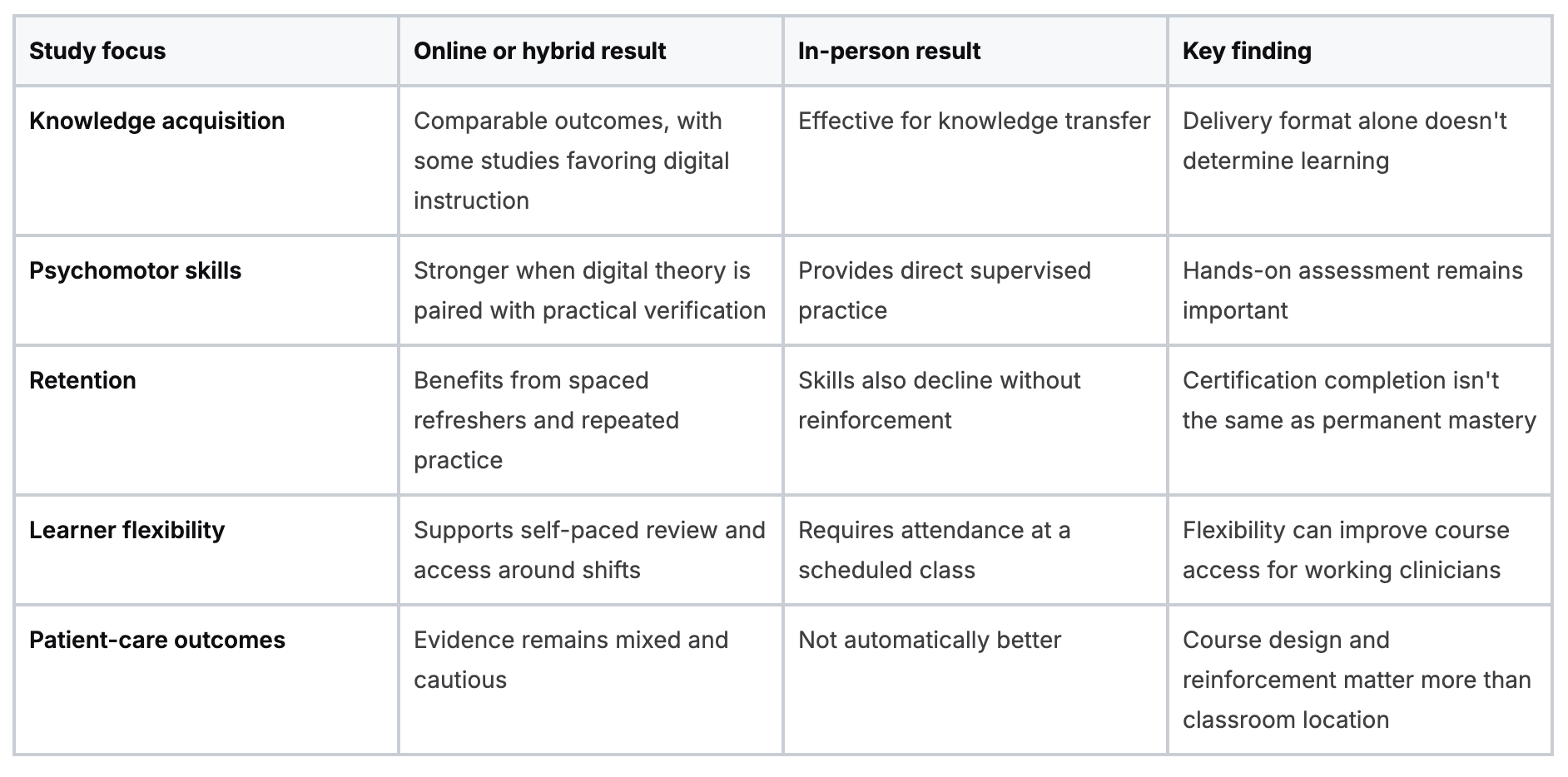
A meta-analysis of internet-based health-professions education found large positive effects compared with no intervention for knowledge, skills, and learner behavior or patient effects. Against non-internet instructional methods, the effects were small and generally similar, with effectiveness described as comparable to traditional methods.
The strongest design is therefore not a video library alone. It combines demonstrations, interactive cases, active recall, timed algorithm practice, feedback, and a meaningful skills check. Spaced digital education also outperformed massed digital education for post-intervention knowledge, with a standardized mean difference of 0.32, and the review reported improvements across knowledge, skills, confidence, and clinical behavior change.
Real-World Scenarios Where Online Certification Shines
A travel nurse may accept a position in another state and discover that credentialing must be completed before the first scheduled shift. An online BLS or ACLS course lets the nurse begin the knowledge review without waiting for the next classroom date. The nurse still needs to confirm the receiving facility's policy and schedule the required skills assessment through an approved process.
A medical student on a rural elective faces a different barrier. The nearest training center may be difficult to reach, while the student has reliable access to a phone or computer. Self-paced lessons provide a practical way to study during available windows, then the student can arrange skills verification when an approved evaluator or site becomes accessible.
Four common scheduling problems
- Relocating clinicians: A travel nurse can complete assigned lessons around credentialing tasks, then submit the correct card and skills documentation to the new employer.
- Rural learners: A medical student can avoid losing clinical time to travel for didactic instruction, while still planning the practical portion deliberately.
- Shift-based staff: An experienced ICU charge nurse can study between shifts instead of giving up a fixed block of clinical coverage.
- Multi-campus employers: A hospital system onboarding staff across campuses can standardize digital coursework while coordinating skills checks locally.
The fourth scenario requires operational planning. An organization shouldn't assume that online completion alone satisfies every credentialing rule. It should identify the issuing body, define the accepted skills process, and give each new hire a clear submission checklist.
A flexible course only helps when the learner schedules the practical requirement before the deadline.
Online learning also supports related credentials when the role calls for them. For example, ProMed's PALS Certification catalog describes an online pathway in which learners review material, pass an exam, and receive a card in as quick as one hour or less. The same employer-verification principle applies: confirm the facility's policy before enrolling.
Claims about Joint Commission or state-board compliance should never be assumed from the word “online.” Those organizations and agencies may recognize an approved course while still requiring specific documentation or practical verification. Ask the credentialing office what it accepts, keep your eCard and completion record, and schedule skills testing early enough to correct an administrative issue.
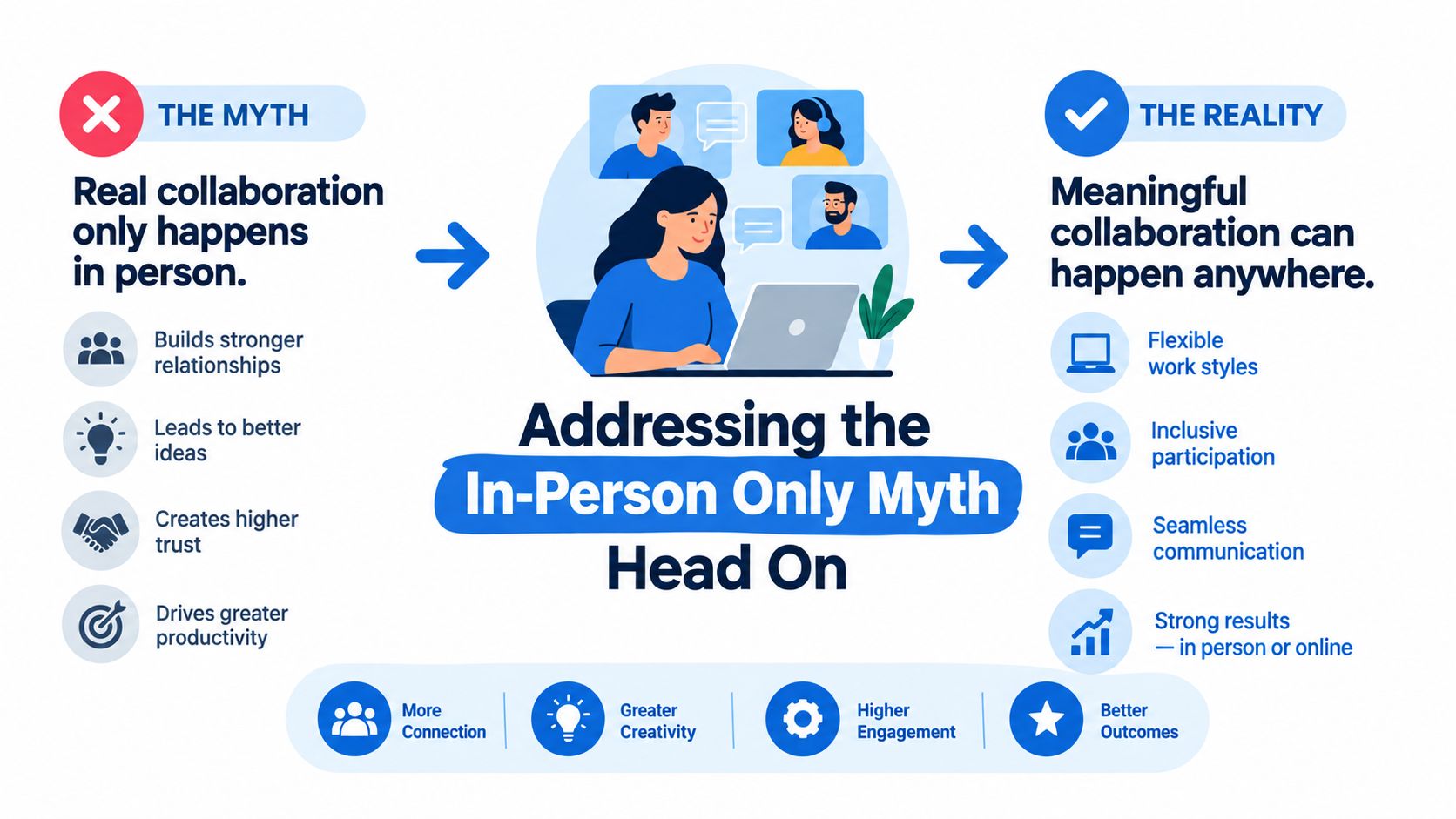
Addressing the In-Person Only Myth Head On
The belief that a valid BLS or ACLS credential requires physical classroom attendance comes from a time when early online courses often lacked strong demonstrations, meaningful interaction, and reliable skills verification. That concern was reasonable when “online” meant little more than reading slides and clicking through a quiz.
The technology and course design have changed. Current digital programs can use adaptive lessons, video demonstrations, interactive scenarios, rhythm exercises, and structured feedback. Blended programs move the knowledge portion online while preserving supervised practical evaluation. The result is not an easier curriculum. It is a different arrangement of instruction and assessment.
What employers are actually checking
Many credentialing offices care about the issuing organization, current guideline alignment, card validity, identity verification, and evidence of skills completion. Some hospitals, state EMS agencies, and clinical training sites still require an in-person skills evaluation. That requirement usually concerns the practical assessment, not necessarily the location of every cognitive lesson.
The AHA's current course model includes blended learning with hands-on skills sessions. ILCOR's 2025 education recommendations support self-directed digital education particularly when instructor-led training isn't accessible or when quantity is prioritized over quality. That doesn't make online-only completion universally acceptable. It shows why the format must be matched to the learner's setting and the employer's standard.
The broader shift is visible in how major organizations discuss digital education. The IFRC's 2025 guidelines endorse online and blended learning for first aid and CPR/BLS education, while recent guidance continues to pair digital knowledge transfer with facilitated practice or verification.
This is why “online versus in-person” is the wrong final question. Ask instead:
- Does my employer accept this issuing organization?
- Does the course include the skills process my role requires?
- Can I access current guideline content?
- Will I receive documentation the credentialing office can verify?
The practical standard is flexible, evidence-based hybrid training when hands-on competency must be demonstrated. Online education isn't a lesser alternative, and classroom attendance isn't a guarantee of competence.
How to Choose the Right Online Course for Your Career
Start with the requirement, not the advertisement. A course can be convenient and educational yet still fail to meet a specific facility's vendor policy. Check whether the organization is AHA-aligned, offers AMA PRA Category 1 Credit, or carries CAPCE recognition when those standards apply to your role. Then verify that the issuing body appears on your employer's approved list.
A four-part decision framework
First, match the credential to your job. BLS and ACLS serve different clinical responsibilities, and ACLS commonly depends on a current BLS card.
Second, choose the learning format you'll complete. Self-paced video lessons suit clinicians who need schedule control. Live virtual instruction may help learners who want immediate interaction. A blended course can provide the best balance when your employer requires supervised skills verification.
Third, evaluate value beyond the enrollment screen. Review the access period, retest policy, card format, skills-session process, and any BLS-plus-ACLS bundle terms.
Fourth, compare the course timeline with your hiring date, clinical placement, or renewal deadline. A fast cognitive module won't help if the skills assessment has no timely appointment.
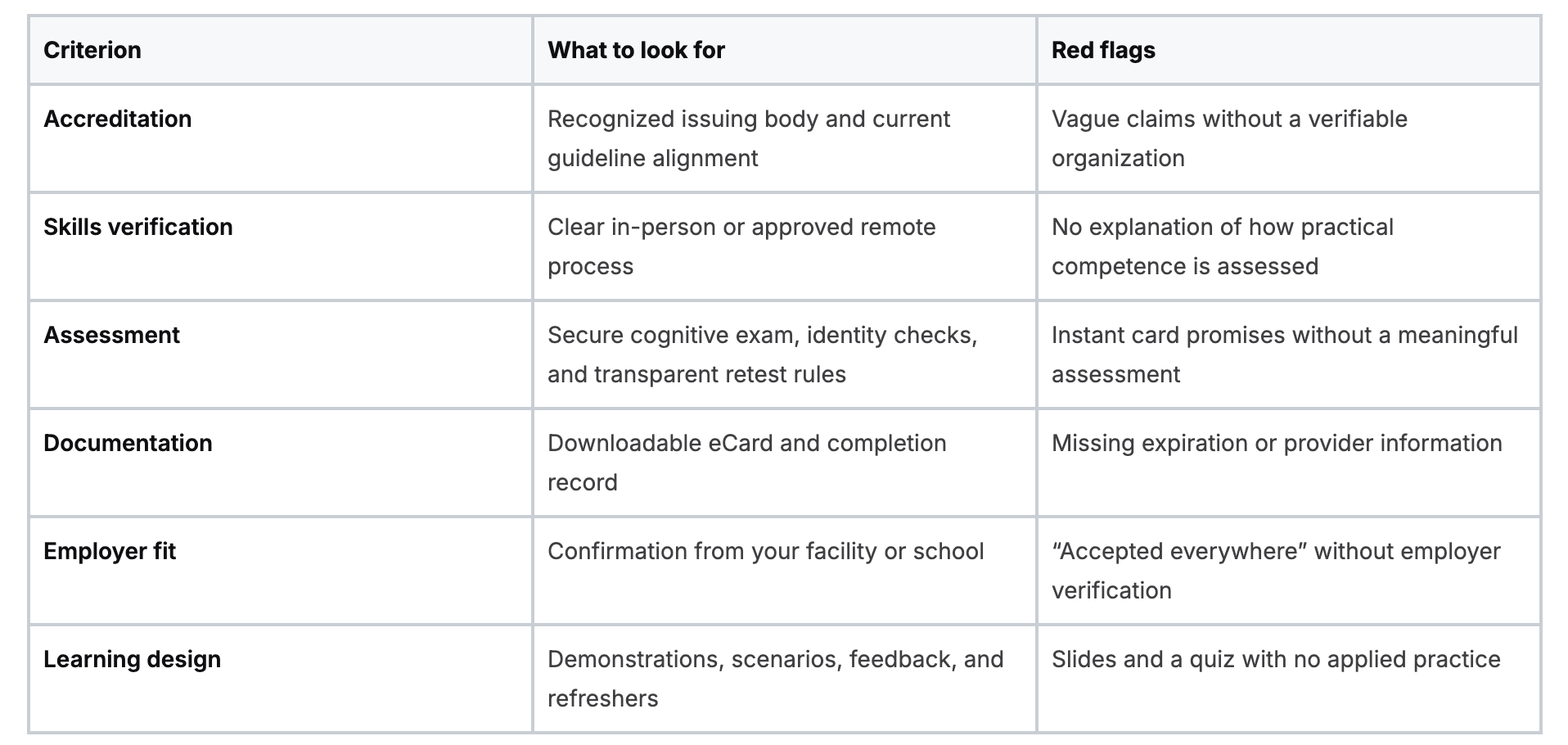
Before checkout, use this guide to choosing an online ACLS course. The right course gives you both credible education and usable documentation.
Next Steps for Getting Certified Online
- Confirm the credential. Identify BLS, ACLS, or both, and check your renewal deadline.
- Verify prerequisites. Have your current BLS card available if ACLS enrollment requires it.
- Ask the employer. Confirm the issuing organization, format, and skills assessment they accept.
- Complete the cognitive work. Study the demonstrations, algorithms, and scenarios instead of rushing to the quiz.
- Pass the skills assessment. Complete the in-person or approved remote evaluation when required.
- Save your records. Download the eCard, completion documentation, and any skills verification.
- Set a renewal reminder. The common certification cycle is two years, but follow the issuing body and employer policy.
Treat certification preparation as a clinical refresher, not a bureaucratic checkbox. For common questions about the ACLS process, review online ACLS certification FAQs.
ProMed Certifications offers online BLS, ACLS, PALS, CPR, and other medical certification courses designed for self-paced completion, with course cards issued after the required assessment steps. Visit ProMed Certifications to compare the course that fits your role, confirm your employer's acceptance requirements, and begin your certification pathway.
.avif)
Stay compliant with ProMed+
Certifications included: ACLS, BLS, PALS, CPR & Neonatal Resuscitation
Unlimited continuing education: over 200 hours of accredited CME
All-inclusive: One price. No surprises.
Get certified today

The Advanced Cardiac Life Support (ACLS) is an accredited online medical certification course that teaches medical professionals to respond to nearly all cardiopulmonary emergencies.

The Pediatric Advanced Life Support (PALS) Recertification instructs medical professionals on performing pediatric cardiopulmonary resuscitation in emergencies.

The Basic Life Support (BLS) Recertification is intended to teach healthcare professionals the basic steps of CPR and rescue breathing for adults, children, and infants.

Our online medical certification course for CPR, Automated External Defibrillator (AED), and First Aid is designed to teach adult, child, and infant CPR and AED use.

The Neonatal Resuscitation Certification trains medical professionals in performing resuscitation procedures and life-saving techniques for newborns at the time of delivery.

.png)
.png)
.png)