


RN License Renewal: Your Complete Step-by-Step Guide
Your license expiration date has a way of sneaking up on you. One minute you're picking up extra shifts, finishing charting, helping a new orientee, and trying to eat lunch before 1500. Then an email, postcard, or coworker comment makes you think, “Wait. When does my RN license renew?”
If you're feeling a little tense about rn license renewal, that's normal. New grads often assume it's just a quick form and a payment. Then they realize every state has its own rules, some require specific continuing education topics, some use online portals with narrow submission windows, and some don't care whether a reminder ever reached your inbox.
The good news is that this process gets much easier once you stop treating it like a last-minute task. Think of renewal the same way you think about a certification deadline, annual competencies, or a medication reconciliation. It runs smoother when you build a system before the deadline is breathing down your neck.
Your Guide to a Stress-Free RN License Renewal
The first shift in mindset is simple. RN license renewal is a career management task, not just an administrative chore. Your active license is what allows you to keep practicing, keep earning, and keep your options open if you want to change units, move states, or add a new role.
A lot of nurses get stuck because they lump everything together. They think “renewal” means one step, when it usually means several:
- Know your expiration date
- Confirm your state requirements
- Complete the right CE
- Save your documentation
- Submit on time
- Verify that your license is active
That sounds obvious on paper. In real life, it gets messy fast if you wait for a reminder notice or assume your CE provider, employer, or board will catch every detail for you.
Practical rule: Start your renewal plan long before the application portal opens.
That matters even more now because CE is no longer limited to driving to a classroom on your day off. For most nurses, online CE is a practical and valid option when it comes from an accredited provider accepted by the relevant board. That old idea that only in-person classes from a narrow list of organizations count doesn't match how many nurses complete education today.
If you've been putting this off because it feels confusing, you're not behind. You just need a clear workflow. Once you have one, rn license renewal becomes much more manageable, and a lot less stressful.
Mapping Your Renewal Timeline and Deadlines
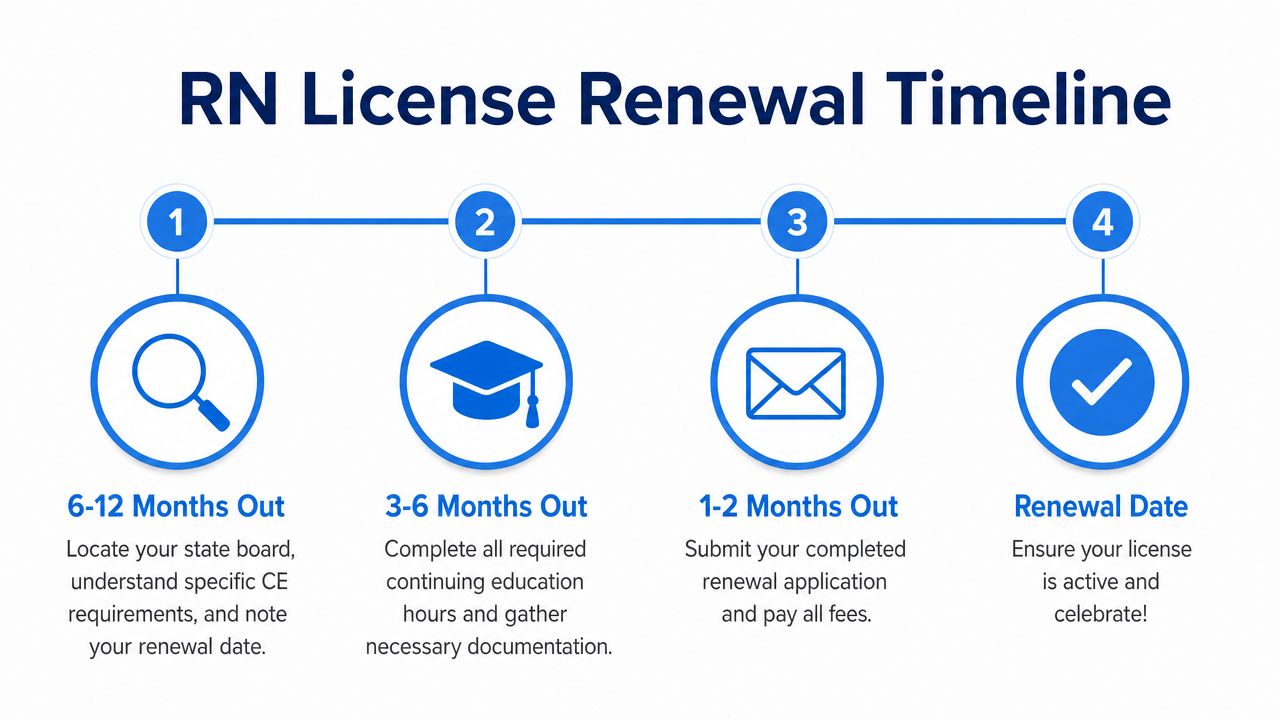
The safest way to handle renewal is to build your own timeline. Don't wait for your board to tell you when to act. By then, you're already playing catch-up.
In the United States, RN license renewal is typically a biennial process, and some jurisdictions may send renewal notices 90 days before expiration. Some also take 4–6 weeks to process applications, according to NurseJournal's state-by-state RN licensing summary. That's your clue to start earlier than the notice window, not inside it.
Build your personal renewal calendar
Start with your license record and write down the actual expiration date. Then put three reminders on your phone or calendar:
- A long-range reminder for planning and requirement review
- A CE completion reminder so your coursework is finished early
- A submission reminder tied to your state's actual renewal window
If your state uses a reporting platform, it's smart to check it before renewal season. Nurses who use systems like CE Broker often benefit from reviewing their records early. If you need a quick refresher, this guide to a CE Broker account can help you understand what to verify.
Know your state's timing rules
States don't all handle timelines the same way. Texas is a good example of why early preparation matters. The Texas Board of Nursing says RN renewal is available only through the Texas Nurse Portal during the final 60 days before expiration, and the renewal application won't appear earlier. The board also requires the application, fee, and any requested supporting materials on or before the expiration date, as outlined on the Texas Board of Nursing renewal page.
That creates a hard reality. If you wait until the portal opens to start gathering CE or paperwork, you may not leave yourself enough room to fix problems.
If your state gives you a short submission window, your real renewal work starts before that window opens.
A manager's approach that works
When I coach a new nurse through a first renewal, I suggest this sequence:
- Months ahead: Check your board website and save the renewal rules as a PDF or screenshot.
- Before the application window: Finish CE and organize certificates in one folder.
- When the portal opens: Submit early rather than treating the deadline like the target.
- After submission: Verify status instead of assuming payment means you're done.
This approach lowers stress because you're not relying on memory, email delivery, or luck. You're using a system. That's what keeps renewal from turning into a scramble at the end of a busy month.
Decoding Your Continuing Education Requirements
Most renewal confusion lives here. Nurses rarely struggle with the idea of CE itself. They struggle with the details. How many hours? Which topics are mandatory? Do one-time topics come back later? Does online CE count?
The short answer is that state rules decide what counts, and those rules can be more specific than many nurses expect.
Start with your board, not social media
A coworker may mean well, but “I think we only need the usual hours” isn't a compliance strategy. State boards can require both a total CE amount and topic-specific education.
Pennsylvania is a good example. The board requires 30 CE hours every two years, including 2 hours of child-abuse education, and beginning May 1, 2026, all RNs must complete 2 hours of organ-donation education one time within 5 years, according to the Pennsylvania RN licensure snapshot. That kind of phased change is exactly why you should verify current rules instead of relying on what applied last cycle.
If you practice in a different state, use a current state-by-state reference and then confirm on your board site. A practical starting point is this overview of continuing education requirements for nurses by state.
The part nurses miss most often
It usually isn't the total hour count. It's the special topic requirement hidden in the fine print.
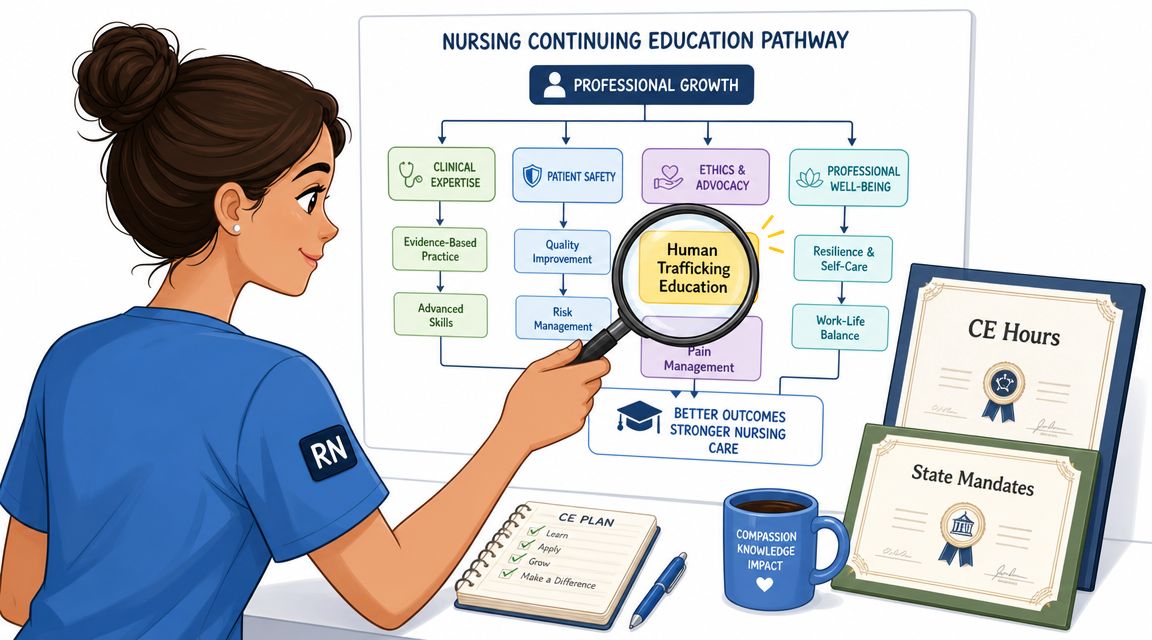
Texas shows how detailed this can get. A step-by-step renewal guide notes a baseline of at least 20 contact hours each renewal period, with added topics in some settings or at certain intervals, including 1 hour in human trafficking prevention, 2 hours in nursing law and ethics every six years, and targeted education for some emergency department and geriatric settings.
Missing one required module can create the same renewal problem as missing all your hours. That's why I tell nurses to make a simple checklist with two columns:

A little structure here saves a lot of frustration later.
Does online CE count
In many cases, yes, if it comes from an accredited provider accepted by your board. That's the point many nurses still second-guess, especially if someone in their workplace keeps repeating that only certain in-person classes are valid.
That belief is outdated. Nursing education has changed, and so has the way professionals complete CE. Busy nurses need options that fit shift work, family schedules, and real life. Accredited online CE gives you that flexibility without forcing you to spend a day off in a classroom unless your state or employer specifically requires an in-person format for a particular skill.
What good CE planning looks like
Use this checklist before you click “enroll” on any course:
- Board acceptance: Confirm the course format and provider meet your state's rules.
- Topic match: Make sure the course satisfies the exact requirement you need, not just a related topic.
- Certificate access: Choose providers that issue clear completion records you can save.
- Reporting workflow: If your state uses a tracking platform, confirm how reporting works.
- Timing: Finish early enough that missing records or technical issues won't put you at risk.
The smartest CE plan isn't “get hours done somehow.” It's “finish the right hours in a format your board accepts, with proof ready to go.”
Online vs In-Person CE A Modern Comparison
Nurses often ask which format is “better,” but that's not always the right question. A better question is which format helps you complete the right education accurately, on time, and without turning your schedule upside down.
For many nurses, online CE wins that comparison because it fits how healthcare professionals live and work. That doesn't mean in-person education has no place. It means in-person learning is no longer the default standard for quality.
Online and classroom formats side by side

Why online CE keeps gaining ground
Online education makes practical sense for renewal because most CE requirements are about documented learning, not physical attendance in a room. If the provider is accredited and the board accepts the format, the learning still counts.
That matters for nurses on nights, nurses with kids, travel nurses, and anyone trying to protect a rare day off. You can log in, complete a module, save your certificate, and move on with your life. That's a much more workable model than hoping an in-person class is offered nearby before your deadline.
A classroom isn't automatically better just because it's a classroom. What matters is whether the education is accepted, relevant, and completed correctly.
When in-person still makes sense
There are times when face-to-face training is useful. Some employers prefer it for team-based mock codes, equipment practice, or onboarding. Some clinical skills also benefit from live demonstration.
But that doesn't make online CE lesser. It makes it one tool in a larger professional toolkit. For most renewal-related education, online formats are a rational choice because they cut friction without lowering standards.
The practical takeaway is simple. Choose the format your board accepts and your schedule can realistically support. For many nurses, that's online.
Navigating the Application and Special Cases
Once your CE is complete, the last stage is submission. Small oversights during submission cause big headaches. The application itself may be straightforward, but the surrounding details matter a lot.
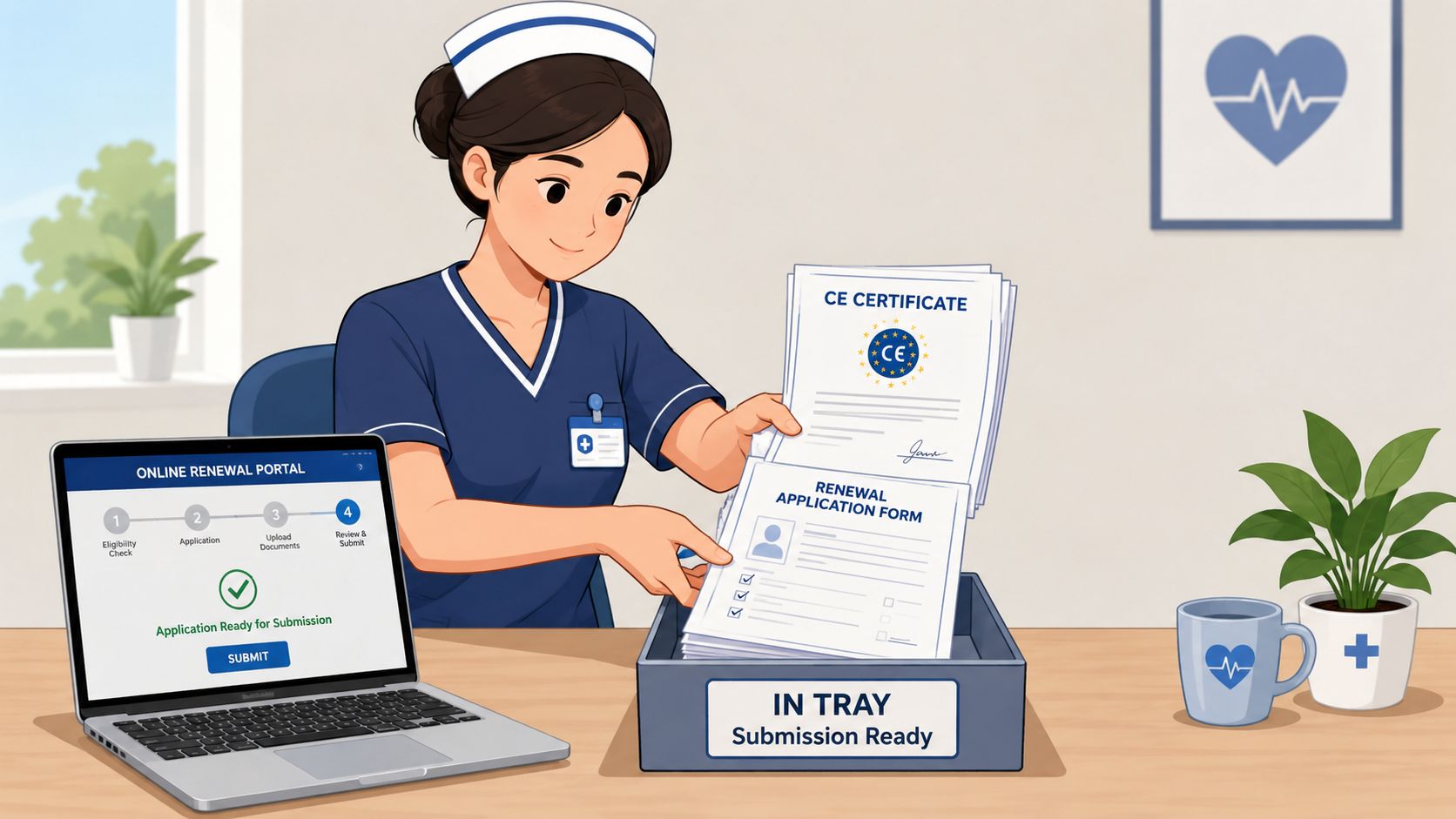
What to have ready before you log in
Think of renewal submission like preparing for a survey or audit. You want your documentation ready before anyone asks for it.
Keep these items together:
- Your license details: License number, expiration date, and current contact information
- CE proof: Completion certificates or confirmation records for every required course
- Practice or competency documentation: If your state requires it
- Payment method: So you can finish the application in one sitting
- Any supporting materials: Only if your board requests them
This is also the point where you should double-check your email and mailing address on file. If they're outdated, notices and status updates may never reach you.
If the renewal notice never arrives
This catches more nurses than it should. Some assume no notice means no action is needed yet. That's risky.
Pennsylvania states that the board will send a renewal notice biennially, but failure to receive the notice does not relieve the nurse of the duty to renew by the expiration date, according to the Pennsylvania renewal information page. That matters even more for nurses dealing with multistate license issues or recent address changes.
So if your reminder never appears, don't wait. Go directly to your board portal and verify your renewal status yourself.
No notice is not a grace period. Your license deadline still applies.
Compact licenses and recent moves
Compact status can create confusion because nurses may be licensed in one state, working in another, and living somewhere new after a move. If your residency changed, don't assume your old renewal routine still fits.
Use a simple decision check:
- What is your primary state of residence now
- Is your current license single-state or multistate
- Did your move trigger a change in where you must renew
If any of those answers are fuzzy, pause and confirm with the board before submitting. This isn't the place to guess.
If your license has lapsed or gone inactive
The exact path depends on the state, so you need your board's instructions. In general, expect more steps than a standard renewal. You may need additional documentation, extra review, or reinstatement procedures before you can legally return to practice.
What matters most is speed and honesty. If you realize you've missed something, act right away. Don't keep working under the assumption that you'll “fix it this week” unless your board explicitly allows practice during that status.
A clean submission process usually looks like this:
- Review requirements one more time
- Submit through the correct portal
- Pay and save confirmation
- Watch for follow-up requests
- Verify active status after approval
That final step matters. Renewal isn't complete because you intended to do it. It's complete when your license record shows the right status.
Simplify Your Next Renewal with ProMed
A smooth renewal cycle usually comes down to three habits. Start early, complete the right CE, and keep your records organized. Nurses who do those three things rarely feel blindsided when the deadline gets close.
That's also why many nurses now prefer digital tools over piecing everything together manually. An online CE platform can help you complete state-required education on your own schedule, store certificates in one place, and reduce the clutter that builds up when renewal paperwork is scattered across email folders and desktops.
One option is why ProMed Certifications works for many healthcare professionals. ProMed offers online CE and certifications for healthcare professionals, including nursing education designed to support license renewal workflows. According to the publisher information provided for this article, its nursing CE platform includes over 200 hours of accredited content, instant certificates, and automated reporting to CE Broker and state boards where applicable.
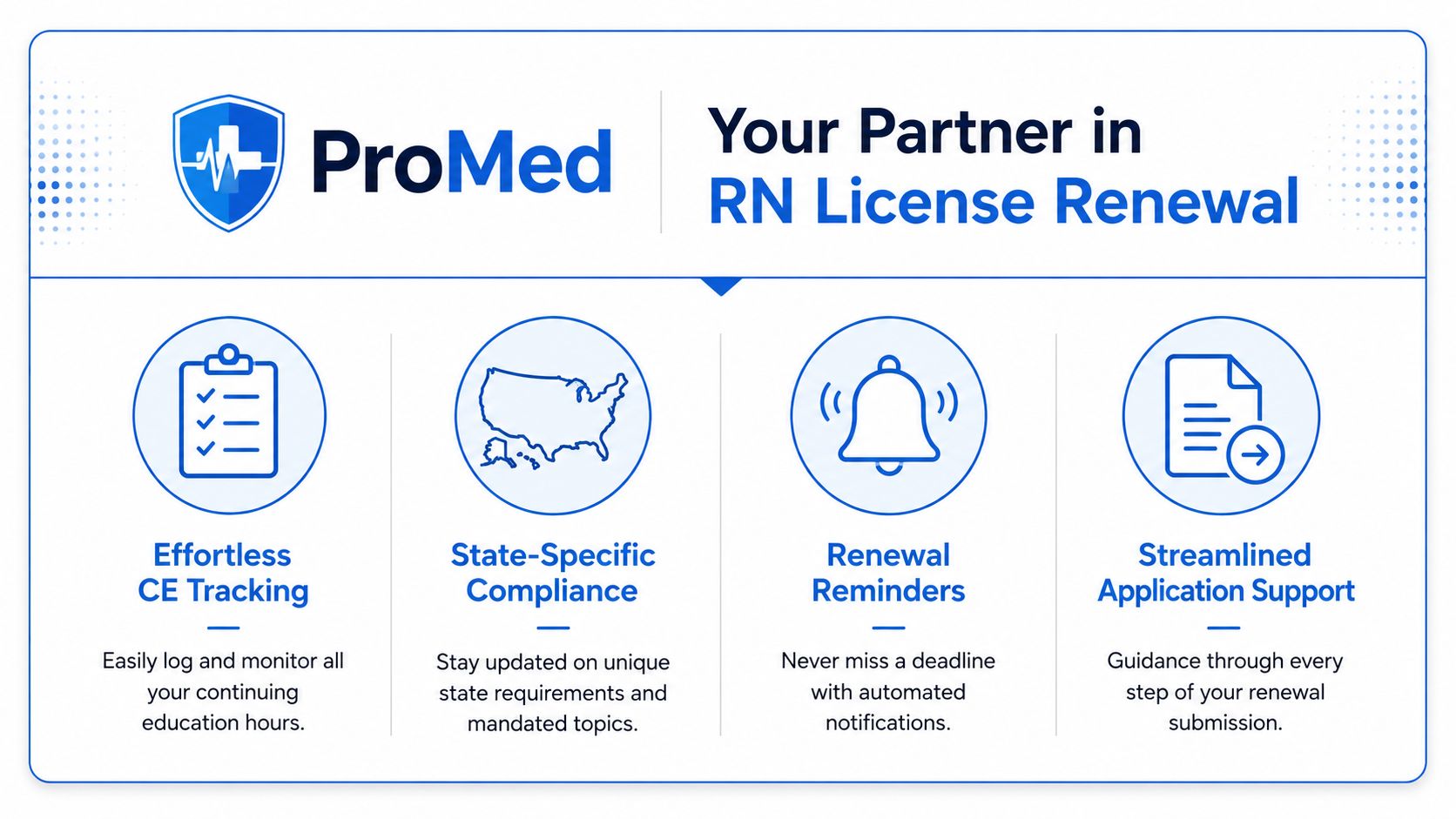
The bigger point is this. RN license renewal gets easier when you stop managing it from memory. Use a calendar. Use a trusted CE provider. Keep digital proof of completion. Treat renewal like part of your professional practice, because that's what it is.
Once you build that system, the next cycle feels much less intimidating.
If you're ready to make renewal simpler, ProMed Certifications offers online CE and certification options that can help you complete requirements, keep documentation organized, and fit learning into a real nursing schedule.
.avif)
Stay compliant with ProMed+
Certifications included: ACLS, BLS, PALS, CPR & Neonatal Resuscitation
Unlimited continuing education: over 200 hours of accredited CME
All-inclusive: One price. No surprises.
Get certified today

The Advanced Cardiac Life Support (ACLS) is an accredited online medical certification course that teaches medical professionals to respond to nearly all cardiopulmonary emergencies.

The Pediatric Advanced Life Support (PALS) Recertification instructs medical professionals on performing pediatric cardiopulmonary resuscitation in emergencies.

The Basic Life Support (BLS) Recertification is intended to teach healthcare professionals the basic steps of CPR and rescue breathing for adults, children, and infants.

Our online medical certification course for CPR, Automated External Defibrillator (AED), and First Aid is designed to teach adult, child, and infant CPR and AED use.

The Neonatal Resuscitation Certification trains medical professionals in performing resuscitation procedures and life-saving techniques for newborns at the time of delivery.

.png)
.png)
.png)