Personalized Learning Pathways in Healthcare
A charge nurse finishes a long shift, checks the family calendar, and notices that a required certification expires soon. The deadline won't move because the unit is short-staffed, the next week includes rotating shifts, and patient care still comes first. A traditional class may be valuable, but finding a suitable date, traveling to it, and sitting through material she already knows can make compliance feel harder than learning itself.
That tension explains why personalized learning pathways matter in healthcare. A pathway can direct an experienced clinician toward focused review while giving a newer learner more practice with foundational concepts. Done well, online CE, CME, and certification training isn't a lesser substitute for classroom education. It's an equally valid route that can fit the realities of clinical work, provided the content, assessments, accreditation, and documentation meet the required standards.
When One-Size-Fits-One Training Stops Working
The charge nurse opens the assigned module after dinner. It begins with definitions she mastered years ago, continues through familiar protocols, and ends with a test that treats every learner as if they started at the same point. She completes it, but much of her limited study time goes toward repetition rather than the areas where her practice has changed.
A newly graduated nurse experiences the same course differently. The module may move too quickly through rhythm recognition, medication safety, or escalation decisions. She needs examples, feedback, and additional attempts. The experienced ICU nurse needs targeted reinforcement. The new graduate needs a stronger foundation. One course can't always provide the right route for both.
The clinical schedule creates a different learning problem
Healthcare professionals rarely learn under school-like conditions. They study between shifts, during changing work patterns, and around family responsibilities. A physician may need CME before a licensure deadline. A travel nurse may need documentation before beginning an assignment. A hospital educator may need to close a competency gap without removing an entire unit from patient care.
Online education addresses that reality directly. Learners can access valid CE and certification content from the setting that works for them, while organizations can assign training without depending entirely on one shared classroom schedule. The format supports flexibility without lowering expectations.
Practical rule: Personalization should remove unnecessary repetition, not remove the evidence of competence.
The gap between uniform training and clinical readiness
Uniform curricula remain useful for establishing a common standard. They become less useful when organizations confuse identical content with identical learning needs. A pathway keeps the standard consistent while allowing the route to vary.
For example, an experienced telemetry nurse might need a concise ECG refresher and targeted practice with less familiar rhythms. A new nurse might need guided explanations, visual examples, and repeated assessment checkpoints. Both learners can still finish with the same required competency expectations.
The rest of this guide connects the concept to healthcare workflows, online CE and certification evidence, implementation choices, and measurement. It also addresses a common misconception directly. AHA and American Red Cross in-person classes aren't the only valid options. Acceptance depends on the issuing organization, accreditation, course requirements, assessment quality, and the policies of the employer or credentialing body, not whether a learner sat in a physical classroom.
What Personalized Learning Pathways Actually Mean
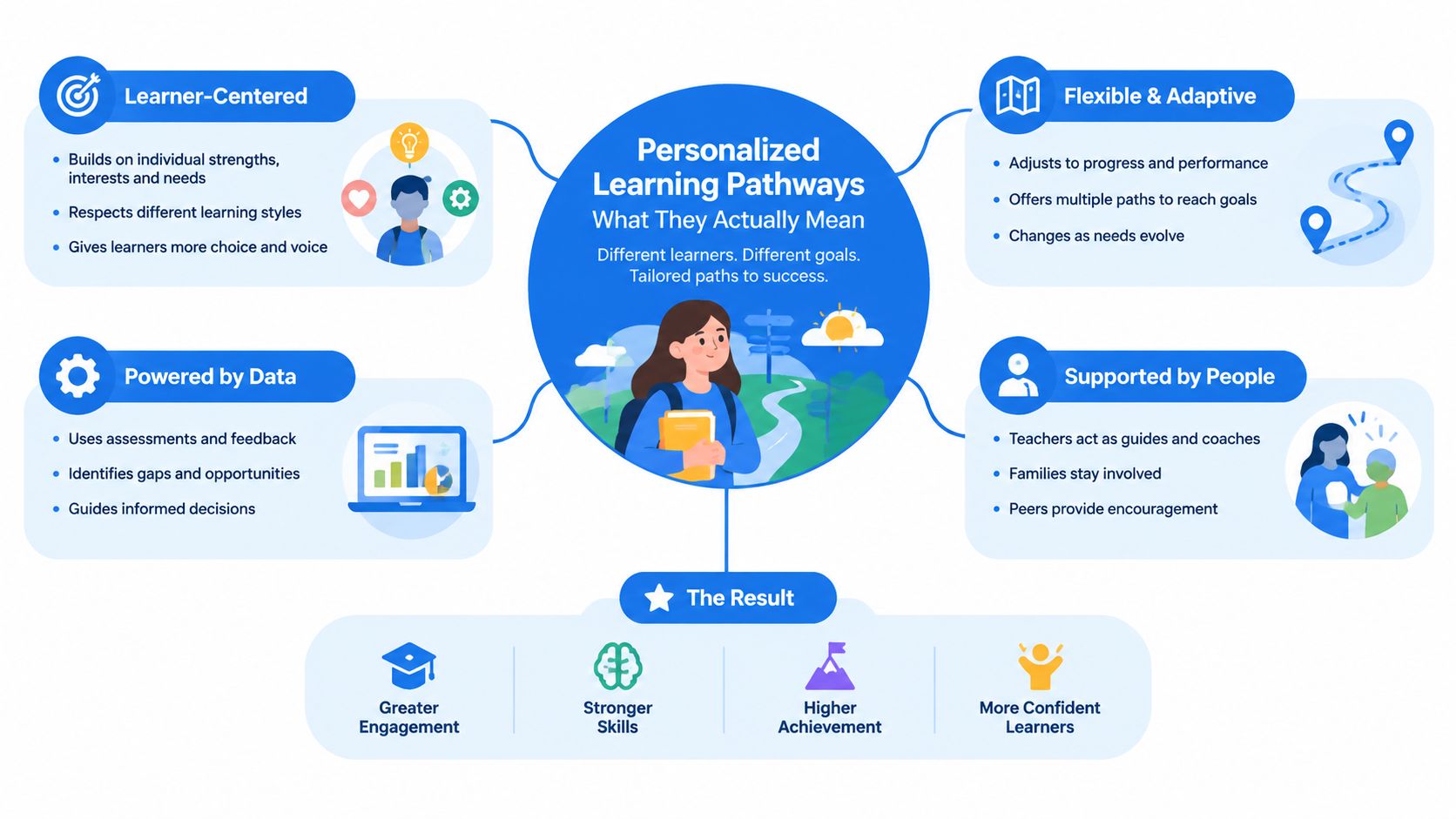
Think of a personalized learning pathway as a clinical roadmap. The destination is the required competency. The route depends on the learner's starting knowledge, goals, performance, and available time. One clinician may take a direct route, while another may need a detour through remediation before reaching the same destination.
The RAND Corporation describes personalized learning through elements that include learner profiles, individualized goals, flexible learning paths, learner choice, and personalized support. Its evaluation found that students in personalized learning schools made greater progress over two school years than peers, with especially notable benefits for learners who started behind. By the study's end, those students were catching up to perform at or above national averages. RAND's evaluation of personalized learning provides a useful foundation for translating the model into healthcare education.
Four parts make the pathway work
A healthcare pathway usually brings four elements together:
- Learner profile: What the clinician already knows, where performance is strong, and where uncertainty remains.
- Competency goals: The knowledge or skill the learner must demonstrate for practice, certification, licensure, or organizational requirements.
- Content sequence: The order of lessons, cases, practice activities, and remediation.
- Assessment checkpoints: The evidence used to decide whether the learner can proceed or needs more support.
This structure applies to practicing clinicians, not only students. A nurse renewing ACLS, a physician completing CME, and a technician reviewing emergency procedures can all follow a pathway built around their role and goals. For a convenient example of a flexible online route, ACLS Certification from ProMed Certifications allows learners to take the course anywhere and complete it within a busy schedule. The provider states that learners can pass the exam and receive their card in as quick as one hour or less.
How related terms fit together
Adaptive learning describes the technology behavior. The system uses performance or engagement information to adjust difficulty, feedback, remediation, or the next task.
Competency-based education describes the progress rule. Learners advance after demonstrating mastery, rather than spending a fixed amount of time in a course.
Differentiated instruction usually describes an educator's approach. An instructor may vary explanations, pacing, examples, or assignments for different learners.
Personalized learning pathways can include all three. The pathway is the complete plan. Adaptive technology may adjust it, competency checks may govern advancement, and an educator or manager may refine it when clinical needs change.
Why Online CE and Certifications Are Equally Valid
The delivery channel doesn't determine educational quality. Accreditation, instructional design, assessment quality, and evidence of learning do. That distinction matters because the outdated belief that only AHA or American Red Cross in-person classes are legitimate still influences some clinicians and managers.
Peer-reviewed evidence supports online CE and CME as a credible format. A controlled trial of 48 internet CME activities involving more than 100,000 physicians reported an average effect size of 0.75 and a 45% higher likelihood that participants would choose evidence-based clinical responses than non-participants. Interactive case-based activities performed even better, with a 51% higher likelihood and an effect size of 0.89. The peer-reviewed CME trial connects online education with clinical decision-making, not just content exposure.
Retention and practice change matter
An evidence update reviewing 15 randomized controlled trials of electronic continuing education found benefits across several comparisons. Four of six studies comparing electronic CE with no intervention showed significant benefit. One of two studies comparing it with lecture favored electronic CE, and both studies comparing it with small-group interactive instruction favored electronic CE. The review also reported that knowledge gains persisted for up to 12 months, while practice effects persisted for up to 5 months. The PubMed-indexed evidence update supports the durability of online learning.
A separate evaluative case study found statistically significant gains in continuing professional education knowledge and self-reported practice performance change. Courses containing a clinical tool produced greater practice change than courses without one. The online healthcare professional education study also identified convenience for geographically and educationally diverse professionals as a meaningful advantage.

A 2023 report on online CME during the COVID-19 pandemic found that 85.21% of respondents were satisfied, 87.29% said the content would influence clinical practice, and 78.07% of three-month follow-up respondents reported actual practice changes. The PubMed record for the online CME report documents those findings.
Healthcare teams can review continuing medical education online when comparing digital CE and CME workflows. Physicians seeking an on-demand option may also review ProMed+ Physician CME, which describes access to a dynamic streaming library with over 200 AMA PRA Category 1 Credits™.
What accreditation changes
Accredited online programs can meet the same educational expectations as accredited in-person programs. State nursing boards, professional accreditation organizations, employers, and specialty bodies may apply specific rules, so clinicians should verify requirements before enrolling. The important point is that online status alone doesn't invalidate a course.
A credentialing review should confirm:
- Issuing organization: Is the provider recognized by the relevant employer or licensing body?
- Accreditation: Does the course carry the accreditation required for the credit or certification?
- Assessment: Does the learner demonstrate knowledge or competency?
- Documentation: Will the provider issue a certificate or report in the required format?
- Skills requirements: Does the credential require a physical demonstration that online delivery cannot replace?
Online CE and certifications are valid when those conditions are satisfied. The classroom is one delivery method, not the definition of legitimacy.
Benefits for Clinicians and the Organizations That Hire Them
Personalization creates value at two levels. The clinician receives a more relevant learning experience, while the organization gains a more manageable way to assign, document, and evaluate education. Both groups benefit when the pathway connects course activity to a real competency or compliance need.
What the clinician gains
A bedside nurse doesn't need another vague promise about flexibility. She needs training that fits around a real schedule.
- Less study fatigue: A learner can focus on weaker areas instead of repeating every topic at the same depth.
- Better scheduling control: Rotating shifts and family obligations don't have to determine whether recertification is possible.
- More confidence: Targeted practice can expose uncertainty before a high-stakes patient encounter.
- Portable documentation: A clear transcript or certificate can support credentialing conversations when a clinician changes employers.
- A more efficient review cycle: Learners who demonstrate mastery can spend less time on familiar material, while those who need remediation receive it.
Consider a telemetry nurse who completes an ECG refresher between two night shifts. The benefit isn't that she studied online. The benefit is that the pathway placed relevant practice within a workable schedule and gave her evidence of completion.
What the organization gains
A hospital or clinic has a different set of pressures. Educators must protect patient coverage, managers must document competency, and compliance teams must find records when audits or renewals arise.
- Simpler competency mapping: Content can be assigned to roles, units, procedures, or identified gaps.
- Less disruption: Staff can complete knowledge-based learning without gathering an entire shift in one room.
- Faster onboarding: Travel staff and newly hired clinicians can begin required education through an accessible platform.
- Clearer records: Certificates, progress dashboards, and completion reports give leaders a consistent view.
- Stronger development support: When employees see a path for professional growth, education becomes part of retention work rather than a last-minute compliance task.
A mature system also helps leaders distinguish completion from mastery. A dashboard may show who opened a course, but a competency checkpoint shows whether the learner can apply the material.
For the unit manager: Assign the same standard, but don't assume every person needs the same amount of explanation, practice, or remediation.
The business case should remain disciplined. Personalized learning doesn't automatically improve patient outcomes, and the healthcare evidence base still has low to very low certainty because studies are heterogeneous and often carry a high risk of bias. A healthcare-focused review found no evidence yet demonstrating real-world practice change or health outcomes from AI-supported personalized learning aids.
How to Build a Personalized Learning Pathway From Scratch
A pathway should begin with a clinical problem, not a platform feature. If leaders start by purchasing content, they may end up assigning material because it exists. A needs assessment keeps the program connected to scope of practice, regulatory expectations, patient populations, and observed performance.
Start with needs and content
Review current competency data, incident themes, audit findings, certification deadlines, and regulatory requirements. Separate what every learner must know from what only certain roles or units require. A medical-surgical unit may need a common medication safety foundation, while a critical care team may need deeper content on hemodynamics or ventilator management.
Then choose accredited content that supports modular completion and meaningful assessment. Look for lessons that can be sequenced by role, prerequisite knowledge, and performance. A useful catalog should support remediation rather than forcing every learner through an identical route.
For a broader explanation of online medical certification fundamentals, the basics of eLearning for online medical certification offers useful context. A CPR-focused pathway may also include CPR AED & First Aid Certification, described as 100% online certification for CPR, AED, and First Aid, with course completion and card delivery in as quick as one hour or less.
Configure the workflow
The technology should make the pathway easier to follow, not create another administrative burden. Configure role-based dashboards, mobile access, prerequisites, assessment rules, and alerts that support rather than overwhelm learners.
IT and education leaders should also consider:
- LMS and HRIS integration: Keep role, employment, and completion information aligned.
- Single sign-on: Reduce barriers to access.
- Certificate routing: Send documentation to credentialing databases or internal records when appropriate.
- Manager visibility: Let leaders see progress without micromanaging study behavior.
- Privacy controls: Limit learner data to what educators and managers need.
A talent development perspective can add useful planning context, so Synopsix's talent strategy guide may help organizations connect education pathways with broader workforce goals.
Pilot, measure, and refine
Start with one unit or role group. The pilot should be small enough to manage, but broad enough to reveal scheduling, technical, and adoption problems. The implementation plan can use a defined pilot window, then compare engagement, completion, assessment performance, remediation patterns, learner feedback, and manager observations.
A pathway is a living document. Revisit it when scope of practice changes, accreditation standards evolve, patient populations shift, or new competency evidence appears. Scaling should follow the data captured during the pilot, not enthusiasm alone.
Online vs In-Person Training and How to Choose
Online and in-person training can both produce strong outcomes. The right choice depends on the learning objective, credential requirements, learner schedule, and available assessment method.

Match the format to the competency
Knowledge-based recertification, protocol updates, pharmacology review, and much of CE translate cleanly to online delivery. Clinicians can pause, revisit difficult material, and complete assessments when they're prepared.
Physical skills require a closer look. A course that requires learners to operate equipment, perform a hands-on assessment, or participate in peer-evaluated simulation may need an in-person component. That doesn't make online learning inferior. It means the educational objective includes an activity the digital format may not fully reproduce.
Validity comes from the standard the learner must meet, not from the chair in which the learner studies.
The belief that only AHA or Red Cross in-person classes count is too broad. Some employers or credentialing programs may specify a particular provider or hands-on requirement, so verify before enrolling. In many cases, accredited online equivalents are accepted when they satisfy the organization's documented requirements.
Before choosing a provider, review how to choose the best online medical certification provider. Check accreditation, employer acceptance, assessment design, certificate documentation, retake policies, and any required skills verification.
Best Practices and Pitfalls When Putting It Into Practice
Successful personalization is less about creating dozens of branches and more about making the right decisions at the right points. An organization needs reliable learner information, leadership support, protected study time, suitable content, and a measurement plan that goes beyond completion.
The practices that support adoption
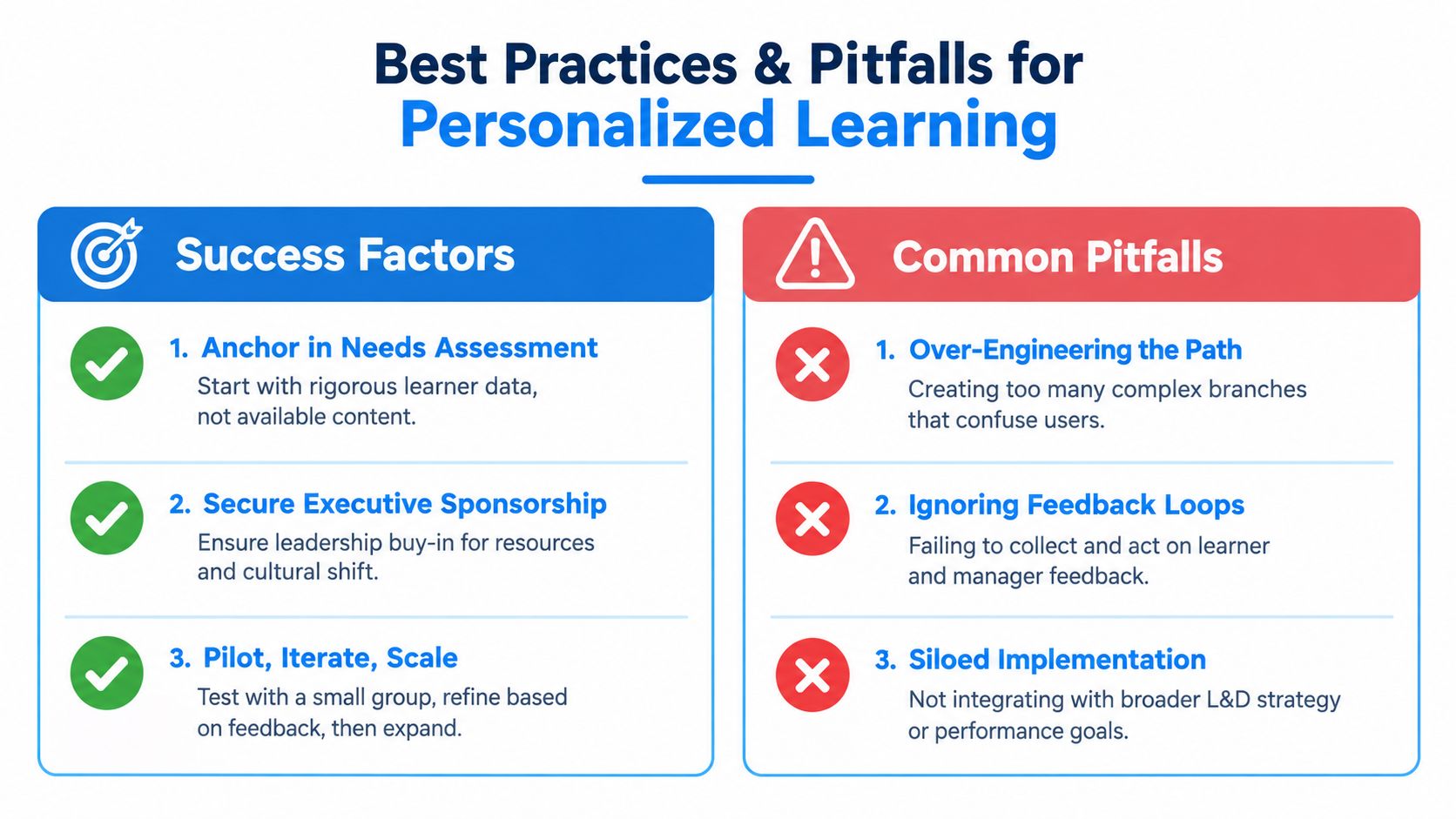
Begin with a learner-centered needs assessment. Ask what clinicians must do in practice, where performance varies, which requirements are approaching, and what barriers prevent completion. Secure executive sponsorship before the pilot begins, because managers need permission to protect learning time and IT teams need resources for integration.
Choose accredited content with competency checks and adaptive features. A mature CE and certification catalog should help learners move through relevant modules, receive remediation, and document progress. It shouldn't reduce personalization to a collection of self-paced videos.
Protect time on the schedule. A flexible course still requires attention, and clinicians won't consistently learn if managers treat education as optional work performed after every other task. Monitor outcomes beyond completion, including assessment performance, repeat attempts, confidence, supervisor observations, and relevant competency indicators.
The problems that prevent scale
The adoption gap often appears after a promising pilot. A course works for one unit, but leaders haven't planned how to support different departments, shifts, managers, data systems, and compliance cycles. Institution-wide deployment requires operational ownership, not just good content.
Common pitfalls include:
- Over-engineering the pathway: Too many branches confuse learners. Start with meaningful differences in role, knowledge, or competency.
- Ignoring feedback loops: Learners and managers should be able to report unclear content, technical friction, or missing clinical context.
- Treating personalization as video access: Without assessments, sequencing, and remediation, self-paced content remains a static curriculum.
- Siloed implementation: Connect the pathway to HR, credentialing, performance goals, and broader talent planning.
- Notification overload: Send only the reminders that help a learner act.
- Assuming adoption will happen automatically: Unit leaders must reinforce the workflow and explain why the pathway matters.
AI-enabled adaptive learning is gaining attention in medical education, especially for individualized pathways and identifying learners at risk. Yet the broader literature still contains many prototypes, pilots, and course-level experiments rather than sustained institution-wide deployments. Recent coverage of AI-driven adaptive learning in medical education highlights why governance, workflow integration, and operationalization deserve as much attention as content quality.
Bringing It All Together and Your Next Step
Personalized learning pathways give healthcare professionals a practical way to connect learning with real responsibilities. They support targeted remediation, flexible pacing, competency checks, and documentation without lowering the standard expected from clinicians.
The evidence supports online CE, CME, and certification as equally valid to in-person education when the program is accredited, the assessment is appropriate, and the credential is recognized by the relevant organization. Online learning isn't a compromise for busy clinicians. For many knowledge-based requirements, it's the format that makes consistent participation possible.
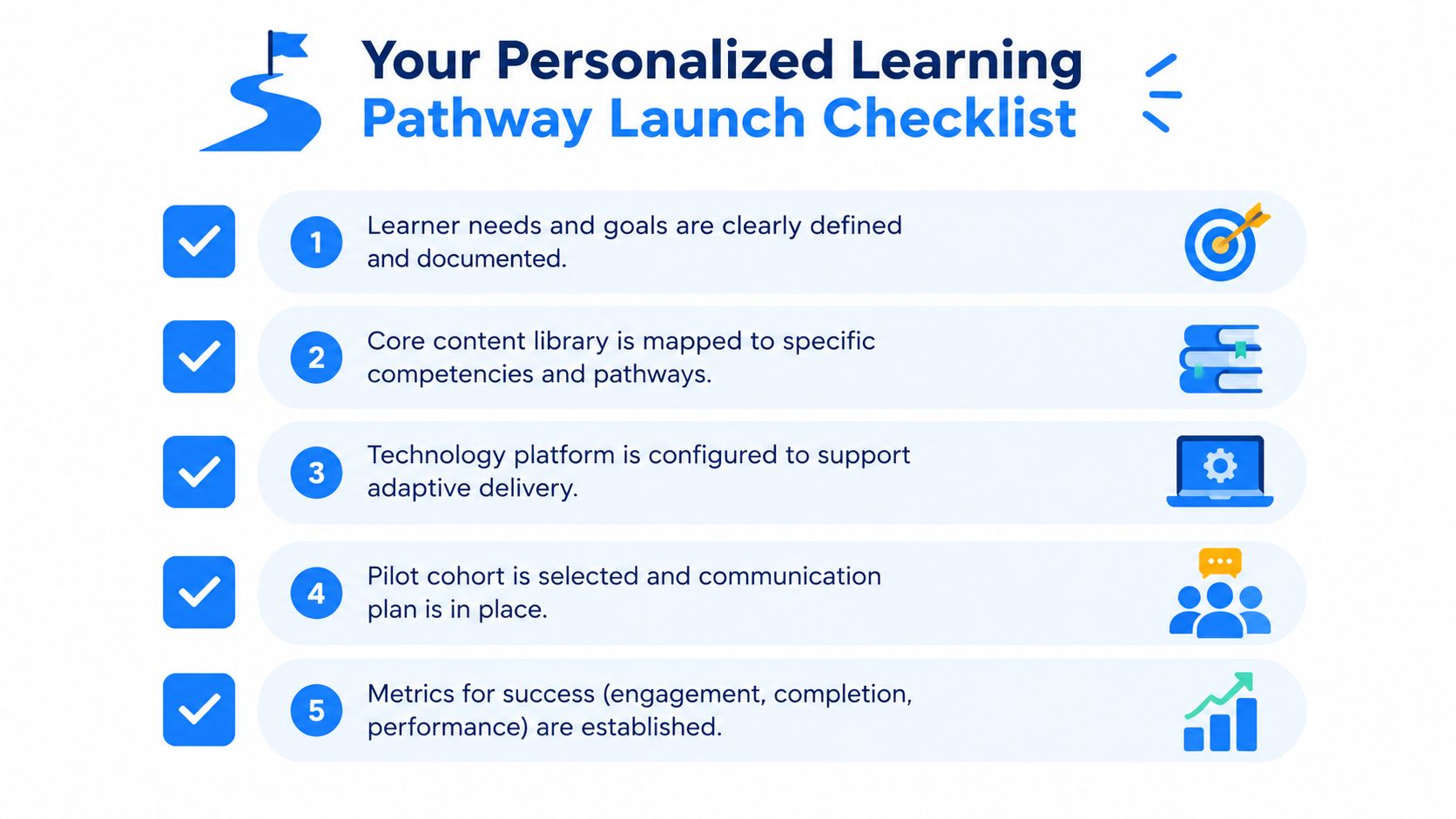
Use this short checklist:
- Define the goal: Identify the certification, CE requirement, or clinical competency you need.
- Find the gap: Use assessments, feedback, or role expectations to determine what needs attention.
- Choose mapped content: Select modules tied directly to the required competency.
- Track evidence: Save certificates, assessment results, remediation activity, and completion dates.
- Connect learning to practice: Review whether the education improved confidence, knowledge application, or documented readiness.
Start with one identified need rather than an entire curriculum. Choose a course or pathway that fits your deadline, role, and competency goal, then keep a record of what you learned and how it supports patient care.
Visit ProMed Certifications to review online CE, CME, and healthcare certification options designed for flexible completion and documented learning. Choose the course that matches your current competency gap or credentialing deadline, and begin a personalized pathway you can manage around clinical practice.

Stay compliant with ProMed+
Certifications included: ACLS, BLS, PALS, CPR & Neonatal Resuscitation
Unlimited continuing education: over 200 hours of accredited CME
All-inclusive: One price. No surprises.
Get certified today

The Advanced Cardiac Life Support (ACLS) is an accredited online medical certification course that teaches medical professionals to respond to nearly all cardiopulmonary emergencies.

The Pediatric Advanced Life Support (PALS) Recertification instructs medical professionals on performing pediatric cardiopulmonary resuscitation in emergencies.

The Basic Life Support (BLS) Recertification is intended to teach healthcare professionals the basic steps of CPR and rescue breathing for adults, children, and infants.

Our online medical certification course for CPR, Automated External Defibrillator (AED), and First Aid is designed to teach adult, child, and infant CPR and AED use.

The Neonatal Resuscitation Certification trains medical professionals in performing resuscitation procedures and life-saving techniques for newborns at the time of delivery.