


Per Diem Meaning Nursing: A 2026 Career Guide

Per diem nursing means work by the day. In nursing, it usually refers to shift-by-shift work that often pays around $40 to $80 per hour, with entry-level roles around $40 to $55 and some specialized roles exceeding $80 per hour, but it typically comes without guaranteed hours or traditional benefits.
If you're looking up the per diem meaning in nursing, you're probably standing at a career crossroads. Maybe you're tired of a rigid schedule. Maybe you want extra income without committing to another full-time role. Or maybe you're comparing flexible options and realizing that terms like per diem, PRN, travel, and contract are often used loosely, even though they don't mean the same thing in real life.
That confusion is normal. Nurses hear “flexibility” and “higher pay,” but the fine print matters. Who employs you? Who handles your taxes? Do you get retirement options? Will taking this route help your career grow, or just patch a short-term scheduling problem?
Think of per diem work like being the nurse equivalent of a relief pitcher. You come in when the team needs coverage, and you're expected to be ready right away. That can be a great setup for the right nurse. It can also be a poor fit if you need predictable income, built-in benefits, or a structured development path.
What Per Diem Nursing Really Means
Per diem comes from the Latin phrase meaning “per day.” In healthcare, it describes nurses hired on a daily or shift-by-shift basis rather than into a fixed full-time schedule. Facilities use this model to cover common staffing gaps such as sick calls, vacations, and patient surges, and one nursing employment guide estimates per diem pay at about $40 to $80 per hour, with entry-level roles around $40 to $55 and specialized roles above $80 per hour in exchange for less predictable hours and fewer benefits (per diem nursing pay and definition).

What it looks like on the job
A staff nurse usually works a regular pattern. Their unit expects them on a known schedule, and their employer builds staffing plans around that availability.
A per diem nurse works differently. The facility, hospital pool, or agency reaches out when coverage is needed. The nurse can often accept or decline based on availability, credentials, and comfort with the assignment.
That's why the simplest way to understand per diem meaning nursing is this: you're not buying into a preset schedule. You're offering skilled coverage when the system needs it.
Why hospitals use it
Hospitals and clinics don't operate on a neat, predictable curve. Census changes. Nurses call out. Vacation seasons hit. Respiratory illness surges can suddenly stretch a unit.
Per diem staffing helps managers fill those gaps without adding permanent headcount for every fluctuation. From the facility's perspective, it's a flexible staffing valve. From the nurse's perspective, it can be a way to control when and where you work.
Practical rule: If a role gives you shift-by-shift choice but not long-term schedule guarantees, you're likely looking at a true per diem setup.
Where nurses get confused
A lot of confusion comes from how employers label jobs. Some listings say “per diem” when they really mean “internal PRN pool.” Others use “PRN” and “per diem” almost interchangeably.
The more useful question is not the label. It's the structure behind it:
- Who schedules you
- Who pays you
- Whether you're tied to one facility
- What happens if shifts dry up
- Whether benefits are included
If you're exploring broader career options for registered nurses, per diem is best viewed as a staffing model, not a specialty. You're still a nurse first. Per diem changes how your work is packaged, offered, and paid.
The Financial Reality of Per Diem Work
Higher hourly pay grabs attention fast. For many nurses, that's the first thing that makes per diem look appealing.
But hourly rate is only one part of the equation. Per diem is closer to freelance-style work than a classic staff role. You may earn more for the shifts you do work, yet still have to absorb costs that a regular employer might otherwise cover.
The headline number versus the real paycheck
One industry source notes that per diem nurses are paid only for the days they work, with potential annualized earnings ranging from about $83,000 to $166,400 if someone worked 40 hours per week at the cited hourly rates. The same source also emphasizes that actual income can vary widely based on shift availability, which makes budgeting an essential skill.
That last part matters more than many job ads suggest.
If your schedule is full, the math can look strong. If your shifts get canceled, seasonal demand slows, or your preferred units stop calling, your income changes immediately. A staff nurse may get a lower hourly rate but still know roughly what the next paycheck will be. A per diem nurse often gives up that predictability.
What may be missing from the offer
When nurses compare jobs, they sometimes compare only the posted rate. That's like comparing two apartments based only on rent while ignoring utilities, parking, and insurance.
Look beyond the number and ask what the role includes:
- Paid time off: If you don't work, you usually don't get paid.
- Health coverage: You may need to arrange your own insurance.
- Retirement support: Employer contributions may be limited or absent.
- Holiday pay rules: Some employers offer premiums. Others don't.
- Canceled shift policies: A high rate loses appeal if shifts disappear at the last minute.
A strong hourly rate can still be a weaker financial package if too much risk gets pushed onto the nurse.
Taxes are part of the decision
Tax handling depends on the work arrangement. Some per diem nurses are paid as employees. Others work in setups that create more individual tax responsibility.
That's why you need to ask direct questions before accepting shifts. Are you on payroll? Are you receiving standard tax documents as an employee? Are you responsible for tracking more of your own work-related expenses? The answers affect your take-home pay and your record-keeping habits.
The exact rules depend on where you work and how you're classified, so local professional advice still matters.
A simple way to think about it
A salaried or regular staff role is like a steady subscription. You know what's included. Per diem is more like paying as you go. You get flexibility and potentially stronger hourly compensation, but you also take on more responsibility for smoothing out the uneven parts.
That doesn't make per diem a bad financial move. It just means the smartest nurses calculate their true working value, not just the advertised rate.
Per Diem vs PRN vs Travel Nursing
Flexible nursing jobs get lumped together all the time. That creates bad career decisions.
The words may sound similar, but the working life behind them can be very different. The key distinction isn't only schedule. It's the relationship between you, the employer, and the assignment.
The biggest difference most nurses miss
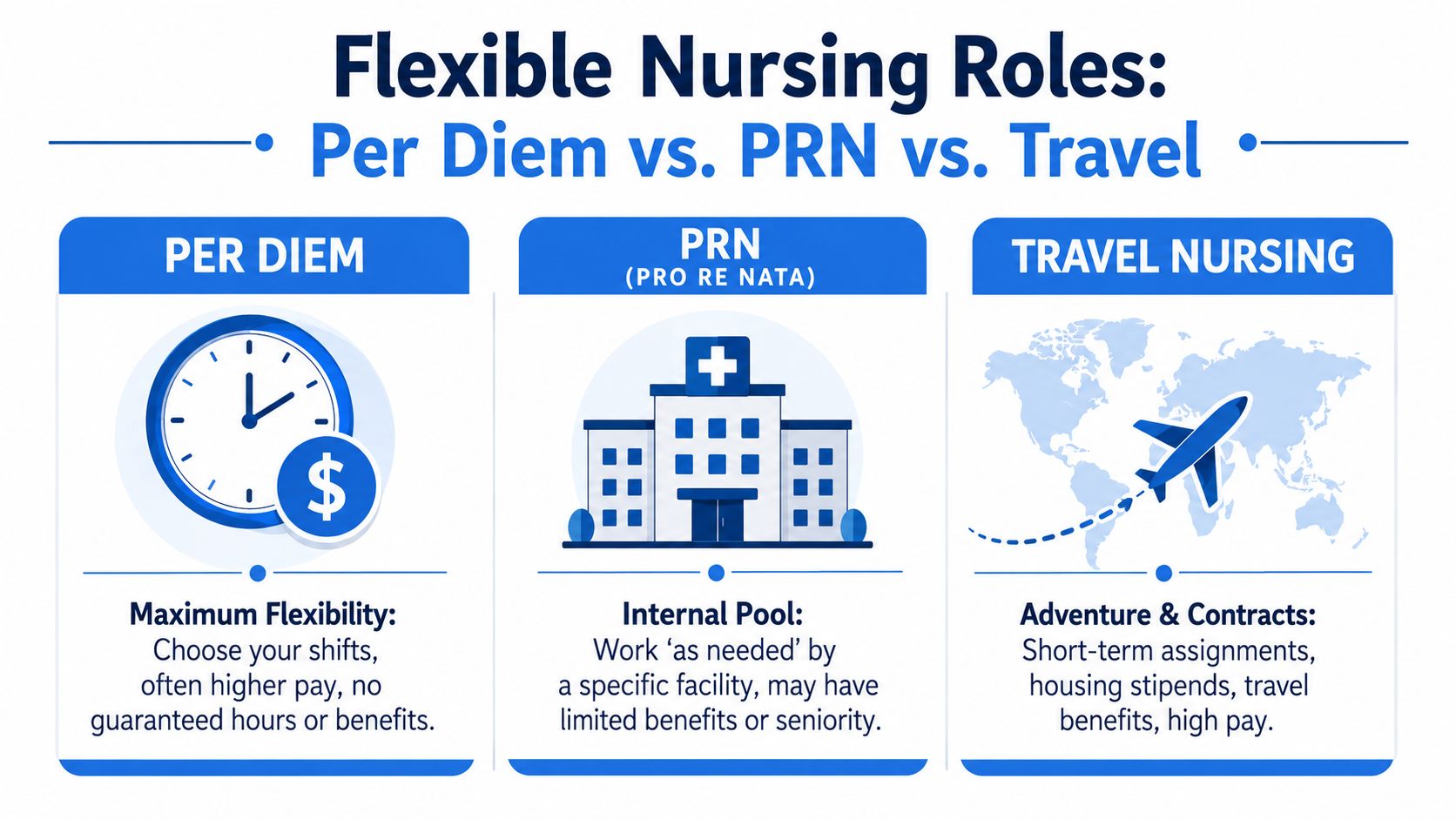
Independent nursing guidance notes that per diem nurses are often not bound to one workplace and may not receive benefits, while PRN roles are commonly tied to a single facility's payroll and can sometimes include access to benefits like retirement plans even without guaranteed hours.
That's the hidden dividing line.
A PRN role may still feel flexible, but it often functions as an internal staffing relationship. A per diem setup may offer more freedom across facilities, but that freedom can come with less support and fewer protections.
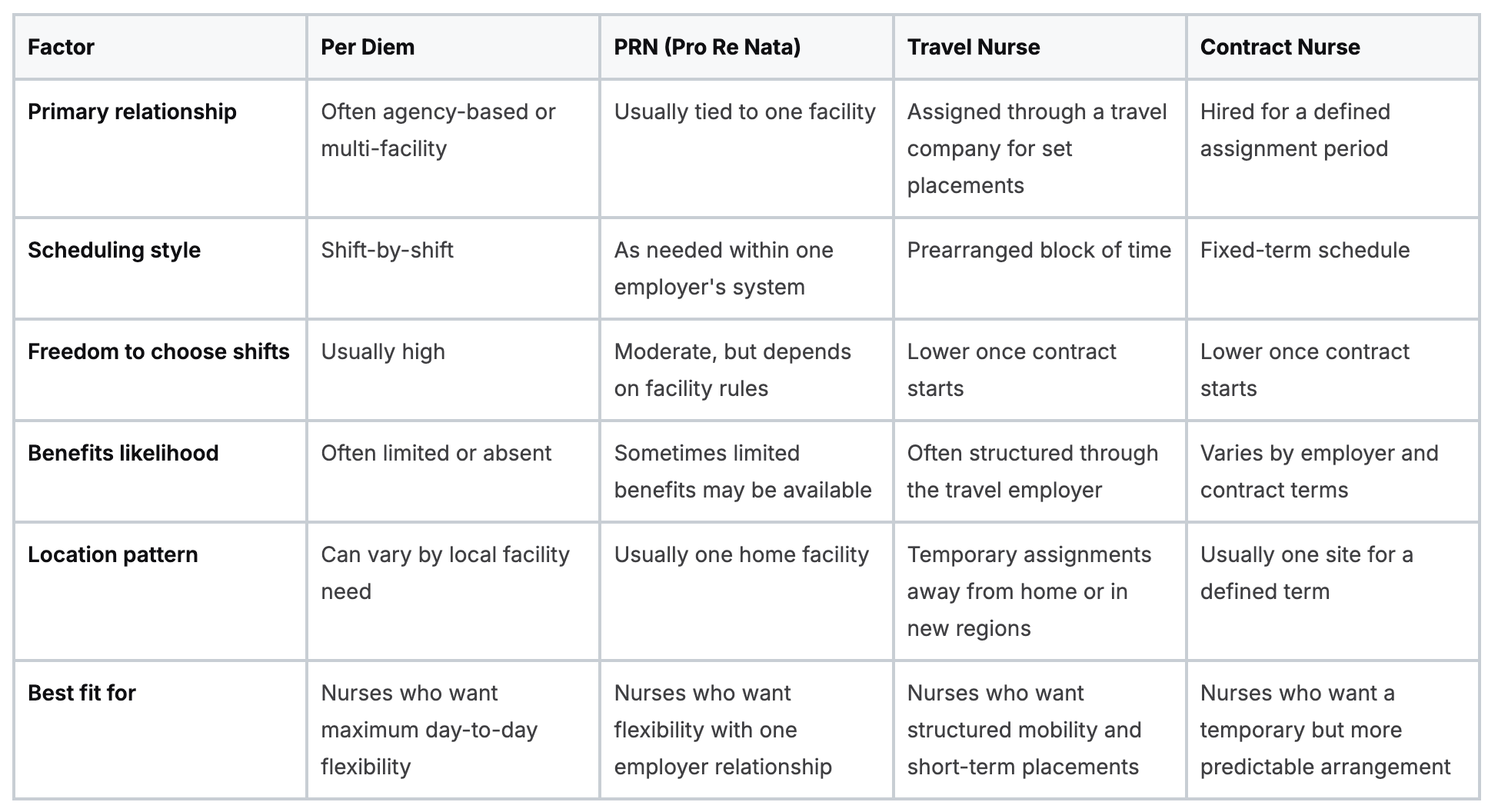
A practical side-by-side view
Here's a cleaner way to compare the options you'll see in the market.
How to choose based on your actual life
If you want control over this week's calendar, per diem often fits best. You'll likely like it if autonomy matters more than routine.
If you want a flexible role but still prefer one badge, one onboarding system, and one manager, PRN may feel more stable.
If you want a change of setting and can commit to temporary placements, travel nursing may offer a better framework. It's less about spontaneous shift-picking and more about stepping into a short-term assignment.
Contract nursing sits in the middle for some people. It's temporary, but not as open-ended as per diem. You trade some freedom for more defined expectations.
Before comparing pay, compare commitment. The work model shapes your daily life more than the job title does.
Career development trade-offs
At this point, many nurses need to pause.
Per diem can broaden your clinical exposure. You may see different workflows, charting systems, and unit cultures. That can sharpen adaptability. But it can also limit access to committee work, preceptor roles, leadership tracks, and long-term mentorship inside one organization.
PRN may offer a little more continuity. Travel can build resilience and range, but not always deep institutional roots. Contract roles can help if you want a focused temporary lane.
If your goal is long-term advancement into educator, leadership, or highly specialized roles, ask whether the model supports that path. Flexibility is valuable. So is professional traction.
Essential Certifications for Per Diem Success
Per diem nurses don't have much runway. Employers often need help fast, and they expect the nurse who accepts the shift to be ready to practice safely with minimal orientation.
One nursing resource points out that per diem nursing usually requires recent clinical experience, an active RN license, and short-notice availability. Facilities use per diem nurses as a high-skill buffer and expect them to be fully credentialed and ready to work across varied settings with minimal onboarding, which makes current certifications a prerequisite.
What “credential-ready” really means
In practice, credential-ready means you shouldn't be scrambling to renew something after the shift offer arrives.
Common requirements often include:
- License readiness: Your RN license needs to be active and easy to verify.
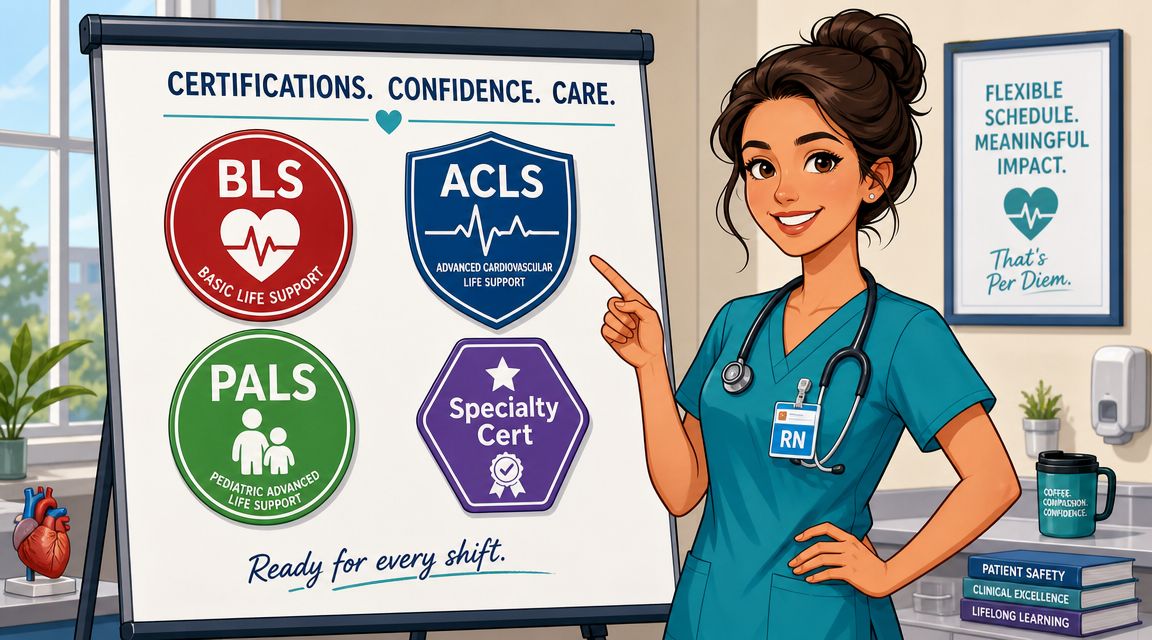
- Core life support training: Depending on the role, employers may expect current BLS, ACLS, PALS, CPR, or specialty-specific preparation.
- Document access: Keep digital copies of cards, IDs, immunization records, and onboarding paperwork organized.
- Skills alignment: A med-surg shift, ICU opening, and pediatric assignment won't ask for the same preparation.
If you're brushing up on the basics, this plain-language guide to what BLS certification is is a useful starting point.
The old myth about only in-person courses
A lot of nurses still hear some version of this: only in-person classes from a small handful of organizations count.
That belief is outdated.
What matters is whether the certification meets the employer's requirements and whether the training is credible, current, and aligned with accepted standards. Plenty of healthcare professionals now complete CE and certification work online because it fits real clinical schedules better. For knowledge-based learning, review, and renewal prep, online education is a practical format that many professionals and institutions increasingly accept.
That matters even more for per diem nurses because your schedule may change week to week. You might work nights, stack shifts, or cover multiple facilities. In that world, flexible education isn't a shortcut. It's a sensible professional tool.
Why online learning fits per diem nurses so well
A per diem nurse often needs three things from education:
- Access on demand when the calendar opens up
- Clear content that gets to the point
- A format that doesn't require losing work time unnecessarily
Online CE and certification formats support all three. They let you review material at your own pace, revisit weak areas, and fit renewal into the reality of your work life. That's especially useful when your schedule isn't built around a fixed employer's education calendar.
Keep your certifications current before you need them. In per diem work, readiness is part of your employability.
Finding Per Diem Jobs and Asking the Right Questions
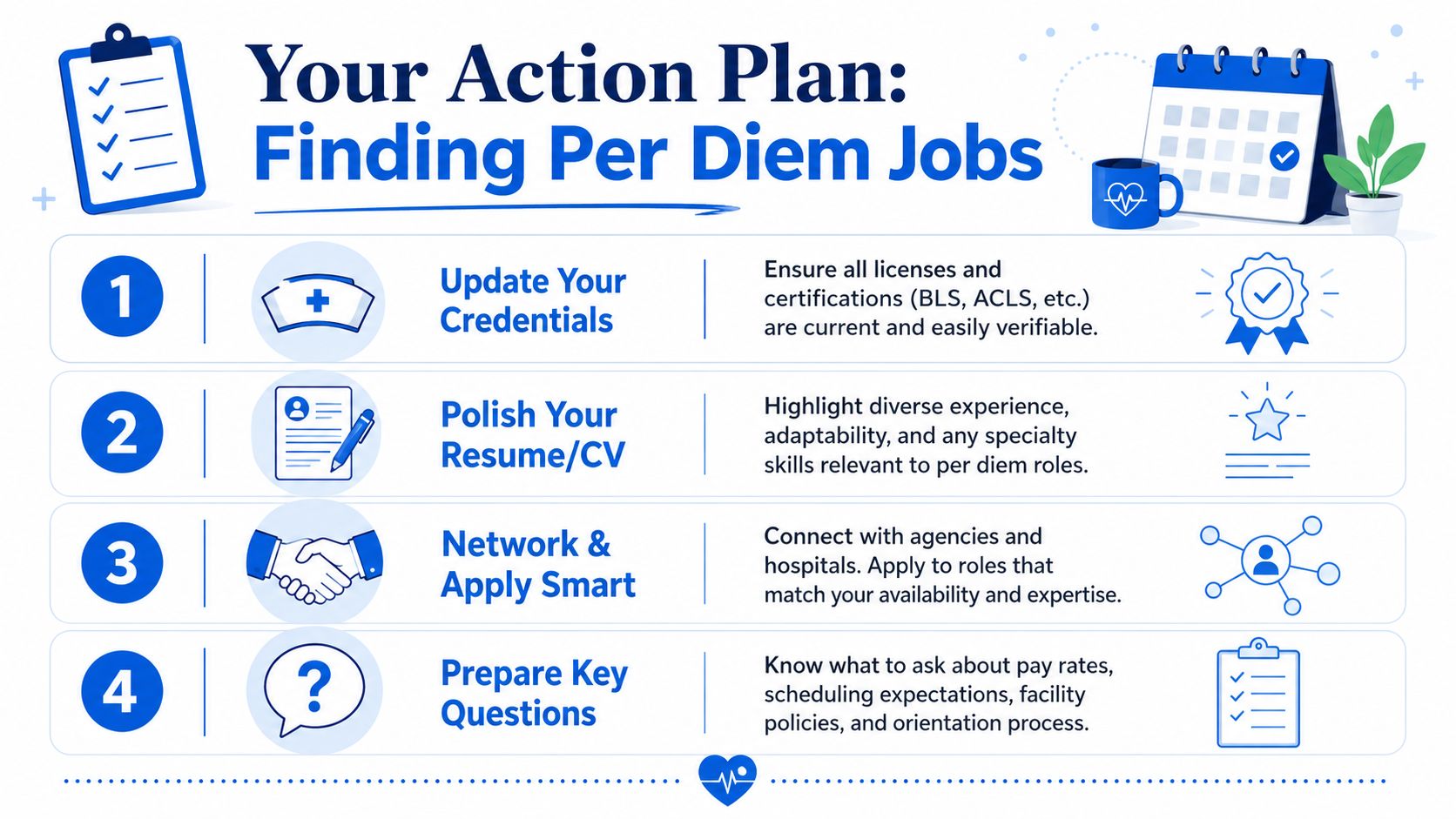
The fastest way to make a bad per diem decision is to focus only on the posted rate. A better approach is to treat every opportunity like a staffing partnership interview.
Some nurses find per diem work through hospital float pools. Others work with staffing agencies. Some use a mix, keeping more than one channel open so they aren't dependent on one stream of shifts.
Where to look first
Start with the places most likely to have organized systems:
- Hospital internal pools: Good if you want familiarity with one health system.
- Specialized staffing agencies: Useful if you want access to several facilities.
- Former employers and colleagues: Managers often remember reliable nurses.
- Professional networks: Local nurse groups can reveal openings before they spread widely.
Make sure your education record is current too. If you're checking licensure and renewal timelines, a state-by-state overview of continuing education requirements for nurses can help you avoid surprises.
A short walkthrough can also help you think about the process from the employer side:
Questions that protect you before you say yes
Ask these before you accept regular shifts:
- How are cancellations handled? If the facility cancels, do you receive any minimum pay?
- What are the minimum shift requirements? Some roles expect a certain number of shifts each month.
- Who is my employer on paper? The answer affects payroll, benefits, and tax handling.
- How long is orientation? A single shadow shift may be fine for one setting and unsafe for another.
- Which units will I float to? “Med-surg” can mean very different patient loads and workflows.
- How quickly are credentials verified? Delays here can slow down your start date.
- When am I paid? Weekly, biweekly, and delayed payroll cycles feel very different.
- What documentation systems are used? A new charting platform can change how comfortable a shift feels.
Small red flags matter
Watch for vague answers. If a recruiter can't explain cancellation policy, floating expectations, or payroll classification clearly, that's a warning sign.
A good per diem opportunity should feel flexible, not chaotic. Flexibility gives you room to choose. Chaos leaves you absorbing preventable problems.
Frequently Asked Questions About Per Diem Nursing
Can a new grad work per diem
Sometimes, but it's often harder.
Many per diem roles expect nurses to step in with minimal onboarding. That's why employers often prefer recent hands-on experience. A new graduate usually benefits more from a role with structured support, consistent preceptors, and a stable clinical environment before moving into highly flexible staffing models.
Do per diem nurses get treated differently by full-time staff
Sometimes, yes. Usually not because of the title itself, but because you're arriving in an environment where other people already know the routines and each other.
The best way to reduce friction is to be easy to work with. Show up prepared, ask focused questions, and avoid acting like a visitor who's exempt from the unit culture. Staff nurses tend to appreciate per diem colleagues who are adaptable, safe, and low-drama.
“Learn the flow fast, help where you can, and don't pretend you know a unit better than the people who live in it.”
Is per diem better than PRN
It depends on what problem you're solving.
If you want broader flexibility and possibly work across more than one facility, per diem may fit better. If you want one employer relationship and a little more continuity, PRN may be the stronger choice. The better option is the one that matches your need for schedule control, financial predictability, and career stability.
How should I think about taxes
Start by finding out how you're classified and who issues your pay. Don't guess.
Keep records from the beginning. Save pay documents, track work-related expenses when appropriate, and get professional guidance if your arrangement is more complex than a standard employee role. Nurses often wait until tax season to sort this out, and that's usually when preventable problems surface.
Can per diem help my career, or does it stall growth
It can do either.
Per diem can strengthen adaptability, expose you to different clinical settings, and help you build confidence in unfamiliar environments. But if you want leadership roles, committee involvement, or a long institutional track inside one system, too much scattered work can make that harder. The key is to use per diem intentionally, not drift into it without a plan.
What should I keep current at all times
At minimum, keep your license, required certifications, and employment documents organized and easy to access. In per diem work, readiness is part of your professional reputation.
If someone offers you a strong shift and you can't produce your paperwork quickly, another nurse will get the call.
If you're building a flexible nursing career, ProMed Certifications gives you a practical way to keep your credentials current without forcing your schedule around an in-person class calendar. Their online certifications and CE options are built for working healthcare professionals who need convenience, credibility, and a modern learning format that fits real clinical life.
.avif)
Stay compliant with ProMed+
Certifications included: ACLS, BLS, PALS, CPR & Neonatal Resuscitation
Unlimited continuing education: over 200 hours of accredited CME
All-inclusive: One price. No surprises.
Get certified today

The Advanced Cardiac Life Support (ACLS) is an accredited online medical certification course that teaches medical professionals to respond to nearly all cardiopulmonary emergencies.

The Pediatric Advanced Life Support (PALS) Recertification instructs medical professionals on performing pediatric cardiopulmonary resuscitation in emergencies.

The Basic Life Support (BLS) Recertification is intended to teach healthcare professionals the basic steps of CPR and rescue breathing for adults, children, and infants.

Our online medical certification course for CPR, Automated External Defibrillator (AED), and First Aid is designed to teach adult, child, and infant CPR and AED use.

The Neonatal Resuscitation Certification trains medical professionals in performing resuscitation procedures and life-saving techniques for newborns at the time of delivery.

.png)
.png)
.png)