


PALS Meaning: A Practical Guide for Healthcare Pros
.png)
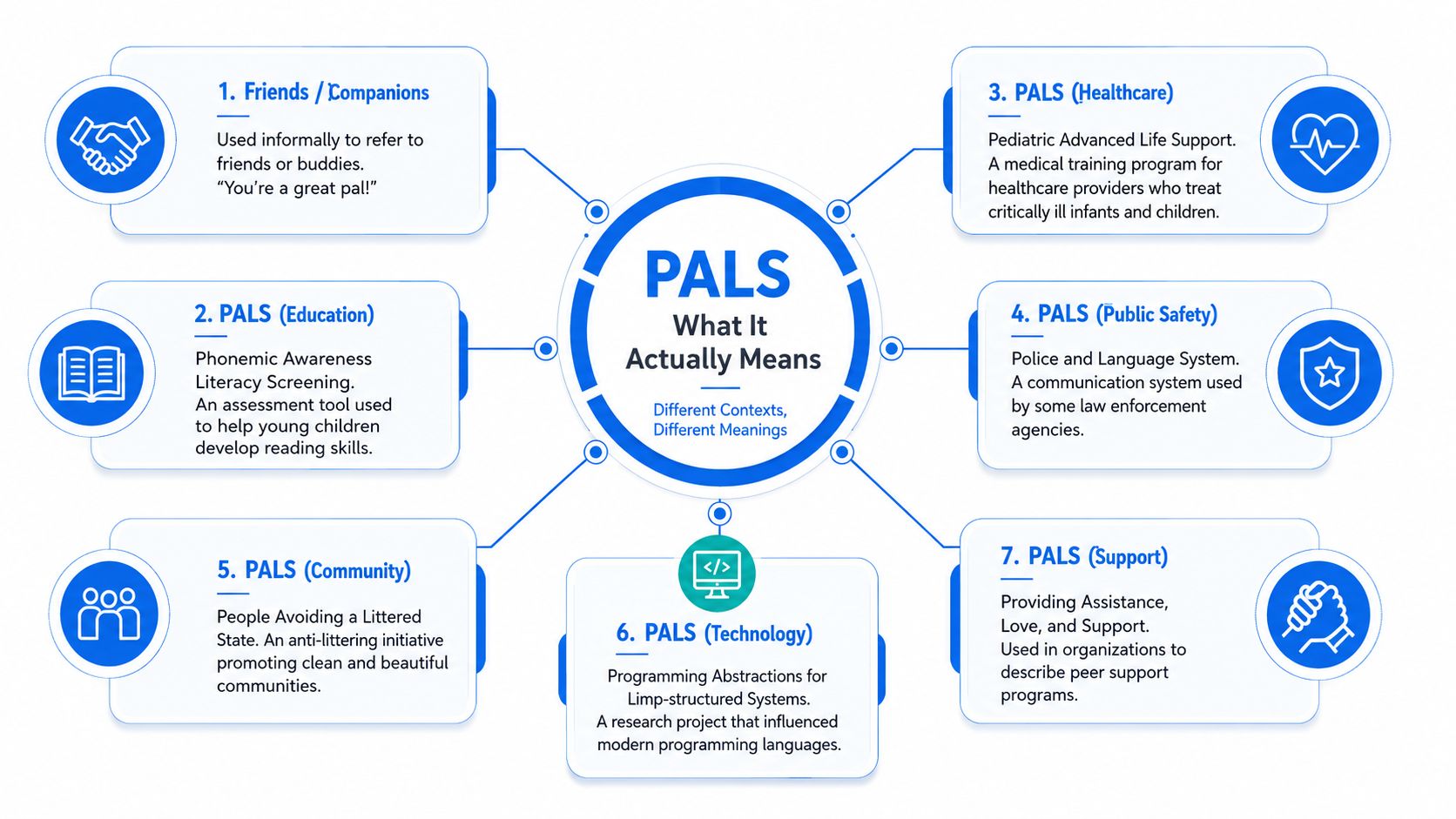
If you searched PALS meaning, you probably did not want a single dictionary answer. You wanted the right one for your situation, because PALS can mean a casual word for friends, a pediatric emergency certification, a school-based tutoring program, or a runway lighting system. That's why the first job is context, not memorization.
In healthcare, the confusion matters more than it looks. A nurse, paramedic, or physician might read PALS and think Pediatric Advanced Life Support, while someone in education may mean Peer-Assisted Learning Strategies. In aviation, it can point to Precision Approach Lighting System. In everyday English, pals just means friends, and that meaning is the simplest one to keep in mind when tone and audience are informal.
If you searched because you work in healthcare, keep reading. If you only needed the friendship meaning, you've already got the short answer. If you want the clinical one, the next section gets precise fast.
What PALS Actually Means in Different Contexts
Four different meanings, one abbreviation
Pals can mean multiple friends in ordinary English, and that's the meaning most learn first. Merriam-Webster defines pal as “a close friend,” and Cambridge also gives the familiar sense of “a friend” or someone you know well and like. In casual speech, it's warm, low-pressure, and common in everyday conversation.
In healthcare, PALS most often means Pediatric Advanced Life Support. That's a formal clinical framework for providers caring for infants and children during emergencies. It's a much more specific use than the casual noun, so the surrounding words usually tell you whether the speaker means medicine, not friendship.
In education, PALS can mean Peer-Assisted Learning Strategies. The Institute of Education Sciences describes it as a supplemental peer-tutoring program in reading and math, with 30 to 35 minute sessions where students coach and correct one another. The IES report on PALS shows why the acronym shows up in school settings as well as hospitals.
In aviation, PALS can mean Precision Approach Lighting System. That use belongs in the world of runway lighting, approach alignment, and landing support in low-visibility conditions. The practical clue is simple, if the sentence mentions aircraft, runways, or landing, you're probably not dealing with a medical course at all.
Practical rule: read the words around PALS before you guess the meaning. The context usually gives it away.
PALS in Healthcare and Why Pediatric Cases Are Different
Pediatric Advanced Life Support is not just CPR for smaller bodies. It's a protocol-driven framework that helps clinicians recognize and treat respiratory distress, respiratory failure, shock, cardiac arrest, and arrhythmias in infants and children. The value of the training is in the sequence. You're not guessing. You're following a structured way to spot deterioration early and respond fast.
Why the pediatric arc matters
Children often don't crash the same way adults do. In pediatric emergencies, breathing problems may show up first, and cardiac arrest can be the end point if the team misses the early warning signs. That's why PALS puts so much emphasis on assessment and early intervention. It's a slow leak that keeps draining until the system fails, not a sudden switch that flips from normal to arrest.
The official pediatric education language reflects that focus. The Institute of Education Sciences describes PALS as structured peer-supported learning in school settings, while healthcare training uses the acronym for emergency resuscitation work. In medicine, the idea is the same even when the meaning changes, use structure, observe patterns, and intervene before the situation narrows.
A good pediatric response starts with age-aware thinking. Airway size, breathing effort, heart rate interpretation, and team roles all change with the patient's age. That's why pediatric emergency care is a discipline of details, not just a smaller version of adult resuscitation. The pediatric chain of survival overview fits neatly with that mindset, because it reinforces early recognition and coordinated action.
For busy teams, the workflow matters too. A well-organized emergency department keeps supplies where staff can reach them quickly, and practical layout decisions support that speed. If you're thinking about how pediatric readiness affects everyday operations, even a resource like browse emergency department storage can help frame how environment and response time work together.
The clinical version of PALS is about reading the patient, not just running a checklist. That's why it stays relevant in emergency care, critical care, EMS, and transport settings. If you've ever watched a child deteriorate from “not quite right” to unstable, you already understand why this certification exists.
Clinical takeaway: in pediatrics, early breathing problems matter. PALS trains you to catch that window before arrest develops.
Who Needs PALS and What the Course Actually Covers
PALS is typically for clinicians who manage children when seconds matter. That includes pediatric physicians, emergency physicians, nurses in ED and critical care settings, paramedics, respiratory therapists, and advanced EMTs. In practice, the people who need it are the ones who may be first to recognize a child in trouble or first to lead a team response.
The skills you're expected to use
The course is built around systematic pediatric assessment. You learn to sort through airway, breathing, and circulation concerns in a structured way, then decide what comes next. The goal isn't memorizing isolated facts. It's learning how to think under pressure.
Common content areas include:
- Recognizing respiratory distress versus failure, so you can act before the child decompensates.
- Managing shock, including fluid resuscitation decisions and ongoing reassessment.
- Interpreting rhythms, because pediatric arrest algorithms depend on reading the rhythm correctly.
- Coordinating team-based resuscitation, since one person rarely handles a true emergency alone.
- Working through cardiac arrest algorithms, which helps the team move in order instead of reacting in pieces.
The certification process usually has two parts. One is knowledge-based, often a written or online exam. The other is a performance component, often called a megacode, where you work through a realistic emergency scenario. That split matters because PALS is about both understanding the logic and using it in action.
What the provider should look like
If you're choosing a course, the best ones don't just hand you slides. They make the sequence clear, tie the material to current guidelines, and give you enough repetition to keep the steps straight. That's especially useful for nurses and paramedics who need the material to stick under real workload pressure.
For readers comparing options, PALS Certification is offered as 100% Online PALS Certification with self-paced review and exam access. That format fits the reality of shift work, call schedules, and recertification deadlines without forcing you into a classroom slot you can't reach.
How PALS Compares to BLS and ACLS
BLS, ACLS, and PALS aren't competitors. They're a stack of skills that cover different patient groups and different levels of complexity. BLS gives you the foundation. ACLS applies advanced adult algorithms. PALS does the same kind of advanced work for pediatric patients.
A quick comparison
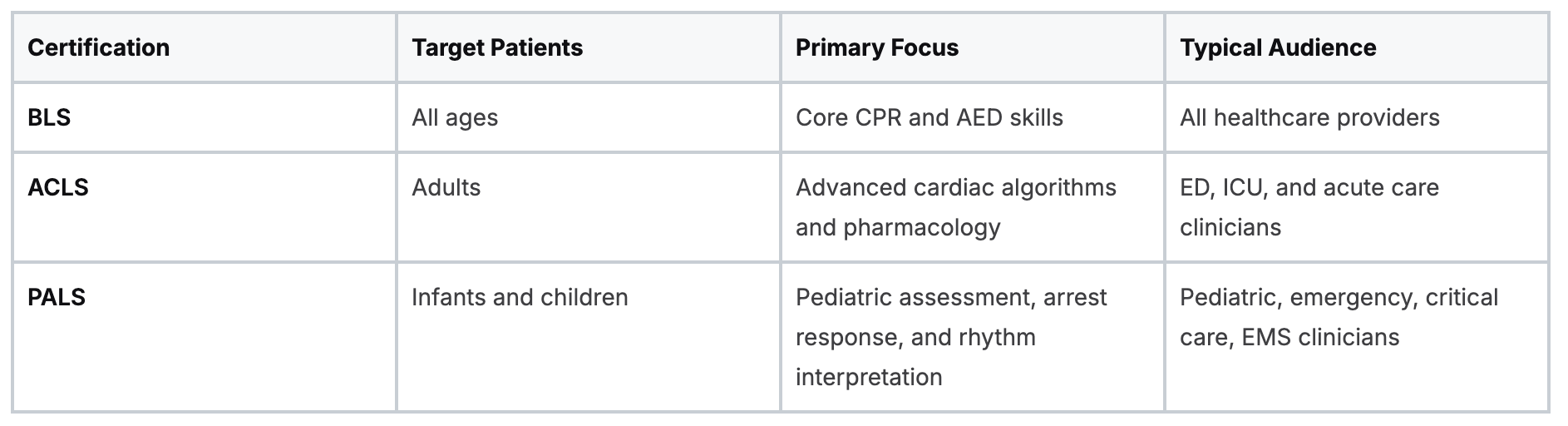
The confusion usually comes from assuming one certification replaces another. It doesn't. A clinician can hold BLS and still need PALS for pediatric care. Likewise, ACLS doesn't cover pediatric-specific dosing, airway considerations, or the pattern of deterioration you see in children.
PALS sits closest to ACLS in intent, because both teach structured response under time pressure. The difference is patient age and physiology. Pediatric care needs age-specific thinking from the start, not adult rules scaled down. That's why a clinician working around children often needs PALS even if they already have BLS or ACLS.
Simple rule: BLS is the base, ACLS is adult advanced care, and PALS is pediatric advanced care.
Why Online PALS Certification Is a Real Option
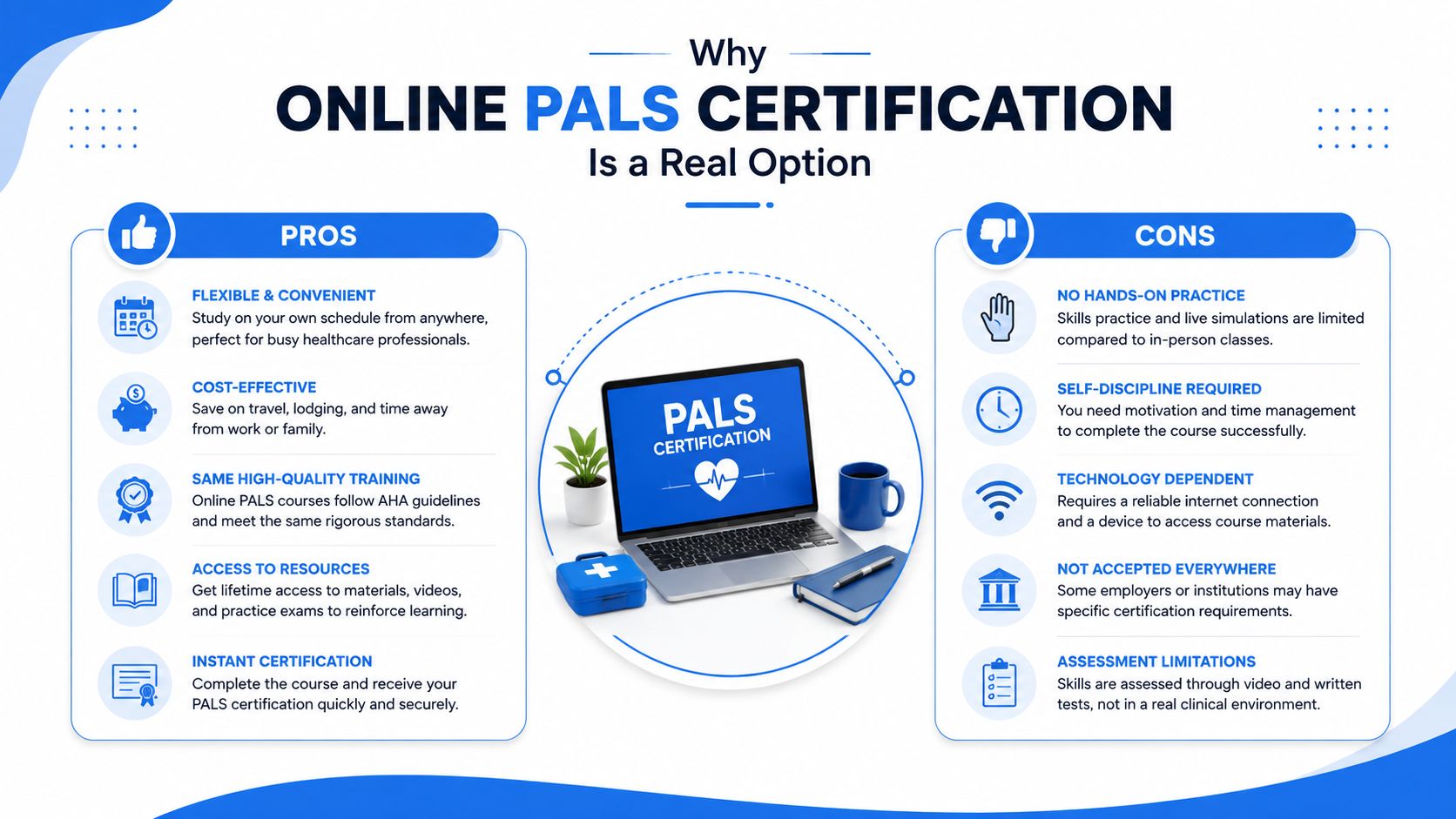
The old idea that only an in-person class counts is outdated. In healthcare education, online CE and certification formats are valid, accessible, and increasingly accepted by hospitals, clinics, and EMS organizations. The strongest programs line up with current guidelines, give you a clear assessment path, and produce a credential employers recognize.
What actually drives acceptance
Acceptance usually comes down to three things. First, the course content should match current standards. Second, the provider should be transparent about what the certification includes. Third, the employer should accept the credential in practice. When those pieces line up, online learning becomes a practical route, not a shortcut.
That's why many clinicians prefer digital training. It saves time, fits around shifts, and removes the travel burden that makes a classroom session harder to schedule. For recertification, that flexibility matters even more, because you're usually trying to stay current without losing a day off.
The broader industry trend is moving toward broader online acceptance, especially when the course is accredited and aligned with recognized guidance. You'll still hear people say only AHA or American Red Cross in-person classes are valid, but that blanket statement doesn't reflect how many healthcare organizations now evaluate training. What they care about is whether the course is current, credible, and accepted by their own policies.
If you want a deeper breakdown of that decision, 7 reasons to get your PALS recertification online gives a useful lens on convenience and fit. The most convincing online courses are the ones that keep the education serious while making the logistics easier.
How to Get PALS Certified and What to Look For
Start with the provider. You want a course that says exactly what it covers, whether it aligns with current AHA guidelines, and how the exam works. If the provider is vague, keep looking. Clear course design is usually a sign that the training was built for working clinicians, not just marketed to them.
A practical checklist
- Check guideline alignment: Make sure the course states that it follows current pediatric resuscitation guidance.
- Verify acceptance terms: Employers care about whether the certification is recognized where you work.
- Look for self-paced study: Shift workers need room to move through material on their own schedule.
- Confirm retake policy: Unlimited exam retakes can reduce pressure and help you finish cleanly.
- Read the recertification window: Most institutions follow a two-year cycle, so timing matters.
A good provider should also explain how quickly you can complete the process, what comes after passing, and whether your card is issued digitally. That transparency saves time later when you're trying to upload records for a manager, agency, or credentialing office.
If you're comparing options, it helps to think like a buyer and like a clinician at the same time. You want a course that respects your time, but you also want one that builds confidence with real content. For a broader framework on selection criteria, how to choose the best online PALS certification course is a useful companion read.
Online certification is not a backup plan. It's a workable path for busy clinicians who need current education without sacrificing quality or credibility. If your goal is to stay prepared for pediatric emergencies and keep your credential current, the right online course gets you there without adding friction.
If you want a straightforward way to complete PALS training without rearranging your whole schedule, ProMed Certifications offers online healthcare courses built for working clinicians, including PALS. Visit ProMed Certifications to review the course options and choose the path that fits your timeline and your practice.
.avif)
Stay compliant with ProMed+
Certifications included: ACLS, BLS, PALS, CPR & Neonatal Resuscitation
Unlimited continuing education: over 200 hours of accredited CME
All-inclusive: One price. No surprises.
Get certified today

The Advanced Cardiac Life Support (ACLS) is an accredited online medical certification course that teaches medical professionals to respond to nearly all cardiopulmonary emergencies.

The Pediatric Advanced Life Support (PALS) Recertification instructs medical professionals on performing pediatric cardiopulmonary resuscitation in emergencies.

The Basic Life Support (BLS) Recertification is intended to teach healthcare professionals the basic steps of CPR and rescue breathing for adults, children, and infants.

Our online medical certification course for CPR, Automated External Defibrillator (AED), and First Aid is designed to teach adult, child, and infant CPR and AED use.

The Neonatal Resuscitation Certification trains medical professionals in performing resuscitation procedures and life-saving techniques for newborns at the time of delivery.

.png)
.png)
.png)