


Pain Management Training: A Modern Guide for Clinicians
Why is pain management training still treated like a niche skill when pain shows up in nearly every clinical setting?
If you work in primary care, emergency care, nursing, rehabilitation, palliative care, orthopedics, or outpatient medicine, you already know the answer from experience. Patients don't arrive with pain neatly separated into “simple” and “specialist only” categories. They arrive with back pain, neuropathic pain, post-procedural pain, cancer-related pain, arthritis, mixed symptoms, fear, poor sleep, and functional limits that affect everything else you're trying to treat.
That's why pain management training now belongs in mainstream professional development. It isn't only about procedures or prescribing. It's about assessment, communication, safety, function, and choosing the right tool for the right patient.
It's also where many clinicians get stuck. They wonder whether online learning is respected, whether only a few legacy organizations count, and whether a modern course can actually prepare them for real-world care. Those concerns are understandable, but they're often based on outdated assumptions. Today, accredited online education plays a central role in healthcare CE and certification. For many working professionals, it's the most realistic and effective way to build competence without stepping away from practice.
Why Pain Management Training Is an Essential Skill
Pain management training matters because pain is not a side topic in healthcare. It is a daily clinical reality.
The U.S. Pain Management Best Practices Inter-Agency Task Force reported significant “gaps” in pain management education across the healthcare community and called for stronger training in professional schools, postgraduate education, and continuing education to help address the needs of over 50 million American adults living with chronic pain in its 2019 best practices report. That language is important. It tells us this isn't an optional enrichment area. It's a recognized education gap.
Pain care now affects nearly every role
A nurse assessing a post-op patient needs pain communication skills. A physician managing a complex outpatient panel needs a safe, multimodal plan. A rehabilitation professional needs to understand function, pacing, and referral timing. A clinician in palliative settings needs confidence with serious symptom burden and patient goals.
Pain management training supports all of those decisions.
It also helps clinicians move away from narrow thinking. Older models often treated pain education as a medication issue alone. Modern care asks for more. You need to assess the source of pain, understand how it affects function, recognize psychosocial contributors, and know when to escalate, refer, monitor, or combine approaches.
Practical rule: If you routinely care for patients, you routinely care for pain. Training should reflect that reality.
Why the urgency has increased
Healthcare systems are asking clinicians to do more with better judgment and clearer documentation. Pain care sits right in the middle of that pressure. Patients want relief, but they also want to stay mobile, alert, and engaged in daily life. Employers want evidence of current competency. Licensing and CE expectations continue to reinforce structured learning.
The same federal report also recommends expanding clinician training in acute, chronic, and end-of-life pain evaluation and treatment, including telehealth and tele-mentoring models such as Project ECHO. That tells you something else: modern pain education is not tied to one classroom or one building. National guidance already recognizes flexible delivery models as part of the solution.
What good training changes in practice
A strong course won't turn every learner into a subspecialist. It will do something just as useful. It will help you:
- Assess more accurately so pain complaints are less likely to be reduced to a symptom score alone
- Choose interventions more thoughtfully across pharmacologic, procedural, rehabilitative, and supportive options
- Document with more clarity when risk, rationale, and follow-up matter
- Communicate better with patients whose pain history is complicated, frustrating, or emotionally charged
That's why pain management training has become an essential professional skill. It meets a clinical need, an educational need, and a system need all at once.
What to Expect from a Comprehensive Training Curriculum
A good pain management course should teach the whole playbook, not just one or two plays.
Some clinicians hear “pain training” and think of medication updates alone. Others think only of injections. Neither view is broad enough. A credible curriculum should help you understand pain from the anatomy level up through patient evaluation, procedures, safety, and care planning.
The core knowledge base
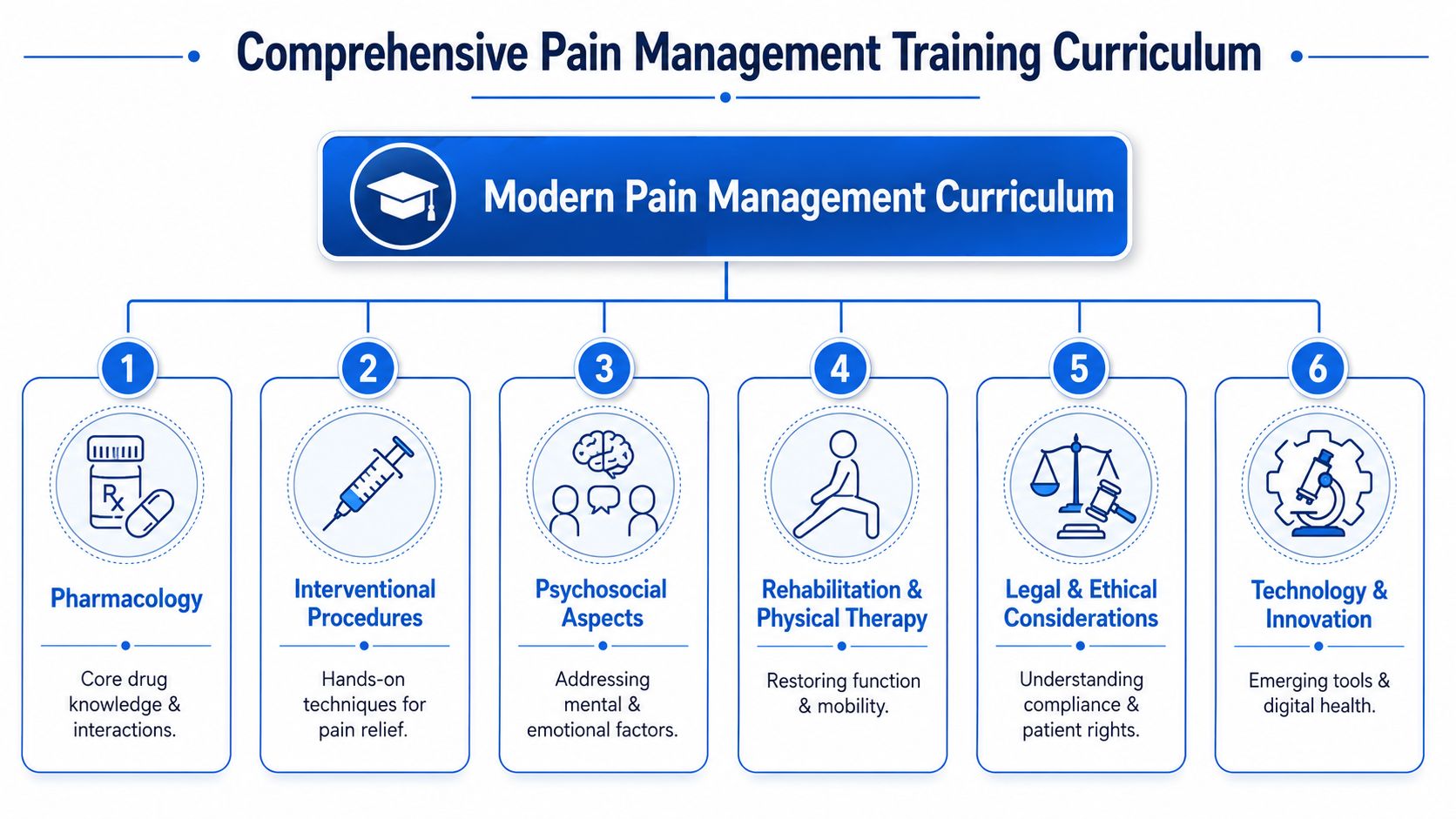
The most useful programs build from fundamentals first. According to the AAOPM pain management training guide, a thorough curriculum includes pain neuroanatomy, patient evaluation, fluoroscopic and ultrasound-guided injection techniques, and risk management. That matters because there are only an estimated 5,000 to 6,000 board-certified pain specialists in the U.S. serving over 51 million chronic pain patients, which highlights why broader clinician upskilling has become so relevant.
That doesn't mean every learner needs the same depth in every area. It does mean your course should show how the pieces connect.
A modern curriculum often includes topics such as:
- Pain neuroanatomy and pathophysiology so you understand where symptoms may originate and how pain signals behave
- Patient evaluation including history, exam logic, red flags, functional impact, and differential thinking
- Image-guided techniques such as fluoroscopic and ultrasound-guided injections for clinicians whose role includes procedures
- Risk management and documentation because safe care depends on clear reasoning, informed consent, and follow-up planning
It should reflect real multidisciplinary care
Pain rarely improves because of one intervention in isolation. That's why the best curricula connect clinical decision-making to movement, rehabilitation, behavior, communication, and practical self-management.
For example, if you care for patients with osteoarthritis or mobility-related pain, it helps to understand how exercise guidance fits into a broader plan. Resources on joint-friendly exercises to manage arthritis can complement formal training by showing how conservative movement strategies support comfort and function between visits.
You should also expect some attention to pharmacology, especially if your scope includes prescribing or medication review. For nurse practitioners, a focused resource on CME pharmacology for nurse practitioners can be useful when you want to strengthen medication judgment alongside pain-specific learning.
Signs the syllabus is too narrow
A curriculum may be too limited if it does only one of these:
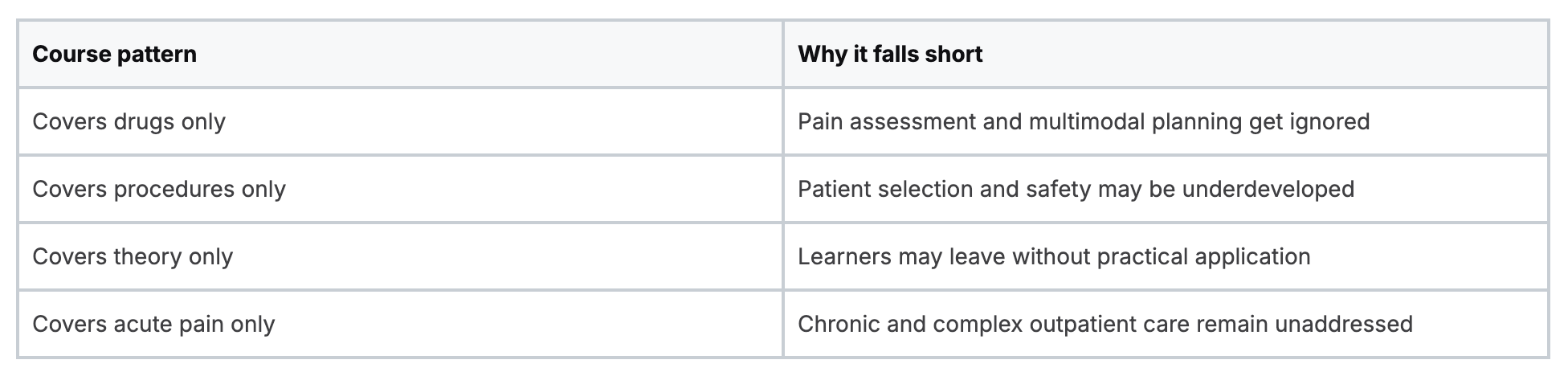
Comprehensive pain education should help you think better, not just memorize more.
When you review a syllabus, look for breadth first, then match that breadth to your role. A procedural clinician needs technical detail. A generalist needs strong assessment and referral judgment. Both need a curriculum that reflects how pain care works in practice.
Navigating Accreditation and Regulatory Requirements
Many clinicians still ask the wrong first question.
They ask, “Is this from one of the big legacy names?” A better question is, “Is this properly accredited for my profession, and will it meet employer and board expectations?”
That distinction matters. Brand familiarity is not the same as educational legitimacy.
Accreditation is the real quality marker
For CE and CME, what you want to verify is recognized accreditation. In healthcare education, that's the standard employers and licensing bodies look to when they evaluate whether a course meets formal requirements.
Depending on your license, that may include bodies such as:
- ACCME for physician continuing medical education
- ANCC for nursing continuing education
- ACPE for pharmacy-related continuing education contexts
Those acronyms matter more than marketing language. If a course clearly states its accreditation, identifies the credit type, and explains who the activity is intended for, you're already asking the right questions.
The in-person-only myth is outdated
A persistent misconception says that only certain in-person classes are valid, especially when people think about healthcare certifications more broadly. That isn't how modern professional education works.
What matters is whether the program is accredited, current, and accepted within the learner's professional context. Plenty of healthcare institutions, clinics, and employers recognize high-quality online education because they understand that delivery format and educational quality are not the same thing.
Don't confuse tradition with regulation. They're not the same.
That's especially important for working clinicians. If a self-paced online course is accredited, clearly documented, and aligned with current standards, it can be just as legitimate as an in-person alternative for CE and certification purposes.
For a practical overview of how this works, continuing medical education online is worth reviewing because it breaks down what professionals should look for when evaluating digital CME options.
How to read the label before you enroll
When you're comparing courses, scan the details in this order:
- Provider status
Identify who is offering the education and whether they disclose recognized accreditation. - Credit designation
Check the type of credit offered and whether it matches your license and state expectations. - Target audience
A course may be excellent but not intended for your scope of practice. - Current content
Pain care changes. You want education that reflects current clinical thinking, not recycled slides. - Documentation
You should know how completion is recorded, how certificates are issued, and what support is available if your employer requests verification.
What credibility looks like in practice
Credible education is transparent. It tells you who accredits it, who teaches it, what you'll learn, and how completion is documented. It doesn't rely on vague prestige or imply that only one legacy pathway counts.
That's good news for clinicians. It gives you more flexibility, more access, and more control over how you meet your CE and certification needs without sacrificing standards.
Comparing Training Formats Online vs In-Person
The old debate treats online learning like a backup plan. In practice, it's often the format that makes continuing education possible.
That doesn't mean in-person education has no value. It does. Live workshops, labs, and direct observation can be helpful for certain procedural skills. But when clinicians compare formats, the core question isn't which one feels more traditional. The central question is which one delivers credible learning in a way busy professionals can effectively use.
What clinicians are already choosing
A 2022 survey of healthcare professionals involved in pain care found that online independent learning was one of the most common pain-related learning activities at 44 percent, second only to reading journal articles. That's a strong signal that digital learning is already part of the professional mainstream.
This shouldn't surprise anyone in healthcare. Clinicians work variable schedules. They cover nights, weekends, call shifts, and back-to-back clinics. Self-paced online education fits that reality far better than a rigid classroom calendar.
Side-by-side differences that matter

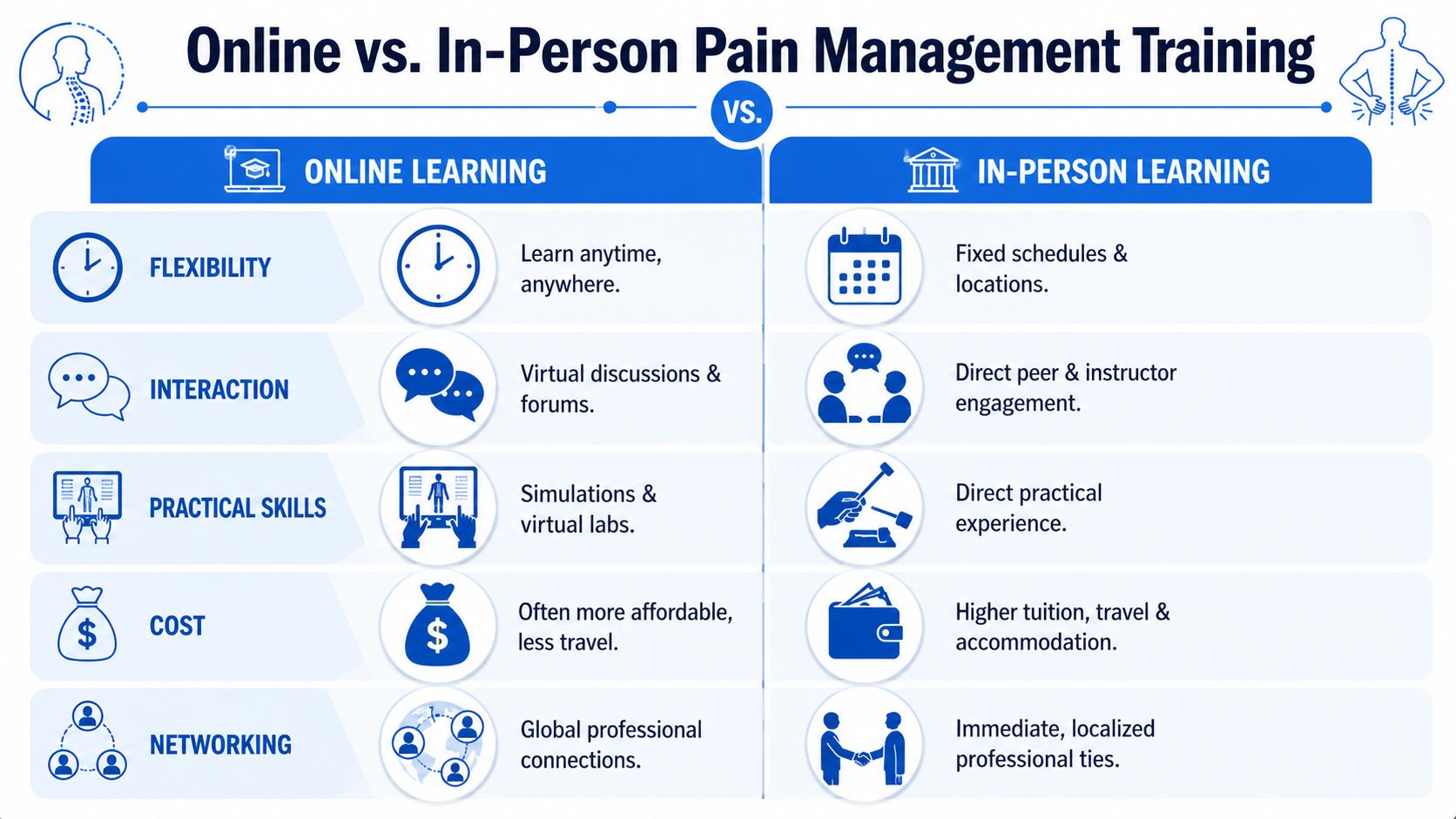
Here's a concise breakdown of the practical tradeoffs:
- Flexibility matters when your learning has to fit around patient care, not compete with it
- Replay value matters because complex topics often make more sense on the second pass
- Travel burden matters when education requires time away from clinic, transportation, and added expense
- Consistency matters because online modules can deliver the same structured content each time
A helpful comparison of in-person vs online medical certification differences can clarify why so many professionals now prefer digital formats for recurring requirements.
Why online learning works so well for CE
Online learning is especially strong for CE and certification because adult learners benefit from control. You can pause, review, revisit difficult concepts, and move faster through familiar material. You can also study when you're mentally available, which is a major advantage over sitting in a lecture after a long shift.
A well-designed online course isn't a compromise. It's a format built for how clinicians actually learn after licensure.
What about hands-on skills
This is the part where readers often hesitate. The answer is straightforward. Not every skill belongs in the same format.
Knowledge-building, guideline review, decision pathways, documentation, pharmacology, case reasoning, and many certification requirements work very well online. Some procedural competencies may also require simulation, supervised practice, or live workshops depending on the learner's role and scope. That doesn't weaken online education. It means good professional development uses the right format for the right objective.
For CE and many certifications, online learning is not second best. It's efficient, credible, and increasingly normal.
How to Choose the Right Pain Management Course
Choosing a course gets easier once you stop looking for the “most famous” option and start looking for the best fit.
Some clinicians want broad competency for general practice. Others want procedure-focused education. Some need CE credits quickly. Others want a longer-term professional development path. The right course depends on your role, scope, and daily patient population.
Start with this seven-point checklist
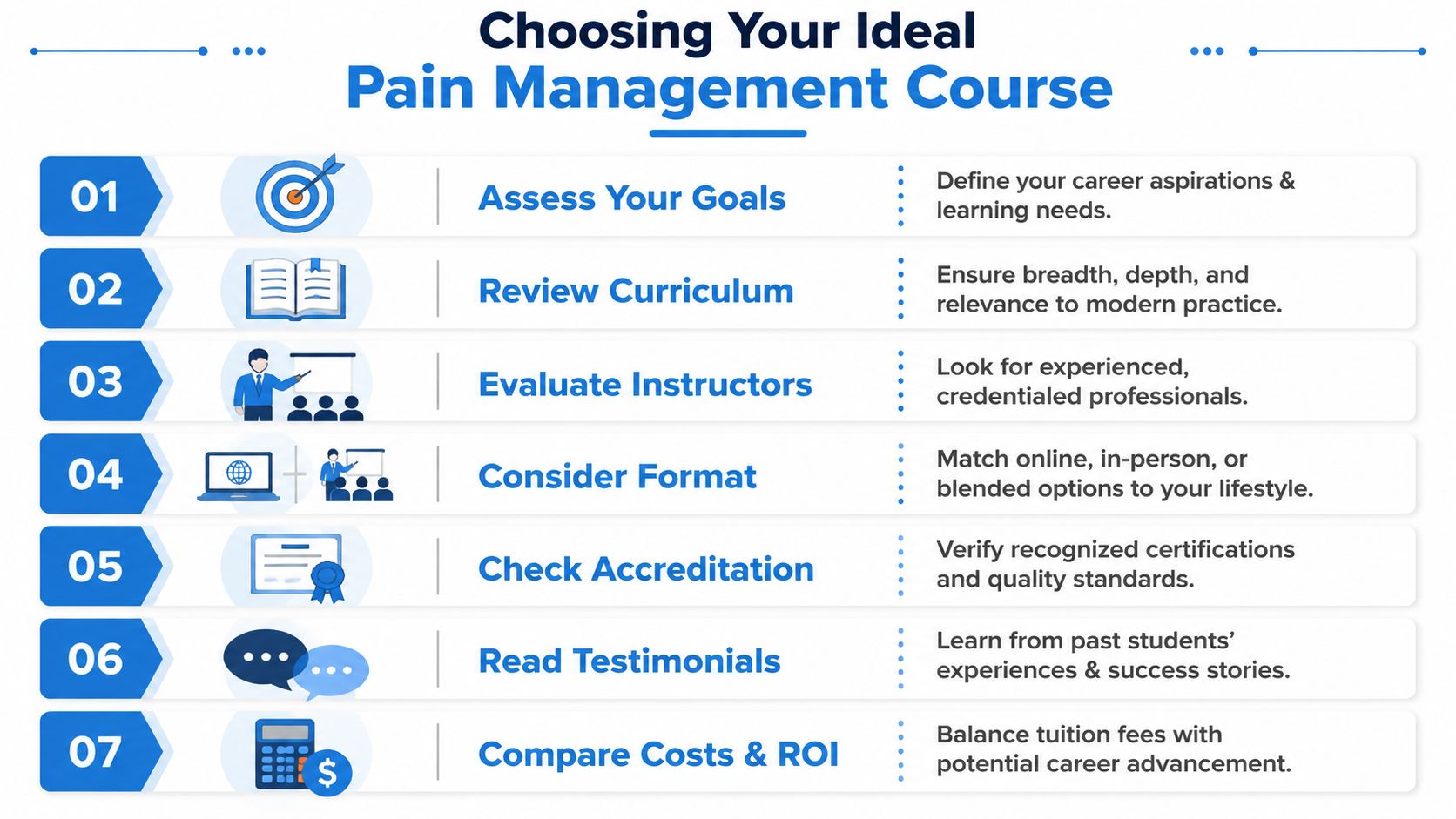
Use these questions before you enroll:
- Does the accreditation fit your license?
This is the first screen. If the course doesn't clearly identify recognized accreditation and credit type, move on. - Do the learning outcomes match your real job?
A hospitalist, outpatient NP, rehab clinician, and procedural specialist won't need the same depth. - Is the curriculum broad enough to be useful?
Look for assessment, multimodal planning, safety, communication, and role-appropriate technical content. - Are the instructors qualified for the topic?
You want education built by people who understand current practice, not generic content assembled without clinical depth. - Will your employer accept it?
If you're unsure, ask before purchase. A brief email to your manager, educator, or credentialing office can save time. - Can you realistically complete it?
The best course on paper still fails if the schedule clashes with your work and life. - Does the format support how you learn best?
Some professionals thrive in live environments. Many do better with self-paced review and repeat access.
A quick way to compare options

Watch for common mistakes
Course selection often goes wrong in predictable ways:
- Choosing by brand alone instead of accreditation and fit
- Buying the cheapest option first without checking quality or relevance
- Overreaching on scope by selecting advanced procedural content that doesn't match practice needs
- Ignoring completion logistics such as certificate access, retakes, and support
A smart choice feels boring in the best way. It is clear, documented, appropriate for your role, and easy to complete without unnecessary friction.
The strongest pain management training choice is usually the one that helps you apply what you learn next week in clinic, not the one that looks most impressive in a browser tab.
How ProMed Certifications Meet Modern Training Needs
Many clinicians want the same four things from professional education. They want it to be credible, flexible, efficient, and easy to document.
That's exactly where online platforms have improved healthcare learning. Instead of forcing professionals into a one-size-fits-all classroom model, modern providers can support self-paced study, instant documentation, and broad access across devices. For working clinicians, that's not a luxury. It's what makes completion realistic.
Why this model fits today's professionals
A busy nurse, physician, or compliance manager rarely needs more scheduling friction. They need education that fits around practice demands while still meeting formal standards. A strong online certification platform does that by reducing unnecessary barriers.
That includes features such as:
- Self-paced access so learners can study between shifts, after clinic, or over several short sessions
- Unlimited retakes because adult learners benefit from review without penalty
- Instant certificates which make compliance easier to document
- Mobile-friendly delivery so education isn't tied to one desktop or one classroom
These design choices matter. They support completion without lowering standards.
Accreditation and acceptance matter more than legacy branding
This is also where many professionals need reassurance. Some still assume that a certification or CE course only “counts” if it comes from a narrow list of long-established in-person providers. That isn't the rule modern institutions use.
The better standard is transparent accreditation, current content, and employer acceptance. ProMed's physician CME offerings are described by the publisher as accredited by organizations including ACCME, ACPE, and ANCC, with online delivery built around convenience and compliance. The platform also states that it offers a money-back guarantee if an employer does not accept its certifications.
The strongest sign of confidence in an online education provider is clear accreditation paired with a clear acceptance policy.
Practical benefits for individuals and organizations
For individual learners, online education works best when it removes downtime. You don't need to wait for the next local course date or rearrange an entire week around a live session.
For organizations, the value is different. Managers need visibility, consistency, and easier tracking. According to the publisher information, ProMed also offers a Group Portal for managing employee certifications, which helps standardize training across teams without relying on paper records or fragmented scheduling.
That combination reflects where healthcare education is heading. Professionals want trusted online learning. Employers want scalable systems. Platforms that provide both are aligned with how CE and certification now function in real clinical environments.
Your Next Steps and Frequently Asked Questions
If you've been postponing pain management training because you weren't sure what counted, what fit your schedule, or whether online education would be respected, you're not alone. Those are common concerns. They're also solvable.
The key is to separate myths from actual decision criteria. Look for accreditation, fit, usability, and employer acceptance. If those boxes are checked, you can move forward with much more confidence.
Frequently asked questions
Is online pain management training really as valid as in-person learning for CE?
Yes, when it's properly accredited and designed for your profession. The format does not make a course weak or strong by itself. The quality comes from the accreditation, curriculum, and educational design.
Do only a few big organizations offer acceptable certifications?
No. That's an outdated assumption. Employer and board acceptance typically depend on recognized accreditation and clear documentation, not on a narrow brand list.
Can online education teach complex topics well?
Absolutely. Online delivery is especially effective for guideline review, case-based learning, pharmacology, assessment frameworks, and repeat review of difficult concepts. Many clinicians prefer it because they can revisit material until it sticks.
What if I need hands-on practice too?
Then use a blended mindset. Complete the knowledge-heavy portion online, then add supervised practice or live skills training if your role requires it. That's often the most efficient path.
How do I know whether a course fits my role?
Check the audience, outcomes, credit type, and scope. A pain course for broad clinical awareness will look different from one intended for image-guided procedures.
A simple action plan
If you want to move from uncertainty to action, do this:
- Pick your goal first whether that's CE compliance, stronger assessment skills, or role expansion
- Verify accreditation next so you know the course meets formal requirements
- Confirm employer acceptance if needed before paying
- Choose the format you'll finish because convenience supports completion
- Use supplemental career resources when your path spans multiple disciplines, such as this guide to comprehensive PT career guidance for clinicians interested in rehabilitation-oriented growth
The bottom line
Pain care has changed. Education has changed too. Online CE and certification are no longer fringe options. They are a standard, credible, and practical part of modern professional development.
If you choose carefully, pain management training can sharpen your clinical judgment, improve patient conversations, and make your care plans more complete. And if an online format helps you get there with less disruption, that isn't settling. It's choosing a model that fits the practicalities of healthcare work.
If you're ready for a modern, flexible path to healthcare CE and certification, explore ProMed Certifications. Their fully online courses are built for working professionals who need accredited education, simple documentation, unlimited retakes, and a format that fits real clinical schedules.
.avif)
Stay compliant with ProMed+
Certifications included: ACLS, BLS, PALS, CPR & Neonatal Resuscitation
Unlimited continuing education: over 200 hours of accredited CME
All-inclusive: One price. No surprises.
Get certified today

The Advanced Cardiac Life Support (ACLS) is an accredited online medical certification course that teaches medical professionals to respond to nearly all cardiopulmonary emergencies.

The Pediatric Advanced Life Support (PALS) Recertification instructs medical professionals on performing pediatric cardiopulmonary resuscitation in emergencies.

The Basic Life Support (BLS) Recertification is intended to teach healthcare professionals the basic steps of CPR and rescue breathing for adults, children, and infants.

Our online medical certification course for CPR, Automated External Defibrillator (AED), and First Aid is designed to teach adult, child, and infant CPR and AED use.

The Neonatal Resuscitation Certification trains medical professionals in performing resuscitation procedures and life-saving techniques for newborns at the time of delivery.

.png)
.png)
.png)