


Boost Workplace Safety: Back Injury Prevention
.png)
A back injury at work often gets treated like a one-time mistake. In healthcare, that mindset misses the core problem. Back injury prevention works best as a system, not a reminder poster, not a yearly lecture, and not a list of tips people forget during a busy shift.
That matters because the stakes are much larger than one sore back after one difficult transfer. In clinical settings, back strain affects how you move, how long you can stay in the profession, and how safely you can care for patients when the unit is short staffed or the pace turns chaotic. A strong prevention program protects people before the injury report is ever written.
Why Back Injury Prevention Is a Critical Priority
Low back pain is the single leading cause of disability worldwide, responsible for 619 million prevalent cases globally in 2020, and it costs the United States approximately $200 billion annually in management and healthcare expenditures. Those numbers change the conversation. This isn't just about discomfort after a long shift. It's a major workforce, patient-safety, and operational issue.
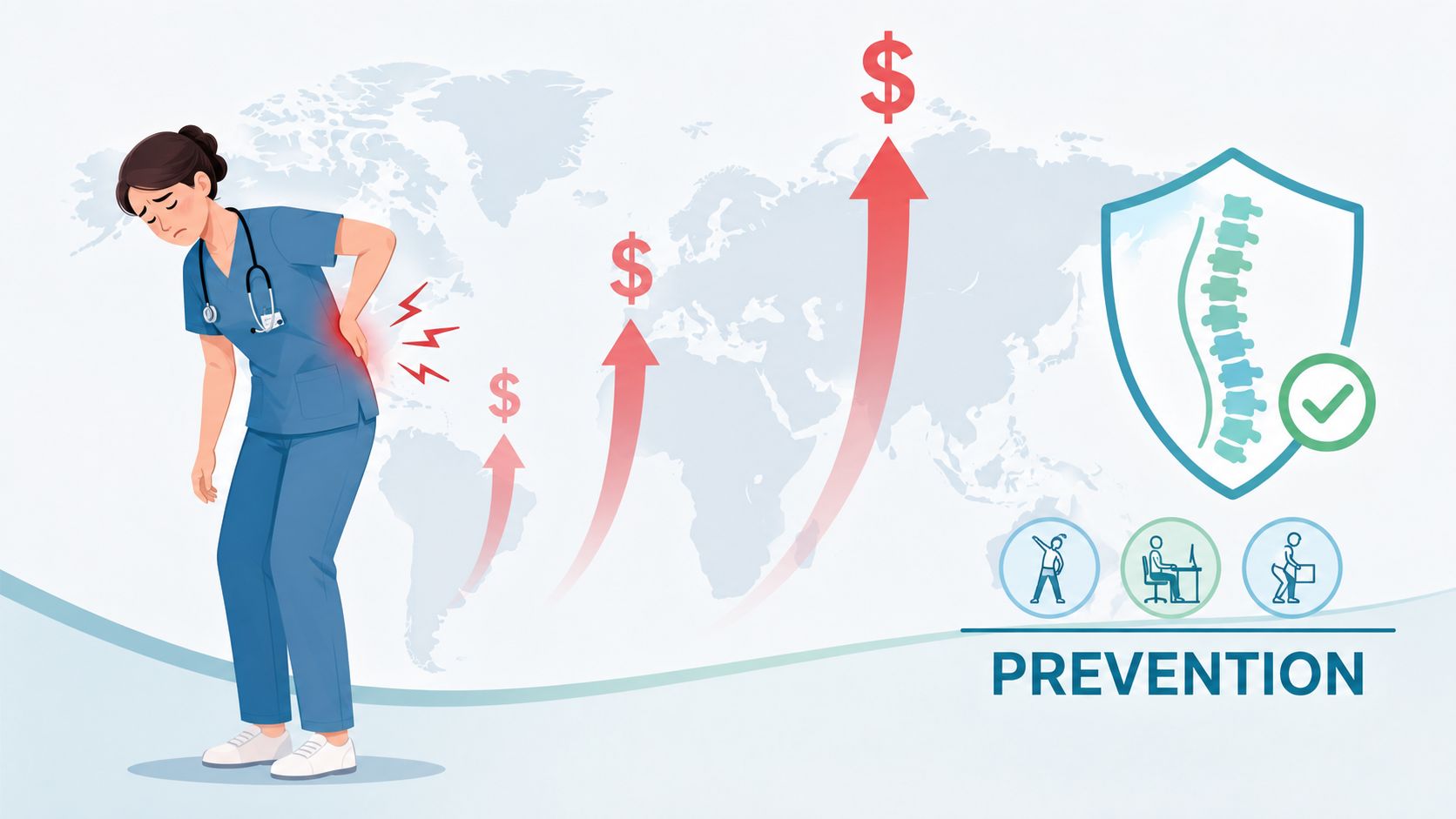
For healthcare professionals, the risk is built into ordinary tasks. Repositioning a patient. Catching someone who starts to fall. Holding an awkward posture over a stretcher, OR table, or bedside monitor. None of those moments look dramatic, but together they can wear down the spine over time.
Why this matters on the floor
A sore back doesn't stay isolated to your back. It changes how you bend, how quickly you respond, and how much reserve you have left late in the shift. A nurse who hesitates during a transfer because of pain isn't careless. That nurse is working with less margin for error.
Back injury prevention also affects retention. Experienced clinicians often know how to spot patient distress in seconds, but even highly skilled people can't outwork a poorly designed system forever. If the workplace depends on grit instead of safe design, injuries become predictable.
Practical rule: If your safety plan depends mostly on people “lifting better,” you don't have a prevention program yet.
Prevention is bigger than technique
The strongest organizations treat prevention the way they treat infection control or medication safety. They build policies, equipment standards, reporting systems, and training around it. They don't assume good intentions are enough.
That broader mindset fits within preventive health more generally. Preventing strain is far easier than recovering from it.
Identifying Key Risks in a Healthcare Setting
Healthcare workers rarely injure their backs because of one obvious bad lift. More often, risk builds from a combination of force, repetition, posture, fatigue, and time pressure. That's why a quick reminder to “use proper body mechanics” doesn't go far enough.
In the United States, back pain accounts for approximately 83 million lost workdays annually, and the World Health Organization identifies reducing strain during physical work and making ergonomic adjustments in the workplace as foundational prevention methods, as outlined by the World Health Organization low back pain fact sheet.
The risks people notice and the ones they miss
Heavy lifting is often the first thing that comes to mind. That's real, but healthcare creates several other common hazards:
- Patient repositioning in bed often looks simple, yet it combines pulling, leaning, and sustained force.
- Boosting a patient up in bed can place you in a bent posture while your arms work far from your body.
- Long bedside procedures can keep your trunk flexed and rotated for extended periods.
- Emergency response moments can push people into fast, awkward movements with no setup time.
- Repeated small tasks such as turning, reaching, and bending can accumulate strain during the shift.
Think of your spine like a mast on a sailboat. It handles load best when the support lines are balanced. Once you lean, twist, and reach at the same time, the forces stop staying centered.
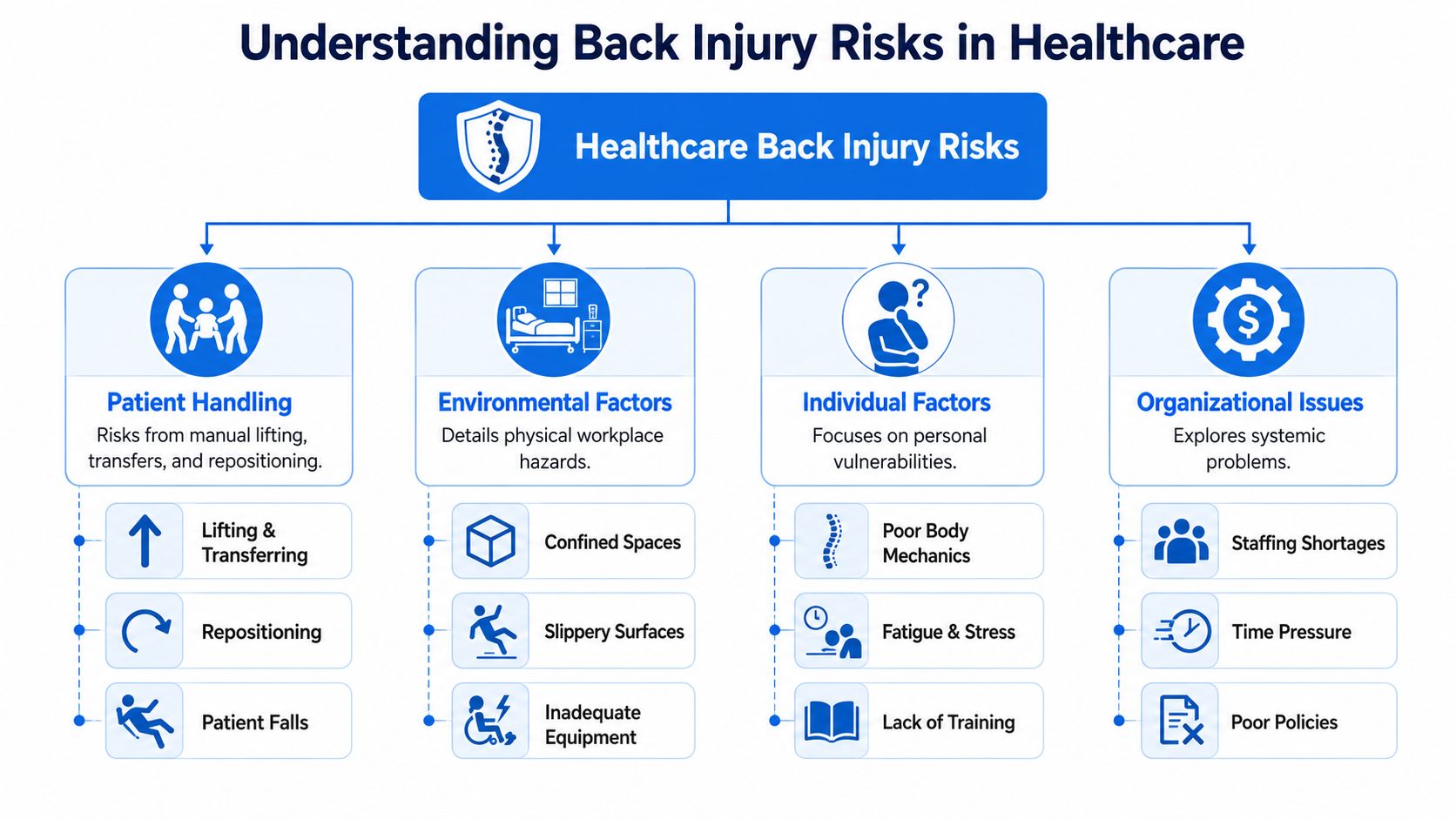
Four categories worth watching
A useful way to spot hazards is to group them.
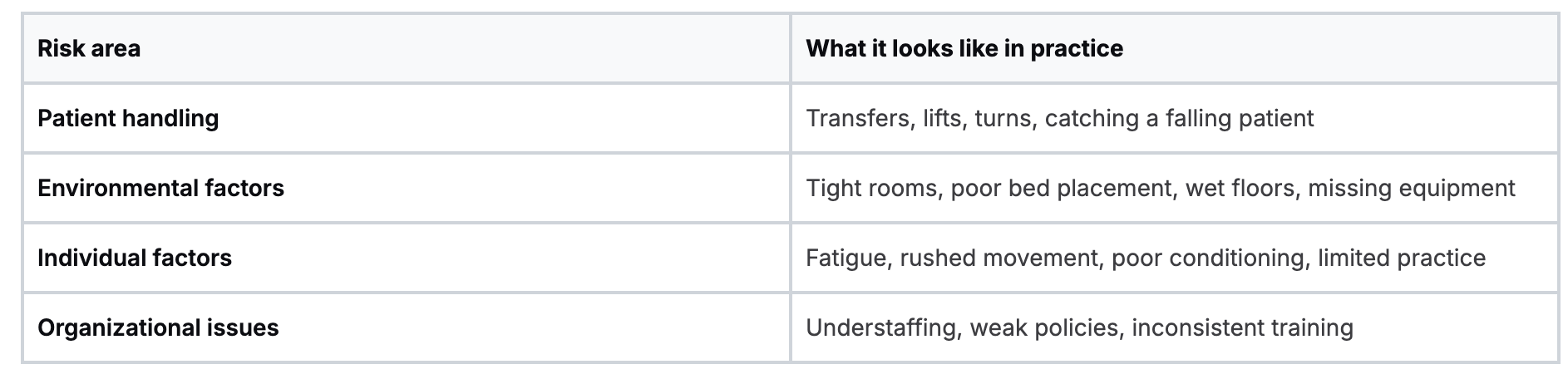
The right fix depends on the category. If the room is too cramped for safe transfer equipment, telling staff to “bend their knees” doesn't solve the problem. If staffing levels force a rushed solo transfer, technique advice won't remove the underlying risk either.
Staff often know the correct posture in theory. The hard part is using it consistently when the unit is busy, space is limited, and fatigue sets in.
A simple way to think about solutions
Use the hierarchy of controls as your mental model. Start with the workplace, not the worker.
- Eliminate or reduce the hazard when possible.
- Use engineering controls such as lifts, slide sheets, and adjustable beds.
- Add administrative controls such as staffing rules, transfer protocols, and training.
- Use individual technique as the last layer, not the first.
That order helps people avoid a common mistake. In healthcare, back injury prevention isn't mainly about telling strong, motivated clinicians to be more careful. It's about designing tasks so they require less spinal strain in the first place.
Mastering Ergonomics and Safe Patient Handling
If you remember one principle, remember this: equipment beats willpower. Good intentions help, but they don't lower spinal load the way the right tool does.
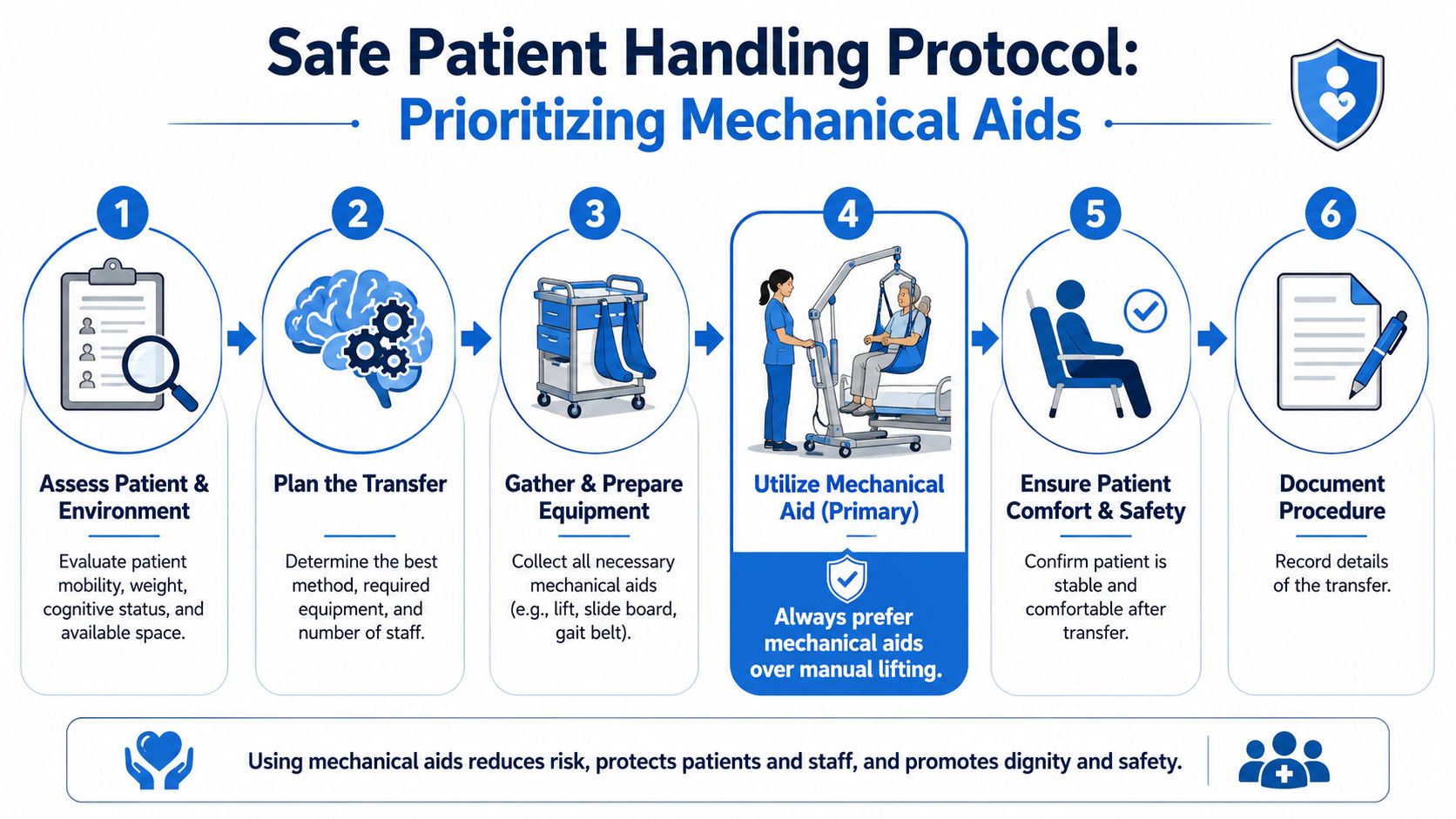
Programs that prioritize engineering controls matter because mechanical aids like hydraulic lifts can reduce spinal compression forces from 3,400 N to below 1,200 N, and programs using these controls can achieve a 35–45% reduction in work-related musculoskeletal disorder claims, based on the NCBI review of occupational back injury prevention.
Start with the hierarchy of controls
When clinicians hear “safe lifting,” they often think of body mechanics first. That's understandable, but it puts the last layer of protection at the center of the discussion. A better sequence looks like this:
- Engineering first
Use ceiling lifts, hydraulic lifts, friction-reducing devices, slide sheets, transfer boards, and height-adjustable beds. - Administrative next
Create clear rules for when staff must use equipment, when a second person is required, and when a transfer should be delayed until the right setup is available. - Technique last
Body mechanics still matter, but they support the system. They don't replace it.
Think of your spine like a crane. It handles vertical load far better than angled, twisting load. The farther the patient or object is from your center, the harder your muscles must work to control it.
The power zone for patient handling
Your safest working zone is generally close to your body, around mid-height, where you don't have to reach low or shrug high. In practice, that means adjusting the bed or stretcher before you start.
Use this quick checklist before a transfer:
- Raise the surface so you aren't bending over from the waist.
- Bring the patient close before moving, not halfway through the effort.
- Clear the room so you can step and pivot without twisting.
- Gather devices first so you don't improvise under load.
- Pause and assign roles if another staff member is helping.
A rushed transfer often goes wrong before anyone touches the patient. It goes wrong during setup.
For teams that want a visual refresher, this short training clip shows safe handling principles in action:
Practical handling rules that reduce strain
Some instructions are easier to remember when they're concrete.
Keep the patient close
Holding load away from your body increases strain quickly. If you're boosting or pivoting while your arms are extended, your back is doing extra work just to maintain position.
Move your feet, not your spine
Twisting while loaded is a classic injury setup. Pivot with your feet and turn your whole body toward the direction of movement.
Use friction-reducing tools for bed mobility
A slide sheet can change a high-force pull into a more controlled glide. That's a major difference over the course of a shift.
Match the method to the patient
A cooperative patient with good leg strength doesn't need the same plan as a confused or dependent patient. Assess mobility, cognition, and likely unpredictability before you start.
When a patient might suddenly sit, slump, grab, or resist, choose the safer method first. Don't wait for the transfer to become unstable.
When mechanical aids aren't available
Sometimes the ideal setup isn't there. In those situations, the goal shifts from perfect to safer.
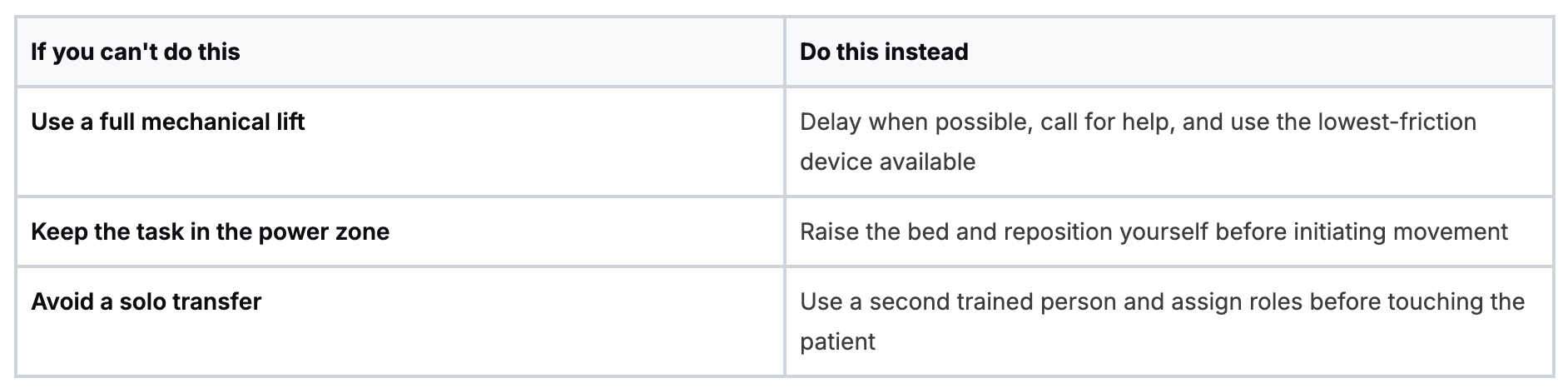
The key is not heroics. It's harm reduction. Good back injury prevention in healthcare means clinicians don't have to rely on strength, speed, or luck to finish common patient-handling tasks safely.
Building Resilience Through Exercise and Conditioning
Ergonomics changes the load outside your body. Conditioning changes how well your body handles load once it arrives. You need both.
Systematic reviews show that combining exercise with education reduces long-term disability from low back pain by 18–22% compared to control groups, and a practical starting point is 20 to 30 minutes of core-stabilizing and mobility exercises 3 to 4 times per week, according to the British Journal of Sports Medicine review. That's useful because it gives healthcare workers a realistic entry point, not an athlete-level program.
Why the core matters in clinical work
“Core” doesn't just mean ab muscles. It refers to the muscle system that helps you control the trunk, pelvis, and hips while your arms and legs work. During patient care, that control helps you resist collapse when you reach, brace, pull, or change direction.
A stable trunk also reduces wasted motion. If your midsection feels loose or fatigued, your back often takes over in tasks your hips and legs should be sharing.
A simple weekly routine
You don't need a complicated plan. A short, repeatable routine works better than an ambitious one you abandon after a week.
- Planks build trunk endurance. Think of them as teaching your body to hold alignment under low-level stress.
- Bird-dog variations train control while opposite limbs move. That's close to what happens when you're reaching, turning, or steadying a patient.
- Glute bridges help the hips contribute more force, which takes pressure off the lower back.
- Lumbar and hip mobility work can make it easier to reach neutral positions before demanding tasks.
If you want a practical exercise reference with clear demonstrations, this guide to best exercises for lower back pain is a helpful companion.
The goal isn't to “work harder” in the gym. The goal is to make basic job movements feel more controlled and less costly.
Consistency beats intensity
Healthcare workers often assume they need hard workouts to get meaningful protection. Most of the time, the better strategy is smaller doses performed regularly. A brief routine before shifts, on days off, or after work is more sustainable than waiting for a perfect free hour.
Stress matters too. Tension changes breathing, posture, and movement quality. If your shoulders stay raised and your trunk stays braced all shift, even simple tasks can feel heavier than they should. These mindfulness exercises for healthcare workers coping with stress can support recovery and body awareness alongside physical conditioning.
For nurses who need to keep up with required education while fitting prevention habits into a crowded schedule, ProMed+ Nursing CE is described as your your ultimate one-stop shop for all continuing education needs, with a streaming platform designed to help fulfill CE requirements in one place.
What good conditioning should feel like
A useful program leaves you feeling steadier, not wrecked. You should notice:
- Better control during reaching and transfers
- Less end-of-shift fatigue in the back and hips
- More awareness of when your posture starts to drift
- Fewer moments where you rely on a sudden back-driven effort
That kind of resilience is one more layer in a complete back injury prevention plan. It doesn't replace safer systems. It helps you function better inside them.
The Critical Role of Training and Modern Certification
A prevention program only works if staff can apply it under real conditions. That requires training that is specific, repeatable, and easy to access. In healthcare, that can include safe patient handling, emergency response, lifting strategy, and certifications tied to hands-on clinical roles.
The old belief that only in-person classes from the AHA or American Red Cross are valid is outdated. That's not true. Accredited online education has become a standard part of professional learning, and many healthcare institutions and clinicians now recognize that online CE and certifications can deliver the same educational value as classroom formats.

What the evidence says about online learning
Peer-reviewed evidence supports the effectiveness of online learning across healthcare education. One especially useful finding is that virtual training for clinicians achieved readiness and proficiency benchmarks at rates 12–14% higher than in-person training, while delivering aggregated cost savings of $399 per clinician, as reported in this study on virtual clinician training.
That result lines up with what many educators already see in practice. Online formats remove commuting, scheduling bottlenecks, and classroom seat limits. For busy clinicians, that flexibility isn't a side benefit. It's often the reason training gets completed on time and reviewed thoroughly.
A broader pattern also matters. Studies and industry articles increasingly show that knowledge gains in online learning are similar to in-person instruction, and in some settings retention and readiness are equal or better. That's one reason the industry consensus is gradually shifting. Hospitals, clinics, and healthcare organizations are becoming more open to accredited online CE and certifications as part of normal workforce education.
Why this matters for back injury prevention
Training quality affects whether staff can use safe practices when conditions are less than ideal. A person may understand transfer steps during a lecture, but still struggle to apply them during fatigue, distraction, or urgency. Strong programs address that gap through repeated exposure, scenario-based review, and clear decision rules.
Modern delivery offers practical advantages. Staff can revisit modules before a new unit assignment, refresh technique after time away, or complete required education without losing a full day to travel and classroom scheduling. Teams planning staff development across settings may also find this overview of home health agency training useful because it reflects the broader move toward flexible, role-based education.
Good training isn't defined by the room it's taught in. It's defined by whether clinicians can use it correctly when the job becomes demanding.
Online doesn't mean lower standard
That assumption lingers, but it doesn't hold up well. Online education can be structured, accredited, and rigorous. It can also be more practical for professionals who work nights, rotate units, or need recertification on a tight timeline.
When certifications come up, it's worth saying clearly that AHA and Red Cross are not the only recognized options. Employers and organizations often evaluate accreditation, course design, and acceptance policies, not just whether a learner sat in a physical classroom.
One example is ACLS Certification, which ProMed Certifications describes as a quick and convenient online option that lets clinicians take the course anywhere and fit it into a busy schedule. The course can be completed, the exam passed, and the card received in as quick as one hour or less.
That future-focused model fits where healthcare education is heading. Online CE and certifications are valid, accessible, and increasingly accepted because they meet clinicians where they work and learn.
Implementing Your Workplace Prevention Program
A good program doesn't start with buying one lift or holding one training day. It starts when leaders decide that back injury prevention is part of daily operations, not an optional wellness topic.
The easiest way to begin is to build from policy to practice. Write down the standard, assign responsibility, and make reporting simple enough that staff will use it.
A workable rollout plan
Use a short sequence that people can follow:
- Create a written policy
Define expectations for patient handling, equipment use, team lifts, and escalation when the right tools aren't available. - Assess your highest-risk tasks
Look closely at transfers, repositioning, transport, and emergency response moments. Those tasks usually show where the greatest strain is. - Standardize equipment access
A lift that's hard to find won't get used. Place equipment where the task happens. - Train and refresh regularly
Use repeatable education, short refreshers, and role-specific review for new hires and unit changes. - Track near-misses and early discomfort
Don't wait for OSHA-level events to learn something. Small warning signs are useful data.
Build a culture where people speak early
Many clinicians stay quiet until pain becomes hard to ignore. That delays intervention and makes return-to-work harder than it needs to be.
Use a reporting culture that treats early symptoms as operational feedback. If one room layout causes repeated awkward transfers, that isn't an individual weakness. It's a system issue. When injuries do happen, a supportive return-to-work plan helps lower the chance of repeated strain.
Keep the program alive after launch
Programs fade when nobody owns them. A safety committee, unit champions, or department leads should review patterns, barriers, and equipment use on a regular basis.
A few signs your program is working:
- Staff ask for devices early instead of treating them as a last resort
- Supervisors correct unsafe setups before the move starts
- New hires learn unit-specific handling rules quickly
- Training links directly to real tasks staff perform during the week
Emergency teams need that same structure under pressure. If your organization is strengthening rapid-response readiness along with injury prevention, these resources on emergency response team training can help connect safety planning to real clinical operations.
A safer workplace doesn't come from one perfect class or one motivated employee. It comes from a program people can use on ordinary days, on rushed days, and on the days when everything goes sideways.
A strong back injury prevention program protects clinicians, supports safer patient care, and reduces avoidable strain across the whole organization. If your team needs flexible online certifications and healthcare education that fit busy schedules, ProMed Certifications offers online courses designed for working professionals.
.avif)
Stay compliant with ProMed+
Certifications included: ACLS, BLS, PALS, CPR & Neonatal Resuscitation
Unlimited continuing education: over 200 hours of accredited CME
All-inclusive: One price. No surprises.
Get certified today

The Advanced Cardiac Life Support (ACLS) is an accredited online medical certification course that teaches medical professionals to respond to nearly all cardiopulmonary emergencies.

The Pediatric Advanced Life Support (PALS) Recertification instructs medical professionals on performing pediatric cardiopulmonary resuscitation in emergencies.

The Basic Life Support (BLS) Recertification is intended to teach healthcare professionals the basic steps of CPR and rescue breathing for adults, children, and infants.

Our online medical certification course for CPR, Automated External Defibrillator (AED), and First Aid is designed to teach adult, child, and infant CPR and AED use.

The Neonatal Resuscitation Certification trains medical professionals in performing resuscitation procedures and life-saving techniques for newborns at the time of delivery.

.png)
.png)
.png)